Latest News and Comment from Education

Thursday, August 27, 2015

TBT: The 1970 Chicano Moratorium Against the War in Vietnam – 45 Years Later!

The 1970 Chicano Moratorium Against the War in Vietnam – 45 Years Later!:

The 1970 Chicano Moratorium Against the War in Vietnam – 45 Years Later!


Chicano Moratorium poster


By Herman Baca / August 26, 2015
Long forgotten by US history and barely remembered by many (even in the Chicano community) is the historical 45th anniversary of theAugust 29, 1970 Chicano Moratorium against the War in Vietnam.
The Moratorium held in Los Angeles, California was one of the most seminal historical events for Chicanos in the US since the end of the US/Mexico War of 1848.
Depending on whom you speak with; the moratorium drew 20 to 40,000 Chicanos from all over the US that marched and protested the war in Vietnam, where Chicano youths were dying in disproportion numbers. Parents, children, seniors, working people, students, war veterans and activists from thru-out the U.S., Mexico and Puerto Rico marched.
Numerous persons were hurt; hundreds were jailed including national Chicano leader, Rodolfo “Corky” Gonzales. Three people were shot and killed by the police; martyred Angel Diaz,Lynn Ward, and LA Times Journalist, Ruben Salazar. The moratorium at the time was the largest protest to be organized by Chicanos in their 130 years history as a conquered people in the US. In essence, the demonstration turned into a police riot that was planned and carried out by the LA police, and the US Government.
The Vietnam War – President Lyndon B. Johnson in 1965 had declared a police action in Vietnam. Chicanos, at that time comprised but 6% of this nation’s population, but made up an obscene number of the causalities in Vietnam! Young whites were receiving college deferments and white controlled draft boards begin to draft (in record numbers) poor people, blacks, and especially Chicanos for Vietnam.
After five years of the Vietnam War, reality finally hit home. Young Chicanos were dying and numerous “body bags” were being returned to the homes of grieving families throughout the US.
It had always been the Chicano movement’s political position that the US’s white supremacist system had made Chicanos strangers in their own land, placed them last in jobs, education and rights but had always placed them first to die in its wars!
From the beginning, the demonstration organized was to be a peaceful protest to seek redress from the US Government under rights supposedly guaranteed and protected by the US Constitution.
I remember arriving in Los Angeles on Saturday morning around 7:00 am. At least one thousand persons from San Diego attended the demonstration. The march was 5 long miles, it was a very hot day and arrived at Laguna (now Salazar) Park around 2 or 3 p.m. People were tired, resting on the grass and the scene appeared to be like a giant family picnic.
As we sat down we heard and saw a commotion at a liquor store on Whittier Blvd. Suddenly without provocation the sheriff and police began to advance on the peaceful crowd. Security (the The 1970 Chicano Moratorium Against the War in Vietnam – 45 Years Later!:

High-stakes teacher evaluations may not help :: SI&A Cabinet Report

High-stakes teacher evaluations may not help :: SI&A Cabinet Report :: The Essential Resource for Superintendents and the Cabinet:

High-stakes teacher evaluations may not help


(N.Y.) High-stakes teacher evaluations have not been shown to improve student achievement and may even be detrimental to student success, according to a recent study.
Researcher Alyson Lavigne, an assistant professor of curriculum studies at Roosevelt University, said that even when highly-reliable and valid measures are implemented and teacher retention is based on effectiveness instead of seniority, results may be dismal.
“Even if basic requirements and assumptions are met, gains in student achievement may be short-lived, insignificant, or practically meaningless,” Lavigne wrote. “The possible unintended consequences could result in worse, rather than better, student achievement outcomes and increase the gap in opportunity to learn for students attending the most and least affluent schools.”
Prompted by federal grants and No Child Left Behind waiver exceptions, a large majority of states have battled with the complexities of adopting new college and career ready standards while also overhauling teacher evaluation systems in order to include student test scores. Critics argued that it was unfair to base teacher salary or job security on student scores which were expected to be lower due to the new tests.
Specifically, Race to the Top winners must consider teacher evaluations when making decisions regarding professional development, compensation, promotions, tenure and dismissal. A similar demand has been made on states that received waivers from key requirements called for under NCLB.
Supporters of high stakes evaluations say they make it easier to remove ineffective teachers, reward effective ones, and identify and support those who are struggling, thereby creating a better learning environment for students.
According to the study’s author, however, unintended consequences in areas including teacher attrition, retention, stress, morale and job satisfaction arise from the use of such evaluations despite the good intentions when considering them.
As part of a natural pattern, effective teachers will likely choose to remain while ineffective ones will drop out of the profession without being pushed out through a tough evaluation process. However, even effective teachers are more likely to leave struggling schools when graded on a value-added High-stakes teacher evaluations may not help :: SI&A Cabinet Report :: The Essential Resource for Superintendents and the Cabinet:


SBE to set attendance mark for federal reporting

(Calif.) Elementary and middle schools would be expected to maintain an average student attendance rate of 93 percent for federal accountability purposes, under a plan set to come before the California State Board of Education next week.
Staff is also recommending the board consider using chronic absenteeism rates as an indicator of school success in its own accountability system – currently under development.
A memo out this week from the California Department of Education said that “the impact of chronic absenteeism on student achievement and dropout rates, and its correlation with attendance data suggest that chronic absenteeism would be a good indicator in the new multiple measures accountability system.”
The action follows adoption earlier this year of several amendments to the state’s federally-required accountability plan, one of which was using attendance data to replace California’s Academic Performance Index as an indicator of Adequate Yearly Progress under the No Child Left Behind Act.
Amendments to the plan, which must be approved by the U.S. Department of Education, are being made even as Congress is considering a rewrite of the federal education law that would return broad authority over accountability reporting to the states. The CDE staff notes, for instance, that 2015 could be the last year the agency is required to produce the AYP report if NCLB is reauthorized this fall.
California – one of only six states in the nation not granted a waiver from meeting the performance mandates set out in NCLB – has gone its own way, refusing to report test scores not aligned to current curriculum and negotiating with federal officials on alternate methods for accountability.
The state board in January approved seven amendments to the so-called Consolidated State Application Accountability Workbook, including replacing the test score-based API. That move effectively gave students and teachers another year to adjust to the new content standards without having to worry about performance requirements.
While statewide testing is a part of the plan being worked out between state and federal officials,

SBE to set attendance mark for federal reporting


#FightForDyett Parents Hunger Strike For High School City Of Chicago Planned To Close | ThinkProgress

Parents Hunger Strike For High School City Of Chicago Planned To Close | ThinkProgress:

Parents Hunger Strike For High School City Of Chicago Planned To Close


A small group of parents and community members in the South Side of Chicago have gone on a hunger strike until the Chicago Board of Education agrees to a proposal to revitalize a local school. It has lasted 10 days. Dyett High School will shut its doors by the time the 2015-16 school year begins, unless officials decide to move forward with a proposal to convert it into the Global Leadership and Green Technology High School.
To understand what is happening in Chicago, and why the story has gained national attention in the news and on social media, you have to look at the long, heated fight between the Chicago Teachers Union President Karen Lewis and Chicago Mayor Rahm Emanuel (D). In 2012, there was a massive teachers strike over maintaining the schedule for career advancement, putting less emphasis on standardized testing in teacher evaluations and providing compensation for longer school years.
In 2013, Emanuel announced a decision to close 49 schools, which were mostly in black neighborhoods. Lewis commented on the closings, saying, “Let’s not pretend that’s not racist.” Lewis led protests outside of City Hall, where protesters accused the mayor of racism for the proposed closures. Emanuel countered that the closures and other reforms would be better for students over the long haul, saying, “We used to have four out of 10 kids drop out of high school … In two years’ time, we’re going to have eight out of 10 graduate high school. And more kids now are going to high school than ever before in the city of Chicago.” The veracity of the data Emanuel has used on graduation rates has been questioned, however.
In the hunger strikes, advocates have reignited a discussion on school closings in black and Hispanic communities, which has the support of Rev. Jesse Jackson, Randi Weingarten, president of the American Federation of Teachers and Alliance to Reclaim Our Schools. The 11 hunger strikers, one of which is in the hospital, continued their protest Wednesday. Hunger strikers and supporters picketed outside of the Chicago School Board and held a press event outside Dyett High School Wednesday morning.
There is urgency on this issue because the Chicago Public School system is having a budget crisis, as it is still in negotiations with the teachers union and cuts may exceed $200 million or the district must borrow more money if more funding is not provided. There will be 1,500 staff layoffs and the city estimates a $1.1 billion budget deficit for next school year. CPS Chief Executive Officer Jesse Ruiz wants the Chicago Teachers Pension Fund to loan back $500 million to help offset the budget deficit. CPS asked the Chicago Teachers Union to take a 7 percent pay cut but Lewis said the proposal would be worth striking over. In an interview with In These Times, hunger striker Jeanette Taylor-Raman argued that CPS has the funds, but “black and brown people are just not the priority,” citing the fact that CPS spent millions on a new building recently.
A Chicago-based fiscal responsibility watchdog group, Civic Federation, has released a warning, saying that if a multi-year plan for Chicago Public Schools is not created soon, the school system could fail. It asked CPS to send out a contingency plan to teachers, parents and taxpayers. More than $6 billion of the school district’s debt falls into the junk bond category, according to Reuters.
Of course, the closure of public schools in black neighborhoods in Chicago has been going on well in advance of Emanuel becoming mayor. In 2002, the trend toward closing low-performing schools and replacing them began, led by CPS CEO Arne Duncan. The idea was that by closing low-performing schools and starting from scratch, students would have a better chance to succeed, but now, even some of Duncan’s turnaround schools have been closed by CPS. According to areport by the Chicago radio station WBEZ on school closures from the 2001-2002 school year to 2011-2012 school year, school closings and school turnarounds have disproportionately affected schools in black neighborhoods. Many of the closings are near former Chicago Housing Authority Developments and only 15 percent of replacement schools were rated high performing by CPS and Parents Hunger Strike For High School City Of Chicago Planned To Close | ThinkProgress:

Dirty Tricks in District 6 | Crazy Crawfish's Blog

Dirty Tricks in District 6 | Crazy Crawfish's Blog:

Dirty Tricks in District 6


Kathy Edmonston, my opponent in the District 6 BESE race, just released a poll that her political consultant ran that shows her tied with the incumbent Chas Roemer, me at 6%, and the undecided at 44%. 
This is not the first time I’ve seen or heard these numbers.  The first time I heard them was Thursday August 20th when some of my friends reported that people were contacting them them about this poll, and telling them they needed to stop backing me.  They were being told that I was helping Chas Roemer (who has not declared his candidacy by the way) win, by staying in the race.  (Coincidentally? This was the same day I was endorsed by the NPE (Network for Public Education) and Diane Ravitch, which probably impacted the timing of their release of their poll numbers to me and my supporters.)
I was a bit hurt by this.  Kathy and I had agreed to run a clean campaign on issues and let the voters decided based on our stances, not money, or attacks, or dirty tricks.  I had agreed to this originally with her friend and longtime supporter on the Ascension Parish Republican PEC Kathryn Goeppelt, who asked me to pray with her over our lunch where we met to set some ground rules.  While Kathryn was clearly running the show and doing most of Kathy’s speaking for her at every event I attended, I subsequently confirmed this arrangement with Kathy Edmonston.
I had a significant online presence and following at the time and Kathy had nothing really on Facebook, or anywhere else.  I could have used my early advantage to question the timing of Kathy’s entrance into the race, a mere 4 months or so ago after it was rumored Chas would not be running. I did not even bring up very legitimate questions such as:
“Where we you the last  four years that I have fought Common Core, John White and Chas Roemer?”
“Where were you, Kathy, when I spoke at numerous Common Core rallies, testified and Dirty Tricks in District 6 | Crazy Crawfish's Blog:


AFT President Randi Weingarten joins #FightForDyett hunger strikers. | Fred Klonsky

AFT President Randi Weingarten joins #FightForDyett hunger strikers. | Fred Klonsky:

AFT President Randi Weingarten joins #FightForDyett hunger strikers.


JUSTICE


Life in Rahm’s Chicago. Welcome back, Amer


ahmad
My drawing from July, 2014.
The poster boy for Rahm’s City Hall corruption, Amer Ahmad, is coming home.
Not home to Chicago, where he was hired by Mayor Rahm’s Chief Financial Officer, Lois Scott.
Home to Ohio where he is accused of steering $3.2 million in securities and brokerage work to a high school classmate who then kicked back $500,000 to Ahmad.
His flight back to Ohio was free.
Ahmad was extradited from Pakistan and flown to Columbus, Ohio, where he will appear for a hearing before U.S. District Court Judge Michael H. Watson at 10 a.m. Friday.
Ahmad was a fugitive in Pakistan ever since he fled the States following his conviction for bribery and conspiracy and sentenced to 15 years in prison.
His crimes had all taken place prior to Lois Scott bringing him to Chicago.
Scott was known as Rahm’s financial guru.

CURMUDGUCATION: PA: Charter Vampires on the Loose

CURMUDGUCATION: PA: Charter Vampires on the Loose: "PA: Charter Vampires on the Loose"

PA: Charter Vampires on the Loose


In Pennsylvania, opening a charter school, particularly a  cyber-charter, has long been just like printing money in your garage (only you won't get in any trouble for it).

The current plight of the Chester Upland School District highlights just how screwed up the whole mess is, and how charters are set up to suck the public system dry. Yesterday's news roundup at Keystone State Education Coalition has most of the best coverage of the story, but let me pull up some highlights for you.

I'll remind you that before CUSD ever started to get in trouble, the state of Pennsylvania has been distinguishing itself by some of the most inequitable funding in the country. This is a bi-partisan screwing of public ed. Democratic Governor "Smilin' Ed" Rendell used stimulus funds exactly as he wasn't supposed to, as a replacement for regular state funding of education, and his successor Republican Tom "One Term" Corbett slashed education on top of the auto-slashing that occurred when those stimulus funds went away. Bottom line-- funding of our poorest schools is in free-fall, because they get very little from the state.

As it turns out, CUSD gets negative support from the state. That's because the hugely generous payment formula for charters has resulted in CUSD losing more money to charters than they get from the state of Pennsylvania.

Each school district pays charters based on their own per capita costs per student. That's right-- what the charter collects has absolutely nothing to do with what it actually costs to educate the student. Perhaps that's how it's possible to pay the six top executives at cyber monster K12 a grand total of $16.4 million. Perhaps that's how Vahan Gureghian, King of the Keystone Edupreneurs, can end up building (and now selling) an $84.5 mansion in Palm Beach (not to be confused with the 30,000 square foot manse he built in upscale suburban Philly).

Gureghian operates one of the largest charters in PA, located right in Chester County. So it's only a mild stretch to say that Chester Upland Schools are in danger of being shut down so that Gureghian 
CURMUDGUCATION: PA: Charter Vampires on the Loose: "PA: Charter Vampires on the Loose"


Mike Klonsky's SmallTalk Blog: DAY 10 -- Support builds and the media curtain has finally lifted.

Mike Klonsky's SmallTalk Blog: DAY 10 -- Support builds and the media curtain has finally lifted.:

DAY 10 -- Support builds and the media curtain has finally lifted.


Rep. Bob Martwick and other pols step up. Martwick is sponsor of the Elected School Board bill. 


The Tribune and Sun-Times have finally discovered the hunger strike. So has theWashington Post.

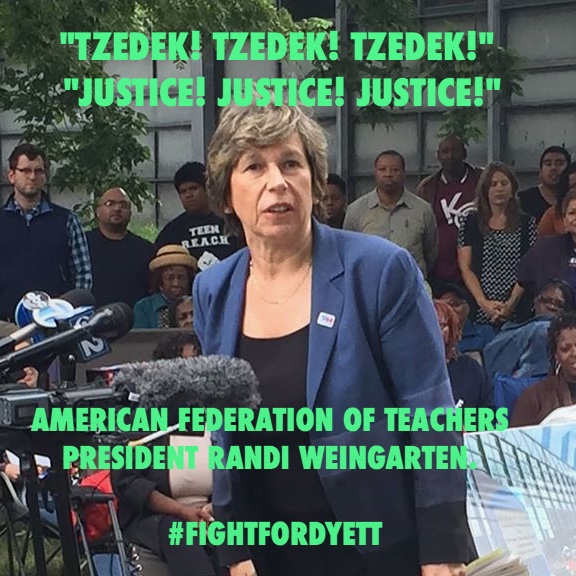
A SMALLTALK SALUTE goes out to AFT Pres. Randi Weingarten who flew in yesterday to speak in support of the strikers. She was joined by a group of pols including Reps. MartwickFlowers, Hernandez & Ford; CommissionerChuy Garcia; Progressive Caucus Alders John Arena, Sue Susan Sadlowski Garza, Carlos Rosa and others.


Pres. Weingarten & hunger striker Jitu Brown
Weingarten called the community's proposal for a public (not charter or "contract") Dyett Global Leadership and Green Technology High School, “the best proposal I have seen in my entire career.” 

CTU V.P. Jesse Sharkey spoke. As did IFT Pres. Dan Montgomery. CTU Pres. Karen Lewis voiced her support in the Defender.

I spoke on the phone yesterday with Stanford Prof. Linda Darling-Hammond who voiced her support for the hunger strikers.

Ald. Will Burns is alleged to be hiding under the mayor's desk.

With striker Jeanette Ramann hospitalized yesterday after collapsing at the CPS board meeting and Irene Roninson hospitalized Monday, many of the strikers are now feeling the effects. But still no action on the part of the mayor or his Mike Klonsky's SmallTalk Blog: DAY 10 -- Support builds and the media curtain has finally lifted.:

2015 Superintendent of the Year: High-stakes testing is the ‘fool’s gold’ of accountability - The Washington Post

2015 Superintendent of the Year: High-stakes testing is the ‘fool’s gold’ of accountability - The Washington Post:

2015 Superintendent of the Year: High-stakes testing is the ‘fool’s gold’ of accountability


Philip D. Lanoue is the superintendent of the 13,000-student Clarke County School District in Georgia, the most impoverished county in the state — and he is the 2015 American Association of School Administrators National Superintendent of the Year. As Clarke superintendent since 2009, he is credited with making more gains to close the achievement between economically disadvantaged and non-disadvantaged students than any other district in the state.  Here’s a piece by Lanoue on the difference between high-stakes testing and meaningful assessment.

By Philip D. Lanoue
We are in the midst of a testing epidemic. We are requiring teachers to give students test after test, and students are asking who the test evaluates – because it is not about them anymore. Why are we only looking at students as no more than a test score, and evaluating teachers in the same way? Evaluating the total learning experience for either students or teachers through high stakes testing has no real research base and holds little value for students. Let’s not confuse the high-stakes testing movement with the practice of effective and meaningful assessment.

Is the testing movement really about children learning?
That is the question that is most perplexing to me. I look at my colleagues in other districts across the country, and I believe there is consensus among educators that conversations regarding school transformation must shift from problems and failure to solutions and successes.
It is clear that the annual testing merry-go-round is not going to get the results we want: all students engaged and performing at high levels. Rather, this fixation on ratings through high stakes testing is so entrenched that we are missing the bigger picture about the true purpose of our classrooms. Teachers need to be able to inspire students to seek answers using new skills and knowledge to solve problems. Students and teachers alike should not have such great emphasis on singular tests that hold the key to how both are ultimately assessed.

Can we approach assessment differently and meaningfully?
We need to shift the conversation away from testing and toward one where the primary focus is educating students to be inquisitive and engaged, and to foster their own understanding of individual strengths and areas for growth. Through clearly articulated performance standards, teachers can design lessons to challenge students and create assessments to inform both students and teachers of their progress. Teachers can then provide students with the needed feedback and support to ensure they are growing and learning.
With education technology constantly evolving, we can leverage new solutions with new processes. We must also ensure strong professional development is in place to use these new tools. The process must be continuous to effectively 2015 Superintendent of the Year: High-stakes testing is the ‘fool’s gold’ of accountability - The Washington Post:

Phantoms Playing Double-Dutch: Why the #FightForDyett is Bigger than One Chicago School Closing | Seven Scribes

Phantoms Playing Double-Dutch: Why the Fight for Dyett is Bigger than One Chicago School Closing | Seven Scribes:

Phantoms Playing Double-Dutch: Why the Fight for Dyett is Bigger than One Chicago School Closing


Phantoms Playing Double-Dutch: Why the Fight for Dyett is Bigger than One Chicago School Closing


Cause everybody dies in the summer / Wanna say your goodbyes, tell ‘em while it’s spring / I heard everybody’s dying in the summer So pray to God for a little more spring.”– Chance the Rapper tweet
The first thing that struck me when I walked up King Drive to 35th Street, where the throng of people sat in front of the fourth ward alderman’s office, was the heat. Don’t get me wrong—I’ve been a Chicagoan since the day I was born, which means I was born for bad weather. I lived through the heat wave of 1995, when over 700 people died, and through the blizzard in 2011, when the cars sat stacked on Lake Shore Drive, still, like terracotta warriors. So it wasn’t the factof the weather that got me; it was the old folks there in it. And the babies. And then, when my eyes lingered a bit longer, it was the mothers, and the teenagers, and—well, everybody. They sat in folding chairs under the scant, moving shade of skinny trees, or leaned against the wrought iron fence, or sat on the steps of the alderman’s office. They were gathered in the name of Dyett, the high school that the leaders of Chicago Public Schools (CPS) announced in 2012 would be shuttered at the end of 2015. This group of parents, community members, and students—many of them affiliated with the Kenwood-Oakland Community Organization (KOCO), one of the oldest black organizing groups in the country—sat in the 95-degree heat to demand a meeting with the alderman, Will Burns. They wanted him to consider their proposal to re-open Dyett as an open-enrollment, community-based school.
I shared some bottles of water and sat for a while. It was hot. We moved the chairs periodically as the sun shifted across the sky. A city worker drove by in a pickup truck, hauling a trailer laden with park maintenance equipment. He raised his fist out the window and gave a cheer, and the folks gathered cheered back. I listened to Mrs. McCall1 talk about how her grandfather owned a store in Mississippi, how she moved north when she was 12 years old and spent her summers traveling back to visit him. She told me how to make the best of my time in graduate school. “What is your passion?” she asked me. “What do you love the most?” My gaze traveled across the street, to the King Branch library where I had once hosted afterschool research sessions so that my students could have help finding reference books, where many of them stayed in the afternoons because it was a safe, free place to do homework until their parents got off work, where if I stopped to just borrow or return a novel they would grin broadly, excited to see me outside of school. I pretended I had x-ray vision, and squinted my eyes to look through the library, to peer west one block and north three blocks, to where that school was, the school where I taught. What do you love the most? 
That day, that hot day, that was a year ago. Last week, I saw some of those same old folks, those same babies, in front of Dyett, at the northern end of the South Side’s sprawling Washington Park. And unlike all the other times I had seen them, they were not demanding a meeting. They were through with meetings. Today, twelve of them were beginning a hunger strike. I knelt in the grass next to Irene Robinson, a grandmother of nine children, who I saw get escorted away by police in City Hall a few weeks ago when she showed up to protest the closing of Dyett; every time I see her, she strikes me with the same two memorable traits—she wears fantastic purple or fuschia lipstick and, when we part, bids farewell by saying “I love you!” so enthusiastically that I am moved to say it back.
“Are you scared, Ms. Irene?”
“I’m scared,” she tells me, looking past me to the behemoth black building that stands empty behind my shoulders. “I’m scared for my grandchildren.”
Tonight, as I write this, it is Sunday, day seven of the hunger strike. This morning, I attended a special service at Mt. Carmel Baptist Church, where the pastor has joined the strike in a show of support. Ms. Robinson and the other hunger strikers sat in the front pews, across the aisle from where I sat with my niece, Leila, who at two (almost three) is nevertheless remarkably good at sitting quietly in church. She watched, wide-eyed, as KOCO’s lead education organizer, Jitu Brown, stood at the pulpit. I split my time between watching him and watching her, thinking about the nights I have spent scouring the internet for an affordable, high-quality place for her to go to preschool (spoiler alert: there aren’t any). I think about the map I saw recently in a report from the University of Chicago’s Chapin Hall Center for Children, charting the availability of state-licensed childcare in Chicago, community by community. Our neighborhood was noted as having .07 – .21 slots for every child aged 0-5, meaning that quality childcare would be out of reach for 79-93% of young children in the area. I think about how I wish Leila could at least get to three before the Phantoms Playing Double-Dutch: Why the Fight for Dyett is Bigger than One Chicago School Closing | Seven Scribes:

21 Oregon districts, ranging from small to huge, miss targets for Smarter Balanced test participation | OregonLive.com

21 Oregon districts, ranging from small to huge, miss targets for Smarter Balanced test participation | OregonLive.com:

21 Oregon districts, ranging from small to huge, miss targets for Smarter Balanced test participation


Twenty-one Oregon districts ranging from small to the state's largest failed to meet federal testing targets for Smarter Balanced assessments,according to state data.
The launch of new Common Core aligned assessments last school year sparked opt-out movements across the country. States are required to test at least 95 percent of students overall and in every group, such as low-income students and English Language Learners, to fit the No Child Behind law and receive federal education dollars.
In New York, more than 200,000 students, or 20 percent of those set for exams, sat out testing, according to the New York Times. And in Washington, preliminary figures show that up to 53 percent of juniors skipped exams though the state hit targets in other grades.
Oregon is also noting lower participation rates than previous years. Students take rigorous Smarter Balanced tests, which replaced the Oregon Assessment of Knowledge and Skills starting during the 2014-2015 school year, in grades three to eight and 11 in English language arts and math.
Rates fell below 95 percent in at least one subject area for 21 Oregon districts and youth corrections and detention programs, according to the Oregon Department of Education. In 2013-2014, only two districts missed the mark in a subject area and none fell below subject targets the year prior.
(See chart below)
Oregon's schools chief Salam Noor told superintendents and principals in an email that $344 million in funding could be at risk. This year about 95 percent of Oregon students took the tests but rates for African American students and students with special needs dropped to 93 percent.
The U.S. Department of Education said in a statement that the department has not yet had to withhold funding due to participation requirements because states either fit the law or addressed low rates at specific schools or districts. 
The department has not made any decisions in relation to Oregon's latest participation rates, said Press Secretary Dorie Turner Nolt.
"We have made no decisions, and as we have said many times, continue to look to states to ensure districts and schools are meeting the law," she said.
Oregon districts that missed participation targets in at least one subject range from small, rural areas to the state's largest. For example, in Gaston, near Forest Grove, 340 students were scheduled to take exams and about 92 percent did. And out of the approximately 25,100 students set to test in Portland Public Schools, roughly 87 percent took assessments.
Upwards of a quarter of students at some schools refused to test, according to Portland Public Schools figures. Portland community members had at times 21 Oregon districts, ranging from small to huge, miss targets for Smarter Balanced test participation | OregonLive.com:


#FightForDyett hunger-strikers vow to continue fight Randi Weingarten praised the actions of the hunger strikers at Dyett

Dyett hunger-strikers vow to continue fight:

Dyett hunger-strikers vow to continue fight


Randi Weingarten, president of the American Federation of Teachers, praised the actions of the hunger strikers at Dyett High School. | Mitch Dudek/Sun-Times


On Wednesday morning — Jeannette Taylor’s 10th day of a hunger strike aimed at saving a neighborhood school in Bronzeville — paramedics removed her from a Chicago Board of Education meeting because she was too weak to walk out on her own.
As Taylor, 40, was taken to Northwestern Memorial Hospital, her fellow hunger strikers — a dozen in all — sat in folding chairs outside Dyett High School, 555 E. 51st St., where they have spent their days since giving up food on Aug. 17.
One of them, Jitu Brown — who has lost 17 pounds since August 17 — began feeling dizzy about noon and grabbed a friend’s shoulder, but stumbled. Onlookers called an ambulance.
“Paramedics checked me out and said my blood pressure is a little high,” said Brown shortly after the incident. “But I didn’t want to go to the hospital. So I told them I’m staying here. My body may be weak, but my spirit is strong.”
Brown has been drinking liquids and vegetable broth for sustenance.
Another in their ranks, Irene Robinson, 50, was hospitalized Monday for about 24 hours. At the hospital, she refused to eat food that doctors said was necessary for her to take her high blood pressure medication.
“I’ll be here until I die,” Robinson, who has grandkids who attend CPS, said Wednesday outside Dyett.
Hunger-strikers Irene Robinson and Jitu Brown at Dyett High School on Wednesday. | Mitch Dudek/Sun-Times

In 2012, Chicago Public Schools decided to close Dyett High School this June citing low enrollment and poor performance. Rather than closing all at once, CPS phased out the student body so last year, only 13 seniors remained, finishing their school careers in a nearly empty building.
But faced with community backlash, including arrests at City Hall of some of the folks now on hunger strike, CPS accepted proposals on what should become of the school.
The hunger strikers and other members of the community offered their proposal they’ve developed over the last five years: transform the school into The Dyett Global Leadership and Green Technology Community High School, which would partner with the DuSable Museum, Chicago Botanic Gardens and UIC’s College of Education. Acontract school also has been proposed, as well as a sports-themed neighborhood school.
Randi Weingarten, president of the Washington D.C.-based American Federation of Teachers — which boasts 1.6 million members — joined the hunger strikers Wednesday at a news conference outside of Dyett.
“These hunger strikers are pursuing justice — not for themselves, but Dyett hunger-strikers vow to continue fight:

Former CPS CEO Paul Vallas blames successors for $1B deficit | abc7chicago.com

Former CPS CEO Paul Vallas blames successors for $1B deficit | abc7chicago.com:

FORMER CPS CEO PAUL VALLAS BLAMES SUCCESSORS FOR $1B DEFICIT


Strong words from a former head of Chicago Public Schools. Former CPS CEO Paul Vallas is in Chicago talking about the current budget woes and how to fix it.

The school system is dealing with more than a billion dollar deficit. Vallas points the finger at his successors and says "they lost their budget discipline."

Paul Vallas--who was CPS CEO from 1995 to 2001-- would not blame any of those who followed him by name. But his immediate successor--Arne Duncan--is now the top education official in the country.

"In 2001, the district had $1.2 billion in cash reserves," said Paul Vallas, former CPS CEO.

Vallas told the City Club audience that at the end of his six-year run as chief executive officer, CPS was fiscally sound.

"They had six years of structurally balanced budgets," he said.

Vallas says the district's current $1.1 billion deficit took root after his resignation. He never said the names of his successor, Arne Duncan, or Mayor Richard M. Daley.

But on CPS' fiscal managers after 2001, Vallas said: "They abandoned all budget discipline. They stopped long-term financial planning. They began borrowing. Many of the practices at the school district were the same practices that the city engaged in during the same period."

Duncan served as CEO until 2009 when he resigned to become U.S. Secretary of Education under President Obama, a job he continues to hold today.

Vallas appeared on a five-person panel discussing whether CPS should be allowed to declare bankruptcy. If approved by Springfield, a Chapter 9 filing could settle debts to pension funds and financiers who hold district bonds.

"The bondholders take by far the biggest haircut. The retirees take by far the lowest haircut and often no haircut at all," said George Panagakis, a bankruptcy expert.

"Since it's our decision and solely our decision it would never be filed on my watch and I would never be part of a vote to do that," said Jesse Ruiz, CPS board member.

Bankruptcy, which possibly could save taxpayers money, also is opposed by the teachers union and its pension funds as well as bondholders.

In response to Vallas' allegation, a U.S. Department of Education spokesman said Secretary Duncan would
Former CPS CEO Paul Vallas blames successors for $1B deficit | abc7chicago.com:


How kindergarten got so serious - LA Times

How kindergarten got so serious - LA Times:

How kindergarten got so serious


Where did the playtime go in kindergarten?

The blocks?

The sandbox?

The Times published a front-page story over the weekend about efforts in Sacramento to make kindergarten mandatory. Right now, parents in California are not required to send their children to school until they’re 6 years old. In other words, mandatory schooling starts in first grade. The bill calls for mandatory kindergarten, though the age for mandatory schooling would still be 6.

This story led us to look into kindergarten a bit more. We wanted to understand how it has changed over the past few decades. The kindergarten of many of our childhoods was focused on play and didn’t have the rigorous academic standards that 5-year-olds in California face today.

So we asked some experts about what changed, and here’s what they told us.

Fifteen years ago, schools were happy if children left knowing the names of letters and whether they were in upper- or lower case, says Lisa Harmison, a teacher at 186th Street Elementary who has more than 30 years of teaching experience.

State standards upped the seriousness of kindergarten in California, she said. "If they drew a picture and wrote a simple sentence about their picture and they used some high-frequency words and some sound spellings, that was sufficient” under state standards, Harmison said.

The state’s English-Language Arts kindergarten standards from 2000 state that students should “know about letters, words, and sounds. They apply this knowledge to read simple sentences.” They should also be able to “write words and brief sentences that are legible.” That meant they could “distinguish letters from words” and spell phonetically, based on how a word sounds. They didn’t necessarily need to be able to read a full sentence, but they could identify where the author’s name and a book’s title are on the page, and use pictures to contextualize the material.

And now, under current Common Core State Standards? “At this point, we have kindergarteners who must write to a specific writing prompt, and we expect them to produce anywhere from one to three sentences on a given topic. And we’re looking for beginning and ending punctuation,” Harmison said.

New standards do prepare students better for the rigor of first grade, she said. Earlier progress reports were more subjective, based on effort. She likes that the new standards ensure everyone is working toward the same goal, evening out the academic field.

Others are not so sure and say that kids are losing the opportunity to learn through play.

“They’re setting the kinds of expectations for children that are really putting pressure on teachers to get them to read, to get them to be up to snuff in terms of mathematical concepts, all the kinds of things in really good early-childhood practice can be done in very organic, integral ways,” said Susan Ochshorn, founder of the early childhood education consulting company ECE PolicyWorks. “There’s a lot of concern as kindergarten is becoming more rigorous.”

Reach Sonali Kohli on Twitter @sonali_kohli or by email at sonali.kohli@latimes.com.