Latest News and Comment from Education

Thursday, August 27, 2015

Dyett hunger strikers gain support; striker collapses at CPS board meeting - #FightForDyett

Dyett hunger strikers gain support; striker collapses at CPS board meeting - Chicago Tribune:

Dyett hunger strikers gain support; striker collapses at CPS board meeting


 On the 10th day of their hunger strike, a group of parents and activists rallying to save a Chicago high school were joined by national education leaders, a handful of elected officials and dozens of organizers who wanted to lend their support.

But as Jitu Brown, Irene Robinson, Anna Jones and about six others who have stopped eating to draw attention to their cause gathered in front of Dyett High School, another one of the hunger strikers collapsed after testifying before the Chicago Board of Education.

Paramedics had to treat Jeanette Taylor-Ramann, the second striker to need medical care after giving up solid foods.

"These hunger strikers are doing something sacred for their schools and their community," said Dan Montgomery, the president of the Illinois Federation of Teachers, which represents more than 100,000 teachers and school support staff.

The 12 activists from the Coalition to Revitalize Dyett High School are refusing to eat to force the CPS board to decide the fate of the Washington Park school, which was once slated for closure.

The district has accepted proposals from three community organizations to run the school. Charter schools were not considered.

But while CPS leaders have said they are committed to a "community driven process" to eventually determine the fate of the school, the Bronzeville activists say there have been constant delays that they think will eventually lead to the school being permanently closed.

At the board meeting, newly installed President Frank Clark said the protesters are justified to push for answers.

"The issue around Dyett, I do agree, has gone on for a very long period of time," he said. "We do need to reach a conclusion. It may or not be the conclusion that everyone wants, but a conclusion is necessary as soon as we can do that."

On Wednesday, the strikers sat in their chairs in front of the school as they have since Aug. 17. Some said they were struggling with fatigue and dizzy spells. The coalition wants to see Dyett transformed into a science-focused school.

Although the activists have been battling to save Dyett for six years, their hunger strike comes at a particularly crucial time in the Washington Park community. Although plagued by violence, poverty and a scarcity of grocery stores and retailers, the neighborhood is also undergoing a modest Dyett hunger strikers gain support; striker collapses at CPS board meeting - Chicago Tribune:


10 Things Smart Teachers Don't Do | Peter Greene

10 Things Smart Teachers Don't Do | Peter Greene:

10 Things Smart Teachers Don't Do


Over at the Inc website, contributing editor Jeff Haden last week contributed "10 Things the Smartest People Never Do." It's business-oriented, but it actually translates well into the teaching world as well. Here's the teacherfied version of the list of things that smart people never do.
1. Thoughtlessly waste other people's time.
This doesn't just apply to our colleagues -- it applies to our students as well. I actually make this explicit promise to my students every fall, and if they demand an explanation of why something I've asked them to do is not a waste of their time, I give them one. It is easy to view our students as essentially trapped in school, and so it doesn't matter how we spend their time because they never had any control over their schedule anyway. Wrong. We're talking about minutes of fellow human beings' lives. Don't waste them.
2. Ignore people "beneath" your level.
Every beginning teacher gets that important advice-- make friends with the office secretary and the janitor for your hall. But the word "ignore" is key here. For many of our students, the worst thing about life is that they are invisible to their peers and to much of the world they encounter. Haden advises to see people, and I believe that applies to students as well. It doesn't necessarily take a huge fifteen-minute interaction with them -- just a quick exchange that translates as, "I actually see you." It is one of the most powerful things we can do.
3. Ask for too much (especially too soon).
Do not be the teacher who depends on all other teachers to take care of your business for you. Do not require everyone else on staff to cover your butt. Take care of your business and more people will be more inclined to give you more help.
4. Ignore people in genuine need.
This includes colleagues and students. This can be hard because we are always tight on time and genuine need never arrives at a convenient moment. Haden offers this observation:
Though I don't necessarily believe in karma, I do believe good things always come back to you, in the form of feeling good about yourself.
For teachers, the stakes are much higher, because we work with people who are often in genuine need.
5. Ask a question just so you can talk.
You know that guy. You hate that guy. Don't be that guy in the classroom. There is enormous power that can be unlocked in a classroom by asking real questions with the real intent to hear what students really say (see #2 and #4). Yes, that's a challenge 10 Things Smart Teachers Don't Do | Peter Greene:

For-profit schools getting a hall pass as state watchdog plays hooky

For-profit schools getting a hall pass as state watchdog plays hooky:

For-profit schools getting a hall pass as state watchdog plays hooky


In 2010, the U.S. Department of Education issued a “program integrity” rule in an attempt to increase state oversight of for-profit colleges. Among the provisions was a requirement that all students enrolled in for-profits be made aware of where they can file a complaint with the state agency that accredits such schools.
In Oregon, that agency is the Office of Private Postsecondary Education, part of the Oregon Higher Education Coordinating Commission. Officials in the office have told the Tribune that in recent years, “virtually” no complaints have been received, and no investigations have been conducted.
Students and school counselors approached by the Tribune said they had never heard of the office, and had no idea where they would take complaints against for-profit colleges. Even HECC executive director Ben Cannon acknowledges that is probably the case.
“The fact that the vast majority of students don’t know this resource is available to them is problematic,” Cannon says.
But the commission’s complaint procedure is daunting. The HECC website doesn’t have a clear complaint procedure for students at degree-granting for-profit colleges. And complaints about career schools can’t be made online. Instead, students must complete a four-page form and mail it to the agency.
The form asks students to detail whether they have tried to resolve problems with teachers, school directors and school owners. It asks students to attach documents such as enrollment agreements, advertisements and financial papers. And it tells students that, “Unless the complaint is a violation of a state or federal law or administrative rule, the decision of the school is final.”
Inhibiting complaints
The Oregon complaint process is anything but student-friendly, according to David Halperin, a Washington, D.C., attorney and author of “Stealing America’s Future: How For-Profit Colleges Scam Taxpayers and Ruin Students’ Lives.” The legal language in the form, Halperin says, reads as if HECC is trying to scare students away from filing complaints rather than encourage their input so the state can uncover disreputable schools.
“It makes them feel they are likely to be rejected,” Halperin says of the Oregon form. What the online form doesn’t do, he adds, is give the impression that the agency intends to advocate for students. Cannon says that even if students at for-profits were registering complaints, there isn’t much the agency could do about it. He says that Oregon law only allows his commission to look at whether a school is likely to remain solvent, not whether it is turning out students with too much debt, or taking in students who don’t graduate or get decent jobs after graduation.
So if an Oregon student alleges a for-profit school provided a subpar education or misled him or her during recruiting, there is little recourse, according to Cannon.
Asked whether that was a problem, Cannon responded, “I certainly believe there’s cause for concern. And certainly reason for some very significant consideration about whether our authorities are sufficient.”
In fact, Oregon administrative rules give HECC broad power to investigate for-profit career schools. HECC can impose civil penalties for schools making misleading claims, among other violations, and it can initiate suspension and revocation proceedings. With degree-granting for-profits, if a school fails to satisfy even one of a long list of requirements, HECC can take away their authority to grant degrees.
Oregon not alone
A state that fails to help students who have been preyed upon by for-profit schools is far from unusual, according to Halperin. Still, some have been making progress.
Last month, the Attorney General in Massachusetts found that two schools operating there—Lincoln Institute and Kaplan Career Institute — inflated their For-profit schools getting a hall pass as state watchdog plays hooky:

New Orleans' switch to charter schools after Katrina: a 'takeover' or a success? | US news | The Guardian

New Orleans' switch to charter schools after Katrina: a 'takeover' or a success? | US news | The Guardian:

New Orleans' switch to charter schools after Katrina: a 'takeover' or a success?

In 2005 the city enacted radical education reform, turning its worst-performing public schools into an educational marketplace of sorts run by charter operators – but locals remain wary of its aims even as performance has improved


I was disconnected because I was focusing on surviving. That's what makes this so insidious
Karran Harper Royal


To Ashana Bigard, a mother of three, the New Orleans public school system seems built on instability. Her 22-year-old daughter switched high schools three times before passing the GED exam and going to college. Bigard’s eight-year-old, meanwhile, has already attended three different elementary schools – one run directly by the local school board, another a charter school under that same board’s umbrella, and a third overseen by the Recovery School District (RSD), the state construct that has come to govern most public education in post-KatrinaNew Orleans.
“They just got beaten down,” Bigard said of her children. “Whether [the school system] is better or not, I don’t know … I’ve seen too many fishy things. I don’t trust the current numbers.”
Trust in New Orleans’s school system is in short supply for some, like Bigard, for whom the city’s much-lauded education reform over the past decade remains tainted by its controversial origins. Like any parent, Bigard has tried to take advantage of the newfound choice in the almost all-charter school system. But information on different options remains confusing or incomplete, she said, and the board at her daughter’s former RSD charter school appeared unresponsive to parent concerns.
“I’m hoping to make more money so that I can put my children in private school,” Bigard said.
Since Katrina, New Orleans has made perhaps the most revolutionary attempt at education reform in modern American history, a near-wholesale shift from a centralized, democratically controlled urban district to a technocratic system in which nonprofit charter operators hold considerable autonomy over schools they run. The city’s schools have made collective gains on standardized test scores, graduation rates and college enrollment. The RSD, which comprises institutions that were chronically underperforming before Katrina, now fashions itself as an educational marketplace.
But local buy-in to the system remains elusive among some segments of the predominantly black public school population, and both the state-run RSD and individual charter schools still grapple with how to best engage the people they serve. Some charter operators have softened internal disciplinary policies, while others have founded schools under the banner of community-centric ideals.
The RSD has also made a number of district-wide reforms in response to parent or student feedback – some of it rising to the level of protest. But whether the school system can institutionalize that feedback to engage all parents as partners remains an open question.
“We want to make sure our decisions have an inclusive community voice without diminishing the authority the RSD superintendent has by law,” said Patrick Dobard, the RSD superintendent, adding that community relations have improved.

Starting from scratch

Such community feedback was muted when Louisiana began rebuilding the school system in November 2005. The legislature voted to raise the criteria that allowed the state to take over schools deemed “failing”, giving the RSD control of more than 100 of New Orleans’s public schools performing below the state average. The remaining high-performing schools stayed under control of the locally elected school board, creating a bifurcated governing structure.
The move caught many parents and advocates, who were just beginning the long process of putting their lives back together after catastrophic flooding, unaware.
“I remember knowing that something was going on, but I was disconnected because I was focusing on surviving,” said Karran Harper Royal, a local education activist whose second son graduated in 2014. “That’s what makes this so insidious … They came in and made life-altering decisions for a whole community when the community was least able to fight back. That’s the definition of a takeover, and by our own government.”
The parish school board soon fired all of its 7,500 employees – many of them black and unionized – eliminating invaluable knowledge of and social ties to the local community. Backed by national nonprofits, data-driven charter operatorsreplaced them with teachers who were often young, white outsiders. Schools had the power to craft their own curricula and institute their own disciplinary policies.
Though there had been near-universal agreement that New Orleans schools had been terrible before Katrina, such measures screamed of a power grab to many in the black community. In a recent editorial, the New Orleans Tribune, an African American newspaper, decried the reforms as attempts by white “social engineers and profiteers” to gain local clout.
Establishing a sense of public ownership in the new system could very well help it reform from within, advocates say. In theory, the RSD and individual charters have more flexibility to adapt to public concerns – and do so quickly.
Local input has indeed played a growing role in some of the system’s major policy changes in recent years. Amid outcry over RSD schools’ Byzantine application process – to say nothing of suspicion that principals manipulated it to attract brighter students – the district unveiled a near-universal common application in 2011. “It was our initial step in finding government’s role without stepping on the autonomy of individual schools,” Dobard said. He added that about 80% of students were placed at one of their top three choices last year.
Some reform has also come from within schools themselves. In November 2013, students at a Treme high school staged a hallway sit-in after one of their teachers was fired. “The real reason we chose to take part in a peaceful demonstration was the feeling that we were losing our voice in our education,” then junior Cassie Thomas wrote in an op-ed for the New Orleans Times-Picayune. Her school’s charter operator responded by replacing its principal and making modest changes to its disciplinary policy.
After Collegiate Academies, a top-performing charter operator, came under fire that same year for its district-leading out-of-school suspension rates, it began punishing more students with in-school suspensions instead.
“School leaders believed heavily in managing the environment to improve the learning culture,” said Gregory St Etienne, who sits on the charter boards of both Collegiate Academies and FirstLine Schools. “But we found that it was counterproductive … It taught a lesson to school leaders who thought their way was the way to go. Now, they have a broader perspective.”

Measurable improvements

The 10 years of near-constant tinkering in the city have seen overall academic improvement in many statistical measures. Citywide graduation rates have risen for both students with disabilities and the general student body. From 2008 to 2014, the percentage of RSD third- through eighth-graders scoring at or above grade level on standardized tests rose from 28% to 57%, according to Louisiana Department of Education data. Performance on the ACT college-entrance exam has likewise improved, while the RSD graduation rate has risen 11 points, to 61%, over the past five years.
Melissa Quintal, whose 13-year-old son is an eighth-grader at Arthur Ashe charter school, said the new system rewards parents who do their homework on school choice. “A lot of people wait to the last minute,” she said, “and then they’re upset with what school their children end up in.” Quintal and her husband began New Orleans' switch to charter schools after Katrina: a 'takeover' or a success? | US news | The Guardian:

Plan to curb boycott of NY standardized tests creates a backlash | NCPR News

Plan to curb boycott of NY standardized tests creates a backlash | NCPR News:

Plan to curb boycott of NY standardized tests creates a backlash


The New York State education commissioner’s plans to quell the testing opt-out movement is getting some backlash from some Republicans in the legislature, including a former teacher.
Mary Ellen Elia watched as New York's Board of Regents voted to elect her the next state education commissioner. Photo: Karen DeWitt
At a recent conference held by the teacher’s group Educators for Excellence, State Education Commissioner Mary Ellen Elia said she plans to try and convince parents not to have their children boycott the tests associated with the Common Core learning standards. Because of this year’s boycott, 20 percent of students statewide did not take the tests. “I think opt-out is something that is not reasonable,” Elia told the conference.

Elia told the group that schools with very high opt-out rates are at a disadvantage, because they don’t have the data to help children who may be struggling with specific learning skills. The commissioner said she hopes she can explain that to school leaders, teachers, and parents over the coming months who might not be “aware” of that.
Elia told Politico New York that she is putting together a “tool kit” to help school superintendents reverse the boycotts in their schools. She had also talked to the education department’s legal staff and asked them to provide the school administrators with more information on laws that require the exams be administered. Those remarks set off some lawmakers.
Assemblyman Jim Tedisco spent a decade as a special education teacher in the Schenectady school system. “I call this the goon squad,” said Tedisco. “They are going to intimidate the parents.”
Assemblyman Bill Nojay, a Republican from the Rochester area who described himself as libertarian leaning, was never a teacher, but his mother was one. He said education officials should be listening to the parents instead. “The parents, the teachers and the students have got more than enough information,” Nojay said. “They don’t need somebody who is new to New York State to say ‘Listen to me, I know better than you do.’”
They do not need somebody who is new to New York State to say, listen to me, I know better than you do.
A spokesman for Commissioner Elia said the "tool kit" has been misunderstood and it will not be a means to coerce parents into having their children take the tests. Spokesman Dennis Tompkins said it will instead provide suggestions and information school superintendents can use to better inform parents about the value of the assessments. The materials might include, for example, a sample parent report to show parents the kind of feedback they would receive if their children take the tests.

Assemblyman Tedisco is the sponsor of a bill to allow parents to opt their children out of Common Core associated standardized tests. He said the larger issue is whether New York has become too reliant on the exams for students and to evaluate teachers. “Use Plan to curb boycott of NY standardized tests creates a backlash | NCPR News:

Is Teach for America Flunking Out? - The Daily Beast

Is Teach for America Flunking Out? - The Daily Beast:

Is Teach for America Flunking Out?


Among a divided community of alumni, a plethora of blog posts and think pieces, and a controversial business model, Teach for America has reached its moment of truth.
As students head back to school in the coming days, the lowest number of new Teach for America (TFA) teachers since the start of the decade will go with them—just 4,100 new “corps members,” down from an incoming group of 6,000 in 2013.
For the past 25 years, the nonprofit organization has been recruiting young college graduates to spend two years teaching in low-income school districts after participating in a five-week summer training program. TFA’s growth over that period of time has been steady, increasing its operating budget straight through the Great Recession.
Key to its success has been substantial private and public funding. Wells Fargo is one of the group’s corporate partners and the Wal-Mart founders’ Walton Family Foundation has donated at least $5 million. TFA has also relied on “tens of millions” of public funds and, in 2010, the U.S. Department of Education gave the organization a $50 million Investing in Innovation grant.
But now, as TFA’s applicant pool shrinks and recruitment dips, its critics are claiming that alumni horror stories and ideological critiques of the organization are finally starting to take their toll. TFA, on the other hand, maintains that ongoing economic recovery is impacting their recruitment by driving top-tier applicants away from teaching. Whatever the case may be, this is the first major sign of faltering the organization has shown in over a decade.
Jameson Brewer is one of TFA’s most outspoken young critics. Unlike many TFA corp members, he majored in education as an undergraduate and initially pursued a traditional teaching career. But when teaching jobs proved especially scarce after the 2007 financial crisis, he turned to TFA to get his start. Suffice it to say, he did not have a good experience.
Now, alongside University of Georgia professor Kathleen deMarrais, Brewer is the co-editor of the new volume Teach for America Counter-Narratives: Alumni Speak Up and Speak Out. The book, he told The Daily Beast, was prompted by the dozens of e-mails he received from current and former TFA members after he began blogging about the organization a few years ago.
Brewer, now an Educational Policy Ph.D. student, firmly believes that the Is Teach for America Flunking Out? - The Daily Beast:

Wednesday, August 26, 2015

State removes 15 years of test results before releasing new scores | EdSource

State removes 15 years of test results before releasing new scores | EdSource:

State removes 15 years of test results before releasing new scores


California Department of Education officials have repeatedly cautioned against comparing students’ scores on past state standardized tests with forthcoming results on tests aligned with the Common Core standards. The academic standards have changed and the tests are different, making comparisons inaccurate, they and others have warned.
Earlier this month, as the department got ready to send parents the initial student scores on the new tests sometime over the next few weeks, department officials deleted old test results going back more than 15 years from the most accessible part of the department’s website, impeding the public’s ability to make those comparisons.
The department has removed results dating back to 1998 in math and English language arts from DataQuest, the website where it posts education data it collects. That includes the database of the Standardized Testing and Reporting program, known as STAR, which enabled the public to search results by district, school and student subgroups from grades 3 through 12 since 2003.
Currently, the only test score results that remain on the site are those from science and history tests, which have not changed because the state academic standards in those subjects remain the same. For individuals adept with Excel spreadsheets, the data do remain available as downloadable research files, which can be found here.
On Monday, the department said it removed the data in order to comply with the 2013 state law that set the timetable for ending tests measuring performance under the old state standards and starting new Smarter Balanced tests in math and English language arts aligned with the Common Core. The new tests in California have been named the California Assessment of Student Performance and Progress, or CAASPP.
The 2013 law, sponsored by State Superintendent of Public Instruction Tom Torlakson and backed by the State Board of Education, forbids state agencies and local districts from comparing results of the two different tests (see page 6 of Education Code document for precise wording of EdCode 60641(a)(2)). The law says the California Department of Education and local school districts “shall not use a comparison resulting from the scores and results” of the new tests “and the assessment scores and results from assessments that measured previously adopted content standards.”
The law says nothing about whether the old test results should be made available to the public.
On Wednesday, state Deputy Superintendent Keric Ashley issued an additional statement saying the education department removed the data to “avoid confusion” regarding the new California Assessment of Student Performance and Progress System.
“DataQuest is a living, breathing database that we periodically update so that it provides the most relevant information to the public,” he wrote. “We removed the STAR test results from DataQuest because we are soon going to put up the CAASPP test results and we want to avoid confusion because the two tests cannot be compared.”
Others criticized the move as an overreaction.
“The department did not have to bury the old test results,” said David Plank, executive director of Policy Analysis for California Education, a State removes 15 years of test results before releasing new scores | EdSource:

Philanthropy & Washington Post Reporting: A Few Missing Facts | Education Town Hall

Philanthropy & Washington Post Reporting: A Few Missing Facts | Education Town Hall Forum: Weekly Broadcast Archives, Extended Discussion, plus Monthly BUS Ride:

Philanthropy & Washington Post Reporting: A Few Missing Facts 


DC won more money per student from pro-privatization donors than any other urban school system, according to researchers who followed several years of educational philanthropy. The report has not yet been released, but the Washington Post shared some of results this week.
The Post article shares pertinent, if unsurprising, facts from the report:
  • Cities that had a Teach for America site or laws that encourage the growth of charter schools, for example, were more likely to receive foundation funding.
  • Some funding is tied to “more rigorous lessons tied to Common Core standards” (Cornerstone Assignments)
  • National foundations support projects like DC’s Empowering Males of Color
In addition to focusing on the MSU research, reporter Michael Alison Chandler also added some details about PTA and other local giving:
Not included in the total is PTA funding, which brings a significant additional stream of funds to some schools in more affluent communities. The PTA at Maury Elementary School in Capitol Hill increased its fundraising dramatically in recent years. Its budget for this school year is $157,000, up from about $15,000 in 2009-2010.
The DC Education Fund — which funnels great sums from the Walton Family Foundation, The Broad Foundation, and other donors into DC schools — crowed, via Twitter, that the findings mean: “enthusiasm abt leadership, progress, programs driving success in fundraising.” But there may be other explanations.


A Few More Facts

There are a number of related points the Post doesn’t mention. For example:


The Melting of Mark Zuckerberg’s Donation to Newark Schools - The New York Times

The Melting of Mark Zuckerberg’s Donation to Newark Schools - The New York Times:

The Melting of Mark Zuckerberg’s Donation to Newark Schools


The national debate over how to best educate our children is usually undertaken at a high level of abstraction. Constructive dialogue is often hampered by intense philosophical preconceptions that drive the perceptions and characterizations of all key players in the underlying drama: union leaders, charter operators, philanthropists, school administrators, politicians and teachers. The great strength of Dale Russakoff’s heartbreaking and disheartening book, “The Prize: Who’s in Charge of America’s Schools,” (Houghton Mifflin Harcourt, 2015) is its steadfast insistence on avoiding generalities and explaining realities.

In place of the cardboard figures that often dominate education narratives, Ms. Russakoff provides nuanced portraits of flawed but largely well-meaning human beings. It is not just sticking to the facts and the avoidance of taking sides that makes “The Prize” such a moving and thought-provoking book. It is the painstaking specificity with which she describes the lives of those strangely absent from many more ideological tracts: the children.


Mark Zuckerberg’s $100 million gift to Newark public schools in 2010 provided the perfect canvas on which to examine a failing urban school district. Although not an education expert as such, Ms. Russakoff’s long tenure in The Washington Post’s New York bureau earned her access to all of the protagonists in the unfolding tragedy. Many may question their decision to be quite so open after reading “The Prize,” whose only heroes are individual teachers and principals working with particular children and their families to occasionally overcome breathtaking odds.
Watching the $200 million iceberg (Mr. Zuckerberg’s $100 million donation was contingent on raising a matching amount) slowly melt into an ocean of recrimination over the course of 256 brisk pages can be a sometimes painful exercise. The union boss, Joe Del Grosso, demanded a ransom of $31 million to compensate for what he felt members should have received in previous years — before agreeing to discuss any labor reforms. The superintendent, Cami Anderson, demanded accountability from schools but set her own performance goals only after the academic year was largely over and relied on expensive consultants — whose total bill ultimately exceeded $20 million — without clear objectives long after she had promised to recruit a permanent leadership team.
The school reform movement’s focus on measurable results and “business-style management” is laudable. But it is downright chilling to watch the leadership team throw around buzz phrases from business best-sellers with minimal focus on the nuanced requirements of applying these principles to the education ecosystem generally or to the Newark public schools particularly. Too many of Newark’s children have suffered unspeakable trauma from their exposure to a combination of violent crime, family turmoil and deep poverty. With all the high-minded talk of revolution and “ripping off Band-Aids” and “changing the engine while flying the plane,” remarkably little thought went into the actual effect these policies might have on this population in desperate need of stability — much less how $200 million could be best spent in this context.
Reformers here also seem to be willing to assign responsibility to true believers with modest records of accomplishment. Gov. Chris Christie, who controlled the Newark school budget, appointed Chris Cerf as New Jersey state education commissioner. Mr. Cerf, a lawyer, secured this position and a previous “reform” role in New York City on the strength of his eight-year tenure at Edison Schools — initially as general counsel but ultimately serving as president — an early reform effort that collapsed in the face of disastrous financial and operating performance as well as accounting irregularities. Mr. Cerf abandoned Newark just as public anger there peaked in March 2014 to work as a senior executive at Amplify, Rupert Murdoch’s for-profit educational venture. He left that job barely a year later, just before News Corp., Amplify’s parent, announced its intention to sell the division in the face of mounting losses. In July, Mr. Cerf was appointed the superintendent of Newark public schools shortly after Ms. Anderson resigned.
“The Prize” contains plenty of dramatic confrontations between those who The Melting of Mark Zuckerberg’s Donation to Newark Schools - The New York Times:


Seattle opt out numbers for 2014-2015. It’s on! | Seattle Education

Seattle opt out numbers for 2014-2015. It’s on! | Seattle Education:

Seattle opt out numbers for 2014-2015. It’s on!


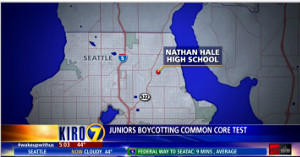
Hale_opt_out_kiro_small


Seattle had an incredible first year resisting the SBAC.
Let’s take a look at the final numbers and see what happened. It’s also worth noting Seattle’s opt out numbers turned out to be higher than what was initially reported by OSPI in July.
11th Grade
Seattle’s 11th graders captured the media’s attention with their willingness to step up and opt out. This became such a phenomenon John Oliver mentioned Nathan Hale in his profanity laced take down of high stakes testing.
What do the final numbers look like? A mind blowing 76.1% of 11th graders opted out of the ELA and 80.5% for Math.
For ELA, this translates into 2,425 students.
For Math, this translates into 2,557 students.
big_11th_Seattle
What’s also interesting is a significant number of 3rd through 8th grade students opted out. After the OSPI press release, the narrative became parents of 3rd through 8th grade students must be OK with the SBAC.
Granted, the final numbers aren’t as stunning as the 11th grade. That said, the final count was high enough to throw a wrench in the system. Each grade, from 3rd to 8th, failed to meet the 95% participation requirement. That’s quite an accomplishment for the first year of resistance to a brand new assessment.
It’s important to remember that these are the kids who will face the SBAC as a graduation requirement. Now is the time to rise up and squash it, before more harm is done.
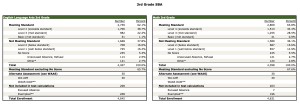
Below is a break down of the opt out numbers by grade. (Click on the image to enlarge. Opt outs are listed as “No Score”)
3rd Grade
OSPI Not Tested Report for 3rd grade ELA. Student refusal = 118.
In final report, total students with no score = 235. Total refusal rate of 5.3%
 OSPI Not Tested Report for 3rd grade Math. Student refusal = 121.
In final report, total students with no score = 245. Total refusal rate of 5.5%

big_3rd_Seattle

4th Grade
OSPI Not Tested Report for 4th grade ELA.  Student refusal = 145.

Hospitalized Dyett Activist Returns to Continue Hunger Strike for 10th Day #FightForDyett

Hospitalized Dyett Activist Returns to Continue Hunger Strike for 10th Day - Grand Boulevard - DNAinfo.com Chicago:

Hospitalized Dyett Activist Returns to Continue Hunger Strike for 10th Day


 Irene Robinson has returned to a 10-day hunger strike at Dyett High School after being hospitalized Monday for dangerously high blood pressure.

Irene Robinson has returned to a 10-day hunger strike at Dyett High School after being hospitalized Monday for dangerously high blood pressure.


GRAND BOULEVARD — A dozen school activists are being forced to consider when to stop a 10-day hunger strike calling on Chicago Public Schools to make a decision on reopening Dyett High School after the first of the group was hospitalized.
Irene Robinson, grandmother of 14 CPS students, was admitted to Provident Hospital on Monday afternoon with dangerously high blood pressure.
“It’s uncontrollable right now, but they’re trying to manage it,” Robinson said Wednesday after being released from the hospital Tuesday. “The doctor said my heart is weak.”
Robinson was back in front of Dyett, 555 E. 51st St., on Wednesday and still holding to the hunger strike, having not eaten even in the hospital.
Organizers for the group said the medical staff monitoring the 12 on a hunger strike are starting to become worried as all are now showing more serious symptoms.
“The nurses are scared to death,” said Jawanza Malone, executive director of the Kenwood Oakland Community Organization.
He said all of the group has now lost more than 10 percent of their body weight and the medical staff monitoring the situation have told them it is now more dangerous.
He said the group is experiencing fatigue, nausea, diarrhea, headaches and other symptoms of starvation.
“We’re not going to have people dying out here,” Malone said.
Though Malone said the group must now start considering when some of the dozen must stop, all twelve said they were committed to continuing the hunger strike until CPS makes a decision on Dyett.
The hunger strike started on Aug. 17 after CPS delayed a scheduled hearing on three proposals for reopening the school, the proposal authored by the activists for a district-run school focused on green technology, an arts-based contract school proposed by Little Black Pearl and a sports and business themed high school proposed by the school’s former principal Charles Campbell.
On Aug. 7, CPS said it needed more time to address the district’s budget woes and get new Board of Education members and administrators up to speed on all three proposals. The hearing was rescheduled for Sept. 15, with a vote expected by the board shortly after.
"Chicago Public Schools is carrying out a community-driven process to select a new high-quality school for the former Dyett site," said Bill McCaffrey, a spokesman for CPS, on Aug. 17. "Identifying a high-quality education option for the former Dyett site is a priority for the district, and CPS is reviewing school proposals to determine the best open enrollment, neighborhood education option for the site."
New board President Frank Clark met with the hunger strikers on Wednesday morning to discuss Dyett, according to CPS.
The group got an added boost of support on Wednesday when American Federation of Teachers President Randi Weingarten, Illinois Federation of Teachers President Dan Montgomery and local and state politicians signed on in support of the activists plan for Dyett.
“This is the best proposal I have seen in my entire career,” Weingarten said at a Hospitalized Dyett Activist Returns to Continue Hunger Strike for 10th Day - Grand Boulevard - DNAinfo.com Chicago:

Teachers sing ‘One Day More’ before students return to school — and it’s awesome | WGN-TV

Teachers sing ‘One Day More’ before students return to school — and it’s awesome | WGN-TV:

Teachers sing ‘One Day More’ before students return to school — and it’s awesome


DES MOINES, Iowa — Teachers and staff in the West Des Moines school district broke into song during an employee meeting last week, accurately capturing the angst over having only one more day before students return from summer break.
Superintendent Lisa Remy was speaking when she was interrupted by a school employee. More than 30 people joined in to help sing “One Day More” from “Les Miserables.”
The song was complete with parody lyrics