Latest News and Comment from Education

Saturday, May 2, 2015

Why We Should Trust Teachers to Determine Who is Career and College Ready

Why We Should Trust Teachers to Determine Who is Career and College Ready:


Currently, Washington State law allows five pathways to a high school diploma. These are the SBAC exams, the EOC exams, college entrance exams like the SAT, “collection of evidence” policies set by local school districts and course grades determined by teachers who have spent an entire year observing and helping students learn. Four of these Graduation Pathway options would be eliminated if House Bill 2214 passes. The only option left would be the SBAC test – an unfair high failure rate test that is designed to fail 67% of the students who take the test! Students who fail this test during their Junior year would be required to a take and pass “rigorous” makeup courses during their Senior year to get a high school diploma. 
01

House Bill 2214 would give Washington state the most rigid and unfair graduation requirements in the nation. There is no need to impose rigid and inflexible graduation requirements on Washington state students as Washington state students have historically excelled on both national and international tests. I have written an article detailing all of the drawbacks of House Bill 2214 which you can read at the following link. 
http://coalitiontoprotectourpublicschools.org/why-house-bill-2214-is-a-crime-against-our-kids

In this article, we will review the research showing that high stakes exams, like the SBAC, EOC, SAT or MAP are not the best way to determine career and college readiness. For many years, large scale scientific studies have shown that the most valid and reliable predictor of career and college readiness is a student's high school Grade Point Average (GPA)– or the average of the combined grades from 24 teachers who worked with the student during their four years of high school. Here are links to and descriptions of three of these studies. 

Defining Promise, William Hiss, National Association for College Admission Counseling, February 5 2014.” This study found that students who did not submit high stakes tests performed as well in college as students who did submit high stakes test scores. 
http://www.nacacnet.org/research/research-data/nacac-research/Documents/DefiningPromise.pdf

Predicting Freshman Grades from High School Test Scores, Daniel Koretz, et al, Harvard Graduate School of Education, August 26 2014.” This study found that while high school grades in the state of New York predicted 50% of the variance in college grades that high stakes tests were only able to predict 33% of the variance. 
http://projects.iq.harvard.edu/files/eap/files/cuny_fgpa_prediction_8.26.2014_wp.pdf

Validity of High School Grades in Predicting Student Success, Geiser and Santelices, University of California, 2007.” 
In a study of more than 81,000 students entering the University of California system, Geiser and Santelices (2007) found that high school grade point average is the most reliable predictor of college success. This study found that while high school grades were able to predict 31% of the variance in college freshman grades, high stakes tests (SAT) were not able to predict more than 21% of the variance. Note that SAT I is a test of general reasoning and SAT II are tests of specific subjects.http://www.cshe.berkeley.edu/sites/default/files/shared/publications/docs/ROPS.GEISER._SAT_6.13.07.pdf
02

The same study found that high school GPA was also a better predictor of college graduation and college GPA than any other factor. 
03

What high stakes tests are more closely related to is the family income of the parents. High school GPA is also fairer to low income students because it is not as closely tied to family income as high stakes single point tests. 
04

Why is it that student GPA is a more accurate predictor of career and college readiness than high stakes tests that cost hundreds of millions of dollars to produce and administer? The simple answer is that each student is unique and has different aptitudes and life experiences. Some students do poorly on high stakes testing despite the fact that they have demonstrated understanding of subjects by doing well in their year long course work (a condition commonly referred to as test anxiety). Teachers who are able to spend time directly with each student are much better at assessing students than any one time high stakes test. 

Why are high stakes exams more closely related to family income than grades? The simple answer is that families with high incomes are able to buy test prep books and pay for test prep courses than poor families cannot afford. 

Why we should trust teachers rather than high stakes tests to judge career and college readiness
This year thousands of students in Washington state are at risk of not being able to graduate due to failing a single high stakes test called the 
Why We Should Trust Teachers to Determine Who is Career and College Ready:

Corporate Reformer Pretending to be something he isn’t - the wealthy are buying the U.S. one election at a time

Evidence of a Corporate Reformer Pretending to be something he isn’t, and how the wealthy are buying the U.S. one election at a time | Lloyd Lofthouse:

Evidence of a Corporate Reformer Pretending to be something he isn’t, and how the wealthy are buying the U.S. one election at a time


 There are two previous updates that may be found at the bottom of this post. In the 13 days since the last update, NINE more poster sized flyers poured into our mailbox, and it is obvious that Steve Glazer’s wealthy and corporate supporters are outspending Susan Bonilla at least $8 to $1 if not more.

FOUR of the flyers that supported Glazer came from JobsPAC (Chevron and AT&T are two of the corporate supporters that contribute money to this group)—KNOWN SPECIAL INTERESTS!!!
Another FOUR that supported Glazer came from Bill Bloomfield, a millionaire oligarch with a proven history of supporting the corporate education reform movement and corporate Charter Schools—A KNOWN SPECIAL INTEREST!!!
Only ONE flyer was paid for by Susan Bonilla for Senate 2015, and it made no claims against Steve Glazer. Instead, it let us know that Susan was endorsed by the California Small Business Association.
What did JobsPAC have to say?  Two of the flyers claimed Bonilla spent taxpayer money (like all elected representatives do all the way to the U.S. Congress) to furnish her offices and made other allegations. The other two flyers alleged she voted for a bill that would make it harder to fire teachers that abuse kids (THIS IS FALSE) and the governor vetoed the bill (TRUE). At the bottom of the flyers in very small print, they provide the bill number they are referring to. It was AB 375. I looked it up.
Here is a link to the history of AB 375:
I challenge anyone to read the history of this bill and find where there is language that protects teachers who abuse kids!  AB 375 passed both the assembly and state senate by overwhelming majorities. The governor did veto the bill on 10/10/13, and here is Governor Brown’s reason:
To the Members of the California State Assembly:
I am returning Assembly Bill 375 without my signature.
The goal of this bill is to simplify the process for hearing and deciding teacher dismissal cases. I have listened at great length to arguments both for and against this measure. While I agree that it makes worthwhile adjustments to the dismissal process, such as lifting the summer moratorium on the filing of charges and eliminating some opportunities for delay, other changes make the process too rigid and could create new problems.
I am particularly concerned that limiting the number of depositions to five per side, regardless of the circumstances, and restricting a district’s ability to amend charges even if new evidence comes to light, may do more harm than good.
I share the authors’ desire to streamline the teacher discipline process, but this bill is an imperfect solution. I encourage the Legislature to continue working with stakeholders to identify changes that are balanced and reduce procedural complexities.
Sincerely,
Edmund G. Brown Jr.
The flyers paid for by Bill Bloomfield claim that Steve Glazer has a record of fighting for education, but they don’t define what that means. I’ll tell you what it means. It means he has a record of fighting for corporate education reform and corporate Charter schools, that might profit off of our children if Steve Glazer is elected.
****
If you aren’t aware of the war being waged in the United States by a few billionaire oligarchs to remake the United States into a country that fits what they think, then it’s time to wake up and learn how to discover the signs of oligarch funded propaganda designed to manipulate and fool voters during elections. These billionaires are buying their way into the Republican and Democratic parties, and they are libertarians, neo-liberals, and neo-conservatives—and all of them threaten our freedom and way of life, because to win, they subvert the democratic process protected by the U.S. Constitution and Bill of Rights.
For Instance, for the last few weeks, occasionally, the phone rings, and the call ends up being for one of the candidates running in a special election in California’s State Senate District 7 (where I live) that will be held on May 19.  There are two candidates in this runoff election, and both are Democrats, but I think one of them is a corporate loving, teacher bashing, union hating, corporate reformer pretending to be something he isn’t.
The two candidates are Steve Glazer and Susan Bonilla. Bonilla is in the state legislature and identities herself as an educator. Campaign literature for Glazer claims he is a mayor and a university trustee.
The phone rang a few days ago, and I ended up talking to someone working in Glazer’s campaign, who claimed this was a dirty campaign and inferred that Bonilla was responsible for the dirt and lies. Then this guy went and said that Glazer was running a clean and honest Evidence of a Corporate Reformer Pretending to be something he isn’t, and how the wealthy are buying the U.S. one election at a time | Lloyd Lofthouse:

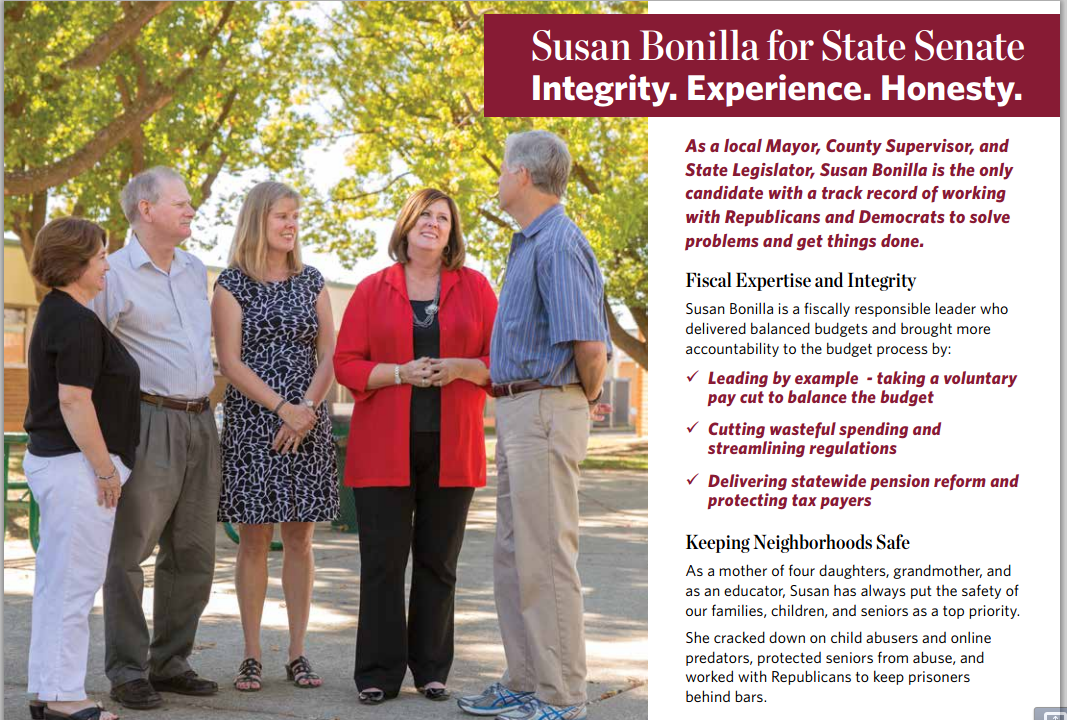
Susan Bonilla for Senate 2015

Susan Bonilla for Senate 2015


Susan Bonilla for Senate 2015

photo.Susan_Bonilla.140x250
Assemblywoman Susan Bonilla is a former high school teacher, mayor and county supervisor, who has worked to strengthen neighborhood schools, protect public safety services, and support job growth and working families across the state.
Prior to her election to the State Assembly in 2010, Bonilla served as a Contra Costa County Supervisor and as the Mayor of Concord – the largest community in the State Senate District. While serving her local community, Bonilla built and expanded job-training programs and job creation efforts that successfully helped residents get back to work during the recession.
Additionally, Susan Bonilla authored Assembly Bill 484 – an important and revolutionary change to education policy. Signed by the Governor Brown in 2013, the law enables our schools to phrase out outdated STAR tests and prepare students and teachers for better assessments that reflect the real world knowledge needed in tomorrow’s job market.
Susan has provided steadfast leadership in protecting early childhood education programs, saving transitional kindergarten, which provides our youngest learners the foundations they will need to succeed.
Susan authored historic legislation that expanded health care access for women, created the highest safety standards for California industrial sites while protecting manufacturing jobs, and provided more tools for law enforcement to keep our communities safe.
As a member of Contra Costa County’s Board of Supervisors, Assemblywoman Bonilla created the Foster Youth Employment Program, providing youth in the county foster system job opportunities within the county structure. She also developed partnerships to open the Michael Chavez Center for Economic Opportunity to provide job training directly to residents within the Monument Corridor of Concord.
Prior to serving in public office, Susan was an English teacher in the Mt. Diablo Unified School District. She has a B.A. in English from Azusa Pacific University and teaching credentials from CSU Los Angeles. Susan resides in Concord with her husband, John. They have four daughters and three grandchildren.

How to Buy a School District - Education Under Attack

Education Under Attack | Attacks on public education system hurt America:


How to Buy a School District

Sold-sign
The Lyons Elementary School District 103 was recently purchased for $11,512.  The district, serving 2,600 students in west Cook County, has an annual budget over $30 million.  What a great deal!
How the school district was bought:
The mayor of one of the five communities the district serves, Chris Getty, decided he should be running the district.
Mayor Getty got five of his henchmen to run for the school board.
Mayor Getty helped the henchmen form the Political Action Committee (PAC)Parents for Student Excellence on 2/24/15.  It’s unusual to form a PAC for school board candidates – even in the Chicago area!
Three days later Getty’s own two PACs United Citizens Party and Citizens for Getty each gave Parents for Student Excellence $975 as seed money.  Why such an odd number?  Because the Illinois Board of Elections must be notified within two days of any donations over $1,000.  $975 keeps it under the radar.
Citizens for Getty hid more expenditures as “in-kind contributions” until after the election.  A few days before the election they spent $10,341.95 on “in-kind” printing and mailings on behalf of Parents for Student Excellence.
Not one of the five board candidates gave a penny to Parents for Student Excellence.  Nor did they bother to show up for the League of Women Voters’ candidate forum.
In addition to the $10,341.95 of “in-kind” contributions Parents for Student Excellence spent $1,169.82 on pictures of themselves (for a flyer) and a mailing service.  The PAC spent at total of $11,512.
So what did they spend it on?  They sent out flyers and emails telling the residents that the district was “in disarray,” students got “bad test scores” and that the current board engaged in “wasteful spending.”  (Riverside-Brookfield Landmark)
The PR blitz worked – four of the five henchmen were elected to the board of education.  And Mayor Getty has given them their first marching orders: fire the interim superintendents and hire his political-buddy as superintendent, fire the Education Under Attack | Attacks on public education system hurt America:
 Beware of AstroTurf Ed Reformers 

Just Like Michelle Rhee's Students first only BETTER


Astroturf lobbying refers to political organizations or campaigns that appear to be made up of grassroots activists but are actually organized and run by corporate interests seeking to further their own agendas. Such groups are often typified by innocent-sounding names that have been chosen specifically to disguise the group's true backers

Just Like Michelle Rhee's
 Students first Astroturf lobbying (only Better) 
Other Astroturf lobbying groups


Just Like Michelle Rhee's
 Students first Astroturf lobbying (only Better

Evaluation regs to be adopted without formal public comment | Capital New York

Evaluation regs to be adopted without formal public comment | Capital New York:

Evaluation regs to be adopted without formal public comment


 ALBANY—State education officials will soon adopt regulations finalizing a new teacher evaluation system, but because of a statutory deadline imposed by Governor Andrew Cuomo and the Legislature, they’ll do so without the formal public comment period that’s typically required by law.

The state education department has worked to offer limited opportunities for the public to weigh in before the regulations are adopted, circulating an email address people may use to send comments and offering another outlet at an Albany “summit” next week.
But department officials will present regulations for emergency adoption at the state Board of Regents’ mid-June meeting, skipping a 45-day public comment allowance with which they are typically required to comply under a statute that allows agencies to promulgate rules with the force of law.
Stakeholder groups blame Cuomo and lawmakers for not providing more time for comment and overall implementation of the controversial, complex system. 

MORE ON CAPITAL

“There really is no time for public comment, and we’re not happy about that,” said Rick Longhurst, executive administrator for the New York State Parent Teacher Association, whose organization pressed lawmakers for a delay in a recent letter. “I don’t know what to do about that, other than to ask the Legislature to call a time out and extend the overall deadline and give everybody a little more time.”
The recently adopted state budget included an overhauled teacher evaluation system pushed primarily by Cuomo, who has pursued policies that would make it easier to fire teachers who are deemed ineffective.
In the budget, Cuomo and lawmakers detailed the new system, which will be based on student test scores and classroom observations, while tasking education officials with finalizing some technical aspects of implementation.
Under the law, the Board of Regents is required to adopt regulations by June 30, after which school districts will have until Nov. 15 to receive state approval for their locally negotiated evaluation plans, lest they lose a scheduled increase in state aid.
As part of officials’ effort to meet the deadline, the board has invited experts to testify at a “summit” on May 7 at the New York State Museum, which is intended to inform their work. Education department staff will then present preliminary recommendations to the board at its May meeting, make changes based on the regents' discussion and then recommend emergency adoption of final regulations in June.
The state’s regulatory process allows for an agency to adopt emergency regulations for 90 days. Officials would then have to publish the rules and accept public comment for 45 days. According to that timeline, the public comment period would not occur until shortly before districts are required to implement the new evaluations.
“To reflect this, we have built in opportunities on the front end to hear from the public,” education department spokesman Jonathan Burman said in an email.
Since the budget was approved, the department has been accepting comments through the email address eval2015@nysed.gov.
The summit, which is invite-only, “will be simulcast to the public, with the opportunity for the public to submit comments,” according to a department memo last week.
Although the Regents board members expect to meet the deadline for adopting regulations, the board's chancellor, Merryl Tisch, announced late last month that the department would use its authority to extend the November deadline to September 1, 2016, for districts facing “hardships.”
Education stakeholders—superintendents, school board members, teachers and others—have been concerned primarily with the deadline for districts, especially because of the risk of losing money. But now that Tisch has offered some flexibility there, they’re also pushing legislators to extend the regents’ June 30 deadline.
And despite the unlikelihood that Cuomo will agree to slow implementation of the new evaluations, lawmakers are considering such a change, in part because of the intense pressure they have felt from constituents since passing the unpopular education provisions of the budget.
State Senate education committee chair John Flanagan, a Long Island Republican and prominent member of his conference, said this week he and his colleagues are discussing extending the deadline, specifically to allow for public comment.
“The most critical aspect of this is the ability for public comment, and one of the overarching themes of our members is, public comment is great, but if the regents and S.E.D. don’t have the time to properly review and incorporate that into their decisions, that seems imprudent,” Flanagan said on Wednesday during an interview on the “The Capitol Pressroom” on WCNY.
“Maybe we should be looking at extending the public comment period,” he said on the radio. “Maybe June 30 is not the best approach.”
In an earlier interview with Capital, Flanagan insisted that the state budget allowed enough time for public comment.
“I believe the actions we took did a couple of things: It provided for public comment,” he said during a phone interview on April 23. “It avoided the issuance of emergency regulations, which would have bypassed public comment. I was very, very clear, as were my colleagues, that we wanted a public comment period."
Flanagan said he expected there to be an “explosion of comments,” especially given how active parents have been on social media, and he said he would understand if the department were not able to respond to each comment.
But, at the very least, “it’s critically important that anyone who sends in comments gets an appropriate acknowledgement that it’s been received,” he said.
Additionally, a group of 18 State Assembly Democrats last week said they would consider extending the deadline.
"If the Regents cannot meet the June 30th deadline, they must inform the Legislature as soon as possible so that the law can be amended,” the group, which included Aileen Gunther of Orange County and Amy Paulin of Westchester County, said in a statement.
Cuomo, however, has insisted the timeline for the evaluations wouldn't change and urged regents to limit the use of the "hardships" exemption.
New York State United Teachers, a statewide union, has pushed the Board of Regents tohold public hearings around the state on the evaluations. Short of that, they’re now asking individual regents to hold hearings in their respective districts, as at least one regent, Judith Johnson of the lower Hudson Valley, has said she would do.
“It’s important for the regents to hold hearings to solicit input from students, parents and Evaluation regs to be adopted without formal public comment | Capital New York:

Jersey Jazzman: One Newark: "Choosing" Segregated Schools?

Jersey Jazzman: One Newark: "Choosing" Segregated Schools?:

One Newark: "Choosing" Segregated Schools?


 Last week, I released a new brief at the NJ Education Policy Forum about One Newark, the one year-old school choice plan in New Jersey's largest city. I think this subject is important enough -- not just for Newark, but for education policy in general -- that it's worth my doing some wonk-to-English translating here to explain what I found.


A little background: last year, State Superintendent Cami Anderson, over the objections of many, implemented a "portfolio" system in Newark that calls for families to choose from a menu of both charter and district schools. The district's role in this system, called One Newark, is supposedly to be both a facilitator and an impartial arbiter, providing necessary information for families so they can make an informed decision.

As I wrote last year, economic theory suggests that consumers need high-quality information to negotiate a market, and that the state-run Newark Public Schools' role in One Newark should be to provide that information. The district does give both charter and district schools ratings under One Newark: "Great," "On The Move," and "Falling Behind."

The problem is that these ratings are tied to test scores, which have enormous biases against schools that serve more students who are in economic disadvantage, or have special education needs, or have more black students, or who even have more boys. Here's the breakdown on student characteristics and One Newark ratings:

This is, to my mind, the central question in whether One Newark will actually help improve the city's education system: What are Newark families actually "choosing"? Are they opting for "better" schools, or merely schools that have differing student populations?

Bruce Baker* has been on this for a while: see here and here. Given the unequal distribution of both students and resources across Newark's schools, it's both unfair and unhelpful to rate schools by test score outcomes. You can't ask a school with more students in disadvantage to compete with a school with fewer of those students, especially if they don't have similar resources.

And we shouldn't be surprised that schools with less challenging students and better resources are more "popular" in a choice system. In fact, given the preliminary release of the results of the initial One Newark applications, that seems to be exactly what happened. Here are the results released by NPS as reported at NJ Spotlight:


Most popular schools under One Newark are "Great" according to NPS. Again, that
- See more at: http://jerseyjazzman.blogspot.com/2015/05/one-newark-choosing-segregated-schools.html?spref=fb#sthash.kT728Y1k.dpuf

Louisiana Educator: Latest News in the War Against Public Education and the Teaching Profession

Louisiana Educator: Latest News in the War Against Public Education and the Teaching Profession:

Latest News in the War Against Public Education and the Teaching Profession


First the Good News:

HB 330 which would have greatly expanded vouchers, and HB 505 that would have taken away all due process rights of teachers were removed from the House Education Committee agenda for last week. These bills may not be revived partly as a result of the many emails legislators received opposing such legislation. I want to thank many of my readers for communicating with their legislators and informing them that these bills would be destructive to public education. HB 505 by Ivey is however, rescheduled for consideration by the committee this coming Wednesday, but even Governor Jindal has indicated that he may not support it. Please continue your efforts to defeat this horrible bill.

Now for the Continued Attack on the Teaching Profession:

House bill 418 passed a carefully stacked committee of the House Labor and Industrial Affairs Committee Thursday despite much vocal opposition from teacher, police, and firemen unions. This is the bill that would prohibit teachers and other public employees from using payroll deduction for payment of their union or association dues. Our state government is 1.8 billion dollars in deficit, and public employees are subject to layoffs, pay freezes, and outright cuts, yet big business (LABI) and teacher haters want to pass legislation that reduces the influence of professional educators, but does not save the state or local governments one penny!

HB 418 is cynically named the Payroll Protection Bill. These union hating legislators pretend with the use of this title that teachers, police, and firemen are like innocent children who need for their big brothers in government to protect them from the "evil" unions. Payroll deduction will still be available for numerous charities, insurance policies, and even highly questionable cancer polices that are considered by the insurance industry to be little more than rip-off polices. Our big buisness bosses in LABI don't care about the teachers that may be preyed upon by all of these other groups. They only want to protect teachers from their own organizations that are dedicated to fighting for teacher rights and benefits.

Are those big buisness interests such as LABI and CABL concerned about the innaccuracy of VAM ratings, or the serious flaws in the new evaluation system, or the loss of seniority for teachers, or the interference of the LDOE in enforcement of student discipline, or the fact that now some teachers are being required to work many extra hours without pay? No, in fact they helped sponsor and lobby for these changes. But they do want to neutralize their biggest upponents in beating up on teachers!

I am proud to say that even though retired, I am a lifetime member of the Louisiana Association of Educators and I also have great respect and support for the Louisiana Federation of Teachers. I worked for 20 years as a staff member of the LAE and helped to win many important battles for teachers. I am now watching helplessly and frustrated the de-professionalization of teaching. It is sad to regularly get letters from dedicated teachers who are being driven out of the teaching profession because of the many ant-teacher policies and laws passed in recent years.

HB 418 will be going to a vote on the House floor probably the week after next. That means that every Representative will get to vote whether or not they want to deny educators one more benefit and whether they really want to stifle the voice of teachers in speaking out against bad education policies and in favor of improving benefits and status of the teaching profession. No, this won't destroy the teacher unions if it passes, but statistics show that when you deny a group of employees payroll deduction for the payment of union or association dues, the membership of those organizations declines and their influence is curtailed. This bill has nothing to do with Payroll Protection! Its only purpose is to reduce the influence of educators on education policy.

This is both Stupid and Ironic

I got an email from a frustrated teacher not long ago, basically saying the following:
 "I am sick and tired of the teaching profession being blamed for everything that parents are not doing in the rearing of their children. I have never before worked so hard to educate children and received so little support and appreciation for the job that I have done for 20 years.  If they want to take away my payroll deduction for dues, I just may not join in the future." 

All I can say to that is, wow how stupid! This is exactly what LABI wants to accomplish. Surely no one else in the teaching profession could possibly be willing to play into their hands this way. Look, I know how frustrated teachers must be at this point but such a reaction is childish and counterproductive!

I believe educators have a good chance of defeating this repressive and unproductive legislation. LABI is letting it be known that its PAC will contribute to legislators who help them do this dirty deed. But even so, all teachers have to do to defeat it is tell their Representative and Senators to vote No for HB 418! It's all going to be determined by how many emails they get (or don't get) from teachers opposing this.

SB 54 passed to Senate floor by Senate Education Committee

Senate bill 54 by Senator Broome is a well intentioned bill, but will in my opinion do nothing but harm by tying the hands of Louisiana Educator: Latest News in the War Against Public Education and the Teaching Profession: 

Are government officials trying to intimidate parents who resist testing? - The Washington Post

Are government officials trying to intimidate parents who resist testing? - The Washington Post:

Are government officials trying to intimidate parents who resist testing?


Tens of thousands of parents in a number of states have decided this spring to opt their children out of high-stakes standardized tests aligned to the Common Core and similar standards, and as that movement has grown, so has pushback from administrators. Now, government officials, both state and federal, are sounding off on the issue, with some threatening consequences to schools where  students refuse to take the assessments. What to make of the threats? Here’s an analysis by Monty Neill, executive director of the National Center for Fair and Open Testing, known as  FairTest, a nonprofit organization that works to end the misuses of standardized testing and to ensure that evaluation of students, educators and schools is fair, open, valid and educationally sound.
By Monty Neill
The rapid rise of the test resistance movement has spawned a backlash by federal and state bureaucrats seeking to intimidate schools and districts where large numbers of parents and students refuse the tests. Opt-outs on the New York English Language tests more than tripled, from under 60,000 in 2014 to around 200,000 this year. In New Jersey, refusals went from perhaps a thousand last year to nearly 60,000 on the first round of the PARCC test. Activists in nearly all states now report opting out, compared to about half last year, with thousands refusing in some jurisdictions.
In response, U.S. Education Secretary Arne Duncan said that “the federal government is obligated to intervene if states fail to address the rising number of students who are boycotting mandated annual exams.” A few days earlier, a U.S. Department of Education (DOE) spokespersonindicated the department “could withhold funding from states if some of their districts have too few students take the exams.” Authorities in several states have used these comments to back up their efforts to halt the opt out movement by threatening funding loss and other sanctions.
How seriously should parents and school leaders take the federal and state threats? We believe these threats have little legal substance and are not politically viable.
No Child Left Behind does state that 95 percent of students must take federally mandated state exams or their schools and districts will fail to make “adequately yearly progress” (AYP). That failure unleashes a chain of escalating sanctions. However, the list of AYP sanctions does not include a provision to withhold federal funds.
Unable to use AYP-based sanctions, the DOE has moved to protect testing requirements by relying on the fact that NCLB is essentially a contract with each state. The DOE claims it can withhold funds if states fail to fulfill any part of the law. But by focusing only on the requirement to test 95 percent of eligible students, DOE is cherry-picking provisions to enforce. It has notthreatened to impose sanctions for failure to meet other NCLB testing requirements such as assessing “higher order thinking skills,” using “multiple measures,” or providing meaningful individual “diagnostic reports.”
In the highly unlikely case that the DOE decided to pursue enforcement of these contracts, the first step would be a “corrective action” plan to address the low participation rates. This is typically a multi-year process during which time schools would not lose funding. If such corrective actions began this year, they would not reach the stage of funding cuts until after the Obama administration had left office. Lacking plausible threats, the federal statements seem designed to prod and bolster state authorities
States have varying provisions regarding whether a superintendent can withhold funds from a district. New Jersey Commissioner David Hespesaid that “schools with especially high opt-out rates could have state funding withheld.” But New Jersey advocates point out that Hespe has not identified any statute that gives him this authority. Obtaining it would require legislative action, which is extremely improbable. In fact, legislators have said they will introduce a bill to prohibit the commissioner from withholding state funding based on parental test refusals.
We know of no state or district that levied penalties against schools with high opt-out rates. Though at least one third of New York schools and Are government officials trying to intimidate parents who resist testing? - The Washington Post:

Michigan Governor Takes Recovery School District Model to New Chaotic Level | Larry Miller's Blog: Educate All Students!

Michigan Governor Takes Recovery School District Model to New Chaotic Level | Larry Miller's Blog: Educate All Students!:

Michigan Governor Takes Recovery School District Model to New Chaotic Level


Filed under: Recovery District — millerlf @ 2:47 am 
By Ann Zaniewski, Detroit Free Press Education April 30, 2015
Story Highlights
• Snyder wants to create new education boards whose members he and Mayor Mike Duggan would appoint.
• DPS teachers went to Lansing to protest the plan, forcing the closure of at least 18 DPS schools.

This is a update since this article was published:

[Mayor Mike Duggan expressed disappointment with Gov. Rick Snyder’s sweeping reforms of Detroit schools, and said he wants nothing to do with the proposed plan, the Detroit News reports.
Christine Ferretti of the News writes that Snyder’s proposal calls for Duggan to play a role in naming members to oversee the new district — the City of Detroit Education District — as well as a separate oversight commission.
“I have no interest in that role,” Duggan told The Detroit News. “I am very disappointed in this plan. In particular, that it basically creates long-term state control of local schools. State control of local schools is bad and it’s been a failure in Detroit.”]
Gov. Rick Snyder announced plans Thursday for a sweeping overhaul of Detroit’s education system, including a proposal to split Detroit Public Schools in two as a way to eliminate its crippling debt but at the expense of other districts across Michigan.
One entity would become a brand-new public school district, run by a seven-member school board appointed by Snyder and Mayor Mike Duggan. The state would contribute $53 million to $72 million annually to support it.
“It’s important to create a system of success for students in the City of Detroit,” Snyder said, adding that the future of Detroit and the state are linked to having strong city schools. He said he did not see the plan as a bailout.
Initial reaction included some high-profile criticism, including from state lawmakers and about 250 DPS teachers who missed a day of school to take up picket signs at the state Capitol.
The proposal calls for each entity — an “old” and “new” district — to be overseen by its own school board and subjected to a financial review board, similar to what was used in Detroit’s bankruptcy, until the debt is resolved.
Legislation would have to pass this fall so the split could take place by July 1, 2016. It is expected to be proposed this summer.
Snyder’s plan raises concerns about local control
The plan aims to holistically address not only the persistent financial distress of DPS but also the generally poor academic performance of public schools across the city.
“We’re just not seeing the results these students deserve,” Snyder said at a news conference at the Cadillac Place state office building in Michigan Governor Takes Recovery School District Model to New Chaotic Level | Larry Miller's Blog: Educate All Students!: