Latest News and Comment from Education

Sunday, April 26, 2015

Thanks to Vincent Precht I got to Watch The NPE Conference Live and It was A Gas! #‎NPEChicago


Thank You Vincent Precht

itunes pic


California Father


I am a teacher, writer, filmmaker and live streamer. I have produced live stream events for United Opt Out featuring addresses by Diane Ravitch and Karen Lewis and am making a documentary, which includes interviews with Noam Chomsky, Jesse Hagopian and many others. Published in the New York Times, Seattle Review, TriQuarterly and elsewhere, I have written award winning short stories. I have been a public school teacher for 29 years. The biggest moments of my life were having a son and 40 years earlier meeting the Beatles.

Vincent Precht http://bit.ly/1GwPEPv
schoolhouselive.org


Vincent Precht http://bit.ly/1GwPEPv

Land Shark Alert: 'Odd couple' battles it out for senate seat - ContraCostaTimes.com

'Odd couple' battles it out for senate seat - ContraCostaTimes.com:

'Odd couple' battles it out for senate seat


 WALNUT CREEK -- It's hardly your typical political matchup -- pitting a missionary's daughter backed by Planned Parenthood and nearly every major Democratic lawmaker against a close confidant of Gov. Jerry Brown, who is counting on independents and Republicans to carry him to Sacramento.

The state Senate race between Assemblywoman Susan Bonilla, D-Concord, and Orinda Mayor Steve Glazer is a confrontation between Democratic moderates who have drifted in opposite directions and now champion causes that might have surprised their earliest supporters.

File: Assemblywoman Susan Bonilla, center, visits with campaign volunteers Doug Jones and Mary Jo Rossi at her campaign office in Concord, Calif., on
File: Assemblywoman Susan Bonilla, center, visits with campaign volunteers Doug Jones and Mary Jo Rossi at her campaign office in Concord, Calif., on Tuesday, March 17, 2015. (SUSAN TRIPP POLLARD)
It is also a battle between two of the most powerful interests in Sacramento -- organized labor and the Chamber of Commerce -- both of which see far more at stake in the May 19 special runoff election than merely who will represent much of Contra Costa County and the Tri-Valley region of Alameda County in the already strongly Democratic state Senate.

The seat was vacated last year when Mark DeSaulnier, D-Concord, was elected to Congress.

A Glazer victory, after he made headlines during his unsuccessful bid for Assembly last year by calling for the outlawing of BART strikes, could have statewide ramifications for the Democratic Party and its allies in organized labor, political analysts said.

"I think labor is one of the last trip wires the Democrats can't step over," said Richard Temple, a Republican consultant with the firm McNally Temple Associates. "If Glazer wins, this will tell other Democratic candidates that there may be a path that doesn't require them to have union support."

That path comes at a steep cost as voters inundated with a daily barrage of campaign mailers can attest. Glazer has benefited from nearly $2 million in independent expenditures from the Chamber of Commerce and Bill Bloomfield, a Republican-turned-independent Southern California millionaire who funds pro-business Democrats.

File: Mayor Steve Glazer chats with vendors at the Orinda Farmer’s Market in Orinda, Calif., on Saturday, April 4, 2015.
File: Mayor Steve Glazer chats with vendors at the Orinda Farmer's Market in Orinda, Calif., on Saturday, April 4, 2015. (Dan Honda)
Bonilla, who votes with the chamber about 40 percent of the time, has benefited from the nearly $1.5 million that union-supported committees have spent opposing Glazer. Bonilla has voted for every labor-backed bill since 2012, including legislation last year that required employers to provide paid sick leave.

With the advent of California's "top two" election system and the Republican Party's long decline, it's becoming increasingly common for labor and business to back different types of Democrats in politically moderate legislative districts.
What makes this runoff so closely watched is the degree to which Glazer, who finished first in last month's primary, has been willing to buck local Democratic leaders on union issues, especially 'Odd couple' battles it out for senate seat - ContraCostaTimes.com:

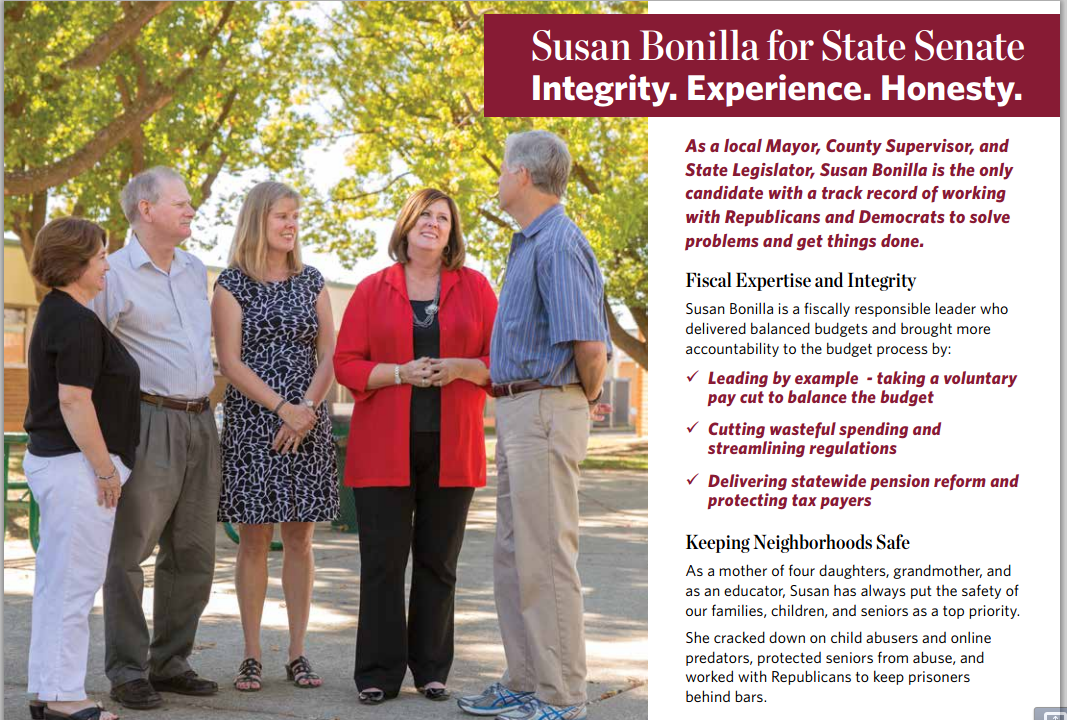
Susan Bonilla for Senate 2015

Susan Bonilla for Senate 2015:


Susan Bonilla for Senate 2015

photo.Susan_Bonilla.140x250
Assemblywoman Susan Bonilla is a former high school teacher, mayor and county supervisor, who has worked to strengthen neighborhood schools, protect public safety services, and support job growth and working families across the state.
Prior to her election to the State Assembly in 2010, Bonilla served as a Contra Costa County Supervisor and as the Mayor of Concord – the largest community in the State Senate District. While serving her local community, Bonilla built and expanded job-training programs and job creation efforts that successfully helped residents get back to work during the recession.
Additionally, Susan Bonilla authored Assembly Bill 484 – an important and revolutionary change to education policy. Signed by the Governor Brown in 2013, the law enables our schools to phrase out outdated STAR tests and prepare students and teachers for better assessments that reflect the real world knowledge needed in tomorrow’s job market.
Susan has provided steadfast leadership in protecting early childhood education programs, saving transitional kindergarten, which provides our youngest learners the foundations they will need to succeed.
Susan authored historic legislation that expanded health care access for women, created the highest safety standards for California industrial sites while protecting manufacturing jobs, and provided more tools for law enforcement to keep our communities safe.
As a member of Contra Costa County’s Board of Supervisors, Assemblywoman Bonilla created the Foster Youth Employment Program, providing youth in the county foster system job opportunities within the county structure. She also developed partnerships to open the Michael Chavez Center for Economic Opportunity to provide job training directly to residents within the Monument Corridor of Concord.
Prior to serving in public office, Susan was an English teacher in the Mt. Diablo Unified School District. She has a B.A. in English from Azusa Pacific University and teaching credentials from CSU Los Angeles. Susan resides in Concord with her husband, John. They have four daughters and three grandchildren.

Martin R. Castro, civil rights chairman, criticizes school districts not enrolling undocumented kids - Newsday

Martin R. Castro, civil rights chairman, criticizes school districts not enrolling undocumented kids - Newsday:

Civil Rights Commission Chairman Martin R. Castro criticizes schools not enrolling undocumented children

Martin R. Castro, chairman of the U.S. Commission
Martin R. Castro, chairman of the U.S. Commission on Civil Rights, in an undated photograph. Photo Credit: U.S. Commission on Civil Rights


CHICAGO - A top federal civil rights official criticized school districts Saturday who have been slow to enroll recent waves of undocumented refugee children from Central and South America.

Martin R. Castro, chairman of the U.S. Commission on Civil Rights, took aim at districts such as Hempstead.

“Every child, regardless of their immigration status…is entitled to a free public primary education and secondary education,” he said, citing a federal court case.

DATAPlacement of immigrant kidsSEE ALSORead the auditMORE COVERAGEOpinion and analysis: Hempstead School District

The Hempstead district, along with others across the country, has been accused by immigrant rights groups of failing to admit children who recently entered the United States illegally.

New York State has investigated and attorney general Eric Schneiderman reached a settlement with Hempstead schools. An independent monitor was hired earlier this month.

Hempstead schools officials have denied charges of discrimination. They have said the district lacked the space and resources to educate the influx of children.

Castro, speaking to business journalists here, said it was “a common misperception” that undocumented children aren’t entitled to a public school education.

He also said the children’s “due process rights” in the deportation process are being trampled upon.

Hearing notices aren’t being received and representation by attorneys is rare, leading to more deportations of children.

“Many of them have been deported,” Castro told the Society of American Business Editors and Writers convention. “Many of them are awaiting their hearing and while they are, one of the benefits they are entitled to is a free public education.”

He said the civil rights commission will tour immigration detention centers in Texas next week to investigate reports of sexual abuse of refugee children.

http://www.newsday.com/news/breaking/state-audit-reveals-questionable-financial-decisions-in-hempstead-school-district-1.9757933

SEE ALSORead the audit

How school reform stacks up against Grade 5 Common Core test standards. (Hint: not well.) - The Washington Post

How school reform stacks up against Grade 5 Common Core test standards. (Hint: not well.) - The Washington Post:

How school reform stacks up against Grade 5 Common Core test standards. (Hint: not well.)


Scott Levy is a parent of children with attend New York state public schools. From February 2014 through February 2015, he was a senior research fellow at the Harvard Kennedy School of Government, during which he analyzed the rollout of the federal Race to the Top program in in New York State. In the following post, Levy looks at the standards set for the fifth-grade math assessment aligned to the Common Core State Standards that students took over three days last week across New York. Then he uses them to evaluate just how well school reforms set by education policymakers in Albany stack up against those standards. Hint: Not so well.

By Scott Levy
More than 1 million students, including my fifth-grade daughter, just took the New York State Common Core Mathematics Test. But there’s something about state education policy that just does not add up. Shouldn’t we hold our politicians in Albany to the same standards that the state expects from my fifth-grader? Let’s measure Albany’s education reforms against the standards outlined in the New York State Educator Guide to the 2015 Grade 5 Math Test.
As one would expect, the Grade 5 Math Testing Rubric requires students to employ “mathematically sound procedures.” Ironically, many academics have expressed serious doubts about the type of statistical procedures the state utilizes to link test scores to teacher rankings. The American Statistical Association (ASA), whose mission is to promote “sound statistical practice to improve public policy,” has cautioned that “ranking teachers by their VAM (Value-Added Model) scores can have unintended consequences that reduce quality” and that “large standard errors make rankings unstable.” Furthermore, the ASA asserted “the lack of consistency among various methods using the same data alone raises concerns about the application of VAMs for high stakes decisions.” Yet Albany has upped the ante on high stakes testing, making it an overriding factor in the teacher evaluation process.
The exam also measures fifth-graders on their “ability to critique the arguments of others.” During an April 1st Capitol Pressroom interview, Gov. Andrew Cuomo was asked about the argument put forth by statisticians who believe that VAMs are unreliable. He responded, “That’s been seized upon because that’s what people have used to excite parents.” Is that response, devoid of substance on the statistical efficacy issue at hand, the Governor’s best defense? I don’t think New York parents are that naïve.
The Grade 5 Math Test is used to “assess student reasoning.” Unfortunately, the latest legislation in Albany does not pass the reasonable test. First, it has been widely documented that New York State managed the roll out of the Common Core and Race to the Top very poorly. The governor himself admitted, “Common Core’s implementation in New York has been flawed and mismanaged from the start.” Furthermore, parents across the state have pushed back on the use of high stakes tests, and many states across the country are reducing reliance on high stakes exams. So what did Albany decide to do? Despite the poor track record, New York’s 2015 budget shifts additional power to the state at the expense of local districts and amplifies the role of high stakes standardized testing. These actions defy logic and reason.
My fifth-grade daughter recently asked, “Dad, if we spend nine hours taking state tests, how come we can’t get them back so we can at least learn from our mistakes?” I wish I had an answer that passes the reasonable test. Regrettably, the current testing program prioritizes teacher evaluations above student learning.
The state exam asks fifth-graders to “apply their knowledge to the context.” But instead of applying their policy knowledge in the proper context, the state designed a “one size fits all” policy solution. The highest-performing public schools must implement the same changes as under-performing schools. Although certain charter schools were given flexibility to opt out of the state’s current teacher evaluation program, New York’s top public schools were denied the ability to do so. On a positive note, New York State Chancellor Merryl Tisch recently started a dialogue about providing more autonomy to highly successful public schools.
Another  fifth-grade test component is how to “represent and interpret data.” Albany can use remedial help in this regard. The state uses data to justify policy decisions, but its data has not always been accurate. Just recently, local districts found major discrepancies in a state report that measured the percentage of 2012 high school students still in college.
New York’s fifth-graders are expected to demonstrate “procedural fluency.” As parents understandably explored the pros and cons of having their children opt-out of state exams, they quickly discovered that the state could not fluently explain its own procedures. A message sent by a Westchester school district to families eloquently captured the situation, stating “we’ve been working with the state on a daily basis to get clarification on testing regulations. We’ve received vague and often contradictory responses.”
Lastly, it is required that a “student shows appropriate work” on the fifth-grade test. Don’t you wish we had the same level of transparency from Albany? Perhaps then we can understand how crucial reform policies that impact millions of children were embedded deep within the 2015 state budget.
It is clear from statewide protests and a growing opt-out movement that How school reform stacks up against Grade 5 Common Core test standards. (Hint: not well.) - The Washington Post:

Opinion: Why competitive model fails schools. No one should lose in education. | Get Schooled

Opinion: Why competitive model fails schools. No one should lose in education. | Get Schooled:

Why competitive model fails schools. No one should lose in education.


An academic essay by two education researchers published on this blog sparked discussion around the country and promoted strong responses, two of which I shared.
The authors of the piece comparing the school privatization program in Chile with what we are now seeing in the United States were Alfredo Gaete of Pontificia Universidad Catolica de Chile and Stephanie Jones of the University of Georgia.
The pair sent me a second essay that addresses some of the criticisms:
No hedBy Alfredo Gaete and Stephanie Jones
Newspaper editorials are not the ideal form for opening up complex problems, and yet they play a key role in informing the public and generating dialogue and ideas of what might be possible.
We wrote an essay that was criticized by institutions that support the privatization of education and the idea that an unregulated free market is the best way to organize a society, including the public education system.
We responded to one of the critiques and largely perceived the second critique as a public relations effort. The Cato Institute has published a second critique, however, and we wish to respond to that criticism here.
Both criticisms focused on one or both of the first two points, out of seven, that we made in our original essay about the results of Chilean market-based education reform after 30 years of implementation. We acknowledge these two statements could have been phrased more precisely – and we will do so here.
But before doing that we want to note that even if we cut off these two points from the list, there are still five points virtually untouched by the criticism we have received so far – and also that these five points alone are everything needed to raise serious doubts about the desirability and success of the market-based educational model in question.
We claimed that the following seven facts were helpful to assess “the Chilean experiment” (the last 3 decades of market oriented educational policy in Chile):
  • First, there is no clear evidence students have significantly improved their performance on standardized tests, the preferred measurement used to assess schools within this scenario of the free market.
  • Second, there is now consensus among researchers that both the educational and the socioeconomic gaps have been increased. Chile is now a far more unequal society than it was before the privatization of education – and there is a clear correlation between family income and student achievement according to standardized testing and similar measures.
  • Third, studies have shown that schools serving the more underprivileged students have greater difficulties not only for responding competitively but also for innovating and improving school attractiveness in a way to acquire students and therefore funding.
  • Fourth, many schools are now investing more in marketing strategies than in actually improving their services.
  • Fifth, the accountability culture required by the market has yielded a teach-to-the-test schema that is progressively neglecting the variety and richness of more integral educational practices.
  • Sixth, some researchers believe that all this has negatively affected teachers’ professional autonomy, which in turn has triggered feelings of demoralization, anxiety, and in the end poor teaching practices inside schools and an unattractive profession from the outside.
  • Seventh, a general sense of frustration and dissatisfaction has arisen not only among school communities but actually in the great majority of the population. Indeed, the ‘Penguins Revolution’ – a secondary students’ revolt driven by complaints about the quality and equity of Chilean education – led to the most massive social protest movement in the country during the last 20 years.
Now, regarding point one, we neglected to include up-to-date data showing that in fact there are some relevant gains both in PISA and SIMCE scores (the two measures invoked by our critics) during the last 10 years or so.
Yet, researchers (including Professor Elacqua, whose work was cited against our assertions) have reasons to believe – and our critics have neglected to report this in turn – that these gains are not due to the competition mechanisms of the market-oriented scheme, but rather to other factors such as, for instance, the implementation of the “Ley SEP,” a recent affirmative action legislation developed precisely to alleviate the inequalities of the scheme.
It is this same affirmative action legislation that may explain the improvements in the last decade that have been made on equality, especially regarding the academic achievement gap. So it would not be in order, we think, to invoke this progress as evidence of the alleged advantages of the privatization of education. Nor does this render false our second point, namely, that Chilean society is more unequal (both academically and economically) today than it was before the privatization of education and that the correlation between family income and student achievement is clear.
And finally, we regret to acknowledge that in our original essay we fell into the trap of highlighting and questioning test scores as part of our argument against the privatization of public education. The testing and accountability fetish being used to support privatization efforts is destroying the integrity of the teaching profession, engaging in what we consider child labor where children’s forced and repetitive work on test preparation and testing has financial benefits for adults and private companies, and diminishing what the word education means in practice and theory.
Regardless of the “miracles” claimed by proponents of competition and privatization efforts, it seems as though the dirty – and much more complex – truth comes out at some point. The Texas Miracle used to design No Child Left Behind was a case of cooking the books; the Atlanta Miracle included systemic cheating to save jobs and schools from being closed and educators are now sentenced to serve time behind bars; the New Orleans Miracle continues to be an embarrassment with the retraction of research reports indicating success and criticisms about bad data; and in 2013 there was confirmed test cheating in 37 states and Washington D.C., but surely it is more widespread than that given the high-stakes of the very tests that have been criticized for their bias, invalidity, very high cost, and damaging effects on what schooling has become.
Not everything is a competition, not everything should be designed as a competition, and education – especially – should not be treated as a competition where there are guaranteed winners and losers.
No one should lose in education.
Education is a public necessity that calls for collaboration; the sharing of resources, information and practices; and justice. It should be the job of a healthy state aiming for the common good, not a game for businesses with a focus on profits, losses, and hedging financial bets.Opinion: Why competitive model fails schools. No one should lose in education. | Get Schooled:

“What Would You Do?” | educarenow

“What Would You Do?” | educarenow:


“What Would You Do?”

It’s not unusual for me to get push back from friends and others that goes something like this. “You give lots of criticism, and no answers.  What would you do?”
I hate it when that happens.  For a number of reasons.
One reason is that what these questioners are really asking is, “What is the solution that you would impose on others if given the opportunity?” The question is asked in ignorance of the fact that education is under assault because some, mainly business leaders, outside of education are imposing their solutions on others.  This question obscures issues of power.  It doesn’t recognize that any solution has to be determined with those directly affected by the solution.  In this case, those directly affected are educators, parents and children. The question  also accepts the assumption, ignorantly again, that “failing schools” and teachers are a problem, thus the need for a solution. To quote Peter Block,  “When we believe that the ‘other’ is the problem and that transformation is required of them and not of us, we become the beneficiaries of their suffering in the world.  Some of us make a living off of gather deficiencies…All in the name of virtue.”  Replace “the ‘other'” with “teacher in the above quote and Block’s description offers much clarity to what is taking place under the auspices of education reform.
The main reason I hate this question is that it shows that those who ask it just aren’t paying attention. And, because of its highly politicized nature, those of us in public education greatly depend on the knowledgeable attention of those outside of  it. There are lots of great programs, visions and ideas around.  Just “What Would You Do?” | educarenow:


STARTING NOW! Closing Keynote and Call to Action Chicago’s Very Own Karen Lewis #‎NPEChicago

Big Education Ape: Schoolhouse Live NPE 1 THE NETWORK FOR PUBLIC EDUCATION NATIONAL CONFERENCE #‎NPEChicago:


Karen Lewis 


The Queen of Soul


image (3)


Watch live streaming video from schoolhouselive at livestream.com


California Father


I am a teacher, writer, filmmaker and live streamer. I have produced live stream events for United Opt Out featuring addresses by Diane Ravitch and Karen Lewis and am making a documentary, which includes interviews with Noam Chomsky, Jesse Hagopian and many others. Published in the New York Times, Seattle Review, TriQuarterly and elsewhere, I have written award winning short stories. I have been a public school teacher for 29 years. The biggest moments of my life were having a son and 40 years earlier meeting the Beatles.


Vincent Precht http://bit.ly/1GwPEPv


Thank You Vincent Precht

itunes pic


Alex Caputo Pearl speaks to LAUSD Board June 24, 2014


Published on Jun 24, 2014
Labor Partners Update: UTLA President-elect Alex Caputo Pearl calls on LAUSD Board for follow through on restorative justice, class size reduction and teacher salary restoration. "We're losing great teachers." "Making sure we recruit and retain educators is not just about salary, it's also about respect." "We've got to do something about the housed teacher crisis...Please Board, followup on your own policy, which is to have investigations done within 30 days so that schools aren't destabilized."

Jersey Jazzman: More Bad Reformy Testing Metaphors

Jersey Jazzman: More Bad Reformy Testing Metaphors:

More Bad Reformy Testing Metaphors


 We've got a twofer this morning from the reliably reformy Star-Ledger editorial board [all emphases  in this post are mine].

There are many reasons why PARCC boycotts are a big mistake. The exam is like an MRI for education. It can tell us where kids are failing and help diagnose the problem, even when it's hidden in an otherwise well-performing district. 
You know what one of the biggest problems with MRIs is? They're overused:
Overuse of medical interventions, such as MRI, is a considerable problem, leading to excess costs and adverse outcomes. Overuse is driven by many factors, including patient expectations, physician concerns about litigation, and lack of physician accountability for cost. Solutions will require strict adherence to appropriate guidelines and better education of patients. The efforts of the Choosing Wisely2 consortium to mobilize medical societies to show leadership in reducing overuse is a positive step to this end.
And this overuse is running up costs:
Despite current guidelines that recommend against CT or MRI for uncomplicated headaches, primary physicians have been ordering nearly $1 billion worth of scans per year, researchers reported here. 
During routine visits to a primary care physician, CT or MRI were ordered for 9.1% (95% CI 4.9%-13.2%) of chronic primary headache patients, and for 13.6% (95% CI 5.6%-22.8%) of migraine patients, according to Brian C. Callaghan, MD, of the University of Michigan in Ann Arbor, and colleagues. 
"Neuroimaging is routinely ordered even in common clinical contexts (migraine, chronic headaches, [in the] absence of red flags) where current guidelines explicitly recommend against its use," Callaghan and colleagues wrote in a study they presented at the American Neurological Association's annual meeting.
You know, maybe I should change the title of this post -- because it seems like Tom Moran and his crew at the S-L have inadvertently stumbled on to a perfect analogy for today's testing madness.

We're spending billions each year on statewide standardized tests. These tests are warping the curriculum in our schools, yet any evidence that this regime of testing has improved American education is, at best, weak.

Our obsession with standardized testing is like our overuse of MRIs: our "diagnosis" isn't telling us much we didn't already know, and our headaches still haven't gone away.

Like I said, today's column in the S-L has two bad metaphors:
But because parents in more affluent communities have become increasingly suspicious of the state test itself — not unlike the overwrought side-eye given to childhood vaccines — what's now at risk is funding for kids who are most vulnerable.
Actually, the resistance to the overuse of tests is completely unlike the resistance to the use Jersey Jazzman: More Bad Reformy Testing Metaphors:

Rolling teachers’ strike in Washington State | Seattle Education #NPECHICAGO

Rolling teachers’ strike in Washington State | Seattle Education:


Rolling teachers’ strike in Washington State

Teachers on the steps at the Capital Building in Olympia, WA on April 25, 2015
Seattle Teacher Jesse Hagopian Explains That Proposed State Budget Would Benefit Neither Teachers Nor Students


Something's Wrong With Both Standardized Tests And The 'Opt-Out' Movement - Forbes

Something's Wrong With Both Standardized Tests And The 'Opt-Out' Movement - Forbes:

Something's Wrong With Both Standardized Tests And The 'Opt-Out' Movement


 All of these reports about the “opt-out movement”—where parents choose not to have their children take the federally mandated standardized tests—are a bit disturbing. The debate seems to have spiraled out of control. We all seem caught in a polarized narrative, a kind of hopeless argument that has more to do with some of the inherent philosophical tensions of modern life than it does with issues of education. Big questions just like the one’s we’re grappling with when it comes to standardized testing actually appear in many areas of our modern lives.


One of the hardest things about living in a hyper-networked world is that we are all constantly trying to figure out how to maintain our individuality despite the ever increasing convenience of conformity. You can see this tension as our media conglomerates reduce human viewers to groups of niche demographics. The tension is in the produce section of our grocery stores thanks to a food supply infrastructure that provides consistent inexpensive mangoes—bruise resistant, but not uniquely flavorful—even in a snow storm. And the tension builds as we browse the well-stocked shelves of our big box retailers which look more or less identically fashionable no matter where in the country you find them. The fact is that with the advantages of egalitarian ubiquity necessarily comes a sacrifice of variety, of regional or local distinction.

When it comes to education, we live at a time when more people have access to formal education than ever before in human history.  That means they also have access to an unprecedented and ever-increasing degree of autonomy and freedom.  But unfortunately, just like all the other gifts of the industrial world, this opportunity simultaneously brings with it a certain degree of homogeneity and standardization. This is the great paradox of modernity: the more access we get to individuality, the more limited the possibilities for expression.


If we consider standardized testing in schools, it is clear to me that many folks get caught up in the fire of the debate and lose the ability to see both sides of the story clearly. Those who take an extreme anti-testing position are well meaning. They want to protect children’s individuality. They want to shield them from unnecessary anxiety. They want to protect valuable learning time. They want to spare children the indignity of punching chads and filling in circles. And they want to empower young people by providing them with life-long experiential learning skills.


But some of these critics also seem to forget that those who advocate for measured accountability are also well meaning. The intention behind the assessment mandated by No Child Left Behind was to make sure that previously overlooked children were accounted for—it was literally an acknowledgment that these children count—it required that underprivileged individuals not be hidden in the shadows, that their progress be tracked and their right to learn protected by the federal government. Federally mandated standardized testing was born from a desire to guarantee the right to individuality and autonomy across socio-economic bounds. When seen from a desk of a federal bureaucrat, standardized tests make more children stand out. When seen from the desk-chair of a classroom pupil, children are robbed of the individuality that comes from differentiated instruction.


Of course, everyone I’ve ever talked to—parents, students, teachers, administrators, politicians, heads of state—agree that the current tests are insufficient indicators of whole child development. They agree that the very practice of comparatively and competitively evaluating students is probably not in kids’ best interest. And they know that the educational practices which have exalted standardized tests to their current high-stakes stature—in which a single score has the ability to shape an individual’s future—is ethically and morally deplorable.  But these are problems with the way testing data is used, not with assessment in itself.


Ultimately, there’s no way for the Federal Department of Education to equitably serve the 50 million students who attend public schools in the United States without some sort of assessment data. But do the current tests provide meaningful data? The critics say no. The advocates point out that all data is ultimately incomplete, but that doesn’t make it worthless.Something's Wrong With Both Standardized Tests And The 'Opt-Out' Movement - Forbes:


Schoolhouse Live NPE 3 THE NETWORK FOR PUBLIC EDUCATION NATIONAL CONFERENCE #‎NPEChicago


THE NETWORK FOR PUBLIC EDUCATION NATIONAL CONFERENCE


NPE 3

SCHEDULE: SUNDAY, APRIL 26 (Central Time) For more information visit The Network for Public Education
9:00-NPE 1: Schools of Opportunity        
        NPE 2: How to Have Conversations with Teach for America Supporters 
        NPE 3: Knocking Down the Barriers Together: College Access for All
10:25-NPE 1: Diane Ravitch, in Conversation with AFT's Randi Weingarten and NEA's Lily Eskelsen Garcia
11:40-NPE 1:Teacher Education: Doing Right When Everything is Wrong 
         NPE 2: BATS Pushing Back Against the Dismantling of Special Education
         NPE 3: Getting Your Book Published
1:05-NPE 1: Karen Lewis


Watch live streaming video from npechannel3 at livestream.com