Latest News and Comment from Education

Saturday, March 28, 2015

An Activist Handbook for the Education Revolution: United Opt Out’s Test of Courage


An Activist Handbook for the Education Revolution: United Opt Out’s Test of Courage


In the summer of 2013, United Opt Out spent all of June writing 50 state opt out/refusal guides to arm everyone with an essential tool, specific to their state, in order to halt corporate education reform via opt out. This summer we have taken it a step further. We have documented our activist journey in an effort to share a broader understanding of “opt out” – “opt out” is much more than simply refusing high stakes tests. As we reclaim the conversation on public education with An Activist Handbook for the Education Revolution we share with you our UOO personal journey, detailed actions, and research to support you in 2014-2015. All proceeds from our book will be used to further our efforts at United Opt Out to educate, take action and allow all children to have the following – as stated in our demand:
United Opt Out National serves as a focused point of unyielding resistance to corporate ed. reform. We demand an equitably funded, democratically based, anti-racist, desegregated public school system for all Americans that prepares students to exercise compassionate and critical decision making with civic virtue.
We also ask that you sign up as a member of UOO to receive updates. We lost all of our contacts when our website was hacked this past March. So, in order to keep up with our work in 2014-2015 it is necessary to sign up as a member here.   We are now organized by regions and we will be sharing national as well as local information to keep folks up to date.
Our book is available for ordering here: An Activist Handbook for the Education Revolution
Many thanks to everyone who has supported our work.  Join the revolution in 2014-2015 - UOO, as always, pushes forward, with a focus on truth and action.
Click on picture to Listen to Diane Ravitch
A Handbook for Education Activists | Diane Ravitch's blog http://bit.ly/1Dcuaq7

CURMUDGUCATION: Help for the Failing Schools

CURMUDGUCATION: Help for the Failing Schools:

Help for the Failing Schools


 This is newest reformster talking point-- the Big Standardized Test is a big boon to poor and minority students, and to ask them to opt out is to ask them is to ask them to become invisible. Robert Pondiscio was pushing it again at the Fordham's blog this week. It's a nice rhetorical move, but it's limited by the degree to which it doesn't actually reflect reality.


Pondiscio makes a few side points before he gets to the main event, suggesting that the New Jersey numbers on how many actual opt-outs are perhaps somewhere between fuzzy and wrong. But then he breaks down the numbers and the opt-out sales pitch to make another point-- as a battleground, Opt Out is shaping up as rich white suburbanites vs. poor brown and black urban dwellers.

I'm going to leave that point alone. Sarah Blaine turned over her blog space to Belinda Edmondson, a mom in Montclair, NJ, who is surprised to discover that she's white and pleased to inform her family that they're wealthy. Edmondson deals with that part of Pondiscio's point pretty well. 

Instead, let's move on to Pondiscio's larger point, which is that BS Tests have been a force for positive change in "non-affluent non-white" communities.

Blacks, Latinos, and low-income kids have generally benefitted from test-driven accountability, particularly in the increased number of charters and school choice options...

Okay, if you think charters have actually benefited those students over and above any benefits they would have experienced from public school, I can see believing this point is valid. But first, the case that charters have benefits greater than public schools is a case that has not been effectively made. What we do know is that charters accept only a portion of the students in a community, stripping resources from the schools where all of the rest of the students remain. Are the gains (ranging from arguable to non-existent) for the few charter-accepted students worth the costs to all the other students?

Nor is it clear that BS Tests really had anything to do with these "benefits." Are there really pockets of bad, run-down, under-resourced schools out there that existed in some sort of unseen, unheard reverse Shangri-La and not a soul knew about them until test results came out? Because I haven't heard a convincing story of that yet.

Kids who are not tested end up not counting,” observed Kati Haycock, president of the Education Trust

This is one of those lines that sounds good, but what are we really saying here. Specifically, those untested kids end up not counting to whom? Surely not their parents. To their schools? To their state and federal representatives? If that's the case, are we really saying that in the face of poverty and want and crumbling buildings and lack of resources and students crying out for dignity, support and education that it's a score on a standardized test that's our best idea of how to move the needle?


"It could be a race problem but it's definitely a respect problem,” says Derrell Bradford, the African American executive director of NYCAN. “There is a pretty strong undertow beneath the opt-out 
CURMUDGUCATION: Help for the Failing Schools:

The Gates Foundation vs. the World Social Forum: A Tale of Two Meetings | Common Dreams | Breaking News & Views for the Progressive Community

The Gates Foundation vs. the World Social Forum: A Tale of Two Meetings | Common Dreams | Breaking News & Views for the Progressive Community:

The Gates Foundation vs. the World Social Forum: A Tale of Two Meetings

Food sovereignty activists protest outside a secret elite corporate seed conference convened by the Bill and Melinda Gates Foundation (BMGF) and the United States Agency for International Development (USAID) on March 23, 2015. (Photo: Jess Hurd/reportdigital.co.uk/flickr/cc)


This week the Bill and Melinda Gates Foundation and USAID hosted a meeting in Londonwith big agribusinesses to discuss strategies to increase corporate control over seeds in Africa. The location of the meeting was secret. So was the agenda. Attendance was strictly invite-only and nobody who even came close to representing African small farmers was invited. 
Meanwhile farmers and food sovereignty activists met at the World Social Forum in Tunis, Tunisia to discuss their solutions to the problems of our food system. These two meetings represent not just two different types of meeting – a closed, secretive meeting of the powerful versus an open, democratic meeting of grassroots activists – but also two radically different paths for the future of our food. One is based on corporate control and would generate vast profits for a small elite; the second is centred on sustainable, democratic, local food production.
"There is powerful evidencethat organic farming practices and local seeds used by small-holder farmers are able to produce more food on less land and with less water than industrial agriculture."
As often was the case in colonial times the corporate agenda in Africa is today often disguised as paternalistic benevolence. Friendly-sounding projects such as the Alliance for the Green Revolution in Africa, backed by the Bill and Melinda Gates Foundation, and the DfID-supported New Alliance for Food Security and Nutrition promise to eliminate hunger by creating the conditions that will bring new corporate technologies and more big business investment to African agriculture.  
On the face of it that all sounds very good. So why this level of secrecy for the meetings about the projects? Samwel Messiak, a Tanzanian food campaigner I met in Tunis tells a very different story of the corporate agenda for Africa’s food. He told me that in Tanzania the New Alliance has helped corporations “buy” land off local communities without their consent and without paying them compensation for their lost land.
This is because the corporate agenda of AGRA and the New Alliance threaten to move control of land and seeds into corporate hands. The push for corporate engagement in Africa’s agriculture also has a strong focus on producing cash crops for consumption in richer parts of the world (a practice started in colonial times) which if anything provides less food for people living locally. It seems strange that a supposedly charitable organisation such as the Gates Foundation is involved in this agenda; it seems they have swallowed the idea that only the market can provide for our needs.
Democratic food
In a very different setting from the corporate meeting in London, an alternative vision for our food is forming. In a packed room at the World Social Forum in Tunis, farmers and food sovereignty campaigners discussed a radically different food system.
Farmers and campaigners from across the world shared examples of how agriculture can provide livelihoods for farmers, food for local communities and can be a central part of women’s liberation as women are taking a leading part in food production in most places.There is powerful evidence that organic farming practices and local seeds used by small-holder farmers are able to produce more food on less land and with less water than industrial agriculture.

GUEST VOICES: Opting Out in the Jersey Suburbs, Or, White Like Me by Belinda Edmondson | parentingthecore

GUEST VOICES: Opting Out in the Jersey Suburbs, Or, White Like Me by Belinda Edmondson | parentingthecore:


GUEST VOICES: Opting Out in the Jersey Suburbs, Or, White Like Me by Belinda Edmondson

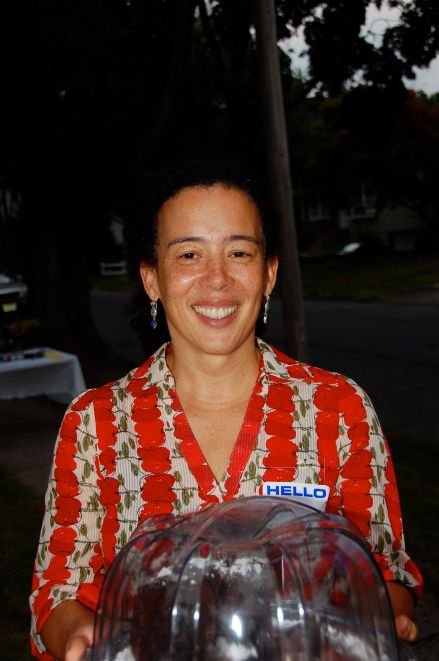
Author Belinda Edmondson at one of our annual block parties (Photo: Sarah Blaine).
The latest attacks by the education reformers and standardized testing advocates against the test-refusal movement have focused on the issue of race.  For example, on March 25, 2015, Robert Pondiscio of The Thomas B. Fordham Institute wrote a piece titled “Opting out, race and reform.”  Dependably divisive Laura Waters then jumped on the bandwagon. As a white, suburban mom who is part of the test-refusal movement, I know from personal experience that this latest reformer narrative is deeply flawed, but I recognize that a privileged white woman arguing with other privileged white people about the experiences of people of color is an effective silencing of people of colors’ own voices.  So instead I reached out to friends of color who refused to allow their children to take the PARCC.  Below is a guest voice piece by my friend and neighbor, Belinda Edmondson, who has two children in the Montclair Public Schools.  Her words speak for themselves. Thank you for reading. — Sarah
Opting Out in the Jersey Suburbs: Or, White Like Me
by Belinda Edmondson
I live in Montclair, an affluent town in New Jersey, and I opted my children out of the PARCC.
According to the education reformers, that makes me one of those rich white soccer moms throwing a hissy fit because  “their children aren’t as brilliant as they thought they were, their schools aren’t quite as good as they thought they were.” New Jersey is a flashpoint for the opt-out debate because, they argue, as a state with poor cities full of minorities and wealthy suburbs full of whites,“it puts the state’s affluent white progressives potentially at odds with low-income and heavily Democratic families of color, since there is little evidence that such families are opting out in significant numbers.”
In other words, if the numbers are to be believed, I’m a wealthy white liberal hypocrite. I spout platitudes about racial inequality while opposing reforms that would help children of color. Apparently I and my fellow black-and-brown opt-outers are in denial about how badly these awful Montclair schools are failing our kids. Who knew?
Certainly not me.  I thought Montclair was full of black people. Active, vocal, black people. Brown people too. I thought I was black. So did my children, who had no idea they are white—or rich (yay!). But these are the facts about New Jersey, according to the reformers: only wealthy white liberals are opting out of PARCC.
The reformers should have notified the large multiracial group of opting-out students who crowded into Montclair school auditoriums during PARCC testing that opting-out is a whites-only privilege. They should have informed the protesting black and brown students who took over the Newark schools superintendent’s office that they are the wrong color. They should take aside those outspoken black parents at the Newark Board of Education meetings and minority anti-reform groups like the New York City Coalition for Educational Justice, and let them know: these are not the actions of black people. Stay in your lane, already.
Yes, it’s true that majority-black-and-brown districts in NJ are less likely than well-off districts to have students who oppose PARCC and other reforms. Camden, a high-poverty, majority-black city, is an example. There the state has hijacked the school system and children of color are being forced into charter schools. Groups like Save Camden Schools are fighting back, but it looks like a losing battle. Silly me, I thought that was due to class, and social capital: you know, the fact that educated, well-connected families of any color are more likely to be able to challenge the reform mandates and not be GUEST VOICES: Opting Out in the Jersey Suburbs, Or, White Like Me by Belinda Edmondson | parentingthecore:

Stunning revelation Bill Gates has spent $2.3 Billion on Common Core – #PARCC | North Denver News

Stunning revelation Bill Gates has spent $2.3 Billion on Common Core – #PARCC | North Denver News:

Stunning revelation Bill Gates has spent $2.3 Billion on Common Core – #PARCC


 The new curriculum driven into law by Secretary of Education Arne Duncan, the Common Core Standards, is a product of massive spending on an unprecedented historical level by Bill Gates.

Research by Jack Hassard, Professor Emeritus at Georgia State, shows compelling evidence that Gates has spent $2.3 billion pushing the Common Core. More than 1800 grants to organizations running from  teachers unions to state departments of education to  political groups like the National Governor’s Association have pushed the Common Core into 45 states, with little transparency and next to no public review.
The Common Core now represents a de facto and de jure national school curriculum, something theoretically prohibited by federal law. But the Common Core comes with common high-stakes tests and common textbooks, making  the standards are more than standards.
The Gates involvement, profiteering by testing publishers like Pearson and the heavy-hand of federal coercion in the Common Core has aroused political opposition from right and left, as well as from education experts who have called the standards inappropriate developmentally, pushing young children into material they aren’t ready for.
The Colorado Department of Education was a major recipient of Gates Foundation money, during a time when funding for Colorado classrooms was slashed. CDE’s Colorado Legacy Foundation received $9.7 million in Gates money in 2011, and $1.4 million in a second grant that year. CDE received another  $6 million in 2012. In 2012, and 2010,  CDE received $1.74 million each. In 2013, $828,000 was received. At over $22 million in recent years, the Colorado Department of Education is one of the largest Gates recipients in the nation.
Colorado Legacy Foundation2010College-ReadyUS Program$1,747,441
Colorado Legacy Foundation2013College-ReadyUS Program$828,653
Colorado Legacy Foundation2013College-ReadyUS Program$36,540
Colorado Legacy Foundation2011Global Policy & AdvocacyUS Program$149,876
Colorado Legacy Foundation2012Global Policy & AdvocacyUS Program$200,000
Colorado Legacy Foundation2012College-ReadyUS Program$5,992,250
Colorado Legacy Foundation2013College-ReadyUS Program$100,001
Colorado Legacy Foundation2010College-ReadyUS Program$16,100
Colorado Legacy Foundation2013College-ReadyUS Program$36,540
Colorado Legacy Foundation2011College-ReadyUS Program$1,397,601
Colorado Legacy Foundation2011College-ReadyUS Program$9,707,210
Colorado Legacy Foundation2012College-ReadyUS Program$1,748,337
Denver Public Schools received $10 million in a grant that was largely purposed to boosting charter school enrollment in 2010. In 2012, DPS received $4 million. For 2011, it was a paltry $1.1 million. Another $10 million came to the district in 2013, making DPS one of Bill Gates largest clients. Prior to 2010, DPS netted nearly $900,000.
Denver Public Schools2011College-ReadyUS Program$330,008
Denver Public Schools2009 and earlierCollege-ReadyUS Program$871,202
Denver Public Schools2013College-ReadyUS Program$1,362
Denver Public Schools2009 and earlierCollege-ReadyUS Program$300,000
Denver Public Schools2010College-ReadyUS Program$10,000,000
Denver Public Schools2012College-ReadyUS Program$1,725
Denver Public Schools2012College-ReadyUS Program$4,001,999
Denver Public Schools2013College-ReadyUS Program$100,000
Denver Public Schools2011College-ReadyUS Program$1,100,000
Denver Public Schools2013College-ReadyUS Program$10,000,000
The Aspen Institute, which has spearheaded a program that looks to break teacher’s unions, received nearly $4 million in 2009 and prior. It took in another $3.6 million in 2013, along with another $1.5 million that year.
Colorado Children’s Campaign, a group whose mission has morphed into pushing charter schools and vouchers, has received $8.7 million. It’s former head, Barbara O’Brien now sits on the DPS School Board, underscoring the deep conflicts of interest causes by the massive Gates giving. Critics say the only programs getting attention in DPS are those funded by Gates.
Colorado Children’s Campaign2009 and earlierCollege-ReadyUS Program$750,000
Colorado Children’s Campaign2011Global Policy & AdvocacyUS Program$521,858
Colorado Children’s Campaign2013College-ReadyUS Program$146,337
Colorado Children’s Campaign2009 and earlierCollege-ReadyUS Program$8,062,122
read the rest of the story... click share

Report: Idaho wasted millions on Pearson management system | Education Dive

Report: Idaho wasted millions on Pearson management system | Education Dive:

Report: Idaho wasted millions on Pearson management system


Dive Brief:

  • The Idaho Legislature’s Office of Performance Evaluations has released a new report with some devastating findings: the state mismanaged and ultimately wasted $61 million on the rollout of a Pearson management system, Schoolnet.
  • The report doesn't look good for former state schools superintendent Tom Luna, who, the report says, pushedSchoolnet into Idaho schools despite multiple warnings that the Pearson product wouldn't work.
  • Current state Superintendent Sherri Ybarra has told legislators that while the report is correct, it reflects the old regime. “It was not us. It was the previous administration," Ybarra's assistant told lawmakers. "Superintendent Ybarra did not create that problem, but Superintendent Ybarra is going to be about fixing that problem."

Dive Insight:

And it's not just $61 million wasted by the state on the Schoolnet: The J.A. & Kathryn Albertson Foundation donated $21 million for the system's rollout , as it was under the banner of Luna's school reform program “Students Come First."
A big issue with the Schoolnet rollout was that Luna tried to push it out on a statewide level, even though the tool was developed for a much smaller district-wide usage.
While the rollout of Schoolnet is different from the case of Buzz in Detroit, it's hard not to see continuities between the questionable push for certain technologies within schools.
In the case of Buzz, the never-before used product was being tested within the Detroit district to get feedback before it was then marketed to other districts.  A local paper, MetroTimes, did a massive investigation into the use of Buzz and found, through Freedom of Information Act Requests, that everyone at the top levels was well aware that the software was riddled with bugs and a headache for teachers and students to use, yet they continued pushing it into the classroom.
The case can also be tied back to the bungled iPad rollout in the Los Angeles Unified School District, where it has recently come to light that then-superintendent John Deasy may have had connections to either Apple or Pearson, who were both involved in the deal.Report: Idaho wasted millions on Pearson management system | Education Dive:

Recommended Reading