Latest News and Comment from Education

Friday, March 27, 2015

Chuy Garcia Wakes Up and Hits Rahm Hard in Second Debate ‪#‎Chuy2015‬ ‪#‎imwithchuy‬

Chuy Garcia Wakes Up and Hits Rahm Hard in Second Debate | Chicago magazine | Felsenthal Files March 2015:

Chuy Garcia Wakes Up and Hits Rahm Hard in Second Debate

After a sleepy first round, the mayoral challenger came alive and challenged Rahm—a lot—during last night’s match.
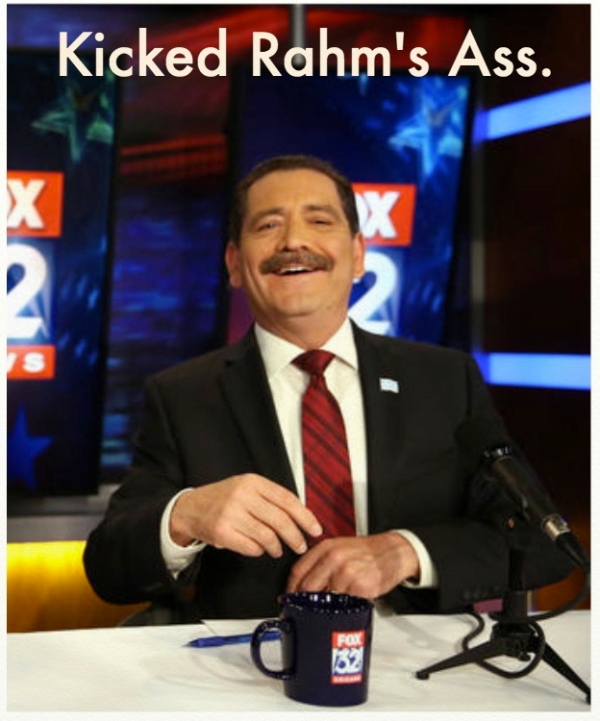
Kicked ass.


Mayor Rahm Emanuel and Chuy Garcia met for their second debate last night and, my take, watching the hour-long matchup closely on television, is Chuy saved his hide.
Did someone give him a triple espresso before airtime?
Garcia’s performance during the first televised debate on March 16 with NBC5’s Carol Marin moderating was so sleepy, so lacking in detail, confidence and energy, that, with polls showing 18 percent of the city’s potential voters undecided, a repeat nonperformance would have sent enough voters Rahm’s way to ensure a victory.
Broadcast on Fox with the station’s seasoned political editor Mike Flannery moderating, the hour passed quickly; it was a much more even match this time. Chuy didn’t let Rahm consume what seemed, last time, like two-thirds of the air time. When Rahm touted his having produced four balanced budgets in four years, Chuy shot back that Rahm “balanced them on the backs of ordinary Chicagoans” with fees, fines and penalties—and red light cameras.
The Tribune’s editorial writer opined after the first debate that the last hour-long matchup didn’t merit watching past 15 minutes. This one was worth watching to the end.
Some observations:
If the mayor of America’s third largest city deserves some respect, Chuy was having none of that. Not only did he outright laugh at the Mayor’s answers, and drop in the phrase “C’mon Rahm,” he accused him of “lying.” When Rahm credited himself with closing a coal plant in Little Village, Chuy pounced, arguing that people in Little Village, Pilsen, Canaryville, and Bridgeport had worked for years to close that plant—years before Rahm moved back to the city from D.C. Rahm took credit for a park in Little Village and Chuy shot back that all Rahm did was cut a ribbon. “He’s grandstanding.”
When Flannery questioned Chuy on his flip-flop position on the Obama library (something I also asked him recently), Chuy countered that he did no such thing and admonished Flannery, “Let me represent my own positions.” While Rahm defended bringing the Lucas Museum to the lakefront, claiming that it will bring “thousands of jobs,” Chuy called it a “monument to Darth Vader.”
Rahm seemed tired, and so did his material. His recitation of full-day kindergarten, universal pre-K, expanded school day, expanded school year, free community college for high school graduates with a B average, were delivered in a staccato monotone and lessened the impact of some real achievements. The lines, “They [students] don’t get a do-over,” are old and need refreshing. Chuy was able to make the point that an extended day and year don’t necessarily mean more education. “You failed to fund the district; you cut back on libraries.”
As usual, Garcia talked much more about spending money—on additional cops on the streets, on reopening the neighborhood mental health centers that Rahm closed—than on where that money is going to come from, although he did mention expanding the sales tax on luxury items, such as boats and fur storage. Chuy also reverted to his usual talk of audits—of CPS of CPD, and of opening the books and letting Chicagoans see how money is spent. He couched it in terms of his being a collaborative person who will invite neighborhood people into the process, listen to them, and use his vast network of neighborhood contacts to engage people and turn the neighborhoods into the vibrant life blood of the city—funneling the energy that flows from the city’s neighborhoods to charge the downtown—kind of a reverse trickle down.
Somehow, last night, Rahm’s talk of the jobs and the companies that he’s brought downtown, and the resulting new families that will find homes in the neighborhoods, didn’t resonate; perhaps because those people aren’t moving to neighborhoods like Little Village, where Chuy lives, or to the ailing south and west side neighborhoods.
There was much talk about the dangerous finances of CPS, the bond downgrades (Chuy’s mentions), and the looming teachers contract and possibility of a strike. Flannery asked if parents should be “lining up babysitters.” Rahm, not surprising, said no, he’ll work things out and again pointed to the full-day kindergarten, longer school day and year, etc. Chuy called out Rahm’s latest appointed school board member, Deborah Quazzo, and suggested that her companies are profiting from school-related contracts. (CPS officials have strongly denied this claim.) Chuy blasted Rahm for “failed leadership,” a board “riddled with conflicts of interests.” and suggested, again, auditing CPS finances and going to Springfield for help.
When Flannery pointed out that Gov. Rauner has promised to cut funding everywhere, Rahm responded that Rauner had promised specifically to increase school funding. “The Governor said he’ll increase funding and I told him we’ll keep him to his word.” (To my mind, when Rahm said this, came the vision of Rauner and Rahm talking school finances over thatinfamous $600 bottle of wine.)
Chuy claimed that he wouldn’t kowtow to his biggest supporter, the Chuy Garcia Wakes Up and Hits Rahm Hard in Second Debate | Chicago magazine | Felsenthal Files March 2015:


Critiquing How Cuomo Rates Teachers - NYTimes.com

Critiquing How Cuomo Rates Teachers - NYTimes.com:

Critiquing How Cuomo Rates Teachers


To the Editor:
Re “Clash Over Cuomo’s Plan for Grading Teachers” (front page, March 23), about the dispute over Gov. Andrew M. Cuomo’s proposal to use state testing for 50 percent of public school teachers’ evaluation:
The “growth model” used to evaluate teachers is based on an arcane formula that tries to measure student academic growth under a particular teacher’s tutelage. The formula is so flawed that if every one of a teacher’s students failed the state assessments, that teacher could still have a “highly effective” growth score. Conversely, a teacher could have every student achieve a perfect score and still be considered “ineffective.”
A 2011 On Education column by Michael Winerip, “Evaluating New York Teachers, Perhaps the Numbers Do Lie,” focused on a New York City teacher, Stacey Isaacson, who was among the lowest-ranked teachers in the city because of poor growth scores on state assessments, though her students scored extremely well. She taught all honors classes, where students’ scores were already near-perfect, with little room for growth. She was lauded as an outstanding and dedicated teacher. Still, she was expected to be denied tenure.
Dismissing good teachers is not going to make public education better. The overemphasis on a statistical model that doesn’t work, based on poorly conceived assessments, may, in a special bit of irony, enable some truly incompetent educators to keep their jobs. Additionally, charter schools, with which the governor is closely allied, should not be exempt from teacher evaluation system requirements imposed on public schools.
Outside of the governor’s office and the State Education Department, this is not anyone’s idea of an effective evaluation process for teachers.
ROD DRISCOLL
Peru, N.Y.
The writer, a teacher, is a former school board president and president of a local teachers union.
To the Editor:
An important point needs to be stressed: The tests administered to the students last year were “atrocious,” Bob Bender, the principal for P.S. 11 in Manhattan, wrote in a letter to parents.
The new tests “were confusing, developmentally inappropriate and not well aligned with the Common Core standards,” Elizabeth Phillips, the principal of the high-performing P.S. 321 in Brooklyn, wrote in an April 10 Op-Edessay in your paper.
How can Gov. Andrew M. Cuomo evaluate teachers based on flawed, atrocious tests? This should be the first order of business to discuss!
DEBBIE DEANE
Brooklyn
To the Editor:
Gov. Andrew M. Cuomo has repeated his absurd contention that “99 percent of the teachers were rated effective while only 38 percent of high school graduates are ready for college or careers” so many times that one could believe that the entire education reform agenda in New York was designed just to provide him with this one sound bite.
Everyone in the state, including the governor, knows perfectly well that new tests given in grades three through eight are far more difficult than the ones they replaced. A steep decline in English and math test scores was Critiquing How Cuomo Rates Teachers - NYTimes.com:

Despite state mediator, LAUSD and teachers still $774 million and an evaluation system apart

Despite state mediator, LAUSD and teachers still $774 million and an evaluation system apart:

Despite state mediator, LAUSD and teachers still $774 million and an evaluation system apart


A referee from California’s top labor authority proved little help Thursday in the fray between Los Angeles’ school district and teachers union.
The two sides remain divided by more than $774 million per year and at odds over teacher evaluations, Los Angeles Unified School District Chief Labor Negotiator Vivian Ekchian said in a written statement.
A key issue for district officials is $171 million in federal dollars that could be lost if teachers don’t agree to an evaluation system that groups them into one of three categories based, in part, on student performance.
“The union has not yet agreed to this proposal, leaving at risk these vital school-site services to students,” Ekchian said.
Thursday’s meeting in front of a mediator appointed by California’s Public Employment Relations Board was the first of three legally mandated gatherings, with additional dates set for April 6 and 15. Should mediation fail, a fact-finding panel will be formed, before United Teachers Los Angeles can strike.
The teachers union is demanding an 8.5 percent pay raise after more than seven years without an across-the-board increase. UTLA also wants LAUSD to hire an estimated 5,081 additional counselors, nurses and librarians, according to LAUSD’s estimates.
District officials have countered with a 5 percent bump and offered to spend $26 million on hiring new teachers – enough for just 277 of the 5,081 educators being sought by union leaders.
LAUSD also wants the teachers union to accept a new evaluation system that has been rejected by the union, which won a legal battle to repeal.
District administrators say $171 million will be lost over the next three years if UTLA fails to accept a performance rating that distinguishes the best and worst teachers under the federal program that aims to improve schools.
While the state of California declined to accept those federal demands for an evaluation system — causing its application to be rejected — Los Angeles Unified is one of nine districts that went directly to the U.S. Department of Education two years ago.
In September, all seven of the remaining school districts were placed in a “high-risk” category and Despite state mediator, LAUSD and teachers still $774 million and an evaluation system apart:

Mom: Why my 9-year-old gets despondent about school - The Washington Post

Mom: Why my 9-year-old gets despondent about school - The Washington Post:

Mom: Why my 9-year-old gets despondent about school


Sandy Stenoff is a public school advocate in central Florida who has opposed the standardized test-based education reforms imposed in the state for years. In this piece, she writes about the toll that standardized testing — including test prep and the narrowing of the curriculum — has affected her young children. This appeared on the Web site of Opt Out Orlando, run by activists who are urging parents to opt their children out of state-mandated standardized tests.
In this piece, Stenoff refers to the FCAT/FSA. The FCAT is the Florida Comprehensive Assessment Test, the longtime test that the state used to hold schools “accountable.” It has been replaced by the FSA, the Florida Standards Assessment, which is supposed to be aligned to the new Florida Standards. The FSA is the state-mandated assessment Florida paid a private company to create in place of the PARCC exam, a Common Core test. Florida dropped the Common Core State Standards and developed a new set of standards that many say are remarkably similar to the Core.

By Sandy Stenoff
Opting out of high stakes tests is about much more than just the test.
As the parents of young children consider opting out, one of the issues we face is how to talk to them about opting out.  They are, after all, the ones who will be doing the opting out. In all dealings with children, honesty is always the best policy. If you get busted by your kid for fudging the truth, you’re sunk. So what do we talk about?
When my daughter was 8, we started a conversation that has evolved over the past two years. She is now 10, and our conversation now includes my son, who is 9. 

I have tried to explain it to them this way:
When you take the test, you get a score. Your score gives your teacher and your school a grade. That grade tells the state and the district how much money your teacher and your school should get paid. It can even determine if your teacher gets to keep teaching, or if your school might be closed.
They asked me, “Is that why we have to do so much test prep?
“Perhaps, but it’s also complicated.”
We talk about recess a lot, because they don’t get recess. Usually, it’s the first thing I hear at pick up – whether he had recess or not. The Recess Report. He gets in the car, slams the door shut and says, 

”No recess… again,” 

”Bus loop – one lap,” or 
”Bus loop – two laps.”

 They get recess on Wednesdays. That’s it. On non-PE days, if everyone has been good at lunch (recess should be neither reward nor punishment), when there is time for a break, they get to run the bus loop. The first time I heard this, let’s just say I was more than annoyed. I’ve told this to friends and they have no idea what I mean. The bus loop is the paved driveway where the school buses turn around. That’s right. The “recess” my kids get is five minutes around the bus loop. Their school is old, in not the greatest surroundings, currently next to highway construction, so it’s not even a pretty bus loop. Anyone who has ever played on a sports team of any kind knows that laps are a form of discipline – for being late, for talking back to the coach, for Mom: Why my 9-year-old gets despondent about school - The Washington Post:

The Daily Targum :: Faculty members analyze PARCC standardized test

The Daily Targum :: Faculty members analyze PARCC standardized test:

Faculty members analyze PARCC standardized test


While it is no secret that many teachers, students and parents dislike student testing, University professors are now discussing the ramifications of the latest standardized test implemented in the Garden State.
Following the New Jersey State Assembly’s unanimous March 26 vote to allow students to opt out of the Partnership for Assessment of Readiness for College and Careers (PARCC) standardized test, University professors are now shedding light on the controversial examination.
The new exam was developed by PARCC and the private-sector publishing company Pearson earlier this year in 12 states including New Jersey, and was distributed to all public school children in third grade through 11thgrade, according to a Feb. 13 article on MyCentralJersey.com.
The new PARCC test outraged many parents of New Jersey school children because it can impact how students learn in the classroom setting, said William Firestone, a professor in the Department of Educational Theory, Policy and Administration.
“One of the things standardized tests do is influence the way teachers teach,” he said. “One of the problems in the past with multiple choice tests is that they only encourage testing for recall.”
The New Jersey Department of Education has wanted a redesign of standardized assessments for over a decade, and was planning on implementing one with the new PARCC exam, Firestone said.
Instead of teaching students to only memorize information during class, PARCC wanted to guide teachers toward developing student problem-solving skills, he said.
PARCC is supposed to test student knowledge of the New Jersey Core Curriculum Content Standards, Firestone said.
The standards include 21st Century Life and Careers,
 Comprehensive Health and Physical Education, 
Science,
 Social Studies, 
Technology, 
Visual and Performing Arts and
 World Languages, according to the State Department of Education's website.
“Districts and states haven’t quite known how to realign what they’re teaching to fit the new standards, and they’ve gotten poor guidance,” he said. “It takes more than just a change in the test to change the way teachers teach.”
The PARCC test is detrimental to student learning because educators feel forced to teach lessons with the purpose of ensuring students pass, said Julia Sass Rubin, an associate professor in the Edward J. Bloustein School of Planning and Public Policy.
“This is just the latest iteration of … what high-stakes standardized tests are doing to public education,” she said. “They’re leading to a narrowing of the curriculum, they’re leading to teaching to the test … because the test has such high consequences.”
Although PARCC cut scores are due for release this summer, both PARCC and the Smarter Balanced Assessment Consortium (SBAC) plan to peg their scores to the National Assessment of Educational Progress (NAEP) proficiency level, Rubin said.
If the PARCC cut scores are pegged to the NAEP exam, about 40 percent of students are going to fall short of the standard for college readiness, which is equivalent to being at a “solid A” proficiency level, she said.
PARCC hurts student learning because the implications of student test scores encourages teachers to emphasize proficiency in language arts and mathematics and focus less on subjects such as science, social studies and the arts, Rubin said.
“The focus is so overwhelmingly on passing these tests that they create this very negative incentive system,” she said. “Things that aren’t related to the test get dropped or deemphasized, so schools eliminate … anything that isn’t about passing the test.”
Several studies have shown that standardized tests, such as the PARCC exam, are not effective in standardizing student education levels in an economically unbiased fashion, Rubin said.
Test scores rise with household income, she said. A child from a family making about $20,000 per year will have a 400-point differential on average compared to a child from a family making about $200,000.
A volunteer for Save Our Schools NJ, Rubin said one of her primary concerns is how certain members of the The Daily Targum :: Faculty members analyze PARCC standardized test:

4 things Mike Flanagan said about charter schools, at-risk authorizers | MLive.com

4 things Mike Flanagan said about charter schools, at-risk authorizers | MLive.com:

4 things Mike Flanagan said about charter schools, at-risk authorizers


HOLLAND, MI - State Superintendent Mike Flanagan spoke with MLive Thursday, March 26, about the future of charter schools and his recent removal of seven authorizers from at-risk status.
Flanagan announced last August he was placing 11 of the state's 40 charter school authorizers on notice that could have prevented them from opening any additional schools. He cited low academic performance and transparency issues within the oversight.
This week Flanagan removed Grand Valley State University, Ferris State University,Muskegon Heights Public Schools, Lake Superior State University, Kellogg Community College, Macomb Intermediate School District, and Northern Michigan University.
"I really admire the ones we took off the list because they've taken it seriously," said the retiring Flanagan. "I know I got some president's attention, which was part of my motive."
Flanagan said the other four, Detroit Public Schools, the Education Achievement Authority, Highland Park Schools and Eastern Michigan University, "still have work to do." However, he has said they won't be suspended.
While visiting West Ottawa Public Schools, as part of his monthly district trips, Flanagan, who is retiring, shared the following thoughts about charters and the at-risk list.
• It's time to rethink the law that permits chargers to address quality education results, achievement and transparency, but the state should not do away with charters.
• Among transparency issues to address are buying and selling land and transparency of the charter management company.
• Flanagan defended the perception that he is against charter schools. "Sometimes 4 things Mike Flanagan said about charter schools, at-risk authorizers | MLive.com:


National Association of Charter School Authorizers (NACSA) Group: 1 in 5 charter schools not doing well enough to stay open
A group that oversees more than half of the nation's 5,600 charter schools said
 as many as one in five U.S. charter schools should be shut down because of
poor academic performance.
http://seattletimes.com/html/nationworld/2019784379_charterschools29.html

Ohio charter-school-reform bill does not go far enough: editorial | cleveland.com

Ohio charter-school-reform bill does not go far enough: editorial | cleveland.com:

Ohio charter-school-reform bill does not go far enough


This is the year when key officials -- from Gov. John Kasich and Ohio Democratic and Republican state lawmakers to opponents of charter schools and even some charter-school proponents -- had promised to reform the state's troubled charter-school system.
But the recent passage of House Bill 2, which allows sponsor-hopping among established charter schools and rejects Ohio Auditor Dave Yost's proposal that operating management companies should have to report some of their finances signals that, for all of the grand talk, Ohio's charter school reform may end up being far from comprehensive or significant.
The Senate should rise to the rescue. Ohio Sen. Peggy Lehner, a Republican from the Dayton-area, will present her bill soon and it must do what HB 2 has failed to do: Rein in charter schools so that youngsters get the best education possible and so that taxpayers can see where their money is going.


 HB 2 does have some decent provisions -- it limits school leases to no more than 5 percent above market value, and forbids charter sponsors with the lowest ratings from the state from overseeing schools.

But it doesn't get to the core of the problems of Ohio's charter school system -- a system that spends hundreds of millions of taxpayer dollars per year on schools subject to little public scrutiny or oversight and that are, in most parts of the state, even weaker academically than their public-school counterparts.
Some Republicans argue that the private companies, particularly for-profit management companies, that run charter schools should not have to open their books to the public
However, when a private company is in essence taking over a state function -- running a public school with taxpayers' dollars -- their books should be open. It's not fair to block the public from a microscopic view of such spending. Such oversight and transparency will also limit abuses. 
Moreover, the bill's reinstatement of a recently eliminated loophole in Ohio that had allowed established charter schools with poor grades to stay open by seeking new sponsors is unconscionable.
The state should be allowed to close poorly performing charter schools and the public should be allowed to see the financial records of all charter school management companies.Ohio charter-school-reform bill does not go far enough: editorial | cleveland.com:

A Growing Movement of Teachers of Conscience: More in Seattle Refuse to Administer the #SBA/#SBAC Tests – | Teachers' Letters of Professional Conscience

A Growing Movement of Teachers of Conscience: More in Seattle Refuse to Administer the #SBA/#SBAC Tests – | Teachers' Letters of Professional Conscience:


A Growing Movement of Teachers of Conscience: More in Seattle Refuse to Administer the #SBA/#SBAC Tests -


All Aboard the Opt Out Bus
There are many ways teachers are fighting back against the Common Core high stakes tests.  We delivered our Letters of Professional Conscience to our school board, and Seattle teachers are finding new ways to empower teachers, parents, and students by refusing to administer the test.
This blog exists to tell these stories in order to spread a movement led by courageous teacher leaders – teachers doing what we do best – teaching.  In this case, we are here to teach other teachers how to resist the test. The test is the glue that holds corporate education reform together.  Without the test, corporate reform’s house of cards falls, collapsing the fundamental hoax of so-called “failing schools”.
Things are heating up in Seattle.  Last year it was Scrap the Map (Measures of Academic Progress).  That movement spread across the nation:
“Garfield’s actions helped spark a national movement to oppose the abuses of standardized testing. In Portland, students initiated their own boycott of the OAKS tests. Some 10,000 parents and students marched in Texas against the overuse of high-stakes tests. Kindergartners and their parents staged a “play-in” at the Chicago School District headquarters against the replacement of the arts with norm-referenced exams.” ~ Jesse Hagopian, Liza Campbell (2013), Seattle Times
This year, Nathan Hale’s Senate – which is their leadership team consisting of students, parents, and teachers – voted to refuse to give the SBAC to all 11th grade students.  The Nathan Hale teachers gave the following reasons for their refusal written February 24th, 2015:
Reasons for refusing the SBAC for 11th graders included (summary):
1. Not required for graduation
2. Colleges will not use them this year
3. Since NCLB requires all students pass the tests by 2014, and since few if any schools will be able to do that,  all schools will therefore be considered failing by that standard. There is thus no reason to participate in erroneous and misapplied self-labeling.
4. It is neither valid nor reliable nor equitable assessment. We will use classroom based assessments to guide next instructional steps.
5. Cut scores of the SBAC reflect poor assessment strategy and will produce invalid and unreliable outcomes.
6. Student made this point: “Why waste time taking a test that is meaningless and that most of us will fail?”
7. The SBAC will tie up computer lab time for weeks.
8. The SBAC will take up time students need to work on classroom curriculum.
This is an important step. Nathan Hale is asserting its commitment to valid, reliable, equitable assessment. This decision is the result of community and parent meetings, careful study of research literature, knowledge of our students’ needs, commitment to excellence in their 
A Growing Movement of Teachers of Conscience: More in Seattle Refuse to Administer the #SBA/#SBAC Tests – | Teachers' Letters of Professional Conscience:


Gov. Andrew Cuomo and teacher evaluations: Standardized test scores are the wrong place to focus.

Gov. Andrew Cuomo and teacher evaluations: Standardized test scores are the wrong place to focus.:

Value Subtracted

Gov. Cuomo’s plan to tie teacher evaluations to test scores won’t help our public schools.


 New York Gov. Andrew M. Cuomo’s proposal for overhauling how teachers are evaluated, compensated, and protected from losing their jobs appears to be meeting stiff resistance from the state legislature, which may create a special commission as a next step. The most controversial element of Cuomo’s plan would tie 50 percent of reading and math teachers’ evaluations to their students’ standardized test scores.

If the ultimate goal is to improve the quality of teaching, depending so much on highly unreliable scores is likely to be counterproductive. A much more effective and proven approach is to promote team-based, data-driven support systems to help teachers become better at their jobs, day in and day out.    
Currently, teacher ratings are primarily based on principals’ evaluations, sometimes in combination with parent or student surveys. Few would argue for retaining the status quo, which provides minimal useful feedback to teachers. But embracing standardized test scores because of their purported objectivity is a false promise. Abundant research shows that test scores are a poor proxy for teacher quality and that adopting them will make it harder to implement changes that are proven to help student outcomes. 
New York is running behind the national stampede toward incorporating “objective” measures of student performance in evaluating teachers. Drawing from the vernacular of economics and business, such “value-added” measures suggest that the worth of teachers can be derived from comparing how their students’ standardized test scores change over the course of a school year. The Obama administration has used its Race to the Top grants and waivers of No Child Left Behind requirements to push states to adopt value-added provisions, which are championed by well-heeled foundations as well as conservative critics of teachers’ unions. From 2010 to 2013, the number of states requiring that teacher evaluations include standardized test scores soared from 16 to 41, according to the National Council on Teacher Quality. As of September 2013, 35 states’ and the District of Columbia’s public schools require that standardized test scores be counted as either a significant or the most significant factor in teacher evaluations.
Bad ideas tend to blossom in vacuums, and no one can cogently defend the old-fashioned teacher evaluation system that held sway throughout most of the past century. Typically, a principal would conduct one or two visits to each classroom a year and then grade the entire faculty as satisfactory or better. In New York last year, 96 percent of teachers were rated either effective or highly effective, much like Lake Wobegone’s entirely above-average student body.
Clearly teachers need to be held to higher standards and receive meaningful feedback about their strengths and weaknesses, as teachers’ unions generally acknowledge. But there are better ways of replacing this transparently feckless system.
The research identifies three basic, persistent problems with value-added methods of teacher evaluation. One is that the results tend to be very unstable for all but the very best and very worst teachers. When a teacher’s standardized test scores vary significantly from year to year and even from test to test, factors unrelated to the teacher’s performance are likely to be causing the volatility.
Second, the students assigned to each teacher will affect variations in test score performance, and those differences can be both substantial and difficult to quantify. A few especially disruptive students can make a teacher’s job much harder than it would be in their absence. Moreover, teachers with many English-language learners and special-needs students tend to receive lower value-added scores.
Third, students in any given classroom are affected by all sorts of factors outside a teacher’s control. Experiences at home, with peers, and elsewhere in the school and beyond can critically impact how students perform on standardized tests. In an important 2011 study, the authors wrote: “With respect to value-added measures of student achievement tied to individual teachers, current research says that high-stakes, individual level decisions, or comparisons across highly dissimilar schools or student populations, should be avoided.” That conclusion was shared in a report by the American Education Research Association and the National Academy of Education.  
Using test scores to judge teachers isn’t just ineffective. It risks draining the lifeblood of otherwise highly successful, vital schools in which teachers and administrators collaborate to improve teaching and learning. If decisions about compensation and promotions are tied to how each teacher’s students perform, why would Ms. JohnsonGov. Andrew Cuomo and teacher evaluations: Standardized test scores are the wrong place to focus.:

Thursday, March 26, 2015

CUOMO WORLD! | DCGEducator: Doing The Right Thing

CUOMO WORLD! | DCGEducator: Doing The Right Thing:

CUOMO WORLD!


 This is a perfect example of what we face in NYS:

A recent NYT story about 2 simultaneous rallies in Albany: It favors the New York City’s charter school rally in held in a park just outside the Capitol, with video screens, a rock-concert atmosphere, an enthusiastic mix of thousands of students, a raft of state leaders, a pop star, dance troupes and booming club music, including the Republican Senate majority leader, Dean G. Skelos.
The audience was supplied by the main charter organizations in NYC:

  • KIPP, recruited parents and graduates to attend.
  • Achievement First, brought its Brooklyn students if their parents came along.
  • Eva S. Moskowitz‘s Success Academy, closed schools, held class on buses, and if parents did not want their children to make the trip north, they had to send them elsewhere for the day.
At the same time, supporters of teachers’ unions gathered at a convention center adjacent to the Capitol. Smaller in numbers, less festive, the unions were targeted lawmakers, including the heads of education committees from the Assembly and State Senate. Michael Mulgrew, the New York City union’s president told 1,000 parents and members in attendance at the convention center that it was their day to fight.
The points being that we are hidden indoors, union led, talking to pols, and they are packing a public outdoor space with recruited kids and parents in uniformed t shirts and hats and celebrities….
What’s it all about? Governor Andrew Cuomo’s budget proposal! Which is filled with:
THREATS AND BLACKMAIL:

His proposed $1.1 billion increase in school aid is contingent upon the approval of a series his education reform proposals, including a teacher evaluation system based more heavily on standardized testing.
To put pressure on districts, his staff has not released how much money each school district would receive after applying the state’s complex funding formulas. Without the charts, school districts cant plan their budgets, which must be approved by voters in the spring.
These are his demands:
  1. CHANGE TEACHER EVALUATION. Cuomo described as “baloney” the state’s roughly 700 school districts own evaluation plans.
He wants to:
A – Require that student standardized test scores account for a full 50 percent of a teacher’s evaluation rather than the current 20 percent.
  • He ignores the position of the American Statistical Association on how not to use statistics to evaluate teachers.