Latest News and Comment from Education

Wednesday, March 25, 2015

Eleven Reasons to Refuse Standardized Testing for Your Children By: Jacky Boyd - Badass Teachers Association

Badass Teachers Association:

Eleven Reasons to Refuse Standardized Testing for Your Children
By:   Jacky Boyd


Originally posted on  http://crunchymoms.com/eleven-reasons-refuse-standardized-testing-children/

 This month, schools across America administer the two Common Core State Standards aligned standardized exams: Partnership of Assessment for Readiness for College and Careers (PARCC) developed by Pearson and Smarter Balanced.


My state, Maine, belongs to the Smarter Balanced consortium.  And while my city is small compared to education battlegrounds New York City or Chicago, we have our own share of standardized testing controversy.  Schools fail to inform (or try to deny) parents’ right to chose if their children participate in the exam.  Misinformation is rampant.  Officials remain mute as often as possible, and when they speak on the subject, they only praise the data the test will generate and remind us all of the US DOE’s threat to control a portion of Title I funding if too many students fail to participate.

But the fact remains that parents do have the legal right to refuse testing, or “opt out.”  Here are eleven reasons why you should.

1.  Standardized tests penalize students who do not master material on an arbitrary date.  Testing companies and school administrators set the test dates. A child needing more time to master a concept isn’t allowed that opportunity with a fixed test date.  Thus, the data doesn’t reflect if the child masters the content five weeks, five days, or five minutes after the exam because it records only one arbitrary point in time.  Also, the system harms those who master material quickly.  Test makers give all students growth targets; high achievers already well above grade level must make expected progress or their above average score counts as a failure. To paraphrase Douglas Reeves, these tests are autopsies when we should use assessments as physicals.

2.  Standardized tests are developmentally inappropriate for young students.  If you’d like to see the tests in action: go here for a practice PARCC exam and here for a practice Smarter Balanced exam.  While you’re there, consider if a third grader has the computer skills to simultaneously  scroll two screens, highlight, drag and drop, and type as the test requires.  Many education experts argue the actual content of the test is developmentally inappropriate, too.  The standards (from Common Core), the questions, and even some of the reading passages are years too advanced in some cases.  And while this post focuses on Smarter Balanced and PARCC which aren’t administered until third grade, many schools give other standardized tests starting in kindergarten.

3.  Preparing for and administering standardized tests uses hours of instructional time.  Both the Smarter Balanced exam and PARCC use complex computer interfaces.  Test takers need practice learning how to navigate the test screens in preparation for the actual test.  Those experiences teach children nothing except how to take one test, and thus are wasted instructional time.  The exams themselves take hours to complete.  The timed PARCC takes 9-12 hours depending on grade level while Smarter Balanced estimates 7-8.5, but allows students as long as necessary to finish.

4.  Standardized tests narrow curriculum.  What’s on the test is what’s taught.  PARCC and Smarter Balanced only evaluate math and literacy, and thus science, social studies, and the arts are lost to spend maximum instruction time on the tested material.  There is no time for creativity, collaboration, and curiosity.  To increase time for improving test scores, some schools cut recess, and schools even Badass Teachers Association:

BAT

The one about Opting Out, Positive Responses and Tipping Points - mrob's blog

The one about Opting Out, Positive Responses and Tipping Points - mrob's blog:

The one about Opting Out, Positive Responses and Tipping Points

25 Mar 2015


We recently received an email from our school district about M-STEP (Michigan Student Test of Educational Progress) Testing dates--for those not in Michigan, this is the new "required" state test for children in grades 3-8 which replaces the MEAP.

For one of our boys, the M-STEP testing schedule was to span 6 different days and include tests on English Language and Mathematics. The thought of our son missing class time for 6 days to sit for standardized tests--the results of which couldn't possibly inform his learning or his teachers' instructional practices, due to the tests being administered in the Spring rather than in the Fall, with the results not being made available until after the close of the school year--was bad enough. But to make matters worse, this "summative" test was not intended to be a long-term solution to the state's testing policies:

“Our challenge is that this is a one-year interim assessment. I’m not sure how meaningful that will be for us because we can’t compare results,” Grandville Public Schools Superintendent Ron Caniff said about the M-STEP. “This will be a snapshot of how our students measure up to other students (nationwide), but we won’t be able to measure it in terms of how our students are learning and growing – that’s the downside.” (http://www.mlive.com/news/grand-rapids/index.ssf/2014/11/west_michigan_school_leaders_v.html)

The bottom line was that our child was being pulled out of classes for 6 days, for tests that weren't intended to really measure student learning or growth, or to provide any meaningful feedback for his teachers, and these tests were not likely to be given again in subsequent years. The whole thing seemed like a terrible, awful, really bad idea--but the kicker was the following tag line on the district's email announcement:

"PLEASE DO NOT MAKE APPOINTMENTS FOR YOUR CHILD ON THE DATES ATTACHED. If your child misses these dates, then they will do make up testing and will be pulled from other academic classes. If your child is ill, they should stay home, of course! We 
The one about Opting Out, Positive Responses and Tipping Points - mrob's blog:

Parents Can Opt Out - United Opt Out National

Click Here to go to United Opt Out National: 


Click Here to go to the WebsiteUnited Opt Out Team
Home
Click Here to go to the Website FairTest

Here's what No Child Left Behind got Wrong - Business Insider

Here's what No Child Left Behind got Wrong - Business Insider:

3 big ways No Child Left Behind failed


Boehner Bush No Child Left Behind


The No Child Left Behind (NCLB) Act has been languishing for years, and Congress may now end up rewriting the law to fix its many flaws.
In 2002, the law was enacted as a reauthorization of the Elementary and Secondary Education Act, with the intent of setting high standards for students and holding schools accountable to meet measurable success.
However, it's now been discredited to the point that almost all states now receive waivers that allow them to miss key elements of the law without any punishments.
So where did it go wrong?
1. High-stakes testing
Before the vocal outcry over Common Core testing, people spoke out against the high-stakes tests of NCLB. In fact, NCLB testing is really the father of Common Core testing. NCLB required all students in third through eighth grade to take annual tests in math and reading.
In doing so, the law ushered in a new era of testing linked to punishments that didn't exist before the law was enacted in 2002. These punishments come in the form of less funding or closures for schools that don't make progress towards proficiency on annual exams.
Opponents of NCLB argue the increased testing has created an environment where teachers teach to the exam.
"Just as importantly, there is no evidence that any test score increases represent the broader learning increases that were the true goals of the policy — goals such as critical thinking; the creation of lifelong learners; and more students graduating high school ready for college, career, and civic participation," the National Education Policy Center (NEPC) at the University of Colorado Boulder wrote in a memo in February.
And more concerning, the policy center noted that the annual tests rolled out through NCLB haven't done very much in closing the education gap — the main goal of NCLB. 
2. Adequate Yearly Progress (AYP)
NCLB's annual tests were supposed to track the annual progress of students in reading and math proficiency. The testing results are displayed on publically disclosed school report cards — another result of NCLB — for parents, administrators, and lawmakers to see.
"If their school is not making adequate yearly progress and has been identified as needing improvement, corrective action or restructuring, No Child Left Behind requires that districts


Read more: http://www.businessinsider.com/heres-what-no-child-left-behind-got-wrong-2015-3#ixzz3VRUNqc3T

California teachers unions promote charter school ( Accountability) bills | The Sacramento Bee The Sacramento Bee

California teachers unions promote charter school bills | The Sacramento Bee The Sacramento Bee:

California teachers unions promote charter school bills


California’s politically potent teachers unions are promoting bills requiring charter schools to hold open meetings and to consider all applicants while cracking down on for-profit charter operators.
Charters schools, which receive public funding but operate under different rules than traditional public schools and often employ non-unionized staff, now number more than 1,100 in California. Critics that often include union officials accuse charters of selectively admitting only the most promising students, warn that charters produce uneven results and argue that some schools are motivated more by the pursuit of profit than by student success.
“What we see nationally and in California is that these for-profit companies are siphoning off funds that should go to the classroom for corporate profits,” said Ron Rapp, a lobbyist for the California Federation of Teachers. “This must stop.”
A bill sponsored by the California Teachers Association, the California Federation of Teachers and the California Labor Federation would prohibit charter schools from being managed by for-profit corporations. Assembly Bill 787 would also ensure charter teachers are covered by the Education Employment Relations Act, part of what the bill’s author called an effort to help teachers organize.
The bill “would open up the already legal avenue to unionize,” said Assemblyman Roger Hernández, D-West Covina. “The ability to unionize is a civil right, the right of association is a civil right, but charter schools have this culture of infringement on those rights.”
While many charter schools do an exemplary job, said Sen. Mark Leno, D-San Francisco, he argued that some cherrypick students by imposing entrance requirements that include having parents volunteer, requiring entrance exams or dictating a minimum GPA. Senate Bill 322 would ban such requirements and have charters comply with the same expulsion and suspension requirements governing traditional public schools.
“Charter schools were established with the mission of providing educational opportunities for all students, with a special emphasis on providing educational opportunities for students who are academically low-performing or with some special needs,” Leno said, adding that his bill “re-establishes California’s commitment to this goal.”
Assembly Bill 709, by Assemblyman Mike Gipson, D-Carson, would require charters to comply with open meetings and public records laws.
Representatives of the California Charter Schools Association, which is opposing the Leno and Gipson bills and is evaluating Hernández’s measure, said supporters of the package repeatedly mischaracterized charter schools. Charter schools’ student bodies “look an awful lot like traditional public schools,” said California Charter Schools AssociationCalifornia teachers unions promote charter school bills | The Sacramento Bee The Sacramento Bee:
Big Education Ape: New report: charter school fraud could be costing CA taxpayers $81 million « Education Votes http://bit.ly/1HBjWAF
Big Education Ape: California charter schools vulnerable to fraud, report says - The Washington Post http://bit.ly/1CYUNih

Pearson: Who scores your child’s tests? | Reclaim Reform

Pearson: Who scores your child’s tests? | Reclaim Reform:

Pearson: Who scores your child’s tests?

Who are the experts that score your child’s state mandated high stakes tests from Pearson?
(Remember that these test scores determine your child’s future, the school’s funding and rating, the surrounding property values, and the firing or retention of your child’s teachers.)
Visit PEARSON’S OWN SITE if you have any college degree earned at any time from any country and are willing to undergo 4 to 5 hours of training and then receive $13 per hour for scoring whatever tests they give you. After you work a day job and wish to work evenings until 10:00 pm, you can make even more money – $14.30 per hour – even though you might be really tired by then.
Pearson Test Grader
A regular commentator on my blog who lives in the northern suburbs of Chicago brought this to my attention from the newspaper ads she has seen. Here is her comment.
Have the Pear$on “Help Wanted” ads come to YOUR city yet? Of course (as usual) they put a quarter-page COLOR ad (someone knowledgeable told me it likely cost them $5K–if they put one in numerous papers in numerous 
Pearson: Who scores your child’s tests? | Reclaim Reform:

Bad Reporting About Education Is Harming Schools And Students

Bad Reporting About Education Is Harming Schools And Students:

Bad Reporting About Education Is Harming Schools And Students

MARCH 25, 2015


 Be afraid, be very afraid, any time you see a reporter in the business media turn his or her attention to education and public schools. What will likely follow is a string of truisms used to prop up a specious argument, steeped in biased notions that were themselves picked up from ill-informed conversations promoted by other clueless business news outlets.

All of this chatter would be something best to ignore were it not for the fact that reporters and pundits from these outlets are often raised to prominence, labeled as “experts,” and lionized by political leaders and policy makers, while real authorities on education are overlooked or completely drowned out in the babble.
Exhibit A in the case against bad reporting on education is in the Feb. 14, 2015 issue of The Economist. An article titled “Pro Choice” highlights efforts to create new school voucher programs in many states and allow parents to take money meant for public education and use those tax payer dollars to enroll their children in schools of their choice, including private schools and charter schools.
This topic has been the subject of countless research studies and is a matter of ongoing examination by numerous authorities. Yet the writer barely skims the research and consults with a bare minimum of real experts on education policy.
Had The Economist made the effort to consult some real research and talk to bona fide experts, they would have learned that school vouchers pose some very big problems, and there are better alternatives for improving our schools.
It’s important to call out this article and others like it, not only because it’s an example of feckless journalism, but also because it exemplifies an all too common pattern when low-information reporters tackle stories about education.
When Education ‘Experts’ Aren’t
At liberal-leaning watchdog group Media Matters for America,Hilary Tone closely follows how journalists in major media outlets report on education. She unearths some startling revelations. One such discovery revealed that whenever cable news outlets such as CNN, Fox News, and MSNBC feature programming devoted to education, those segments hardly ever feature real educators.
Over all cable news channels, only 9 percent of guests in education segments were educators. This would be like CNBC reporting on the stock market and hardly ever consulting with experts on finance and investing or the CEOs of publicly traded companies.
Print and online news outlets aren’t much better. Tone recently came across a study that found “education experts” often cited in print and online news stories “may have little expertise in education policy.” The study found that the “experts” who are cited the most often are neither career educators nor scholars who’ve published and achieved advanced degrees; rather, they tend to be individuals from influential right-wing think tanks, with little to no scholarly work or graduate-level degree work in education.
Tone links to a write-up of the study in ScienceDaily that explains the researchers found so-called education experts associated with the American Enterprise Institute, a conservative think tank based in Washington, DC, “were nearly 2.5 times more likely to be cited” than were career educators and education scholars. In the online world, experts affiliated with AEI and the libertarian group Cato Institute were, respectively, 1.5 to 1.78 times more likely to be mentioned in blogs.
The authors conclude their findings are “cause for concern because some prominent interest groups are promoting reform agendas and striving to influence policymakers and public opinion using individuals who have substantial media relations skills but little or no expertise in education research.”
In some sense, then, The Economist is following a pattern of reporting – one that tends to spread misinformation and promote shallow opinion on very important issues.
In its examination of the long-standing school voucher program in Milwaukee – now being pushed out to the rest of Wisconsin by Gov. Scott Walker – The Economist reports that results have been “mixed,” though they impart “lessons for elsewhere.” One of those lessons, apparently, is that a school system aided by “choice” and “competition” ensures good outcomes. “Good schools, however constituted, have good teachers, inspiring principals and respond to their surroundings,” the article states. “Some of these things are easier to achieve in private schools.”
The writer does not substantiate this conclusion with any links to research studies, citations from any Bad Reporting About Education Is Harming Schools And Students:


California charter schools vulnerable to fraud, report says - The Washington Post

California charter schools vulnerable to fraud, report says - The Washington Post:

California charter schools vulnerable to fraud, report says


Journalists, auditors and other investigators have turned up more than $80 million in charter school fraud in California to date, according to a new report by a coalition of left-leaning organizations, which argues that lax oversight of the state’s charter schools is leaving taxpayer dollars vulnerable to abuse.
California has more than 1,100 charter schools that serve more than a half-million students — far more than any other state in the nation. They receive more than $3 billion in public funds each year. But state and local officials don’t have a rigorous enough system to ferret out misuse of those dollars, according to the report, which says that oversight relies too heavily on audits paid for by charter schools and complaints by whistleblowers.
“Despite the tremendous investment of public dollars and the size of its charter school population, California has failed to implement a system that proactively monitors charters for fraud, waste and mismanagement,” says the report.
It was released Tuesday by the Center for Popular Democracy, an advocacy group that is allied with teachers’ unions and has published several studies of state-level charter-school fraud; the Alliance of Californians for Community Empowerment Institute, an organization that works on issues including housing and education; and Public Advocates Inc., a nonprofit law firm and advocacy organization.
The report recounts some of the charter school scandals that have come to light in California. In 2012, for example, state auditors found that the American Indian Model Charter Schools (AIMS) – an Oakland school that had won national recognition for the achievement of its low-income students — had paid its founder, his wife and their various businesses about $3.8 million. The audit was initiated after a whistleblower raised concerns.
More recently, in 2014, state auditors found that a Los Angeles charter school — the Wisdom Academy of Young Scientists Charter Schools (WAYS) — had made payments totaling $2.6 million to the school’s former executive director and her family members and close associates.
“There simply isn’t enough oversight to prevent a huge amount of fraud in the charter sector, and that’s unacceptable,” said Hilary Hammell, a lawyer for Public Advocates. “That’s unacceptable because it’s vulnerable youths and their families who suffer when money that should be spent on kids at the school level instead goes elsewhere.”
The California Charter Schools Association responded with an extensive statement that called into question the motives of the report’s authors, arguing that they had turned up no evidence of a substantial problem. Many of the examples of fraud cited in the report were old and resulted in charter revocation, overhauls in school management or changes to state law, the association said.
“We agree that inappropriate use of public dollars intended for public school students should be prevented,” the statement says. “We believe that the system that California has very carefully and thoughtfully implemented does just that.”
California school system superintendents who suspect fiscal mismanagement at charter schools can request an “extraordinary audit” from a state agency known as the Financial Crisis and Management Assistance Team. But that agency — or some other oversight body — should be auditing all charter schools on a regular basis, according to the report, which argues that absent such a systemic review, misuse of tax dollars is going undetected.
Charter schools are  required to submit a number of financial documents to oversight agencies and local school superintendents, including annual audits performed by private auditors. The report’s authors argued that those audits are not designed to catch fraud, while the California Charter Schools Association questioned why charter schools should have to undergo state audits when traditional public school systems do not. “To assume that there is a greater risk at charter schools than school districts, particularly in light of all the real time oversight on financial reports, is California charter schools vulnerable to fraud, report says - The Washington Post:

Delaware PTA: Parents should have say in standardized test

Delaware PTA: Parents should have say in standardized test:

Delaware PTA: Parents should have say in standardized test


 The Delaware Parent Teacher Association is joining teacher unions and several school boards in saying that parents should have a right to opt their children out of taking the state standardized test.

The PTA’s Board of Managers, made up of the local leaders for each school, overwhelmingly voted Tuesday night to give parents power over tests. Teri Hodges, the group’s president, said the resolution is about parents having control over their child’s education.
“We feel that a parent should have a right to make this decision on behalf of their students and, if they feel that the test is not in the best interest of their students, they should have the option to act on that,” Hodges said.
About 100 representatives were there for the vote; only one opposed the motion and two abstained, Hodges said.
PTA leaders emphasize that the vote does not mean PTA thinks parents should pull their students out of testing, only that they should have a right to.
“It’s not our place to tell parents what to do,” said Yvonne Johnson, the group’s immediate past president. “What we’re saying is that parents have a right to make the decision that they think is best for their child.”
PTA leaders say the decision means they will support a bill in the Legislature explicitly allowing parents to opt out of the test and work to make sure students who don’t take the test have some kind of meaningful academic activity while it is being administered to others.
Delaware is moving to a tough new standardized this year called the Smarter Balanced Assessment. Because it is designed to measure the “higher bar” for academics set by the Common Core State Standards, the test requires more thorough answers than multiple-choice questions.
State leaders have tried to discourage parents from pulling their children out of the test, saying state law requires students to be tested and does not provide a mechanism for those who aren’t sick or severely disabled to be exempted.
State officials say testing helps teachers figure out how to best help students and is an invaluable tool for district and state leaders to make smart decisions. They also point out that federal law requires 95 percent of students to be tested and say the state, districts or schools could face consequences, like a loss of funding, if they fall below that figure.
But those arguments have not swayed a small group of vocal parents who have told their schools not to give their children the tests. Those parents, many of them teachers, say too much time is being spent testing and preparing. They say tests place too much stress on kids and testing is being used to for purposes they don’t like, such as judging schools and teachers.
So far, officials in several districts say they have received a handful of opt-out requests from parents, but it does not appear any district so far is at risk of falling below that 95 Delaware PTA: Parents should have say in standardized test:

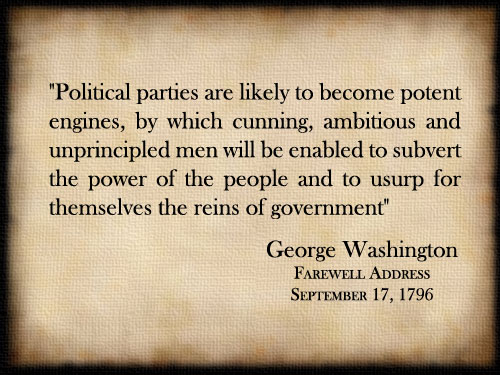
Oligarchs and Corporatist: Dad Warned Us About You!


Oligarchs and Corporatist: Dad Warned Us About You!


"All obstructions to the execution of the laws, all combinations and associations under whatever plausible character with the real design to direct, control, counteract, or awe the regular deliberation and action of the constituted authorities, are destructive of this fundamental principle and of fatal tendency. 
They serve to organize faction; to give it an artificial and extraordinary force; to put in the place of the delegated will of the nation the will of a party, often a small but artful and enterprising minority of the community; and, according to the alternate triumphs of different parties, to make the public administration the mirror of the ill concerted and incongruous projects of faction, rather than the organ of consistent and wholesome plans digested by common councils and modified by mutual interests. 
However combinations or associations of the above description may now and then answer popular ends, they are likely, in the course of time and things, to become potent engines by which cunning, ambitious, and unprincipled men will be enabled to subvert the power of the people and to usurp for themselves the reins of government, destroying afterwards the very engines which have lifted them to unjust dominion."
U.S. Senate: 1851: Washington's Farewell Address -- February 22, 1862 http://1.usa.gov/1EGbGsY


Grading Teachers by the Test - NYTimes.com

Grading Teachers by the Test - NYTimes.com:

Grading Teachers by the Test


In 2004, the Chinese government decided there were too many accidental deaths. China’s safety record, it decreed, should be brought in line with those of other middle-income countries. The State Council set a target: a decline in accidental deaths of 2.5 percent per year.
Provincial authorities kicked into gear. Eventually, 20 out of a total of 31 provinces adopted “no safety, no promotion” policies, hitching bureaucrats’ fate to whether they met the death ceiling. The results rolled in: by 2012 recorded accidental deaths had almost halved.
It wasn’t, however, all about increased safety. For instance, officials could reduce traffic deaths by keeping victims of severe accidents alive for eight days. They counted as accidental deaths only if the victims died within seven.
In a study of China’s declining deadly accidents, Raymond Fisman of Columbia University and Yongxiang Wang of the University of Southern California concluded that “manipulation played a dominant role.” Bureaucrats — no surprise — cheated.
This is hardly unusual. It is certainly not exclusive to China. These days, in fact, it has acquired particular importance in the debate over how to improve American education.
The question is, what will happen when teachers are systematically rewarded, or punished, based to some extent on standardized tests? If we really want our children to learn more, the design of any system must be carefully thought through, to avoid sending incentives astray.
“When you put a lot of weight on one measure, people will try to do well on that measure,” Jonah Rockoff of Columbia said. “Some things they do will be good, in line with the objectives. Others will amount to cheating or gaming the system.”
The phenomenon is best known as Goodhart’s Law, after the British economist Charles Goodhart. Luis Garicano at the London School of Economics calls it the Heisenberg Principle of incentive design, after the defining uncertainty of quantum physics: A performance metric is only useful as a performance metric as long as it isn’t used as a performance metric.
It shows up all over the place. Some hospitals in the United States, for example, will often do whatever it takes to keep patients alive at least 31 days after an operation, to beat Medicare’s 30-day survival yardstick. Last year, Chicago magazine uncovered how the Chicago Police Departmentachieved declining crime ratessimply by reclassifying incidents as 
“We don’t know how big a deal this is,” said Jesse Rothstein, a professor at the University of California, Berkeley, who has criticized evaluation metrics based on test scores. “It is one of the main concerns.”
American education has embarked upon a nationwide experiment in incentive design. Prodded by the Education Department, most states have set up evaluation systems for teachers built on the gains of their students on standardized tests, alongside more traditional criteria like evaluations from principals.
Fourteen more states are expected to have fully developed systems this academic year, according to the National Council on Teacher Quality — an advocacy group that supports rigorous assessments. All but six states are expected to have one by the 2016-17 school year.
The assessments are backed by sophisticated research. An important study by Professor Rockoff and two Harvard professors, Raj Chetty and John Friedman, found that teachers who improved students’ scores, termed high value-added teachers, raised the students’ chances of going to college as well as their salaries later in life.
But teachers — and parents — are up in arms. In New York, the teachers’ union strongly opposes Gov. Andrew Cuomo’s proposal to increase the weight of test scores to 50 percent of a teacher’s evaluation. The governor is being hammered over the issue in opinion polls.
“People who claim to be market-based reformers want to sell the theory noncriminal.
Grading Teachers by the Test - NYTimes.com:

Teacher: The disturbing things I’ve learned about our new Common Core tests - The Washington Post

Teacher: The disturbing things I’ve learned about our new Common Core tests - The Washington Post:
Teacher: The disturbing things I’ve learned about our new Common Core tests


 Emily Talmage is an elementary school teacher in Lewiston, Maine who did some research on the new Common Core tests that her students are taking this spring. In Maine, students are taking the Maine Educational Assessments in math and English Language Arts, developed by the Smarter Balanced Assessment Consortium, one of the two multi-state consortia given a total of some $360 million in federal funds to develop new exams that align with the Core standards. In this post, Talmage reports on what she found.


By Emily Talmage
As a teacher of 20 vibrant, curious, and, yes, often challenging fourth graders at Montello Elementary School in Lewiston, Maine, I constantly search for ways to improve my students’ learning experiences and to understand what will best help them succeed.  So, like many teachers around the state, as I began hearing about the new Smarter Balanced Tests (or MEA) that we are required to give our students this spring, I wanted to know how it would help me with the daily task of getting twenty learners to grow their hearts and minds in meaningful ways.
Here is a brief summary of what I have discovered.
First, no matter what my students and I do, statistics have already shown that my students will more than likely fall below proficient on this test.  In the field test given a year ago, 91 percent of English Language Learners and nearly 80 percent of low-income students did not meet proficient.  My class is comprised of 40 percent English language learners and nearly 100 percent are low-income.  Because new state legislation (required by the federal government if we are to keep valuable sources of funding) has already passed that will link my students results to my professional evaluation, this does not bode well for me or for my colleagues.  School “grades” are suspended for one year because we do not yet have baseline data for these tests, but it does not take a statistician to predict that schools like mine, with high levels of poverty and English language learners, will not look particularly good to the public once results are released in 2016.
Second, “assessment experts” (which seem to be primarily business consultants) within major, for-profit corporations like McGraw-Hill, AIR, and ETS were at the forefront of developing these tests.  Throughout the process, some teachers were asked for “input” (I was not one of them and I don’t know any teachers who were), but I have found it impossible to discern in what way this input was actually applied.  Instead, a number of math and literacy experts have said publicly that many test items are far above grade level and are developmentally inappropriate.  It is unclear why their advice was not heeded. Meanwhile, billionaires like Bill Gates and Rupert Murdoch have espoused the incredible potential these tests have to grow the education market. I am certain that they would pleased to know that in Lewiston, we have already clamored to purchase Common Core-aligned products designed by the same companies that have built these tests.
Third, many teachers in states giving the Smarter Balanced Test were encouraged to hear that unlike its well-known counterpart, the PARCC, our particular version of the Common Core Assessment would be “adaptive,” meaning that it would adjust to student’s ability level as they progressed through the test.  Some teachers, including myself, find that adaptive tests can be somewhat more useful than those that simply label students according to their level of proficiency, as they have the potential to gauge Teacher: The disturbing things I’ve learned about our new Common Core tests - The Washington Post: