Latest News and Comment from Education

Tuesday, January 13, 2015

Congressional Hearings on Testing – The Network For Public Education |

The Network For Public Education | NPE Calls for Congressional Hearings – Full Text:


 Your voice has been HEARD! Congressional hearings on testing announced!


Congressional Hearings on Testing

At the conclusion of NPE's first national conference in Austin, TX we requested that the Health, Education, Labor and Pension Committee holdhearings to investigate the over-emphasis, misapplication, costs, and poor implementation of high-stakes standardized testing in the nation's K-12 public schools. In our statement we asked 11 essential questions about testing which you can read here.

We asked you to call and write your representatives, and you responded.

You have been heard, and now the Committee has questions of its own.

Senator Lamar Alexander (R) was Secretary of Education under George H.W. Bush, and selected NPE President Diane Ravitch as his Asst. Secretary for Research. Sen. Alexander became the Chair and ranking Republican on the Senate's Health, Education, Labor and Pension Committee, on January 7, 2015 and now he has questions he wants answered too.

"Every parent, every teacher in 100,000 public schools is asking the question, 'Are there too many tests?' "Alexander said in an interview Thursday. "I don't know the answer. I'm asking the question. And the United States Senate ought to be asking that question as we think about No Child Left Behind."

It has been widely reported that on Tuesday, January 20th, the same day as the State of the Union address, the Committee on Health, Education, Labor and Pensions will indeed hold hearings on testing as part of Sen. Alexander's desire to oversee a reauthorization of the Elementary and Secondary Education Act (ESEA) that has been stalled since 2007.

Secretary Duncan unmoved

In a prepared speech yesterday, delivered at Seaton Elementary School in Washington DC, Secretary Arne Duncan made clear that the administration is committed to annual standardized testing.


"All students need to take annual state standardized tests that are aligned to their teacher's classroom instruction in reading and math in grades 3-8 and once in high school." - Arne Duncan, January 12, 2015


The trouble for Secretary Duncan is the tests remain wildly unpopular with parents and teachers, and since the advent of NCLB the focus on testing has done little to raise student achievement or diminish inequities in our schools. Pushback is mounting nationwide with parent groups and teachers unions leading the charge. Opt-out groups are growing exponentially, and are expected to only continue to gain momentum as Common Core aligned PARCC and Smarter Balanced tests are administered for the first time this spring.

Secretary Duncan does have allies in his quest to maintain the federal mandate for annual testing, however. Some are likely allies, such as theCouncil of Chief State School Officers and the Business Roundtable, which is "an association of chief executive officers of leading U.S. companies."

Some are less likely, including a group of civil rights organizations that released a statement in support of the reauthorization of ESEA, including the need for annual testing.

The debate is certain to be lively and passionate, and we want you to be a part of it! NPE will provide frequent updates as information becomes available, so please make sure you like us on Facebook and/or follow us on Twitter. We will also send newsletters and action alerts as necessary.

 
Like us on Facebook          Follow us on Twitter
 
WE ARE MANY. THERE IS POWER IN OUR NUMBERS. TOGETHER WE WILL SAVE OUR SCHOOLS.
 
United Opt Out Holds Fourth Annual Conference, January 16-18
 
 It's not too late!

NPE ally UNITED OPT OUT 
NATIONAL is hosting their fourth annual conference, Standing Up For Action, at the Broward Convention Center in Ft. Lauderdale, Florida. There is still time to register for the conference which runs from January 16th - 18th!

Standing Up For Action is a working session for local and national activists, concerned parents, educators, students and all who have a general interest in equitable and quality public education.

The conference will include speakers, panelists and group leaders including:

Author, Living in Dialogue blogger, and NPE Board Member Anthony Cody
Author and educator Sam Anderson

Chicago Teachers Union activist Michelle Gunderson

Author and University of Southern California Professor Stephen Krashen

Massachusetts Teachers Association President Barbara Madeloni

FairTest Public Education Director Bob Schaeffer

Orange County School Board member Rick Roach

City University of New York Professor Ira Shor

Youth representatives from Dream Defenders, Baltimore Youth Dreamers, and Detroit BAMN

UOO Administrators will also be on hand to sign their newly published book titledAn Activist Handbook for the Education Revolution: United Opt Out's Test of Courage.

Three-day attendees are asked to register in advance here and one day attendees to RSVP on Facebook and register upon arrival. 

Support The Network for Public Education

The Network for Public Education is an advocacy group whose goal is to fight to protect, preserve and strengthen our public school system, an essential institution in a democratic society.

Over the past year, donations to The Network for Public Education helped us put on our first National Conference, and the first PUBLIC Education Nation. In the coming year, we will hold more events, webinars, and work on the issues that our members and donors care about the most!

To Make a Donation, go to the NPE website and click the donate button. We accept donations using PayPal, the most trusted site used to make on-line payments.

The war against critics of charter schools | Bob Braun's Ledger

The war against critics of charter schools | Bob Braun's Ledger:


The war against critics of charter schools

Share on FacebookTweet about this on TwitterEmail this to someoneShare on LinkedInShare on Google+Share on StumbleUpon
Julia Sass Rubin
Julia Sass Rubin
Julia Sass Rubin, a tenured faculty member and researcher at Rutgers University’s Edward Bloustein School of Planning and Public Policy, and Mark Weber, a university graduate student who blogs under the title “Jersey Jazzman,” are publishing aseries of monographs that analyze publicly available data about New Jersey’s privately-operated, publicly-funded charter schools. In response to the first installment of the series, a lobbying group, the New Jersey Charter Schools Association (NJCSA),  filed state ethics charges against Rubin and sent press releases about the charges to main-stream media outlets.
The NJCSA, which has notoriously failed to police ethical lapses among its own member organizations, invoked state power to silence critics of charter schools while, at the same time, it sought to shame Rubin and Weber by using clueless media outlets to spread the smear against critics whose work is backed by hard, empirical evidence.
Because charter schools cannot refute the evidence on its merits, they have chosen to try to intimidate those who make the facts available to the public. To ruin their reputations and future job prospects.
In a New Jersey run  by Chris Christie, a governor who prides himself in acting the puerile bully, the charter school lobby is aping the same behavior. Little surprise here–since charter schools have been the recipients of tens of millions of dollars in state economic development aid, doled out by Christie’s special friend, Michele Brown, a woman who once borrowed money from Christie  in an unrecordedThe war against critics of charter schools | Bob Braun's Ledger:

New Jersey Charter School Law, Race and Equal Protection « New Jersey Education Policy Forum

New Jersey Charter School Law, Race and Equal Protection « New Jersey Education Policy Forum:


New Jersey Charter School Law, Race and Equal Protection

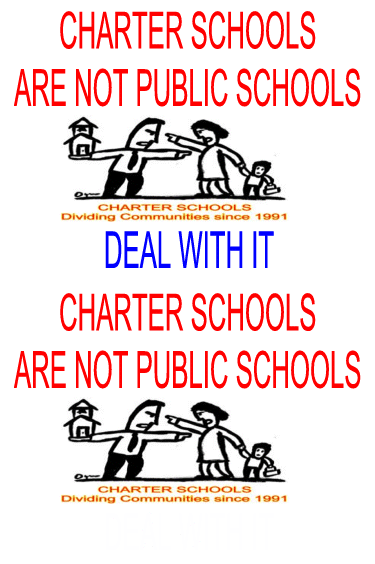
 Charter Schools - Dividing Communities since 1991


New Jersey Charter School Law, Race and Equal Protection

Joseph O. Oluwole, Montclair State University

Introduction

This brief addresses the constitutional import of the New Jersey Charter School Program Act’s race-conscious student enrollment mandates. The New Jersey Charter School Program Act provides that charter schools must not discriminate on any “basis that would be illegal if used by a school district.”[1] It also provides that charter schools must “be open to all students on a space available basis.”[2] If the school gets more applicants than the spaces available, the charter school must use a random selection process to determine admittees.[3] Despite these non-discrimination and space-available admission requirements, the law allows schools to exercise preferential treatment in admissions: a charter school can restrict admission to specific grade levels or to the school’s subject areas of concentration.[4] These subject areas include the arts, sciences or mathematics.[5]
Additionally, despite the non-discrimination requirement, the Charter School Program Act mandates certain discriminatory practices which are not readily subject to legal challenges. For instance, the Charter School Program Act dictates that students in the resident district of the charter school must be given enrollment preference over other prospective students.[6] If more resident students apply than space available, these students will then be subjected to the random-selection process as well.[7]
Another preference in the law deals with the enrollment of continuing students. The Charter School Program Act provides that, as long as a charter school has the requisite grade level at the school, it must give enrollment preference to students who attended the school in the immediate prior school year.[8]
The Charter School Program Act also authorizes but does not require enrollment discrimination on the basis of family ties. In particular, the law states that “[a] charter school may give enrollment priority to a sibling of a student enrolled in the charter school.”[9] Charter schools are also authorized but not required to craft and incorporate into their charter, criteria that is reasonable for evaluating prospective students.[10] However, such criteria must not discriminate against prospective students because of their intellect, handicap status, athleticism, English language proficiency, aptitude measures, achievement measures, or other ground that would be legally invalid for a school district to use.[11]
Notwithstanding the non-discrimination and space-available admission requirements, the Charter School Program Act requires charter schools to incorporate race in their enrollment decisions in order to ensure that a cross section of the community is represented in the school’s enrollment. Specifically, the law provides:
The admission policy of the charter school shall, to the maximum extent practicable, seek the enrollment of a cross section of the community’s school age population including racial and academic factors.[12]
This provision is important because of the tendency of charter schools to become one-race charter schools. There are also many charter schools in heavily-minority districts furthering segregation. This makes it important to ensure that diversity rather than segregation persists in those districts.
This brief examines the constitutionality of this and other race-conscious mandates of the New Jersey Charter School Program Act under the United States Equal Protection Clause. It also analyzes the mandates under the New Jersey Equal Protection constitutional provision.

Race-Conscious Mandates in the New Jersey Charter School Program Act

As noted earlier, even though the Charter School Program Act prohibits discrimination on any ground that would be legally invalid if employed by school districts, it also provides that:
The admission policy of the charter school shall, to the maximum extent practicable, seek the enrollment of a cross section of the community’s school age population including racial and academic factors.[13]
The language of this mandate suggests that it is a race-conscious provision rather than a racial quota. It is evident that it is not a quota since it does not require reservation of specific number of seats for a particular race(s).[14]
There are other race-conscious mandates in the state laws governing charter schools. For instance, the New Jersey Department of Education regulations provide that:
Prior to the granting of the charter, the Commissioner shall assess the student composition of a charter school and the segregative effect that the loss of the students may have on its district of residence.[15]
Further, the regulations state that:
On an annual basis, the Commissioner shall assess the student composition of a charter school and the segregative effect that the loss of the students may have on its district of residence.[16]
If the Commissioner finds that the charter school has segregative effect, the Commissioner can impose a remedy.[17] According to the Superior Court of New Jersey Appellate Division, if a charter school has already been approved, a school district must wait until the school actually has a segregative effect on the district before seeking judicial or administrative remedial action for the segregative effect.[18]
The New Jersey Department of Education regulations require that charter schools seeking to be regional schools include in their application a “plan to ensure the enrollment of a cross section of the school-age population of the region of residence, including racial and academic factors.”[19]
The regulations empower the commissioner to deny or grant charter renewals based on the “annual assessments of student composition of the charter school.”[20] The regulations also provide that:
No later than January 15 of subsequent school years [after the initial recruitment period for a charter school], a charter school shall submit to the Commissioner the number of students by grade level, gender and race/ethnicity from each district selected for enrollment from its initial recruitment period for the following school year.[21]
What is evident from the above provisions is that New Jersey places a premium on the racial composition of its charter schools.

The United States Equal Protection Clause and New Jersey’s Charter School Laws’ Race-Consciousness

The Equal Protection Clause of the Fourteenth Amendment of the United States Constitution provides:
No State shall … deny to any person within its jurisdiction the equal protection of the laws.[22]
The Equal Protection Clause is designed to protect people from discrimination on the basis of various characteristics including race.
The scope of the Equal Protection Clause with respect to voluntary race-conscious mandates was muddled for many years because the United States remained silent on the constitutionality of such mandates. Unlike in desegregation cases which seek to remedy legally-sanctioned segregation,[23]race-conscious cases involve voluntary efforts to promote diversity. In 2007, in Parents Involved in Community Schools v. Seattle School District No. 1,[24] the United Supreme Court finally ruled on the constitutionality of race-conscious measures. Even though the Parents Involved case involved race-conscious New Jersey Charter School Law, Race and Equal Protection « New Jersey Education Policy Forum:

The Future of Test-Driven Accountability Is Bleak | John Thompson

The Future of Test-Driven Accountability Is Bleak | John Thompson:


The Future of Test-Driven Accountability Is Bleak

Posted: Updated: 

Parents Can Opt Out United Opt Out National

Click Here to go to United Opt Out National: 


Click Here to go to the WebsiteUnited Opt Out Team


 The best single prediction for the top education stories of 2015 was made by the conservative Rick Hess who anticipates:

Proposals for "Smart" Policy Disappoint, Yielding Calls for "Smarter" Policy. We will hear a lot of anguished, thoughtful calls for "smart" regulation and policy. When those regulations and policies are adopted and don't work as intended, we'll be told that it's an "implementation problem." The solution to this problem will be new proposals for "smarter" regulations and policies.
In their predictions for 2015, the mainstream education press bumps into several of the classic themes that Hess spoofs. More earnest prognosticators ask whether the "smart" standards known as Common Core will be implemented. Will "smarter" tests, survive and influence national politics, and will blended learning finally start to live up to its hype? There seems to be little doubt, however, that objective analysts anticipate the escalation our testing wars.

National Public Radio's Claudio Sanchez predicts, #1 Standardized Testing Under Fire. The new tests tied to the Common Core, PARCC and Smarter Balanced, will continue to be targets as calls for a high stakes testing moratorium gather steam. Even Bill Gates and Arne Duncan could become allies in opposing the testing mania.
Also, #2. More Troubles For The Common Core, leads to the prediction that "more (Republican-led) legislatures will call for long, drawn-out reviews, or the outright repeal, and ... Some states may simply 're-brand' the core to satisfy opposition groups." So, CCSS opponents will face a tougher battle in defeating the standards, even if they successfully attack Common Core tests.
Politico's Maggie Severns, in her analysis of next year's battle over reauthorizing No Child Left Behind, also focuses on testing, and concludes with a similar prediction. In 2015, anti-testing advocates will offer alternatives to test, sort, and punish, such as testing students every other year or a few times throughout their school careers, or testing a sample of students. Reformers (such as Bill Gates and Arne Duncan?) will likely reject these common sense ideas because they hold firm to value-added evaluations of teachers and principals.
Although the Republicans will attack Duncan's obsession with test-driven accountability, in doing so they might be "capitalizing on the chance to grab hold of an issue they can use as a bargaining chip down the line." And that leads to the most likely outcome of NCLB Reauthorization. As conservative Mike Petrilli predicts: "The president vetoes a long-awaited rewrite of NCLB, 'and Republicans have a bill that they could run on.'"
Regardless of the accuracy their speculations on these edu-political horse races, nothing in these journalists' predictions indicate that smarter high-stakes testing can be implemented in ways that actually improve schools.
I hope Larry Ferlazzo's predictions turn out to be the most accurate. His #2 prognostication seems to be wishful thinking: the Gates Foundation "will cease its support of Value Added Measurements as a tool for teacher evaluation." His 4th prediction, however, seems pretty safe to me. The appeal of the anti-due processThe Future of Test-Driven Accountability Is Bleak | John Thompson:

A Supreme Court case that public education advocates should be watching - The Washington Post

A Supreme Court case that public education advocates should be watching - The Washington Post:


A Supreme Court case that public education advocates should be watching


Critics of education reform that focuses on standardized tests for accountability purposes and the expansion of “choice” correctly point out that what happens in a classroom is impossible to entirely divorce from what happens to children outside their school buildings. Government housing, tax and other policies affect public schools, though they are very rarely considered when people talk about how to close the achievement gap or about how to provide more college access to children from low-income families. In the following piece, scholar Richard Rothstein looks at a coming U.S. Supreme Court case that he says could indirectly be the most important public school desegregation case since Brown vs. Board of Education was handed down in 1954 and ruled unconstitutional all state laws that created separate public schools for black and white children. In fact, in a piece last year on the 60th anniversary of Brown vs. Board, Rothstein noted that public schools remain segregated today because neighborhoods in which they are located are segregated, and he wrote, “Education policy is housing policy.”
Rothstein is  a research associate at the Economic Policy Institute, a non-profit created in 1986 to broaden the discussion about economic policy to include the interests of low- and middle-income workers. He is also senior fellow of the Chief Justice Earl Warren Institute on Law and Social Policy at the University of California (Berkeley) School of Law, and he is the author of books including  “Grading Education: Getting Accountability Right,  and “Class and Schools: Using Social, Economic and Educational Reform to Close the Black-White Achievement Gap.” He was a national education writer for The New York Times as well. This appeared on the EPI website and I am republishing it with Rothstein’s permission.
Public education advocates should be watching this case.
By Richard Rothstein
The U.S. Supreme Court could be on the verge of issuing a major setback to neighborhood integration, and thus to school improvement, in a case that has attracted little attention outside the fair housing community. Educators should take note: The segregation of low-income minority schools undermines efforts to narrow achievement gaps between middle class and low-income minority students.
When a few children in a classroom come from homes with less literacy and without the benefit of high-quality early childhood care, a skilled teacher can give those children special attention. But when most children in that classroom have these disadvantages, the average instructional level must decline. The most skilled teachers must devote more time to A Supreme Court case that public education advocates should be watching - The Washington Post:

Gov. Snyder proves his rhetoric on Michigan’s Emergency Manager law was lies, will appoint new EM for Detroit schools | Eclectablog

Gov. Snyder proves his rhetoric on Michigan’s Emergency Manager law was lies, will appoint new EM for Detroit schools | Eclectablog:


Gov. Snyder proves his rhetoric on Michigan’s Emergency Manager law was lies, will appoint new EM for Detroit schools

Monday, January 12, 2015

More Evidence That Public Beats Private in Education

More Evidence That Public Beats Private in Education:


More Evidence That Public Beats Private in Education

2015.1.12.Buchheit.BF"In the mindset of big business, the best education is in learning how to make money off the children," writes Buchheit. (Image: Jared Rodriguez / Truthout)PAUL BUCHHEIT FOR BUZZFLASH AT TRUTHOUT
In fact, except for the debilitating effects of poverty, our public school system may be the best in the world.

The most recent data from the National Center for Education Statistics (NCES) reveal that the U.S. ranked high, relative to other OECD countries, inreadingmath, and science (especially in reading, and in all areas better in 4th grade than in 8th grade). Some U.S. private schools were included, but a separate evaluation was done for Florida, inpublic schools only, and their results werehigher than the U.S. average.

Perhaps most significant in the NCES readingresults is that schools with less than 25% free-lunch eligibility scored higher than the average in ALL OTHER COUNTRIES.


The Obvious: Reduce Poverty and Improve Education.

What should be obvious to our legislators is apparently not. K-12 funding declined in 2011 for the first time since the Census Bureau began keeping records. A 2014 study by the Center on Budget and Policy Priorities found that "States' new budgets are providing less per-pupil funding for kindergarten through 12th grade than they did six years ago — often far less."

It gets worse. Numerous studies have shown that pre-school helps all children to achieve more and earn more through adulthood, with the most disadvantaged benefiting the most. But the U.S. ranks near the bottom of the developed world in the percentage of 4-year-olds in early childhood education. And yet Head Start was recently hit with the worst cutbacks in its history.

The evidence for national improvement is staring us in the face, but the people in charge are ignoring facts and experience and turning instead to the corporate profit-seekers.


How Education Funding Is Put in the Hands of the Super-Rich

Tax money that should be used for education is either deferred or simply not paid, by both corporations and individuals. Warren Buffett's Berkshire Hathaway, for example, has deferred $44 billion in recent years, and Boeing, Caterpillar, and Verizon are a few of the leading non-payers of state taxes, some of which would go toward public education.

Wealthy individuals, who took much of the nearly $5 trillion in stock market gains in 2013, defer taxes until they cash in the stocks, and then pay a lower capital gains rate. They can also get tax breaks by putting some of this money into their reform-minded educational foundations.


Using the Corporate Model on Our Children

Much of the vast new wealth of the super-rich is being used for the purpose of educational 'reform.' Rupert Murdoch called K-12 "a $500 billion sector in the U.S. alone that is waiting desperately to be transformed." Forbesadded, "The charter school movement [is] quickly becoming a backdoor for corporate profit." Most recently, the Wall Street Journal reported, "As states race to implement the Common Core academic standards, companies are fighting for a slice of the accompanying testing market, expected to be worth billions of dollars in coming years."

The result of private educational reform is seen in unproven charter schools that eat up budgetsovercharge on a per-student basis, pay CEOs many times more than their public school counterparts, and, in one case, double the pay of executives in just one year.

These are unsustainable costs for long-term educational success.


The Business of School Children

In Brown v. Board of Education in 1954, Chief Justice Earl Warren said, "Education...is a right which must be made available to all on equal terms." In the mindset of big business, the best education is in learning how to make More Evidence That Public Beats Private in Education:

AFT’s Weingarten on Secretary Duncan’s ESEA Reauthorization Remarks

AFT - American Federation of Teachers - A Union of Professionals:


AFT’s Weingarten on Secretary Duncan’s ESEA Reauthorization Remarks


WASHINGTON— Statement from American Federation of Teachers President Randi Weingarten on Education Secretary Arne Duncan’s speech regarding the reauthorization of the Elementary and Secondary Education Act.

"As I've said before, any law that doesn't address our biggest challenges—funding inequity, segregation, the effects of poverty—will fail to make the sweeping transformation our kids and our schools need. Today, it was promising to hear Secretary Duncan make a call for equity, stressing, as we did through the Equity and Excellence Commission, the importance of early childhood education and engaging curriculum. It was encouraging to hear him laud the hard work of educators, who have had to overcome polarization and deep cuts after a harsh recession. And it was heartening to hear him acknowledge the progress our schools have made. However, the robust progress we saw in the first 40 years after the passage of ESEA has slowed over the last 10 years.

“On testing, we are glad the secretary has acknowledged that ‘there are too many tests that take up too much time’ and that ‘we need to take action to support a better balance.’ However, current federal educational policy—No Child Left Behind, Race to the Top and waivers—has enshrined a focus on testing, not learning, especially high-stakes testing and the consequences and sanctions that flow from it. That's wrong, and that’s why there is a clarion call for change. The waiver strategy and Race to the Top exacerbated the test-fixation that was put in place with NCLB, allowing sanctions and consequences to eclipse all else. From his words today, it seems the secretary may want to justify and enshrine that status quo and that's worrisome.

“Yes, we need to get parents, educators and communities the information they need. And all of us must be accountable and responsible for helping all children succeed. That's why we have suggested some new interventions, like community schools and wraparound services; project-based learning; service internships; and individual plans for over-age students, under-credited students and those who are not reading at grade level by third grade.

“If one test per year can cause an entire school to be shuttered or all the teachers fired, something is wrong with the way that test is being used. Even in the District of Columbia, where the secretary spoke from today, the school district has pulled back from the consequential nature of these tests.

"At the end of the day, the most important part of the debate shouldn't happen in big speeches. It should happen in real conversations with parents, students and teachers, who are closest to the classroom. Communities understand the huge positive effect ESEA had for impoverished and at-risk communities 50 years ago. Those communities are saying loudly and clearly that they want more supports for students and schools, and data used to inform and improve, not sanction. It's my hope that, in the coming weeks, leaders in Congress and the administration will listen to these voices and shape a law that reflects the needs of all our kids."

Postscript: An advanced copy of Secretary Duncan’s remarks today included a quote from Albert Shanker, former president of the AFT, on accountability. To this, Weingarten responded, “If the secretary wants to invoke Shanker on accountability, then invoke him on his proposals for grade-span over annual testing. Shanker once called for ‘an immediate end to standardized tests as they are now,’ instead favoring testing over five-year intervals.”

LeBrun: A disaster dressed up as 'reform' - Times Union

LeBrun: A disaster dressed up as 'reform' - Times Union:


LeBrun: A disaster dressed up as 'reform'


"I'm big on knowing what I don't know ... If you don't know, don't dabble.
— Gov. Andrew Cuomo on the decision to ban fracking in the state.

Cynics among us might snort that this classic platitude from the dark prince is yet another example of his word rising to nothing more than the essential stuff that grows mushrooms best.
I prefer to see it as a rare example of blinding insight, which the governor does everything he can to suppress.
Properly and justly dealing with the considerable problems of public education in this state has been his greatest failure.
But he continues to fiercely dabble in it anyway, because he can. Now he's trying to convince us that by giving him more power and taking key decisions away from local school boards, he can "reform" public education. In reality what he proposes is a formula for disaster.
Additionally, he says that in the coming legislative session he aims to pin the tail on the wrong donkey yet again — on teachers, for failures in student achievement. They and their union had the audacity not to support him in the last election, and they have to be punished. Never missing a chance to bully your enemies is a Cuomo trademark.
Where that tail actually belongs is well within the governor's reach. Chronic underfunding of public education by the state, particularly in high needs districts, has become scandalous and is entirely in the governor's hands to correct.
Half the school districts in the state, including most of those high needs districts, are getting less state aid today than they got in 2008.
It seems that the governor is trying to starve traditional public education. It's more than just being tone deaf to public education and prone to listening, not for the first time, to the wrong people. He's caught up in the national, deeply conservative charter school movement, dear to the hearts of the 1 percent in this country.
The cynics I mentioned earlier might see this as a grand design to prepare the field for privatizing public schools with more charters at taxpayer expense; which would accomplish another Cuomo trademark gesture, rewarding his biggest donors, those hedge fund billionaires who wolfishly look at public education in New York as a profit making opportunity.
As to public school funding by the state, we're in crisis, and something's got to give. As we go forward in 2015 with a $5 billion state budget surplus, if a significant portion is not applied to the deepening imbalance that is crippling public education, to help relieve the pressure on LeBrun: A disaster dressed up as 'reform' - Times Union: