Latest News and Comment from Education

Thursday, January 8, 2015

Teaching Children How to Think Instead of What to Think | The Mind Unleashed

Teaching Children How to Think Instead of What to Think | The Mind Unleashed:


Teaching Children How to Think Instead of What to Think

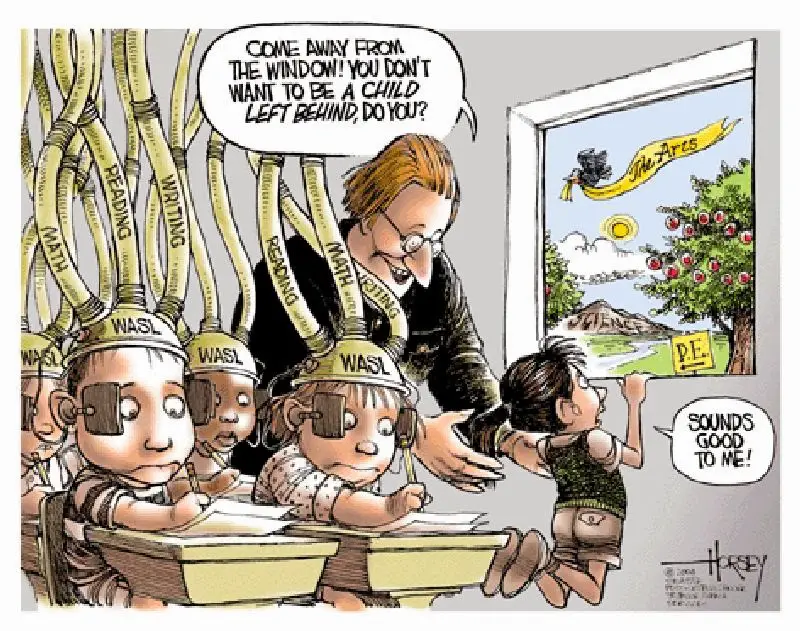
http://themindunleashed.org/wp-content/uploads/2015/01/teachinggg.gif
Right now our education system is doing more to indoctrinate our children than to educate them. In fact, that has been the case for quite some time. Our young minds are being told to accept authority as truth instead of truth as authority, and teachers talk at the students instead of with them.
Teachers have become repeaters of information. They are merely regurgitating everything they once learned from their own teachers, and perpetuating the recycling of information; information that has managed to evade scrutiny for generations. Children are no longer the masters of their own learning, and instead, their minds are being treated as storage containers.
childddd
The factory model of education, with its focus on academic and economic elitism, is churning out obedient workers for the system, encouraged to conform every step of the way. We are not being treated as organic, creative, investigative human beings, but instead as parts in the machine. The education system is filtering out the inquisitive nature of our being, with the ultimate goal being to prevent dissent against the system. The system doesn’t want thinkers. It doesn’t want people toquestion its methods. It wants a population that can be easily manipulated and controlled so as to relinquish all its power to the elite.

philosss
There are those who say that critical thinking skills cannot be taught in schools. Socrates would likely scoff at that notion, were he still alive today. It was Socrates who said, “I cannot teach anybody anything; I can only make them think.” If we’re going to solve the problem of indoctrination in our school system, we have to learn to begin asking questions instead of giving answers. Real learning is achieved through the investigative process. Children have to be encouraged to search for the answers themselves. It is up to the teachers to provide the tools and resources necessary for the children to conduct these inquiries and make meaningful discoveries. One well-formed question will do more to inspire than any number of answers. In every facet of our educational pursuits, it becomes crucial to begin an open dialogue with our students, to encourage healthy debate and to have them form their own conclusions.
The importance of teaching philosophy in schools cannot be underestimated. In a world where most of humanity is running on the treadmill with the blinders on, it is paramount that we re-evaluate our own perspectives from time to time, and look at the big picture. What teaching philosophy does is it gets us thinking, it gets us questioning, and it gets us contemplating. Without these skills, humanity Teaching Children How to Think Instead of What to Think | The Mind Unleashed:

“Stupid, absurd, non-defensible”: New NEA president Lily Eskelsen García on the problem with Arne Duncan, standardized tests and the war on teachers - Salon.com

“Stupid, absurd, non-defensible”: New NEA president Lily Eskelsen García on the problem with Arne Duncan, standardized tests and the war on teachers - Salon.com:


“Stupid, absurd, non-defensible”: New NEA president Lily Eskelsen García on the problem with Arne Duncan, standardized tests and the war on teachers

Arne Duncan has met his worst nightmare -- an NEA president armed with facts and guts. She tells Salon what's next


"Stupid, absurd, non-defensible": New NEA president Lily Eskelsen García on the problem with Arne Duncan, standardized tests and the war on teachers


Lily Eskelsen García, Arne Duncan (Credit: NEA.org/AP/Jacquelyn Martin)
For years, politicians and policy leaders have been running the nation’s public education system basically by the seat of the pants, drafting and passing legislative doctrine that mostly ignores the input from classroom teachers, research experts and public school parents.
Just the latest example of this fly-by-night leadership came from Rand Paul, the senator from Kentucky and expected GOP presidential contender. According to the Politico newsletter, Paul is “planning a major push on education reform, including ‘education choice, school choice, vouchers, charter schools, you name it.”‘
Gotta love the “you name it” proposal, don’t you? So reassuring to parents. “Relax, we’re enrolling your kid in the ‘You Name It’ program this year. Everything will be fine.”
In an astonishing display of incoherence, he told the Politico reporter how much he, and his children, had benefited from traditional public schools – “I grew up and went to public schools. My kids have gone to public schools” – and then suggested we create something that looks nothing like them.
“Have one person in the country who is, like, the best at explaining calculus … teach every calculus class in the country,” he rambled, in belief, somehow, that having “2 million people in the classroom” would ensure more children “have a teacher that may be having a more hands-on approach.” Really?
Have education policies from the Democratic Party been any better?
Apparently, most teachers don’t think so. As Politico, again, reported, teachers are organizing at an unprecedented level. Through their unions, teachers have amassed “tens of millions in cash” and have acquired “new data mining tools that let them personalize pitches to voters,” in an effort to “run a huge get-out-the-vote effort.”
Education Week suggested that a “new era” in teacher organizing has begun, with “a remarkable policy convergence, portending what could indeed be a more unified response to national and state education issues.


“The convergence, observers say, is the product not only of the unions’ need to assume a defensive posture in the face of legislative and legal attacks, but also of the pressure brought by internal factions that have urged the unions to take a tougher stance against market-based education policies.”
What’s got teachers stirred up? How real and potent is this upsurge of their activism? Why should people who identify with progressive causes care? Salon recently posed those questions, and others, to Lily Eskelsen García, the new president-elect of the National Education Association, the nation’s largest teachers’ union, at the recent Netroots Nation conference in Detroit.
First of all, congratulations on becoming the new NEA president.
Still president-elect. I take office Sept. 1. We have an incredible president, Dennis Van Roekel, who basically said a transition period should be a transition period, not go stand in the corner. So he gave me the president-elect title and told me I would take the press “Stupid, absurd, non-defensible”: New NEA president Lily Eskelsen García on the problem with Arne Duncan, standardized tests and the war on teachers - Salon.com:

NYC Public School Parents: Public Advocate and Class Size Matters legally challenge DOE on authority and transparency of School Leadership Teams

NYC Public School Parents: Public Advocate and Class Size Matters legally challenge DOE on authority and transparency of School Leadership Teams:


Public Advocate and Class Size Matters legally challenge DOE on authority and transparency of School Leadership Teams

Yesterday, Public Advocate Letitia James and Class Size Matters filed papers in court, requesting to intervene in a lawsuit in which the Department of Education is arguing that School Leadership Teams are not subject to Open Meetings Law because they have only advisory powers. 

In April of 2014, Michael P. Thomas, a retired teacher,  tried to attend a School Leadership Team at a middle school on Staten Island,  and was prevented from doing so.  In an earlier case, teacher Francesco Portelos, was also prevented from attending his school’s SLT meeting.  In that case, a Judge wrongly found on the side of the DOE that SLTs are not public bodies because they are only advisory.  

Yet the DOE's position is wrong for at least three reasons.  First of all, School Leadership Teams, made up of half parents and half school staff,  have more than advisory powers, and they make critical decisions for each school, as clearly delineated in Chancellor’s regulations and in New York State law. In 2008, when then-Chancellor Klein rewrote the regulation on SLTs and tried to strip them of their powers, Class Size Matters helped Marie Pollicino, then a member of the Community Education Council in District 26, file a complaint with the State Education Commissioner. (Here's a Daily News article and our blog about this complaint.) Marie's complaint was later joined by Mel Meer, an active Queens parent and Community Board member, and the UFT.

In his decision, Education Commissioner Mills ordered the Chancellor to rewrite the regulation, because it “strips the SLT of this basic, statutorily mandated authority” to develop the school’s Comprehensive Education Plan, which contains the fundamental goals of each school and the roadmap for achieving them.  Principals must align the school-based budget with the CEP, and if they do not, SLT members have the right to issue a formal complaint.  (Here's an article about this decision from our blog, and Chalkbeat, then called GothamSchools.) The SLT’s ultimate authority over the CEP was subsequently reinserted not only in Chancellor’s regulations but also in the 2010 state law pertaining to New York City school governance.

Secondly, the DOE errs in its definition of a “public body.” There are many public bodies that are subject to Open Meetings law, such as Community Boards, Commissions and other official bodies that may have only advisory powers but have a mandated role in governance.  Public bodies perform a governmental function for the state, an agency or department, must follow certain set procedures and require a quorum to operate.  This is also the case with SLTs, which according to state law, must meet monthly, have a quorum to make decisions, and  must “provide notice of monthly meetings that is consistent with the open meetings law.”   Even a DOE powerpoint during Walcott's chancellorship NYC Public School Parents: Public Advocate and Class Size Matters legally challenge DOE on authority and transparency of School Leadership Teams:

Proposed Teacher Prep Legislation Needs Changes! Badass Teachers Association:

Badass Teachers Association: Proposed Teacher Prep Legislation Needs Changes!:


Proposed Teacher Prep Legislation Needs Changes!


The Badass Teachers Association calls for changes to be made to the Department of Education’s recent legislative proposal to attach student test scores to the effectiveness of new teachers and their credentialing programs. This proposal, under the guise of providing access to more meaningful indicators of teacher preparation program performance, proposes to create a continuous feedback loop of communication between school districts and institutions of higher learning to facilitate program improvement and provide information that can be used by potential employers to guide their hiring decisions as well as prospective teachers to guide their application decisions.

We disagree with the premise that teacher preparation programs are not adequately preparing teachers. The trend of a higher attrition rate for new teachers has little to do with how well they are educationally prepared and armed with theoretical knowledge of classroom management and teaching skills. This is yet another false narrative created in an attempt to disguise the fact that the over-management of the classroom by people who have little educational background or training is one of the biggest causes of stress for any educator and therefore, one of the leading reasons teachers leave the classroom. This legislation fails to acknowledge the very people that it proposes to assist - new teachers and underserved student populations. This new proposed rule sets in motion the construction of yet another data analysis system that fails to address the real issues that are faced by the new teacher in socio-economically disadvantaged neighborhoods.  

The Department of Education is seeking to define “high-quality teacher program” through statutory regulation in an attempt to provide limits and definitions for the purpose of establishing TEACH Grant eligibility. Authorized under title IV of the HEA, the TEACH Grant program provides aid to students and institutes of higher learning who are preparing to become teachers. In return, a student must teach in a low-income school and in a high-need field for four years. Effectively, the groundwork is being laid for a decimation of the TEACH grant program. If a teacher that is teaching in a low-income or high-need school, the fact that is still being ignored is that student educational achievement is directly related to a student’s socio-economic status. Research shows that student growth scores will not be measurably increased in these areas until the issues of poverty are dealt with; the perceived effectiveness of schools that educate teachers to teach in these urban and rural areas will not be rated highly and grant eligibility will likely be revoked. The DOE does not need to Badass Teachers Association: Proposed Teacher Prep Legislation Needs Changes!:

Ten Common Core Promoters Laughing All The Way To The Bank

Ten Common Core Promoters Laughing All The Way To The Bank:


Ten Common Core Promoters Laughing All The Way To The Bank

The people who wrote and pushed Common Core on the nation are making bank while the nation’s kids, teachers, and parents writhe in the grip of their curriculum contraption.


 NPR recently came out with an image-repair article profiling one of Common Core’s five coauthors, former Bennington College professor Jason Zimba. Moms and dads tearing hair out at their kids’ math homework and Environmental Protection Agency regulation reading assignments (yes, that’s really Common Core-recommended) should feel sorry for him, because it says Zimba was frequently up until 3 a.m. devising their family torture device. Somehow, I’m not that surprised or sympathetic to hear Common Core has mysteriously not improved math instruction at Zimba’s daughter’s school. Because it hasn’t improved it much of anywhere else, either.

Even as Zimba and his colleagues defend the standards against cries of federal overreach, they are helpless when it comes to making sure textbook publishers, test-makers, superintendents, principals and teachers interpret the standards in ways that will actually improve American public education, not make it worse.
Like McCallum, Zimba agrees with the North Carolina dad that the question on his son’s Common Core-labeled math quiz was terrible. But as long as Americans hold to the conviction that most of what happens in schools should be kept under the control of states and local communities, the quality of the curriculum is out of his hands. ‘Like it or not, the standards allow a lot of freedom,’ he said.
The real problem with Common Core is that it’s not prescriptive enough! I’m so sorry, fellow Americans, but there’s this little thing standing in the way of applying my education omniscience to all children—it’s called “truth, freedom, and the American way”!
It’s now clear that everyone but the people who wrote and thrust Common Core upon the nation will bear the blame for its failure. First on the list of bumbling idiots: Teachers. Second: Curriculum developers. Neither apparently can understand what Common Core wants them to do. One wonders if it’s written in English? Because, you know, we use language to communicate? It can actually be very precise. Ah, right, even a quick look at Common Core will reveal that it is not, in fact, written in English. Design flaw? No, no: Blame the teachers who can’t read non-English!

Common Core Coauthor Jason Zimba

Zimba
To the point: NPR further reveals that Zimba gave up his professorship to devote his time to writing Common Core curriculum through an organization he co-founded with two other Common Core coauthors. How much does Zimba make through his public service through this nonprofit? Well, its 2012 IRS form 990 (the latest available—I’ve been through a lot of these babies, and they are usually quite outdated) says he made a cool $332,263. That’s probably not his entire annual income, as he travels to show teachers how to do Common Core right.
Zimba isn’t the only person making a lot of money from constructing a disaster. In fact, everywhere you look, people intimately involved with creating or pushing Common Core are making a lot of money despite having demonstrated exactly zero proven success at increasing student achievement. How convenient for them.

David Coleman, Zimba’s Partner in Crime


David Coleman is another of the five Common Core coauthors, and he and Zimba go way back. They were both Rhodes scholars. Zimba worked at the college Coleman’s mother runs. They started Student Achievement Partners(SAP)—the nonprofit where Zimba now works—together. They wrote a report calling for national curriculum mandates that got them noticed and hired by education nationalizers to write Common Core, for a still-undisclosed sum and under still-undisclosed conditions (apparently, NPR’s reporting only goes so far as the material Zimba and Coleman wish to feed Ten Common Core Promoters Laughing All The Way To The Bank:

The worst possible way to push kids into studying science, math and engineering - The Washington Post

The worst possible way to push kids into studying science, math and engineering - The Washington Post:


The worst possible way to push kids into studying science, math and engineering

A 1961 reform doubled the number of Italian students graduating with STEM degrees.


It’s an old debate in education: what skills should we be teaching students? In some circles, it’s not a debate at all; President Obama has perennially championed science, technology, engineering and math (STEM) as key fields for the economic success and competitiveness of the economy. This, too, is an old faith, one that dates to the Sputnik anxieties of the Cold War.
The tech industry, of course, is a huge booster of STEM education efforts. By their account, the nation suffers from a dire drought of technical workers, and in addition to training more at home, we should also lift the caps on importing engineers from China and India. A Brookings report from July found that openings for STEM jobs indeed seem harder to fill. The postings stay up for longer, especially those that call for specialized programming knowledge.
Since there appears to be a shortage of tech workers, what sort of market failures or policies are to blame? And how can we go about fixing them?
These days, for instance, it’s recognized that lack of opportunity holds back many students who might thrive in STEM occupations. The Obama administration has pledged to recruit more low-income students into STEM fields, which would also help them gain access to the middle class.
For some illumination, it’s helpful to look at how other countries have responded to the pressure to techify their workforces. A new study from Stanford looks at what happened in Italy, when a 1961 law doubled the number of students in STEM majors graduating from the country’s universities.
Italy’s big push on STEM
In postwar Italy, the obstacles were — quite literally — a set of fascist rules left over from the Mussolini regime. At age 14, students enrolled in specialized high schools. Only those in college-prep programs had full access to college; students in technical or vocational schools were limited to specific, non-science majors. A 1961 reform law loosened some of these restrictions, and for the first time, students from technical high schools could go to college for a degree in fields like math, physics and engineering.
To study the consequences, Nicola Bianchi, an economics PhD student, collected transcripts from public high schools and universities in Milan between 1958 and 1968. (At the time, students who went to high school in Milan overwhelmingly chose to stay in Milan if they wanted to attend college, so Bianchi got a full portrait of their academic lives.) Bianchi then used tax data from 2005 to see what these same students were earning at the height of their careers.
The first surprise: College seemed to provide no financial benefit to the students from the technical schools, who typically came from less-educated families. These charts show what happened (Bianchi calls people from technical high schools “Type B” students):
After they were granted the opportunity to major in STEM fields, students from the technical high schools signed up for university courses in droves. It used to be that about 8.2 percent of them finished college. The lifted The worst possible way to push kids into studying science, math and engineering - The Washington Post:

The ugly segregationist history of the charter school movement - Salon.com

The ugly segregationist history of the charter school movement - Salon.com:


The ugly segregationist history of the charter school movement

Popular education "reform" measures are rooted in white resistance to Brown v. Board of Education


This article originally appeared on AlterNet.
AlterNetAs a parent I find it easy to understand the appeal of charter schools, especially for parents and students who feel that traditional public schools have failed them. As a historical sociologist who studies race and politics, however, I am disturbed both by the significant challenges that plague the contemporary charter school movement, and by the ugly history of segregationist tactics that link past educational practices to the troubling present.
The now-popular idea of offering public education dollars to private entrepreneurs has historical roots in white resistance to school desegregation after Brown v. Board of Education (1954). The desired outcome was few or, better yet, no black students in white schools. In Prince Edward County, Virginia, one of the five cases decided in Brown, segregationist whites sought to outwit integration by directing taxpayer funds to segregated private schools.
Two years before a federal court set a final desegregation deadline for fall 1959, local newspaper publisher J. Barrye Wall shared white county leaders’ strategy of resistance with Congressman Watkins Abbitt: “We are working [on] a scheme in which we will abandon public schools, sell the buildings to our corporation, reopen as privately operated schools with tuition grants from [Virginia] and P.E. county as the basic financial program,” he wrote. “Those wishing to go to integrated schools can take their tuition grants and operate their own schools. To hell with ‘em.”
Though the county ultimately refused to sell the public school buildings, public education in Prince Edward County was nevertheless abandoned for five years (1959-1964), as taxpayer dollars were funneled to the segregated white academies, which were housed in privately owned facilities such as churches and the local Moose Lodge. Federal courts struck down this use of taxpayer funds after a year. Still, whites won and blacks lost. Because there were no local taxes assessed to operate public schools during those years, whites could invest in private schools for their children, while blacks in the county—unable and unwilling to finance their own private, segregated schools—were left to fend for themselves, with many black children shut out of school for multiple years.


Meanwhile, in less blatant attempts to avoid desegregation, states and localities also enacted “freedom of choice” plans that typically allowed white students to transfer out of desegregated schools, but forced black students to clear numerous administrative hurdles and, not infrequently, withstand harassment from teachers and students if they entered formerly all-white schools. When some segregationists began to acknowledge that separate black and white schools were no longer viable legally, they sought other means to eliminate “undesirables.”
Attorney David Mays, who advised high-ranking Virginia politicians on school strategy, reasoned, “Negroes could be let in [to white schools] and then chased out by setting high academic standards they could not maintain, by hazing if necessary, by economic pressures in some cases, etc. This should leave few Negroes in the white schools. The federal courts can easily force Negroes into our white schools, but they can’t possibly administer them and listen to the merits of thousands of bellyaches.” (Mays vastly The ugly segregationist history of the charter school movement - Salon.com:

Wednesday, January 7, 2015

The Battle Over the Reauthorization of NCLB and 2016 Presidential Politics. | Ed In The Apple

The Battle Over the Reauthorization of NCLB and 2016 Presidential Politics. | Ed In The Apple:


The Battle Over the Reauthorization of NCLB and 2016 Presidential Politics.

Hours after the November election talking heads began musing: why did the Democratic voters abandon the party? A large chunk of the Democratic voters are teachers, the heart and core of the party and living in each and every congressional district. The Duncan-Obama policies have angered and alienated teachers for years; however, a Democratic strategist told me, “Where are teachers going to go? Not the Republicans.” He was wrong, they had someplace else to go, they could stay home.
The progressive wing of the Democratic Party leads the education reform movement; Arne Duncan became the archangel, the spear carrier of the federal assault on public schools, parents and teachers. Annual high-stakes testing, punitive teacher evaluation and Duncan’s cheering the Vergara decision to strip teachers of tenure, all from the Obama administration playbook.
2014 was a Democratic disaster, record low turnouts and teachers staying home or voting for a third party.
Across the nation there is a cyber-revolution, blogs and tweets and Facebook pages reach millions of readers, teachers and public school parents. Long Island Opt Out (See Facebook page) has over 20,000 members, the Network for Public Education (NPE) has over two hundred bloggers who spin out post after post and tweet after tweet. What is so fascinating is this cyber-revolution was not organized by teacher unions; it is truly a grassroots movement, blog by blog, tweet by tweet.
Education moved from the back burner to become the darling of the progressives and the reaction, the pushback, has grown from an annoyance to a tsunami.
Millions of angry teachers and parents, locally organized on cyber platforms: where will they go in 2016?
Suddenly the long simmering reauthorization of No Child Left Behind (NCLB) has major political implications.
Should the Republicans pass a bill that the president can sign, or, craft a bill that he is likely to veto?
Should the Democrats support Republican bills or urge the president to veto a The Battle Over the Reauthorization of NCLB and 2016 Presidential Politics. | Ed In The Apple:

THE NEXT SUPERINTENDENT: L.A. Unified must decide on an insider or outsider as its next chief and whether to embrace aggressive reform

4LAKids - some of the news that doesn't fit: THE NEXT SUPERINTENDENT: L.A. Unified must decide on an insider or outsider as its next chief and whether to embrace aggressive reform:


THE NEXT SUPERINTENDENT: L.A. Unified must decide on an insider or outsider as its next chief and whether to embrace aggressive reform

BY HOWARD BLUME | LA TIMES | HTTP://LAT.MS/1WQ03MW


January 7, 2015. 4:00 AM  ::  As a three-term Colorado governor, Roy Romer, a Democrat, had to deal with a combative Republican majority in his state Legislature. He later headed his party's fractious national committee.
But nothing was as difficult, he said, as running the Los Angeles Unified School District.
"Educating kids in a large urban city is difficult by default," said Romer, who headed L.A. Unified for six years. "You have a whole lot of social and economic pressures. … Los Angeles is especially tough because it's so large, so diverse."
And so political, he said.
In the eight years since Romer left, the school system has changed top leaders four times, including the October departure of John Deasy, who left under pressure.
The nation's second-largest school system now finds itself at a crossroads. Does the system go with a leader from the inside who knows the system and its players? Or does it go with an outsider who would be charged with making rapid progress and difficult decisions while working to understand a byzantine bureaucracy?
For decades, leading L.A. Unified has involved managing factions vying for leverage, including the teachers union, administrators and civic leaders. The job has become further complicated by competing visions of the best way to improve schools — a debate that has raged nationwide.
"I don't know who's going to take Los Angeles," former New York City schools Chancellor Joel Klein said. "I'm not sure they're going to want someone who's regarded as an aggressive reformer and people who are aggressive reformers may be reluctant."
Klein is among the civic and corporate elite who praise leaders such as Deasy, a veteran superintendent who arrived from a senior post at the Bill & Melinda Gates Foundation with a "reform" mantra for rapid change. The former Los Angeles superintendent favored forceful strategies, including replacing the faculty of schools with persistently low test results and using students' scores in teacher evaluations.
Some of these superintendents have had limited tenures; most have faced pushback from employee unions and community activists. Los Angeles superintendents have been undone for a variety of reasons.
Former Supt. Ruben Zacarias, for example, was pushed out because he was widely regarded as an insider who was unwilling or unable to challenge colleagues with whom he spent his entire career. Later, outsider David Brewer, a retired admiral, pledged to shake things up. But he never mastered the district's complexities and politics, in the view of senior district officials and civic leaders.
When Deasy left, former Supt. Ramon C. Cortines, 82, returned. He said he is willing to remain until a replacement is found; a search is unlikely to start before the end of the school year.
By then, elections for four of seven board seats will have concluded. A new board majority will have to agree on whom it wants and what it wants. That dynamic, however, could change all over again in election cycles that occur every two years.
"A superintendent is a political appointee. That's all he really is," said board member George McKenna, who served as superintendent in Inglewood Unified for six years. "The board picks him — that is a political decision and the board uses that person to promote political agendas."
It follows, he added, that "the demise of the superintendent-board relationship is the biggest reason superintendents lose their job."
Urban superintendents also face the challenge of dealing with large numbers of the lowest achieving students — in Los Angeles, many of them don't speak English fluently. Even so, school chiefs are expected to show rapid progress.
And yet there's no proof that any big-city district has closed the gap in achievement that separates poor Latino and black students from white, Asian and wealthier students, said Russ Whitehurst, director of the Brown Center on Education Policy at the Washington, D.C.-based Brookings Institution. He said research also suggests that superintendents have less effect on test scores than educators closer to the classroom.
Like his recent predecessors, Deasy oversaw student achievement gains. In addition, student attendance improved and suspensions, especially for minority boys, dropped sharply. He had backing from philanthropists, key civic leaders and wealthy out-of-town donors.
Those supporters say the Board of Education needs to look for a leader who will prove just as impatient on behalf of students.
"We need another superintendent to make gains as great and as quickly as John Deasy," said Bruce Reed, president of the Los Angeles-based Broad Foundation.
But such superintendents can overreach, said Jeffrey R. Henig, an education professor at Teachers College of Columbia University.
"Pushing too hard and too fast puts district leaders at risk of backlash — not just from the recalcitrant and self-interested, but from potential allies who could be won over with a more incremental and inclusive approach," Henig said.
An internal candidate would have some advantages, said David Bloomfield, professor of education leadership at Brooklyn College. "It's less about national leadership and experience as a superintendent and more about somebody who really knows the local district and can work 4LAKids - some of the news that doesn't fit: THE NEXT SUPERINTENDENT: L.A. Unified must decide on an insider or outsider as its next chief and whether to embrace aggressive reform:

Jeb Bush education foundation played leading role in mixing politics, policy - The Washington Post

Jeb Bush education foundation played leading role in mixing politics, policy - The Washington Post:


Jeb Bush education foundation played leading role in mixing politics, policy


 January 6 at 6:33 PM  
An employee of Jeb Bush’s education foundation was unequivocal when New Mexico’s top schools official needed someone to pay her travel costs to Washington to testify before Congress: The foundation would give her “whatever she needs.”
When Maine’s education commissioner, Stephen Bowen, lamented that he could not persuade the state legislature to expand online learning in schools, a foundation employee assured him that Bush “will probably want to engage Governor [Paul] LePage directly to express our support for efforts to advance a bold agenda.”
The exchanges, revealed in e-mails from 2011 and 2012, illustrate the leading role Bush’s Foundation for Excellence in Education has played in many states since its creation in 2008, following the Republican’s two terms as governor of Florida.
The foundation has forged an unusual role mixing politics and policy — drafting legislation and paying travel expenses for state officials, lobbying lawmakers, and connecting public officials with industry executives seeking government contracts.
It also has sustained, and even expanded, Bush’s influence in the years since he left office and would no doubt be a focal point of his likely presidential campaign — one in which he would portray himself as a candidate with intellectual heft and a record of reform on an issue that affects millions of Americans.
But the foundation, from which Bush resigned as chairman last week as part of his preparations for a possible White House bid, has been criticized as a backdoor vehicle for major corporations to urge state officials to adopt policies that would enrich the companies.
The foundation has, for instance, pushed states to embrace digital learning in public schools, a costly transition that often requires new software and hardware. Many of those digital products are made by donors to Bush’s foundation, including Microsoft, Intel, News Corp., Pearson PLC and K12 Inc..
The foundation has helped its corporate donors gain access to state education officials through a committee called Chiefs for Change, composed of as many as 10 officials from mostly Republican-led states who convene at the foundation’s annual meeting. The meetings include private two-hour gatherings with the officials and company executives.
Patricia Levesque, the Bush foundation’s chief executive, said the group does not endorse donors’ products or get involved in sales, saying that “we promote policies” but are “neutral on the providers.” She said the foundation raises money from corporate donors like any other nonprofit organization.
“There are businesses who sponsor our event just like they sponsor any other event, whether it’s board gatherings or teachers-union gatherings,” she said. “We have a definite viewpoint on policy, and our sponsors tend to share it.”
Education and 2016
The foundation is likely to become a major point of contention in a Republican primary if Bush runs. The former governor will almost certainly single out the organization as evidence of his dedication to improving public schools, particularly those in poor and minority communities, by fighting what he calls “government-run, unionized, politicized monopolies” that “trap good teachers, administrators and struggling students in a system that nobody can escape.”
But many conservatives have become skeptical of national efforts to Jeb Bush education foundation played leading role in mixing politics, policy - The Washington Post: