Latest News and Comment from Education

Wednesday, January 22, 2014

Does Freedom of Speech end at the Principal’s Office? | EdCentrist

Does Freedom of Speech end at the Principal’s Office? | EdCentrist:


Does Freedom of Speech end at the Principal’s Office?


I’ve watched this video a few times, trying desperately to find any justifiable reason Newark officials suspended these school leaders. Unfortunately, I’ve yet to see anything that would call for such a serious disciplinary action. In fact, it’s quite scary to think that Newark officials suspended these dedicated school leaders for speaking out and defending their schools, staff, and students.
What’s going on in Newark? This strikes me as highly un-American. So much for freedom of speech!


Raising the (Dun)Bar?
Since August 2013, Dunbar Senior High School has received a great deal of public attention, and rightfully so. A historic DC high school with an important national legacy, Dunbar has long been a unique American institution. But, now that the new paint has dried, Dunbar is bracing for a new round of publicity. This time, … Continue reading →

empathyeducates – The Danger of Telling Poor Kids That College Is the Key to Social Mobility

empathyeducates – The Danger of Telling Poor Kids That College Is the Key to Social Mobility:


The Danger of Telling Poor Kids That College Is the Key to Social Mobility

Photograph; Matt Rourke/AP Images

Higher education should be promoted to all students as an opportunity to experience an intellectual awakening, not just increase their earning power.

By Andrew Simmons | Originally Published at The Atlantic. January 16, 2014
A 12th-grader wrote a college admissions essay about wanting to pursue a career in oceanography. Let’s call her Isabella. A few months ago, we edited it in my classroom during lunch. The writing was good, but plenty of 17-year-olds fantasize about swimming with whales. Her essay was distinctive for another reason: Her career goals were not the highlight of the essay. They were just a means of framing her statement of purpose, something surprisingly few personal statements actually get around to making.
The essay’s core concerned the rhetoric that educators had used to motivate her and her peers—other minority students from low-income communities. She’d been encouraged to think of college foremost as a path to socioeconomic mobility. Since elementary school, teachers had rhapsodized about the opportunities that four years of higher education could unlock. Administrators had rattled off statistics about the gulf in earnings between college graduates and those with only high-school diplomas. She’d been told to think about her family, their hopes for her, what they hadn’t had and what she could have if she remained diligent. She’d been promised that good grades and a ticket to a good college would lead to a good job, one that would guarantee her financial independence and enable her to give back to those hard-working people who had placed their faith in her.
Thankfully, Isabella decried this characterization as shortsighted and simplistic. My guess is that only students like her ever have to hear it.
The black and Latino kids I teach live in Inglewood and West Adams in Los Angeles. Their parents are house-cleaners, truck drivers, and non-union carpenters. When administrators, counselors, and teachers repeat again and again that a college degree will alleviate economic hardship, they don’t mean to suggest that there is no other point to higher education. Yet by focusing on this one potential benefit, educators risk distracting them 

Mike Klonsky's SmallTalk Blog: Braving sub-zero temps to stop the charter invasion

Mike Klonsky's SmallTalk Blog: Braving sub-zero temps to stop the charter invasion:


Braving sub-zero temps to stop the charter invasion

At last night's vigil
A SmallTalk Salute goes out to the dozens of protesters who demonstrated their commitment last night byholding an all-night vigil and sleeping out in sub-zero temps, outside CPS headquarters. They, along with hundreds of others, will pack today's board meeting to try and stop Rahm's hand pick board's vote for further charter expansion.

Another goes out to Wisconsin high school social studies teacher Al Levie, one of three recipients of a Martin Luther King Jr. humanitarian award. During a celebration honoring the late civil rights leader, Al refused to accept the award from Rep. Paul Ryan, saying, “I can’t in good conscience accept this award, as a humanitarian, Paul Ryan stands for everything I don’t believe in.”

After Ryan spoke, Levie criticized the congressman’s policies before being walked off the stage. Levie had earlier stated that he would like to see collective bargaining restored in Wisconsin, fair immigration reform and a fair tax system among other suggestions.
“Paul Ryan had no business at a Martin Luther King event, it’s totally hypocritical. On the one hand he votes to slash health care, while on the other hand, King dedicated his life and he died for it — for people to have adequate healthcare, to have adequate jobs.”
And a third salute goes out to  Ald. Nick Sposato (36th), and members of the City Council's 

Tuesday, January 21, 2014

Early education narrows the gap between the haves and have-nots | EdSource Today

Early education narrows the gap between the haves and have-nots | EdSource Today:


Micah Ali
Micah Ali
Compton, Watts and other South Los Angeles communities are filled with families struggling with the growing income disparity that grips the country.
During the last 30 years the so-called “one percenters” of American income earners have had their incomes rocket upward. For the middle class and those at the bottom, statistics show tiny gains and even backsliding. Since 1988 and through 2012, the median California income rose an embarrassing 7 percent.
Rather than wallow in the inequity of all this, what can we do? As president of the Compton Unified School District, my answer is to empower all kids from the very outset of their young lives. We need universal pre-kindergarten to get kids on par with their peers, rather than have them show up for their first day of school already behind. That’s why I support the expansion of “transitional kindergarten” at the heart of the proposedKindergarten Readiness Act of 2014 and strongly encourage Gov. Jerry Brown to fund it.
Research has shown investing in universal preschool pays dividends for years to come. Most studies calculate long-term returns of up to $11  in economic benefits for every dollar invested in preschool programs. In Los Angeles County, the early childhood educational space contributes nearly $1.7 billion to the local economy through job creation alone. By educating children at an early age, they will be more likely to stay in school, develop career skills and effectively compete in the global marketplace.
Supporters of strong early education programs include Nobel Prize-winning economist James 

Cuomo’s Pre-K Plans Set Up Tax Conflict With de Blasio - NYTimes.com

Cuomo’s Pre-K Plans Set Up Tax Conflict With de Blasio - NYTimes.com:


Cuomo’s Pre-K Plans Set Up Tax Conflict With de Blasio


Gov. Andrew M. Cuomo delivered his budget address on Tuesday in Albany. Nathaniel Brooks for The New York Times


 Gov. Andrew M. Cuomo on Tuesday unveiled abudget plan containing a glittering prize for Mayor Bill de Blasio: money for the prekindergarten classes that he had made a centerpiece of his insurgent bid for mayor.

Mr. de Blasio sent back a calm, but firm message: Not good enough.
It was the latest twist in a battle that has captivated New York politics, with consequences that could reach far beyond the issue of childhood education, and a clear signal that the tension between the state’s two most powerful Democrats is not likely to abate any time soon.
Mr. Cuomo, a centrist accustomed to governing by the art of the possible, is confronting a new challenge in the form of Mr. de Blasio, a staunch liberal who has channeled the impatience of a national left fed up with leaders who trade ideology for compromise.
The mayor electrified liberals with his campaign promise to provide prekindergarten classes in New York City by raising taxes on wealthy 

Humanities majors don’t fare as badly as portrayed, new earnings report says | Hechinger Report

Humanities majors don’t fare as badly as portrayed, new earnings report says | Hechinger Report:


Humanities majors don’t fare as badly as portrayed, new earnings report says

By
People who major in the humanities and social sciences don’t earn as much as their classmates in the physical and natural sciences, math, or engineering, but the gap is not as wide as has been portrayed.
That’s the message of a new reportfrom the Association of American Colleges and Universities, which represents liberal-arts colleges and universities, on the eve of the association’s annual conference.
The report, which was also produced by the National Center for Higher Education Management Systems, refutes what it calls “assaults” on the humanities and social sciences, using Census Bureau data to show that the income gap between humanities and social-science graduates and others narrows over their careers.
Humanities majors may earn an average of $5,000 less than professionals and preprofessionals right out of college, it says, but they make an average of $2,000 more by the time they reach their 40s.
Still, humanities and social-science majors persist at making less over the course of their lives than engineers and people with degrees in the physical and natural sciences and math, the report concedes. They can expect average peak earnings of $66,185, compared to $64,149 for professionals or preprofessionals, $86,550 for workers with degrees in the physical and natural sciences and math, and $97,751 for engineers.
Still, humanities and social-science majors persist at making less over the course of their lives than engineers and people with degrees in the physical and natural sciences and math.
The unemployment rate for humanities and social-science grads is also higher at every age than that of their counterparts in other fields, albeit only four-tenths of a percentage point higher for those in their 40s.
And the report says there is an oversupply of humanities 

Immense Unease Over Advertisers Nabbing Student Data: Poll

Immense Unease Over Advertisers Nabbing Student Data: Poll:


Immense Unease Over Advertisers Nabbing Student Data: Poll

student data privacy
A server build technician stands at a work bench while monitoring a clients data and performing maintenance inside pod two of International Business Machines Corp.'s Softlayer data center in Dallas. Most U.S. school districts rely on cloud computing services, but an overwhelming number of Americans fear student data may fall into the hands of companies, including advertisers. (Ben Torres/Bloomberg via Getty Images) | Bloomberg via Getty Images


As technology continues to seep into U.S. classrooms, an overwhelming number of parents and others worry that children's private information may not be secure.
A whopping 89 percent of Americans reported they are "very" or "somewhat" concerned about "advertisers using personal data about children to market to them," according to a nationally representative survey conducted by the Benenson Strategy Group on behalf of Common Sense Media, an advocacy group for children and families. The survey asked questions of 800 registered voters, including 227 parents, by phone earlier this month, and has a 3.5 percent margin of error.
The poll found that while only 37 percent of the public has "seen, read, or heard" "some" or "a great deal" about schools collecting, storing and sharing information, including age, weight and grades, 90 percent are "somewhat" or "very" concerned about private companies having access to student data.
"Student privacy and the protection of data is about to explode as an issue in the United States," said James Steyer, who heads Common Sense Media. "The numbers 

No Really, Stay In Class - The Jose Vilson | The Jose Vilson

No Really, Stay In Class - The Jose Vilson | The Jose Vilson:


No Really, Stay In Class

by JOSE VILSON on JANUARY 21, 2014
blackirondoor
After lunch, students drag their feet to class, chatting it up with friends in the hallway, taking elongated sips of fountain water, peeking into their former teachers’ classes, and generally finding any excuse to not go to their next class. Even as passionate, deliberate, and rock star-ish as I am, kids still do this for my class, too. Students after lunch drag their feet on the routines we established in class, like taking out notebooks and working on the “Do Now” on the board.
Generally, I can get students to focus on our work for the day, and into some meaningful classroom discussion, except for one or two.
With one in particular, I find myself having to metaphorically pull his ears to get into class. The arguments remain: “How come?” “Why do you want me in class?” “Because is not a good enough reason.” “Can I sit outside?” “Can I go to the bathroom for a really long while?” “All of a sudden, my head hurts. Can I go to the nurse and never come back?”
Most of the time, it’s more respectful than that, but it annoys the hell out of me every time. Early in my career, one of my friends told me, “Why spend time on the one or two students who don’t want to be in my class when I have 27 who do?” There’s a point worth exploring. Aside from all the planning, grading, managing, prompting, questioning, shifting, thinking, thinking, and thinking I have to do, I also pride myself on wanting students to come into class, especially if I
- See more at: http://thejosevilson.com/really-stay-class/#sthash.gagAzSKR.dpuf

Forget the war on public education. Georgia Senate tackles the... | Get Schooled | www.ajc.com

Forget the war on public education. Georgia Senate tackles the... | Get Schooled | www.ajc.com:


Forget the war on public education. Georgia Senate tackles the war on Christmas instead.  

Related

Christmas tree photo
How many parents are fretting because their children's school lacked a Christmas tree? (AJC Photo)
As a parent whose children sit in crowded classrooms, I have to wonder why the state Senate is spending time on legislation to safeguard Christmas trees and “Merry Christmas” in schools.
As an education reporter and blogger, I get hundreds of emails from readers voicing concerns about their schools. I can’t recall any complaints about a dearth of Christmas trees in their children's schools or a prohibition on holiday well wishing.
If people want their kids awash in Christmas trees, can’t they put one in every room of their own house? Why do we need Christmas trees at school?
Today, the Senate Youth and Education Committee took up Christmas-gate and gave unanimous approval to Senate Bill 283. Among the bill’s provisions: A local school system may educate students about the history of traditional winter celebrations and allow students and school system staff to offer traditional greetings regarding the celebrations, including:  (1) "Merry Christmas"; (2) "Happy Hanukkah"; and  (3) "Happy holidays."
The bill now goes to Senate Rules, where it will likely pass because it’s far easier to raise your hand for “Merry Christmas” than full school funding. If the senators had any sense, the only greeting elicited by this bill would be a Bronx cheer.  
According to the AJC:
One Georgia lawmaker’s push to protect Christmas trees and “happy holidays” greetings in public schools statewide cleared its first hurdle Tuesday with unanimous approval 

Competition begins for $250M ‘career pathways’ grants | EdSource Today

Competition begins for $250M ‘career pathways’ grants | EdSource Today:


Introducing new EdSource newsletter on early education - by Lillian Mongeau
Subscriptions are now available to Eyes on the Early Years, EdSource’s new free, monthly newsletter on issues facing children from infancy through 3rd grade. The first issue features stories about the state and federal movements to create universal public preschool, a proposed federal funding increase for Head Start and more. Check out the ... [[ This is a content summary only. Visit the Edsource


Quick Hit LogoThe California Department of Education officially opened the grant application process Tuesday for a $250 million state fund for career and college readiness programs, signaling the start of a fierce competition among education leaders seeking to forge stronger student connections between the classroom and the workplace.
The California Career Pathways Trust, a one-time grant fund, aims to broaden the reach of existing programs while forging new partnerships and initiatives that provide students with rigorous academic instruction linked to workplace experience in high-earning, high-skilled careers.
State Superintendent of Public Instruction Tom Torlakson described the grant as a “dream come true” during a media teleconference. Torlakson said programs linking academics with careers have already produced student success on a small scale but that this new state grant is poised to replicate those achievements throughout the state.
Senate President pro Tempore Darrell Steinberg, D-Sacramento, who successfully lobbied to have the fund included in the 2013-2014 budget, joined Torlakson for the announcement. He called the funding “an unprecedented investment” and noted that it’s more than double the proposed federal spending President Barack Obama has identified for similar efforts.
“The economy is growing (statewide),” he said, “but there are not enough educated and trained 

empathyeducates – Education on the Move

empathyeducates – Education on the Move:


Education on the Move

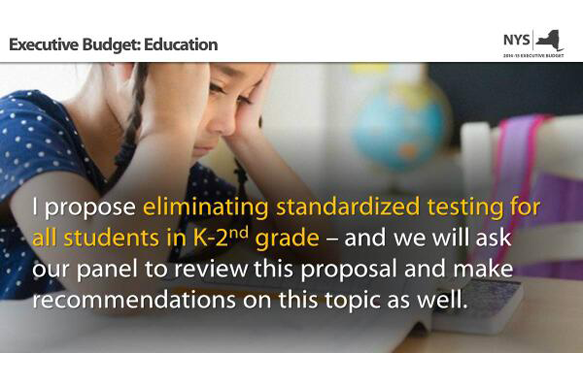
The perpetual question is when is progress progressive. When is a following a trend to an earnest desire to bend? Intellectually we know that nothing happens in an instant. Change, while constant, is incremental. There is a need for constant vigilance. So we ask, who can we trust and when. Does our heart leap when a Governor tweets a proposal to eliminate standardized testing for all k-2 students? Do we dare to think that this might be the beginning of an end to all standardized testing? When this same administrator recommends more dollars for prekindergarten education do we “commend,” condemn, or consider the possibility? Governor Andrew Cuomo is a man on the move, but to where.

Cuomo Expected to Unveil $1.5 Billion Plan to Expand Pre-K Statewide

By Susanne Craig and Thomas Kaplan | Originally Published at http://nyti.ms/1cQkdv3>The New York Times.January 21, 2014
ALBANY — Gov. Andrew M. Cuomo, in his budget address on Tuesday, is expected to propose setting aside $1.5 billion over five years to pay for an expansion of prekindergarten classes statewide, administration officials said.
The proposal by Mr. Cuomo is likely to be seen as an attempt to outmaneuver the new mayor of New York 

IL AFL-CIO endorses governor who cut union employee pensions – for teachers, etc. Why? | Reclaim Reform

IL AFL-CIO endorses governor who cut union employee pensions – for teachers, etc. Why? | Reclaim Reform:


IL AFL-CIO endorses governor who cut union employee pensions – for teachers, etc. Why?

IL AFL-CIO Pres. Mike Carrigan and the Executive Board made union history by endorsing Gov. Pat Quinn (D) for re-election. Quinn and other Democratic super-majority members of the state Senate and House passed SB1 to cut union teacher and state employee pensions. In spite of opposition by most members of the Illinois Federation of Teachers (IFT) and the American Federation of State and Municipal Employees (AFSCME), union members’ dues money will be handed to Quinn and others who signed this horrific bill.
Carrigan 1
Why would the IL AFL-CIO endorse the governor whose decision is being brought to court by AFL-CIO unions? Why?
AFL-CIO unions are planning to take the SB1 pension pillage decision all the way to the state Supreme Court. The IL AFL-CIO endorsement of the same politicians who have enacted the bill is self-defeating. The IL AFL-CIO is part of the divide in Divide-and-Conquer.
This is not a matter of choosing the lesser of two evils; corporate backers of all the gubernatorial nominees want a piece of the pension pillage. Quinn has done more damage 

Ms. Jablonski's Class Blog 1-21-14

Ms. Jablonski's Class Blog:


Citizens United
     Four years ago today, in the Citizens United v. Federal Election Commission case,  the U.S. Supreme Court  held that the First Amendment prohibits the government from restricting political independent expenditures for corporations, associations, or labor unions. In the most recent election following the ruling, President Obama spent a record-high amount on his presidential campaign. Unsurpris


Former Virginia Governor and Wife Indicted
     Former Virginia governor Bob McDonnell and wife have been indicted by a federal grand jury for accepting an estimated $140,000 in loans and gifts in exchange for the ex-governor to promote dietary supplements. McDonnell is accused of lying on loan applications by failing to report money donated by Jonnie Williams Sr., the chief executive of Star Scientific, a dietary supplement company. Mrs.
Ms. Jablonski's Class Blog 1-20-14
Ms. Jablonski's Class Blog: The Future of GlassholesBy now, most of us have heard of Google’s latest endeavor to give us what we…may or may not need: smart glasses. These futuristic ‘Google Glasses’ allow users to access a world of holographic information, making it possible to use the internet (and more) without having to drag out those cumbersome smartphones. Though critics have been quick to po