Latest News and Comment from Education

Monday, August 12, 2013

Signs Your Teen is a Victim of Cyberbullying - High School Notes (usnews.com)

Signs Your Teen is a Victim of Cyberbullying - High School Notes (usnews.com):

Signs Your Teen is a Victim of Cyberbullying

August 12, 2013 RSS Feed Print
Anxiety and changes in online behavior are red flags that can indicate to parents that their teen is the target of cyberbullying.
Cyberbullying is serious, and scary. Teens can be harassed anytime, anywhere and by anyone.
The incessant taunting can drive students to take drastic measures. One Oregon teen attempted suicide after classmates harassed him online, and police are investigating whether cyberbullying was a factor in a recent suicide by a 12-year-old girl in New York, according to reports.
More than one in 10 teens feared for their safety or were afraid to go to school because of social media activity, according to a report by McAfee. The online security company interviewed close to 1,180 youth ages 10 to 23 for the June 2013 report.
Almost 15 percent of those surveyed reported being the target of cyberbullying, but only 6 percent of parents believed their teen had been a target, the report notes.
While digital harassment doesn't leave physical signs such as bruises and black eyes, there are emotional and behavioral red flags that can tell parents if their high school student is a victim of online bullying.
If your high school student normally spends all night on Facebook and 

High-Quality Early Education for Children Who Have Autism |

High-Quality Early Education for Children Who Have Autism |:

High-Quality Early Education for Children Who Have Autism

Photo: Alessandra Hartkopf for Strategies for Children
A new study takes on the debate over which preschool teaching models effectively support children who have autism spectrum disorders.
The study found that several models were beneficial. According to the study’s researchers, what appears effective for supporting children who are on the autism spectrum – as well as for those who are not – is being enrolled in a high-quality early education program.
Comparing Interventions
As Education Week explains in its blog, “A comparison of two well-known interventions for young children with autism, LEAP and TEACCH, has found that both of them produce gains among students during the school year—and so does high-quality classroom instruction that is not tied to any particular model.”
“The TEACCH model is based on creating an environment that meets the characteristics and learning needs of young children with autism, often using visual schedules and work systems,” according to a summary of the study, which was conducted by researchers at the Frank Porter Graham Child 

LISTEN TO DIANE RAVITCH 8-12-13 Diane Ravitch's blog | A site to discuss better education for all

Diane Ravitch's blog | A site to discuss better education for all:

Click on picture to Listen to Diane Ravitch


Who Supports Common Core? Business Leaders.
The collapse of test scores in New York State was immediately followed by a ringing endorsement by business leaders. Their statement was assembled by Education Reform Now, a corporate reform group that promotes privatization. The business leaders, including Joel Klein, are certain that there will be no prepared workers for them to hire without Common Core. How many of them know what the standards

The CAN Vulture Arrives in North Carolina
Supporters of public education in North Carolina are reeling as a result of the sustained assault by the Legislature in this session, but in comes a Gates-funded project to claim that defeats are actually victories and to lobby for merit pay. The CAN idea is supported by hedge fund managers and Gates to promote charter schools, evaluating teachers by test scores, awarding higher pay to those whose


Matt Damon: A Hero of American Education
Here, Arthur Goldstein explains why Matt is a hero of public education, and why those who send their kids to tony elite schools while they close public schools are not. The corporate reform PR machine has trained its big guns on him because he put his kids in a private school. First, they wreck public schools by turning them into testing factories, then they ridicule those who don’t like what they

Why Did Stores Abandon Teacher Appreciation Day?
This article tells a sad story of teachers in San Francisco who count on a yearly event called Teacher Appreciation Day to get free stuff for their students. Before the era of deep budget cuts, teachers didn’t have to forage for school supplies. But once the budget cutting started, it never ended. The teacher in this story plans her day and figures she can visit nine stores to pick up free stuff t

No Accountability for Nonpublic Schools
A reader from Milwaukee sent this comment: “You would think there would be accountability, but here in Milwaukee we have had religious school choice and charter for a number of years. “There is practically no accountability to the state DPI regarding certification of staff, assessments, curriculum, open records, etc. We are requiring them to seek some type of private school accreditation, but giv

A Hero Educator in Long Island
This superintendent saw the scores on the Common Core tests and hit the ceiling. He was not shy in contacting his legislators and parents to tell them that he smelled a rat. The state commissioner predicted a 30-37% fall in scores last fall, and lo and behold, there was a 30-37% fall in scores. Superintendent Joseph V. Rella of the Comsewogue School District in Long Island joins the honor roll tod

Chile: The Most Pro-Market School System in the World, Part 1
This is the first of three posts written by Professor Mario Waissbluth about education in Chile. I invited him to contribute to the blog, because Chile represents our future if we continue our present course of action towards a market system built around the principles of testing and choice. Chile´s Education (I): The most pro-market system in the world Mario Waissbluth This is the first of three


A Hero Educator in Upstate Néw York!
Imagine the superintendent of a high-performing district who is fearless and speaks boldly about the political manipulation of the Common Core test scores. Imagine a woman who defends the students and staff against the rigging of scores by ambitious politicians and bureaucrats. That is Teresa Thayer Snyder of Voorheesville in upstate Néw York, a district that has a 97% graduation rate. Scores cras
Diane in the Evening 8-11-13 Diane Ravitch's blog | A site to discuss better education for all
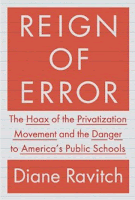
Diane Ravitch's blog | A site to discuss better education for all: Reign of Error: The Hoax of the Privatization Movement and the Danger to America's Public Schools Hardcover – Deckle Edgeby Diane Ravitch  (Author)What’s Not to Like About Exeter? Sidwell? Lakeside? Dalton?The folks at the Thomas B. Fordham Institute are struggling to come to terms with the New York testing disaster. They certainly

 Reign of Error Coming Soon (click picture)

Study: Georgia Performance Standards More Rigorous and Detailed than Common Core | Scathing Purple Musings

Study: Georgia Performance Standards More Rigorous and Detailed than Common Core | Scathing Purple Musings:

Study: Georgia Performance Standards More Rigorous and Detailed than Common Core


Rate This


From Carly Sharec in the Gainesville Times:
Sen. William Ligon, R-Brunswick, released independent study results Aug. 5 that showed the previous Georgia Performance Standards were more rigorous and detailed than Common Core.
“This is a study that’s not just pulled out of the air,” said Gainesville Superintendent Merrianne Dyer. “(These are) reputable people that have done the study. I would think we would welcome a study like that to be done.”
The studies were independently conducted by Mary Kay Bacallao, a mathematics professor at Mercer University’s Tift College, and Sandra Stotsky, the professor emerita of education reform at the University of Arkansas. Stotsky is also a former member of the Common Core Validation Committee.
Dyer pointed out that there are studies that show the other side of the 

8-12-13 Ed Notes Online

Ed Notes Online:


Can We Close the Achievement Gap Between Success Academy and Democracy Prep, KIPP et al?
Emergency crisis emerges as Eva's Success exposes massive achievement gap amongst charters.Moskowitz proclaims: They would have done better if not for those bad teachers at the charter schools. Clearly there are not enough choices out there for parents to choose between good and bad charters. But since we are the only good charter, I am changing my position on choice. We should be the only choice.

Rob Rendo on Common Core
Common Core or no Common Core, standards for what children should know by a certain age (skills or content) have always been in flux and controverted.The CCSS is, I think, on an extreme part of that spectrum of flux.The consensus reality and research that more or less corroborates what, for example, a fifth grader should be able to do in math or ELA, has been largely ignored by policy makers for t
8-10-13 Ed Notes Online
Ed Notes Online:   Newsday: drop in scores cd strengthen opt out movementImagine if they gave a test and nobody came. Grow the opt-out movement. Support the refuseniks. Join with Change the Stakes. Let's start organizing a parent boycott of the tests. Leonie sent this Newsday piece.http://shar.es/yYoR9Hofstra Prof: Parents backed into corner LI Supe: new data uselessThe dramatic drop in student sc

Common Core poses big challenge for students, big opportunity for teachers | EdSource Today

Common Core poses big challenge for students, big opportunity for teachers | EdSource Today:

The complex language skills that are the focus of Common Core's English language arts standards will be required in math and the new science standards and are integral to the newly adopted California language standards for English learners (courtesy of Dr. Norma Sanchez of CTA's Instruction and Professional Development Department and presenter at CTA's Summer Institute this month.
The complex language skills that are the focus of Common Core’s English language arts standards will be needed to excel in Common Core math and the new science standards. They are  stressed, too, in California’s new language standards for English learners. Courtesy of Dr. Norma Sanchez of CTA’s Instruction and Professional Development Department and a presenter at CTA’s Summer Institute.
With an emphasis on developing verbal and analytical skills, the new Common Core standards will pose a big step up for most students. For English learners, who comprise a quarter of California’s children, it’ll seem more like a pole vault.
“Common Core is pushing us toward a higher level of achievement, and that depth is predicated on an ability to use language in sophisticated ways,” said Ben Sanders, director of standards, assessment and instruction for the 10 districts that formed the nonprofit California Office to Reform Education, or CORE.
Recognizing this will also be a unique opportunity and a heavy lift for teachers. CORE’s second annual Common Core summer conference for 450 teachers and administrators in San Francisco this month concentrated on teaching academic language – the shorthand for becoming fluent in the vocabulary, compound sentences and thought processes demanded to analyze texts, 

The Role Of Businesses In Education Reform | toteachornototeach

The Role Of Businesses In Education Reform | toteachornototeach:

The Role Of Businesses In Education Reform

by Katie Lepi
Better prepared, higher achieving students mean better workers, stronger businesses and a better economy, right? In all theory, this should be true. In the handy infographic below, the US Chamber of Commerce Foundation takes a look at the US education system from a business perspective. Will more students staying in school mean less unemployment? Will outcomes-based learning reform make a difference? These questions are being asked but it doesn’t seem like anyone is answering them. That’s not unlike schools right now where classrooms are becoming a bit less reliable as indicators of the health of a country. In other words, the U.S. education system (to pick one as an example) is in need of some healthy education reform and there’s a role that businesses of all sizes should be playing. Not to make money off the system but instead to help make it better and productive. That, in turn, will yield some high quality students for those businesses in the long run. Below are just some of the interesting statistics offered in this visual look at ed reform.
Why should a small (or any size, really) business care about education reform? This visual sheds some light on the key things all businesses should know.

A Business Case For Education Reform

  • 49% of US employers say they have difficulty filling job vacancies due to lack of 

NYC Educator: Who's Afraid of Matt Damon?

NYC Educator: Who's Afraid of Matt Damon?:

Who's Afraid of Matt Damon?

It's amazing watching reformy people fall all over themselves to condemn actor Matt Damon for sending his kid to a private school. They claim to be wounded because the less fortunate haven't got that option. The poor are stuck in a world where schools full of kids who don't speak English or have learning disabilities fail to pass standardized tests.

You'd think it was an outrage, and that Damon was personally depriving the less fortunate of the opportunity to attend a charter school where they can march around like little soldiers for 200 hours a week. You'd think those schools actually accepted the non-English speakers or the kids with extreme learning disabilities without exception. You'd think that test scores were the only thing that was important, or that rich people sent their kids to schools where tests were all that mattered.

Personally, I would not send my kid to a charter school on a bet. Nor would fervent charter supporters Rahm Emanuel, Michael Bloomberg, Joel Klein, Reformy John King, or Barack Obama. In fact, these are the very people that dictate the all tests. all the time. In fact, by closing schools based on test scores, these people deprive Americans of the choice they take as a given--neighborhood schools.

These are the same people who have fought the middle class for years. Here's a secret--the one thing that makes a middle class thrive is union. Look at history if you don't believe me. Then take a look at Walmart's history with union. They close entire departments and stores rather than pay a living wage. Then, ask yourself why the Walmart 

In education, a ‘pobrecito’ syndrome « NewsTaco

In education, a ‘pobrecito’ syndrome « NewsTaco:

image
By Esther J. Cepeda, The Salt Lake Tribune
CHICAGO — When prospective educators go through training to prepare for teaching low-income, minority or at-risk children, they learn how to empathize with their students’ lives. They’re taught to acknowledge environments lacking in resources, order or stability and “meet” the students at their level before expecting them to learn as easily as other children do.
Yet for all the lip service that modern pedagogy pays to the precept that “all children can learn,” rare are the educators who believe this enough to push such students toward their full academic potential.
Instead, educators come up with misguided policies to go easy on groups of underperforming students, perpetuating the worst kind of disrespect — that of lowered expectations — on whole categories of children who are assumed to be less capable.
Click HERE to read the full story.
[Photo by Old Shoe Woman]

Serviceable Myths about School Reform: Second Time Around | Larry Cuban on School Reform and Classroom Practice

Serviceable Myths about School Reform: Second Time Around | Larry Cuban on School Reform and Classroom Practice:

Serviceable Myths about School Reform: Second Time Around


This post initially appeared November 7, 2010 just after the U.S. Congressional election that brought Tea Party Republicans and anti-Obama candidates into the U.S. Congress, state legislatures, and local offices. The split among  urban school reformers (“no excuses” crowd vs. those who advocate for a broader approach to reform encompassing the effects of poverty) still persists in mid-2013.
Even with the shift to the political right across the nation in last week’s election, both Republicans and Democrats, continue to tell a familiar story about American schools. That well-worn story often repeated by self-confident reformers (or “reformy types”) can be reduced to three statements.
1.U.S. children and youth have done poorly on international tests in reading, math, and science.
2. Students in other nations not only score better than U.S. students but also, upon graduation, possess competence and skills that surpass American workers thereby threatening America’s global competitiveness.
3. U.S. students do poorly on these international tests and in competition with workers elsewhere because the nation’s schools are broken. They can be fixed by holding practitioners accountable for student performance on tests, getting effective teachers 

Philadelphia schools again on precipice - Philly.com

Philadelphia schools again on precipice - Philly.com:

Philadelphia schools again on precipice

POSTED: August 11, 2013


"We have a responsibility to students and families," said Superintendent William R. Hite Jr. "We will not put them at risk, even if it means the first day of school may not be until after Sept. 9."

Philadelphia Superintendent William R. Hite's stunning announcement that schools will not open on time unless the district is assured of $50 million from the city, raised alarms this week.
But it was not the first time school operations had been threatened.
In 1998, then-Superintendent David Hornbeck warned that the district might have to close schools early the following year unless the state sent more money to the cash-strapped system.
The schools never closed. But Hornbeck's threat so enraged Harrisburg lawmakers that they passed legislation that led to a state takeover of the district in late 2001.
Despite a dozen years of state control, with three gubernatorial appointments on the five-member School Reform Commission, Philadelphia schools are on the precipice again: The deficit still stands at more than $270 million in a $2.39 billion budget. Nearly 4,000 employees have been laid off.
And Hite said Thursday that it would be irresponsible to open schools as planned Sept. 9 without counselors, noontime aides, assistant principals, and other support staff.
"This funding problem is real," he said. "We have a responsibility to students and families. . . and we will not put them at risk, even if it means the first day of school may not be until after Sept. 9."
But longtime educational observers and activists say the school system is facing much different circumstances now than 15 years ago. Privatization of education has taken hold, and the district's coffers are being drained by expenses outside its control.
"This is much deeper and much more threatening," said Shelly D. Yanoff, who retired in January after directing Public Citizens for