Wednesday, May 9, 2012

NYC Public School Parents: Juking the Stats: Hallmark of the Bloomberg administration

NYC Public School Parents: Juking the Stats: Hallmark of the Bloomberg administration:


Juking the Stats: Hallmark of the Bloomberg administration


Two of the most damning legacies of the 12-year Bloomberg imperium will likely be the fallacious, manipulative (over)use of data in the NYPD and the DOE -- what is commonly known in the police world as "juking the stats." For all who watch our children's educations and our city's public schools being systematically ruined by an ill-conceived and obsessive focus on "management by measurables," it is highly instructive to pay attention to the NYPD's parallel world of systemic data manipulation, intentional mis-reporting, and quota-driven law "enforcement" slowly being revealed as equally invalid, and equally damaging to cititzens' rights, self-respect, and even safety.

In Tuesday's NY Times, Michael Powell continued this reporting ("No Room for Dissent in a Police Department Consumed by Numbers). Just as Joel Klein and Dennis Walcott would sooner be tortured than 

Thoughts on the Washington State PTA Convention | Seattle Education

Thoughts on the Washington State PTA Convention | Seattle Education:


Thoughts on the Washington State PTA Convention

I had watched the charter resolution develop over the last several months from the time that the original plank was developed by Chad Mangendanz and Alison Meryweather through until the convention when Chad got up and talked about his visit to KIPP in San Diego as a school board member and how wonderful the school  was and how there was a graduation rate of 95% and on and on.
Chad called charter schools another “tool in the tool kit” during his impassioned plea for the vote on the resolution. The tool reference has become a worn out phrase used by the corporate privatizers when describing everything from TFA, Inc. to merit pay and now charter schools. But from my vantage point, I believe that the WSPTA was used as a tool by corporate reformers and it was an effective tool indeed.
All it took were a few people with an agenda to turn the voting process in their direction. Kelly Munn with the League of Education Voters, Chad Magendanz, and Alison Meryweather hail from the well to do suburbs of the Issaquah/Bellevue region, Region 2, the area with the greatest number of memberships and involvement. That region had the largest presence at the convention also. Whether the membership was there before and was 

Malloy’s 2012 Education Reform Initiative: It’s Not Whether You Win or Lose, But How You Spin the News… - Wait, What?

Malloy’s 2012 Education Reform Initiative: It’s Not Whether You Win or Lose, But How You Spin the News… - Wait, What?:


Malloy’s 2012 Education Reform Initiative: It’s Not Whether You Win or Lose, But How You Spin the News…

Hechinger Report | Getting a teaching license may soon include a new test — can hopefuls handle a classroom?

Hechinger Report | Getting a teaching license may soon include a new test — can hopefuls handle a classroom?:


Getting a teaching license may soon include a new test — can they handle a classroom?

To earn a teaching license in most states, candidates must pass a handful of exams — largely multiple-choice — that test basic skills and knowledge of specific subjects. Some states also include tests that focus on teaching strategies. One state, Montana, requires no tests at all, just graduation from a teaching program.
This pathway to the classroom has long been called into question. Now, 25 states — including Minnesota — are preparing to test a brand-new assessment that will judge teachers-to-be on how they work with real students. As policymakers and reformers across the country push to make America’s teaching force more effective, developers of the so-called Teacher Performance Assessment hope it will provide a much-needed overhaul to the 

Everyone has iPad except the BIG EDUCATION APE

Orangutans at Miami's Jungle Island use iPads to communicate - Florida Wires - MiamiHerald.com:


Orangutans at Miami's Jungle Island use iPads to communicate


ASSOCIATED PRESS

The 8-year-old twins love their iPad. They draw, play games and expand their vocabulary. Their family's teenagers also like the hand-held computer tablets, too, but the clan's elders show no interest.
The orangutans at Miami's Jungle Island apparently are just like people when it comes to technology. The park is one of several zoos experimenting with computers and apes, letting its six orangutans use an iPad to communicate and as part of a mental stimulus program. Linda Jacobs, who oversees the program, hopes the devices will eventually help bridge the gap between humans and the endangered apes.
"Our young ones pick up on it. They understand it. It's like, 'Oh I get this,'" Jacobs said. "Our two older ones, they just are not interested. I think they just figure, 'I've gotten along just fine in this world without this communication-skill here and the iPad, and I don't need a computer.'"
Jacobs said she began letting the orangutans use iPads last summer, based on the suggestion of

Read more here: http://www.miamiherald.com/2012/05/09/2790545/orangutans-at-miami-zoo-use-ipads.html#storylink=cpy

FCMAT » Cali Education Headlines Wednesday, May 9, 2012

FCMAT » Fiscal Crisis & Management Assistance Team:


Education Headlines

Wednesday, May 9, 2012


Lodi Unified says plans 'stable' for 2012-13 school year

The Lodi Unified School District remains in position to fully implement an estimated $215 million spending plan for 2012-13.

Bret Harte kids bring their own computers

Bret Harte Union High School District will continue its “Bring Your Own Device” program next year, after a successful spring trial run that allowed students to use their own laptops and other electronic devices for academic work on campus.

Schools benefit changes could take until 2014

San Diego schools have put together a timeline to determine whether they’re getting a good deal on $167 million of annual health benefits for employees, and the process could take 19 months.

Twin Rivers Unified's legal tab nearly $1 million for 4 months; union seeks audit

Outside legal counsel for Twin Rivers Unified billed the north area school district nearly $1 million in the past four months, prompting renewed calls by its teachers union for an audit.

Teachers, school district at impasse

Teachers in the Jurupa Unified School District, who are at an impasse in contract negotiations with district officials, took their message to the streets on Monday, May 7.

Modesto teachers, district reach an impasse

The Modesto Teachers Association has come to an impasse with Modesto City Schools after negotiations between the two sides broke down over cuts to the Child Development Program and proposed salary restorations.

Palm Springs USD to cut 40 jobs

About 40 teachers and support staff will be laid off from Palm Springs Unified School District this year, the Board of Education decided Tuesday.

LAUSD approves $2M for New Media and Technology Center at Granada Hills Charter High School

Granada Hills Charter High got the OK Tuesday for a $2 million New Media and Technology Center that will add 200 seats to the nation's largest charter campus.

Moraga's Measure A short of passing

With 5,324 ballots tallied Tuesday evening, Measure A, an annual $225-per-parcel tax, was 334 votes short of passing. While 64.58 percent of voters approve of the measure, that number is short of the two-thirds majority required for passage.

Potrero Hill elementary school is a success story

Six years ago, they were idealistic new moms living on Potrero Hill and embarking on an unlikely quest: saving their neighborhood school, Daniel Webster Elementary, from closure by the San Francisco school board.

School districts on edge of insolvency hit record high

The number of California school districts at risk of failing to meet their near-term financial obligations has reached an all-time high and is likely to increase between now and June, the state’s watchdog on school finance reported Tuesday.

Details emerging about Brown’s revised school financing plan

Gov. Jerry Brown will unveil his revised May budget on Monday amid growing signs the administration’s plan for restructuring school financing will differ significantly from the current proposal.

Weighted formula in waiting

With the cancellation of today’s joint hearing with the Senate and Assembly Education Committees, the Brown administration has dodged – for now – tough questioning on the governor’s plan for a weighted student formula.

Education leaders call for overhaul of state’s school accountability system

As state education leaders consider whether to seek a waiver from the most onerous provisions of the federal No Child Left Behind, they are also proposing a “comprehensive review” of the state’s accountability system put in place in 1999.

Arts high school students walk out to protest proposed budget cuts

More than 1,000 students from the Cortines School of Visual and Performing Arts walked from their downtown campus to school district headquarters Tuesday afternoon to protest budget cuts that have the potential to devastate the school’s arts program.

All L.A. Unified students must pass college-prep courses

The Los Angeles Unified School District will require all students to pass a college-preparatory curriculum beginning next fall. The Class of 2016, next year's ninth-graders, will be the first in the nation's second-largest school system who must take those courses needed to apply to a four-year state university.

Columnist: L.A. Unified's annual dance of death

They're doing the dance again — the soul-sapping, time-wasting annual ritual of figuring out how many of society's most important public servants to push off a cliff. RIF season, some call it, for Reduction in Force.

Report: California's public schools face crushing stress levels

California's public schools may be facing unprecedented levels of pressure as they try to teach an increasing number of children in poverty with fewer employees and a continual threat of cutbacks, a report by the Mountain View-based research group EdSource found.

The Privatization of Creativity | Dissident Voice

The Privatization of Creativity | Dissident Voice:


The Privatization of Creativity

1. The new hype about creativity
Who can hate creativity? Who would want less of it? No one, obviously.
But something profound has happened to the idea of creative expression in the past 20-30 years that should give us pause. For one, it’s become big business: as the globalized economy becomes more and more competitive, corporations are increasingly desperate to have their workers “create” new and different things to sell. As advertising media accelerate and slowly fill up public space, marketers are frantic to “creatively” (the people who come up with advertising ideas are actually called “creatives”) develop new ways of pitching products. And workplaces—from factories to hospitals to high tech firms to fast-food joints to schools—are all eager to “create” new products and forms of efficiency to keep the wolf at bay (usually at the expense of workers who must work longer, faster and leaner).
But it’s not just business that has embraced creativity as key to survival in the brave new world. These days whole governments have fallen in love with creativity as a means towards economic growth and social prosperity. Despite cuts to arts and culture budgets in this “age of austerity,” national, regional and local politicians pay lip service to the power of creativity not only to express people’s individuality, but to create jobs and heal communities. University of Toronto urban development guru Richard Florida has been staggeringly successful in 

Studying school quality, to fight inequality - MIT News Office

Studying school quality, to fight inequality - MIT News Office:


Studying school quality, to fight inequality

New MIT center examines education and its lifelong effects.
“The charter schools’ idea is, ‘Let a thousand flowers bloom,’” Angrist says. “Well, many of those flowers are dandelions. …


Charter Schools - Dividing Communities since 1991


 Education has long been perceived as a great leveler in the United States, providing opportunities throughout society. But at a time of economic struggle, millions of people are wondering if the country’s schools can still provide a platform for success.

“School quality and human capital are major issues on the American policy agenda,” says Josh Angrist, the Ford Professor of Economics at MIT, noting the emphasis President Barack Obama placed on the issue during his most recent State of the Union address. 

Yet it is hard for parents to make confident decisions about the subject. “A very difficult question is finding out what is a good school for your child,” says Parag Pathak, a 

David Chura: Who Are the True 'Failures' in America's School System?

David Chura: Who Are the True 'Failures' in America's School System?:


Who Are the True 'Failures' in America's School System?

"Those who can, teach. Those who cannot pass laws about teaching."

Like most teachers I've gotten some praise from my high school students over my 26 years of teaching -- a lesson "wasn't bad," or a particular class was "sorta interesting." I've even been told that I was a "pretty good teacher." High praise coming from teenagers.

But the truth is I wasn't a "good teacher." I was a "failure," at least according to America's "education reformers" -- that "odd coalition of corporate-friendly Democrats, right-wing Republicans, Tea Party governors, Wall Street executives, and major foundations" as Diane Ravitch aptly defines them -- because the kids I taught consistently lagged behind their peers in every measure, performing well below grade level, failing state standardized tests.

Given the present state of teacher evaluations, with a significant portion allotted to student 

Schools Matter: The Naked Truth about the National Reading Panel Report

Schools Matter: The Naked Truth about the National Reading Panel Report:

National Reading Panel Erred; Letter Incorrect
Published in Education Week, May 9, 2012

To the Editor:

I was astounded to read Linda Diamond's revisionist view of the last decade in literacy research ("Common-Core Standards in Reading Not 'Flawed,' " March 28, 2012).

Ms. Diamond maintains that the National Reading Panel's conclusions supporting explicit and systematic instruction "in the reading-foundation skills" is "well supported by research." Either Ms. Diamond is not aware of the furious criticism that emerged after the panel's report was published or she is ignoring it.

In a series of books, papers (published in the most respected journals in our field), and letters published in Education Week, Elaine Garan, Gerald Coles, and I, among others, argued that the National Reading Panel erred in its analysis and reporting of studies, omitted studies, ignored major issues in the field, and violated basic principles in appraising experimental research.

Despite its claims of being "scientific," the National Reading Panel report was simply bad science. Ms. Diamond is free to disagree with our conclusions, but she is not free to ignore them.

Stephen Krashen
Professor Emeritus
University of Southern California


The Naked Truth about the National Reading Panel Report

Stephen Krashen's letter to Ed Week in the previous post has motivated me to post the following review here for all those young teachers who are reading the deceptive, revisionist crap by those who want to impose another generation of the mind-scrubbing literacy tactics based on ideology rather than pragmatic practice grounded within good research and sound principles.

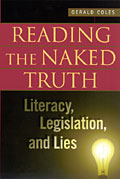
I did the following review of Gerald Coles' book in 2003, which examines the manipulations and strong-arming that produced the NRP Report and the failed Reading First initiative that followed.  The review was published by Gene Glass at Education Review.  Please excuse the short history lesson at the beginning.


Please buy and read the book.  

Coles, G. (2003). Reading the naked truth: Literacy, legislation, and lies. Portsmouth, NH: Heinemann. $24


October 12, 2003


A hundred years ago in America the contestants in a new conflict were fortifying their positions for the opening battles in a war for the control of American schools, a war that would see no lasting truce even to this day. While not the only contenders in a lengthy conflict that has seesawed back and forth over the generations, both of the primary combatants claimed progress as their cause and science as their main weapon. Their definitions and aims of science and progress, however, represented two very different and increasingly-polarized conceptions that were reflected in acrimonious differences on the aims and proper methods for schooling. One side, the hard progressives, wished to extend the goals of prediction and control from the hard sciences to efficiently manage social problems and maintain social stability through proper school training; the other softer progressivism blended philosophical romanticism with the emerging social sciences in an attempt to map and understand child development as the natural beginning point for designing 

Shanker Blog » The Weighting Game

Shanker Blog » The Weighting Game:


The Weighting Game

A while back, I noted that states and districts should exercise caution in assigning weights (importance) to the components of their teacher evaluation systems before they know what the other components will be. For example, most states that have mandated new evaluation systems have specified that growth model estimates count for a certain proportion (usually 40-50 percent) of teachers’ final scores (at least those in tested grades/subjects), but it’s critical to note that the actual importance of these components will depend in no small part on what else is included in the total evaluation, and how it’s incorporated into the system.
In slightly technical terms, this distinction is between nominal weights (the percentage assigned) and effectiveweights (the percentage that actually ends up being the case). Consider an extreme hypothetical example – let’s say a district implements an evaluation system in which half the final score is value-added and half is observations. But let’s also say that every teacher gets the same observation score. In this case, even though the assigned (nominal) weight for value-added is 50 percent, the actual importance (effective weight) will be 100 

Citing Costs, Poor Service, Charters Ditch District Special Ed - voiceofsandiego.org: Education

Citing Costs, Poor Service, Charters Ditch District Special Ed - voiceofsandiego.org: Education:


Citing Costs, Poor Service, Charters Ditch District Special Ed

Posted: Tuesday, January 17, 2012 6:00 am
 
There's a quiet, studious hum in Deborah Armusewicz's classroom. Kids dressed neatly in button-down, pine-green sweater vests and neckties politely raise their hands to answer questions while two support teachers mill around the room like earnest chaperones, pausing occasionally to whisper encouragement or corrections over a child's shoulder.
Observing this calm period at one of the two special education classes at Gompers Preparatory Academy is Jane Firpo, the school's assistant director. Firpo's eyes gleam as she watches the classroom click. She nods approvingly when kids answer correctly and stands to attention with the students as they "honor" each teacher in turn.
"Good morning Miss Armusewicz," she says, in unison with the children.
Firpo, who oversees Gompers's special education program, believes wholeheartedly in the way Gompers teaches children with special needs. She should. She and her team built it from scratch in 2009, when Gompers broke its last remaining tether to the school district.
The Chollas View school is one of dozens of local charters that have abandoned San Diego Unified School District's special education program since 2005 for reasons of quality, cost and philosophy.
Charter schools are almost entirely independent from San Diego Unified. They're independently funded and have the freedom to hire and fire employees without any input from the district. The 

Rheeform faces Rheesistance in Nashville | The Tennessean | tennessean.com

Great Hearts charter school faces resistance in Nashville | The Tennessean | tennessean.com:


Great Hearts charter school faces resistance in Nashville

Parents fear school wants affluent, white families


Officials with Arizona-based Great Hearts Academies charter school chain say they never have had resistance trying to start schools around Phoenix like they’re having in Nashville.
After laws changed in Tennessee to lift a cap on the number of charter schools that can open, and also allow any student to enroll, Great Hearts targeted the Volunteer State and Texas to expand.
But about 50 Metro school parents stood before a microphone at Tuesday’s school board meeting, half asking members not to approve the charter school’s opening in 2013.
“We’ve never had … coverage like this — we just want to run schools,” said Peter Bezanson, chief academic officer for the chain.
Several parents against the charter, which is a public school but privately managed and offers a private school-like curriculum, said they feared Great Hearts is targeting affluent, white families in West Nashville. That could cherry pick high-scoring students out of