Latest News and Comment from Education

Sunday, April 18, 2010

Alan Pagano, Teaching and Learning: Merit pay for teachers - Santa Cruz Sentinel

Alan Pagano, Teaching and Learning: Merit pay for teachers - Santa Cruz Sentinel
Alan Pagano, Teaching and Learning: Merit pay for teachers

A heated debate surrounding merit pay for teachers has existed for decades in the United States, where since the 1920s public schools began awarding compensation primarily according to title and years of experience rather than performance.
Political leaders such as President Barack Obama and US Secretary of Education Arne Duncan have recently expressed support for the notion of merit pay for teachers. In March 2009, Obama said that teachers should be treated "like the professionals they are while also being held more accountable. Good teachers will be rewarded with more money for improved student achievement, and asked to accept more responsibilities for lifting up their schools."
This has reinvigorated the debate, with many groups staking out positions on either side. The National Education Association, for example, has opposed merit pay, while the United Federation of Teachers, at least in part, seems to support the idea.
Here is a summary of questions and pro and con responses within the debate.
Does merit pay help attract and retain quality teachers and "weed out" bad teachers?

World Sentinel | Changes in Teaching are Possible When Teachers Work Together to Solve Instructional Problems

World Sentinel | Changes in Teaching are Possible When Teachers Work Together to Solve Instructional Problems

Changes in Teaching are Possible When Teachers Work Together to Solve Instructional Problems

Newswire Services
Washington, DC -- Teachers are more likely to make deliberate changes in their teaching practices when they work collaboratively and systematically to solve instructional problems, according to a research study published by Dr. Brad Ermeling in the journal Teaching and Teacher Education.

"International research shows us that teaching is a cultural activity, and the routines we learn as teachers are very difficult to change," said Dr. Ermeling. "This study is noteworthy because it's one of the first to trace a connection between teachers working together to study their teaching and specific changes in classroom practice."

The research focused on a group of science teachers at a high school in southern California. Findings from the project informed the secondary school design of Pearson Learning Teams, an evidence-based, collaborative model that brings together teachers to learn from each other, refine their skills to improve student performance and self-assess their progress. Dr. Ermeling is now senior director for Pearson Learning Teams.

The study, "Tracing the effects of teacher inquiry on classroom practice," is published in the April edition of Teaching and Teacher Education and is available atwww.sciencedirect.com.

Although they are widely practiced in professional development, there has been little evidence until now that the teacher collaboration models of learning teams, action research, Japanese lesson study and other inquiry-based models, though common, actually lead to changes in instruction. Dr. Ermeling's study is one of the first to establish this connection through a systematic analysis, identifying a particular instructional innovation that emerged from the team's research and planning and tracing its faithful implementation into the classroom.

The teachers in the study made some small but rather dramatic changes in their approach to teaching science by planning and implementing lessons, observing eac

SF Senator Gets Student Journalism Awards This Weekend: The Alley: SFAppeal

SF Senator Gets Student Journalism Awards This Weekend: The Alley: SFAppeal

SF Senator Gets Student Journalism Awards This Weekend


State Sen. Leland Yee, D-San Francisco/San Mateo, will receive two awards this weekend for authoring bills that protect student journalists and their advisors.
The Journalism Education Association will present Yee with its Friend of Scholastic Journalism Award at a ceremony in Portland, Ore. today.
The award goes to an individual or group that makes a significant contribution to scholastic journalism, according to the Journalism Education Association.
The California College Media Association will also present Yee's staff with the organization's first annual Leland Yee Award today, which will be given to an individual who goes "above and beyond" in supporting college media. The ceremony will be held at Hearst Castle in San Simeon.
Yee said he was honored to receive the awards.
"It is essential that our high school and college campuses have a press free from censorship and that our laws protect students and teachers from retaliation by administrators," he said in a prepared statement.
In 2006, Yee authored AB 2581, which prohibited censorship of college student press in California and made it illegal to retaliate against students for exercising this right.
SB 1370 extended this protection from retaliation to university employees, including faculty

EDITORIAL: Free association - Opinion - ReviewJournal.com

EDITORIAL: Free association - Opinion - ReviewJournal.com
EDITORIAL: Free association

High court takes up First Amendment case

On Monday, called upon to overturn yet another piece of "inclusionary" nonsense from the 9th U.S. Circuit Court of Appeals, the U.S. Supreme Court will consider whether a public university can force a Christian student group to accept as voting members students who explicitly reject core tenets of the group's faith.
Oh, what a tangled web we weave ...

The case is Christian Legal Society v. Martinez. At the University of California's Hastings College of the Law in San Francisco, the Christian Legal Society is an evangelical Christian student group that accepts all students at its functions but requires voting members and leaders to sign a statement of faith. The statement endorses "biblical principles of sexual morality," and makes clear that a student who "advocates or unrepentantly engages in sexual conduct outside of marriage between a man and a woman" isn't eligible to vote for or become a group leader.
If they were, what would be the point of having the group?
The group's petition to the court explains: "A person's mere experience of same-sex or opposite-sex sexual attraction does not determine his or her eligibility for leadership or voting membership." CLS does not prohibit gay students from voting membership or leadership positions -- providing the gay student shares CLS's view of homosexuality.
The distinction may seem a bit convoluted, but so is case law on the First Amendment's freedom of association. The court has held, for instance, that a Jaycees chapter could not continue excluding women from membership, since the group could not articulate any specific way in which admitting women would be at war with the group's purposes.
On the other hand, the case most closely on point is Boy Scouts of America v. Dale (2000), in which the Supreme Court ruled that the private organization had the right, under the Constitution, to discriminate in its hiring policy because the organization stood primarily for certain values.

Digital Domain - Two Billion Laptops? It May Not Be Enough - NYTimes.com

Digital Domain - Two Billion Laptops? It May Not Be Enough - NYTimes.com

Two Billion Laptops? It May Not Be Enough


Udai Singh Pawar
Students in Tamil Nadu, India, trying a Microsoft program that allows multiple users on a single computer.


It’s been slow going. About 1.6 million of the group’s laptops have been distributed to date, said Matt Keller, vice president for global advocacy at the O.L.P.C. Foundation, based in Cambridge, Mass. Today, the largest concentrations are in Uruguay, at around 400,000, and Peru, at 280,000, followed by Rwanda (110,000) and Haiti and Mongolia (15,000 each).
In 2006, the O.L.P.C. Web site pitched its laptop as a technology that “could revolutionize how we educate the world’s children.” Today, the “R” word is gone. Now the site speaks in more muted language of “developing an essential resource — educated, empowered children.”
“The biggest obstacle to our spreading the dream is cost,” Mr. Keller said.
Ninety percent of the machines have been paid for by the recipient countries’ governments, whose resources are extremely limited. I asked Mr. Keller if project leaders had reconsidered the “per child” part of the program. “One Laptop Per Classroom”

Viewpoints: Future of state's students still rests on skill of teacher in the classroom - Sacramento Opinion - Sacramento Editorial | Sacramento Bee

Viewpoints: Future of state's students still rests on skill of teacher in the classroom - Sacramento Opinion - Sacramento Editorial | Sacramento Bee

Viewpoints: Future of state's students still rests on skill of teacher in the classroom

As former teachers, our roots are in the classroom. Paths taken beyond teaching have kept us focused on the tremendous challenge of educating the state's more than 6 million students. One lesson we have learned absolutely is that effective teachers are essential to student success. So it is with great sadness that we have witnessed recent events that could irreparably damage the teaching profession and, as a result, further threaten educational opportunities for California's children.
Over the past five years, in what is characterized by some as "death by a thousand cuts" (literally), districts have responded to the budget crisis in part by sending layoff notices or "pink slips" to tens of thousands of teachers. The effects of these notices go well beyond school boundaries. History tells us that when they are issued, there is a concurrent decline in the number of individuals preparing to become teachers and fewer


Read more: http://www.sacbee.com/2010/04/18/2685026/viewpoints-future-of-states-students.html#ixzz0lSVgjDrm

Students rally, demand end to UC’s kangaroo court system : Indybay

Students rally, demand end to UC’s kangaroo court system : Indybay
Students rally, demand end to UC’s kangaroo court system
by Occupy CA (repost)
Sunday Apr 18th, 2010 1:09 AM
UC Santa Cruz students demand an immediate end to the UC’s unconstitutional and coercive judicial proceedings directed at those who were present at or involved in the occupation of Kerr Hall during a three day political uproar against UC Regents’ 32% tuition hike in November 2009.

UC Santa Cruz students demand an immediate end to the UC’s unconstitutional and coercive judicial proceedings directed at those who were present at or involved in the occupation of Kerr Hall during a three day political uproar against UC Regents’ 32% tuition hike in November 2009. Since the three-day occupation at which hundreds of students were present, along with faculty and family observers, UC admins have conducted a cynical political campaign against 36 students to silence them, charge them “restitution” fees in the amount of $34,000, and shut them out of a campus-wide dialogue concerning debilitating cuts to public education.

Both state of California and UC admins greatly fear a growing and powerful student movement that threatens their capacity to privatize higher education and avoid addressing the failure of priorities at the UC, such as spending millions on redundant administrative jobs while laying off teachers. At stake in the student politics this year are the shared principles that guide the university’s commitment to an accessible and outstanding education. UC executives’ breathless disregard for student involvement in helping to define these principles is exposed in their use of a university “Handbook” to react to peaceful collective student behavior of a political nature: the “Handbook” may provide a workable mechanism for adjudicating non-political, individual violations that disturb the day-to-day functioning of the university, but it is wholly inadequate to comprehend the nature, intent, and ultimate justification for collective political actions to defend public education, sometimes even against leaders who seem to have abandoned their responsibility to do so. Instead of having the political courage to grant students the space necessary to disrupt what cannot be denied is a much larger, social ill in California concerning the state’s failure to support public education, Chancellor Blumenthal, EVC Kliger, and Vice Chancellor Felicia McGinty have shrunk to the status of institutional bureaucrats more concerned with law and order by (1) threatening students with police intimidation and force during the Kerr Hall occupation, (2) executing since then a shamefully uncivil judicial campaign that has a chilling effect on student dissent.

Furthermore, the UC has had the gall to pass off their judicial process as fair while barely attempting to conceal the fact that it casually dismisses basic concepts of constitutionality, including due process, protection against self-incrimination, free speech and assembly. Indeed, in a letter dated April 14 addressed to Chancellor Blumenthal, over 100 UCSC faculty demanded that “no students be separated from their student status or be charged with restitution for participation in the events in and around Kerr Hall, or for other political actions past and future…We call for a suspension of the student disciplinary procedure in these and future cases involving political dissent until the problems have been addressed.” A full rebuttal of both the University’s list of damages at Kerr Hall and its kangaroo court follows below.


Mass rally: 12:00 p.m., April 16, UCSC Quarry Plaza

A rebuttal of the University’s tactics and allegations

On November 19th-22nd, 2009, hundreds of UCSC students, faculty, workers, and other concerned affiliates, participated in an occupation of Kerr Hall, the main UCSC administration building, in protest of the UC Regent’s decision to


Interview with Chris Christie: New Jersey's 'Failed Experiment - WSJ.com

Interview with Chris Christie: New Jersey's 'Failed Experiment - WSJ.com

New Jersey's 'Failed Experiment'

The new governor is on a mission to make his state competitive again in attracting people and capital.


"I said all during the campaign last year that I was going to govern as if I was a one-termer," explains New Jersey Governor Chris Christie on a visit this week to the Journal's editorial board. "And everybody felt that it was just stuff you say during a campaign to sound good. I think after the first 12 weeks, given the stuff I've done, they figure: 'He's just crazy enough to do it.'"
Call it crazy, or just call it sensible: Mr. Christie is on a mission to make New Jersey competitive once again in the contest to attract people and capital. During last fall's campaign, while his opponent obliquely criticized Mr. Christie's size, some Republicans worried that their candidate was squishy—that he wasn't serious about cutting spending and reining in taxes. Turns out they were wrong.
Listen to Mr. Christie's take on the state of his state: "We are, I think, the failed experiment in America—the best example of a failed experiment in America—on taxes and bigger government. Over the last eight years, New Jersey increased taxes and fees 115 times." New Jersey's residents now suffer under the nation's highest tax burden. Yet the tax hikes haven't come close to matching increases in spending. Mr. Christie recently introduced a $29.3 billion state budget to eliminate a projected $11 billion deficit for fiscal year 2011.
California and New York have attracted headlines for their budget woes. Yet, as Mr. Christie points out, "Their problems are much smaller than ours as a percentage. [Gov.] David Paterson's talking about an $8.2 billion deficit in New York—I only wish."
After taking office in January, Mr. Christie declared an official state of emergency. This allowed

The culmination of Piru's charter battle � Ventura County Star

The culmination of Piru's charter battle � Ventura County Star:

The culmination of Piru's charter battle


"The Piru charter petition was approved 5-2 by the California Advisory Commission on Charter Schools at an April 6 in Sacramento. The chairwoman, Beth Hunkapiller, explained that the legal duty of the commission is to determine if the charter petition meets the 16 required elements. The petition must contain an appropriate educational plan and a budget that is balanced.

The charter petitioners and administrators of the Fillmore Unified School District then gave their presentations, followed by questions from the commissioners mainly about enrollment and the budget.

Questions to administrators mainly focused on their denial of the charter. Superintendent Jeff Sweeney responded by saying, “Ask the parents; they will tell you.” It seems Sweeney was oblivious to the fact that the commissioners wanted his professional assessment.

About 50 people, mostly charter opponents, addressed the commission. After a public deliberation, the vote was taken. If the California Department of Education grants approval next month, the last step in converting Piru Elementary School to Piru Charter"


Saving a neighborhood school


The concept of a neighborhood public elementary school is as American as apple pie. Neighborhood schools provide our children neighborhood friends. A neighborhood school also provides a culture similar to the culture in which our homes are located.
Further, in a neighborhood school, our children are generally closer to us — we can get to them more quickly in emergencies when we must. Finally, we can attend meetings at school more easily if our house is near to the school.
The concept of a neighborhood school is being severely tested right now in the small, rurally isolated town of Piru. Culturally, it is home to ranchers and farmers who have lived among the citrus orchards, palm trees and cactus for generations. A large Spanish-speaking population, some of them migrant, also live both in Piru and close by in a housing development called Rancho Sespe.
Piru contains one public elementary school. A sign on campus reads, “Piru Elementary School Est. 1887.” Of its 345 students, Spanish is the home language for 191 of the students, or 55 percent. The nearest elementary school outside of Piru is San Cayetano, 

Community Colleges see double-digit enrollment increases - Fosters

Community Colleges see double-digit enrollment increases - Fosters
Community Colleges see double-digit enrollment increases
Four-year schools embrace credit transfer programs

By Jason Claffey
jclaffey@fosters.com
Sunday, April 18, 2010

Picture

John Huff/Staff photographer Great Bay Community College.


Faced with an unprecedented surge in enrollment, community colleges across the country — including local ones — are having to do something they've rarely done before: say no to applicants.

And the trend is leading traditional four-year colleges to increasingly embrace the "two plus two" model, through which a student earns a four-year degree by spending two years at a community college and two at a four-year institution.

Last year, Maine's community college system turned away 4,000 students from their first program of choice. While New Hampshire's community college system doesn't keep track of the same numbers, an official with the system said its most popular programs are filling up faster than ever.

The trend isn't only local. California's community colleges were forced to turn away 200,000

Inside the Rubber Rooms: Teachers Who Don't Teach - Associated Content - associatedcontent.com

Inside the Rubber Rooms: Teachers Who Don't Teach - Associated Content - associatedcontent.com

Inside the Rubber Rooms: Teachers Who Don't Teach


As a teacher, I have the utmost respect for my colleagues. Having worked in the field since college, I have been around some very hardworking and dedicated professionals. You have probably heard of the debate of
whether or not teachers get paid too much or too little. Some feel that teachers have a ton of work and have to deal with behavioral issues, parents, administration and paperwork. Others think that teachers have "summers off" and should be paid less. This is a lengthy debate and one that is completely subjective. What I am concerned about is the when teachers get paid to do nothing.

Recently, New York Schools have been shoved into the spotlight for a decision to put an end to "rubber rooms." What is a rubber room? According to the Associated Press article, NYC to stop paying teachers to do nothing, it is a room "where hundreds of educators spend months or years in bureaucratic limbo, costing taxpayers tens of millions of dollars a year." Furthermore, these teachers

Special education a second chance for pink-slipped teachers - San Jose Mercury News

Special education a second chance for pink-slipped teachers - San Jose Mercury News


Special education a second chance for pink-slipped teachers

Updated: 04/17/2010 12:49:07 PM PDT

OAKLAND — Eric Bankston, a corporate salesman-turned-physical education teacher, had a moment of doubt when a pink slip arrived in the mail last spring, informing him that his position at Pinole Middle School might be cut.
"It leaves you asking yourself, What do I do now?" he said.
With some encouragement from his colleagues, the answer came to him: He would go into special education. A year later, the 37-year-old Oakland resident is teaching at the same West Contra Costa County school with many of the same kids — just in a different field.
Bankston is part of a new, statewide push to bring pink-slipped general education teachers into special education, an area with chronic staffing shortages. On Wednesday, the California Teacher Corps announced that the state's alternative teacher certification programs would work with school districts to provide special education training to teachers subject to layoffs.
State Superintendent of Public Instruction Jack O'Connell touted the initiative as a way to counter "the chilling effect on our teacher pipeline" caused by the state budget crisis.
"It's a win for everybody," said Catherine Kearney, president of the teaching corps. "The teacher keeps the job, the

California's university system: What went wrong? - Inside Bay Area

California's university system: What went wrong? - Inside Bay Area


California's university system: What went wrong?

Updated: 04/18/2010 05:26:45 AM PDT


Click photo to enlarge

Fifty years ago this month, California promised a low-cost, high-quality university education for every qualified high school graduate in the state. But that promise — inflated by growing populations and academic aspirations — expanded beyond the state's willingness to pay for it.
What went wrong? How did the university system that was long the envy of the world suddenly become the focus of angry street protests, overcrowded classrooms, soaring tuition and a monumental debate over whether the state can ever make good again on its groundbreaking mission?
While the recession turned a slow-brewing problem into an instant crisis, a Mercury News analysis of California's higher-education mess reveals that many factors drove the inevitable and ugly collision between the university system's ambitious and uncoordinated growth and the state's declining ability and desire to pay for it. Among the most critical:


  • Plummeting state support: Since 1990, state spending per student has dropped by half in inflation-adjusted dollars. While the state paid about 90 percent of a student's education 40 years ago, it now pays 69 percent for CSU students and 62 percent for those in the UC system.


  • No guaranteed funding: Unlike K-12 education, universities are not guaranteed a steady stream of funding. In the last 40 years, higher education's piece of the state's spending pie has been sliced in half — even while enrollment has jumped 21/2 times.


  • Continued expansion: In the past eight years, despite declining state support, UC added a new campus, seven new schools and at least 45 new programs. Cal State added a campus, many new science centers, and even a Ph.D. program — adding a research emphasis that was not part of its original mission.


  • Little coordination: While university systems in several other states must seek approval for spending and expansion plans, there is no oversight body in California with the formal authority to play such a role. UC and Cal State are often

  • Sacramento area schools try to serve healthier food - Health & Fitness - sacbee.com

    Sacramento area schools try to serve healthier food - Health & Fitness - sacbee.com

    Sacramento area schools try to serve healthier food

    Kids are lining up for sausage pizzas and corn dogs at Sacramento elementary schools, and that's just for breakfast.
    Strict school nutrition guidelines pending in the U.S. Senate may push those unhealthy breakfasts and other salty, processed foods off school lunch menus.
    The issue of school meals has gone prime time in recent months. First lady Michelle Obama has been making appearances across the country and on TV to bring attention to childhood obesity, which she links to an underfunded school nutrition system and diminishing physical education programs.
    Celebrity chef Jamie Oliver has irked many cafeteria workers with his reality show that highlights unhealthy food served in American schools.
    Oliver wants to change the standards in many elementary school cafeterias, where processed entrees arrive frozen, precooked and waiting


    Read more: http://www.sacbee.com/2010/04/18/2686657/sacramento-area-schools-try-to.html#ixzz0lSLEx1iw

    Saturday, April 17, 2010

    Education Alternatives 102: Mann, Dewey & Lane | Lefty Parent

    Education Alternatives 102: Mann, Dewey & Lane | Lefty Parent

    Education Alternatives 102: Mann, Dewey & Lane

    April 17th, 2010 at 19:49

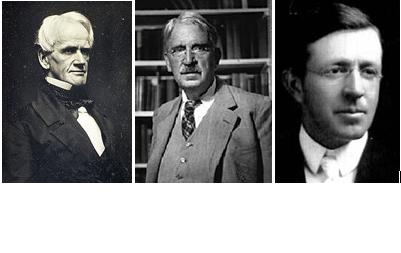
    Education Innovators Horace Mann, John Dewey & Homer Lane

    Following up on my recent“School Alternatives 101”post, I want to share some quotes from three great educational innovators who were “parents” (in this case, all “fathers”) of the three types of educational alternatives I talked about in my post. I want to focus on their visions’ of who drives the educational process, which I believe is a key way to distinguish these three approaches from each other. This may seem like “education-wonk” stuff to some of you, but I think it is really important, even from a parent’s point of view, when considering educational options for your and other kids.

    The three innovators I am talking about are…

    1. Horace Mann, the progenitor of the American public school system in the early 19th Century.

    2. John Dewey, who set the philosophical basis of American secular/progressive/liberal education in the early 20th Century.

    3. Homer Lane, a lesser know Briton and contemporary of Dewey, who was the mentor of A.S. Neill and the “free school” movement.

    The inspiration for this post was an article by Ronald Swartz in the most recent Spring 2010 Education Revolution Magazine (which is edited by my friend and colleague Ron Miller). Swartz’s piece is titled “John Dewey and Homer Lane: The Odd Couple among Educational Theorists” and focuses on this issue of who drives the educational process. According to Swartz, “Dewey and Lane are the founding fathers of two distinct twentieth century educational reform movements.”

    Dewey and Lane represent key “parents” to two of the educational alternatives, “holistic” and “free” schools that I talked about in my previous piece. To enhance and complete the comparison, I think it is useful to compare the ideas of these two to the words of Horace Mann, a Unitarian (like me), and an educational visionary who has had arguably more impact on the American

    Local News | Nonprofit school in talks to use T.T. Minor Elementary | Seattle Times Newspaper

    Local News | Nonprofit school in talks to use T.T. Minor Elementary | Seattle Times Newspaper

    Nonprofit school in talks to use T.T. Minor Elementary

    The boarded-up TT Minor Elementary School at 17th Avenue and Union Street could have a new tenant as early as this summer.
    Seattle Times staff reporter
    The boarded-up T.T. Minor Elementary School in Seattle's Central Area could have a new tenant as early as this summer.
    The Seattle School District is in talks with Hamlin Robinson, an independent, nonprofit school in South Seattle that serves first- through eighth-graders with dyslexia and other language-related problems, to lease the shuttered building at 17th Avenue and Union Street.
    T.T. Minor closed after the 2008-2009 school year as part of districtwide cuts. In December, the district announced it would accept proposals to lease seven school buildings, one of which was T.T. Minor. It's not for sale, though. District officials say they may need it to meet future enrollment demands.
    "(T.T. Minor) was really of interest to us, and it looks like a building we can move into pretty quickly," said Jeanne Turner, head of Hamlin Robinson.
    She said officials are hoping to grow their school, which now has about 120 students, into a destination center for people of all ages struggling with reading and writing.
    Such a move, if approved by the School Board, would narrow the competition for the Martin Luther King Jr

    Making sure students with disabilities get included: Parent-driven hope | OregonLive.com

    Making sure students with disabilities get included: Parent-driven hope | OregonLive.com

    Making sure students with disabilities get included: Parent-driven hope

    By Betsy Hammond, The Oregonian

    April 17, 2010, 4:13PM

    I got the chance to swing by the fifth annual parent-led conference Saturday for Portland-area parents and educators who want to drive constructive change in the way special education students are treated and taught in local schools.

    The energy and intensity were inspiring. About 140 parents and 70 special education teachers, principals and other education professionals were there, spending their whole Saturday learning about "universal design for learning," "co-teaching" and other hot topics in the field.

    The conference, called All Born In, is designed to address the common concerns that so many families who have a child with disabilities face on their own, says Angela Jarvis Holland, executive director of the Northwest Down Syndrome Association and a driving force behind the yearly confab. Portland State University also plays a big role in providing support and expertise.

    "The topics grow out of all the phone calls we get all year, that it's crazy to try to answer one by one by one," she says.

    Topics also are chosen to be positive and forward-looking, to try to instill new expertise in local parents and teachers, who often feel beaten down