Latest News and Comment from Education

Wednesday, March 4, 2020

5 Reasons Betsy DeVos is Bad for Public Schools - Education Votes

5 Reasons Betsy DeVos is Bad for Public Schools - Education Votes

5 Reasons Betsy DeVos is Bad for Public Schools


By Amanda Menas
Over the two years since Betsy DeVos was confirmed as President Trump’s secretary of education, she has worked against the best interests of public schools. From proposing funding cuts to promoting privatization to rolling back protections for vulnerable children, she has ignored the voices of educators across the country about what students need. 
DeVos has never worked in a public school. She has never been a teacher, a school administrator, nor served on any public board of education. She didn’t even attend public schools or send her children to public schools. 
As NEA President Lily Eskelsen García, a former elementary teacher from Utah, says DeVos is “the first secretary of education with zero experience with public schools…. She is out of her league when it comes to knowing and doing what works for public school students.”
Educators knew from the start that DeVos would be a disastrous choice, and she has been. Here are five times she has harmed our students, educators, and public schools.

1. She wants to privatize public schools

 Betsy DeVos has consistently pushed to expand federal vouchers that will take money from public schools to give to private schools. Her voucher bill is a brazen scheme that would take $50 billion from public schools over 10 years. Meanwhile, DeVos and President Trump proposed to cut education spending by $8.5 billion in 2020, eliminating more than two dozen programs that help public schools, including teacher development, academic support and enrichment, and after-school activities.
In the 2020 State of the Union, it was clear she had influenced Trump when he called for a national voucher program. She has also opened the door for private schools and religious organizations to receive a windfall of taxpayer funding. DeVos says the U.S. Department of Education will no longer enforce provisions that require federally funded services be provided only by public employees or contractors independent of private schools and religious organizations. It is an unprecedented move for a federal agency to indicate its intent not to enforce the law as written.

2. She won’t support students with disabilities

Starting off on the wrong foot, Betsy DeVos could not even address fundamental questions about the Individuals with Disabilities Education Act, including whether states and localities have to comply, during her confirmation hearing. Since then, she has stalled efforts to fight racial inequities in special education, causing a judge to rule against the education secretary’s proposal to delay an Obama-era rule that protects minority students in special education. The judge referred to DeVos’ attempted delay as “arbitrary and capricious.”
When DeVos proposed a $7 billion cut to education funding, she included a 26 percent  CONTINUE READING: 5 Reasons Betsy DeVos is Bad for Public Schools - Education Votes

Education Research Report TODAY: Number of Student Data Breaches, Ransomware Attacks Nearly Triple in Last Year

Education Research Report: Number of Student Data Breaches, Ransomware Attacks Nearly Triple in Last Year

Number of Student Data Breaches, Ransomware Attacks Nearly Triple in Last Year
Complete report


There was a sharp rise in the frequency of cyber incidents affecting public school districts across the U.S. in 2019, according to new research conducted by the K-12 Cybersecurity Resource Center.


Arlington, VA, February 27, 2020 – According to a report released today by the K-12 Cybersecurity Resource Center, The State of K-12 Cybersecurity: 2019 Year in Review, public K-12 education agencies across the country experienced a total of 348 cybersecurity incidents during calendar year 2019. This is nearly 3 times as many incidents as were publicly-disclosed during 2018. Many of these incidents were significant, resulting in the theft of millions of taxpayer dollars, stolen identities, and the denial of access to school technology and IT systems for weeks or longer.
Student and educator data breaches were the most commonly experienced type of incident in 2019. Over half of these were due to the actions of insiders to the school community, including edtech vendors and other third-party partners. The next most frequent type of cyber incident experienced by schools during 2019 was ransomware, mirroring the experiences of other local government agencies.
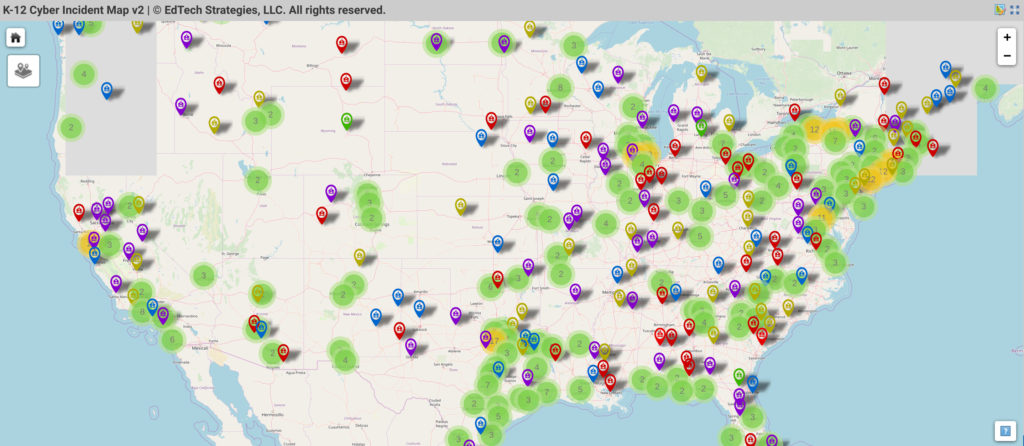
Data for the report is drawn from publicly disclosed incidents cataloged on the K-12 Cyber Incident Map. The map and underlying database capture detailed information about two inter-related issues:
  • publicly disclosed cybersecurity incidents affecting public K-12 schools, districts, charter schools, and other public education agencies (such as regional and state education agencies) in the 50 states and DC, and
  • the characteristics of public school districts (including charter schools) that have experienced one or more publicly disclosed cybersecurity incidents.

The K-12 Cyber Incident Map has identified over 775 school cybersecurity incidents since 2016.

Since 2016, the K-12 Cyber Incident Map has documented over 775 publicly disclosed incidents affecting students and educators across the country and grown to become the definitive source of K-12 cyber incident data.


Special challenges for charter schools, all subject to the same special education obligations under federal law as a traditional school district

Complete report Families with children with disabilities must constantly work to advocate for their children, find the school that provides the best fit, and assess whether educators are providing the right interventions. This can be exhausting and frustrating, especially when it comes on top of the unique demands of parenting a child with a disability. Add to that the reality of living in povert
Completing College National and State Reports - Updated with State-Level Trends​

The national college completion rates continue to rise. The six-year and eight-year college completion rates have reached new highs, 60 percent and 62 percent, respectively. As the eighth in the series, the national report presents both the national six-year completion outcomes for the fall 2013 entering student cohort and the national eight-year results for the fall 2011 beginning student cohort
Bridging digital divides between schools and communities

Schools have historically been the beneficiaries of public and private sector investments in digital infrastructure, programs, and other resources. Funding has been primarily directed at in-school internet connectivity, after school programs and a wide range of related activities, including teacher professional development, e-books, and on-site computer labs. One of the largest sources of technol
Number of Student Data Breaches, Ransomware Attacks Nearly Triple in Last Year

Complete report There was a sharp rise in the frequency of cyber incidents affecting public school districts across the U.S. in 2019, according to new research conducted by the K-12 Cybersecurity Resource Center. Arlington, VA, 
Education Research Report: Number of Student Data Breaches, Ransomware Attacks Nearly Triple in Last Year

Seattle's highly capable program need to be integrated

Seattle's highly capable program need to be integrated

Don’t get rid of gifted and talented programs in the name of integration. Integrate them.
Seattle Public Schools is one of several districts looking to dismantle gifted and talented programs as a way to end racial segregation within schools, but will the solution hurt more kids than it helps?


The Seattle School Board is taking steps to dismantle a gifted and talented program at one of its middle schools to make room for a more racially inclusive curriculum. Gifted and talented, or G&T programs, are directed at children whose outstanding abilities and potential for accomplishment will not otherwise be challenged and developed.

But, too often, gifted and talented programs create separate tracks that end up creating segregated systems within schools. For instance, Seattle Public Schools began offering advanced courses in the 1980s through its “Individual Progress Program” to prevent white families from leaving the district. According to school district documents, the separate track of courses, which was limited to “extremely gifted” (read white) students, appealed to white families. These courses evolved in the 2000s into what’s known now as the “highly capable cohort” program (HCC).
However, the racial composition of the highly capable cohort looks like the original conception. Black students comprise about 15 percent of the district’s overall enrollment but represent only about 1.6 percent of students in the highly capable cohort program. The program is offered in several of the district’s schools.
These racial disparities prompted the Seattle Public Schools superintendent, Denise Juneau, to call the program’s legacy “unacceptable and embarrassing.” She has sought to abolish the program altogether and replace it with a more integrated model. But the school board, in response to opposition by livid parents, failed to pass the resolution to phase out the program last year. So this year Juneau put forth a new proposal that would phase out a highly capable cohort program CONTINUE READING: Seattle's highly capable program need to be integrated


2020 L.A. County election results: LAUSD school board - Los Angeles Times

2020 L.A. County election results: LAUSD school board - Los Angeles Times

Results unclear in union-versus-charter contests for L.A. school board


In early results Tuesday night, Jackie Goldberg had a comfortable lead in her bid to remain on the Los Angeles Board of Education.
Results in two other competitive contests were tighter, following campaigns marked by big spending from outside interests and negative, frequently inaccurate mailers against some of the candidates.
The early tallies in all races were too small to be conclusive.
Four of seven board seats were on the ballot in contests that are expected to determine whether the teachers union or charter school supporters will have greater influence in the nation’s second-largest school system. Headed into the election, all four seats were held by board members who leaned pro-union, and the shift of even one seat could result in a more pro-charter Board of Education.
District 1, parts of south and southwest L.A.
The easiest race was in District 1. One-term incumbent George McKenna was opposed only by write-in candidate Michael Batie, whose name does not appear on the ballot.
District 5, parts of east and north L.A., southeast cities
In District 5, Goldberg has been the presumed favorite. But that did not stop businessman Bill Bloomfield from swamping the race with positive mailers about opponent Christina Martinez Duran and negative mailers about Goldberg.
Goldberg had a comfortable majority in incomplete early returns.
Bloomfield spent more than $600,000 in support of Duran and more than $744,000 in negative mailers that distorted Goldberg’s record of pushing for increased funding for schools and supporting gun control. Unions spent about $232,000 on behalf of Goldberg, who already was well known in areas of her district north and northeast of downtown. She’s less well known in the cities of southeast L.A. County.
Goldberg first served on the board in the 1980s and later on the L.A. City Council and in the state Assembly. She returned to the Board of Education last May in a special election to complete the term of Ref Rodriguez, who resigned after pleading guilty to campaign-finance violations.
The switch from Rodriguez, the cofounder of a group of charter schools, to Goldberg, a union ally and charter critic, altered the board’s ideological balance. Charters are privately operated public schools that compete with district operated schools for students. Most charters are non-union.
In her first year, Goldberg has suggested that she would look with some skepticism at petitions for new charters, but also insisted she would not target existing charters — more than 200 — for shut down.
District 3, West San Fernando Valley
To tilt the board toward supporting charter growth, backers needed only one win, and they pushed hard in District 3. In this race, one-term incumbent Scott Schmerelson — a retired principal backed by the district’s employee unions — was opposed by charter-backed Marilyn Koziatek, a district parent who has led community outreach efforts at a local charter school.
Schmerelson was ahead in early returns, but the race was far from settled.
Charter backers spent more than $1.6 million to boost Koziatek and more than $1 million against Schmerelson. Unions spent more than $671,000 in support of Schmerelson and also tried to flood neighborhoods with teachers who volunteered to walk precincts.
The other candidate, Elizabeth Bartels-Badger,  CONTINUE READING: 2020 L.A. County election results: LAUSD school board - Los Angeles Times

Ed Notes Online: WE Caucus makes inroads in Philadelphia Teacher Union Election Against President Jordan but the AFT Machine Still Prevails with big majority

Ed Notes Online: WE Caucus makes inroads in Philadelphia Teacher Union Election Against President Jordan but the AFT Machine Still Prevails with big majority

WE Caucus makes inroads in Philadelphia Teacher Union Election Against President Jordan but the AFT Machine Still Prevails with big majority

Longtime teachers’ union president Jerry Jordan will hold on to his leadership post after fending off a challenge from an increasingly vocal and consequential caucus within the Philadelphia Federation of Teachers... Philadelphia Inquirer
The trend within teacher unions for more militant action bodes well for WE and caucuses like it. But in Philadelphia at least, it’s delayed by four years.... Mike Antonucci, Intercepts
March 3, 2020 - 4PM I'm watching a live feed on FB of Nancy Pelosi on the education bill with Randi standing next to her. Standing with them is newly elected Philly union president Jerry Jordan who just defeated the left WE caucus in the election last week. Hmmm. No Alex Caputo-Pearl who led a successful strike as president of the UTLA and was just elected VP after yielding to Cecily Myart-Cruz has been elected president of UTLA, the first biracial Black woman elected to lead the union in its 50-year history. UTLA, the 2nd largest union in the AFT after the UFT. Or Jessy Sharkey, president of the Chicago TU, the third largest local which was leaning Bernie but due to some Warren support did not endorse? (Randi endorsed Warren over the weekend- a political play since Mulgrew is running as a Biden delegate and we know they are on the same page. In other words, I see this as a shot at the left. (I wonder if WE pushed for an endorsement of Bernie as we saw MORE members under the guise of Labor for Bernie do in the UFT?)

I remember at the 2014 AFT convention in LA, a workshop was set up for Alex Caputo-Pearl and then Chicago union president Karen Lewis to discuss progressive unionism and Randi forced them to include Mulgrew and Jerry Jordan as part of the panel. I taped it but never published that very interesting debate. Alex and Karen were bulldozed by Randi.

Since I always look for conspiracy theories I see the Jordan presence as a slam at the left by Randi.

Anyway, here is some info on what happened in Philly where WE (Caucus of Working Educators) ran its 2nd campaign and CONTINUE READING: 
Ed Notes Online: WE Caucus makes inroads in Philadelphia Teacher Union Election Against President Jordan but the AFT Machine Still Prevails with big majority

Mercedes Schneider Has Written a New Book! | Diane Ravitch's blog

Mercedes Schneider Has Written a New Book! | Diane Ravitch's blog

Mercedes Schneider Has Written a New Book!


As every reader of this blog knows, Mercedes Schneider is a relentless, dogged, and accurate researcher. She has the skills to dig through IRS reports and other online data that connect the dots and reveal how big money and Dark Money are controlling organizations and elections, thus endangering our democracy. In addition to teaching high school English in Louisiana, she has a doctorate in research methods and statistics. She’s good at taking a complicated subject and teaching it.
In 2018, Mercedes was invited to do a workshop at the annual conference of the Network for Public Education in Indianapolis with Andrea Gabor and Darcie Cimarusti about digging for data. The session was packed.
So many people wanted to learn more that Mercedes decided to write a book sharing her knowledge.
Mercedes announced the book.
My latest book, A Practical Guide to Digital Research: Getting the Facts and Rejecting the Lies, is now available for purchase on Amazon.
Garn Press will have the book available for purchase on March 03, 2020.
About the book:
In A Practical Guide to Digital Research, Schneider draws on her years of experience as an educational researcher to offer an easy-to-read, easy-to-digest, concise tutorial for equipping both novice and more experienced researchers in navigating numerous research sources. These include nonprofit tax form search engines, CONTINUE READING: Mercedes Schneider Has Written a New Book! | Diane Ravitch's blog


 Garn Press - https://www.garnpress.com/

CURMUDGUCATION: NWEA Offers More Testing Baloney

CURMUDGUCATION: NWEA Offers More Testing Baloney

NWEA Offers More Testing Baloney


When a system doesn't work, you have a couple of choices-- you can address the problems that are causing failure, or you can insist that the original system is super-duper and start imposing new rules to try to work around the flaws in your original system. Like the latch that doesn't work properly, but instead of fixing the latch, you just teach everybody to lift and push the door to the side to get it to open.

The problem is particularly acute when your entire business is based on a failed model.


Absolutely not looking at latest MAP test
So here we are with another great piece of "research and thought leadership" from NWEA, the folks who bring you the delightful MAP test. You may be a state where the MAP is attached to your Big Standardized Testing machinery, or you might be like my old district where the MAP is used as a pre-test/practice as part of the test prep programming. Education thought leaders like the tests because they come in a fully packaged online latchkey operation. Log on the kids, let them take the "adaptive" test, watch the software spit out some numbers and charts which look really cool, even if gthey don't contain much actually useful information.

But I have to give credit to NSWEA for one thing-- they seem to grasp the most fundamental problem with these tests-- students have to actually give a rat's rear end about the test: CONTINUE READING: 
CURMUDGUCATION: NWEA Offers More Testing Baloney


John Thompson: How the Billionaire Boys (and Girls) Club Ravaged America’s Public Schools | Diane Ravitch's blog

John Thompson: How the Billionaire Boys (and Girls) Club Ravaged America’s Public Schools | Diane Ravitch's blog

John Thompson: How the Billionaire Boys (and Girls) Club Ravaged America’s Public Schools

John Thompson is a historian and a retired teacher in Oklahoma. This article appeared originally in the Oklahoma Observer.
How the Billionaire Boys Club Ravaged America’s Public Schools
SLAYING GOLIATH The Passionate Resistance To Privatization And The Right to Save America’s Public Schools
Diane Ravitch started writing Slaying Goliath: The Passionate Resistance to Privatization and the Fight to Save America’s Public Schools in 2018 as teachers strikes erupted across the nation. These walkouts began in Red states where conservative legislatures drastically cut funding to under-resourced schools. Even in the places with the lowest salaries, like Oklahoma, educators were motivated by terrible working conditions that meant awful learning environments for students.


It wasn’t just the lack of money, and the resulting damage done by huge class sizes, a lack of textbooks, and neglected buildings, that motivated teachers. They also were resisting the disruption caused by corporate school reform, and the damage it had done to their kids. Teachers were sick of teach-to-the-test malpractice, reward and punish cultures and mandates that produce in-one-ear-out-the-other skin-deep instruction. The joy of teaching and learning was being undermined by the privatization of education. Many or most of these CONTINUE READING: John Thompson: How the Billionaire Boys (and Girls) Club Ravaged America’s Public Schools | Diane Ravitch's blog

Bloomberg Has Years of Experience Trying to Buy Elections. This Time He Isn’t Succeeding. | janresseger

Bloomberg Has Years of Experience Trying to Buy Elections. This Time He Isn’t Succeeding. | janresseger

Bloomberg Has Years of Experience Trying to Buy Elections. This Time He Isn’t Succeeding.


Mike Bloomberg has spent nearly half a billion dollars to try to buy the presidency.  But after yesterday—Super Tuesday, when fourteen states voted—it doesn’t look as though he’s going to be able to realize his investment by becoming the candidate of the Democratic Party.
I have really just begun to think seriously about the meaning of Bloomberg’s candidacy.  After all, I live in Ohio—not a Super Tuesday state.  Because our primary election isn’t until March 17, we have only this month begun to see the flood of Bloomberg’s ads.
I had started thinking back about what I know about Bloomberg’s takeover of the New York City Public Schools from 2002-2013. (See here and here.) But I had sort of forgotten that one of Bloomberg’s pet causes over the years has been contributing gobs of money to candidates all over the country who are strong supporters of charter schools. In a recent blog post, Diane Ravitch refreshed my memory that trying to buy elections isn’t a new practice for Michael Bloomberg,
Bloomberg didn’t invest exclusively in New York, where he lives and where he was mayor. Bloomberg has made large political donations, for example, to candidates for the local school boards in Oakland and Los Angeles, and to candidates in Louisiana competing to join the Louisiana Board of Elementary and Secondary Education.
Ravitch directs readers to a new report in Time Magazine, where Alana Semuels describes Bloomberg’s political investment habits when it comes to candidates running for positions that control public education policy: “Bloomberg’s money has gone especially far in California, where two ethnically and economically diverse school districts, Los Angeles and Oakland, have embraced charter schools. He gave $500,000 to the California Charter Schools Associations Advocates Independent Expenditure Committee in February of 2017, which in turn spent hundreds of thousands of dollars on two pro-charter candidates running for the Los Angeles Unified School District school board.  After that race—at the time, the most CONTINUE READING: Bloomberg Has Years of Experience Trying to Buy Elections. This Time He Isn’t Succeeding. | janresseger

Project-Based Learning, the final chapter | The Merrow Report

Project-Based Learning, the final chapter | The Merrow Report

Project-Based Learning, the final chapter


At its most basic, education is about ownership.  Students are not just studying History or algebra.  They are engaged in ‘building a self,’ which is the only company they will have for the rest of their lives. 
The ‘self’ that each individual student is building (with our help) must include more than test-taking, listening to lectures, and spitting back what the teachers and the textbooks have put forth.
Done well, project-based learning is a wonderful way to ‘build a self.’   It gives students more control over what they are learning, engages them in the process of creating knowledge, teaches teamwork, leadership, and other interpersonal skills, and reinforces the basic underpinning of a quality education: reading, writing, speaking, and working with numbers.
I’ve been writing about this for the past four weeks, and now I want to try to answer  questions about evaluating projects: How are projects graded?  Because it’s a group effort, does everyone get the same grade? What if a couple of students aren’t pulling their weight?  What if the project fails?
But before I go there, one more point: Projects can be entirely classroom-based, or they can take students out into the world.  Two quick stories.
1.  After deciding they would survey the community about its pressing needs, fourth graders in Yellow Springs, Ohio, built a portable kiosk, which they set up in a CONTINUE READING: Project-Based Learning, the final chapter | The Merrow Report