Tuesday, February 18, 2020

Important update: invitation to speak at Council hearings on class size Feb. 24! | Class Size Matters

Important update: invitation to speak at Council hearings on class size Feb. 24! | A clearinghouse for information on class size & the proven benefits of smaller classes

Important update: invitation to speak at Council hearings on class size Feb. 24!


1. Just a quick note to let you know that the hearings on class size have now been rescheduled on Mon. Feb. 24 at 1 PM at 250 Broadway; 14th floor across from City Hall.
We really need parents and concerned citizens and, if possible, teachers to come speak about why this is an important issue to them. The hearings are likely to continue to at least 4 PM.
If you cannot attend, you can also send a statement or written testimony by Feb. 27 at 5 PM to jatwell@council.nyc.gov who will share it with Education Committee members.  
If you do plan to testify or send a statement, is always best to speak from your own experience as a parent or teacher. But additional points you could make are provided in our Class Size FAQ here.
We may hold a rally beforehand at City Hall, but not yet sure; will let you know as soon as this is settled.
2. If you haven’t already, please also call Speaker Corey Johnson at 212-564-7757 or 212-788-7210 and your own Council Member – you can find out their contact info at https://council.nyc.gov/districts/
Urge them to allocate at least $100 million in next year’s budget for class size reduction.
Then follow up by letting us know at our quick survey.  Thanks so much to those of you who’ve done this already.
Hope to see you next Monday, Leonie
PS I was flattered to discover I was just named the 16th most powerful education leader in NY State by City and State Magazine; you can check out the entire list here.
Important update: invitation to speak at Council hearings on class size Feb. 24! | A clearinghouse for information on class size & the proven benefits of smaller classes

Monday, February 17, 2020

Jeff Bryant: The Charter School Movement Is Imploding. What Comes Next May Be Worse - Progressive.org

The Charter School Movement Is Imploding. What Comes Next May Be Worse - Progressive.org

The Charter School Movement Is Imploding. What Comes Next May Be Worse
Trump’s plan for ‘school choice’ will lead to the further privatization of public education.


“For too long,” Trump declared in his State of the Union address on February 4, “countless American children have been trapped in failing government schools.”
Trump, to shore up his point, introduced two guests in the audience: Stephanie Davis, a black single mom from Philadelphia, and her fourth-grade daughter, Jayinah, who the President said was on a waitlist in Pennsylvania's voucher program. Trump then revealed that one of these voucher had magically “become available” for Jayinah.
It turns out that none of this was quite true. 
First, federal officials—Trump, included—do not have the power to issue a school voucher for a child in Pennsylvania or any other state. Jayinah was only able to skip a waiting list more than 40,000 applicants for a voucher because of Education Secretary Betsy DeVos, who promised to personally fund her tuition for an indefinite number of years. 
Second, Trump called Jayinah’s school a “government school”—the term privatization advocates use when they refer to public schools. But, as The Philadelphia Inquirer reported, she wasn’t enrolled in a public school. She was attending a charter school, which are often privately managed and, though run on public funds, not truly public. 
And finally, Trump blamed Pennsylvania Governor Tom Wolf for thwarting the girl’s admission into a private, voucher-supported school. He claimed that CONTINUE READING: The Charter School Movement Is Imploding. What Comes Next May Be Worse - Progressive.org

Peter Greene: How Do The Current Democratic Candidates Stack Up On Public Education?

How Do The Current Democratic Candidates Stack Up On Public Education?

How Do The Current Democratic Candidates Stack Up On Public Education?

You’d be hard-pressed to find many single-issue voters whose single issue was public education, but if you could find such animals, what could they make of the current set of Democratic contenders? Ignoring other issues, including what may be the biggest question of them all (”How would you get Congress to enact any of this?”), how do the candidates stack up in education?
It is heartening to see so much substantive education policy discussion; four years ago it was good enough to be for pre-K schools and against for-profit charters, the policy equivalent of being for kissing babies and against armed yetis riding on unicorns. But this time we have seen a series of policy ideas appear, garner discussion, and spread across campaigns. At this stage of the race, most campaigns agree that IDEA should be fully funded, that Title I should be increased by some large amount, teachers should be paid more, and Betsy DeVos should be done as secretary of education (this is not exactly a revelation, as most new-party Presidents clean out the cabinet, but it still gets plenty of applause).
Here’s the stack, in descending order.
Elizabeth Warren
The strength of Warren’s plan is that it is deep and wide. Warren understands that there is a whole for-profit industry hiding behind non-profit charter schools, and she supports the promise of strong schools for all students. She understands that the foundation of school segregation is community segregation. She has taken a stand against high-stakes testing. Her plan has the details and the funding to indicate that she understands the complexities involved in being a strong supporter of public education, and in turn making public education a strong part of our country itself. And she has it planned down to the pennies she’ll collect to pay for it. For an education voter, she’s one of two top choices.
Bernie Sanders
Sanders brought out his education plan early, and it was a strong support for public education then, particularly in the need for funding for education and support for teachers. At the time it was CONTINUE READING: How Do The Current Democratic Candidates Stack Up On Public Education?

Carl J. Petersen: The Children Are Left Behind in LAUSD School Board Race

The Children Are Left Behind in LAUSD School Board Race

The Children Are Left Behind in LAUSD School Board Race

In 2015, the California Charter Charter School Association (CCSA) ran a campaign for now convicted felon Ref Rodriguez that first accused incumbent Bennett Kayser of being a racist and then referenced his diagnosis with Parkinson’s. Two years later they stumped for the ethically challenged Nick Melvoin by blaming his opponent for John Deasy’s iPad Debacle, even though Steve Zimmer was the only board member not to vote for the former Superintendent. In 2020, it is Scott Schmerelson’s turn to be savagely attacked by the charter school industry as they try to regain a majority on the school board and overturn all attempts to hold their schools accountable for the public funds that they receive.


Support Scott for LAUSD 


FOLLOW THIS DISGUSTING STORY ON 
 Los Angeles Education Examiner 
News and views on public education in and around Los Angeles


California: Charter Schools Advocates Distribute Vile, Anti-Semitic Poster of School Board Member Scott Schmerelson | Diane Ravitch's blog

California: Charter Schools Advocates Distribute Vile, Anti-Semitic Poster of School Board Member Scott Schmerelson | Diane Ravitch's blog

California: Charter Schools Advocates Distribute Vile, Anti-Semitic Poster of School Board Member Scott Schmerelson

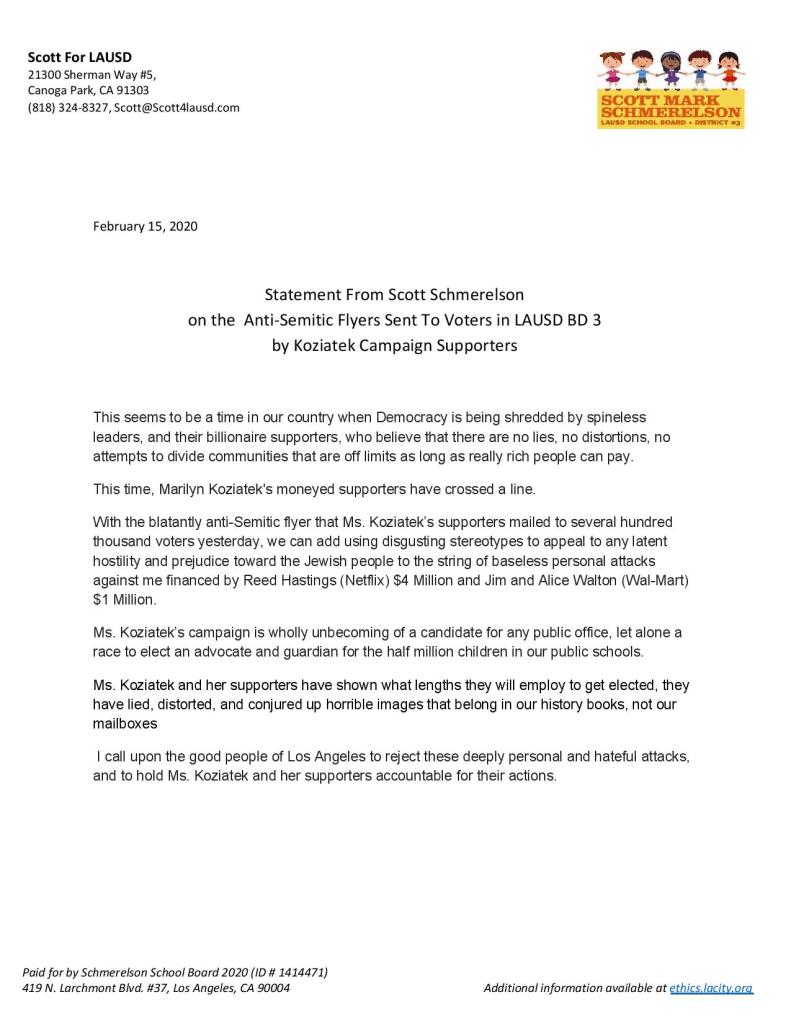
A front group for the California Charter Schools lobby, which calls itself “Families and Teachers United,” released a flyer that attacked school board member Scott Schmerelson, a pro-public school member of the LAUSD school board and well-qualified educator. Schmerelson has been endorsed by every Democratic club in Los Angeles.
The scurrilous flyer accuses him of investing in mutual funds that include products that are harmful to children (tobacco). Anyone whose pension is invested in large mutual funds knows that individual shareholders do not choose the stocks in the fund’s portfolio. My own pension fund includes companies I find abhorrent and there’s nothing I can do about it.
The flyer accuses Schmerelson of “double dipping” because he collects a pension for his decades of service as an educator in the LAUSD schools and a salary as a board member, like other board members.The flyer does not mention that board salaries were increased in 2017 based on the recommendation of an independent commission.

Should he give up his well-earned pension? Of course not! Should he refuse to take the same salary as other board members? Of course not!


Support Scott for LAUSD 


FOLLOW THIS DISGUSTING STORY ON 
 Los Angeles Education Examiner 
News and views on public education in and around Los Angeles

New Hampshire Seeks to Pilot Online Pre-Schooling and Tries Again for Charters | Diane Ravitch's blog

New Hampshire Seeks to Pilot Online Pre-Schooling and Tries Again for Charters | Diane Ravitch's blog

New Hampshire Seeks to Pilot Online Pre-Schooling and Tries Again for Charters

New Hampshire’s Governor is a Trump-style extremist, Chris Sununu, whose father John advised the first President Bush. Sununu appointed Frank Edelblut as state commissioner of education. The state commissioner home-schooled his children and follows the ideology of Betsy DeVos. He thinks government money should go wherever children go, regardless of who gets the money. That’s called “Learning Everywhere.”
Edelblut is an extremist libertarian.
Now he wants to pilot online leaning for pre-schoolers. This is his response to the growing recognition of the value of early childhood education.
Not surprisingly, advocates for ECE are alarmed that sitting in front of a computer is being substituted for play, where children learn to cooperate with others and make things and use their imagination. One group said:
Kids aren’t meant to sit still in front of a screen. They use their whole bodies to learn, and they want and need to move. Let’s not forget that some of the essential CONTINUE READING: New Hampshire Seeks to Pilot Online Pre-Schooling and Tries Again for Charters | Diane Ravitch's blog

Do You Know About Mike Bloomberg’s Record on Public Education? | janresseger

Do You Know About Mike Bloomberg’s Record on Public Education? | janresseger

Do You Know About Mike Bloomberg’s Record on Public Education?


Much of what follows is from a November post on this blog about the education policies of New York City’s former three-term mayor, Michael Bloomberg, who was granted the right, by the state legislature, to run New York City’s public schools.  In November when this was originally posted, Bloomberg was exploring whether to join other Democrats running for President in 2020. Bloomberg has now declared his candidacy. He has spent millions of dollars already on widespread television advertising. But his ads don’t tell us much about his extensive record as a mayor who, for more than a decade, controlled the nation’s largest school district.

Bloomberg is a plutocrat and he ran the schools as a technocratic businessman, with disruption conceptualized as the key to making everybody work harder to raise student achievement as measured by test scores.  Turnarounds, more charters, more school co-locations: all of these so called “reforms” were introduced by Bloomberg and his schools chancellor Joel Klein in New York City before Arne Duncan brought the same turnaround strategy to the whole country through Race to the Top.
On December 14, at a Public Education Forum 2020, we had an opportunity to hear from other leading candidates for the Democratic nomination about their plans for the nation’s public schools.  Additionally, we were able to listen as each one responded to questions from parents and public school students and schoolteachers.  All of the leading candidates pledged at least to triple Title I spending for public schools serving children in poverty as a top priority.  Neither Bernie Sanders nor Joe Biden nor Elizabeth Warren nor Pete Buttigieg nor Amy Klobuchar promoted the sort of policies that Mike Bloomberg launched as the mayor CONTINUE READING: Do You Know About Mike Bloomberg’s Record on Public Education? | janresseger


With A Brooklyn Accent: Why Donald Trump Hates Our Educational System and Demonizes Teachers- A Personal Reflection

With A Brooklyn Accent: Why Donald Trump Hates Our Educational System and Demonizes Teachers- A Personal Reflection

Why Donald Trump Hates Our Educational System and Demonizes Teachers- A Personal Reflection

Why Donald Trump Hates Our Educational System and Demonizes Teachers- A Personal Reflection
As someone who is exactly the same age as DJT and went to school during the same years, I look at his rise to the top of our society with astonishment. As a young person from a family of modest means, going to public schools in Brooklyn, I did everything people told me to allow me to move into the middle class and become a respected professional. I got good grades. I scored well on standardized tests and on my SAT's. I became a successful athlete whose exploits were written up in school newspapers and occasionally the local press I applied for every scholarship in sight. And it worked. I got into Columbia where, after a slow start, the same pattern emerged.Starting in my sophomore year, I got excellent grades in my major. My sports exploits were written up in the school paper. With the support of my professors, I received numerous fellowships to go to graduate school. Every single thing I mentioned here is a matter of public CONTINUE READING: With A Brooklyn Accent: Why Donald Trump Hates Our Educational System and Demonizes Teachers- A Personal Reflection

UFT won’t endorse Bloomberg – that’s not good enough | JD2718

UFT won’t endorse Bloomberg – that’s not good enough | JD2718

UFT won’t endorse Bloomberg – that’s not good enough


The United Federation of Teachers has created a convoluted rationale for not making an endorsement at this time in the presidential race. Given their history of endorsements, I am surprised anyone is upset.
In short, the national federation, the American Federation of Teachers, has given the green light to locals to make an endorsement. But the UFT has said they are so influential, that if they made an endorsement it would prejudice the whole open process. Well….
In the meantime, Michael Mulgrew is running to become a Biden delegate. I guess the UFT president plumping for a candidate is not an endorsement. Huh? Can you make sense of that? Not likely. In any case, I guess it seemed a lock that Mulgrew’d be going to the DNC as a Biden delegate when he signed up, but with Joe choking in Iowa and New Hampshire, maybe Mulgrew will lose. It’s harder to run in elections where the outcome is not predetermined.
UFTers for Bernie is pushing for the UFT to endorse Sanders. Unlikely with AFT President Weingarten knocking Bernie on Twitter for having loyal supporters and championing universal healthcare.
In the meantime, the UFT leadership remembers who Bloomberg is, and Mulgrew makes it seem like he won’t endorse Bloomberg. Though, perhaps not strangely, the AFT’s Randi Weingarten seems to take a deferential tack towards Bloomberg. The sliver-tongued billionaire often CONTINUE READING: UFT won’t endorse Bloomberg – that’s not good enough | JD2718

Sunday, February 16, 2020

Educational Redlining - Student Borrower Protection Center

Educational Redlining - Student Borrower Protection Center


Educational Redlining Report

The SBPC’s analysis of fintech and banking products uncovered cases where a prospective borrower may be hit with thousands of dollars in additional credit costs if he or she attended a community college, an Historically Black College or University (HBCU), or an Hispanic-Serving Institution (HSI).  (Download report here)

Educational Redlining - Student Borrower Protection Center

The Black Teachers in Our City Dropped From 40% to 24%. We Can Change That, If We Want To - Philly's 7th Ward

The Black Teachers in Our City Dropped From 40% to 24%. We Can Change That, If We Want To - Philly's 7th Ward

THE BLACK TEACHERS IN OUR CITY DROPPED FROM 40% TO 24%. WE CAN CHANGE THAT, IF WE WANT TO


I will never forget the time I attended a teaching job expo in Valley Forge, PA.  Districts from around the state had laid out the welcome mat, eager to attract the newest and brightest teachers into their ranks.
I stood among the crowds, these hundreds of people ready to join this most important and dearest of professions, and several realities struck me at once.
The first was how long the lines were for some districts, and the lack of lines at others.
Affluent, predominantly white school districts had lines that curved through the auditorium, eager faces adorned with anxiety as they saw the physical representation of how slim their chances were of getting their sought after placement.
How long was the line for the School District of Philadelphia – a district brimming with talented Black and Brown children? 
The second thing I noticed was the demographics of the folks eager to CONTINUE READING: The Black Teachers in Our City Dropped From 40% to 24%. We Can Change That, If We Want To - Philly's 7th Ward

I Love Teaching, Even When It Doesn't Love Me Back | The Jose Vilson

I Love Teaching, Even When It Doesn't Love Me Back | The Jose Vilson
I Love Teaching, Even When It Doesn't Love Me Back

At 2:45 pm, the students have already left the classroom. The door is slightly ajar, just open enough to let the teenage energy dissipate from this great green room. A whiteboard displays equations, diagrams, and words in different color markers. Desks once rigidly paired are slightly misaligned with untucked chairs and random doodles on them. The random handout, pencil shaving, and returned assignment lay on the floor. This teacher sits at his desk, still decompressing from another day of more than a hundred students over the course of eight periods. Two large stacks of ungraded papers and lesson plans hide his hands from the casual passerby.
He’ll need a few more minutes. He’ll shake it off. He’ll do this again tomorrow. He’s passionate. He’s tired. Millions of other teachers get it.
I get it, too. It’s February. There’s a whole litany of reasons for why children and the adults charged with caring for them are tired. After 100 days of having to with and for one another, we all need a cool-off from one another. Kids won’t sit down and pay attention to a 25-minute lecture? Adults won’t do it, either, and we’re paid to do that (kinda). Kids don’t want to wait for the bathroom? Teachers have to either wait until their schedule says they can use the potty or beg a colleague in the hallway with one foot in the door to hold down the fort.
Kids aren’t prepared for class? How’s that lesson plan from two years working out for us?
But I can’t shake the feeling of the cumulative exhaustion so many of us have in this work. No school CONTINUE READING: I Love Teaching, Even When It Doesn't Love Me Back | The Jose Vilson


Why School Counselors Are More Essential Than Ever - Teacher Habits

Why School Counselors Are More Essential Than Ever - Teacher Habits

Why School Counselors Are More Essential Than Ever
By Frankie Wallace


When you think about some of the most influential people in the lives of children, there are a few that probably immediately come to mind. Parents, of course. Maybe grandparents or other involved members of the family. Perhaps a close family friend or godparent. Definitely school teachers. But what about school counselors?
Many of us fail to recognize the very valuable role that school counselors play in shaping the lives of our children and pushing them towards success. Often times, counselors work in the background, taking care of things that fall outside of the realms of both teachers and the administration. They are there for the kids through thick and thin. 
Given this, it is tragic that counselors are almost always one of the first positions to be discarded during budget cuts and one of the last to experience increases in support in good budget years. Counselors are anything but “non-essential” to the schools they work for. Like the majority of positions within the education system, they are understaffed, underappreciated, and overworked. 
Image result for wearing many hats
All the Hats of a Counselor
What exactly do counselors do day to day? Honestly, the better question to ask is: what don’t counselors do as part of their job? Job CONTINUE READING: Why School Counselors Are More Essential Than Ever - Teacher Habits

Mitchell Robinson: A Betsy DeVos-approved accreditation group authorized a "visa mill" college with no students or faculty | Eclectablog

A Betsy DeVos-approved accreditation group authorized a "visa mill" college with no students or faculty | Eclectablog

A Betsy DeVos-approved accreditation group authorized a “visa mill” college with no students or faculty


According to a breaking story in USA Today, a Betsy DeVos-sanctioned accreditation agency gave approval to operate for Reagan National University in South Dakota, a “university” with no students, faculty, administration, or facilities–things which one might think an “accreditation agency” might notice.

President Donald Trump poses for a photo with students of Saint Andrew Catholic School on Friday, March 3, 2017, during a tour of the school in Orlando, Florida. Also shown is U.S. Secretary of Education Betsy DeVos.

DeVos’ Department of Education saved this accreditor from being removed from the DoE’s list of approved accreditation agencies, even though the agency, the Accrediting Council for Independent Colleges & Schools (ACICS), had engaged in shady practices in the past, including accrediting predatory for-profit colleges such as ITT Tech, Corinthian Colleges and Brightwood College–all of which closed last decade, leaving “thousands of students without degrees and undermin(ing) the value of the education of those who did graduate. Those closures led President Barack Obama’s Education Department to strip ACICS’ powers in 2016.”
Not to fear: Betsy DeVos was all too happy to ignore these problems with ACICS’ judgement, and restored the agency’s authorization to accredit the mostly for-profit colleges that formed the core of its customer base.
Even more ironic than a university without students and faculty is that Reagan National University CONTINUE READING: A Betsy DeVos-approved accreditation group authorized a "visa mill" college with no students or faculty | Eclectablog

School Reforms That Are Persistent And Admired But Marginal (Part 3) | Larry Cuban on School Reform and Classroom Practice

School Reforms That Are Persistent And Admired But Marginal (Part 3) | Larry Cuban on School Reform and Classroom Practice

School Reforms That Are Persistent And Admired But Marginal (Part 3)

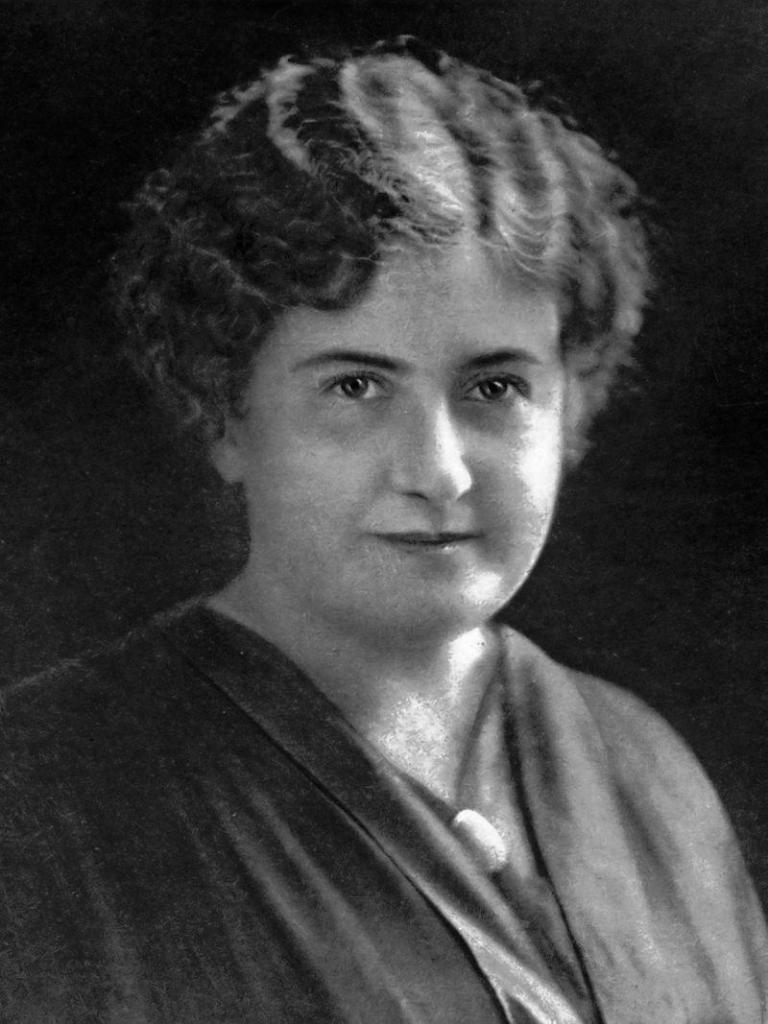
Who am I quoting here? Hint: Quotes come from person born in the 19th century.
If education is always to be conceived along the same antiquated lines of a mere transmission of knowledge, there is little to be hoped from it in the bettering of man’s future. For what is the use of transmitting knowledge if the individual’s total development lags behind?
The ancient superficial idea of the uniform and progressive growth of the human personality has remained unaltered, and the erroneous belief has persisted that it is the duty of the adult to fashion the child according to the pattern required by society.
If you guessed John Dewey, you were wrong. The quotes come from Maria Montessori (1870-1952).
Born in Italy, Montessori became a physician –one of few women to do so at the time. In 1906, she was appointed as head of the Casa Dei Bambini where she developed ideas, materials, and teaching practices for poor children in Rome that have since become known as the Montessori Method.

Montessori schools spread throughout Europe before and after World I, the Great Depression, and after World War II. Dr. Montessori came to the U.S. in 1913 and 1915 and 
schools –all private–sprung up throughout the U.S.

Beginning in the 1970s, the private sector of Montessori schools slowly CONTINUE READING: School Reforms That Are Persistent And Admired But Marginal (Part 3) | Larry Cuban on School Reform and Classroom Practice