

Friday, July 26, 2019
It's Larry Ferlazzo's Websites of the Day... A VERY BUSY DAY | The latest news and resources in education since 2007
Larry Ferlazzo's Websites of the Day... | The latest news and resources in education since 2007


State Takeovers: Radical Seizure of School Districts vs. Organic, Community Grounded School Improvement | janresseger
State Takeovers: Radical Seizure of School Districts vs. Organic, Community Grounded School Improvement | janresseger
State Takeovers: Radical Seizure of School Districts vs. Organic, Community Grounded School Improvement


State Takeovers: Radical Seizure of School Districts vs. Organic, Community Grounded School Improvement
This blog will take a one-week, mid-summer break. Look for a new post on Monday, August 5.
We are in the midst of a wave of state school takeovers.
On Tuesday evening In Providence, Rhode Island, the state Council of Elementary and Secondary Education granted the authority for Rhode Island’s recently appointed State Education Commissioner, Angelica Infante-Green, to take over the Providence Schools. A new and scathing report by a team from John Hopkins University had criticized the current operation of the school district—already under mayoral governance. For the Providence Journal, Linda Borg reports: “Under a 1997 statute, Infante-Green now has the power to revamp the teachers’ contract, revise how the school district is governed, even make decisions over hiring and firing… Infante-Green also confirmed that she will hire a superintendent to takeover the schools by early November. In fact, she is already speaking with several individuals, although no one has been named.” Diane Ravitch provides some background about Angelica Infante-Green: “Infante-Green has never run a school district. She has never been a school principal. She entered education through Teach for America, then ran bilingual programs in Bloomberg’s (NYC) Department of Education. She belongs to Jeb Bush’s Chiefs for Change.”
In Benton Harbor, Michigan, Governor Gretchen Whitmer continues to threaten to close Benton Harbor’s high school or take over the school district. In a commentary for Bridge Magazine, Tom Watkins, the state’s school superintendent from 2001-2005 warns that shutting down the high school or taking over the district won’t solve the core problem: “The Benton Harbor school crisis is ground zero for a dysfunctional educational funding model and a state government that has been pretending to address the problem going back decades… If you have a hole in your roof, pretending to fix it does not keep the rain out. Our system of funding our schools is fundamentally, structurally unsound….” In a recent podcast (link includes a transcript), the education writer Jennifer Berkshire and Massachusetts education historian Jack Schneider add that Michigan’s system of cross-district open enrollment conspires with structural racism to undermine poor school students by driving out students, each one carrying school funding away from places like Benton Harbor. The system is set up to CONTINUE READING: State Takeovers: Radical Seizure of School Districts vs. Organic, Community Grounded School Improvement | janresseger
Big Education Ape: CURMUDGUCATION: The Takeover Lie - http://bigeducationape.blogspot.com/2017/05/curmudgucation-takeover-lie.html
Big Education Ape: STATE TAKEOVER: An Achievement School District Primer - Mitchell Robinson: Reforming Reform - http://bigeducationape.blogspot.com/2015/07/state-takeover-achievement-school.html
Big Education Ape: Experts warn of murky results from State Takeover charter schools - http://bigeducationape.blogspot.com/2016/06/experts-warn-of-murky-results-from.html
National Charter School Advocacy Exec’s Lackluster State Advocacy Results | deutsch29
National Charter School Advocacy Exec’s Lackluster State Advocacy Results | deutsch29
National Charter School Advocacy Exec’s Lackluster State Advocacy Results


National Charter School Advocacy Exec’s Lackluster State Advocacy Results
On July 19, 2019, West Virginia Public Broadcasting published a piece entitled, “Q&A: National Charter School Proponent Weighs in on W.Va.’s Education Bill.”The piece opens as follows:
Emily Schultz is the director for state advocacy and policy with the National Alliance for Public Charter Schools [NAPCS]. Lawmakers consulted her as they shaped the education reform bill recently signed into law that allows for the establishment of charter schools in West Virginia for the first time in the state’s history.
WV legislators consulted with national-level charter school advocacy director, Emily Schultz, for a bill on charter schools in WV.
The question is, what charter school notches does Schultz have in her corporate-modeled, school choice belt as evidence that her advice is based upon actual success in establishing charter schools?
WV Public Broadcasting includes this brief bio for Schultz, which links to her NAPCS bio:
Emily Schultz is the director for state advocacy and policy for the National Alliance for Public Charter Schools. Prior to joining the National Alliance, she served as the executive director of the Alabama Coalition for Public Charter Schools.Emily started her career in education as a second-grade teacher at Cascade Elementary in Atlanta through Teach for America. She is an Alabama native and has an undergraduate degree in Political Science and Educational Studies from Carleton College, and a Master in Education Policy from Stanford University.
Let’s expand upon Schultz’s bio a bit.
According to her Linkedin bio, Schultz has a lot of experience promoting corporate education reform. She was a “program manager” in DC from 2008 to CONTINUE READING: National Charter School Advocacy Exec’s Lackluster State Advocacy Results | deutsch29

Shanker Blog: The Role of States in Teacher Pay Gaps | National Education Policy Center
Shanker Blog: The Role of States in Teacher Pay Gaps | National Education Policy Center
Shanker Blog: The Role of States in Teacher Pay Gaps

Shanker Blog: The Role of States in Teacher Pay Gaps | National Education Policy Center
Shanker Blog: The Role of States in Teacher Pay Gaps
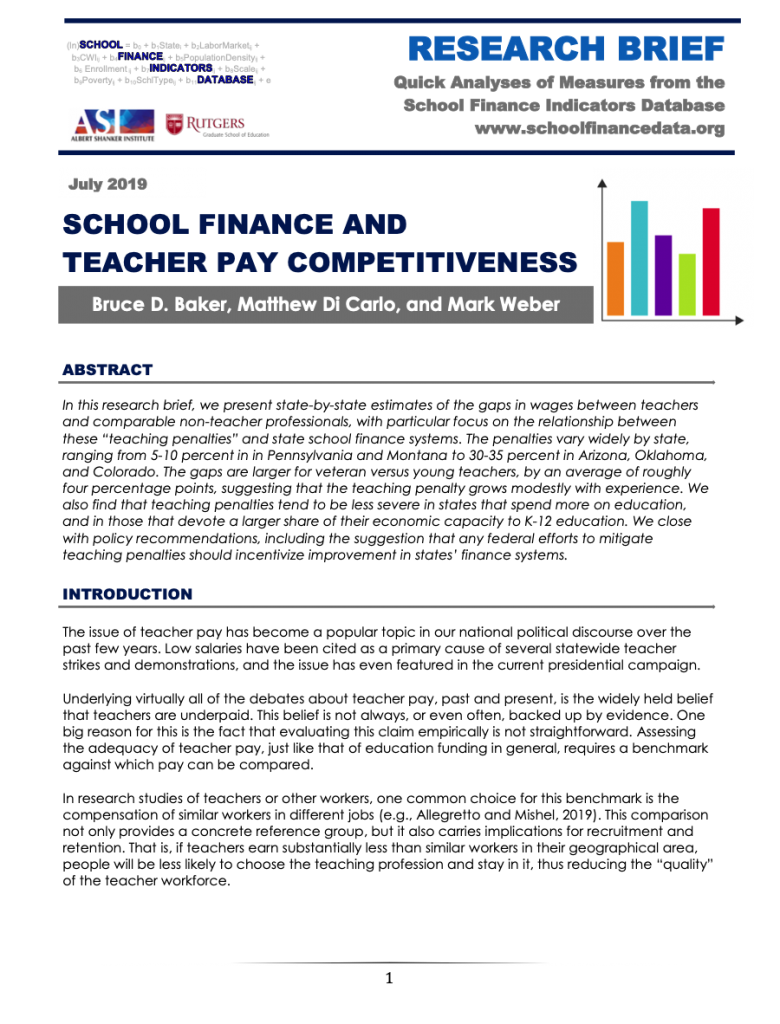
We recently published a research brief looking at gaps in pay between teachers and comparable non-teacher professionals. These gaps are sometimes called “teaching penalties.” The brief draws on data from the School Finance Indicators Database (SFID), a collection of school finance and resource allocation measures published by the Shanker Institute and the Rutgers Graduate School of Education.
The first part of the brief presents our estimates of teaching penalties, by state, for young (age 25) and veteran (age 55) teachers. We find that the gaps between teachers and similar non-teacher professionals range between 5-10 percent in states like Pennsylvania and Montana to 35-40 percent in Arizona, Oklahoma and Colorado (the latter three are all states in which there were recent major teacher strikes). To be clear, these estimates do not include benefits, although our rough calculations (discussed in the brief) suggest that the inclusion of benefits would not come close to closing these gaps in most states.
Our primary focus, however, is on the relationship between these teaching penalties and states’ school finance systems.
Specifically, we find a significant relationship between the size of the penalties and adjusted state K-12 spending. In other words, states that spend more exhibit smaller gaps. We find a similar relationship between the penalties and states’ fiscal effort, which measures how much of their total “economic capacity” they spend on K-12 education – i.e., states that put forth more “effort” tend to have smaller gaps.
On the one hand, these findings are not surprising. A large proportion of state education spending goes to teachers’ salaries. So, teachers will tend to be better-paid in states that spend more, and will therefore earn wages that are more competitive with those of their non-teacher counterparts. Moreover, to be clear, we do not take any position on how additional funds to improve teacher pay, if allocated, should be distributed (e.g., across the board versus targeted raises).
On the other hand, our results illustrate a few important ideas underlying the eternal debates about the adequacy of teacher pay, debates that have gained new momentum in the wake of a recent proposal from a Democratic presidential candidate to supplement teacher pay with federal funds.
First, and most obviously, raising teacher pay to a more competitive level will require greater resources from some states than from others. Our results indicate that teacher/non-teacher pay gaps are substantial in virtually all states, but the magnitude of the problem varies considerably by state.
Second, policy matters in school finance when it comes to improving teacher pay. Teaching penalties vary between states for a variety of reasons, some of which may be peripheral to education policy – e.g., the composition of non-teacher workforces, collective bargaining laws, etc. But it is no accident that higher-effort, higher-spending states tend to have smaller teaching penalties.
Third, and perhaps most importantly, what we’re showing here, put simply, is that some states are constrained in how much they can pay their teachers, whereas others seem to underpay teachers by choice – i.e., by refusing to raise sufficient revenue to properly fund their school systems.
Mississippi, for example, exhibits a large teaching penalty – teachers in that state earn wages that are 23-27 percent lower than their non-teacher counterparts', depending on age. But that’s principally because Mississippi’s economy (economic capacity) is small, and despite their relatively high fiscal effort, they have trouble raising a lot of revenue. Put differently, Mississippi devotes a relatively large share of its economy to K-12 education, but its economy is so small that spending falls short.
By contrast, there are a number of other states, such as Arizona, Colorado and North Carolina, in which teaching penalties are among the largest in the nation, not because of a lack of economic capacity, but rather because these states put forth relatively low effort. That is, revenue – and therefore teachers’ salaries – is low due in part to deliberate policy choices.
From this perspective, regardless of how any federal efforts to improve teacher pay are distributed within states, we strongly recommend that they are designed to incentivize improvement in states’ funding systems.
For instance, priority should be given to helping states like Mississippi, which is putting forth effort but falling short due to economic constraints. When it comes to low-effort states, however, federal funds should be partially contingent on improvements to finance policy in these states.
Low teacher pay – and insufficient education funding, in general – are due to state-level choices and the ultimate focus should therefore be on state-level reform. The federal government should not be subsidizing states that can help themselves but have refused to do so.
This blog post has been shared by permission from the author.
Readers wishing to comment on the content are encouraged to do so via the link to the original post.
Find the original post here:
Readers wishing to comment on the content are encouraged to do so via the link to the original post.
Find the original post here:
The views expressed by the blogger are not necessarily those of NEPC.
Subscribe to:
Posts (Atom)