While PAA does not endorse candidates, we’re thrilled to see one of PAA’s chapter leaders run for elected office, as several other inspiring PAA leaders have done over the past eight years.
“If We Don’t Do Something, It’s Never Going to Change”
At the panel discussion on educator walkouts at the National Education Writers Association (EWA) conference this week, NEA President Lily Eskelsen Garcia was asked what was driving this unprecedented activism happening across the country, including the latest action in Oregon this week.
“A moment in West Virginia became a movement,” Eskelsen Garcia said. “It is inspiring. It’s energizing. And it’s always a little scary because no one knows how these things will turn out, but so far we’ve had 100 percent success in that every place where teachers have raised their voices and thrown on their #RedForEd t-shirts and gone to the public, they’ve won support. [It’s about ending] the absolute neglect of education funding and giving kids the programs and services they need.”
People are hearing what educators have been saying for years: There is much more that should be done to support public education. It hasn’t been enough for decades.
“Parents, the public, have all marched with their educators in support of more funding for education.” Eskelsen García said. “They’re asking, ‘What do you mean you have to pay for your own supplies? What do you mean you have 40 students in classrooms.’ ”
After arriving two hours before the start of the meeting and securing my place as the 46th person in line, I was able to sign up for public comment about the item. However, I was notified just minutes before the start of the meeting that the item was probably not going to be heard. This was confirmed by Monica Garcia as the meeting started and she announced that she was using her prerogative as the Board CONTINUE READING: LAUSD Board Delays Vote on Cutting Public Speaking Time
Secretary of Education and Disney villain Betsy DeVos spoke to a group of education writers in Baltimore the other day, and it appears her feelings are hurt.
“I never imagined I’d be a focus of your coverage. I don’t enjoy the publicity that comes with my position. I don’t love being up on stage or on any kind of platform. I’m an introvert,” she told them.
Many in the media, DeVos added, “use my name as clickbait” or “try to make it all about me.”
But education is “not about Betsy DeVos nor any other individual,” she said. “It’s about students.”
Ironically enough, this bit of “poor little me” whining comes on the heels of one of Ms. DeVos’ most outrageous statements, an attempt to redefine the very meaning of “public education”:
“Let’s stop and rethink the definition of public education,” she said. “Today, it’s often defined as one type of school, funded by taxpayers, controlled by government. But if every student is part of ‘the public,’ then every way and every place a student learns is ultimately of benefit to ‘the public.’ That should be the new definition of public education.”
No, Betsy. Just no. That’s not how any of this works. You don’t get to snap your grubby little money-stained fingers and just redefine the very nature of public schooling in our country, like some Teach-for-America-Thanos.
And, Betsy, if you truly believe that most public schools are “failing” (Narrator: “They are not.”), or that “school choice” and “Education Freedom Scholarships” are going to fix the problems in the CONTINUE READING:"Poor Betsy" doesn't like being criticized… | Eclectablog
Oakland Unified offers critical view of charter schools to state task force
Against the backdrop of greater scrutiny of charter school operations across California, officials at the Oakland Unified School District have drawn up a sweepingly critical portrait of the impact of charters on their district.
These include the costs of having to deal with lawsuits and revocations of charters, the turmoil created by charter schools that close during the middle of the year and the negative consequences of locating charter schools on the same campuses as district schools. This practice — called “co-location” — is “harmful to students” because it allows less space for “intervention” programs for students in district schools. It can also require staggered lunch schedules, as well as combining grades in single classrooms.
The catalog of criticisms is contained in a 28-page PowerPoint presentation that district officials, including board president Aimee Eng, made last month to the Charter Task Force, an 11-member body created by State Superintendent of Public Instruction Tony Thurmond at the request of Gov. Gavin Newsom.
The panel is charged with making recommendations by July 1 on how to amend California’s charter school law. As part of its deliberations, it is hearing case studies of districts with large numbers of charter schools. So far, it has heard presentations from Oakland and San Diego Unified, with Los Angeles Unified and its charter schools still to come.
The information that districts with large numbers of charter schools like Oakland provide could have a significant impact on what the task force recommends to Newsom. The panel’s deliberations are not open to the public, but Oakland’s presentation was provided by the district at EdSource’s request. San Diego CONTINUE READING: Oakland Unified offers critical view of charter schools to state task force | EdSource
The tide, it appears, may finally be starting to change. After a generation of test-centered accountability for teachers, the state of Maine has passed a law that removes a requirement that standardized test scores be used to evaluate teachers. I suspect more states will follow, if for no other reason than all educational trends eventually fall out of favor when we realize the old ways maybe weren’t so terrible after all.
No matter what other states do, the question will remain: How do we fairly evaluate the performance of teachers? There is no easy answer, and it’s largely because there are two competing beliefs about how to identify good (and bad) teaching.
I read two articles in the last couple of days that illustrate the tension at the center of teacher evaluations. The first was written by Alfie Kohn way back in 2008, but its message is often repeated today. In It’s Not What We Teach; It’s What They Learn, Kohn asserts that “what we do doesn’t matter nearly as much as how kids experience what we do.” He provides a number of examples, explaining that it doesn’t matter what an adult intends if a child interprets the adult’s words or actions differently. Kohn writes:
The “grammar of schooling” is stubborn. It is the DNA of U.S. public schools.
Because it is taken-for-granted, as common as the air we breathe and seemingly as essential to schooling Americans as sleeping is to decent health, few reform-minded policymakers, practitioners, donors, researchers, and parents challenge it. In Part 2, four researchers described and analyzed efforts to alter substantially this quiet institutional machinery that influences both students and teachers 36 weeks a year. For the most part, these researchers described in their case studies how the “grammar of schooling’ persisted after mighty efforts to reduce or remove it in public schools and districts.
In Part 1, I described private schools that had, indeed, dispensed with the “grammar of instruction.” I ended that post with this paragraph:
The tradition of challenging the dominant structure of the age-graded school and its “grammar of schooling” continues to this day with micro-schools in Silicon Valley and elsewhere illustrating anew that such reforms to the traditional “machinery of instruction” have resided, for the most part, in private schools where tuition runs high and students bring many economic and social advantages school. In a profound way, the high cost of these private schools and the resources available to their founders in experienced teachers, aides, technologies, space, and materials show clearly the prior conditions necessary not only to operate such schools in public venues but also what is needed to contest the prevailing “grammar of schooling.”
‘For all the many reasons teachers should be thanked, this should not be one of them'
Who is surprised anymore when news breaks that another school has been the scene of a shooting and the lives of everybody in that community are forever changed?
It happened again Tuesday in Colorado when two students allegedly opened fire in STEM School Highlands Ranch — a charter school campus with more than 1,800 students in kindergarten through 12th grade — and killed one person while injuring eight others. A student who charged one of the shooters to help protect others lost his life.
The Colorado shooting followed by just days a shooting at the University of North Carolina at Charlotte that killed two and wounded four. A student tackled the gunman in that case, too.
We are in an era where students and teachers may find themselves in a position of dodging bullets or taking on shooters directly to save others’ lives.
The Colorado shooting occurred during Teacher Appreciation Week, which inspired one educator to write a letter honoring his colleagues and speaking to this moment in the country’s violent history.
The author of the following post is Rich Ognibene, a chemistry and physics teacher in New York who was that state’s 2008 Teacher of the Year and a 2015 National Teacher Hall of Fame inductee.
By Rich Ognibene
Today, during Teacher Appreciation Week, I’m thinking about the teachers (and paras, and secretaries, and administrators) at STEM School Highlands Ranch in Colorado.
Adaptive learning. Computer-enhanced psychometrics. Personalized learning via computer. Knewton was going to do it all. Now it's being sold for parts.
Knewton started in 2008, launched by Jose Ferreira. By 2012, Ferreira led the ed tech pack in overpromising that sounded both improbable and creepy. In a Forbes interview piece, Ferreira described Knewton as "what could become the world’s most valuable repository of the ways people learn." Knewton could make this claim because it "builds its software into online classes that watch students’ every move: scores, speed, accuracy, delays, keystrokes, click-streams and drop-offs." How does this work?
Students go at their own pace, and the software continuously adapts to challenge and cajole them to learn based on their individual learning style. As individual students are correlated to the behaviors of thousands of other students, Knewton can make between 5 million and 10 million refinements to its data model every day.
This guy.
You will be unsurprised to learn that founder/CEO Ferreira has no real background in education. He has a BA from Carleton College and an MBA from Harvard Business School. He worked for Kaplan for a few years, then went into the money biz, first as a derivatives trader for Goldman Sachs and later working venture capital for Draper Atlantic. In between he was strategist for the John Kerry campaign; that may be because he's John Kerry's nephew. From venture capital, it was a quick step to Knewton.
It raises one question that I don't have an answer for. Ferreira obviously had nothing to do with the actual creation of the software that was Knewton's heart and soul. Whose work was Knewton? A puzzle for another day.
This data is a bit out of date, but I couldn’t find a more recent analysis. Moreover, it seems pretty much consistent with what I, myself, have seen in the media.
Take Wyatt Cenac’s “Problem Areas,” a comedy journalism program on HBO. The second season focuses entirely on education issues. Though Cynac interviews numerous people in the first episode (the only one I saw), he put together a panel of experts to talk about the issues that he would presumably return to throughout the season. Unfortunately, only two of these experts were classroom teachers.
It surprised me to hear the word “clickbait” in Betsy DeVos’s working vocabulary. I wonder if it wasn’t put into her speech—on Monday in Baltimore at the Education Writers Association’s annual meeting—by one of her more with-it staffers. I confess that as a retired person, I was slow several years ago to grasp the meaning of the term, but as a blogger I know I paid attention, even before I knew the word, to the number of people who click on posts about particular topics. I realize, of course, that my purpose is to do justice, not to pay attention to the number of clicks on different subjects, but like all writers who post on-line, I notice. And I grieve about the paucity of clicks on worthy topics.
As you have, no doubt, heard by now, Betsy DeVos went to the Education Writers Association and asked the nation’s education journalists not to use her as clickbait. See here, here, here, and here.
DeVos also described her weird philosophy of public education. The last time I remember her channeling Margaret Thatcher was in July of 2017 at a meeting of the American Legislative Exchange Council—the far-right, corporate driven, bill mill that creates the anti-regulatory and pro-privatization model bills that are then broadcast across the 50 state legislatures to be introduced.
I suspect this time, at the Education Writers Association, Betsy DeVos chose a less sympathetic audience.
In her prepared remarks for Monday’s speech, DeVos, the U.S. Secretary of Education, emphasizes freedom from government as the foundation of her strategy. You’ll remember that DeVos is responsible for administering government programs like Title I and the Individuals CONTINUE READING: Betsy DeVos as Clickbait | janresseger
House Democrats seek cut in federal charter school funding, saying Education Department isn’t a ‘responsible steward of taxpayer dollars’
House Democrats are proposing a sweeping cut in federal funding for charter schools, saying they are “deeply concerned” that the U.S. Education Department “does not intend to be a responsible steward” of taxpayer dollars used to help the charter movement.
The House Appropriations Committee on Tuesday released its proposed 2020 budget for the Education Department and is seeking $75.9 billion. That is $11.9 billion more than President Trump and Education Secretary Betsy DeVos are requesting, and $4.4 billion more than what was enacted in 2019. There are big boosts for Title 1 — a program intended to help children from low-income families — and special education.
The section on charter schools is seeking $400 million for the federal Charter Schools Program, which is $40 million less than what was given last year and $100 million less than Trump’s proposed budget. Trump and DeVos have said that expanding alternatives to traditional public school systems, including charter schools, is their top priority.
Whether Congress will approve this cut is unclear. But the proposal marks a change for Democrats, who for years have largely been as enthusiastic as Republicans about expanding charters.
Charter schools are funded with taxpayer dollars but operated by nonprofit organizations or for-profit companies with varying levels of oversight. Supporters say they are every bit as public as traditional districts, while critics say these schools are part of an effort to privatize public education.
The 2019 Florida legislative session came to an end yesterday, and only a day late. Which is remarkable, considering the level of dysfunction, where deeply compromised Tallahassee politicians tell blatant lies during debate.
For example, Hialeah Gardens Senator Manny Diaz, Jr., who tried unsuccessfully tried for days to retroactively change referendum language overwhelmingly approved by his own district, claimed Miami-Dade County Public Schools had deceived the public into approving a referendum to raise public school teachers’ salaries.
The truth is that MDCPS superintendent took a town hall tour of the whole the district, consistently making the school board’s case for why they wouldn’t be sharing any millage with charter school teachers.
In fact, the senator’s multi- Pulitzer Prize-winning home town newspaper published several articles in the lead-up to the election with headlines like, “Charter schools aren’t included in school ballot measure…,” describing how Academica, the senator’s own employer, was circulating fliers urging parents to vote No.
But the dysfunction isn’t limited to the senate. The house’s own education chair was trying to make the case for why public dollars should be used to pay for private school vouchers. “If it’s a failing school, I trust parents not to send their children there,” even after admitting that private and religious schools are not graded by the state. https://www.orlandosentinel.com/opini...
“[Mount Dora Rep. Jennifer] Sullivan’s vacuous response to a valid question speaks volumes about the real intent of school choice, which is an ideology-driven legislative agenda to steadily erode the public school system by shifting money and students into private-sector education, often in religious schools.” https://www.orlandosentinel.com/opini...
Here’s a few more headlines this week.
“The death sentence for Florida’s public schools” https://www.tampabay.com/opinion/edit...
“Florida legislators stick it to public education, as usual” https://www.orlandosentinel.com/opini...
“Florida’s charter-school sector is a real mess” https://www.washingtonpost.com/educat...
“Teachers with guns only makes sense to lawmakers who have lost their minds“ https://www.miamiherald.com/opinion/o...
To recap, this legislative session Tallahassee politicians passed a K-12 education budget that’s still below pre-recession levels.
They gave all the capital outlay funding to corporate charters to build and maintain privately held assets. Not one dime of local property taxes to build a new a neighborhood school, or to renovate an existing one. Or to buy a single computer.
And to add insult injury, they opened the probability that the next kid shot in a school will be by a teacher.
Happy Teacher Appreciation Week.
When it comes to American education, few policy areas are as misunderstood — or as crucial — as school finance.
Over the past several years, a political and empirical consensus has emerged about the importance of equitable and adequate school funding for high quality K-12 education. Certainly, there are plenty of contentious debates about how education funds should be spent. But regardless of one’s opinions on specific education policies, virtually all of the options for improving America’s schools require investment, particularly for disadvantaged students.
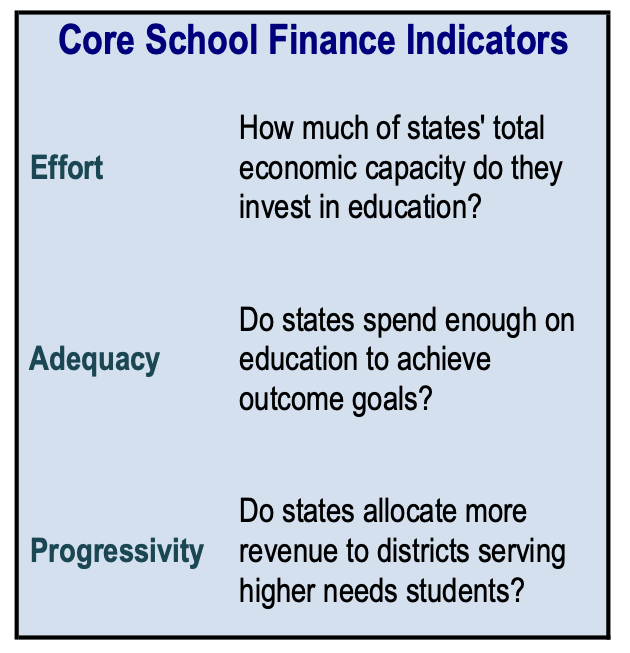
We introduce in this report an updated, public database of state school finance measures, and present results for three key measures in this system: effort, adequacy, and progressivity. Our results indicate, as would be expected, that states vary widely on all three measures. There are several states in which educational resources are comparatively adequate and distributed equitably.
In general, however, resources in most states tend to be allocated non-progressively or even regressively, That is, higher poverty districts do not receive more funds — and in some cases receive sustantially less — than do lower poverty districts, even controlling for factors that affect costs, such as regional wage variation, district size, and population density. Moreover, using models that estimate spending levels required to achieve common outcome goals, we find that the vast majority of states spend well under the levels that would be necessary for their higher-poverty districts to achieve national average test scores.
We do not provide state rankings or grades in this report, as the interplay between effort, adequacy and progressivity is complex. We do, however, include recommendations as to how researchers, policymakers, and the public can use our findings, as well as our database, to evaluate state systems and inform debates about improving school finance in the U.S.
Authors: Bruce D. Baker, Matthew Di Carlo, and Mark Weber