Latest News and Comment from Education

Tuesday, March 12, 2019

California: Tony Thurmond Called Me | Diane Ravitch's blog

California: Tony Thurmond Called Me | Diane Ravitch's blog

California: Tony Thurmond Called Me


Many of the readers of this blog were disappointed, as was I, to see that the new Superintendent of Public Instruction in California, Tony Thurmond, appointed a task force to review charter law in which six of the 11 members are or were connected to the charter industry. We know how hard that industry has opposed any regulation or accountability. We know how many billionaires have used their influence to support the charter industry, both financially and politically. We know that they spent millions to defeat Tony Thurmond, and they lost. Many of us were disappointed in the task force’s composition, because we had supported his candidacy, believing that he would fight charter abuses.
The task force is expected to analyze the fiscal impact of charters on public schools. I wrote several critical posts, because I didn’t like the optics of having this review conducted by a committee in which a majority of the members were associated with the charter sector.
If I had had Tony Thurmond’s phone number, I would have spoken to him first to understand how this happened. I didn’t have his number.
This morning, Tony called me. He had my number.
He assured me that the task force will present recommendations for reform of the charter law. He assured me that he is personally in charge of the task force and its work product. He asked that I (we) (all of us) judge the task force and him by results.
I told him that I thought that was a reasonable request and that I would suspend judgment until I see what the task force produces.
I reminded him, though he needed no reminder, that California has one of the worst charter laws in the nation. It is a law that the charter industry has fought to keep weak and to allow bad actors to proliferate. I pointed out that it is wrong to allow a district to authorize a charter in someone else’s district, without its consent, especially when the authorizing district is hundreds of miles away.
California has more charter schools (more than 1300) than any other state, in part because it has such a large population. It has also seen more charter closures (more than 300) than any other state, including charters that opened and closed on the same day or within a few months. Under current law, a charter begins by applying to a district. If the district says no, the charter operator appeals to the county board of education. If the county says no, the charter operator appeals to the State Board of Education. Under Governor Schwarzenegger and then Governor Brown, the State Board of Education has rubber-stamped charters, no matter how awful their record or their application.
California charter law is in desperate need of reform. Tony knows that.
The charter sector is not going away; but it should play by the same academic, ethical, professional, and financial rules as public schools, and it should not drain resources away from the public schools. Charters should be audited and monitored to the same extent as public schools. Certification requirements for charter teachers and principals and superintendents should be no less than for public schools. Only educators, not entrepreneurs, should be allowed to operate charters. Charters should open only in districts that approve them and need them, and when they close, their students and property should revert to the public schools. Charters should enroll the same demographic as the district in which they are located. If I had my druthers, charter chains would be banned, as would charters managed by foreign entities. That’s my view.
I pledged to Tony that I would withhold judgment and see what his task force produces.
I think that is fair.
He promised that there would be charter reform.
I normally do not report on private communications, but Tony encouraged me to report our conversation.
Let’s watch and wait and hope that the task force produces the reforms that are needed.
California: Tony Thurmond Called Me | Diane Ravitch's blog


Don't Be Fooled: Charter Schools Are Not About Choice - LA Progressive

Don't Be Fooled: Charter Schools Are Not About Choice - LA Progressive

Don’t Be Fooled: Charter Schools Are Not About Choice


In a moral society, “Single Payer” is the singular, optimal solution.
Steve Lopez says:  “…There’s a place for both [innovative, popular charters and regular district schools], and a need for greater support of all public schools”.
These are separate, and non-touching, concepts. The latter is a question of funding, more funding, being sent down the Education pipeline.  That is well, good and necessary. Learn more and sign the petition here.
But whatever you send down the chute, is what’s there in that chute.  When you set up a school system with that public money, what you’ve got is a “fixed margin” of monies:  that’s all you’ve got. The apportionment of monies within the system is “zero sum”: giving to Paul takes away from Peter.  Period.

What is being asked by the charter school system, is a pass for allowing some to have more than others by pretending there is “Choice” involved. By privileging some at the expense of others.

There may be a place for both “types” of schools, but an innovative, popular school is what any and every child wants, nay deserves. There is no moral justification for isolating the offering. What is being asked by the charter school system, is a pass for allowing some to have more than others by pretending there is “Choice” involved. By privileging some at the expense of others.
This is why the conversation about charters is not and never can be about “excellence”. Never mind the uncomfortable truth that “excellence” will always be a subjective term no matter how much you paint it in quantitative metrics. Never mind the structural aspect to charters that is an inherent driver of segregation.
What Lopez is referring to in invoking funding in a democratic educational system, is Sharing Risk.
If you’re not willing to sanction better for some, or more funds for others; separate-but-equal doctrines or an inherent acceptance of structural disparity, then public education must be understood as shared, pooled risk. Just like health care.
The cheapest, most efficient way to share the risk of the high expense of health care is for CONTINUE READING: Don't Be Fooled: Charter Schools Are Not About Choice - LA Progressive

Teachers speak out at Indianapolis rally to defend public education - World Socialist Web Site #REDFORED

Teachers speak out at Indianapolis rally to defend public education - World Socialist Web Site

Teachers speak out at Indianapolis rally to defend public education


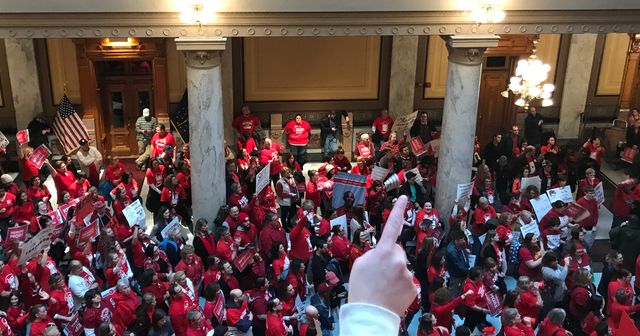
On Saturday, over a thousand teachers from across Indiana rallied in the state Capitol to oppose the growing attacks on public education. The rally, sponsored by the Indiana State Teachers Association (ISTA), was officially billed as the “Indiana Red for Ed Rally” and described as an event to “demand lawmakers provide more resources for our kids and increased pay for teachers.”
Held inside the Indiana Statehouse, ISTA created a party like atmosphere. Continuous loud music blared, reducing the possibility of discussion amongst teachers. Union leaders gave demagogic speeches urging teachers to pressure the Republican legislature of Indiana to fund public schools.
The words “strike” and “walkout” were not mentioned by any of the union officials during their speeches and the union is urgently attempting to avoid a walkout like those that have hit West Virginia and other states.
Nonetheless teachers chanted “strike!” multiple times during the rally. In comments to reporters from the World Socialist Web Site teachers spoke about their conditions and the struggle to defend public education.
Teachers chanting during the rally
Lisa, a first-grade teacher from Washington Township for 15 years, said, “I love teaching students and being there to witness the growth that occurs among our children and to witness when they tap into their own strength and intelligence as we try to nurture that along.
“I’m here because I support public education. The growth of charter schools and privatization is weakening the public school system. It’s an attack against democracy. Public education is the one way that ensures everyone has access to upward mobility, and now that ladder is being shaken.
“As a whole, teacher pay is not increasing, it’s stagnating. Meanwhile, everything else is rising in prices. [With] the growth of the charter schools, CONTINUE READING: Teachers speak out at Indianapolis rally to defend public education - World Socialist Web Site

NYC Public School Parents: John Pane of RAND writes to correct my post on Teach to One and my response

NYC Public School Parents: John Pane of RAND writes to correct my post on Teach to One and my response

John Pane of RAND writes to correct my post on Teach to One and my response


About two weeks ago, I posted a history of the program Teach to One (TtO): how it had first been developed in NYC Department of Education as a blended learning math program called School of One, how after it had spun off from DOE as a separate company called New Classrooms, the developer Joel Rose had promised never to charge NYC schools a fee to use it, instead granting them with a “royalty free, perpetual, non-exclusive license”, but then how the company has continued to charge a license fee to NYC schools anyway. The main focus of the piece was to describe how the huge hype surrounding the Teach to One program and the suppression of the findings of negative or null evaluations of its results has allowed it to expand to more schools, despite disappointing  results and a 60 percent school attrition rate.
In a single paragraph towards the end of this rather lengthy post,  I summarized the findings of a RAND report on the Next Generation Learning Challenge (NGLC) schools, assuming that schools using Teach to One were part of the evaluation, since TtO is a grantee of the NGLC program.  Diane Ravitch subsequently ran excerpts of my blog on hers.
John Pane, the lead researcher on the Rand report, wrote to Diane that New Classrooms / Teach to One was not one of the programs included in this evaluation.  I have posted a correction on that matter on my original blog post.   
He also critiqued the way I reported his remarks to Education Week about “personalized learning” schools in general, that “the evidence base is very weak at this point,” and said that the paragraph in which I described the results of the Rand report had “numerous false and misleading statements,” including my summary of survey results that suggest that the students at NGLC schools “were more likely to feel alienated and unsafe compared to matched students at similar schools.”

He has granted his permission to quote his letter in full below, which I have done, along with my response to the points in his letter.   

On Thu, Mar 7, 2019 at 12:17 PM Pane, John <jpane@rand.org> wrote:
Dear Diane, 
On March 4, 2018 you published this blog entry, “Leonie Haimson: Reality Vs. Hype in “Teach to One” Program,” excerpting from Leonie Haimson’s blog. Your excerpt included this paragraph about my own research (with colleagues) and my public statements:
“The most recent RAND analysis of schools that used personalized learning programs that received funding through the Next Generation Learning initiative, which have included both Summit and Teach to One, concluded there were small and mostly insignificant gains in achievement at these schools, and their students were more likely to feel alienated and unsafe compared to matched students at similar schools. The overall results caused John Pane, the lead RAND researcher, to say to Ed Week that ‘the evidence base [for these schools] is very weak at this point.’“
 This paragraph by Haimson has numerous false and misleading statements. Here I summarize my critique, excerpting the original paragraph: 
“The most recent RAND analysis of schools that used personalized learning programs that received funding through the Next Generation Learning initiative, which have CONTINUE READING: NYC Public School Parents: John Pane of RAND writes to correct my post on Teach to One and my response

Argosy University Collapse Exemplifies Lax Protection of Students—and Taxpayers—Under DeVos | janresseger

Argosy University Collapse Exemplifies Lax Protection of Students—and Taxpayers—Under DeVos | janresseger

Argosy University Collapse Exemplifies Lax Protection of Students—and Taxpayers—Under DeVos


Argosy University, a for-profit college serving  8,800 students at 22 sites across the country, shut down suddenly last Friday.  Actually the collapse has been happening since 2017, but somehow across Argosy’s many campuses most people didn’t quite connect the dots.
And the U.S. Department of Education didn’t intervene until it became clear that the Argosy University had used $13 million in student financial aid for another purpose: paying off the debts of the collapsing institution. Finally when fraud was documented, the Department was forced to step in and deny further financial support in the form of student loans and grants. The university was so completely dependent on federal financial aid for its operations that, when the money stopped arriving, it closed mid-semester. It seems that Argosy was known for its graduate programs in psychology, and its closure leaves its students—some in the midst of writing their dissertations—in the lurch.
Argosy University was part of Dream Center Education Holdings—a nonprofit, religious social service agency.  NY Times reporters Stacy Cowley and Erica Green explain that when Dream Center acquired colleges and trade schools from the failing Education Management Corporation in 2017, Dream Center hoped to make a profit to support its charities. “But Dream Center had never run colleges… Almost immediately, the organization discovered the schools were in worse shape than expected, with aging facilities and outdated technology… Dream Center had anticipated a $30 million profit in its first year…. Instead, it was facing a $38 million loss.”
While last Friday’s closure may have seemed sudden, there were a lot of warning signs, including that Argosy University was in receivership.  Cowley and Green report: “The problems grew in mid-January when a creditor sued Dream Center Education Holdings over unpaid bills and asked a federal court to install a receiver to wind down the insolvent CONTINUE READING: Argosy University Collapse Exemplifies Lax Protection of Students—and Taxpayers—Under DeVos | janresseger


Betsy DeVos’s $5 billion school tax-credit plan is being slammed. And not by whom you might think. - The Washington Post

Betsy DeVos’s $5 billion school tax-credit plan is being slammed. And not by whom you might think. - The Washington Post

Betsy DeVos’s $5 billion school tax-credit plan is being slammed. And not by whom you might think.


You might think that allies of Education Secretary Betsy DeVos would applaud the announcement that the Trump administration is seeking $5 billion for a federal tax credit program that would use public funds to send students to private and religious schools.
Isn’t expanding school choice always a positive to those who want more alternatives to traditional public school districts?
Apparently not in this case — at least not to some of the fiercest school choice advocates who ordinarily embrace DeVos’s thinking on education policy.
The Trump administration is proposing a $5 billion tax-credit program that would be operated from the Treasury Department to provide dollar-for-dollar tax credits to individuals and corporations that contribute to programs that pay for students to attend private and religious schools. The amount would be capped at 10 percent of an individual’s gross income and 5 percent of a business’s taxable income.
Supporters say using public money for private and religious school tuition is part of a necessary movement to provide families with choices for their children, while opponents say such programs harm the school districts that enroll most schoolchildren and that they serve to privatize the public education system.
DeVos recently announced her support of the federal tax-credit proposal, which would mirror programs in Florida, Arizona and other states. She appeared at an event to push legislation creating the program that was introduced in the Senate by Sen. Ted Cruz (R-Tex.) and in the House by Rep. Bradley Byrne (R-Ala.).
While Cruz is gung-ho on the idea, the Republican-led legislature in Texas has repeatedly refused to pass a program that would use public funds for private education, even though there are many charter schools in the state.
Legislators in rural areas in Texas — and other states — who support school choice don’t like these kinds of programs largely because so few private schools exist in the jurisdictions they represent. In 2017, legislators in the Texas House rejected such legislation, and last year, some of the initiative’s biggest backers were voted out while a number of voucher opponents were elected.
DeVos has been active for decades in efforts to push charter schools and voucher and tax-credit programs through state legislatures. But she has always opposed federal involvement in education policy, saying it CONTINUE READING: Betsy DeVos’s $5 billion school tax-credit plan is being slammed. And not by whom you might think. - The Washington Post

Principals As Instructional Leaders: Hype and Reality | Larry Cuban on School Reform and Classroom Practice

Principals As Instructional Leaders: Hype and Reality | Larry Cuban on School Reform and Classroom Practice

Principals As Instructional Leaders: Hype and Reality

Six years ago, I published a post on the highly popular slogan of principal as instructional leader. Following up on this blog’s post of Chicago Mayor’s Rahm Emmanuel’s publicized reversal of his initial school reform beliefs and what he ultimately learned about the importance of Chicago’s principals in turning around schools’ low academic performance, I re-visited this earlier post.  I was surprised that few, if any, observational studies of principal behavior linked to student achievement have been published since 2013. The one I did find is included below.
The strong belief held by practitioners and researchers that of the three essential roles principals perform (instructional, managerial, and political), they “must” be first and foremost, instructional leaders continues its dominance in the literature in spite of weak evidence.


Past and current research on principals reveal that school-site leaders perform managerial, instructional, and political roles in and out of their schools. Of these multiple (and often conflicting) roles, however, the instructional leader role has been spotlighted as a “must” for these men and women because, as the theory (and rhetoric) goes, it is crucial to improving teacher performance and student academic achievement.
of principal behavior in schools makes clear that spending time in classrooms to observe, monitor, and evaluate classroom lessons do not necessarily lead to CONTINUE READING: Principals As Instructional Leaders: Hype and Reality | Larry Cuban on School Reform and Classroom Practice

The True Cost Of This Election In LAUSD5 – redqueeninla

The True Cost Of This Election In LAUSD5 – redqueeninla

The True Cost Of This Election In LAUSD5


The $100K PAC-drop of Eli Broad was heard around LA this week, but it’s not the first or even tenth time this sort of thing has gone on.  It’s basically just SOP to use money as a political bludgeon, at the last second – for after when the polls are open and association with shady doings will no longer influence a vote.  The shenanigans following all this sloshing money is hard to track and harder still to fathom.

Because what does it net?
Four candidates in Tuesday’s LAUSD board member Special Election had Independent Expenditure (IE; aka “PAC” or Political Action Committee) accounts opened on their behalf.  The candidates are supposed to have no interaction with those running the IEs, enabling “plausible deniability”.  Remember that term? It dates from the Vietnam-era, and was much employed during the Iran-Contra affair as well.  It all funds unscrupulousness personified. Mud slinging par excellence.
This time, it was Eli Broad filling up an SEIU PAC on behalf of Heather Repenning.  He’s used the California Charter School Association (CCSA) as this sort of courier in the past. But that whole industry is kinda hot right about now so he evidently found another interest group willing to shroud his personal interests.
And what has it netted them?  The count is not finished and more votes will be registered tomorrow, depressing this calculation of cost-per-vote. Even while the provisional and Mail-in ballots (VBM) counted between election night and last Friday swelled the totals by 24% (25K -> 31K) and reversed the second and third place finishers.
So for now calculating the negative-IE expenditures as money spent for each of the other three candidates, the least-vote recipient of these four, Allison CONTINUE READING: The True Cost Of This Election In LAUSD5 – redqueeninla


Thrive Public Schools Renewal Petition Hearing on Friday | tultican

Thrive Public Schools Renewal Petition Hearing on Friday | tultican

Thrive Public Schools Renewal Petition Hearing on Friday


3/11/2019 by T. Ultican
Thrive Public Schools has petitioned the state of California to renew its charter. San Diego Unified School District (SDUSD) and the San Diego County Office of Education (COE) both recently denied Thrive’s renewal petition. It is the last hope for this politically and financially well connected charter management organization.
The post “Thrive Public Schools All Hat and No Cattle” describes how the state ignored the evidence from SDUSD and the COE when bestowing a charter to Thrive. It also presents the school’s wretched four year record of plummeting test scores, discipline issues and angry parents. The stunningly poor performance by Thrive has reinforced the wisdom of both the county’s and district’s original rational for denying the charter in 2014. That original Thrive charter ends this June.
A PhD who has been working at Thrive as a substitute wrote me about a deep concern. Sharing,
“Dear Mr. Ultican. Good evening. I recently read your Nov. 26 article on Thrive Charter Network. I have read a lot about Thrive over the past six months, and even attended the school board meeting at which the decision to deny the charter was discussed. I am a substitute teacher, working part time while I pursue my teaching credential …. I have completed 17 days (I think about 130 hours) at Thrive’s high school, middle school and elementary school campuses. I am morally outraged by the behavior of CONTINUE READING: Thrive Public Schools Renewal Petition Hearing on Friday | tultican

The Unbearable Whiteness of Being: The Permanent Vacation from Race | radical eyes for equity

The Unbearable Whiteness of Being: The Permanent Vacation from Race | radical eyes for equity

The Unbearable Whiteness of Being: The Permanent Vacation from Race


Over my spring break last week, I made a trip to IUPUI in Indianapolis to present as part of a series spanning their academic year, White Racial Literacy Project Speakers Series, addressing whiteness as part of their diversity and inclusion initiatives.
One controversial aspect of this approach has been providing separate spaces for white faculty, staff, and students as well as people of color to investigate whiteness. That sits inside a larger paradox of this series—an effort to center whiteness as a process for de-centering whiteness.
During the session for people of color, I addressed how I often navigate issues of race from the context of my own life, specifically framing my discussion of race by self-identifying as a redneck (see my PowerPoint here).
This racial identification, I note, is important because I have the privilege of stepping into a racial discussion of whiteness indirectly, using “redneck” and still not actually saying “white.”
A woman in that session responded by acknowledging my privilege in controlling the narrative of myself—I can ignore (or as I say, take a vacation from being white) my whiteness almost all the time, and even when I confront it, I can maintain some level of invisibility (normalcy). She added that both race and gender are imposed on her, leaving her no option for similar vacations from race or gender.
This woman’s response spoke directly to the video in my presentation of author Toni Morrison calmly checking Charlie Rose’s question about her CONTINUE READING: The Unbearable Whiteness of Being: The Permanent Vacation from Race | radical eyes for equity

Monday, March 11, 2019

‘Common sense regulations’ or ‘an extended middle finger’— How far will California go on charter schools?

How far will California go on charter schools?

‘Common sense regulations’ or ‘an extended middle finger’—how far will California go on charter schools?


With new fast-tracked transparency rules for charter schools in California, Gov. Gavin Newsom has fulfilled a January pledge to bring “long overdue” accountability measures to this growing sector of public schools.
But the open meeting and disclosure law signed Tuesday, March 5 — after Gov. Jerry Brown vetoed similar bills twice in prior years — may turn out to be the least controversial part of the Capitol push for tighter charter school regulation.
Several bills, introduced as teachers strikes have amplified the issue, would impose far more consequential and politically loaded restrictions on the state’s 1,300-plus charters, publicly-funded schools that operate outside of the control of school districts and are mostly non-union.
Among them:
  • A cap on charter schools at their current level.
  • Strict limits on charter school locations and the appeal of charters denied by local school districts.
  • New rules that would let districts deny a charter based, at least in part, on the potential financial impact on traditional public schools.
Assembly Bills 150515061507 and 1508 would curb the growth of California’s charter schools, which educate about 10 percent of the state’s 6.2 million public-school students. Legislators pushing the proposals say they are long-needed revisions to laws that have gone mostly unchanged for decades.
But unlike Senate Bill 126, which Newsom signed Tuesday, and on which most charter advocates were neutral, the forthcoming proposals can expect vigorous and organized pushback.


“These are the policy equivalent of an extended middle finger,” said Eric Premack, executive director and founder of the Sacramento-based Charter Schools Development Center.  “This is not the type of legislation that is designed to engender constructive discussion.”
Unions were equally adamant.
“It’s been a long time coming,” Alex Caputo-Pearl, president of United Teachers Los Angeles, said of the proposed bills, which he called “common-sense regulations.”
“The massive community support that was seen in both the L.A. and Oakland teachers’ strikes showed that parents and communities and the public are willing to fight for the sustainability of public schools,” Caputo-Pearl said. He added that the charter cap bill sponsored by Assemblyman Kevin McCarty of Sacramento was the “most important” CONTINUE READING: How far will California go on charter schools?


Education Reform’s Deep Blue Hue: Are School Reformers Right-Wingers or Centrists—or Neither? - Education Next : Education Next

Education Reform’s Deep Blue Hue: Are School Reformers Right-Wingers or Centrists—or Neither? - Education Next : Education Next

Education Reform’s Deep Blue Hue
Are school reformers right-wingers or centrists — or neither?


Introduction
Close observers of 21st-century education reform know that champions of charter schooling, teacher evaluation, and accountability are routinely characterized as right-wingers bent on undermining public education. Thus, the education-reform battles tend to be depicted as left versus right or blue versus red, with progressive teachers unions and their allies fending off the attacks of right-wing reformers.
These tropes are omnipresent. The most visible symbols of education reform—such as Teach for America (TFA) and various charter school networks and the foundations that fund them—are characterized as neoliberal, corporatist, conservative, and right-wing. In the Atlantic, the KIPP charter schools have been attacked for their role “in the project of neoliberalizing public goods.” [1] Success Academies founder Eva Moskowitz has been excoriated for promoting a Trojan horse that contains “Donald Trump and Betsy DeVos.” [2] The Walton Family Foundation has been dismissed as “conservative” or “deeply conservative” by the Huffington Post [3] and historian Diane Ravitch. [4]
Regarding Teach for America, Rethinking Schools has published “An Open Letter to New Teach for America Recruits,” which reads: “Many of you no doubt believe you are joining a progressive education justice movement; that is the message TFA sells so well. But TFA is not progressive. The data-driven pedagogy, the fast-track preparation, the union-busting, the forced exploitation of your labor, the deep-pocketed affiliation with corporate education reform are all very conservative, very anti-progressive ideas.” [5]
Meanwhile, education-reform advocates describe their efforts as bipartisan, nonpartisan, and centrist. For instance, Chiefs for Change describes itself as a “bipartisan network of diverse state and district education Chiefs.” [6] Stand for Children touts its “bold independence” and bills itself as “non-partisan and child-focused.” [7]Advocacy group 50CAN explains that it is a “nonpartisan, research-backed organization driven forward by the work of a talented, energetic and diverse staff.” [8] As one Teach for America board member put it a couple years ago, “We’re not living in pragmatic centrist times, but TFA is a pragmatic, centrist-oriented solution.” [9]
So, who is right? Is 21st-century education reform a right-wing project or a purple, bipartisan one? Well, if one considers the candidates whom education reformers support for public office, the answer turns out to be neither.
While it is not practicable to examine the voting habits or partisan affiliations of education reformers, we can identify the candidates and political causes to which they contribute. And the pattern of their political giving suggests that the people who work at the education-reform organizations that the biggest and best-known education-reform foundations support are almost uniformly left-leaning. In other words, education reform turns out to be neither a red nor a purple enterprise—but a deep blue one.
Of course, after a moment’s reflection, this ought not be so surprising. Teach for America chapters, charter school groups, and education-advocacy groups such as the Education Trust and Stand for Children have gone out of their way in recent years to demonstrate their progressive bona fides (and disagreement with Republicans) on issues such as immigration, [10] school discipline, [11] transgender access, [12] and school vouchers.[13]
In this new analysis, which examines the political campaign contributions from those most active in education CONTINUE READING: Education Reform’s Deep Blue Hue: Are School Reformers Right-Wingers or Centrists—or Neither? - Education Next : Education Next


CURMUDGUCATION: Gigging, Progress, and the Unmaking of American Work

CURMUDGUCATION: Gigging, Progress, and the Unmaking of American Work

Gigging, Progress, and the Unmaking of American Work


This is not really about education, and it is totally about education.

Over at The Nation, Malcolm Harris has written a review of Sarah Kessler's Gigged: The End of the Job and the Future of Work. It's a thoughtful and worthwhile read, even if you decide not to tackle the entire book.

Harris opens with the cautionary tale of failed start-up Webvan, and notes the lessons that the founder Peter Relan gleaned from their collapse:

The first problem, he wrote, was customer targeting. Webvan’s strategy was to offer “the quality and selection of Whole Foods, the pricing of Safeway, and the convenience of home delivery,” a combination that attracted working- and middle-class shoppers. What it should have been doing instead, Relan concluded, was “providing a luxury” to a smaller, richer customer base. Second, he wrote, the company shouldn’t have invested in all that infrastructure. Webvan built cutting-edge distribution systems from scratch: giant networks of new algorithms, miles of conveyor belts, fleets of custom trucks with PalmPilot-wielding delivery drivers. At its peak, Webvan had a billion-dollar contract with the construction firm Bechtel for new distribution facilities around the country. Relan named Instacart and Postmates as lean start-ups that were learning from Webvan’s failure.


Look at my flexible income!
Webvan is a signpost from another era (twenty whole years ago) when the idea was that techno-companies would make life better for everyone, workers included. Now, says Harris, Americans have given up on the idea that "progress should improve everyone's life." Every step forward benefits only a few and costs someone, somewhere.

Progress is especially costly for workers, and Kessler tells the stories from the workers point of view. This, via Harris, offers some troubling insights. For instance, all that creative innovative thought that's supposed be a critical skill in the 21st century? Turns out that's important because companies find it efficient and inexpensive to leave their gigployees to solve their own problems. That saves money, because it shifts both the problems of management and the costs of running the business to the gigployees. Imagine if Uber had to CONTINUE READING: 
CURMUDGUCATION: Gigging, Progress, and the Unmaking of American Work