Latest News and Comment from Education

Monday, March 11, 2019

Ensuring Racial Equality – from Classrooms to Bathrooms – Depends on Federal Regulations Trump Wants to Roll Back Education Law Prof Blog

Education Law Prof Blog

Ensuring Racial Equality – from Classrooms to Bathrooms – Depends on Federal Regulations Trump Wants to Roll Back


The Trump administration is considering eliminating one of the federal government’s most basic tools for preventing racial discrimination.
When the government runs or funds programs, those programs are obligated to ensure that everyone gets equal access and treatment. This duty comes from something called “disparate impact regulations.” These regulations require the programs to pay careful attention to whether their policies cause racial disparities.
From my perspective as a scholar of discrimination law, abandoning these regulations would be a major departure from the federal government’s mission since the 1960s of ensuring racial equality.

Historical roots


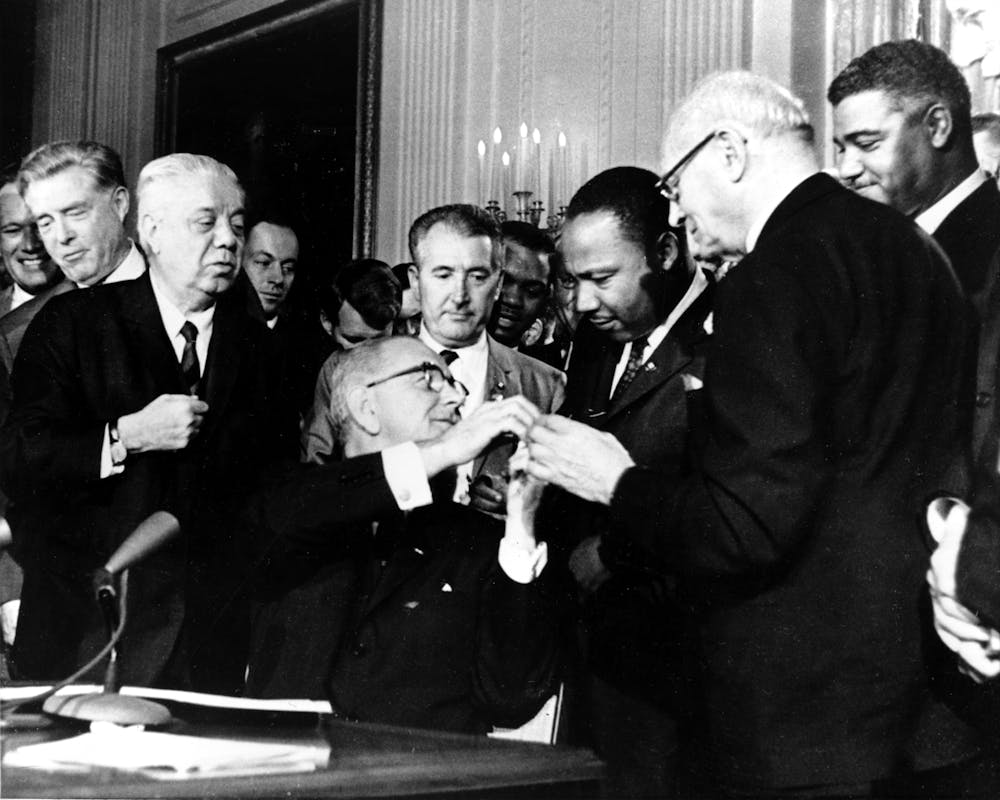
U.S. President Lyndon B. Johnson reaches to shake hands with Dr. Martin Luther King Jr. after presenting the civil rights leader with one of the 72 pens used to sign the Civil Rights Act of 1964 AP Photo

In the 1950s and 60s, civil rights advocates challenged racial segregation and inequality in every facet of public life – from schools, buses and bathrooms to employment, housing and restaurants. Congress passed the Civil Rights Act of 1964 to stamp out as much of that discrimination as possible, prohibiting discrimination in all those areas and more.
But Congress went beyond just prohibiting “discrimination.” It recognized that prohibiting policies with obvious or explicit intent to discriminate was not enough to ensure equality.
Following Congress’s lead, the Department of Justice concluded in a 1966 report that policies that impact one racial group more than another should also be prohibited. Numerous other agencies agreed and put in place what we now call “disparate impact regulations.”
The fact that some policy or practice disproportionately affects a racial group does not alone violate the regulations. The disparity, if serious enough, simply triggers further investigation by a federal agency. That investigation involves two key additional questions.
First, does the program have a good reason, or “legitimate justification,” for the policy that is causing the racial disparities? If not, the agency can block the policy because the disparities are unjustified.
But if the program has a good reason, which it often does, the second question is: Can an alternative policy achieve the program’s goals without producing egregious racial disparities? If so, the program should pursue the less discriminatory alternative because the disparities are clearly unnecessary.

Regulations matter

Today, discrimination and inequality continue largely due to subconscious racial biases. These biases are rampantand affect everything from who gets a job to who gets suspended from school.
These regulations alleviate the need to dig into individuals’ minds and search for very difficult to prove racial CONTINUE READING: Education Law Prof Blog


The Math Of Finite Resources And Fixed Margins – redqueeninla

The Math Of Finite Resources And Fixed Margins – redqueeninla

The Math Of Finite Resources And Fixed Margins


In a moral society, “Single Payer” is the singular, optimal solution.
Steve Lopez says:  “…There’s a place for both [innovative, popular charters and regular district schools], and a need for greater support of all public schools”.
These are separate, and non-touching, concepts. The latter is a question of funding, more funding, being sent down the Education pipeline.  That is well, good and necessary. Learn more and sign the petition here.
But whatever you send down the chute, is what’s there in that chute.  When you set up a school system with that public money, what you’ve got is a “fixed margin” of monies:  that’s all you’ve got. The apportionment of monies within the system is “zero sum”: giving to Paul takes away from Peter.  Period.
There may be a place for both “types” of schools, but an innovative, popular school is what any and every child wants, nay deserves. There is no moral justification for isolating the offering. What is being asked by the charter school system, is a pass for allowing some to have more than others by pretending there is “Choice” involved. By privileging some at the expense of others.
This is why the conversation about charters is not and never can be about “excellence”. Never mind the uncomfortable truth that “excellence” will always be a subjective term no matter how much you paint it in quantitative metrics. Never mind the structural aspect to charters that is an inherent driver of segregation.
What Lopez is referring to in invoking funding in a democratic educational system, CONTINUE READING: The Math Of Finite Resources And Fixed Margins – redqueeninla

Federal Judge Vacates Betsy DeVos’ Special Education Regulation “Delay” | deutsch29

Federal Judge Vacates Betsy DeVos’ Special Education Regulation “Delay” | deutsch29

Federal Judge Vacates Betsy DeVos’ Special Education Regulation “Delay”


On July 1, 2018, states and local education agencies (LEAs) receiving federal funding were supposed to be in compliance with US Department of Education (USDOE) “2016 Regulations” in order to demonstrate consistency across states in determining special education eligibility. The USDOE motivation behind its 2016 Regulations was to have states effectively address and modify special education determination that resulted in disproportionate numbers of children of color in special education.
IMG_1457

Betsy DeVos
Two days after the July 1, 2018, deadline for 2016 Regulations compliance, on July 3, 2018, US ed sec, Betsy DeVos, decided to issue her own “delay regulation,” in which she and her USDOE questioned the issue of the 2016 Regulations producing quotas– an issue addressed in depth in the 2016 Regulations– even as she undercut her own professed concerns about the 2016 Regulations producing quotas by allowing states to still use the 2016 Regulations if they so chose.
On July 12, 2018, DeVos and the USDOE were sued by the Council of Parent Attorneys and Advocates (COPAA), an organization that US District Judge Tanya S. Chutkan determined to have standing in the case.
USDOE filed a motion to dismiss, and Chutkan said no. Instead, Chutkan found that DeVos’ USDOE (also referred to as “the government”) issuance of a “delay CONTINUE READING: Federal Judge Vacates Betsy DeVos’ Special Education Regulation “Delay” | deutsch29

How Sacramento City Unified got into financial crisis By The Sacramento Bee (NOT A WORD ABOUT CORPORATE DARK MONEY AND THE IMPACT ON SAC CITY SCHOOLS)

How Sacramento City Unified got into financial crisis 
 (NOT A WORD ABOUT CORPORATE DARK MONEY AND THE IMPACT ON SAC CITY SCHOOLS)


RELATED: California: More Information About the Foxes Who Guard the Henhouse | Diane Ravitch's blog - https://wp.me/p2odLa-lTj via @dianeravitch


Sacramento City Unified School District is chipping away at expenses in a last-ditch effort to close its $35 million budget gap, but time is running out and a state takeover seems imminent.
The unprecedented rejection of the district’s budget in August by the Sacramento County Office of Education appeared to take many by surprise – but Sacramento City’s fiscal problems didn’t happen overnight.
Auditors have noted that sharp turn toward insolvency came on the heels of the 2017 labor contract between the district and teachers, which narrowly averted a strike. They said that deal combined with other factors, including a decade of financial missteps, leadership problems, labor strife and shrinking student enrollment, to take the district to the brink of disaster.
Here’s who is involved in the budget crisis, how the finances went off the rails, what the future might hold, and what it could mean for the district’s students and their families.

THE PLAYERS


Sacramento City Unified School District: The district is home to more than 42,000 students and 3,000 teachers in 81 schools. It’s the 11th-largest school district in California, with an annual budget of nearly $400 million.
Sacramento City Teachers Association: The SCTA is one of five unions in the district. Representing about 2,500 teachers, it’s the seventh-largest teachers union in California, according to its website. It is an affiliate of the California Teachers Association and the National Education Association. The union and the district are at odds over contract negotiations, with SCTA members currently voting whether to authorize a strike.
California Department of Education: If Sacramento City Unified determines it has become insolvent and needs an emergency loan to pay its bills, it will request one from the state Education Department. That request triggers a state takeover. The department has appointed a trustee for all previous state takeovers, including Oakland Unified in 2003 and Inglewood Unified in 2012. But that responsibility has shifted. Since the passage of Assembly Bill 1840, signed into law last year, the authority to appoint an administrator lies with the school district’s county superintendent.
Sacramento County Office of Education: The county education department, led by Sacramento County Superintendent of Schools Dave Gordon, has been monitoring Sacramento City Unified closely since it started showing signs of financial duress a decade ago. If the district requests a loan from the state, Gordon will assume all legal rights, duties and powers of the school board. He would then appoint an administrator.
Sacramento City Unified Superintendent Jorge Aguilar: Aguilar arrived after a long period of management turnover. The district had gone through six superintendents, some temporary, during the past 15 years. When Aguilar joined the district in mid-2017, it had a $5-million budget surplus, but the relationship between the district and its teachers was poor. A teachers strike was narrowly averted in November 2017 after more than a year of bitter contract negotiations. But labor tensions are again running high amid the financial turmoil.
Sacramento City Unified Board of Education: The board has eight members, including seven trustees elected by trustee area to four-year terms. The eighth member is a high school student selected to a one-year term by the Student Advisory Committee. The board is responsible for general district oversight, including hiring the superintendent. It approves or rejects the administration’s policy, budget and personnel decisions. If the district goes into state receivership, fiscal decisions will be taken out of its hands. The board selected Area 7 trustee Jessie Ryan as its president in 2017.
Sacramento Mayor Darrell Steinberg: Steinberg joined the budget wrangling that averted a teacher strike in 2017. He scribbled a back-of-the-napkin deal that included an 11 percent increase to teacher salaries – an agreement that the union says the district has walked away from.


FCMAT: The state-created Fiscal Crisis and Management Assistance Team provides financial advice, administrative help and training at the request of school districts and county offices of education. In December 2018, FCMAT presented an audit that warned Sacramento City Unified that if it failed to correct its budget deficit, it would face a state takeover in six months. The independent team faulted the district, which announced it would run out of money by November 2019.
California Legislature: Assemblyman Kevin McCarty, D-Sacramento, requested a state audit of the district, which was approved Wednesday by the Joint Committee on Legislative Audit. The audit is scheduled to begin on May 1. If the district requests an emergency loan, it must be appropriated by the state Legislature.

WHAT WENT WRONG?

In the last four fiscal years, between 2013 and 2017, Sacramento City Unified ran surpluses, according to its financial statements and FCMAT.
And then in 2017-18, the district suddenly ran a deficit of nearly $10 million. What caused the crisis?
Insufficient cuts: In April 2008, the county office of education changed Sacramento City Unified’s certification from positive to qualified because the district had not identified enough cuts, and some of the millions targeted still needed board approval.
In 2010, when Jonathan Raymond assumed the role of district superintendent, Gordon noted in a letter that some big-ticket items identified by the district for cuts – namely, furlough days and health benefits – required union negotiations.
“Our understanding is that formal negotiations have only just begun,” read Gordon’s letter. “The timeline is tight and there is little or no room for deadline modifications.”
The county’s Office of Education showed signs of faith in the district. In 2012, it concurred with the district’s qualified certification despite some reservations.
“Our decision to not downgrade the district budget to a negative certification was based on our reliance on the district’s implementation of its budget reduction plan,” read Gordon’s letter.
But the district took risks. Lots of them.
Cash flow estimates submitted by the district in 2012 showed that it would require $50 million in tax revenue anticipation notes – money that it didn’t have in hand, but that it expected from tax increases proposed by Gov. Jerry Brown. Gordon asked the district to prepare a contingency plan if the governor’s tax increases failed to materialize. Ultimately, the money did not come through, forcing the district to spend down millions of dollars from its general funds.
‘Leadership issues’: The December FCMAT audit criticized Sacramento City Unified for past mismanagement, communication failures and inexperienced staff that contributed to its ongoing budget problems.
“It is a governance and leadership problem, period,” FCMAT CEO Mike Fine said when he delivered the audit. “And it’s many years of governance and leadership issues – not purely the last twelve months.”
The audit found that the district’s business team did not communicate enough with other departments, making it more difficult to solve fiscal problems. It also said the district’s staff underutilized software and lacked understanding of how to maintain and analyze data.
Salary agreement, continuing labor strife: While Sacramento City Unified traveled a long road into fiscal trouble, with many warning signs along the way, its finances took a precipitous turn after the district and teachers signed a new labor contract.
The deal was brokered by Steinberg, Aguilar and the union at the mayor’s Greenhaven house over a weekend in November 2017 as a strike loomed. It provided a 7.5 percent salary increase for teachers with an additional 3.5 percent adjustment to mid-range salaries.
At the time, it was lauded as balance between fiscal prudence and paying teachers fairly.
But independent auditors now say that while the salary increases weren’t solely to blame for Sacramento City’s fiscal woes, after the deal was signed, the district quickly slid toward insolvency.
“What happened in 2017 was the tipping point. That seems to have changed the financial CONTINUE READING: How Sacramento City Unified got into financial crisis 

Sunday, March 10, 2019

UPDATE More on Tony Thurmond’s Charter Task Force - Did Tony Thurmond Give the Charter Task Force to the Charter Lobby? | Diane Ravitch's blog

California: Did Tony Thurmond Give the Charter Task Force to the Charter Lobby? | Diane Ravitch's blog

UPDATE More on Tony Thurmond’s Charter Task Force 


I posted earlier that there are no teachers on the task force appointed by Governor Gavin Newsom and State Superintendent Tony Thurmond to study charter law in California, but that’s not quite right. The task force is meeting regularly and it would likely be impossible for a working teacher to leave her or his classroom on a weekly basis to attend task force meetings.
However, there are at least two members of the task force who were active teachers: Erika Jones of the California Teachers Association and Cindy Marten, superintendent of the San Diego Unified School District.
I don’t understand why the task force has so  many representatives of the charter industry on a committee to study charter law, when only 10 percent of students in California schools are enrolled in charters. The charter industry is infamous for protecting its turf and fighting any regulation or accountability. This is like asking representatives of Big Tobacco to participate in a discussion of whether to regulate cigarette sales.
Charter law in the state is notoriously lax. A district with a tiny enrollment can open a charter in a district 500 miles away and collect a commission on the students who enroll. If a charter asks a district for permission to open or for a renewal, and the district rejects the application, the charter can appeal to the county board. If the county board says that its application or its record is deficient, the charter can appeal to the state board. Under Governor Jerry Brown, the state board rubberstamped applications despite rejections from the affected district and county. Under current law, the state need not consider the fiscal impact of charters on nearby public schools, a factor which has severely damaged Oakland, Inglewood, and other districts. Under current law, charters are parasites on the districts that are forced to host them, draining away students and resources and leaving “stranded costs” (fixed costs).
California has had a large number of scandals in the charter sector. The most recent occurred when the CEO of the Celerity Charter chain pled guilty to using the schools’ credit card to charge luxury items, including designer clothing, fancy hotels, haute cuisine and limousine service, as well as to fund her Ohio charter school.
These are issues the task force will consider. Will the large bloc of charter supporters on the task force acknowledge the fiscal problems caused by charters for the public schools that enroll most students? Or will they fight stubbornly to maintain the charters’ freedom from accountability? Why did the California Charter School Association get two members of the task force but the California Teachers Association get only one? If charter schools undermine public schools, it is a net loss for the children of the state. If failing charters are allowed to be renewed again and again, it is a disgrace.
Here is the complete task force:
The task force members are:
  • Cristina de Jesus, president and chief executive officer, Green Dot Public Schools California (charter chain);
  • Dolores Duran, California School Employees Association;
  • Margaret Fortune, California Charter Schools Association board chair; Fortune School of Education, president & CEO;
  • Lester Garcia, political director, SEIU Local 99 (Local 99 took $100,000 from Eli Broad to oppose Jackie Goldberg);
  • Alia Griffing, political director, American Federation of State, County and Municipal Employees (AFSCME) Council 57;
  • Beth Hunkapiller, educator and administrator, Aspire Public Schools (charter chain);
  • Erika Jones, board of directors, California Teachers Association;
  • Ed Manansala, superintendent, El Dorado County; board president, California County Superintendents Educational Services Association; 
  • Cindy Marten,  superintendent, San Diego Unified School District;
  • Gina Plate, vice president of special education, California Charter Schools Association (charter lobby);
  • Edgar Zazueta, senior director, policy & governmental relations, Association of California School Administrators (ACSA endorsed Marshall Tuck against Tony Thurmond). 
Recommended readings:

California: Did Tony Thurmond Give the Charter Task Force to the Charter Lobby?


Last November, there was a bitter contest for the position of Superintendent of Public Instruction in California.
The charter lobby pumped millions of dollars into the campaign of Marshall Tuck, former CEO of Green Dot charter schools. The charters spent twice as much as the California Teachers Association, which backed Tony Thurmond.
In a tight race, Thurmond won.
In two recent teachers’ strikes, in Los Angeles and Oakland, teachers demanded a moratorium on new charters until the fiscal impact of charters on public schools was thoroughly studied.
In response, Governor Gavin Newsom asked State Superintendent Tony Thurmond to set up a task force to examine the issues that charters raise and consider any needed revisions in the law.
Thurmond appointed an 11-member panel. Not a single one of the 11 is a teacher, even though teachers raised the questions in their strikes.
Worse, a possible majority of the panel represent the charter lobby that fought so hard to defeat Thurmond, smeared him with negative ads, and lost.
Here are some of the members:
  • Cristina de Jesus, president and chief executive officer, Green Dot Public Schools California;
  • Margaret Fortune, California Charter Schools Association board chair; Fortune School of Education, president & CEO;
  • Lester Garcia, political director, SEIU Local 99; (Charter against Jackie 100K Broad IE)
  • Beth Hunkapiller, educator and administrator, Aspire Public Schools
  • Ed Manansala, superintendent, El Dorado County; board president, California County Superintendents Educational Services Association; (El Dorado Charter Officers. President. Marcy Guthrie … Ed Manansala, Ed.D., County Superintendent El Dorado Co. Office of Education
    Rite of Passage Charter High School – El Dorado County Office of Education …
  • Gina Plate, vice president of special education, California Charter Schools Association;
  • Edgar Zazueta, senior director, policy & governmental relations, Association of California School Administrators. (LED Endorsement of Marshall Tuck)
It appears that seven of the 11 task force members are in the tank for charter schools.
This is by no means a balanced or open-minded committee.
How likely are they to propose tighter regulation of charter schools?
How likely are they to propose that districts should not be allowed to open charter schools in other districts, a policy that has led to financial abuses?
How likely are they to curb the waste, fraud, and abuse that allow fly-by-night charter schools to open in strip malls, collect money, then disappear?
Tony Thurmond, what happened?
California: Did Tony Thurmond Give the Charter Task Force to the Charter Lobby? | Diane Ravitch's blog

Big Education Ape: DPE Forces are Over-Represented on Charter Law Review “Action Team” | tultican - https://bigeducationape.blogspot.com/2018/08/dpe-forces-are-over-represented-on.html


Big Education Ape: Torlakson’s California Charter Law ‘Action Team’ Has a Troubling Tilt - https://bigeducationape.blogspot.com/2018/09/torlaksons-california-charter-law.html

Take All The Space You Need (For Now) | The Jose Vilson

Take All The Space You Need (For Now) | The Jose Vilson

TAKE ALL THE SPACE YOU NEED (FOR NOW)


It was a humid summer afternoon. I ventured with my son to a few stores along East 86th Street, enjoying parts of the city we don’t normally venture. I wore a black and orange Free Minds Free People shirt, my young one a white t-shirt and shorts. The sidewalks felt like people were walking shoulder to shoulder, two steps slower than their normal pace.
As we made our way up 3rd Avenue to Harlem, an elder white woman in a walker came to a stop and said “Excuse me.” My native New Yorker face belies my tendency towards hospitality and grace. “Do you need help?”
She says in , “You know the problem with you people is …” I already observed how she had already made a few snap judgments and my body already tightened up in anger. “… you really need to talk to your people about health and weight.” A handful of reactions ran through my mind as I clenched my fist. In the few seconds that felt like a few minutes, her voice had become a monotonous whistle waiting for me to break it. The faces around me had gone from minding their business to minding mine. NYC has any number of racial and intergenerational incidents daily, occurrences for people to film and cast judgments upon.
In that moment, I also recognized that my fist was holding my son’s hand. I mustered with furious eyes and bellicose tone: “THANK YOU! THANK YOU VERY MUCH!” My words rang out across the sidewalk as I rushed past the crowds. I took a seat in an emptier block just underneath a few CONTINUE READING: Take All The Space You Need (For Now) | The Jose Vilson


Schools Matter: The Mind Trust’s Neo-colonial War on Parents: Part One

Schools Matter: The Mind Trust’s Neo-colonial War on Parents: Part One

The Mind Trust’s Neo-colonial War on Parents: Part One


I am busy finishing my new book--a follow-up to Hoosier School Heist that will be released next year--and will be blogging again this summer. Please read John Harris Loflin's new and significant piece posted below. Thanks! Doug Martin

The Mind Trust’s Neo-colonial War on Parents: Part One 

By John Harris Loflin 

Due to the Mind Trust’s (MT) view that urban schools are broken and need fixing, this January the non-profit began looking for someone to launch “an independent parent advocacy organization” with emphasis on social justice and closing the Achievement Gap for communities of color in high poverty areas.

However, this commentary argues urban schools are not broken. As concluded in The White Architects of Black Education by Watkins, America’s public schools never meant to educate all children, especially children of color. We can’t call schools broken that were designed to fail.

Because America’s school system was designed to fail and/or mis-educate certain children, it was colonial. That is, its purpose was to colonize Native Americans and other non-whites, “fitting” them and settlers/immigrants into America’s “melting pot.”

“Education’s indoctrination if you're white--subjugation if you're black.” -- James Baldwin

Thus, initial (and current) public schooling confused education with conformity via CONTINUE READING: 
Schools Matter: The Mind Trust’s Neo-colonial War on Parents: Part One


Big Education Ape: Schools Matter: Hoosier School Heist Author Doug Martin on Real Accountability (and Federal Prison) - https://bigeducationape.blogspot.com/2015/12/schools-matter-hoosier-school-heist.html

Big Education Ape: Subscribe to Hoosier School Heist TV - YouTube - https://bigeducationape.blogspot.com/2015/05/subscribe-to-hoosier-school-heist-tv.html


As the author of  Hoosier School Heist,  Doug Martin’s research has been used by or referenced in Salon, Alternet, the Washington Post, the Associated Press, PBS, and newspapers and radio shows across Indiana and America.  His newest book project deals with Big Pharma, Big Medicine, the Cancer Industry, hospital fraud, and nursing home and health care corruption in Indiana.


Hoosier School Heist TV is Doug Martin's channel featuring videos of his book tour across Indiana speaking on the corporate takeover of public education. Order Hoosier School Heist at http://hoosierschoolheist.com/.
Follow Hoosier School Heist on Facebook: https://www.facebook.com/HoosierSchoolHeist
Tweet with Doug Martin at: https://twitter.com/DougMartinED

ALL ABOARD THE CRAZY TRAIN: All about Fla SB 7070 - YouTube

All about Fla SB 7070 - YouTube

ALL ABOARD THE CRAZY TRAIN: All about Fla SB 7070 


Already, on the second day of this year’s legislative session, the Florida Senate Education Committee decided it would be a good idea to advance another controversial omnibus education bill to the full senate floor. Sometimes referred to as a “train bill,” this type of legislation is expressly prohibited by the state constitution. “[E]very law shall embrace but one subject and matter properly connected therewith, and the subject shall be briefly expressed in the title.“ But for several years running, Republican leadership has been unable to advance their agenda piecemeal. So, in the closing days of each session, they’ve bundled everything together into one, unconstitutional mess and forced their members to vote either up or down on the entire package. Among its various proposals, SB 7070 expands on what’s already the nation’s largest voucher program. It allocates $422 million for another bonus program. For those of you keeping track at home, that’s the seventh of its kind, each of which has been deemed an abject failure. The bill also allows charter and private schools to circumvent safety and construction rules, unlike public schools, which must continue serving their communities as designated shelters during natural disasters. “[We] stand here today to vehemently oppose the introduction of SB 7070, a massive ‘Train Bill’ that caters solely to school ‘choice’ lobbyists and special interests. We reject the combining of a massive voucher expansion that will use public dollars […] to pay for private religious education…   “We believe the unfair ‘bonus’ money would be better placed in the base student allocation. We are annoyed that on day two of session we are facing a bill so packed with initiatives that meaningful public comment is impossible. SB 7070 should be broken up into individual bills that can be properly vetted and understood. Anything short of this betrays the trust of voters across Florida.” - Testimony of Catherine Baer, The Tea Party Network Committee Chair Manny Diaz, Jr, complained that “the definition of public education keeps getting twisted.” Yeah. By him and the education profiteers who’ve taken control of our state government. He claims teacher salaries are determined through collective bargaining between local school districts and teachers unions. What a cynical, disingenuous comment from a politician who’s repeatedly sabotaged local school districts’ ability to raise their own funds. This guy is a walking, talking conflict of interest, having personally cashed a $million in salary from the charter school industry he’s supposed to be regulating. http://accountabaloney.com/ https://www.facebook.com/FLBaloney/ @FLBaloney

All about Fla SB 7070 - YouTube


CURMUDGUCATION: Bug-In-Ear Coaching: Why Is This Still A Thing?

CURMUDGUCATION: Bug-In-Ear Coaching: Why Is This Still A Thing?

Bug-In-Ear Coaching: Why Is This Still A Thing?


You're a young teacher, working hard to get the hang of running a classroom, sequencing instruction, monitoring a roomful of students, tracking the clock, and otherwise managing your role as educational Boss Of The Room. It reminds you of when you first started driving, and it was taxing just to carefully monitor everything that needed to be monitored. Your hands are full and your brain is just this far from overloading.

Clearly what you need more than anything else is a voice in your ear offering back seat driving while you are trying to do your job.


Excellent. Do your anticipatory set, then dance for me.
Somehow bug-in-ear coaching continues to be a thing. EdWeek wrote this puffy promotional piece for the practice just last month. But the practice has been around for a while. Here's an extensive piece of happy talk about it back in 2011-- and it cites sources going back to 1994. The writers at least have the sense to acknowledge that "the virtual coach's role can quickly deteriorate into a Big Brother or a nagging mother." Well, yes. They also advise to keep things short, maybe just using key words.

Coaches advocating for this approach insist that teachers love it, which is not exactly a shocker. It's younger teachers or struggling teachers who are mostly likely to have the bug-ear thrust upon them and who are also least likely to say, "Are you kidding me?" But if you want to read an account of someone who went through it and hated it, here's a piece from Ann Berard, a former charter teacher who decided that she did not want to be "just like Tom Brady."

The students were also perplexed by my new earpiece accessory. "Um, Miss, what’s that in your ear?" they asked. I looked over to the three adults in the far back corner of the room for my CONTINUE READING: 
CURMUDGUCATION: Bug-In-Ear Coaching: Why Is This Still A Thing?