Latest News and Comment from Education

Friday, July 6, 2018

Big-name billionaire charter school backers donate to California and other key governor races

Big-name charter school backers donate to California and other key governor races

Big-name charter school backers donate to California and other key governor races


Prominent charter school supporters are dishing out campaign money, as key gubernatorial races in several states have now begun in earnest.
June primary contests set up a number of state battles for governor in the midterm elections this November, with both Democratic and Republican candidates that could change how public resources flow into charter and private schools in the coming years.
Last week, Netflix CEO Reed Hastings and philanthropist Laurene Powell Jobs donated $29,200 each — the maximum amount — to Democrat Gavin Newsom’s campaign for California governor. It’s a sign that the potent charter forces in Golden State politics are pivoting toward the state’s lieutenant governor, who is widely considered a shoo-in to beat Republican businessman John Cox.
Many of the billionaire philanthropists who want to reshape America’s struggling school systems believe that charters — which are privately run but publicly funded schools — help breed better and different ways to educate students who struggle in traditional public schools, especially poor and minority children. Some also support allowing tax dollars to fund vouchers for families that pick private schools, which don’t have public oversight. Studies are mixed when considering how those programs result in academic gains.

Critics, notably teachers unions, reject both charters and vouchers as drains on the cash-starved schools that educate the vast majority of students. Public school advocates also loathe those programs for eroding the neighborhood schooling model that defines communities.
Newsom has said that successful charters would thrive under his leadership, but he would seek to temporarily pause charter school openings to consider transparency issues. The moratorium would be a halting sea-change — if even for a limited time — for California’s robust charter school movement, which has for years enjoyed expansions and developments.
Newsom previously said he was disappointed that Hastings, a prolific charter schools supporter in California, gave millions of dollars to one of his primary challengers, former Los Angeles Mayor Antonio Villaraigosa. Newsom on the campaign trail has mostly Continue Reading: Big-name charter school backers donate to California and other key governor races


In America, Schools Aren’t Required to Teach Kids to Read and Write - The Atlantic

Detroit's Right to Literacy Case and U.S. School Reform - The Atlantic

In America, Schools Aren’t Required to Teach Kids to Read and Write
A judge in Detroit has concluded that the Constitution doesn't require Michigan to ensure schools promote students’ literacy.


What to do when a school is infested with vermin, when textbooks are outdated, when students can’t even read? Perhaps the answer is sue the government.
That’s what seven students in Detroit have done. Their class-action suit filed against the state of Michigan asserts that education is a basic right, and that they have been denied it.
Usually, such education-equity cases wend their way through state courts, as all 50 state constitutions mandate public-education systems, while the country’s guiding document doesn’t even include the word education. But this case, Gary B. v. Snyder, was filed in federal court, and thus seeks to invoke the Constitution. And as of this week, it’s headed to the federal appeals court in Cincinnati.
The lawyers filing the suit—from the pro bono Los Angeles firm Public Counsel—contend that the students (who attend five of Detroit’s lowest-performing schools) are receiving an education so inferior and underfunded that it’s as if they’re not attending school at all. The 100-page-plus complaint alleges that the state of Michigan (which has overseen Detroit’s public schools for nearly two decades) is depriving these children—97 percent of whom are students of color—of their constitutional rights to liberty and nondiscrimination by denying them access to basic literacy. Almost all the students at these schools perform well below grade level in reading and writing, and, the suit argues, those skills are necessary to function properly in society. It’s the first case to argue that the U.S. Constitution guarantees the right to become literate (and thus to be educated) because other rights in the Constitution necessarily require the ability to read.

The case is a long shot. Late last week, the district-court judge in Detroit, Stephen J. Murphy, dismissed it. (The plaintiffs are appealing that dismissal.) Murphy essentially stated that he needed guidance from the Supreme Court if he were to weigh in on whether the students’ abysmal proficiency levels and learning conditions amount to a violation of the Constitution. He also concluded that the suit makes too many hard-to-prove causal claims. Even though Michigan subjects the predominantly black Detroit students to conditions to which it doesn’t subject, say, the predominantly white students of nearby Grosse Pointe, Murphy wrote, there isn’t enough evidence to suggest that the state is treating the former group differently because of their race and thus violating the equal-protection clause. Another obstacle: The federal judiciary has in grown particularly restrained on educational-rights issues in recent decades, in part because of the backlash from parents and othersopposed to integration efforts that followed the wave of school-desegregation Continue Reading: Detroit's Right to Literacy Case and U.S. School Reform - The Atlantic


Is It Time for Parents to Unionize?

Is It Time for Parents to Unionize?

Is It Time for Parents to Unionize?


Think of Alissa Quart’s new book, Squeezed: Why Our Families Can’t Afford America, as “What to Expect When You’re Expecting Under Late Capitalism.” Of the more than 50,000 books listed on Amazon under “Parenting,” few engage as deeply with the economic pressures today’s parents must navigate: precarious work, a shortage of high-quality, affordable daycare and rising costs of living combined with stagnant wages. 
Quart, the executive editor of the Economic Hardship Reporting Project, also profiles efforts to improve the lives of parents and care workers––and offers suggestions about what’s still to be done. She spoke with In These Times about the challenges of organizing parents, why we’re so attached to the fantasy of middle-class life and why she considers her book “radical self-help.”
ITT: I’m interested in the theme of self-blame that runs through Squeezed. You write that after your daughter was born, and it became clear that you and your husband’s freelance earnings weren’t going to be enough to raise her, you began to blame yourself. Why did you have that reaction?
AQ: I think we have a tendency to blame ourselves, or we blame others. It’s binary. You can see that tendency in the way some disenfranchised groups now blame immigrants, say, and then on the other side, there’s a lot of rhetoric of self-punishment in American culture that you’re responsible for your own success and if you don’t make it then there’s something wrong with you.
The self-blame and guilt discourse comes from conservatives but it also emanates off of a certain kind of bootstrap self-help, like Lean In.  “Why aren’t you asking for a Continue reading: Is It Time for Parents to Unionize?


Thursday, July 5, 2018

The Problem With Generalizing About ‘America’s Schools’ - The Atlantic

Revisiting Reagan's 'A Nation at Risk' Report 35 Years Later - The Atlantic

The Problem With Generalizing About ‘America’s Schools’
It’s an abstraction that has obscured the true workings of the country’s education system for decades.

Revisiting Reagan's 'A Nation at Risk' Report 35 Years Later 

Thirty-five years ago, in April of 1983, Ronald Reagan appeared before the press to publicize a government report warning of “a rising tide of mediocrity” that had begun to erode America’s education system. Were such conditions imposed by an unfriendly foreign power, the authors declared, “we might well have viewed it as an act of war.”
Despite its grave tone, the report, titled “A Nation at Risk,” had little direct impact on policy. It did, however, establish a new way of talking about public education in the United States, a master narrative that has endured—and even subtly changed American education policy for the worse—over the past several decades.
Across that stretch of time, politicians and policy makers have spoken often of the inadequacy of “America’s schools.” In fact, this trope is one of the few things that Betsy DeVos, Donald Trump’s regulation-averse secretary of education, has in common with her predecessors; she and previous education secretaries have regularly discussed the nation’s schools as a cohesive whole. This phrasing is useful shorthand for a national official, but it obscures the fact that the United States does not actually have a national education system. Many countries do. In France, for example, a centralized ministry of education governs schools directly. But in the U.S., all 50 states maintain authority over public education. And across those 50 states, roughly 13,000 districts shape much, possibly even most, of what happens in local schools.

The abstraction of “America’s schools” may be convenient for rousing the collective conscience, but it is not particularly useful for the purpose of understanding (or improving) American education. Consider the issue of funding. On average, federal money accounts for less than 10 percent of education budgets across the country, and the rest of the financial responsibility falls to states and local schools. If local schools are unable to raise what they need, the state is usually well positioned to make up the difference, but states differ dramatically in their approaches. On average, states spend roughly $13,000 per student on public education—but looking at the average alone is misleading. Only about half of states spend anything close to that figure: A dozen spend 25 percent more than the national average, and 10 states spend 25 percent less. The result is significant disparities, and some striking incongruities. New York’s schools, for instance, spend roughly three times as much per student as Utah’s schools—a huge difference, even after accounting for New York’s higher cost of living.
Additionally, some states do much more than others to ensure that each district is properly funded. Local property taxes help fund schools nationwide, but in some places, like Massachusetts, the state steps in to provide additional resources for lower-income areas. In other places, like Illinois, property taxes are simply the primary sources of school funding, which means less money for poor districts than for wealthy ones.
Though states often take similar approaches on curricula and teacher licensure, they tend to differ considerably in policy and practice. Things like early  continue reading: Revisiting Reagan's 'A Nation at Risk' Report 35 Years Later - The Atlantic


Wednesday, July 4, 2018

Q&A: Will the New Charter School Bill Impact Commercial Real Estate? WTF is a PRIVATE CHARTER SCHOOL?

Q&A: Will the New Charter School Bill Impact CRE?

Q&A: Will the New Charter School Bill Impact Commercial Real Estate? WTF is a PRIVATE CHARTER SCHOOL?


A new school law, the controversial House Bill 7069, has been causing quite a stir in Florida since coming into effect in 2017. The recent change in legislation targets charter schools and includes a series of provisions that support the creation of an expansive educational system outside of the public school districts’ control. In other words, county school boards are now required to share local tax revenues—such as their construction budget—with private charter schools, among other clauses.
Another significant change brought on by the bill is the creation of Schools of Hope—a new charter school network. More precisely, the legislation encourages out-of-state charter school operators to move into regions where the nearest traditional public schools have persistent low ratings. Construction work, renovations or repairs at the new facilities get funded through local tax revenue granted by school districts. Board approval is not required for the allocations.
Joey Blakley, vice president of the Religious, Education & Not-For-Profit Group at Foundry Commercial, believes the new legislation could impact the commercial real estate market by empowering smaller operators to build or expand their charter schools due to funding from the county. Blakely told Commercial Property Executive how the bill influences new construction and what type of real estate assets developers might target.
What was the status of charter school development before the passing of HB 7069 and how has it changed since?
Blakely: It’s difficult to track charter school development, but according to the state, 34 new charter schools opened in the fall of 2017. Schools just started getting the new share of property tax funds, so it may be a year or two before we see significant changes. We expect to see charter schools use the funds to help expand and upgrade current facilities and develop new ones.
How does the new legislation impact the commercial real estate market? Continue reading: Q&A: Will the New Charter School Bill Impact CRE?

‘Educator spring’ spawns wave of teacher candidates - POLITICO

‘Educator spring’ spawns wave of teacher candidates - POLITICO

‘Educator spring’ spawns wave of teacher candidates
Teachers are building the next blue wave — without much help from Democrats.


Angry educators are flooding down-ballot races in the wake of recent red-state teacher strikes, accelerating the Democratic Party’s rebuilding process at the statehouse level and raising the prospect of legislative gains after years of decline.

Nearly 300 members of the American Federation of Teachers union are running for political office this year, more than double the number in each of the years 2012 and 2016. The teacher candidacies are part of a rising tide of political activism in 2018, with nearly 800 candidates running in the first round of Oklahoma's primaries, breaking the previous record of 594 set in 2006, and more than 200 filing to run in next month's Arizona primary — more than ran during each of the previous three election cycles.

The teacher candidacies suggest that the wave of teacher strikes and protests that began last winter in West Virginia and later spread to Oklahoma, Arizona and elsewhere created a grass-roots political opportunity. With their unions still reeling from a Supreme Court decision last month that's expected to deal a heavy financial blow, the teacher candidates are hoping to unseat conservative majorities that have dominated state legislatures since the Obama years.

“We’re receiving applications by the hour. It’s amazing,” said Lily Eskelsen Garcia, president of the National Education Association. “We’re really seeing the sun, moon and stars line up with the women’s march, the educator spring.”

There are some early signs of success, and not just among Democrats. In May, high school math teacher Travis Brenda defeated the majority leader of the Kentucky House, Jonathan Shell, in the Republican primary. In Oklahoma, three Democrats won special elections in state legislative districts in which President Donald Trump enjoyed huge margins. And in West Virginia, the local teachers union helped defeat Robert Karnes, one of its main antagonists in the state Senate, and voted in Continue reading: ‘Educator spring’ spawns wave of teacher candidates - POLITICO

Tuesday, July 3, 2018

DeVos goes deep with anti-regulatory mission at Education Department

DeVos goes deep with anti-regulatory mission at Education Department

DeVos goes deep with anti-regulatory mission at Education Department
California is the latest state to lob legal challenges at the Education Secretary's controversial policies.


WASHINGTON — Education Secretary Betsy DeVos is expected to take new steps as early as this week toward reversing Obama-era protections for students in debt to for-profit schools, including those that go out of business. It’s the latest in a broader effort by DeVos to recast the mission of her department and to relax safeguards intended to protect economically vulnerable students.
DeVos is also expected to rewrite rules requiring for-profit schools to equip students with minimal employment skills to qualify for federal aid.
DeVos’ plans to transform her department have gone largely unheralded, despite the outcry that greeted her appointment last year as President Donald Trump’s leading voice on education policy. But her push to ease regulations on for-profit colleges has opened a new front in the Democratic resistance effort, sparking lawsuits from state officials.
California added another legal challenge Friday when the state sued the nation’s biggest loan company, Navient, arguing it had engaged in illegal conduct servicing federal student loans. Continue reading: DeVos goes deep with anti-regulatory mission at Education Department


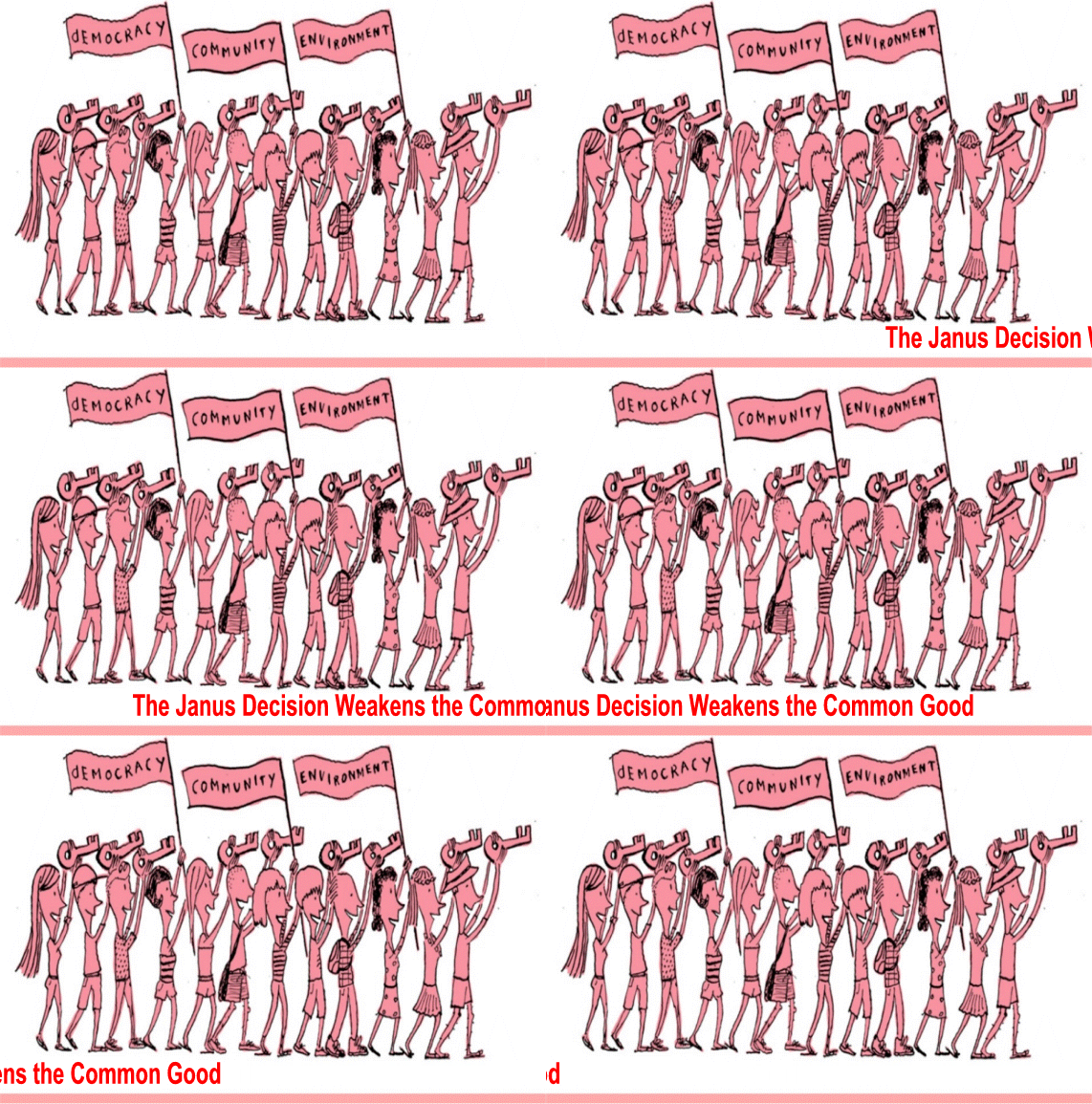
The Janus Supreme Court ruling is bad news for all of us: If you can read this, thank a teacher. If you don’t work the weekend, thank a union

If you can read this, thank a teacher. If you don’t work the weekend, thank a union

If you can read this, thank a teacher. If you don’t work over the weekend, thank a union

The Janus Supreme Court ruling is bad news for all of us


Is this Supreme Court decision the end of teachers unions?” asked an NPR article responding to last week’s shattering decision in Janus v. the American Federation of State, County and Municipal Employees. In the 5-4 decision, the justices overturned an older ruling that said public sector unions could require non-union members to pay “fair share fees” as a condition of union representation for negotiating things that benefit all workers, such as work hours, pay, vacation time and grievance procedures. This will undoubtedly rob unions of fees from “free riders” who benefit from collective bargaining while not paying for the privilege.
Yet if the last 12 months of organizing by teachers’ unions across the country has shown us anything, it is that unions will not go quiet into the night. In the right-to-work states of West Virginia, Kentucky, Arizona, and Oklahoma, teachers have organized quite dramatically in regional and statewide strikes. With their actions, they grabbed headlines in national papers, prodded Republican leadership to action, and in some cases won long overdue concessions in their contracts. Teacher won pay raises in West VirginiaArizona, and Oklahoma, and the legislature agreed to increase the amount of money in the Department of Education budget in Kentucky.
In fact, the Supreme Court decision might even spark more such actions: With fewer negotiating tools available to them, teachers may feel their only option is to strike. This is not a good outcome — for teachers; for students who spend much of their week in schools; for black people, who have higher rates of union membership than white people; the Democratic Party, which benefits from political contributions from unions and their boots on the ground; and for all of the rest of us, even if we don’t believe in unions. After all, collective bargaining gave us the weekend.
Among full-time wage and salary workers, according to the Bureau of Labor Statistics (BLS), union members had median usual weekly Continue reading: If you can read this, thank a teacher. If you don’t work the weekend, thank a union


Monday, July 2, 2018

Randi Weingarten Has 'Hope in the Darkness.' And Also Some Fear.

Randi Weingarten Has 'Hope in the Darkness.' And Also Some Fear.

Randi Weingarten Has 'Hope in the Darkness.' And Also Some Fear.

Our nation’s teachers unions have had a whiplash of a year, from the statewide teachers’ strikes that have swept the country to last week’s Supreme Court ruling in the Janus v. AFSCME case that could severely hurttheir membership. America’s most powerful teachers’ union leader says there is much, much more to come.
For the past decade, Randi Weingarten has led the 1.7 million-member American Federation of Teachers. She has been a prominent voice in battles over public education, organized labor, and national politics. In the dark aftermath of last week’s Janus ruling, which will almost certainly drain members and money from public unions nationwide, she spoke to us about how working class interests can possibly try to survive and thrive in the age of Trump.
SplinterIs it possible that the Janus ruling was even worse than you thought it would be?
Randi Weingarten: No, I expected it. I helped write the amicus brief for both Friedrichs [a nearly identical case on which the court deadlocked] and for Janus, and I had sat through the Janus hearing, which I found to be absolutely worse than the Friedrichs hearing. Gorsuch said nothing, but Alito and Kennedy clearly had their minds made up. Alito has had his mind made up for six years—how to weaponize the First Amendment against working people. And if you think about it, if you go back and read the Citizens United case, which uses the First Amendment to give corporations unfettered right to participate in politics, and now at the same time they’ve used the First Amendment to limit the rights of workers through their unions to have any power. It is the most ideological court that we’ve seen in modern history, and ideological about corporate power and about unfettered markets.
Splinter: What do you think Anthony Kennedy’s retirement means for labor law?
Weingarten: I know Kennedy gets a good rap because of what he did on marriage and what he did on sustaining Roe v. Wade. As a lesbian who just got married this March, I appreciate that. But on economic issues,  continue reading: Randi Weingarten Has 'Hope in the Darkness.' And Also Some Fear.