Latest News and Comment from Education

Wednesday, March 21, 2018

How Education Reform Ate the Democratic Party | Jennifer C. Berkshire

How Education Reform Ate the Democratic Party | Jennifer C. Berkshire:

How Education Reform Ate the Democratic Party
The Democrats and DeVos have more in common than they’d care to admit


IN A FACEBOOK POST THIS SUMMER, hedge fund billionaire Daniel Loeb took aim at the highest ranking Black woman in the New York legislator, Andrea Stewart-Cousins. “[H]ypocrites like Stewart-Cousins who pay fealty to powerful union thugs and bosses,” wrote Loeb, “do more damage to people of color than anyone who has ever donned a hood.” The rant, which had the exquisite misfortune of appearing just days before the actual KKK took to the streets of Charlottesville to menace nonwhite people and their allies, struck a familiar Loeb theme. In a previous post he implored his peer to take up the fight against the teachers union: “the biggest single force standing in the way of quality education and an organization that has done more to perpetuate poverty and discrimination against people of color than the KKK.”
It would be easy to dismiss all this frothing as just Loeb being Loeb. This is, after all, the same crusader for justice who once lambasted a CEO for his imperial lifestyle, not an easy charge to level from a ten-thousand-square-foot penthouse. But the NYC financier is not just any hedge fund billionaire. As the chair of the board of Success Academy, New York’s largest network of charter schools, he is a leading force within the nexus of big money and self-proclaimed school “reformers” within the Democratic party. While Loeb doesn’t limit his donations to Dems (as his profile on the married-but-looking dating site, Ashley Madison, indicated, he is not one to be tied down), he exerts the kind of outsized influence that $3.2 billion in net worth reliably commands these days.
There’s another reason why we can’t dismiss Loeb’s view that teachers unions promote income inequality and serve as a barrier to progress of any sort as just another crackpot rich-bro outburst. That’s because it’s now a key policy plank of responsible elite opinion almost everywhere. Flip back to The Economist—the bible of savvy, entrepreneurial-minded social criticism—circa 2012, and you’ll find Loeb’s screed rendered in assured magazine prose, minus the overt racist incitements. To wit: “no Wall Street financier has done as much damage to American social mobility as the teachers’ unions have.”
And where The Economist goes, influential “thought leaders” are sure to follow. So now, as America ponders the mounting economic disequilibriums that gave rise to the Trump insurgency, concerned plutocrats can all agree on one key article of faith: what is holding back the poor and minority children who figure so prominently in the glossy brochures of charter school advocates is not the legacy of racist housing policy or mass incarceration or a tax system that hoovers up an ever growing share of income into the pockets of the wealthy, but schoolteachers and their unions.
It was thus no great shock to see that, just weeks after Loeb apologized for his offensive language, attributing it to his passion for “education choice,” David Osborne, a professional Democratic party thinker who heads up something called the Reinventing America’s Schools Project at the Progressive Policy Institute, said essentially the same thing. On a swing through Philadelphia to promote his new book on the wonders of school privatization, Osborne told an interviewer that teachers unions belong in the same category with segregationist Alabama governor George Wallace. “They’re  Continue reading How Education Reform Ate the Democratic Party | Jennifer C. Berkshire:


Tuesday, March 20, 2018

School Choice May Be Accelerating Gentrification - The Atlantic

School Choice May Be Accelerating Gentrification - The Atlantic:
School Choice May Be Accelerating Gentrification
The ability to opt out of a neighborhood school increases the likelihood that a black or Hispanic neighborhood will see an influx of wealthier residents.
Related image


When Francis Pearman was studying at Vanderbilt, he and a fellow graduate student noticed a striking phenomenon in Nashville: White, affluent families were moving into low-income neighborhoods without sending their children to the neighborhood schools.

“We were really curious to see what that relationship looked like at the national level,” said Pearman, now a professor at the University of Pittsburgh.

When he and that student, Walker Swain, looked at national data, a pattern emerged. The ability to opt out of the neighborhood school increased the likelihood that a mostly black or Hispanic neighborhood would see an influx of wealthier residents.

“As school choice expands, the likelihood that low-income communities of color experience gentrification increases,” Pearman said.


Their finding adds to the already-contentious policy debates over school choice, gentrification, and segregation. And now another study, focusing on Charlotte, North Carolina, has come to similar conclusions: Housing prices spiked in areas where students were given new ability to switch schools away from one deemed failing.


“What is remarkable in this moment is that schooling and housing are decoupled in a way that hasn’t been the case before,” said Carla Shedd, a professor at the CUNY Graduate Center, who has written about school choice and housing.

To choice advocates, this separation of available school options from segregated housing systems is a key feature. To critics like Shedd, it raises tough questions about whether those newcomers help or harm a community. “What is a neighborhood without a school?” she asks. “What is a school without a neighborhood?”

Pearman and Swain’s national study, published in the peer-reviewed journal Sociology of Education, looked at four different types of school-choice programs: magnet schools, charter schools, private school vouchers, and open enrollment across school districts.

When school choices are limited, poor communities with more white people are School Choice May Be Accelerating Gentrification - The Atlantic:

Monday, March 19, 2018

WSW: How A One-Time Advocate Of Charter Schools Became A Vocal Critic | WMUK

WSW: How A One-Time Advocate Of Charter Schools Became A Vocal Critic | WMUK:

WSW: How A One-Time Advocate Of Charter Schools Became A Vocal Critic


Diane Ravitch was a supporter of charter schools when she worked in the Education Department of the George H.W. Bush administration. But she says evidence convinced her that education choice is “just moving kids around” and doesn’t address the needs of children.


Ravitch will speak at Western Michigan University on Thursday, March 22nd. Her address called Education Reform and the Promise of Public Education begins at 7:00 in the Dalton Center Recital Hall. It’s sponsored by the University Center for the Humanities.
Ravitch worked in the Education Department when Lamar Alexander was Secretary of Education. He was a supporter of charters and vouchers. Ravitch held similar views, but she says research continued to show that charters are not better, and kids who attend them lose ground. Ravitch says the same is true for vouchers which allow people to take the tax dollars that would be spent for their child to attend public school, and use it for private school tuition.
Part of the problem, Ravitch says, is the importance put on standardized tests. She says heavy reliance on test scores leads to cheating, and gaming the system. Ravitch says all students should have an opportunity to get a well-rounded education that includes the arts, music, physical education, access to advanced courses and foreign languages.
Ravitch says the idea of school choice doesn’t mean much when the choice is to go to a worse school. She says the state of Michigan spends a lot of money every year on school choice, she says that money would be better-spent on making all of the state’s public schools better.WSW: How A One-Time Advocate Of Charter Schools Became A Vocal Critic | WMUK:


Sunday, March 18, 2018

School Shootings in America Since 2013 #MarchForOurLives

School Shootings in America Since 2013:

School Shootings in America Since 2013


March For Our Lives - March 24, 2018


Since 2013, there have been more than 300 school shootings in America — an average of about one a week.

How many more before our leaders pass common-sense laws to prevent gun violence and save lives? Communities all over the country live in fear of gun violence. That’s unacceptable. We should feel secure in sending our children to school — comforted by the knowledge that they’re safe.
Consistent with expert advice and common sense, Everytown uses a straightforward, fair, and comprehensive definition for a school shooting: any time a firearm discharges a live round inside or into a school building or on or onto a school campus or grounds, as documented by the press and, when necessary, confirmed through further inquiries with law enforcement or school officials. Incidents in which guns were brought into schools but not discharged are not included. The database is updated as new shootings occur or as new evidence emerges about prior incidents.
When it comes to American children being exposed to gunfire, these shootings are just the tip of the iceberg. A report by the Urban Institute showed that in the single school district of Washington, DC, there were at least 336 gunshots in the vicinity of schools over a single school year. And school shootings have long-term impacts on the school community as a whole: a recent analysis of school shootings found that those involving a homicide reduced student enrollment in the affected schools, and depressed students’ standardized test scores by nearly 5 percent.
Since 2014, Everytown has analyzed these incidents for trends that might help prevent future violence. Click here to read the full report

March For Our Lives - March 24, 2018


March For Our Lives - March 24, 2018


You must be at least 13 years of age to sign up for an account and download and use this app. No information may be submitted to or through this app by users under the age of 13. You must be a U.S. resident to sign up for an account and download and use this app. If you have any questions regarding your data or our privacy practices, please contact privacy@doubledutch.me.

Friday, March 16, 2018

Most U.S. Teachers Oppose Carrying Guns in Schools

Most U.S. Teachers Oppose Carrying Guns in Schools:

Most U.S. Teachers Oppose Carrying Guns in Schools


STORY HIGHLIGHTS

  • 73% of teachers oppose teachers and staff carrying guns in schools
  • 58% say carrying guns in schools would make schools less safe
  • 18% would be willing to carry a gun in school buildings
This story is part of a special series on U.S. teachers' views of carrying guns and school safety.


WASHINGTON, D.C. -- Arming teachers and school staff as a way to handle the United States' problem with school shootings will be a tough sell to those who would have to carry it out -- teachers across the nation.
Nearly three-quarters of U.S. school teachers oppose the idea of training certain teachers and staff to carry guns in school buildings. Nearly six in 10 teachers think it would make schools less safe, and about seven in 10 teachers think carrying guns would not effectively limit the number of victims in the event of a shooting.
Teachers Don't think arming them is the solution to schcool shootings
These findings are based on a nationally representative online Gallup Panel survey of 497 U.S. school teachers in grades K-12. Gallup Panel teachers with web access were invited to take the survey online March 5-12, less than one month after the Feb. 14 shooting at a high school Parkland, Florida, that left 17 people dead and 17 injured.
President Donald Trump has been the most visible proponent of the idea of arming teachers. The National Rifle Association also advocates for this policy, often using the slogan: "To stop Most U.S. Teachers Oppose Carrying Guns in Schools:


Venture capitalist visits 200 schools in 50 states and says DeVos is wrong: ‘If choice and competition improve schools, I found no sign of it.’ - The Washington Post

Venture capitalist visits 200 schools in 50 states and says DeVos is wrong: ‘If choice and competition improve schools, I found no sign of it.’ - The Washington Post:

Venture capitalist visits 200 schools in 50 states and says DeVos is wrong: ‘If choice and competition improve schools, I found no sign of it.’


Ted Dintersmith is a successful venture capitalist and father of two who has spent years devoting most of his time, energy and millions of dollars of his personal fortune to learning about — and advocating for — public education and how it can be made better for all children.
Dintersmith has taken a dramatically different path from other wealthy Americans who have become involved in education issues, departing from the approach of people such as Microsoft founder Bill Gates, who was a prime mover behind the Common Core State Standards and initiatives to assess teachers by student standardized test scores.
Dintersmith traveled to every state to visit schools and see what works and what doesn’t — and his prescription for the future of American education has very little to do with what Gates and others with that same data-driven mind-set have advocated.
He thinks the U.S. education system needs to be reimagined into cross-disciplinary programs that allow kids the freedom to develop core competencies through project-based learning.
He discussed his vision in a book he co-authored, “Most Likely to Succeed: Preparing Our Kids for the Innovation Age,” and he funded and produced a compelling documentary called “Most Likely to Succeed,” which goes into High Tech High school in San Diego, where the project-based educational future he wants is already there.
He has a new book being published in April, “What School Could Be: Insights and Inspiration From Teachers Across America,” about what he learned during his travels and school visits.
In this post, he writes about what he saw and offers advice to Education Secretary Betsy DeVos, who recently said on “60 Minutes” that she had never “intentionally” visited an underperforming school.
By Ted Dintersmith
In her recent “60 Minutes” interview, Secretary of Education Betsy DeVos indicated that perhaps she should visit more schools. Yes.  She needs to get out of her bubble and visit schools across America.  I did, and there’s much to be learned.
For context, I spent the entire 2015-2016 school year immersed in education across America.  In a trip that rivaled de Toqueville’s, I traveled to all 50 states, visited 200 schools of all types Venture capitalist visits 200 schools in 50 states and says DeVos is wrong: ‘If choice and competition improve schools, I found no sign of it.’ - The Washington Post:

Thursday, March 15, 2018

School Segregation is Not a Myth - The Atlantic

School Segregation is Not a Myth - The Atlantic:
School Segregation Is Not a Myth
Skeptics claim that concerns over racially divided schools are false alarms—but they’re missing the full picture.


Is school segregation getting worse?

Plenty of people say yes, including scholarsjournalists, and civil-rights advocates. For the first time in years, there’s something approximating a consensus: Racially divided schools are a major and intensifying problem for American education—maybe even a crisis.

There’s seemingly compelling numerical evidence, too. According to my analysis of data from the National Center on Education Statistics, the number of segregated schools (defined in this analysis as those schools where less than 40 percent of students are white), has approximately doubled between 1996 and 2016. In that same span, the percentage of children of color attending such a school rose from 59 to 66 percent. For black students, the percentage in segregated schools rose even faster, from 59 to 71 percent.


But not everyone is on board. In the eyes of some writers, the warning signs of segregation are all a false alarm—little more than a statistical mirage. The National Review writer Robert VerBruggen recently made this case, attacking what he called the “resegregation myth.” VerBruggen and other skeptics contend that methods meant to identify school segregation are instead detecting something much more benign: The growing diversity of the American population.


This is possible because many measures of school segregation are narrow, focusing only on a single symptom. For instance, one common research technique is to count the number of schools above a certain demographic cutoff (for instance, more than 90 percent nonwhite). Another is to focus on “exposure,” or how common it is for white and nonwhite students to encounter each other in the education system.

Doubters like VerBruggen argue that people using these metrics have been fooled by demographic change. The past several decades have seen a precipitousSchool Segregation is Not a Myth - The Atlantic:


 Big Education Ape: The History of Institutional Racism in U.S. Public Schools - Garn Press - 


Wednesday, March 14, 2018

Must Watch Video: Student speaks in front of the U.S. Capitol on #NationalWalkoutDay


Student speaks in front of the U.S. Capitol on #NationalWalkoutDay
Image result for #NationalWalkoutDay

 Image result for #NationalWalkoutDay
Image result for #NationalWalkoutDay
Related image


Image result for #NationalWalkoutDay

Image result for #NationalWalkoutDay

Image result for #NationalWalkoutDay

Image result for #NationalWalkoutDay
Image result for march for our lives on march 24
https://marchforourlives.com/walkouts

Monday, March 12, 2018

Betsy DeVos’s stumbling ‘60 Minutes’ interview, annotated - WAPO

Betsy DeVos’s stumbling ‘60 Minutes’ interview, annotated - YouTube:

Why it was so easy for ‘60 Minutes’ to rebut Betsy DeVos’s charter-school arguments

Betsy DeVos was picked to run the Education Department largely to continue the work she had embraced through her philanthropic work: advocating an expansion of charter schools. Hers was the most controversial Cabinet nomination by President Trump, requiring Vice President Pence to cast a tie-breaking vote confirming her for the position. That controversy had many causes, but a significant one was that many in the education community were concerned about turning over the department to someone who advocated transferring scarce public funding to what amounted to educational experiments.
Which is to say that DeVos should, by now, be very aware that her advocacy of charter schools is contentious, to understate it a bit. Meaning, by extension, that when being interviewed by one of the most established television news programs in the country, she should be able to defend her position.
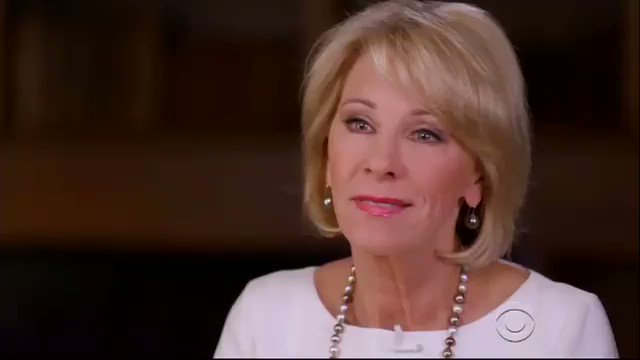
Yet when interviewed by “60 Minutes” for a program that aired on Sunday — she wasn’t.


Betsy DeVos struggles to provide answers to '60 Minutes' when asked for evidence to support school choice policies. http://bit.ly/2tJjstd 
“In places where there is a lot of choice that’s been introduced,” DeVos told CBS’s Lesley Stahl, “Florida, for example, studies show that when there’s a large number of students that opt to go to a different school or different schools, the traditional public schools actually, the results get better as well.” Continue Reading: Why it was so easy for ‘60 Minutes’ to rebut Betsy DeVos’s charter-school arguments - The Washington Post