Latest News and Comment from Education

Saturday, May 20, 2017

Catch up with CURMUDGUCATION

CURMUDGUCATION:

Catch up with CURMUDGUCATION


My 16 Rules
Today I turn sixty, so it's time form one of those posts. These are the rules. Mind you, they are not a sign of any particular wisdom or smartitude on my part-- I have learned about these rules in the same way a somewhat dim cow learns about an electric fence. About 59 years ago. My typing skills have not improved 1. Don't be a dick. There is no excuse for being mean on purpose. Life will provide

YESTERDAY

PA: Cyber School Court-Ordered Crowded Clown Car
Pennsylvania has been a big, fat profitable garden of cyber schools, taking an early lead over even California in letting virtual education take root. And there are so many aspects of cyber-schooling in Pennsylvania that we could discuss. As always, I'll preface this by saying that there are students fro whom cyber-schooling is a useful option. But the modern cyber charter industry is not aimed at

MAY 18

So Now Failure Is Okay, Apparently
" Fail better ," says Michael Q. McShane (Show-Me Institute, AEI) in a piece at US News, arguing to reformsters for the virtue of admitting failure and building upon it. Part of his point is vaid, part is hugely self-serving and part of it is just plain annoying. Policy ideas like charter schools, teacher evaluation and high standards first exist in the abstract. When they are actually implemented

MAY 17

The Geography of Reform
It's an oft-repeated reformster refrain. Students trapped by zip code in failed school s. Paul Ryan offering a lifeline for trapped students . And here's Betsy DeVos at a recent speech, explaining some of the fundamental flaws of our terrible awful no good very bad public education system: The system assigns your child to a school based solely upon the street on which you live. We get these repeat
Petrilli Pokes Personalized Processing
Mike Petrilli, head honcho of the ever-reformy Thomas B. Fordham Institute, has taken a look at the future of Personalized Learning , and he has some concerns. He's read the PR, and he knows about the appeal of super-flexible differentiation, the varied student-customized pathways to excellence. However: Hooray for all that. But after seeing a version of personalized learning in action recently, I
Rutgers Prof Beats NJ Charter Attack
I'm happy to provide a good news follow up to an old story. Two years ago, Rutgers University professor Julia Sass Rubin found herself under attack by the New Jersey Charter School Association. She had published research that contradicted the rosy charter picture in NJ, showing that, much to nobody's surprise, that charters enroll fewer very poor students, fewer non-English speaking students, and

MAY 16

The Takeover Lie
One of the techniques in the reformster arsenal has been the school takeover, in which some august body declares a public school a failure, and that school is marked for Takeover. That failure can be certified by specious Big Standardized Test results (yay, PAARC and SBA) or by the more cynical method of refusing to fuly fund a district and then certifying them, as financially distressed. This par

MAY 14

Artificial Stupidity
Facebook absolutely insist on showing me "top stories." Every time I open the Facebook page, I have to manually switch back to "most recent," because even though the Facebook Artificial Smartitude Software thinks it knows what I most want to see, it can't figure out that I want to see the "most recent" feed. Mostly because the Facebook software is consistently wrong about what I will consider Top
ICYMI: Mother's Day Edition (5/14)
Time for another batch of reading. I know I sound like a broken record, but when you read something you like, share it, pass it along, help add to its reach. How Google Took Over the Classroom The New York Times takes a close look at how Google took over the classroom-- and what price we all may be paying. Don't Put Efficiency in School Ahead of Other Goals Andy Smarick in US News once again apply

MAY 13

Progressive: The Trouble with Ranking Schools
For a while now I've been a "Progressive Fellow in Education" (which is different from being, say, a charming fellow in the low brass section) and I write regularly for them as part of a group of twelve education writers. If you aren't reading the Fellows regularly, you should be. Anyway, I'm going to try to entice you over there by offering the lead to my latest piece, because I think it's impor
(Not) A New Conversation
Phyllis Lockett took to Huffington Post last week to call for a New Conversation , which-- okay, can we stop calling for new conversations? Because they're hardly ever new and often they are barely conversations, and we have had many of these calls and maybe we should just finish one of our old conversations instead of dropping them to start new ones like an easily-distracted party guest. Lockett
CURMUDGUCATION:


Jersey Jazzman: U-Ark Screws Up A Charter School Revenue Study, AGAIN: Part II

Jersey Jazzman: U-Ark Screws Up A Charter School Revenue Study, AGAIN: Part II:

U-Ark Screws Up A Charter School Revenue Study, AGAIN: Part II

Image result for U-Ark Screws Up A Charter School Revenue Study, AGAIN

Here's Part I of this series.


If this is true, it's really disturbing:

Colorado’s General Assembly on Wednesday passed a bill giving charter schools the same access to a local tax funding stream as district schools have, The Denver Post reported.
The bipartisan compromise measure, which supporters say is the first of its kind in the nation, would address an estimated $34 million inequity in local tax increases. It came a day after the University of Arkansas released a study that found charter schools receive $5,721 less per pupil on average than their district counterparts — a 29 percent funding gap. [emphasis mine]
It is, of course, standard operating procedure for outfits like the U-Ark Department of Education Reform to claim their work led to particular changes in policy; that's how they justify themselves to their reformy funders.  Maybe the connection between the report and the Colorado legislation (which is really awful -- more in a bit) is overblown...

But if the U-Ark report did sway the debate, that's a big problem. Because the report is just flat out wrong. 

As I explained in Part I, the claim that Camden, NJ, has a huge revenue gap between charters and public district schools seems to be based on an utterly phony comparison: all of the revenue, both charter and district, is linked to only the CCPS students -- not the charter students. Because the data source documentation in the report is so bad, I can't exactly replicate U-Ark's figures, so I invited Patrick Wolf and his colleagues to contact me and explain exactly how they got the figures they did.

So far, they remain silent.

But that isn't surprising. When U-Ark related its first report in 2014, Bruce Baker tore it to shreds in a brief published by the National Education Policy Center. The latest U-Ark report cites Baker's brief, so they must have read it -- but they never bothered to answer Jersey Jazzman: U-Ark Screws Up A Charter School Revenue Study, AGAIN: Part II:


New National Map Shows That Education Privatizers Have Burrowed into Almost All 50 States | Alternet

New National Map Shows That Education Privatizers Have Burrowed into Almost All 50 States | Alternet:

New National Map Shows That Education Privatizers Have Burrowed into Almost All 50 States

Charter schools, voucher programs, private school tax subsidies and more.


Only three states do not have some form of privatized K-12 education in their public schools, a new nationwide map and accompanying analysis has found, showing how much the charter school and school choice movement has grown in recent years.
Those states are North Dakota, Nebraska and West Virginia, the only states given an “A” grade by the Network for Public Education, a non-profit that opposes privatization, loss of local control, over-testing of students, and other non-governmental efforts that seek to commoditize public schools.       
All the other states and the District of Columbia have some mix of charter schools, charter authorizing authority outside local school districts, online charter school, voucher programs where taxpayers pay for private schools, tax credits for sending children to private schools or educational savings accounts, which is another form of a voucher program, according to the NPE State Report Card 2017.
“Our goal for the School Privatization Explained project was to arm public school advocates with the facts,” said Carol Burris, executive director of the Network for Public Education (NPE) and a former high school principal from New York. “Those who wish to turn our public education system into a private education system have been quite clever in disguising their intent. Our one-page fact sheets ‘rip off the mask.’”
The Network for Public Education was co-founded by Diane Ravitch and Anthony Cody, both longtime educators and advocates of traditional public schools. The group supports numerous policies that would improve public schools but is opposed to private sector efforts to infiltrate K-12 schools via various corporate management and marketing schemes.
“You know what we oppose,” Ravitch says on the website. “High-stakes testing; privatization of public education; mass school closures to save money or to facilitate privatization; demonization of teachers; lowering of standards for the education profession; for-profit management of schools.”
“We want advocates to have facts at their fingertips,” Burris said. “We want them New National Map Shows That Education Privatizers Have Burrowed into Almost All 50 States | Alternet:
 

Big Education Ape: Defend Your Public School from the Trump/DeVos Budget Debacle - Network For Public Education - http://bigeducationape.blogspot.com/2017/05/defend-your-public-school-from.html

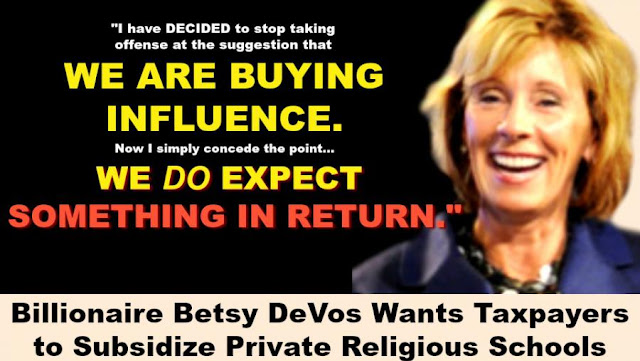
Democrats Look To Close Conflict-Of-Interest Loophole Linked To Betsy DeVos | HuffPost

Democrats Look To Close Conflict-Of-Interest Loophole Linked To Betsy DeVos | HuffPost:

Democrats Look To Close Conflict-Of-Interest Loophole Linked To Betsy DeVos

New bill would require nominees to disclose “dark money” they’ve donated or solicited.


Image result for big education ape devos dark money
WASHINGTON ― Democrats introduced legislation on Wednesday to close a conflict-of-interest loophole spotlighted after President Donald Trump nominated Republican megadonor Betsy DeVos to be Secretary of Education and Scott Pruitt to be head of the Environmental Protection Agency.
At the time of her confirmation, DeVos and her wealthy family were known to have made around $20 million in publicly reported contributions to support Republican candidates. What remained unknown was how much she and her family donated to non-disclosing “dark money” nonprofits that helped elect senators who would vote on her nomination. For Pruitt, the lack of disclosure went the other way, as he had solicited contributions from donors for a dark money nonprofit during his time as Oklahoma’s attorney general.
The legislation, sponsored by Sen. Sheldon Whitehouse (D-R.I.) and Rep. Ted Deutch (D-Fla.), would require executive branch nominees to disclose whether they solicited or contributed money to political candidates, political parties, political action committees and, most importantly, nondisclosing nonprofits active in elections. Additionally, nominees would be required to enter into agreements with the Office of Government Ethics that would explain how they would avoid conflicts of interest after confirmation.
Whitehouse and Deutch cite the Supreme Court’s 2010 Citizens United decision as the main reason why this new conflict-of-interest disclosure is needed. That decision gave corporations the right to spend unlimited amounts of money on elections so long as their spending was independent of the candidates they supported.
A side effect of the decision was that nonprofits that do not disclose their donors were suddenly empowered to spend on direct electoral appeals. This led to a rapid increase in dark money spent to elect congressmen, senators, governors and presidents.
“Citizens United unleashed a tsunami of corporate spending in our politics, threatening to drown out the voices of individual citizens.  It’s time to update our ethics rules to prevent that spending from hatching serious conflicts of interest at the top levels of our government,” Whitehouse said in a statement.
“We ask high-level appointees to disclose their financial relationships, which may have a serious influence on the work they do if confirmed.  We also need to ask about fundraising relationships, which can be just as thorny.  That will help us avoid potentially serious conflicts of interest and the scandal that would follow,” he said.
Deutch said, “Under current law, billionaires can anonymously flood our elections with unlimited amounts of money one day and become heads of an agencies the next. We can’t let the failures in our campaign finance laws be compounded by failures in our ethics laws.”
Sens. Tom Udall (D-N.M.), Chris Van Hollen (D-Md.), Al Franken (D-Minn.) and Tom Carper (D-Del.) cosponsored the Senate bill. Reps. John Sarbanes (D-Md.), Zoe Lofgren (D-Calif.), Mark Pocan (D-Wisc.), David Cicilline (D-R.I.) and Jan Schakowsky (D-Ill.) cosponsored the House bill.

New superintendent champions data use, educational equality for Sacramento schools | The Sacramento Bee

New superintendent champions data use, educational equality for Sacramento schools | The Sacramento Bee:

Buckle up, Sac City Unified parents: A reformer is about to take over


Long before he was named the new superintendent of the Sacramento City Unified School District, Jorge Aguilar was a freshman at UC Berkeley who had his educational self-worth shattered on his first day of chemistry class.
OPINION
“I couldn’t even follow the first lecture; I withdrew from the class,” said Aguilar, who begins work July 1 with several daunting tasks on his to-do list, including reversing Sac City Unified’s dropout rates.
Aguilar didn’t let that temporary setback define his college experience, even though he easily could have, given the challenges of his life. He stayed at Berkeley, got a degree in Latin American studies, then a law degree from Loyola Law School – accomplishments that would become the foundation of a career dedicated to helping others reach their academic potential.
Raised in the small farming town of Parlier in Fresno County, Aguilar takes the reins in Sacramento during a difficult time for the district. Sac City Unified has seen its numbers tumble in several critical areas in recent years while other districts in the county and around the state have been making steady progress.
It’s an embarrassment that in 2016 the high school graduation rate in the capital of California was 80.5 percent, well below the state’s average. Meanwhile, the dropout rate of African American students in Sacramento was 19 percent, more than double what it was in 2013; dropout rates for special education students nearly tripled to 18 percent.
In 2013, the last year under former superintendent Jonathan Raymond, the graduation rate for Sac City Unified was greater than 85 percent. But Raymond left, worn down by teacher-union politics and a lack of support for school reforms. Caretaker superintendent Jose Banda took over and numbers began to slide. Now Aguilar is hoping to correct the course.
I had lunch with Aguilar in his hometown earlier this week, and he asked me if Sac CityNew superintendent champions data use, educational equality for Sacramento schools | The Sacramento Bee: 


Image result for big education ape sacbee

Trouble in California Eden: A Divided Marin County Community Gets a New Charter School | Alternet

Trouble in California Eden: A Divided Marin County Community Gets a New Charter School | Alternet:
Trouble in California Eden: A Divided Marin County Community Gets a New Charter School


On a recent idyllic Marin County afternoon, Manor Elementary School PTA President Heather Bennett sat on her outdoor deck and related the newest incident to inflame the Ross Valley public school community.
“Crazy stuff is going on,” she said, referring to what could be the longest-running conflict in California’s education wars. The ugly and divisive fight pits STAND With Ross Valley Schools — a group of parents who favor traditional public schools — against a breakaway alternative education program soon to become the Ross Valley Charter School (RVC).
“It’s a solution to a problem that didn’t exist, and it actually creates a problem that need not exist,” Bennett said of the charter school.
The dispute, she claimed, which had until recently played out in emotional Ross Valley Elementary School District (RVSD) board meetings, contentious lawsuits and chilly encounters in local supermarkets, had escalated into heated accusations of vandalism on the neighborhood-focused social network, Nextdoor, where many of the daily salvos between the warring sides are hurled.
STAND was formed last December after the not-yet-opened charter school, which was eventually co-located at the district’s lone middle school, filed a facilities request under the aegis of Proposition 39, a 2000 law passed by California voters that compels school districts to house charters on their campuses.
California’s 1992 charter school law waived much of the state’s education code for charters, under the theory that they would be dynamic classroom laboratories capable of closing the state’s education gap for children traumatized by the poverty and social stressors of their neighborhoods. What the law doesn’t do is limit charter schools to low-performing communities, and for small, highly rated districts like Ross Valley, charter schools carry substantial costs that STAND parents maintain have already negatively impacted classrooms.
“What concerns me is that [Ross Valley Charter] is going to eventually take over one of our neighborhood public schools,” said Eileen Brown, who is a STAND member but also a former parent of RVC’s predecessor, a district-run Alternative Schools program called MAP. “They will grow and they will get enough parents to buy in, so that one of our neighborhood public schools that serves all the children is not going to have enough numbers to justify staying open.”
Besides being California’s wealthiest county, Marin is one of its best educated. The high value its residents place on a quality education has given Marin County some of California’s highest-performing and most competitive schools — Trouble in California Eden: A Divided Marin County Community Gets a New Charter School | Alternet:

Keeping retirement weird. Wealth matters? It sure does. | Fred Klonsky

Keeping retirement weird. Wealth matters? It sure does. | Fred Klonsky:

Keeping retirement weird. Wealth matters? It sure does.

One of the subjects that Dad and I didn’t need to talk have a talk about as he approached his passing at age 85 was handling the inheritance.
There wasn’t any.
19WEALTH-master768
Vicki and Ron Weiner have talked with their two daughters about the wealth they will inherit. “The thought of being left all of this money is outside of their frame of reference,’’ Mr. Weiner said.CreditAlex @roblewski for The New York Times
Dad had Social Security and some veterans benefits. But after a lifetime of hard work there wasn’t anything in the way of savings or investments.
Like millions of working class Americans, he left the world leaving pretty much nothing behind in the way of money or possessions.
It made his final years stressful, to say the least.
It is a common story.
That is why when state legislators threaten to take away pension benefits that were promised to those who are depending on those benefits, as Illinois senators did last week, it is really shitty.
Someone wrote me last week complaining that all I do is talk about the problems of Keeping retirement weird. Wealth matters? It sure does. | Fred Klonsky:
static1.squarespace
Tell your Illinois state representative to vote no on pension theft. I did. Will Guzzardi responds. | Fred Klonsky - http://wp.me/p4C3g-l0i 

CURMUDGUCATION: My 16 Rules

CURMUDGUCATION: My 16 Rules:

My 16 Rules


Today I turn sixty, so it's time form one of those posts. These are the rules. Mind you, they are not a sign of any particular wisdom or smartitude on my part-- I have learned about these rules in the same way a somewhat dim cow learns about an electric fence.


1. Don't be a dick.

There is no excuse for being mean on purpose. Life will provide ample occasions on which you will hurt other people, either through ignorance or just because sometimes life puts us on collision courses with others and people get hurt. There is enough hurt and trouble and disappointment and rejection and hurt in the world; there is no reason to deliberately go out of your way to ad more.

2. Do better.

You are not necessarily going to be great. But you can always be better. You can always do a better job today than you did yesterday. Make better choices. Do better, You can always do better. 

3. Tell the truth.

Words matter. Do not use them as tools with which to attack the world or attempt to pry prizes out of your fellow humans (see Rule #1). Say what you understand to be true. Life is too short to put your name to a lie. This does not mean that every word out of your mouth is some sort of Pronouncement from God. Nor does it mean you must be unkind. But you simply can't speak words that you know to be untrue.

4. Seek to understand.

Do not seek comfort or confirmation. Do not simply look for ways to prove what you already believe. Seek to understand, and always be open to the possibility that what you knew to be true yesterday must be rewritten today in the light of new, better understanding. Ignoring evidence you don't like because you want to protect your cherished beliefs is not good.

5. Listen and pay attention.

Shut up, listen, watch, and pay attention. How else will you seek understanding? Watch carefully. 
CURMUDGUCATION: My 16 Rules:


White Guy Problems | Blue Cereal Education

White Guy Problems | Blue Cereal Education:

White Guy Problems


Typical Suburban Neighborhood
Image result for White Guy Problems


My wife and I live in a non-descript middle class suburban neighborhood. It’s more white than not, but there are a half-dozen families of color up and down the block, including a Hispanic couple and their kids two doors down and across the street. We haven’t socialized, but we wave from time to time. You know how it is with neighbors.
I hate mowing. I long for random teenagers to show up wanting to mow my lawn. YES! Oh my god yes – money is no object, son. Cut like the wind! Several years ago, I simply walked down the block to where a kid was mowing and asked if he wanted to come do mine for $20 as well. That was a great summer! Now that it’s Spring once again, I’ve been keeping my eye out for this season’s entrepreneurial youth...
I noticed a young man – a teenager, I think – mowing the lawn at the Hispanic house I mentioned. Excellent! I wonder if he’d be interest—
I stopped.
I’d started to walk over and ask if he wanted to mow my lawn. Then it hit me – he’s Mexican, or something. I was immediately gripped with the conviction that no matter how carefully I tried to phrase it, my “real” question would be clear: “Hey, I notice you’re Mexican – kay posse? You mow my lawnito?”
I had actual panic in my stomach, despite having never left my driveway. I was almost a racist! My brain took an impatient tone (I’d swear it sighed at me internally) and told me how ridiculous I was being. I just wanted someone to mow. Like he was doing right that minute, probably without even thinking about race. Logically, my course was clear.
But… I’ve been mowing my own lawn so far this season. I tell myself it’s about staying in shape. I’m not buying that, of course, but I try not to think about it too much.
There are words and phrases I’ve used for decades which are obvious leftovers from White Guy Problems | Blue Cereal Education:

Susan Ohanian: Schools Matter: Moby-Dick for Babies: Marvel or Monster

Schools Matter: Moby-Dick for Babies: Marvel or Monster:

Moby-Dick for Babies: Marvel or Monster

Image result for baby board-book Moby Dick

NOTE: This first appeared in the Charlotte News, May 17, 2017
Susan Ohanian

A display at my village library invites parents and others who care about young children’s literacy development to take a look at the new assault on childhood—baby versions of the classics.
Cozy Classics, publishers of the baby board-book Moby Dick, claim the book “captures the essence of a literary masterpiece” and is the “perfect vehicle for early learning.” In just 12 words! A Wall Street Journal reviewer insists that this publisher has “done a service to literate families everywhere.” The infant can also settle in for War and Peace, also in just 12 words: soldier-friends-run-dance-goodbye-hug-horse-boom!-hurt-sleep-snow-love. And then move on to Emma, Jane Eyre, Les Miserables, Great Expectations and so on and so on.

BabyLit® offers Anna Karenina as a fashion primer: gown, earring, hairpins and so on. Or Romeo & Juliet: A BabyLit® Counting Primer: 1 balcony through 10 kisses. No deaths. With The Adventures of Huckleberry Finn: A Camping Primer, parents can offer infants such words as “raft,” “river” and “fishing line.”

KinderGuides is another firm set on helping parents move on from Baby Einstein into great literature. The headline of a front page article in the Business Section of The New York Times offered this summary: “Forget ‘Pat the Bunny,’ My child is reading Hemingway.” Well, not quite. KinderGuides reduces the narrative of The Old Man and the Sea, a tale specifically mentioned when Hemingway was awarded the Nobel Prize, to explanation points and editorial intrusions:
Hemingway: “The old man was gaunt with deep wrinkles in the back of his neck. Everything about him was old except his eyes and they were the same color as the sea and were cheerful and undefeated.”

KinderGuides: “The other fishermen make fun of Santiago, saying he’s forgotten how to catch fish. Hey, that’s not nice!”

Blake Edwards knew he had to make dramatic changes to Holly Golightly’s lifestyle if he wanted to get a movie version of 
Schools Matter: Moby-Dick for Babies: Marvel or Monster:

Florida Charter Scandal: Legislators Vote Millions for Charter Schools Where They Earn a Profit | Diane Ravitch's blog

Florida Charter Scandal: Legislators Vote Millions for Charter Schools Where They Earn a Profit | Diane Ravitch's blog:

Florida Charter Scandal: Legislators Vote Millions for Charter Schools Where They Earn a Profit


Fabiola Santiago has a stunning story in the Miami Herald about the deep corruption in the state’s charter industry.
Several key legislators are financially connected to charter schools.
He writes:
Florida’s broad ethics laws are a joke.
If they weren’t, they would protect Floridians from legislators who profit from the charter-school industry in private life and have been actively involved in pushing — and successfully passing — legislation to fund for-profit private schools at the expense of public education.
Some lawmakers earn a paycheck tied to charter schools.
One of them is Rep. Manny Diaz, the Hialeah Republican who collects a six-figure salary as chief operating officer of the charter Doral College and sits on the Education Committee and the K-12 Appropriations Subcommittee.
Some lawmakers have close relatives who are founders of charter schools.
One of them is the powerful House Speaker, Richard Corcoran, the Land O’Lakes Republican whose wife founded a charter school in Pasco County that stands to benefit from legislation. He was in Miami Wednesday preaching the gospel of charter schools as “building beautiful minds.”
Other lawmakers are founders themselves or have ties to foundations or business entities connected to charter schools.
One of them is Rep. Michael Bileca, the Miami Republican who chairs the House Education Committee and is listed as executive director of the foundation that funds True North Classical Academy, attended by the children of another legislator. Bileca is also a school founder.
These three legislators were chief architects in the passage of a $419 million education bill that takes away millions of dollars from public schools to expand the charter-school industry in Florida at taxpayer expense.
They crafted the most important parts of education bill HB 7069 in secret, acting in possible violation of the open government laws the Legislature is perennially seeking to weaken. There was no debate allowed and educators all across the state were left without a voice in the process.
It’s no wonder it all went down in the dark. It’s a clear conflict of interest for members of the Florida Legislature who have a stake in charter schools to vote to fund and expand them. Their votes weaken the competition: public schools.
This issue has nothing to do with being pro or against school choice. It’s about the abuse of power and possible violations of Florida statutes.


When people ask you how you can possibly be against charter schools, think of this story.
Florida Charter Scandal: Legislators Vote Millions for Charter Schools Where They Earn a Profit | Diane Ravitch's blog: