Latest News and Comment from Education

Tuesday, May 16, 2017

Roosevelt University Study: Rapid Charter Growth Has Cannibalized Chicago Public Schools | janresseger

Roosevelt University Study: Rapid Charter Growth Has Cannibalized Chicago Public Schools | janresseger:
Roosevelt University Study: Rapid Charter Growth Has Cannibalized Chicago Public Schools

Image result for big education ape rahm

new poll by the Associated Press exposes widespread support for school choice even though most people don’t know much about what it is:
“(M)ost Americans know little about charter schools or private school voucher programs.  Still, more Americans feel positively than negatively about expanding these programs, according to a new poll released Friday… All told, 58 percent of respondents say they know little or nothing at all about charter schools and 66 percent report the same about private school voucher programs… Even though they are unfamiliar to many, Americans have largely positive reactions to charter schools and vouchers.”
The finding that most people have some sort of positive affinity with the idea of school choice doesn’t really surprise me. After all, our new U.S. Secretary of Education advertises the importance of “parents’ right to choose” every time she opens her mouth.  I believe Betsy DeVos’s support for what she calls “the right” of parents to choose a school is ideological.  She has been affiliated for years with libertarian think tanks that privilege individualism over the public good. I think she also believes in the importance of Christian religious schools or the right of parents to insulate their children by homeschooling them. And I don’t think DeVos has an adequately developed sense of opportunity cost—the reality in this case that school budgets are fixed and if you cut more pieces in the budget pie, all the servings get smaller and smaller.
By talking relentlessly about “parents’ right to choose a school,” DeVos is on-message all the time, driving home the idea that school choice is a right, and that right is currently being denied to poor parents. Hence DeVos talks about the need for more charter schools or publicly funded school vouchers or tax credits or education savings accounts—public money to pay for parents’ private choice.
Let’s stop for a moment to remember that parental choice in a privatized education marketplace is not what is protected by the education clauses in the 50 state constitutions, which instead include language about the state’s responsibility to provide a thorough and efficient system of common schools to serve the children of the state and the well-being of the public. The state constitutions allocate tax dollars for what has long been understood as a public purpose.
A new study from Roosevelt University in Chicago explains precisely how school choice—in this case Chicago’s rapid expansion of charter schools—can destroy the public good. The authors summarize the history of school accountability in conjunction with the explosive growth of charter schools in Chicago: “During the Mayor Richard M. Daley Administration of the 1990s, Chicago Public Schools was shaped by educational accountability practices… Once identified as ‘underperforming’ a school would be subject to a litany of school actions including probation, reconstitution… or closure… By 2001, Chicago augmented its accountability practices with a school choice philosophy… In order to give parents school choice, the public schools system was directed to introduce a greater menu of school choices….”Roosevelt University Study: Rapid Charter Growth Has Cannibalized Chicago Public Schools | janresseger:
Image result for big education ape rahm

National and Urban NAEP Results: Neighborhood Public Schools 23, Charters 4 – Cloaking Inequity

National and Urban NAEP Results: Neighborhood Public Schools 23, Charters 4 – Cloaking Inequity:

National and Urban NAEP Results: Neighborhood Public Schools 23, Charters 4


With increased attention and resources given by President Donald Trump and Secretary of Education Betty Devos to charter schools as an alternative to neighborhood public schools, it is crucial to analyze whether or not students who attend charter schools actually exhibit better education performance results compared to non-charter neighborhood public school students. While standardized test measures are not the most complete or ideal to analyze student outcomes, they can play a role in analyzing whether or not charter schools do truly deliver better performance for students.
This post utilizes data from the National Assessment of Educational Progress (NAEP). The NAEP is conducted by the National Center for Education Statistics and the U.S. Department of Education. The NAEP was “first administered in 1969 and is the largest continuing and nationally representative assessment of what our nation’s students know and can do in subjects such as mathematics, reading, science, and writing.” Standard administration practices are implemented to provide a common measure of student achievement and is consider “the nation’s report card.”
For this blog post, the NAEP Data Explorer tool was used to compare student performance results at the national and large city level. Composite scale scores were compared for charter schools vs. non-charter neighborhood public schools at the “large cities” level due to the fact that the majority of charters are located in urban areas. We consider the Data Explorer’s publicly available composite reading, mathematics, and science scores for 4th, 8th, and 12th graders over the course of six years (2009-2015). This post includes a school-level analysis due to the fact that the student-level data is not publicly available online (For student-level NAEP data comparisons see for example School Sector and Academic Achievement: A Multilevel Analysis of NAEP Mathematics Data).
Results
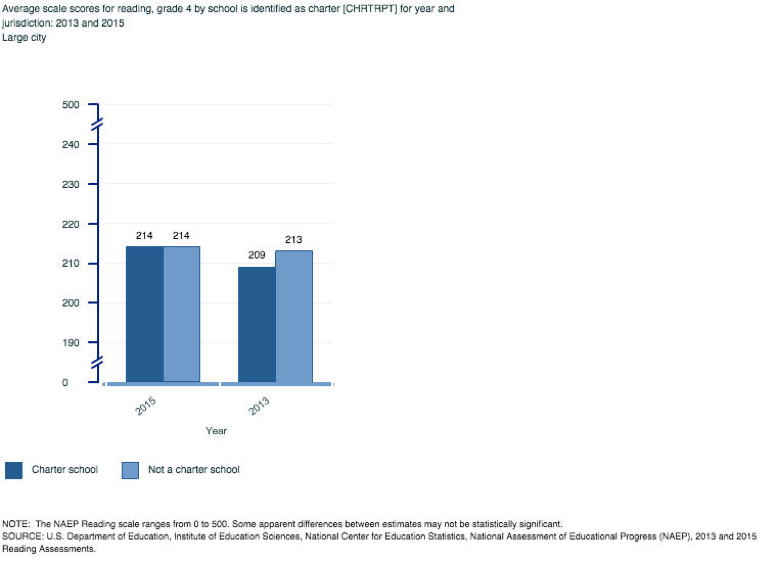
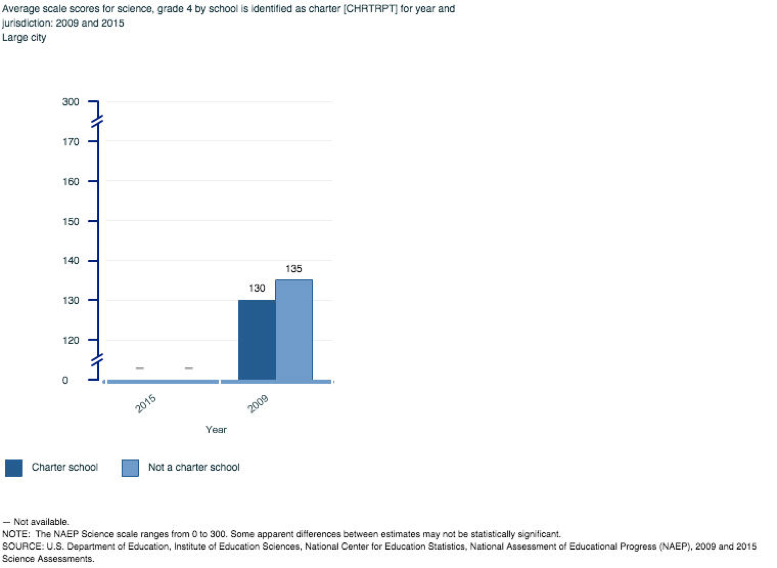
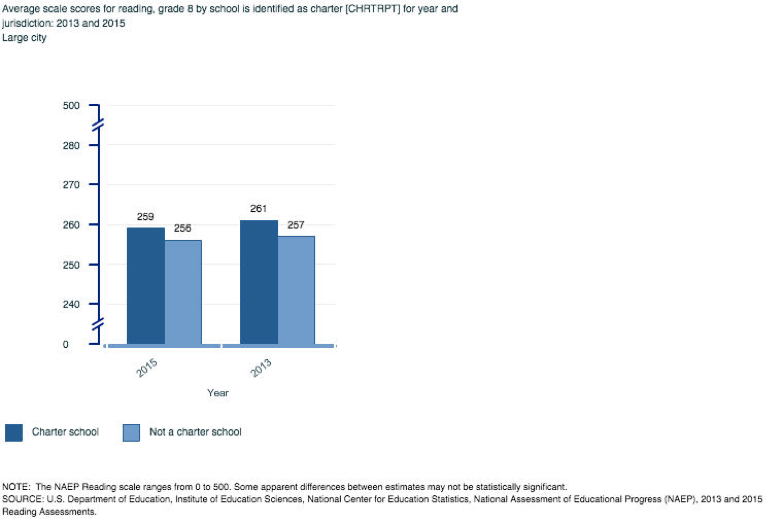
One would most likely suspect from the current positive public discourse about charter schools that they would display higher national and large city NAEP performance when compared non-charter neighborhood schools, however, this is not actually the case when examining achievement data at the school level. Out of the 28 total comparison tests run, only 4 times did charters produce higher composite score averages than non-charter neighborhood public schools— 8th grade reading and math in the years 2013 and 2015. There was a tie in the large city comparison for 4th grade reading in the year 2013 as charter schools and non-charter neighborhood public schools displayed the same average composite scale scores. In the other 23 cases charter schools produced lower average composite scores on the NAEP (math, reading, science) than non-charter neighborhood public schools.

What were the average differences between charters and non-charter neighborhood public schools? Overall, the 18 comparisons utilizing national samples of non-charter neighborhood public schools displayed composite scores 9.3 points higher on average than charter schools. For the ten available comparisons using samples from large cities, non-charter neighborhood public schools displayed composite scores 0.3 points higher on average than charter schools. Thus, the predominant finding is that non-charter neighborhood public schools outperform charters in the NAEP results on average.
The stark difference in student achievement between charters and non-charters is extraordinarily large in the final year of high school. The national comparisons in the 12th grade show about ~20 point differences favoring non-charter neighborhood public schools in reading, math and science over charters. Of note, the 12th grade comparisons are only at the national level because data for comparisons were not available at time of writing for large cities in the NAEP Data Explorer.
In conclusion, the school-level national and large city NAEP results drawn from the Data Explorer are informative for the public discourse as charter schools are presently being presented as a superior alternative to the public school system. These descriptive school-level results from the NAEP Data Explorer suggest that the relationship between charter schools and improved student performance is not being realized nationally and in large cities. As a result, the present conversations promoting outstanding overall success of charter schools clearly need to be reconsidered and reframed.
4th Grade Composite Score Comparisons (National and Large City)
Mathematics
4th Grade Composite Score Comparisons Mathematics
4th Grade Composite Score Comparisons Mathematics large city
Reading
4th Grade Composite Score Comparisons (National and Large City) reading
4th Grade Composite Score Comparisons large city reading.png
Science
4th Grade Composite Score Comparisons science national
4th Grade Composite Score Comparisons science large city.png
8th Grade Composite Score Comparisons (National and Large City)
Mathematics
8th Grade Composite Score Comparisons math national
8th Grade Composite Score Comparisons  math large city.png
Reading
8th Grade Composite Score Comparisons  reading national.png
8th Grade Composite Score Comparisons reading large city

Russ on Reading: An Onset-Rime Approach to Decoding for Struggling Readers

Russ on Reading: An Onset-Rime Approach to Decoding for Struggling Readers:

An Onset-Rime Approach to Decoding for Struggling Readers


I had the pleasure of spending some time with a group of dedicated elementary teachers in New Jersey this past week. The focus was on using Running Records as a diagnostic tool. At the end of the presentation, I asked the teachers to each describe a student they were working with who was having a great struggle in learning to read. One teacher described a struggling first grader whose issues revolved mostly around decoding and particularly around vowel sounds. The teacher described her efforts to teach the vowel sounds to this student, but that the proper vowel pronunciations did not seem to stick when transferred to real reading situations no matter how much instruction or how much reinforcement was provided.

I have had many similar discussions with teachers over the years, as well as having worked with many children who struggled with vowel sounds. There is a very good reason that some children have difficulty with vowel sounds. When compared to consonants, vowels are abstract, impermanent. They do not track naturally to speech patterns and are heavily influenced by the letters around them.

The go to instruction when kids struggle with vowels is to double down on instruction of vowel sounds in the hopes the child will improve. This approach is typical of what is generally called a traditional or synthetic phonics approach. Traditional phonics is based on the flat-structure model of language utterances which views the spoken syllable as consisting of phonemes in sequence with no intermediate structures of importance (Cunningham, et al., 1999).

The vast majority of linguists today, however, view the spoken syllable as having a hierarchical structure (Cunningham, et al., 1999). That is that a spoken syllable is not just a string of sounds, but also can be broken down to an onset (a
Russ on Reading: An Onset-Rime Approach to Decoding for Struggling Readers:

Donald Trump’s Liberty University Commencement Speech | deutsch29

Donald Trump’s Liberty University Commencement Speech | deutsch29:

Donald Trump’s Liberty University Commencement Speech

Image result for Donald Trump Liberty University Commencement Speech

On May 13, 2017, Donald Trump gave his first commencement speech as president, at the 2017 Liberty University ceremony.
At the ceremony, Liberty University President, Jerry Falwell, Jr., presented Trump with an honorary law doctorate.
Falwell was Trump’s first choice for US secretary of education. Falwell was not willing to make a four-year commitment to the position. However, in February 2017, Falwell agreed to lead an education task force assembled by Trump.
An advanced copy of Trump’s remarks was purportedly made public on Friday, May 12, 2017, on Mashable.com. However, given Trump’s penchant for veering from preplanned remarks, I have transcribed Trump’s actual remarks based upon the 32-minute White House video of the event, included below.


Below is approximately half of Trump’s speech. Trump vacillated between reading his prepared remarks and offering impromptu commentary. At the end of the 17-minute transcription below, I have included a link to the entire 32-minute transcription.
In many cases, Trump’s own life decisions conflict with his advice to graduates. In some cases, he even contradicts himself within the speech, and he seems to believe that Liberty University graduates are his forever supporters.
I am reading the biography, Trump Revealed. One statement that stands out to me from my reading earlier today concerns Trump’s business practices. Commercial broker, Stephen Ifshin noted that Trump “burned through people.”
I could go on, but I will refrain.
My chief purpose in transcribing Trump’s speech is to make it easily accessible to the public.
Here we go:
Congratulations to the Class of 2017. That’s some achievement. This is your day, and you’ve earned every minute of it, and I’m thrilled to be back at Liberty University. I’ve been here, this is now my third time, and we love 
Donald Trump’s Liberty University Commencement Speech | deutsch29:

Advocates Release Parent Toolkit for Student Privacy | Parent Coalition for Student Privacy

Advocates Release Parent Toolkit for Student Privacy | Parent Coalition for Student Privacy:

ADVOCATES RELEASE PARENT TOOLKIT FOR STUDENT PRIVACY

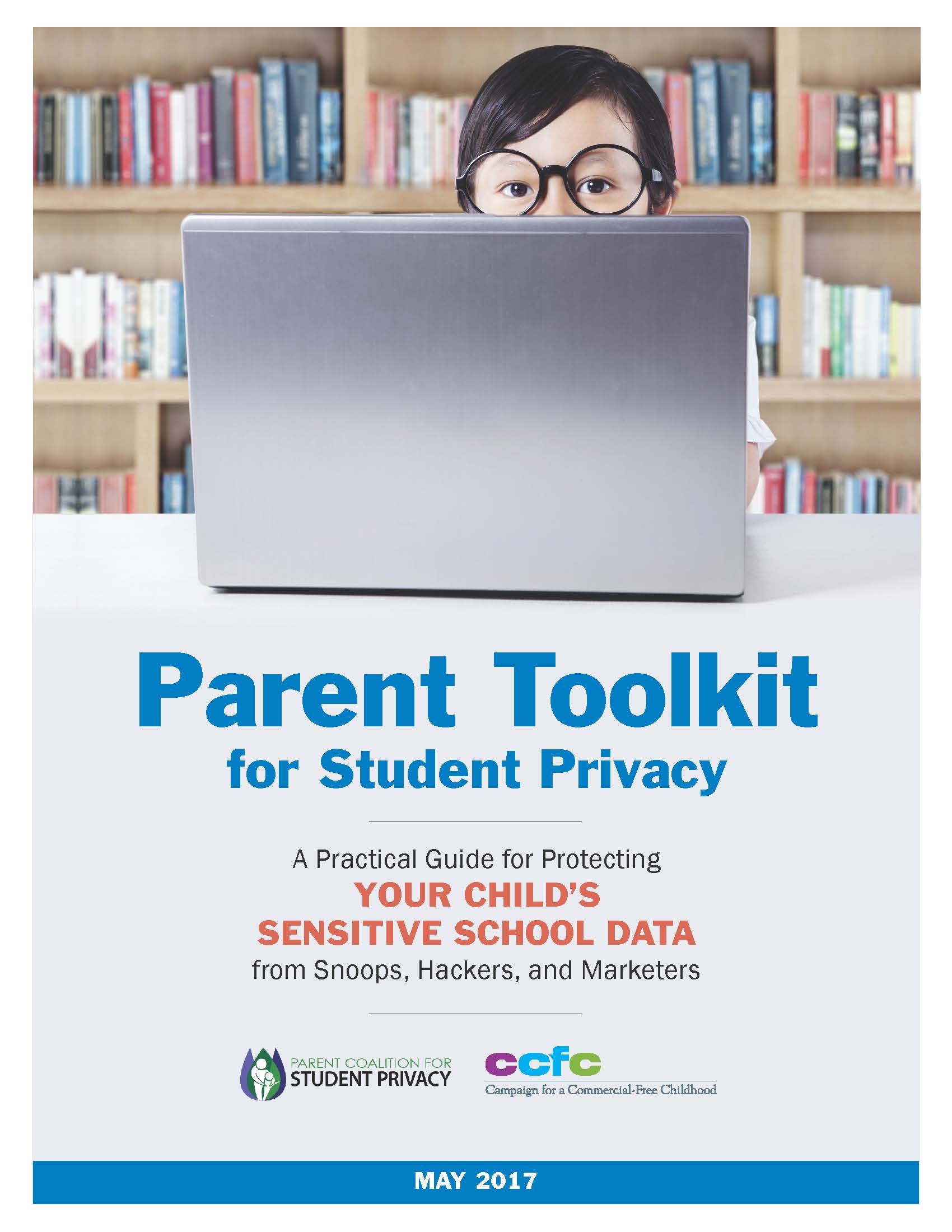
Cover
Learn how to protect your child's sensitive data.
Download a copy of the toolkit HERE


For more information:
Rachael Stickland, (303) 204-1272 rachael@studentprivacymatters.org
Josh Golin, (617) 896-9369, josh@commercialfreechildhood.org
Tuesday, May 16, 2017 – Amid growing concerns about data privacy and surveillance, the Parent Coalition for Student Privacy (PCSP) and the Campaign for a Commercial-Free Childhood (CCFC) have created an important resource for parents to understand and safeguard students’ personal information.
The Parent Toolkit for Student Privacy: A Practical Guide for Protecting Your Child’s Sensitive School Data from Snoops, Hackers, and Marketers is a vital resource in an age where nearly all school records are stored digitally, and where learning, homework, and administrative tasks are increasingly conducted online. Available free to parents on CCFC and PCSP’s websites, the Toolkit offers clear guidance about federal laws that do—and don’t—protect students’ privacy, helps parents ask the right questions about their schools’ data policies, and offers simple steps parents can take to advocate for better privacy policies and practices in their children’s schools.
Rachael Stickland, Co-chair of the Parent Coalition for Student Privacy, explained that many parents are under the false impression that sensitive student records are stored securely in a paper file under lock and key in the principal’s office. “As a parent of two school-aged children, I know first-hand how difficult it is to comprehend the sheer amount of digital data students generate during the course of a normal school day and what that means for our children’s future. With districts outsourcing operations like bus, cafeteria, and instructional services to vendors who store student personal data in the ‘cloud’ and share it with third parties, including state and federal agencies, it’s more important than ever for parents to take some control over their children’s information. It’s not too late to take action when it comes to protecting our children’s privacy.”
A new report issued by the Electronic Frontier Foundation found that students’ activities and information are being monitored by tech companies through devices and software used in classrooms. The data collected by schools and technology vendors often include kids’ names, birth dates, browsing histories, grades, test scores, disabilities, disciplinary records, and more, without adequate privacy and security protections or the consent of parents. Yet few guides exist to help parents navigate the confusing patchwork of laws and regulations that govern student privacy, or help them promote stronger protections.
Other currently available resources are overly technical, filled with jargon, or skewed to the interests of educational technology companies rather than parents and students. CCFC and PCSCP’s new Toolkit, designed with input from experts in education, data privacy, and federal law, is designed to put the needs of families first.
“You shouldn’t need a PhD or law degree to ensure that your child’s sensitive student data isn’t shared with commercial entities,” said Josh Golin, Executive Director of the Campaign for a Commercial-Free Childhood. “Our Toolkit demystifies student privacy and empowers parents to set limits on who accesses the information collected by schools and other third parties about their children.”
Stefanie Fuhr, a Minnesota mother of three, said, “I will be sharing the Parent Toolkit for Student Privacy with parents, teachers, and school administrators, because I don’t think many are aware of the Advocates Release Parent Toolkit for Student Privacy | Parent Coalition for Student Privacy:
The Parent Toolkit for Student Privacy can be downloaded at www.studentprivacymatters.org/toolkit. PCSP and CCFC will co-sponsor a webinar on May 23, 2017, to help parents effectively use the toolkit’s resources.
The Parent Toolkit for Student Privacy was made possible by a grant from the Rose Foundation for Communities and the Environment.

Badass Teachers Association: NY Education Commissioner Criticizes Religious School Funding–Then TRIPLES It by Jake Jacobs

Badass Teachers Association: NY Education Commissioner Criticizes Religious School Funding–Then TRIPLES It by Jake Jacobs:

NY Education Commissioner Criticizes Religious School Funding–Then TRIPLES It 

by Jake Jacobs


Originally posted at: https://truthagainstthemachine.com/index.php/2017/05/15/ny-education-commissioner-criticizes-religious-school-funding-triples/


New York Education Commissioner MaryEllen Elia rescinded approval of the East Ramapo school district’s budget after she discovered it included five days worth of funding for busing students to private religious schools. She then traveled to the district to discuss the budget behind closed doors, where she ultimately approved funding for fourteen days of the busing, at a cost of about $1.4 million dollars.
This is only the latest dust-up in the continuing saga of the embattled East Ramapo school district, where affiliates of a large Hasidic community have controlled the school board for years. For the uninitiated, NPR unpacked the fascinating story in a 2014 episode of This American Life, but the short version is that about 24,000 East Ramapo students attend private yeshivas while public schools hold only about 8,500 students. The Hasidic community is so densely populated in the district they have dominated school board elections and slashed funding for public schools, shifting tax dollars to cover private school expenses and even closed public schools, only to sell the properties to the yeshivas at deep discounts.
The actions of the school board, usually carried out in secret, have been considered detrimental to public education, so the NY state legislature and education department stepped in, appointing outside monitors and oversight of school board activities. But now local parents say the monitors and the education commissioner are part of the problem.
Parent groups and school board candidates are circulating a petition calling for Commissioner Elia to step down after her flip-flop-flip on the latest proposed budget.
Because of East Ramapo’s unique monitor law, Elia has to approve the school budget proposal. She did so last month, apparently without reading it. Two days Badass Teachers Association: NY Education Commissioner Criticizes Religious School Funding–Then TRIPLES It by Jake Jacobs:

Seattle Schools Community Forum: Rich People; Could They Please Leave Public Ed Alone?

Seattle Schools Community Forum: Rich People; Could They Please Leave Public Ed Alone?:

Rich People; Could They Please Leave Public Ed Alone?

Image result for Rich People education


Forbes has just come out with its annual list of the wealthiest people in the world.  

It was a record year for the richest people on earth, as the number of billionaires jumped 13% to 2,043 from 1,810 last year, the first time ever that Forbes has pinned down more than 2,000 ten-figure-fortunes. Their total net worth rose by 18% to $7.67 trillion, also a record. The change in the number of billionaires -- up 233 since the 2016 list -- was the biggest in the 31 years that Forbes has been tracking billionaires globally. 

Bill Gates is the number one richest for the fourth year in a row, and the richest person in the world for 18 out of the past 23 years. He has a fortune of $86 billion, up from $75 billion last year. Amazon’s Jeff Bezos had the best year of any person on the planet, adding $27.6 billion to his fortune; now worth $72.8 billion, he moved into the top three in the world for the first time, up from number five a year ago.

The U.S. continues to have more billionaires than any other nation, with a record 565, up from 540 a year ago.
You can only cross your fingers that all the new U.S. billionaires don't get it into their heads to go the way of Gates in terms of his "helping" public education.   

NPR had a good piece on a new book on philanthropy, The Givers: Wealth, Power and Philanthropy in a New Gilded Age by David Callahan.


"We're seeing just an escalating ideological arms race as more money pours in from wealthy donors across the spectrum," says Callahan, who founded the news website Inside Philanthropy.

Callahan says this philanthropic money comes at a time when most Americans feel disenfranchised. "More and more public policy debates looks like Greek gods throwing lightning at each other, billionaires on the left and the right, as the rest of us watch from the sidelines," he says.
Now the students don't know this happening but the teachers sure do because they tend to be the end users of these new "innovative" ideas that come from on high.

Naturally, there's always more than one reason for their largess:


"If I give a doSeattle Schools Community Forum: Rich People; Could They Please Leave Public Ed Alone?:

NYC Public School Parents: Save the date! Skinny awards, NYSED hearings & what's missing from their school accountability system & more!

NYC Public School Parents: Save the date! Skinny awards, NYSED hearings & what's missing from their school accountability system & more!:

Save the date! Skinny awards, NYSED hearings & what's missing from their school accountability system & more!

Image result for big education ape Skinny awards
Matters Annual Skinny Award Class Size Dinner will be held Tuesday, June 20


1 – Save the date! Class Size Matters Annual Skinny Award Dinner will be held Tuesday, June 20; the venue and honorees TBA. It’s always a fun evening with good food, great company and an opportunity to reconnect, celebrate our victories together and gain inspiration for the battles to come. Please be there if you can! 

2. The NYS Education Department has proposed a new school accountability system under the federal law known as ESSA (Every Student Succeeds Act). The Regents have not yet accepted this proposal and are gathering input through public hearings happening now through Friday, June 16, 2017 as listed here, starting Monday night in Staten Island and Tuesday in the Bronx. 

ESSA allows states more leeway to shape their accountability systems than did its predecessor No Child Left Behind – and to include a range of school quality factors in addition to test scores and graduation rates.  Yet NYSED’s proposal falls short in many ways by failing to move away sufficiently from NCLB's damaging high-stakes testing regime and towards a new evidence-based accountability system that would incentivize schools to provide the sort of well-rounded education that research shows improves students’ chances at success and that parents want for their children. 

Instead, the state’s ESSA proposal is overly simplistic, and could undermine children’s opportunity for an equitable and quality education. It would also likely brand schools with high opt-rates as failing and need of comprehensive support. It’s important that parents attend these hearings and make their voices heard. 

For a summary of what’s wrong with the NYSED proposal, and what Class Size Matters and NYSAPE would like to see instead, including offering incentives for schools to provide an equitable well-rounded education with small classes, art, music, physical education, and more, please click here (pdf) or here (in word) for our fact sheet. If you do attend these hearings, please let me know and feel free to draw from our talking points. The public can also email their comments through Friday, June 16, 2017 to ESSAcomments@nysed.gov.

3. I had a letter last week in the NY Times about why expanding charter schools will NOT lead to more equity, and may actually hurt those children who need our help the most -- as opposed to class size reduction, which narrows the opportunity and the achievement gap. Speaking of class size, Congress voted to cut Title IIA funds by $300 million -- about 12.5% -- through September-- funds that NYC and many high-needs districts use to prevent class size increases. Meanwhile, President Trump wants to eliminate Title IIA funding altogether for the next fiscal year. For a copy of my letter, more on Trump’s damaging proposal, and how the new President of France Emmanuel Macron has proposed capping class sizes in high-poverty schools at 12 students per class, check out my blog here.
  
Hope to see you at the Skinny’s on June 20 – and thanks!

Leonie


 NYC Public School Parents: Save the date! Skinny awards, NYSED hearings & what's missing from their school accountability system & more!:

The Politics of Retribution

The Politics of Retribution:

The Politics of Retribution

-Steve Zimmer, 11/13/12
Betsy Devos, Eli Broad, and Michael Bloomberg have spent millions of dollars pushing to privatize our public schools with disastrous effects for school districts like the LAUSD. Much of this spending is not used to benefit students in any way, but to influence elections. This spending has swelled to the point where once again Los Angeles has broken the record for “the priciest school board race in U.S. history.”
Fueling much of this spending is a desire to eliminate the threat of any Board member who dares to seek accountability for these privately run institutions. Two years ago the target was Bennett Kayser who had a reputation for being a tough critic of the charters. In a campaign that included unproven allegations of racism and mocked his diagnosis with Parkinson’s, they unseated the only LAUSD Board Member who was a guaranteed vote against unregulated charter expansion.
Steve Zimmer has taken a more balanced approach towards the charter industry, but that has not stopped him from being attacked. While he admits to voting for more charter approvals than almost any other School Board member in the county, he also attempted to make sure that charters are accountable to both the students and the taxpayer. This includes Zimmer’s drawing attention to the fact that Granada Hills Charter High School is not serving a proportional number of students with special needs during their renewal hearing. In 2012, he introduced a resolution simply asking “charter operators to voluntarily delay requesting action on new charter applications until the Board has heard the Superintendent’s recommendations and is able to set a timetable for the implementation of changes to better serve all children and families.” After hearing speakers that included representatives from the California Charter School Association (CCSA) and Magnolia Science Academy 3, the Board rejected this proposal. Kayser was the only other “yes” vote.
Instead of taking even minimal steps toward accountability, the CCSA and their allies have spent millions trying to replace Zimmer with Nick Melvoin. Ignoring the problems of charters cherry-picking their students, disrupting District schools, and using public funds for their own personal gain,  Melvoin worships at Betsy DeVos altar of imagined school-choice, even if it results in a system of separate and unequal education. In Melvoin’s vision of education, even the most basic attempts at accountability are seen as an impediment to “market share” and are fought at all costs.
Any airline passenger can testify how well deregulation works for the consumer as companies rake in massive profits at the expense of comfort. The consumers in our education system are our students and they stand to lose more than legroom. Parents who send their children to charters deserve to know that the promises made about academic superiority are nothing more than marketing gimmicks. Students in public schools deserve to have a School Board that represents their interests. None of this is possible if privatizers like Melvoin are allowed to take control of the LAUSD.
____________________________________________
Carl Petersen is a parent and special education advocate and was a Green Party candidate in LAUSD’s District 2 School Board race. He was endorsed by Network for Public Education (NPE) Action and Dr. Diane Ravitch called him a “strong supporter of public schools.” His past blogs can be found at www.ChangeTheLAUSD.com.