Latest News and Comment from Education

Thursday, September 15, 2016

Another Unrealistic Trump Policy Proposal: Homeschool Vouchers - ProPublica

Another Unrealistic Trump Policy Proposal: Homeschool Vouchers - ProPublica:

Another Unrealistic Trump Policy Proposal: Homeschool Vouchers

Trump recently proposed billions in spending to allow the nation’s poorest students to leave public schools and enroll elsewhere, including by using homeschooling. Except the plan won’t work for the poorest students.


 GOP nominee Donald Trump has said he plans to spend billions of dollars on so-called school choice programs. The $20 billion in federal funds would be available only to what he says are 11 million children living in poverty who are also “trapped in failing schools.” Families will be eligible for vouchers to send their children to charter, magnet or even private religious schools. Last Friday, he announced the policy would include homeschooling as well.

“School choice is at the center of this civil rights agenda, and my goal is to provide every single inner-city child in America that is trapped in a failing government school the freedom to attend the school of their choice,” he said at a conservative voters conference. “School choice also means that parents can homeschool their children. Hundred percent.”
But there’s one problem with Trump’s homeschooling plan: Impoverished homeschoolers mostly don’t exist.
“Ideologically speaking, this is significant, but practically very few students will use this money to homeschool,” said Milton Gaither, an education professor at Messiah College. Gaither saw the announcement as a gesture to conservative Christians instead of an actual plan for poor families. “I don’t see a mass movement of the nation’s poor applying for federal funding so they can educate their children themselves.”
The National Center of Education Statistics paints a clear picture of who homeschools — and it isn’t poor inner-city families. In 2012, only 5 percent of homeschooling families made less than $20,000 per year — which is just under the poverty line for a family of four. The survey also shows that 83 percent of homeschooled children are white, and almost 85 percent belong to two-parent households. Homeschooling parents are also far better educated than average — about three-fourths of parents have completed at least some higher education.
By comparison, all of the 11 million children his plan targets are in poverty. Two-thirds of children in poverty are non-white. Only a third of poor children live with married parents, and more than 60 percent of parents of low-income children have no higher education.
Christopher Lubienski, an education professor at Indiana University who studies homeschooling, said these families are unlikely to take up homeschooling because of the “huge opportunity costs” involved even if the federal money might soften some of the blow. Single working parents, for example, are unlikely to give up their full-time jobs to stay home and educate their children in exchange for a few thousand dollars via Trump’s vouchers.
Trump has not given any details about how his plan would work — other than to say that Another Unrealistic Trump Policy Proposal: Homeschool Vouchers - ProPublica:
Image result for big education ape trump

City Charter High School Has Locked Its Doors And Stranded Its Pupils – redqueeninla

City Charter High School Has Locked Its Doors And Stranded Its Pupils – redqueeninla:

City Charter High School Has Locked Its Doors And Stranded Its Pupils

Image result for unaccountable Charter Schools?

Why? Why Is This A Thing?
Why is the public afforded no right to follow its public monies behind the privacy hedge of unaccountable Charter Schools?
What’s it feel like to wake up one morning and discover your school has simply closed?
I’m guessing a whole jumble of feelings vie for primacy from angry, sad, betrayed, scared, anxious, small, vulnerable, unimportant … I’m guessing there’s a huge range of PTSD symptoms, none of which encompases, critically, any feelings at all that happen to be conducive to learning: supported, encouraged, bolstered, trusted, buoyed, secure, powerful, competent.
If the high schoolers of City Charter School on Olympic Blvd in West LA weren’t so busy scrambling to enroll in a new school one month after the start of the school year, we could ask them. Because over last weekend, reportedly, or perhaps as late as Monday night for some, that community was gathered together and informed it would imminently be no more.
As the mother of teenaged high schoolers, I can testify personally to their fragility, susceptible to hormones and insecurities and a pressurized academic system at the mercy of Big TestingHigh-StakesBig Business.
But as a veteran of some 18 years of overwrought admissions-induced panicking parents, it is worth remembering that empirically, kids command remarkable stores of resilience. Subjecting kids to a churn of insecurity will affect their immediate learning achievement, but it is the crisis of vulnerability that determines their plight as political collateral.
Expendable accessories to Education is what these kids have become.
Because for all intents and purposes, Charter schools are corporate educational entities that are not accountable to anyone, and sustain no corporate responsibility for the welfare of their constituent client-students. There is no accountability for Charter School’s finances, not for their academic integrity, not for their functionality, nor for betraying their – our – kids.
We do not know why City Charter HS closed its doors, and because it is not a City Charter High School Has Locked Its Doors And Stranded Its Pupils – redqueeninla:
Image result for unaccountable Charter Schools chartergate

Is Donald Trump The Charter School Industry’s Worst Nightmare?

9/15/2016 – Is Donald Trump The Charter School Industry’s Worst Nightmare?:

Is Donald Trump The Charter School Industry’s Worst Nightmare?


THIS WEEK: Teacher Shortage Crisis … Wealth Gap In Schools … Limits On School Cops … Is Literacy A Right? … School Choice Guidance Needed

TOP STORY

Is Donald Trump The Charter School Industry’s Worst Nightmare?

By Jeff Bryant

“In unveiling his education plan, the Republican candidate proposed a $20 billion federal block grant to allow states to give vouchers to low-income students to attend whatever school they want. The proposal is the most full-throated support for school choice ever issued by a presidential candidate in a general election campaign. It’s also an ill conceived, grandiose, and politically polarizing gesture that many charter school proponents feared most.”
Read more …

NEWS AND VIEWS

America Has A Teacher Shortage, And A New Study Says It’s Getting Worse

The Washington Post

“The U.S. is facing its first major teacher shortage since the 1990s … According to a new study … the shortfall is a result of increased demand for teachers as schools reinstate classes and programs axed during the Great Recession. It has been compounded by a dramatic decrease in the supply of new teachers entering the profession. Enrollment in teacher-preparation programs dropped … 35% … ‘U.S. classrooms were short approximately 60,000 teachers last year … Annual teacher shortages could increase to over 100,000 teachers by 2018 … Teacher attrition … remains high and is the single-biggest contributor to the shortage.”
Read more …

In Connecticut, A Wealth Gap Divides Neighboring Schools

The New York Times

“In Fairfield, a mostly white suburb where the median income is $120,000, 94% of students graduate from high school on time. In Bridgeport, the state’s most populous and one of its poorest cities, the graduation rate is 63% … Seemingly intractable contrasts like those last week led Judge Thomas G. Moukawsher to tell the state that it had 180 days in which to rethink almost its entire system of education … Across the country, school funding cases have often resulted in more money being funneled into poorer districts to help offset the effects of poverty on their students. That may well be the end result in Connecticut.”
Read more …

Obama Administration Pushes To Limit Police in Schools

U.S. News & World Report

“The Obama administration is pushing school districts to ensure that school discipline is being handled by trained educators, not by law enforcement officers … At any one time there are about 400 to 500 federally funded school resource officers nationwide. That’s out of the approximately 17,000 in place in schools around the country, or between 2 and 3% … The goal is to ensure that anyone who is in charge of discipline has the proper training, limits suspensions and expulsions and creates a more trusting environment between students and administrators.”
Read more …

Lawsuit Accuses Michigan Of Violating Detroit Students’ Rights

Reuters

“A lawsuit filed on behalf of seven Detroit students on Tuesday accuses state officials of allowing high rates of illiteracy at several poorly functioning schools in the city, arguing it is a violation of the children’s constitutional rights … [It’s] the first federal case to argue that American children have a right to literacy under the U.S. Constitution. If the case is successful, it could result in court-mandated changes at some Detroit schools and encourage similar lawsuits in other parts of the country … The lawsuit, which seeks court approval to represent all students at the five schools in question, argued students had been denied their right to equal protection under the 14th Amendment of the U.S. Constitution.
Read more …

Federal Report: Schools Need Clarity On Choice And Funding Issues

Education Week

“Officials often struggle to determine if students participating in school choice programs like vouchers and education savings accounts [ESAs] are receiving the ‘equitable services’ they are entitled to under federal law … The U.S. Department of Education has not provided guidance to states and districts on this issue … A majority of the vouchers and ESA programs have placed new requirements on participating private schools, such as entry-level requirements for teachers … Officials … in 4 states with such choice programs (Arizona, Indiana, Ohio, and Wisconsin) said those programs complicate their ability to provide required educational services to private school students.”
Read more …
9/15/2016 – Is Donald Trump The Charter School Industry’s Worst Nightmare?:

Ethics officials launch probe into Stand for Children

Ethics officials launch probe into Stand for Children:

Ethics officials launch probe into Stand for Children

Image result for big education ape astro turf


Tennessee election finance officials have formally launched an investigation into allegations against Stand for Children and several Nashville school board candidates they supported during this year's general elections.
The Tennessee Bureau of Ethics and Campaign Finance's registry board determined Wednesday there were enough questions to issue a show cause notice, which gives its employees the powers necessary to investigate a complaint filed by consumer rights group Tennessee Citizen Action and a Metro Nashville Public Schools parent.
The petition by the consumer rights group questions whether Stand's political action committee illegally coordinated with several pro-charter school candidates during the election.
"My gut feeling is there is enough smoke to open up and look at it," said Tom Lawless, chairman of the registry board. He added: "If they violated (the law), we need to be consistent. We don’t have to be punitive, we can be constructive."
The complaint was filed Aug. 4, a day before Nashville's school board elections, and cites a story by The Tennessean that details emails sent by the head of a prominent Nashville nonprofit that appear to show she coordinated with Stand for Children to find campaign workers for the four school board candidates.
It also cites a July 29 WSMV report that says Stand for Children Director Daniel O'Donnell met with candidate Thom Druffel during a 10-day mandatory blackout period before the election. Stand's attorney said O'Donnell took a day off from work that day and was not in violation of the law.
Stephen Zralek, an attorney with Nashville law firm Bone McAllester Norton PLLC who represents Stand for Children, said the organization takes election ethics issues seriously and consistently follows the law.
"The Registry’s order is standard procedure whenever a complaint is filed. We look forward to answering the Registry’s questions and providing an accurate account of the facts," he said in a Wednesday email.
Gerard Stranch, the attorney who filed the complaint, told the registry he thought it was clear that there was evidence Stand for Children exceeded campaign contribution limits by coordinating with candidates, and violated laws banning donations by a PAC within a "blackout period" in the days immediately leading up to the election.
Stranch said he's pleased in the registry board's action and looks forward to the findings.
“It is important that this investigation go forward, as Stand for Children is currently involved in numerous state House and other races in Tennessee. Stand for Children needs to understand that they have to abide by the laws of the state of Tennessee," he said. “We believe the investigation will show that there was improper coordination Ethics officials launch probe into Stand for Children:

Poll: To address teacher shortage, pay them more | EdSource

Poll: To address teacher shortage, pay them more | EdSource:

Poll: To address teacher shortage, pay them more

Image result for To address teacher shortage, pay them more

As the state grapples with teacher shortages in several subject areas, the most important strategy to address shortages of teachers is to pay them more, according to a new PACE/USC Rossier online poll of registered voters in California.
Respondents also pointed to hard-to-manage students and overcrowded classrooms as other reasons young people are reluctant to go into teaching.
But low pay easily lead the list.
Despite obstacles teachers face, 7 out of 10 of those responding to the poll said that they would encourage young people they know who are considering becoming teachers to follow that career path.
The poll also showed strong support for effective teachers.
Fiftyeight percent of respondents said that half or more of teachers are “highly effective and deserve to be recognized for their accomplishment.”
At the same time, 77 percent said that a half or more “are not as effective as they could be and should be supported to improve.”
The main reason respondents said they would encourage someone to go into teaching is because of the potential they have “to make a difference in the lives of children.” By comparison, other reasons such as professional autonomy and job security got relatively low rankings.
Regarding education reforms now underway in California, the poll showed that just over half of Californians had never heard or read anything about theLocal Control Funding Formula, the landmark reform of the school’s financing system championed by Gov. Jerry Brown and approved by the state Legislature three years ago. Thirty percent said they had not heard or read much about it. Only 3 percent said they had heard or read a good deal about it.
As for parents, just under half said they had never heard about the school funding reforms. That included 45 percent of parents who have children in California’s public schools.
About 1 in 5 parents with children in public schools knew about Local Control and Accountability Plans districts are now required to create to show how Poll: To address teacher shortage, pay them more | EdSource:

California Education is a Game of Chance :: Fox&Hounds

California Education is a Game of Chance :: Fox&Hounds:

California Education is a Game of Chance

Image result for lotto

Californians may think we have a system of public education. But what we really have is a state system for rationing public education.

I got a personal taste of this in the spring, when I took my five-year-old son to our local school district offices to determine his educational future. This being California, the determination was made not by a test of his abilities or an assessment of his educational needs. Instead, it was a lottery. A school administrator pulled names out of the hat to determine whether he would get one of 24 coveted spots in our elementary school’s new Mandarin language program.

The month of September, early in a fresh academic calendar, is the time of year when we hear fine speeches and noble promises about how our state and its school districts are committed to doing the very best for every child. School superintendents and politicians often point to our state constitution’s commitment to universal education, which includes a funding requirement to deliver on that commitment. But when you experience how our schools operate, you learn quickly that such lofty, sweet sentiments and guarantees are so much Fang pi (a Mandarin approximation for cow dung).

In California, when it comes down to who gets precious educational resources, schools as a matter of policy and law leave much to chance.

We do this for two reasons: scarcity and avoidance. Educational resources here are scarce—there is simply more demand for schooling than the state’s wobbly budget system can accommodate. And so we’ve come to use lotteries and formulas, so that our officials can avoid the work of deciding who deserves resources, and so that the rest of us Californians can avoid reckoning with our collective failure to support public education.

Yes, it’s true that K-14 education is the top spending item in the state budget, but there is no area in which our school spending—which remains below the national average despite recent increases— meets education needs.

By all reliable accounts, there aren’t nearly enough good, experienced teachers in our schools. The state offers only 180 days of instruction (when research suggests there should be more than 200 days and more hours of instruction), and only provides half-day kindergarten.  And the inadequacy of newer programs and schools offered by some districts in the name of educational choice only underscore the ongoing scarcity. There are simply not enough Advanced Placement classes, career-readiness programs, charters, magnets, or language immersions to meet the demand for high-quality options.

There’s little hope of trying to do more to meet those needs. California long ago decoupled school funding from educational needs. Our school funding formulas, known collectively as Prop 98, are baked into the state constitution, and are driven by tax revenues, the budget, and income growth, not academic needs. Effectively, Prop 98 guarantees only a portion—you might say a ration—of the state budget to schools. (Tellingly, that money is supplemented by a small amount—usually $1 billion or less than 2 percent of annual education funding —from the state lottery).

So in the absence of funds to meet all our students’ needs, we turn to education’s version of lotteries to allot scarce resources. State law (mirroring federal guidance) directs school districts to use a lottery system for charter school admissions once the number of pupils who want to enroll exceeds the number of spaces. Districts with magnet programs do the same. Many of these lotteries have complicated rules and exclusions, often to help kids go to schools in their own neighborhoods, keep siblings together in the same school, or to make sure campuses are diverse. L.A. Unified has a system of points to govern its lottery for magnet school placement so complicated that a cottage industry (check out “Ask a Magnet Yenta” ) has sprung up to help parents navigate it.

Of course, such lotteries are not all that fair. The winners in lotteries are more likely to be the children of parents who have the time and resources to investigate their local educational possibilities, sign their children up for the lotteries (and, in some cases, write letters or pursue strategies to help their chances).

And the lotteries raise a bigger question, now being debated in California’s courts. Does “random” allocation of educational resources really represent justice?

Earlier this summer, the California Supreme Court showed itself to be divided on the question. A 4-3 majority of justices refused to hear challenges to the state’s systems of hiring and firing public schoolteachers and funding schools. The challengers said that those systems were violating the rights of students, because they didn’t produce enough money and qualified teachers to meet the state constitution’s guarantees of education for all.  But the Supreme Court majority, in declining to hear the challenges, endorsed the position that while there might be problems with funding and teachers, these weren’t constitutional problems—because the impact of bad policies was random and arbitrary, and not felt by any particular group of students.

Mariano-Florentino “Tino” Cuellar, a young associate justice of the Supreme Court, dissented powerfully from that logic. Curtailing access to educational opportunity, the justice argued, doesn’t become justifiable simply because it’s done arbitrarily.

“Arbitrary selection has at times been considered a means of rendering a governmental decision legitimate,” he wrote. “But where an appreciable burden results—thereby infringing a fundamental right [like the right to an education]—arbitrariness seems a poor foundation on which to buttress the argument that the resulting situation is one that should not substantially concern us.”

The brilliantly cynical filmmaker Orson Welles once said,  “Nobody gets justice. People only get good luck or bad luck.” He wasn’t wrong—our parents, where and when we were born, the people we happen to meet, all influence the direction our lives take, through no fault or deed of our own.

My own son was lucky. His name was pulled 16th out of the hat, giving him a place he now enjoys in that Mandarin immersion kindergarten. His own luck will transfer to his younger brother, who is automatically eligible to join the program when he reaches kindergarten age.

But California is not as fortunate in leaning its educational system so heavily on luck. Our schools are supposed to be equalizers, helping counter the lottery of life. Instead, they are emulating it.California Education is a Game of Chance :: Fox&Hounds:

Joe Mathews writes the Connecting California column for Zocalo Public Square

Frustration. Burnout. Attrition. It's Time To Address The National Teacher Shortage : NPR Ed

Frustration. Burnout. Attrition. It's Time To Address The National Teacher Shortage : NPR Ed : NPR:

Frustration. Burnout. Attrition. It's Time To Address The National Teacher Shortage

Teachers Wanted


The good news: There's an uptick in the hiring of new teachers since the pink-slip frenzy in the wake of the Great Recession.
The bad news: The new hiring hasn't made up for the teacher shortfall. Attrition is high and enrollment in teacher preparation programs has fallen some 35 percent over the last five years — a decrease of nearly 240,000 teachers in all. 
Parts of most every state in America face troubling teacher shortages: the most frequent shortage areas are math, science, bilingual education and special education.
We've covered many sides of the shortage issue including the disconnect between training and districts' needs; how the accountability obsession and paperwork aredriving some good veteran teachers away; what factors help teachers stick around; as well as efforts to improve training for special-ed teachers to stem that field's attrition and chronic shortage.
Linda Darling-Hammond, President and CEO of Learning Policy Institute and founder of Stanford University's Center for Opportunity Policy in Education.
Courtesy of Linda Darling-Hammond
Two comprehensive new reports on the issue, from the nonprofit and nonpartisan Learning Policy Institute offer an opportunity to revisit and dig deeper into a widening problem. You can read the full reports - A Coming Crisis in Teaching? Teacher Supply, Demand, and Shortages in the U.S and Minority Teacher Recruitment, Employment, and Retention: 1987 to 2013 here. Also check out the institute's interactive map.
I spoke with the institute's president, Linda Darling-Hammond, Professor of Education Emeritus at Stanford University and co-author of one of the reports.
Whether this is a full blown 'crisis' or just one of many problems in education depends, I guess, on where you sit. The report you co-authored is titled A Coming Crisis in Teaching? Do you think the question mark is really needed?
If you're sitting in Utah or Arizona, there's no question mark. You have a crisis in teaching. If you're in better-paying Massachusetts, where there's something of a surplus in some fields, you feel a little less concerned about it. The other aspect of the question mark is about the future. We do certainly have a shortfall of teachers right now and it looks like it will get much worse. But if we change our policies, we could solve the shortage. The question mark is really a question to us about the policies we'll put in place to address these emerging problems.
High-poverty schools have some of the biggest teacher attrition and shortage challenges. Your report notes that about half of all schools and 90 percent of high-poverty schools are struggling to find enough qualified special education teachers. These shortages are having the biggest impact on the most vulnerable students, aren't they?
They are. In some places we see from the data that one in five teachers in high-minority schools and high-poverty schools is unprepared for teaching. When you think Frustration. Burnout. Attrition. It's Time To Address The National Teacher Shortage : NPR Ed : NPR


According To The GAO, More Vouchers Mean More Problems | Americans United

According To The GAO, More Vouchers Mean More Problems | Americans United:

According To The GAO, More Vouchers Mean More Problems

This sectarian store-front private school in Washington, D.C., has received tax support through a federal voucher plan.

This week, the U.S. Government Accountability Office, an independent agency that works for Congress and investigates how the federal government spends taxpayer money, released a new report on private school voucher programs. The report found that as private school voucher programs continue to spread throughout the states, taxpayers are contributing more and more money each year to programs that are plagued with problems.
What is especially troubling is that students with disabilities and low-income students are the most likely to suffer as a result. The report looked at state voucher programs across the country, focusing on whether students with disabilities and from low-income families are receiving the proper federal services. It found that students who are entitled to receive services funded by federal IDEA (Individuals with Disabilities in Education Act) and Title I (funds for students from low-income areas) dollars, often did not receive those services because they opted to use a private school voucher.  
In some instances, the GAO found that private schools don’t provide the necessary services because they are simply uninformed and confused about what types of services they are required to provide; in other cases, some private voucher schools have actually opted out of providing federally funded services simply because they said it would be too much of an administrative headache.
However, that’s not all the report found. Here are some of the GAO report’s other findings:
Private voucher schools discriminate in admitting students. Private schools in all but four voucher programs across the country can discriminate in the admission of students based on a variety of factors, such as disciplinary history, academic achievement, and religious affiliation.
The money used to fund voucher programs can come directly from the public school funding stream. For example, one-third of the funding for Milwaukee’s voucher program came from state funds that would have otherwise directly funded the public school district for the 2014-15 school year.
Even with vouchers, many students can’t afford to attend private schools. Thirteen out of 22 voucher programs surveyed do not place a cap on private school tuition, meaning that a voucher may not cover the actual cost of attending private schools in the state.
Private voucher schools do not necessarily provide better education. Private voucher schools can teach religious doctrine and employ teachers without the same minimum education requirements that teachers in the public schools must have, such as bachelor’s degrees.
Private school voucher programs can harm public school students. The more students that use vouchers to attend private schools, the more school districts must disperse limited federal IDEA and Title I funds throughout the district, meaning that public schools cannot always provide all the services they would like. 
The GAO has long been a watchdog of private school voucher programs. It has repeatedly chronicled the shortcomings of the Washington, D.C., private school voucher program, finding it to be lacking accountability at all levels of its administration.
In the end, this GAO report reaffirmed what we knew already – voucher programs continue to use taxpayer dollars to fund programs that are ineffective at best, and actually harmful to students at worst.According To The GAO, More Vouchers Mean More Problems | Americans United:
About | Americans United - https://www.au.org/about

New Study Tracks Spending On Common Core | WSKG

New Study Tracks Spending On Common Core | WSKG:

New Study Tracks Spending On Common Core

Image result for New Study Tracks Spending On Common Core


The Common Core learning standards have been in place for a few years now. A lot of the news coverage in New York has been about Common Core-aligned tests. But tests are just one piece of the puzzle.
new national study looks at the money put towards implementation of the Common Core, $4.35 billion from the federal government and also about $330 million from private philanthropy. Where did the money go? WSKG’s Bret Jaspers talked to Mindy Kornhaber from Penn State, one of the authors of the study. Click the player to hear the edited interview.
Interview highlights:
On the Race to the Top competition:
Kornhaber: Within the Race to the Top guidelines, there were five criteria and two of those relate directly to the Common Core. They called for [the use of] common standards and the use of common assessments for which only the Common Core state standards really were available.
On how the money was spent:
Kornhaber: Well, different states used it to get their systems aligned to the Common Core. So they used it in part to get data systems that could track how well kids were doing. They used it in New York State specifically to develop curriculum modules. [They used it] to help districts in some states get access to better professional development that would enable teachers to teach to the new standards and things like that.
On why she likens it to the Gold Rush:
Kornhaber: For the Common Core, teachers and districts and states were asked to mine for better student achievement and to do that, they would need a lot of equipment. They'd need new computers, they'd new data systems, they'd need new curriculum materials, etc. But as in the case of the Gold Rush, most people who went mining in search of gold did not come up with gold.
Jaspers: So you're saying that despite all of this money being spent, it's not necessarily New Study Tracks Spending On Common Core | WSKG:


Wednesday, September 14, 2016

Detroit civil rights lawsuit attempts to assert a constitutional right to literacy | US news | The Guardian

Detroit civil rights lawsuit attempts to assert a constitutional right to literacy | US news | The Guardian:

Detroit civil rights lawsuit attempts to assert a constitutional right to literacy

First legal challenge of its kind in the US says Michigan has disinvested in education in Detroit to the point that children lack fundamental tools to learn

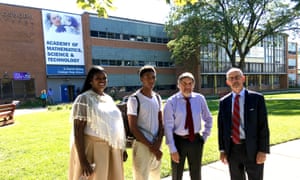
Andrea Jackson, counselor and parent at Osborn Evergreen Academy, with student Jamarria Hall, Mark Rosenbaum, director of Public Counsel, and Michael Kelly, partner at Sidley Austin LLP,
 Andrea Jackson, counselor and parent at Osborn MST, with student Jamarria Hall, Mark Rosenbaum, director of Public Counsel, and Michael Kelley, partner at Sidley Austin LLP Photograph: Public Counsel

Jamarria Hall can’t stomach walking into his high school on Detroit’s east side some days. The classrooms are hot, water fountains don’t work and only 2.2% of students last year achieved college-ready scores in reading and English.
“It doesn’t even feel like school,” said Hall, a senior at Osborn Evergreen Academy of Design and Alternative Energy. “It makes my stomach hurt just walking into the facility, knowing we’re basically getting cheated – really, getting robbed – of education.”
A federal civil rights lawsuit filed on Tuesday aims to challenge Hall’s educational system by asserting a constitutional right to literacy, in what attorneys say is the first legal challenge of its kind in the US. The 133-page complaint says the state ofMichigan has disinvested in education in Detroit so much that children lack fundamental access to literacy.
Hall, 16, said he has friends who can’t read “but it’s not because they aren’t smart, it’s because the state has failed them”.
Proficiency rates in core subject areas are near-zero at the schools where the seven students named in the complaint attend, the complaint says.
“Absent literacy, a child has no way to obtain knowledge, communicate with the world, or participate in the institutions and activities of citizenship,” said Mark Rosenbaum, director of the opportunity under law project of Public Counsel, which is filing the lawsuit.
Harvard constitutional law professor Laurence Tribe, who is not involved in the litigation, said he expects the lawsuit will make history, “much as Brown v Board of Education did”.
“The legal theory underlying the suit is both creative and rock-solid,” he said, “and Mark Rosenbaum’s legal team is nothing short of extraordinary.”
“If you think of Brown v Board as one shoe that dropped, this is the other shoe,” he said, “because though it eliminated, technically, inferior schools for blacks, and eliminated de jure segregation, it didn’t achieve one of its basic goals. And that is a decent educational opportunity for all kids, regardless of race, regardless of class, regardless of geography. That’s become a more elusive goal.”
The plaintiffs include students from five of the lowest-performing schools in the city’s system, which recently was overhauled before the start of the new year, after state lawmakers passed a $617m plan to restructure the district and shed its long-term debt. Teachers this year have waged large-scale protests over the prospect of working without pay and in subpar working conditions, though officials have recently touted improvements in building repairs.
The governor’s office said it doesn’t comment on pending lawsuits. A spokesperson for Detroit’s school system said the district’s legal team hasn’t had time to review the case.
The lawsuit describes a public school system in Detroit that has experienced a Detroit civil rights lawsuit attempts to assert a constitutional right to literacy | US news | The Guardian: