Latest News and Comment from Education

Monday, September 12, 2016

Suit: CPS ignores request for records on firing of principal | Chicago Sun-Times

Suit: CPS ignores request for records on firing of principal | Chicago Sun-Times:

Suit: CPS ignores request for records on firing of principal

Troy LaRaviere | Sun-Times file photo by Max Herman

A lawsuit is charging Chicago Public Schools with intentionally withholding public records regarding the firing of former principal Troy LaRaviere, known as one of Mayor Rahm Emanuel’s strongest critics.


Nick Burt filed a Freedom of Information Act lawsuit against CPS on Wednesday in Cook County Circuit Court. The suit states that CPS “willfully and intentionally” did not respond to Burt’s FOIA requests, not questions from the Attorney General’s office; it seeks records from his final, narrowed request made in May.
LaRaviere, former principal of Blaine Elementary School, was fired one month after he criticized Mayor Emanuel in a campaign ad for U.S. Sen. Bernie Sanders, according a statement from Burt. LaRaviere was elected president of the Chicago Principals and Administrators Association after his firing, the Chicago Sun-Times reported earlier.
Less than a week after the firing, Burt filed a FOIA request seeking documents relating to LaRaviere, Blaine Elementary and Bernie Sanders. His initial request was acknowledged by a CPS FOIA officer. Later, the request was denied because it was “unduly burdensome to Chicago Public Schools,” the suit said.
Burt was asked to narrow the scope of his request, which he did, but it was denied again in May. Burt narrowed his request again, but did not receive any response, even after multiple phone calls and emails to CPS regarding his revised request, the suit stated.
In June, Burt submitted a Request Review to the Illinois Attorney General’s Public Access Counselor. In response, an assistant attorney general wrote a letter to a CPS assistant general counsel inquiring about the status of Burt’s FOIA request. But through August, neither the attorney, nor CPS had responded. In a final attempt, Burt sent a letter to the attorney demanding a response, but it also went unanswered, according to the suit.
“Government agencies stonewall the public because they think they can get away with it,” Burt said in a statement. “They can’t. If CPS is terminating educators because they are critical of the mayor’s wasteful and ineffective school privatization agenda, the public has a right to know.”
CPS did not immediately respond to a request for comment.
The 3-count suit seeks damages up to $5,000 for each intentional violation of FOIA and orders CPS to produce all records with no further assertion of undue burden.Suit: CPS ignores request for records on firing of principal | Chicago Sun-Times:

Study Shows Students of Color Are Disproportionately Affected by School Surveillance - The Atlantic

Study Shows Students of Color Are Disproportionately Affected by School Surveillance - The Atlantic:

When School Feels Like Prison

A new study shows that campuses with larger populations of students of color are more likely to use harsh surveillance techniques.

Image result for When School Feels Like Prison

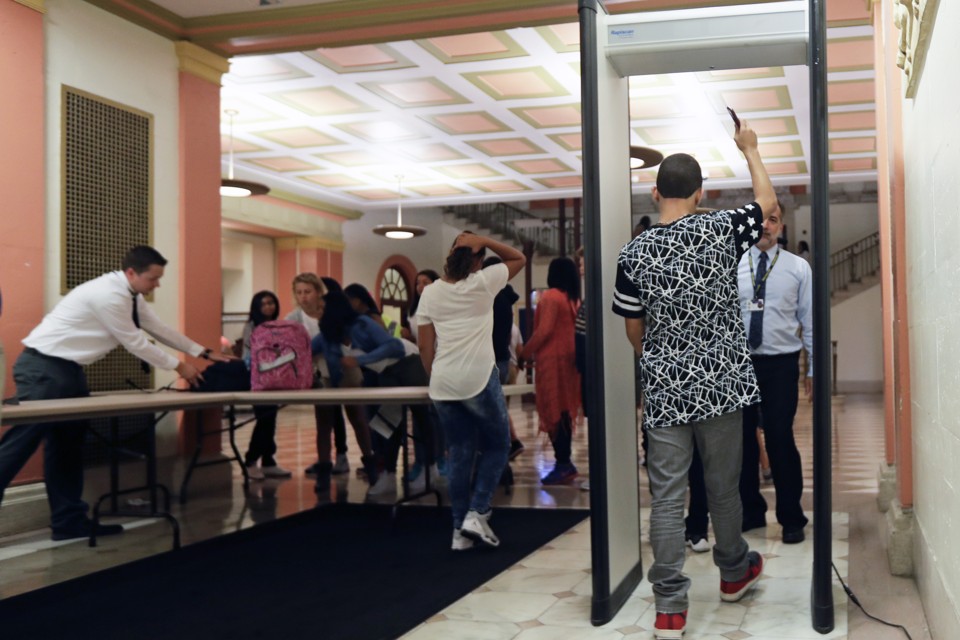
In December 2012, a Senate subcommittee was convened to examine the school-to-prison pipeline, a national trend in which overly punitive school discipline policies push students out of school and into the criminal-justice system. Among the witnesses at the first-ever congressional hearing on this issue was Edward Ward, at the time an honor-roll student in his sophomore year at DePaul University and a recent graduate of Orr Academy on the West Side of Chicago. He offered an eye-opening first-hand account of his high-school experience. “From the moment we stepped through the doors in the morning, we were faced with metal detectors, X-ray machines, and uniformed security,” said Ward, describing a high-poverty, majority-black campus “where many young people … feel unwelcome and under siege.”

Far from an aberration, what Ward depicts—public schools serving primarily black and other nonwhite students that rely on more restrictive security—is quite common, according to a new research paper from Jason P. Nance, an associate professor of law at the University of Florida Levin College of Law. Nance set out to find if there was a proliferation of school security following highly publicized school shootings like the tragedy at Sandy Hook Elementary School in Newtown, Connecticut. He discovered that many schools had intensified their security and surveillance of students, but the practice was not equally applied. Rather, schools with a preponderance of students of color within the school building were more inclined to adopt strict surveillance practices—metal detectors, locked gates, security cameras, random sweeps, and school police.

In the first empirical analysis of its kind, Nance gained authorization to access a restricted database from the U.S. Department of Education—the School Survey on Crime and Safety conducted in 2009-10 and 2013-14—to examine school security methods pre- and post- the Newtown school massacre. He found a clear and consistent pattern, even after controlling for a host of variables that might explain the presence of stricter student surveillance, such as school crime, neighborhood crime, school disorder (disciplinary or behavioral problems on campus), and other student demographics and school characteristics.

“After controlling for all those things, I still found that the concentration of students of color was a predictor of whether or not schools decided to rely on more intense [security] measures,” said Nance, referring to black, Hispanic, Asian, and Native American children. “I questioned why that was [and] it seemed like race was playing a factor in these decisions.”

His research carefully documents the degree to which race influenced surveillance decisions. Nance used logistic regression models—a statistical method for analyzing a dataset—to predict the odds of a school using a particular combination of security options. The study suggests that as the portion of students of color in the school increased, so did the odds that the school would rely on more intense surveillance methods. In schools where students of color accounted for more than half of the student body, the probability of the school using a mix of metal detectors, school police and security guards, locked gates, and random sweeps was two to 18 times greater than at schools where the nonwhite population was less than 20 percent. “Schools with higher concentrations of [students of color],” he concluded, “are more inclined to rely on Study Shows Students of Color Are Disproportionately Affected by School Surveillance - The Atlantic:


CURMUDGUCATION: The New Mascot

CURMUDGUCATION: The New Mascot:

The New Mascot


Consider Pitbull.

The rappish artiste and modern poet ("Face down, booty up, that's the way we like to- what?!") has greeted the new school year with his third charter school. 

Pitbull has tried to make something out of the nickname he was tagged with once-- "Mr. Education"-- but it hasn't really caught on. But it hasn't stuck, perhaps because Pitbull's actual connection with the school is described as "nebulous." The Washington Post once reported that his role was "coming up with different ways to get people involved."

Like Arthur Ashe and Deion Sanders, Pitbull is the new accessory, necessary for the school-as-commercial-enterprise era. We could them a spokespersons or brand ambassadors, but basically they're a whole new kind of school mascot.


"Mr. Matthews, have you cut my check yet?"


School mascots are an odd feature of the school landscape. My own school, around a century ago, had a mascot based on a town motto. See, even longer ago, a state politician had tried to mock our civic pride by calling us "The Nursery of Great Men," but instead of acting mocked, we just picked it up and ran with it. Which is how it ended up that our sports teams, for many years, called themselves the Fighting Nurserymen. Lord knows I have often wished we stuck with that mascot concept, but only slightly less than a century ago, we traded Nurserymen for Knights, a completely conventional mascot that, like most, has nothing in particular to do with our school or our community.

But come to a game and you'll see our student volunteer in a knight costume, exhorting the crowd to get excited (this, it must be said, is an improvement over the attempt a few decades ago to use a mascot mounted on a live horse-- that did not end so well). Our knight does what a mascot is supposed to do-- provide a focal point for spirit, excitement, and investment in the school, as well as providing a literal peg on which to hang the metaphorical identity of the school itself (I keep 
CURMUDGUCATION: The New Mascot:


Did You Miss The Celebration? | Dr. Edward F. Berger

Did You Miss The Celebration? | Dr. Edward F. Berger:

Did You Miss The Celebration?


Those who are celebrating do not intend to represent our communities.
In the primary elections, big money from outside – called Dark Money – succeeded in blocking community interests. Take the future of our public schools for example. By positioning themselves for a win in the general election, they can put in place a plan to destroy our community schools, elected school boards, and the preservation of our highly successful education programs. Why would they do this? The main reason is access to the tax dollars we pay. They are working on many fronts to privatize public services like schools and prisons. They want a big chunk of our tax dollars for personal profit.
A second objective is ideological. A powerful but extreme minority believe that parents can create educational opportunities that better fit their children. These opportunities range from no schooling, to homeschooling, religious schooling, or private schools run for profit. These will be paid for with our tax dollars through schemes like ATM accounts where every kid (family) has access to say, $8,000 per child to spend anywhere in the free market. However, none will be accountable to any democratically elected representatives, standards, or course of study. The plan many in the legislature have in mind is to destroy existing, proven and effective public schools, and let the resulting chaos determine the future of our state and our nation. Their language is full of words like vouchers, scholarships, the marketplace, school choice, and conservative.
Is there any example of programs like these that have worked for children and America? None. Everywhere voucher programs have been tried they have failed. Failure of an ideological experiment may seem like the cost of trying something new, that is until you track the children and families disrupted and severely set back by obvious wrong thinking.
What will happen to our community and to Did You Miss The Celebration? | Dr. Edward F. Berger:

A School District on the Brink of Collapse: Educational Opportunity at the Intersection of Race, Poverty, and Geography Education Law Prof Blog

Education Law Prof Blog:

A School District on the Brink of Collapse: Educational Opportunity at the Intersection of Race, Poverty, and Geography

Image result for erie pa

For the past few years, Pennsylvania's education system has stood at the brink of disaster in some shape, form, or fashion.  First came the state's decision to retreat from its new school funding formula and impose new cuts.  Then came stories of completely upside down budgets, with public schools bleeding money to brick and mortar charter schools. Those were followed with rampant corruption and a federal indictment of a virtual charter school operator.  Mixed in was the story of a Philadelphia girl who fell ill and died on a day when no nurse was present at school due to funding cuts.  This brought national attention on the state's policies.  This past school year did not look much better.  It started with no state education budget.  As late as March, the state was still flirting with finishing the school year in the same position--with no school budget.  Along the way, there were stories of unpaid teachers, shuttered pre-kindergarten programs, extended winter breaks to save money, and the potential collapse of entire school districts.
The Erie School District was one of those districts pushed to the brink.  Its superintendent indicated that the small district might be forced to dissolve itself and allow its students to be subsumed by the much larger neighboring suburban districts if the state did not pass a budget and adopt a more equitable funding formula.  The state passed a budget and tinkered with the funding formula, but neither was substantial enough to change the underlying reality in Erie.  According to NPR, it still is far from having the resources it needs and is considering dissolution:
Erie's schools have been pushed to the brink after six years of deep budget cuts, and he believes the children in the city's district — which predominantly serves students of color — are being systematically shortchanged.
That's in part because urban school districts in Pennsylvania face a particularly brutal logic.
They serve the poorest, most needy students. Yet, when it comes to state funding per pupil, most of themdon't make the top of the list.
Even though Erie is one of the most impoverished districts in the state, and has one of the highest percentages of English language learners, the district currently receives less per-pupil funding from the state than hundreds of other districts.
Excluding pension costs, per-pupil spending in Erie is less than it was in 2008-09.
. . . .
The issue in Erie is even more complicated because of Pennsylvania's education funding policies. For most of Education Law Prof Blog:

NYC Educator: Limiting Parent Access

NYC Educator: Limiting Parent Access:

Limiting Parent Access


It's fundamental that teachers and parents communicate, and for me as a teacher, parents are my first and best support. The first thing I do when I see a problem I can't resolve one on one is call. And while I get a lot of feedback from commenters and colleagues who say the parents are never home, they don't care, that it's a waste of time, or whatever, I haven't found that to be the case. Of course I am pretty determined to make contact and I search under every rock for that number.

It doesn't always work. Sometimes the parents are frustrated and don't know what to do. Sometimes they are unwilling or afraid to do anything. No one's perfect. But now, after thirty years, I'm hearing about letters to limit parent access. They say they're being used unfairly against parents of color, and that white parents don't even know about them. For all I know, that's true, because I'm a white parent and this is the first I've heard of them.

In fact I know of multiple instances of parents coming to school and confronting teachers. Our UFT consultation committee has addressed this and we now have a procedure. In our school, all non-employees sign in and wear guest stickers. The guests write that they're going to this office or that, but we don't actually have anyone following people around the building.

So if some parent decides to come to my classroom and scream at me for being a terrible human being, or whatever, there's not a whole lot I can do to stop it. And we have indeed had cases where parents sought out teachers while they were working. I'm available to see parents by appointment. I cannot address parental concerns while I've got 34 students in front of me. I particularly cannot deal with disagreements in front of my students. It's especially egregious if the student happens to have done something wrong. Should I discuss it in front of her peers, so that they can talk about it all day?

I'm really kind of gobstruck that there is this mechanism and I've never even heard of it. I wonder how it even works. We have over 4,000 students in our building. When someone signs in, are the security guards expected to check the name against a limited access list? How large do these lists get? I suppose it's viable, but what happens if they have a hit? Does this person, unlike everyone else, have to make an appointment before meeting in the school?

I can understand how that would make a person angry. And it would be particularly egregious if an incompetent administrator (and yes, there are one or two of those here and there) saw fit to just shut out everyone and anyone who reflected potential inconvenience. That seems to be 
NYC Educator: Limiting Parent Access:

Donald Trump Comes to Cleveland, Steps Right into Charter School Regulation Mess | janresseger

Donald Trump Comes to Cleveland, Steps Right into Charter School Regulation Mess | janresseger:

Donald Trump Comes to Cleveland, Steps Right into Charter School Regulation Mess


As you may have read, Donald Trump, the Republican candidate for President, showed up in Cleveland last Thursday to announce his education plan—to make $20 billion in federal block grants to the states to expand school choice. The Washington Post reports that it is unclear where that money would come from: “Trump’s plan to add ‘an additional federal investment of $20 billion towards school choice’ would be accomplished by ‘reprioritizing existing federal dollars’….”
Trump’s choice of venue for staging his announcement is fascinating. Maybe he hasn’t been paying close attention, because he stepped right in the middle of Ohio’s big mess: the state legislature has persisted all year in proving that its members are beholden to the campaign donations that are ensuring they don’t regulate for-profit charter schools. And yet, to make his big announcement, Trump went straight to a for-profit charter school. And the for-profit charter school Trump visited is owned by Ron Packard, the former CEO of the notorious national K12 Inc. chain of online charter schools, where Packard was paid a salary of $5 million per year.  Here is what education reporter, Patrick O’Donnell explained about Ron Packard in Friday’s Plain Dealer:
“Trump’s appearance at the Cleveland Arts and Social Sciences Academy (CASSA) is drawing attention to a charter school that usually escapes notice. But its owner Ron Packard has been a major figure in the national charter school community for years as the founder and former CEO of online school powerhouse K12 Inc… Packard helped build K12 into the largest provider of online classes, with e-schools in multiple states. Those include Ohio Virtual Academy, the second-largest online school in Ohio, with 13,000 students. But Packard left K12 in 2014 and founded Pansophic Learning to create the new ACCEL Schools charter school network. Last year, he bought management rights to 12 schools from controversial charter operator White Hat Management and several schools, including CASSA, from the financially struggling but higher performing Mosaica network… ACCEL schools now has 27 schools in Colorado, Illinois, Michigan and Minnesota, with the majority here in Ohio.”  Packard came to Cleveland with Donald Trump and, before Trump spoke on Thursday, O’Donnell reports that, “Packard moderated a panel discussion on school choice and the value of charters.”
I wonder if Donald Trump is aware that the lack of regulation of an out-of-control, for-profit charter school sector has, in Ohio, recently risen to the level of a scandal?  This blog has extensively covered the campaign contributions, lawsuits, and obfuscations of another for-profit charter operator, William Lager of the notorious Electronic Classroom of Tomorrow, in his attempt to ensure that Ohio’s legislature does not crack down to prevent billions of dollars in profits flowing to Lager and other for-profit charter operators.
Trump’s full blown support for school choice comes at a time when Ohio’s ECOT scandal is among many reports of the diversion of public dollars, and of civil rights violations and academic malpractice as states have failed adequately to regulate the charter school sector.  In August, Pennsylvania’s Auditor General Eugene DePasquale, “highlighted more than $2.5 million in lease reimbursements to nine charter schools, including the Propel Charter School System in Allegheny County, the Chester Community Charter School in Delaware County, and School Lane Charter School in Bucks County… ‘What we found in some of our audits is that the same people who own and operate charter schools, they themselves create separate legal entities to own the buildings and lease them to charter schools.’ DePasquale said.”
Then last week there was Jeff Bryant’s report, Who Gains Most from School Choice? Not Low-Income Students of Color.  Bryant features Laura Barr, a Denver, Colorado, school choice consultant who charges a steep fee to help parents figure out their choices in that city’s education marketplace and then position their children to be admitted to the school of their choice: “Laura Barr has operated her school choice consultancy for several years. Business is good. Her thriving practice has five employees and frequently contracts with various Donald Trump Comes to Cleveland, Steps Right into Charter School Regulation Mess | janresseger:

How Texas keeps out tens of thousands of children out of special education - Houston Chronicle

How Texas keeps out tens of thousands of children out of special education - Houston Chronicle:

Report: Benchmark led to special education services denials

Image result for Denied: How Texas keeps tens of thousands of children out of special education


During the first week of school at Shadow Forest Elementary, a frail kindergartner named Roanin Walker had a meltdown at recess. Overwhelmed by the shrieking and giggling, he hid by the swings and then tried to escape the playground, hitting a classmate and biting a teacher before being restrained.
The principal called Roanin's mother.
"There's been an incident."
Heidi Walker was frightened, but as she hurried to the Humble school that day in 2014, she felt strangely relieved.
She had warned school administrators months earlier that her 5-year-old had been diagnosed with a disability similar to autism. Now they would understand, she thought. Surely they would give him the therapy and counseling he needed.
Walker knew the law was on her side. Since 1975, Congress has required public schools in the United States to provide specialized education services to all eligible children with any type of disability.
But what she didn't know is that in Texas, unelected state officials have quietly devised a system that has kept thousands of disabled kids like Roanin out of special education.
Over a decade ago, the officials arbitrarily decided what percentage of students should get special education services — 8.5 percent — and since then they have forced school districts to comply by strictly auditing those serving too many kids.
Their efforts, which started in 2004 but have never been publicly announced or explained, have saved the Texas Education Agency billions of dollars but denied vital supports to children with autism, attention deficit hyperactivity disorder, dyslexia, epilepsy, mental illnesses, speech impediments, traumatic brain injuries, even blindness and deafness, a Houston Chronicle investigation has found.
More than a dozen teachers and administrators from across the state told the Chronicle they have delayed or denied special education to disabled students in order to stay below the 8.5 percent benchmark. They revealed a variety of methods, from putting kids into a cheaper alternative program known as "Section 504" to persuading parents to pull their children out of public school altogether.
"We were basically told in a staff meeting that we needed to lower the number of kids in special ed at all costs," said Jamie Womack Williams, who taught in the Tyler Independent School District until 2010. "It was all a numbers game."
Texas is the only state that has ever set a target for special education enrollment, records show.
It has been remarkably effective.
In the years since its implementation, the rate of Texas kids receiving special education has plummeted from near the national average of 13 percent to the lowest in the country — by far.
In 2015, for the first time, it fell to exactly 8.5 percent.
If Texas provided services at the same rate as the rest of the U.S., 250,000 more kids would be getting critical services such as therapy, counseling and one-on-one tutoring.
"It's extremely disturbing," said longtime education advocate Jonathan Kozol, who described the policy as a cap on special education meant to save money.

Trump's Plan to Destroy Public Education | Huffington Post

Trump's Plan to Destroy Public Education | Huffington Post:

Trump’s Plan to Destroy Public Education


If you are a public school parent or teacher thinking of voting for Donald Trump, be prepared to kiss your school good-bye.
Donald Trump has never had much use for public schools, or for that matter, his own children when they were younger. As a boy The Donald attended the private (and expensive) Kew-Forest School in Queens, New York. Because of “behavior problems” there, he completed secondary school at the New York Military Academy, a private (and expensive) boarding school. Sons Eric and Donald Trump Jr. were shipped out to attend and live at the private (and expensive) Hill School in Pottstown, Pennsylvania, while daughter Ivanka went to the private (and expensive)Chapin School in New York City and then the Choate Rosemary Hall boarding school in Wallingford, Connecticut. At Hill the tuition for 2015-2016 school year was $54,570. Choate is currently a relative bargain at $48,890 a year. Tiffany Trumpescaped with her mother, Trump’s middle wife, to Calabasas, California, where she attended the private Viewpoint School. The youngest Trumpster, Barron, age 10, still lives at home and attends the private (and expensive, annual tuition is over$45,000Columbia Grammar and Preparatory School on the Upper West Side in Manhattan.
All of this makes The Donald as much an expert on public education as he is on the military, foreign policy, or life on the economic margins. But that isn’t stopping Trump from promoting his education plan, one designed to destroy public education in the United States. The basic Trump proposal is to divert $20 billion in federal grants from public school districts to charter, private, parochial, and online schools, effectively bleeding public school systems to death.
Trump calls his school plan choice, as if ordinary Americans will ever be able to choose the kind of schools he chose for his kids. He demands that Americans trust him and boasts they should give him a chance because he will be a great president. The thing is, we already know Trump’s school plan is a recipe for disaster.
We can’t trust private for profit “schools” to educate our children. This month,ITT Technical Institutes, a private for-profit business closed shop. Thirty-five thousand students in 38 states were locked out. The federal Education Department dropped ITT Technical Institutes from the federal financial aid program because the “school” accepted students who were not qualified for the technical programs being offered and misled students about future job prospects.
Students in charter schools frequently perform more poorly on standardized exams than students in traditional public schools. Donald Trump actually presented his education plan to the public in a speech at the Cleveland Arts and Social Sciences Academy, a charter school that received grades of “D” and “F” from Ohio’s school ratings agency in math, reading, and closing achievement gaps.
But this school is not unique. Studies by the Center for Research on Education Outcomes (CREDO) found that students in Ohio charter schools perform worse in reading and mathematics than comparable students in traditional schools, while students in California charters had lower scores in math than their public school peers. A study by the University of Minnesota Law School determined that “ charter schools, which on average score lower that the Chicago public schools, have not improved the Chicago school system, but perhaps made it even weaker.” Non-partisan reports by the Spencer Foundation and Public Agenda concluded “There is very little evidence that charter and traditional public schools differ meaningfully in their average impact on students’ standardized test performance.”
Too many charter school companies are only in it for the money and they walk out on students and communities if the dollars do not roll in. At the start of the 2000-decade, Edison Schools partnered with 130 schools and managed 80. By the end of 2015 it only managed five. In 2000 the for-profit Advantage Schools chain operated schools that enrolled over 10,000 children. Today Advantage Schools operates eight charter schools in seven states. After Hurricane Katrina, Trump's Plan to Destroy Public Education | Huffington Post:


Lawsuit claims that same-sex marriage leads to charter schools, and it may be right

Lawsuit claims that same-sex marriage leads to charter schools, and it may be right:

Lawsuit claims that same-sex marriage leads to charter schools, and it may be right

Same-sex marriage leads to charter schools.
Or, at least, that’s what Josh Lipshutz tells me he hopes will happen in a call about Martinez v. Malloy, an ambitious lawsuit he help craft on behalf of several Connecticut families. Lipshutz, along with his law partners Ted Boutrous and Marcellus McRae of Gibson, Dunn & Crutcher, are the masterminds behind an aggressive effort to rethink the Supreme Court’s role in education. If they succeed, they will shake the foundations of more than forty years of Supreme Court precedent, inject the judiciary into one of the nation’s most contentious debates, and, they hope, enable many of Connecticut’s most underserved children to attend far better schools in the process.
Martinez argues that Connecticut violates “the fundamental due process and equal protection rights” of many poor and minority children. That’s not a new claim. In its 1973 decision San Antonio Independent School District v. Rodriguez, the Supreme Court narrowly rejected a similar attempt to label school systems that poorly serve low-income children a violation of “fundamental constitutional rights.” Moreover, as Lipshutz and his partners explain in a court filing, “most states have recognized a fundamental right to education under their state constitutions.”
What is new about Martinez, however, is the remedy it proposes if its plaintiffs ultimately prevail — fewer barriers to charter schools and magnet schools, plus more opportunity for students to attend classes across school district lines.
Martinez and its backers, in other words, hope to achieve one of the great unrealized liberal priorities from the last time America had a left-leaning Supreme Court — a fundamental right to education. They believe that the moment is right for such a decision in no small part because language in the Supreme Court’s marriage equality decision, Obergefell v. Hodges, opens the door to new lawsuits defending the rights of children.
Yet Team Martinez also hopes to wield this right to achieve the kind of outcomes that the Jacobin-reading crowd would deride as “neoliberal.” It openly embraces market-like reforms as the solution to an ailing education system. And this question of how to ensure that every students’ fundamental right to education is honored could prove to be even more vexing than the question of whether such a right exists.

So What Does Marriage Equality Have To Do With Charter Schools?

Martinez invokes one of the vaguest and most ill-defined legal doctrines that exists in American constitutional law. In addition to the rights specifically enumerated in the Constitution — the right to free speech, the right to practice one’s faith, and so forth — the Constitution also contains several broadly worded passages which allude to unenumerated rights. The Ninth Amendment, for example, provides that “the enumeration in the Constitution, of certain rights, shall not be construed to deny or disparage others retained by the people,” while the Fourteenth Amendment prohibits states from abridging “ the privileges or immunities of citizens of the United States.”
Meanwhile, modern Supreme Court doctrine holds that certain unenumerated rights are implicit in the Constitution’s promise that no one will be denied “liberty . . . without due process of law,” and that laws that provide such rights on an unequal basis may violate the constitutional guarantee of “equal protection of the laws.”
Yet, while the Constitution is very clear that certain rights exist which are not identified anywhere in the document itself, it provides hardly any guidance whatsoever on what these rights may be. In some of the Court’s darkest moments, this vagueness has enabled justices to effectively write their ideologies into the law, as they did in the early Twentieth Century with Lawsuit claims that same-sex marriage leads to charter schools, and it may be right:


State school review underscores rift between Gov. Edwards, Education Superintendent John White | Education | theadvocate.com

State school review underscores rift between Gov. Edwards, Education Superintendent John White | Education | theadvocate.com:

State school review underscores rift between Gov. Edwards, Education Superintendent John White

Image result for  Education Superintendent John White

The public school agendas of Gov. John Bel Edwards and state Superintendent of Education John White appear to be on a collision course.
White's state Department of Education is in the midst of a year-long review of state education policies, which was prompted by a new federal law called the Every Student Succeeds Act.
But Edwards, who is no friend to White, has named an advisory council to do a review of its own, and the group is top-heavy with critics of the superintendent.

RELATED

The governor's panel may recommend changes in how public schools' letter grades are formulated and call for changes to other accountability measures, which would trigger controversy.
Scott Richard, executive director of the Louisiana School Boards Association and a member of Edwards' advisory council, said one purpose of the panel is to "really look at the various initiatives that we have bounced around with in Louisiana and determine if they are truly working."
Debra Schum, executive director of the Louisiana Association of Principals and another task force member, made a similar point.
"The advisory council will make sure that we are looking at the right changes for our accountability system," Schum said. "I think ESSA opens a lot of doors."
Critics contend the governor's panel would like to use its review to try to undo key parts of the public school overhaul in place since 2012, including letter grades, testing and other areas.
"I think it is a shame that certain people would fail to understand that it is time to let the reforms that we put in place take effect and start having an impact," said former Senate Education Committee Chairman Conrad Appel, R-Metairie. He is now a rank-and-file member of the committee.
The new federal law that states have to comply with replaced the No Child Left Behind Act. It is aimed at improving student achievement by requiring schools meet certain benchmarks.
The review by the state Department of Education is not expected to recommend sweeping changes on public school letter grades or other key accountability measures.

RELATED

"It should not substantially change what we already have in place," said Brigitte Nieland, who follows public school issues for the Louisiana Association of Business and Industry.
However, dueling reviews that put Edwards and White on different sides will highlight previous disagreements.

RELATED

The governor vowed to replace White during his campaign last year, then backed off that promise in State school review underscores rift between Gov. Edwards, Education Superintendent John White | Education | theadvocate.com:


The 20 schools that won 2016 Schools of Opportunity awards — and why they were selected - The Washington Post

The 20 schools that won 2016 Schools of Opportunity awards — and why they were selected - The Washington Post:

The 20 schools that won 2016 Schools of Opportunity awards — and why they were selected


Here’s a post by the creators of the Schools of Opportunity awards revealing the 2016 winners and explaining why they were selected. The post beneath this one is an accompanying piece about school ratings. This was written by Kevin Welner, Carol Burris and Michelle Renée Valladares.  Welner is director of the National Education Policy Center at the University of Colorado Boulder and a professor specializing in educational policy and law. Burris, a former award-winning principal who is now executive director of the non-profit Network for Public Education. Valladares is associate director of the National Education Policy Center

By Kevin Welner, Carol Burris and Michelle Renée Valladares
What does it really look like to create opportunities for all students to learn? Today we are announcing 20 schools across the nation recognized as 2016 Schools of Opportunity — the first time the designation has been awarded nationwide.  Led by researchers and school leaders at the University of Colorado Boulder’s National Education Policy Center (NEPC), this recognition provides a research-based answer to the mismatch between existing awards that recognize schools as “the best” because of their high-test scores and the schools that are actually engaging in research-proven practices.
Closing the opportunity gap requires enormous thought and effort, reforming what schools do to address the unique needs of each community while always expecting and supporting engaging and challenging learning for every student. Compare, for example, two of our new Schools of Opportunity, both located in Northern California: Oakland International High School and Hillsdale High School.
Oakland International High School enrolls students who recently (within three years of enrollment) immigrated to the United States and who are learning English. Ninety-six percent of the 400 students are economically disadvantaged. Many of the youth enrolled at this school are refugees fleeing dangerous conditions in their home countries, and almost a quarter are unaccompanied minors. The school responds by providing each student with a full range of services to meet their unique needs—from learning a new language, to advancing academic knowledge, to supporting their physical and mental health.
Nearby in San Mateo, California is another recognized school. Hillsdale High is a comprehensive public high school enrolling 1,400 students, 16 percent of whom are economically disadvantaged. Over the past 15 years, Hillsdale has worked in partnership with Stanford University’s School of Education to re-envision what a public high school can be. Hillsdale used a teacher-led Smaller Learning Community model to dramatically reshape the culture of the school—connecting “house” cohorts of students with teams of teachers and advisors who work with students over two years, allowing them to give all students the same challenging curriculum in heterogeneous classes in many courses.
Oakland and Hillsdale are clearly very different high schools. What they share with each other and with the other 18 new Schools of Opportunity is a common passion to close gaps in The 20 schools that won 2016 Schools of Opportunity awards — and why they were selected - The Washington Post: