Thursday, August 18, 2016

Las Madres de la Plaza, el pueblo las abraza - Lily's Blackboard

Las Madres de la Plaza, el pueblo las abraza - Lily's Blackboard:

Las Madres de la Plaza, el pueblo las abraza

La verdad que pensé que nos podían aplastar. Roberto Baradel, secretario general de SUTEBA, el sindicato de educadores en Buenos Aires, me tenía agarrada de una mano, y de la otra iba agarrada de mi esposo Alberto, mientras caminábamos entre los miles y miles de manifestantes en la Plaza de Mayo, cerca de la Casa Rosada, que mantiene barricadas contra este tipo de protestas. Sabíamos que si nos soltábamos nos perderíamos en el mar de manifestantes.
Estaba en Buenos Aires en una reunión regional de la Internacional de la Educación Soy una de sus vicepresidentes regionales y tuve el honor de formar parte de varias presentaciones. Pero esta marcha no estaba en la agenda oficial. Roberto me preguntó si sabía sobre Las Madres de la Plaza.
Claro que sabía quiénes son. En las décadas de 70s y 80s cuando Argentina estaba gobernada por los militares,los que criticaban el gobierno fueron “desaparecidos”. Fueron secuestrados, torturados y asesinados. Sus cuerpos fueron desechados en tumbas comunes sin identificación o lanzados al mar desde aviones en vuelos rutinarios de muerte. Más de 600 docentes fueron detenidos y desaparecidos.
En el 30 de abril de 1977, una docena de madres dirigidas por Azucena Villaflor llegó a la Plaza de Mayo y se pararon en frente al palacio presidencial. Llevaban colgados del cuello imágenes de sus hijos desaparecidos. Marcharon juntas frente a la Casa Rosada.

Fue un acto de valor inimaginable resultado de la indignación y de un dolor inimaginable. Estas mujeres comunes y corrientes sin fortuna, puestos importantes o incluso el derecho de hablar la verdad, salieron cada semana a marchar en protesta; para exigir justicia; y para avergonzar un gobierno sinvergüenza. Otras personas del pueblo se animaron y empezaron a ir a las marchas semanales para exigir justicia. Hicieron una colecta y compraron un anuncio en el periódico con los nombres de los desaparecidos.
La noche que salió el anuncio, Azucena Villaflor fue sacada de su casa, torturada y “desaparecida”al igual que su hijo Néstor.  El gobierno creyó que su muerte cruel serviría como ejemplo para que los demás desistieran y le pondrían fin a las marchas.
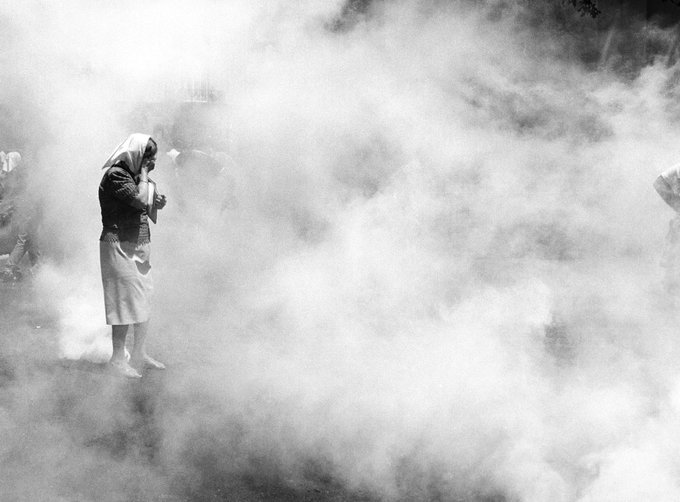
Pero no fue así. 39 años después, Roberto me estaba jalando de la mano para ver a las madres, (hoy en día también abuelas) porque había miles y miles de personas en solidaridad con ellas. Estaban preparando su marcha número 2.000, las 2.000 vueltas, una inmensa marcha. 

Mi foto favorita. Las rondas las hacían ellas, pero ahora las hacemos todos. Gracias a ellas 

El miedo no podía intimidarlas. La violencia no podía callarlas. Incluso su propio dolor no las abatió. Estas luchadoras triunfadoras con pañuelos blancos, algunas apoyadas por andadores, esperaron con calma y paciencia en una pequeña tienda de campaña para apoyarse en los brazos de voluntarios y presentarse como los símbolos vivientes que la injusticia debe ser desafiada, y que la gente común y corriente tiene el poder para organizarse y ganar.
Debido a su incansable persistencia, se colocó la presión internacional sobre el gobierno en busca de respuestas.Una comisión recogió testimonios. Las pruebas de ADN comprobaron la identidad de muchos de los desaparecidos. Oficiales militares de alto rango fueron juzgados, condenados y sentenciados por sus crímenes. Algunas de los desaparecidas eran mujeres embarazadas. Los bebés que nacieron en las prisiones de tortura fueron robados y dados a familias escogidas por los militares luego de que sus madres fueran asesinadas. Las madres de la Plaza tuvieron éxito en la identificación de cientos de estos niños.
Roberto tuvo que convencer a los voluntarios que estaban de guardia con las madres que me dejaran entrar a la carpa donde estaban para conocerlas. Es testimonio de su propio activismo lo conocían y confiaban en él. Me dejaron entrar. Fue un increíble honor conocerlas. Tengo dos hijos. No me puedo imaginar lo que haría si mi gobierno se los llevara, si los desaparecieran. Se me salían las lágrimas pensando en el dolor, pero también de pensar con orgullo de la fuerza de estas magníficas mujeres. La más joven de las madres tiene ahora 87 años.
IMG_6359No habrá un aniversario número 3.000 donde marcharán las madres de la primera vez. Sin embargo, la Plaza de Mayo está repleta. Hijos e hijas y nietos y desconocidos como yo llegan. Las madres han construido una organización de luchadoras apasionadas por la justicia social. Sus hijos perdidos no regresarán a casa. Por eso concentran sus esfuerzos en abogar por los pobres y lo más débiles – por los niños de hoy.
El poder de las madres es una lección universal. Se levantaron mujeres que no tenían derechos; vulnerables y de luto por la pérdida más profunda posible. Su valentía inspiró a otros. Su persistencia llevó a los asesinos ante la justicia. Su visión es tan clara que su legado permanecerá.
Cuando salieron y comenzaron a marchar por la 2.000 vez en frente, la vuelta 2.000, miles y miles de hijos y nietos y amigos adoptados y desconocidos marcharon con ellas en la Plaza de Mayo. Gritamos en su honor:
Las Madres de la Plaza ¡el pueblo las abraza!
No es un simple lema. Es un recordatorio de lo que estamos llamados a hacer cuando las injusticias que enfrentamos parecen insuperables y las fuerzas en nuestra contra parecen omnipotentes.


Recordemos a las madres. Abracémoslas. Marchemos con ellas. Nos han mostrado el camino.Las Madres de la Plaza, el pueblo las abraza - Lily's Blackboard:


Badass Teachers Association: Am I Radical Enough? Thoughts on Being a Black Education Activist Surrounded by White Liberals

Badass Teachers Association: Am I Radical Enough? Thoughts on Being a Black Education Activist Surrounded by White Liberals:

Am I Radical Enough? Thoughts on Being a Black Education Activist Surrounded by White Liberals


This blog was originally published by Denisha Jones at Changing the Narrative on 8/18/16. 

To my non activist friends this sounds like a silly question.  I am pretty sure, when they think of radical activist they think of me. At first it was because I used Facebook to proliferate my radical views but since returning to Washington, DC in 2011 I have attended and organized numerous marches and conferences taking my social media activism to the streets.  However, lately as I get deeper and deeper into the world of education activism I am often left wondering if I am radical enough to be a part of this movement. Or perhaps their definition of radical varies greatly from my definition of radical and that is why I feel like I am not fully welcome in this movement.  And by their version of radical I mean white liberals, because frankly they dominate the education activist movement that I am a part of. This is not surprising, given that white liberals often have the privilege including time and money to fully engage in the activist movement.  When they use that privilege for the common good, then we get one step closer to winning the war. However, when they use that privilege to dictate to others how they must think, act, and behave in this movement, then they become the oppressor no matter how good their intentions may be. 
            In July 2016 the Save Our Schools Coalition for Action organized the People’s March for Education and Social Justice and Activist Conference in Washington DC.  The Save Our Schools Coalition was originally made up of the following 8 organizations: Save Our Schools (SOS), The Badass Teachers Association (BATs), United Opt Out (UOO), Network for Public Education (NPE), the National Council of Urban Education Association (NCUEA), the BAT NEA Caucus, the Center for the Expansion of Learning and Thinking (CELT), and the Florida Opt Out Network. Members from these organizations, spent 10 months working to plan and organize the march, rally, and conference.  We had hopes of substantially growing the number of attendees from the 2011 SOS march and rally but realized that it would cost serious money and none of the coalition organizations could afford to pay for this event. So, as was done in Badass Teachers Association: Am I Radical Enough? Thoughts on Being a Black Education Activist Surrounded by White Liberals:

Christine Langhoff: What the Massachusetts Democratic Committee Said about the Charter Issue | Diane Ravitch's blog

Christine Langhoff: What the Massachusetts Democratic Committee Said about the Charter Issue | Diane Ravitch's blog:

Christine Langhoff: What the Massachusetts Democratic Committee Said about the Charter Issue

Don't Be Fooled -  Vote for Real Democrats

Two days ago, the Massachusetts Democratic Committee overwhelmingly passed a resolution opposing Question 2, which seeks to lift the cap on charter schools.
Massachusetts teacher and daily reader Christine Langhoff expands on my early report (which she kindly sent to me as soon as the resolution passed). Thanks to Christine, I was able to circulate the good news before the daily press. It is kind of amusing seeing the complaint by the representative of DFER, the hedge fund managers’ group. Hedge funds are not generally viewed as champions of those without power; they lack numbers, but they are loaded with money and power. Parents and educators anticipate that the hedge funds and corporate interests will pour close to $20 million into their campaign for Question 2. Supporters of public schools can’t match the dollars, but they can knock on every door and alert every parent that the real goal of this deceptive campaign is privatization, not helping public schools.
She writes:
On Tuesday evening, August 16, the Massachusetts State Democratic Committee overwhelmingly passed a resolution, by voice vote, in opposition to Ballot Question #2, which would eliminate the cap on the number of charter schools permitted in the Commonwealth. Here is part of the text of the resolution, which was offered by Steve Tolman, President of the MA AFL-CIO:
Democratic State Committee Resolution Regarding Question 2
WHEREAS, the Massachusetts Democratic Party platform states that “Massachusetts Democrats are committed to investing in public education”; and
WHEREAS, the national Democratic Party platform states that charter schools “should not replace or destabilize traditional public schools”; and
WHEREAS, more than $400 million in taxpayer money was diverted to charter schools statewide last year from local school districts, forcing cuts to programs that families and students value; and
WHEREAS, charter schools typically serve far fewer special needs students, English language learners and economically disadvantaged students than the traditional public school districts they are located in and use hyper-disciplinary policies and suspensions for minor infractions to push out students; and
Liam Kerr, director of Democrats For Education Reform Massachusetts, was not amused.
“Tonight, a small group of state Democratic Party insiders hijacked a meeting and passed a resolution with little warning and no debate or discussion. Democratic leaders, including Hillary Clinton and President Obama support high-quality public charter schools. The Massachusetts party insiders are so out of step they won’t even listen to those who stand with low-income families and families of color desperate for a better education for their children. There was nothing democratic about this vote.”
The vote flew in the face of predictions by the pro-charter Boston Globe on Monday that it would be a divisive resolution:
“…forcing activists to take sides between two traditional party constituencies: minority and low-income families versus teachers unions…


What Back-To-School Shopping Lists Reveal About Underfunded Schools

8/18/2016 – What Back-To-School Shopping Lists Reveal About Underfunded Schools:

8/18/2016 – What Back-To-School Shopping Lists Reveal About Underfunded Schools

THIS WEEK: Cops In Schools … LGBT Students Traumatized … Caution On EdTech … Wrong About Test Scores … Inside A ‘No Excuses’ Charter

TOP STORY

What Your Back-To-School Shopping List Reveals About Our Underfunded Schools

By Jeff Bryant

“Back to school supply lists are likely longer than ever before due to the simple reason that schools increasingly don’t have the funds to pay for items on the list … But the lack of funding for basic school supplies is just the most obvious sign of America’s growing crisis in education funding … The whole fiasco makes you wonder what the endpoint is.”
Read more …

NEWS AND VIEWS

Bullied By The Badge?

The Hechinger Report

“Since the 1990s, at least 11 states have enacted legislation that funnels state funds into school policing programs … By 2014, 30 percent of public schools had school resource officers, or SROs … Officers inside schools have a significant impact on whether students interact with the criminal justice system … Students who interact with the criminal justice system are more likely to drop out of high school, become involved with the system again and have higher unemployment rates than students who have not been arrested.”
Read more …

Gay And Lesbian High School Students Report ‘Heartbreaking’ Levels Of Violence

The New York Times

“About 8% of the high school population described themselves as gay, lesbian or bisexual, which would be about 1.3 million students. These adolescents were three times more likely than straight students to have been raped. They skipped school far more often because they did not feel safe; at least a third had been bullied on school property. And they were twice as likely as heterosexual students to have been threatened or injured with a weapon on school property. More than 40% of these students reported that they had seriously considered suicide, and 29% had made attempts to do so.”
Read more …

Caution Flags For Tech In Classrooms

NPR

“Both blended learning and online … show results ranging from mixed to negative … Even as computers become ubiquitous in classrooms, there’s a lot we still don’t know – or at least that we’re not doing to make them effective tools for learning … Implementation is really important, yet it’s often ignored … Imperfect data and inadequate evaluation make it hard to understand or improve the use of ed-tech … Computers are enhancing access. There’s less evidence that they’re enhancing learning.”
Read more …

Student Test Scores: How They Are Actually Calculated And Why You Should Care

The Washington Post

“If you think that determining scores on standardized tests is a simple matter of figuring out how many answers each student got right, you are wrong. In fact, scores are derived through statistical models and scaling practices that can be misleading about student achievement … A series of reports … have urged caution in the use of standardized test scores to make high-stakes decisions about students, teachers, principals and schools – but policymakers at the federal and state levels have for years ignored the warnings … This problem is becoming more apparent to more people … The 2016 platform of the Democratic Party says, for the first time ever, that using test scores for high-stakes decisions is a bad practice.”
Read more …

Schools That Accept ‘No Excuses’ From Students Are Not Helping Them

The Washington Post

Former charter schoolteacher Julia Fisher writes, “When I taught at a charter school, I once gave out 37 demerits in a 50-minute period. This was the sort of achievement that earned a new teacher praise … Students encounter careful uniform checks and communal chanting of motivational slogans … Posture and eye contact are important, even for 16-year-olds. Class is not to proceed without total compliance … An administrator watched my class every day. If I didn’t fully enforce the school’s code – under which demerits must be issued for slouching, looking at the wrong person or even taking notes when not explicitly directed to – the administrator would correct me on the spot … Questions were forbidden … Classes were designed to follow No Excuses dogma, in a way that precluded real engagement. Discussion was considered a waste of time because it didn’t produce measurable results … Most of the time was devoted to worksheets.
Read more …
 8/18/2016 – What Back-To-School Shopping Lists Reveal About Underfunded Schools:

Charter Schools & ESSA Regulations: “We Are Not The Same” – Exceptional Delaware

Charter Schools & ESSA Regulations: “We Are Not The Same” – Exceptional Delaware:

Charter Schools & ESSA Regulations: “We Are Not The Same”


We strongly oppose the inclusion of this requirement, which is not authorized by the statute. The Department bases this proposal on a desire “to provide transparency.” (No further justification is provided in the NPRM.) We, too, support greater transparency, regarding both charter and non-charter schools, but this requirement would result in the reporting of misleading data. Moreover, the proposed requirement appears to be based on the premise that charter schools should look the “same” as district public schools in close proximity, when by definition charter schools are open enrollment. Lastly, the proposed requirement that is not in the statute, and would not equally apply to all public schools – only charter schools would be included.
The National Association for Public Charter Schools gave a very long public comment for the draft regulations put forth by the United States Department of Education and Secretary John King.  Even they aren’t happy with parts of these regulations.  Many felt the Every Student Succeeds Act gave gifts to the charters, but apparently the charters do not like some of these regulations.
The most important question is not who is enrolled in a charter school; it is whether all students and families who may wish to enroll have the opportunity to enroll – only then is the parent’s choice a meaningful one. The comparison data that the Department is asking for would not reflect this factor because the data would confuse and conflate the decision to enroll with the opportunity to enroll. As such, comparison data may be one indicator of meaningful access but comparison data are not the correct, best or only frame with which to evaluate equity.
I find some of their statements very ironic.  Especially for some charter schools in Delaware where the opportunity to enroll is buried in selective enrollment preferences and factors that lead to very low populations of at-risk students: African-Americans, students with disabilities, and English Language learners.  So much so that the American Civil Liberties Union filed a complaint with the Office of Civil Rights in December, 2014.
Like some charters in Delaware, this collection of America’s largest charter school organizations and franchises want to cherry-pick through the Charter Schools & ESSA Regulations: “We Are Not The Same” – Exceptional Delaware:
 

The nation’s teacher force lacks diversity, and it might not get much better - The Washington Post

The nation’s teacher force lacks diversity, and it might not get much better - The Washington Post:

The nation’s teacher force lacks diversity, and it might not get much better

In this file photo from 2006, third-grade teacher Marla Wyche opens the "interactive notebook" in her classroom as she prepares to drill students on holidays and people to know. Studies show that minority students can benefit from having minority teachers, but a new study says there are too few of them. (Linda Davidson/The Washington Post)

Persistent achievement gaps among black and Hispanic students have confounded education experts for years. One strategy researchers have found to be successful at narrowing the gaps is a simple one: Employ more minority teachers, who often can forge a better connection with them.
But a new study from the Brookings Institution and the National Council on Teacher Quality identifies several challenges school districts must address in seeking to increase the ranks of minorities leading classrooms, including a leaky recruiting pipeline that could lead to a dearth of qualified candidates lasting decades.
Because few minority college graduates are choosing to become teachers, it is increasingly difficult to recruit minorities into classrooms where they could potentially boost the performance of minority children and increase the pipeline of teacher candidates, according to the study, released Thursday. The authors described it as a cyclical problem that could remain for decades if hiring practices and recruiting efforts do not change significantly. The study suggests there will be minimal improvement as far out as 2060.
The study — from Michael Hansen and Diana Quintero of Brookings and Kate Walsh and Hannah Putman of the NCTQ — notes that while minority children account for half of the nation’s student body in public schools, minority teachers make up just 18 percent of the workforce, creating a significant disparity.
“Given these bleak findings, the chances of success for districts’ laudable goals to build a teaching corps that mirrors their student populations crumble in the face of reality — even looking forward nearly fifty years,” the authors wrote. “While that harsh truth certainly doesn’t excuse districts to give up and resign themselves to a mostly white teaching force, it does suggest that districts must embrace and promote a range of other, more immediately viable The nation’s teacher force lacks diversity, and it might not get much better - The Washington Post:


As Cost of School Supplies Add Up, Educators Step Up to Help Parents

As Cost of School Supplies Add Up, Educators Step Up to Help Parents:

As Cost of School Supplies Soar, Educators Step In to Help Parents

cost of school supplies

‘Tis the season to stock up on school supplies—the spiral notebooks, scissors, glue sticks, and more that will cost about $200, on average, per elementary student this year, or $330 and $375 per middle and high school student, respectively.
In Greece, New York, however, a partnership between the Greece Teachers Association (GTA) and local school officials has dramatically reduced the cost of school supplies, taking a huge bite out of the burden borne by parents. “These supply lists have gone down from $100 or $120 per student to, in some cases, zero to $10,” said Rob Stalter, a high school teacher and a leader in GTA’s social justice committee. For a family with a couple of kids, the savings could pay for a week’s worth of groceries.
This is a big deal in Greece, where its 11,000 students are more likely than ever to live below the federal poverty line. Like a lot of upstate New York communities built around manufacturing industries, “jobs here have been lost and many have not been replaced, or they’ve been replaced by low-paying jobs,” noted Stalter. Over the past 15 years, the percentage of Greece students who qualify for free or reduced-price lunch has risen from about 12 percent to 54 percent.
Meanwhile, the costs of school supplies also has risen over the past decade. According to the Huntington Backpack Index, which has tracked the issue since 2007, the cost of school supplies and school fees has jumped 88 percent for elementary students, 81 percent for middle school students, and 68 percent for high school students, over the past decade.
The idea for the union to take a critical look at school supply lists—the inventory of file folders and highlighters that parents are required to buy each August—originally came from GTA President Jason Cooney, who opened his son’s school locker one day two years ago and discovered a refuse pile of unused supplies. Like most parents, he immediately thought of how much money he had spent on those supplies. When Cooney mentioned it to Stalter, both agreed this was an unnecessary burden on parents, and especially hurtful for Greece’s many low-income parents. Trying to help those families in need made sense for GTA, a social-justice oriented union of about 1,000 members who often organize around community activism—and has received support from the National Education Association to do so.
Since 2007, the cost of school supplies and school fees has jumped 88 percent for elementary students, 81 percent for middle school students, and 68 percent for high school students.
While Stalter began asking teacher colleagues to look critically at their lists—”Do you really need to buy 20 new clipboards every year?”—he also approached Brent Critchley, the school district’s central store supervisor. “I said, ‘your timing is perfect!’” recalled Critchley. He had been considering the same issue, but focusing on how to use the district’s purchasing power to buy the required supplies in bulk.
Consider this: While parents might spend $2 to buy a dozen pencils at an office supply store, the cost at the school district’s central store is just 38 cents per dozen. Glue sticks are 6 cents each. “Where I have an advantage is, I can buy at the very best price, but I need help from the education side: ‘What don’t I carry that you need?’” said Critchley.
“My thinking is let the teachers teach, and let me buy,” said Critchley, and basically that’s exactly what has been happening in Greece as the union and district have worked to align teachers’ and students’ needs with the district’s inventory.
“Things like this don’t happen unless you get some teamwork going — and that’s what this is, the district and union working together,” said Stalter.As Cost of School Supplies Add Up, Educators Step Up to Help Parents:
Big Education Ape: Why Teachers Are Going Broke Buying School Supplies | MONEY - http://bigeducationape.blogspot.com/2016/08/why-teachers-are-going-broke-buying.html

Portfolio School Reform and Unregulated Charters Harm Ohio as School Year Begins | janresseger

Portfolio School Reform and Unregulated Charters Harm Ohio as School Year Begins | janresseger:

Portfolio School Reform and Unregulated Charters Harm Ohio as School Year Begins


 On Monday, children in Cleveland, Ohio began the 2016-2017 school year, but problems in a one-party Republican state whose legislature has warmly embraced “corporate school reform” will affect their education this year.

First of all, as the school year began on Monday, the Cleveland Teachers Union presented the school district with the required 10-day notice of a strike, to begin on the Friday before Labor Day unless the district and the teachers union can reach agreement on a long-running problem.  Teachers, who have been without a contract since early July, are wearing blue t-shirts that proclaim, “I don’t want to STRIKE, but I will!”
Why begin the school year with such conflict? Actually it isn’t a new problem. In 2012—with support from the Cleveland business establishment, the philanthropic sector, and the mayor and his appointed school board—the Ohio legislature passed a portfolio school reform plan (Manage the district like a business portfolio with a marketplace of school choice including rapid expansion of charters that receive local tax dollars.) and imposed it on the Cleveland schools.
Plain Dealer reporter Patrick O’Donnell explains that the Cleveland Transformation Plan also has affected salaries for teachers, and continues to affect contract negotiations four years later: “Negotiations on this contract are more complicated than in most districts, thanks to the Cleveland Plan for Transforming Schools…. That Plan called for a teacher pay plan ‘based on performance,’ instead of the traditional teacher salary schedule other districts use. That made Cleveland the only district in Ohio that no longer gives raises for years of experience and degrees that teachers earn. But the district and union have failed for four years to create the full pay plan called for in law and in the last teacher contract, reached in 2013. Though the sides agreed in their last contract that teachers would receive raises for multiple reasons, the district is only awarding them when teachers receive strong ratings on annual evaluations.  Ignored, so far, are contractually-agreed items like teaching in hard-to fill jobs or undesired schools; completing pre-approved courses and training that directly affect teaching; and Portfolio School Reform and Unregulated Charters Harm Ohio as School Year Begins | janresseger:


NYC Educator: A Lesson for Common Core Enthusiasts

NYC Educator: A Lesson for Common Core Enthusiasts:

A Lesson for Common Core Enthusiasts


Someone sent me an interesting link from the Gates-funded Center for American Progress the other day, about how we could all do fabulous close reading things with the Common Core standards. Believe it or not, just about every organization that's taken money from Gates has fallen head over heels in love with Common Core, on which Gates spent a whole lotta cash. Go figure. 


During the 2014-15 school year, more high school seniors read the young adult-oriented booksThe Fault in Our Stars and Divergent than Shakespeare’s Macbeth or Hamlet, according to a report that tracks what K-12 students at more than 30,000 schools are reading during the school year. These books are generally self-selected, making it not all that surprising that students would prefer to read a contemporary New York Times bestseller than a 17th-century play written in early modern English. And while some of the books that students select are thematically targeted to a mature audience, they are not particularly challenging to read for the average high schooler. The Fault in Our Stars and Divergent, for example, have the readability of a fourth- or fifth-grade text in terms of sentence structure and word difficulty.

God forbid that students should read stuff they enjoy. The end of the world is nigh. What we should value, according to this logic, is difficulty rather than content. Allowing students to self-select has a negative connotation in that paragraph. I'd argue the opposite. If students love to read, they will practice it without guns to their heads. Then, when they are presented with difficult readings, they will figure out how to get through them and deal with them. Forcing them to plod through Shakespere if they don't wish to is not how you get motivated readers. They continue:


Three of the top five most commonly assigned titles in grades 9 through 12 are To Kill a Mockingbird, The Crucible, and Of Mice and Men. All three books, while classics, are not particularly challenging in terms of sentence structure and complexity

Can you imagine that? Those crappy teachers are assigning books because of depth of theme, and they have no regard for how rigorous they NYC Educator: A Lesson for Common Core Enthusiasts:

Social Justice and Critical Pedagogy | BustED Pencils

Social Justice and Critical Pedagogy | BustED Pencils:

Social Justice and Critical Pedagogy

images

The social fibers in our society seem to be unraveling and the ruling class is scrambling to keep it together, as they fight over how to handle gaping social conditions. Historically oppressed minorities and immigrant groups are reminded daily how little they are valued by this society. We are in the midst of a system of mass incarceration and a scourge of unaccountable police murder and brutality, viewed online like the public executions of the past; cities across the country are seeing rebellions and riots. Refugees flee their homelands to come to America, the very place responsible for the policies that forced them to leave in the first place are rejected and sent back callously. If not, they are forced to eek out an existence in the shadows of society as family bonds are fractured and relatives are deported. The numbers of homeless are swelling as tent cities of mentally ill, drug addicted and struggling people, dot the urban landscape.  This is the richest, most powerful country in the world with a wealth gap that is beginning to mirror that of the underdeveloped world.
As a society, we have no answers to these problems. As educators, with access to the future of this nation, what has been our response? Since we as, teachers are generally regarded as ideological custodians of the system, largely, it has been as tools in the reproduction of the status quo. In recent decades, we have seen an attempt to separate from that tradition with Social Justice education. Social justice education is a means to encourage students to analyze the world and see their place in it as an agent of change for a more just world. What does a social justice framework mean?
Cal State Channel Islands school of Education website says,“According to Marilyn Cochran-Smith, a leading scholar in education, a social justice framework is one that “actively address[es] the dynamics of oppression, privilege, and isms, [and recognizes] that society isSocial Justice and Critical Pedagogy | BustED Pencils: