Tuesday, August 16, 2016

Charter school ballot question divides Democrats - The Boston Globe

Charter school ballot question divides Democrats - The Boston Globe:

Ballot question on charter schools divides Democrats

Charter Schools - Dividing Communities since 1991

A ballot proposal to expand charter schools across the state could drive a further wedge between Democratic Party factions when state committee members gather Tuesday night in Lawrence.
Pro-teachers union members of the state committee have been working to line up support for a resolution putting the party on record in opposition to a November ballot question boosting the number of charter schools, a thorny political question for those working to pacify blocs within the party. It was unclear late Monday whether leading party officials would permit the resolution to come to a vote.
“The charter school issue shows a genuine disagreement within the party, that there’s no consensus,” said one party insider, speaking on condition of anonymity to discuss internal Democratic dynamics. “And both sides are really intractable. The notion of a middle ground on charter schools within the Democratic Party, or among the people that are going to be showing up to this meeting, it just doesn’t exist.”
Charter schools have long been a contentious issue among Democrats, forcing activists to take sides between two traditional party constituencies: minority and low-income families versus teachers unions.


If passed, the ballot measure, Question 2, would lift the statutory cap on the number of charter schools in the state. It is strongly opposed by teachers’ unions, who argue that charters drain money from traditional public schools. Proponents say it could boost opportunities for students in struggling communities.
A Suffolk University poll in May found that half of the state’s voters supported lifting the cap on charters in districts with the poorest test scores, with 33 percent opposed.
Governor Charlie Baker, a Republican, is the measure’s leading proponent, standing last month in a midsummer downpour outside the State House in support of the ballot initiative. Two of Baker’s top political advisers, expected to play senior roles if he runs for a second term, are helping steer the procharter effort.
“This is one of those issues where the Republicans can use divisions within the Democratic Party to their benefit,” said Stonehill College political scientist Peter Ubertaccio. “I think there’s no downside to what the governor is attempting to do.”
A spokeswoman for state Democratic Party chair Thomas McGee, a Lynn state senator, said McGee was not available for comment.
The state party confab comes as national Democrats are working to heal fissures opened during the grueling presidential primary between the nominee, Hillary Clinton, and US Senator Bernie Sanders.
In Massachusetts and nationally, top Democrats have shown an uneasiness with education policy and charter schools. Clinton was booed last month during a national teachers union conference after making remarks seemingly supportive of charter schools.
Depending on its wording, the resolution, if adopted, probably would put Massachusetts Democrats in a more stridently anticharter stance than the national party.
The meeting comes as Massachusetts Democrats grope their way through the type of power vacuum they have not experienced since before Deval Patrick, himself a charter supporter, was elected governor in 2006. No Democrat has emerged as the prime challenger to Baker and, party insiders say, even the behind-the-scenes power-brokering can at times seem rudderless.
Bill Dooling, a committee member from Holliston and Vietnam veteran who campaigned for John F. Kerry’s 2004 presidential bid, circulated an e-mail to members last month ripping a procharters Charter school ballot question divides Democrats - The Boston Globe:
 Don't Be Fooled -  Vote for Real Democrats

Voucher vs No Voucher | journalreview.com

Voucher vs No Voucher | News | journalreview.com:

Voucher vs No Voucher

Superintendents disappointed in state’s voucher system

Voucher vs No Voucher


After a successful first week of classes at the three Montgomery County school corporations, superintendents still found disappointment with the publication of a recent report on the Indiana voucher program. 
A record $53 million of tax dollars was used to finance private and religious school tuition in the 2015-16 school year. The cost of the program was detailed in the Choice Scholarship Annual Report released by the Office of School Finance of the Indiana Department of Education in July.
Local superintendents see public schools being shorted funding in an effort to finance public schools. Montgomery County tax dollars continue to be a part of the money sent to the private and religious schools even though there are none of those types of schools in the county.
When state legislators set up the school voucher system, they did it under the pretense that it would help low-income families send their children to private schools. Now it appears, according to the report, that is not happening, but the cost of the voucher program continues to rise.
South Montgomery School Corporation Superintendent Dr. Shawn Greiner said the playing field is not equal between those who can afford private schools compared to those who cannot.
“I do not support spending public tax dollars on private school vouchers, most particularly in instances where private schools’ tuition charges are more than the voucher itself,” Greiner said “In these situations, private schools are creating a situation where those families with means have an advantage over those without. Public education is free, regardless of a child’s family circumstances. When public money supports private education rather than the public education system, this can and often does hurt low-income families by undermining the public schools that those families rely on.”
Republican legislators expanded the voucher system in 2013 when they changed eligibility rules which enabled private school students, who were already attending the private schools, to obtain a voucher. Adding the additional students caused the fiscal cost to Indiana to increase dramatically.
In 2011 through 2013, the state actually saved a total of $9.1 million because students were leaving public schools to attend private schools. Not having to finance the students who chose a private school from their public school saved the state money.
However, when the state legislators opened the vouchers to existing private school students, the cost to Indiana through vouchers ballooned to $53.2 million in the 2015-16 school year. In fact, $53 million is more money than what the state paid for summer school ($18 million), preschool ($10 million), technology ($3 million), English language learners ($10 million) and Gifted and Talented programs ($12 million) all added together.
Crawfordsville Superintendent Scott Bowling said the increase in state education funding is a serious problem to all of the state’s public schools and has caused an accountability problem in the use of tax dollars since private schools are not as accountable to the state as public schools are.
“Public education is the foundation of what has made this country great,” Bowling said. “Indiana’s voucher program hurts that foundation by creating hundreds of individual school districts that are not accountable to the public and not accessible to everyone.”
Public school advocate Vic Smith explained the total cost of the voucher program since its inception in the 2013-14 school year is $131.5 million. He sees that money as funds taken away from public schools. 
North Montgomery Superintendent Colleen Moran said the voucher system has not been good for public Voucher vs No Voucher | News | journalreview.com:

Monday, August 15, 2016

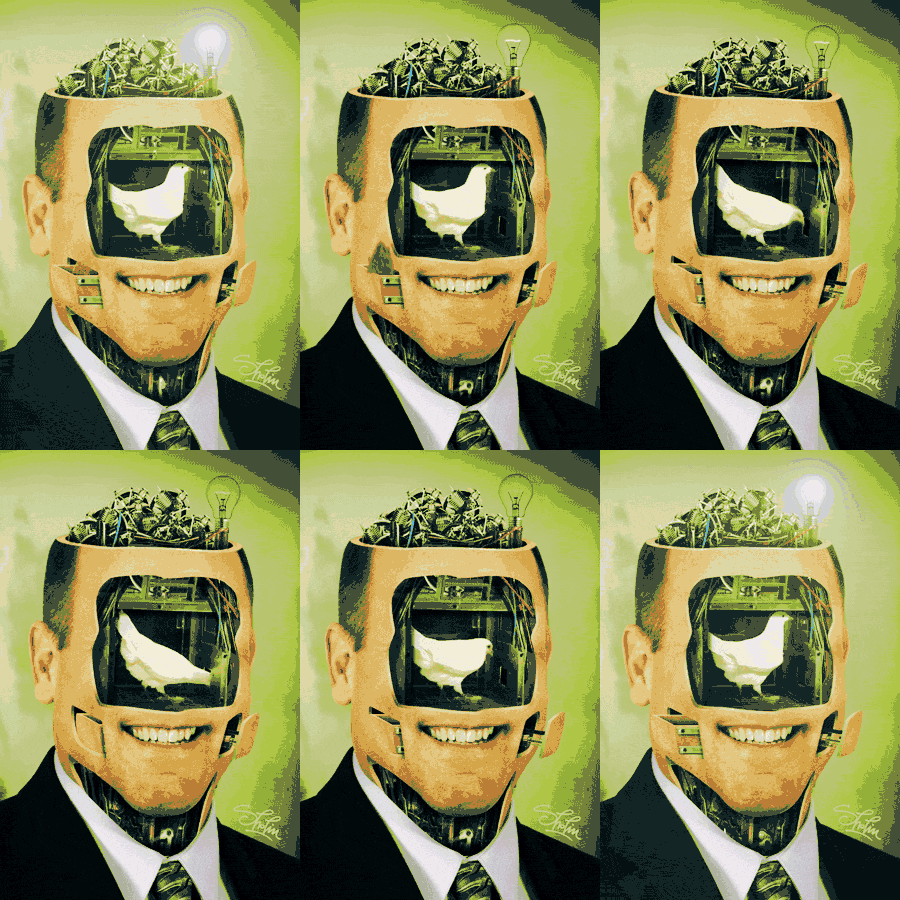
Trump is an object lesson in the problems of machine learning / Boing Boing

Trump is an object lesson in the problems of machine learning / Boing Boing:

Trump is an object lesson in the problems of machine learning


Trump's algorithm is to say semi-random things until his crowd roars its approval, then he iteratively modifies those statements, seeking more and more approval, until he maxes out and tries a new tack.
This is one of the core strategies of machine-learning: random-walking to find a promising path, hill-climbing to optimize it, then de-optimizing in order to ensure that you haven't plateaued at a local maximum (think of how an ant tries various directions to find a food source, then lays down a chemical trail that other ants reinforce as they follow it, but some will diverge randomly so that other, richer/closer food sources aren't bypassed).
It also betrays one of the core problems with machine learning: bias in the sample-set. The people that Trump relies upon to give him his success feedback are the people who show up for Trump rallies, who are the most extreme, least-representative group of potential Trump voters. The more Trump optimizes for this limited group, the more he de-optimizes for the rest of the world.
Biased training data is a huge (ahem, yuge) problem for machine-learning. Cities that use data from racist frisking practices to determine who the police should stop end up producing algorithmic racism; court systems that use racist sentencing records to train a model that makes sentencing recommendations get algorithmic racism, too.
Trump is a salesman -- he says whatever he thinks his audience wants to hear. That's why he's contradicted every position he's ever espoused. He randomwalked into a strategy of saying things that an underserved, vocal group of bigots wanted to hear, and they fed back their approval and he's been death-spiraling ever since.
Cathy "Weapons of Math Destruction" O'Neil explains what this means for machine learning in our political and policy spheres.


The reason I bring this up: first of all, it’s a great way of understanding how machine learning algorithms can give us stuff we absolutely don’t want, even though they fundamentally lack prior agendas. Happens all the time, in ways similar to the Donald.
Second, some people actually think there will soon be algorithms that control us, operating “through sound decisions of pure rationality” and that we will no longer have use for politicians at all.
And look, I can understand why people are sick of politicians, and would love them to be replaced with rational decision-making robots. But that scenario means one of three things:
1. Controlling robots simply get trained by the people’s will and do 
Trump is an object lesson in the problems of machine learning / Boing Boing:


CURMUDGUCATION: Resolve To See

CURMUDGUCATION: Resolve To See:

Resolve To See


For the next couple of weeks, as the beginning of my school year approaches. I'm going to write to renew my resolve to keep focus in my practice. This is one of that series of posts.

I'm not sure that anybody has it harder in school than the invisible kids.

Bullied students are a subset of the invisible students. Bullied students are seen-but-not-really. They are seen for the one characteristic for which they are singled out and mistreated, but rarely seen as actual complete fully human beings.

There are also the students who are completely invisible. Unseen, unknown, just passing through the halls of the school. Their presence and their absence make the same impression on the people around them.

There's a sad but fair argument to be made that all of this invisibility is practice for the adult version, for entering the grown-up world where we talk past or at each other and simply reduce other people to just one or two characteristics, treating our fellow humans as if they are cartoon versions of human beings. We reduce the people we disagree with to gnarled caricatures. We reduce the people we don't mind being around to flat masks, one or two simple characteristics that we can quickly reference before we move on. And we reduce people that we don't want to bother with to nothing at all. Not even ignored, because you can only ignore something that you acknowledge is there. Just invisible.
I suspect it's easier for us to slip into that mode in school because we deal with a relatively narrow slice of humanity. I teach teenagers, and while there are some things that have changed over the decades, teenagers remain for the most part pretty teenagery. On top of that, certain physical and CURMUDGUCATION: Resolve To See:

Mike Klonsky's SmallTalk Blog: Peter Cunningham's reform apologia: 'Fighting segregation and poverty too expensive'.

Mike Klonsky's SmallTalk Blog: Peter Cunningham's reform apologia: 'Fighting segregation and poverty too expensive'.:

Peter Cunningham's reform apologia: 'Fighting segregation and poverty too expensive'.

Sign reads: "We want equal & segregated schools"
Peter Cunningham's latest apologia for school segregation, in U.S. News & World Report, is basically a defense of current reform policies that have been shown to re-segregate schools. It represents more than just the opinion of a lone education gadfly. Cunningham is paid millions to speak for some of the most powerful and wealthiest among those who influence national ed policy.

It's run up the flag pole at a time when corporate-style "reform" has come under attack fromcivil rights groups and teacher unions, and appear to be losing their cachet, even within the Democratic Party establishment.

Cunningham tries to come off as a tormented soul, torn between his personal and "pragmatic" side, the latter arguing that ending poverty and integration are just too "politically difficult and financially expensive" and therefore, instead of spending hundreds of billions more to reduce poverty and reduce segregation, we should just "double down on our efforts to improve schools."

At a recent DFER-sponsored forum at the DNC, Cunningham laid out his anti-deseg line in an obvious attempt to influence Clinton's education agenda. He answered a question about school integration this way:

"Maybe the fight's not worth it. It's a good thing; we all think integration is good. But it's been a long fight, we've had middling success. At the same time, we have lots and lots of schools filled with kids of one race, one background, that are doing great. 
There nothing original in Cunningham's comments. If they strike you as a throwback to Plessy v. Ferguson and the separate-but-equal doctrine, you're definitely on to something. As we Mike Klonsky's SmallTalk Blog: Peter Cunningham's reform apologia: 'Fighting segregation and poverty too expensive'.:

Chinese International Students Affect Asian American Students in Complicated Ways - The Atlantic

Chinese International Students Affect Asian American Students in Complicated Ways - The Atlantic:

The Burden of Being Asian American on Campus

The arrival of Chinese international students comes at a cost to some.

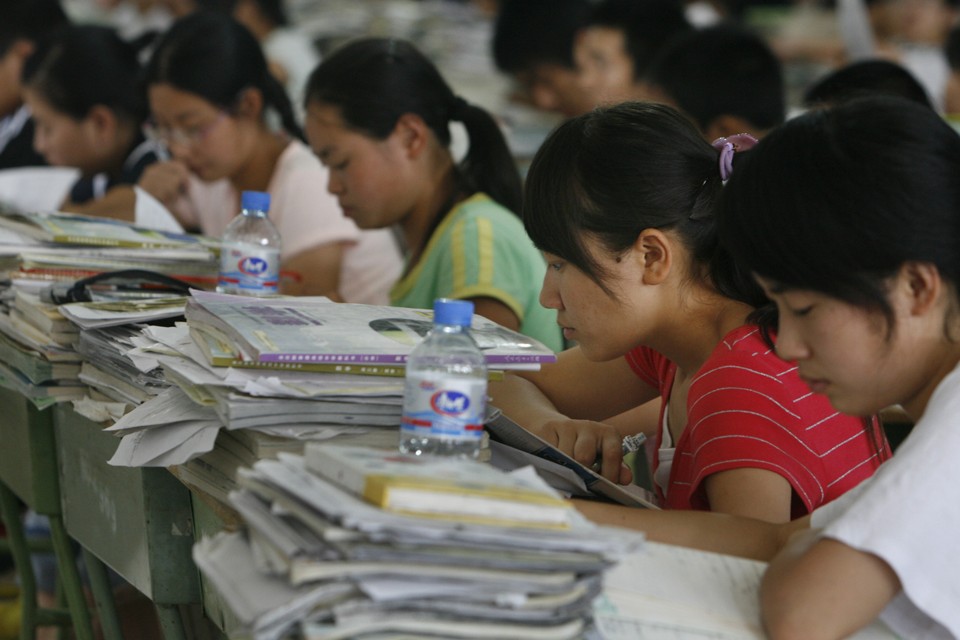
Students prepare for a college entrance exam in China's Sichuan province.Claro Cortes / Reuters

When my father was a graduate student at Loyola University in Chicago, two distinct things marked his day: the “L” and instant noodles. It was 1998 in a studio apartment in Rogers Park below the Red Line. Every night, the sounds of the train woke him up. Every morning, he got up after a restless night and made himself some ramen. After those three years, he never wanted to look at instant noodles again.

At that time, it was almost unheard of for Chinese students to go to the United States for undergraduate study. Instead, everyone suffered through the dreadedgaokao, the Chinese college-entrance examination. For four consecutive days in June, thousands of Chinese high schoolers sat in stuffy classrooms with no air conditioning, sweating and exerting themselves in subjects like mathematics, physics, and English to get one single score high enough to earn a coveted spot at a top university. Most students who did go abroad were graduate students, and many of them stayed in the new country.
The scene today is a little different. The majority of students in China do still take the exam. They study for years in preparation and wait for weeks afterward in anticipation of receiving a number that determines their future. Students are accepted to a college based on how highly they ranked the school and the single weighted score, which they may not even know before submitting their preferences. The convoluted and capricious ranking system may allot them a spot at their last-choice college.
Many, however, now have the option of bypassing that system, with exceptional talent or a significant amount of money. Some apply to a foreign-language school where students can apply to universities abroad instead of taking the gaokao. Others test their way into “experimental” classes at top public high schools, which are fiercely competitive but have high success rates of getting students into Western universities. Those with more disposable income can skip Chinese high school altogether and attend a private boarding school abroad, such as Andover or Exeter in New England. Students from wealthier families usually have a better chance of going abroad because they can hire tutors, take test-prep courses, and afford the high tuition of American private high schools and universities.
In recent years, the number of Chinese nationals studying abroad has increased dramatically, surpassing India, South Korea, and other countries in the number of students sent overseas. According to the Institute of International Education, China was the top sender of students to the United States in 2015, with 304,040 Chinese International Students Affect Asian American Students in Complicated Ways - The Atlantic:

Poor data collection leaves policy makers uninformed :: SI&A Cabinet Report

Poor data collection leaves policy makers uninformed :: SI&A Cabinet Report :: The Essential Resource for Superintendents and the Cabinet:

Poor data collection leaves policy makers uninformed

Poor data collection leaves policy makers uninformed

(District of Columbia) After 85 percent of districts in Florida and Texas reported zero instances of bullying in the most recent Civil Rights Data Collection Survey, federal officials announced late last week that they were revisiting how data is being collected–a problem experts say has been long-standing and all too common.
The department’s national survey of school climate factors, teacher quality and rigorous course access should help districts and state policy makers address apparent problem areas. When the data collected is not representative of reality, however, it cannot provide directions for school improvement.
 “It’s been a struggle for us to get meaningful statistics from this survey because the data is so incomplete,” Victor Leung, staff attorney at the ACLU of Southern California, said in an interview. “I’m sure there are different causes for inaccuracies in different districts. I think sometimes it might be because a district does not want to release data that looks bad, and other times it’s just very poor data collection on behalf of the districts–and that I actually think is quite common.”
Improved transparency, a cornerstone of the Every Student Succeeds Act, requires schools report to parents, the community and lawmakers various aspects that impact students. This includes the number of teachers assigned to classes they are not credentialed to teach, students’ access to college-readiness and career education courses, and instances of violence or bullying on campus.
Lawmakers and school boards alike often rely on what has been commonly referred to as “valid and reliable data” to inform new policy recommendations. The Civil Rights survey results released in June, however, suggest at least some areas of data collection are still unreliable.
Schools across the country have made significant shifts to address issues like bullying in recent years, for example, through implementation of anti-bullying measures, social emotional learning, LGBT-friendly policies and restorative justice practices that allow students to find common ground through mediation. It is unlikely, though, that such behavior has been completely eradicated.
Advocates for various student groups say there is more to be done to address inequity in the classroom or in disciplinary policy, which is unlikely to be accomplished without proper data to help schools identify problems.
Leung, who is currently working on a report regarding police presence in schools in California, said plenty or errors can be found in that data as well.
In some cases, ACLU researchers have found a “zero” marked in the column detailing the number of police on campus, when it is known that the school has many officers present, he said. Other times, a district will have clearly put “one” down every column–similar to a student answering “C” for every question on a quiz.
The Education Department has acknowledged that, because the data is self-reported, there are likely errors to be found. In fact, an update posted to the survey results page last week claims the Department was “alerted to errors in data the state of Florida submitted on behalf of its school districts,” and is working to make corrections. Florida is one of the states that reported no occurrences of bullying in 85 percent of its districts.
“This is self-reported data from school districts, and while we know it’s not perfect, it’s the best national data available on issues of equity in schools,” Dorie Nolt, spokesperson for the Department of Education, said in an email. “We continue to look for ways and work with school districts to improve the accuracy of the data.”
Some districts, especially those which are smaller or more rural, do not have procedures for collecting data and simply do not keep it, Leung said.
“If they don’t keep the data, I guess there’s no way they can report it,” he said.Poor data collection leaves policy makers uninformed :: SI&A Cabinet Report :: The Essential Resource for Superintendents and the Cabinet:

Chicago Public Schools Just Laid Off More Than 1,000 Teachers. Here's What It's Like to Be One of Them | Alternet

Chicago Public Schools Just Laid Off More Than 1,000 Teachers. Here's What It's Like to Be One of Them | Alternet:

Chicago Public Schools Just Laid Off More Than 1,000 Teachers. Here's What It's Like to Be One of Them

School boards and district leadership designed the layoff process to minimize their own responsibility.


 I got my official layoff call at 8:28pm last Friday night.

I was one of more than 1,000 Chicago Public School District educators laid off this summer. It is the third time in six years I’ve been fired.
My principal left a cryptic message during the afternoon (I had been expecting the call since June). She tried her best:
“I’m sorry to have to make this call. They asked me to read a script, but I think that’s inhumane, so I’m just going to tell you.”
I immediately messaged those students (my former students? my forever students?) who had requested I inform them as soon as I knew. In the Chicago Public Schools, when inhumane decisions are inflicted on students and communities, there are a hundred protocols but there’s no plan in place to support the students who are the victims of those decisions.
As I’ve written before, the unelected school board and district leadership have designed the layoff process to minimize their own responsibility. Students (especially those of color) often end up blaming themselves or thinking their teachers chose to leave. I spent the evening talking to students online, receiving love and support from friends and internet acquaintances and sharing mutual support with my partner, Erin. All weekend, we did the mutual care work and, this being my third layoff, it felt almost horrifically normal. We went through the motions of surviving the indefensible.
I found myself doing some consoling of my friends and acquaintances. People asked how something like this could happen again to me. They were “shocked.” They “couldn’t believe my bad luck. Some asked what they could do to help.
Most tried to exceptionalize me, “Don’t worry you are a great teacher, you’ll find something better!” as if it would console me, as if seeing myself as more deserving would somehow protect me.
I want to be clear: Our friends were acting in love—in many ways it was salvation in a time of need—but it still felt wrong. I had to tell them that there were no Chicago Public Schools Just Laid Off More Than 1,000 Teachers. Here's What It's Like to Be One of Them | Alternet:

Segregated Schools May Not Be That Bad | US News Opinion

Segregated Schools May Not Be That Bad | US News Opinion:

Is School Integration Necessary?

Integration is expensive and takes money away from other necessary improvements.


 I recently moderated a panel during the Democratic National Convention in Philadelphia sponsored by Democrats for Education Reform, featuring a civil rights attorney, an advocate for criminal justice reform, a Colorado state legislator and a charter school leader.

The topic was education "intersectionality" – which is essentially how issues outside the classroom affect performance inside the classroom. During the discussion, a member of the audience raised the issue of segregation and I said something that has gotten some attention on social media:
"Maybe the fight's not worth it. It's a good thing; we all think integration is good. But it's been a long fight, we've had middling success. At the same time, we have lots and lots of schools filled with kids of one race, one background, that are doing great. It's a good question."


The context for my comment was how politics, demographics and racism impede integration. America tried to integrate schools back in the 1960's and 1970's, but many white families fled cities for mostly white suburbs. Some cities, like Boston, tried busing but the negative reaction from parents was swift and severe. Few places do it today.
Some cities created magnet schools that students test into, with the explicit goal of creating a handful of racially diverse schools. Today in Chicago, magnet schools have managed to keep the white public school population at about nine percent in a city that is more than one third white. And many have pointed out the downside of magnet schools – intellectual segregation – because they pull stronger students out of neighborhood schools.
Today, 62 years after the United States Supreme Court ruled that segregated schools violate the Constitution, American public schools remain deeply segregated by race. One study concludes they are more segregated today than they were 40 years ago.
Housing patterns that drive school attendance boundaries in cities all across America are also segregated by both race and income. In most communities, efforts to integrate schools have largely been abandoned.
L'Heureux Lewis-McCoy, a Black sociologist from New York and the author of a 2014 book on educational inequality in the suburbs, further suggests that, even in somewhat integrated schools, classes and social networks are often segregated.
Also, for the first time in history, more than half of America's public school students are non-white and for the first time in history, more than half of America's public school children are also poor or near-poor. So, in a school system that is blacker, browner andSegregated Schools May Not Be That Bad | US News Opinion: 

Did Civic Unrest in Ferguson, Missouri, Impact Student Achievement? | US News

Did Civic Unrest in Ferguson, Missouri, Impact Student Achievement? | US News:

Does Civic Unrest Impact Student Achievement?

A new research paper explores the relationship between protests in Ferguson, Missouri, and lowered student test scores.

Demonstrators, marking the one-year anniversary of the shooting of Michael Brown, confront police during a protest along West Florrisant Street on August 11, 2015 in Ferguson, Missouri. Brown was shot and killed by a Ferguson police officer on August 9, 2014. His death sparked months of sometimes violent protests in Ferguson and drew nationwide focus on police treatment of black suspects.
Demonstrators, marking the one-year anniversary of the shooting of Michael Brown, confront police during a protest on Aug. 11, 2015 in Ferguson, Missouri. (SCOTT OLSON/GETTY IMAGES)

For students in and around Ferguson, Missouri, the start of the 2014-2015 school year was unlike any other, occurring amid a period of protests and violence following the death of Michael Brown, an unarmed black teenager shot by white police officer Darren Wilson.
Now, a new research paper published by The Institute for the Study of Labor and highlighted by the Brookings Institution, a Washington think tank, explores whether stress caused by the civic unrest could explain a drop in academic achievement and a spike in chronic absenteeism that occurred among Ferguson-area students that year, especially among students of color and poor students.
The authors, Seth Gershenson, an assistant professor in American University's School of Public Affairs, and Michael Hayes, an assistant professor at Rutgers University-Camden, compared the performance of students in the Ferguson region to that of students from the broader St. Louis area from 2010 to 2015.
Student achievement, while lower in Ferguson than St. Louis, held constant from 2010 through 2014. But there was a significant change in Ferguson-area schools in 2015, the researchers found. Specifically, the proportion of high-needs students scoring at or above basic in math and reading dropped by 11 and 7 percentage points, respectively, with the effects largely seen among elementary school students.

THE BROOKINGS INSTITUTION

"Together, these facts suggest that something, likely the sporadic, intense bouts of civic unrest, affected student performance in Ferguson-area schools in 2015 but did not affect other schools in the St. Louis area," Gershenson and Hayes wrote in a Brookings post on their findings. They argue that disruptions to learning and reduced student achievement are one potential cost of protest movements.
The rate of chronic absence in Ferguson-area elementary schools also increased by about 5 percent, the researchers note in their paper, which likely played a role in poorer student Did Civic Unrest in Ferguson, Missouri, Impact Student Achievement? | US News:

Some schools get state money, deny gay enrollment | The Charlotte Observer

Some schools get state money, deny gay enrollment | The Charlotte Observer:

Some schools get state money, deny gay enrollment


At least four faith-based private schools in Mecklenburg County receive taxpayer money through a state voucher program while sections of their handbooks prohibit lesbian, gay, bisexual or transgender students from enrolling.
The schools are within state law. It prohibits discrimination in nonpublic schools based on race, gender and national origin, but does not address sexual orientation or gender identity.
The vouchers, known as Opportunity Scholarships, offer up to $4,200 per year to students from low-income families for private school tuition. The scholarships are paid through the state’s general fund.
More than 400 schools participate in the voucher program, according to the Opportunity Scholarship website. About 50 of those are in Mecklenburg County.
Many have written policies against discrimination, but don’t address gender identity or sexual orientation. Four schools – Bible Baptist Christian in Matthews, Charlotte United Christian in south Charlotte, Lake Norman Christian and Northside Christian in north Charlotte – note in their handbooks that they reserve the right to refuse admission to a student who identifies as lesbian, gay, bisexual or transgender.
The Bible Baptist handbook states: “The school reserves the right, within its sole discretion, to refuse admission of an applicant or to discontinue enrollment of a current student. This includes, but is not limited to, living in, condoning or supporting any form of sexual immorality (or) practicing or promoting a homosexual lifestyle or alternative gender identity.”
An official at Bible Baptist said the school would respond to questions only in writing, but did not respond to emailed questions this week. Officials at Charlotte United Christian and Northside Christian declined comment.
The Lake Norman handbook states: “Moral misconduct includes, but is not limited to, promiscuity, homosexual behavior, sexual orientation other than heterosexual, transgender identity, or any other violation of the unique roles of male and female.”
Wes Johnston, head of Lake Norman Christian School, said “there are certain things that the Christian church has stood for over the years. ... We don’t discriminate. We discriminate scripturally, if that’s a thing to say.”
N.C. Rep. Paul Stam, a Republican from Apex who sponsored the voucher program in the state legislature, said the program does not discriminate.
“Parents choose where to send children. And parents are free to choose whatever school they want within the hundreds of possibilities,” he said.
But Chris Fitzsimon, co-founder of the liberal-leaning N.C. Policy Watch, questioned the voucher program in a Policy Watch article last month.
“We’re asking taxpayers in North Carolina to support schools that they’re not eligible to attend,” he said an interview. “Why in the world should tax dollars be paid by people who don’t have access to the school?”

$25 million going to vouchers

This year almost $25 million was allotted for the voucher program. The budget passed thisSome schools get state money, deny gay enrollment | The Charlotte Observer:


Read more here: http://www.charlotteobserver.com/news/local/article95390197.html#storylink=cpy

Cutting teacher pay using the logic of an eight-year old. | Fred Klonsky

Cutting teacher pay using the logic of an eight-year old. | Fred Klonsky:

Cutting teacher pay using the logic of an eight-year old.


Our house has been empty of small children for a long time now. My own children are grown and are gone with only short visits home during the summer.
I am about to start the fifth year of my retirement and so my contact with little kids is limited to my volunteer ukulele time at a local public school.
But kid logic? I hear it every day coming from Rahm and the CPS board.
My grandkids are visiting this week. Like any good parents their parents have them on a routine and schedule at home. But routines and schedules fall all apart when families are on the road. Last night my grandson tried to argue that he was entitled to his 45 minutes of the TV time that he gets after dinner even though we had just come home from a larger family gathering and it was very late and way past his bed time.
He’s eight and his sense of fairness doesn’t extend to the larger picture. Since he always get that 45 minutes, it wasn’t fair.
Listening to Rahm, Claypool and the CPS board explain why they are demanding a 7% pay cut from the Chicago Teachers Union is like listening to Cutting teacher pay using the logic of an eight-year old. | Fred Klonsky:
 

.@Facebook Censorship and Jail – Cloaking Inequity

.@Facebook Censorship and Jail – Cloaking Inequity:

.@Facebook Censorship and Jail


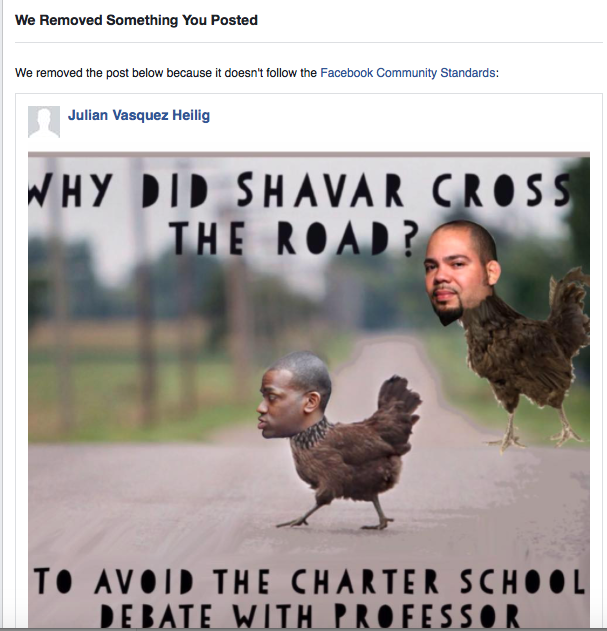
Facebook just deleted my profile photo. A cartoon which I thought was quite humorous and already had more than 100 likes.
Screen Shot 2016-08-15 at 6.54.28 AM
I wish I had the photoshop talent/exactatude to make such a cool and funny image, but the credit for designing it goes to Susan D. More Facebook censorship on behalf of the corporate education reformers.
We discussed the coordinated Facebook censorship of Teach For America posts in the first ten minutes of the Truth For American episode with Diane Ravitch that was taped LIVE at the Network For Public Education Conference.
I suspect the same education reformer internet black ops is responsible.
Oh, and Facebook also blocked me from posting.
Please Facebook Like, Tweet, etc below and/or reblog to share this discussion with others.
Want to know about Cloaking Inequity’s freshly pressed conversations about educational policy? Click the “Follow blog by email” button on this page.
Twitter: @ProfessorJVH
Click here for Vitae.
 .@Facebook Censorship and Jail – Cloaking Inequity:


Big Education Ape: Oh Crap! I guess these are NOT OK to post on Facebook :


Microaggressions in School Culture | The Jose Vilson

Microaggressions in School Culture | The Jose Vilson:

Microaggressions in School Culture

28813221545_cb52316b41

I’m well aware that my role as an administrator took me directly out of conversations in the teacher’s lounge. My friends, who watched me take on this new role, joked that I’d “gone to the dark side.” Teachers and administrators are often pitted against one another in the education world and it’s never to the betterment of what’s good for students. Yet, it’s a part of the culture we rarely discuss in terms of being constructive in creating collegiality and professionalism.
That’s where we get stuck with microaggressions in school culture.
During my first ten years in the classroom I recall feeling like nothing I did could please the superiors in charge of evaluating me. Many novice teachers have felt like we had to fake it until we made it, but that comes naturally with any career in the beginning.
The first time I stood up to an administrator they had just embarrassed me in front of my classroom by belittling me and saying I didn’t have any control over the kids. The fact that they had free time while we waited to be called down to an assembly seemed to escape him and said all this while speaking to the entire class from the speaker system set up in the office.
Horrified, I turned toward my class and put my finger to my lips to signify I needed them to be silent. They complied quickly and many of them felt I had been wronged by the looks of confusion on their faces. After confronting that assistant principal, a job I would have some 10 years later Microaggressions in School Culture | The Jose Vilson:

Schools Matter: Keeping Readers Ignorant to Protect Diane

Schools Matter: Keeping Readers Ignorant to Protect Diane:

Keeping Readers Ignorant to Protect Diane

Emery and Ohanian

From reading Diane Ravitch, it is hard to tell how much our neoliberal matron of anti-reformy complaining does or does not know about the real threat that competency based education (CBE) or "personalized learning" represents to public schools, children, and teachers. 

For even while it is an advertised fact that corporate education deformers are initiating a plan to digitally teacher proof schools and to have children's learning paths determined by computer algorithms, Ravitch seems puzzled about what's really going on. 

Based on her latest post, she seems to think that CBE is just a "very problematic concept" that sort of sounds like computer-assisted instruction (CAI) of yesteryear.  While, then, minimizing the threat to face-to-face learning that CBE represents, she ignores the fact that the ESSA, which she supports, has major stimulus money for states to initiate competency based programs in public schools.  She does not mention that. 

One has to wonder if she is aware that her son's company could profit handsomely from some of those millions in federal seed money for turning children in alienated computer-compliant drones.

What is clear is that the Ravitch team is always alert for any comment at her blog that could indicate Ravitch's lack of understanding of an issue or any comment that would question her real commitment to the public education system that she claims to support. 

Below is one of those comment from a reader of Ravitch's blog that did not get published.   

https://dianeravitch.net/2016/08/13/report-from-the-rio-olympics-personalized-learning-will-make-every-student-a-winner/


Digital learning is designed to segue into algorithm-driven workforce development. Schools Matter: Keeping Readers Ignorant to Protect Diane: