Latest News and Comment from Education

Tuesday, August 9, 2016

Ban school suspensions!

Ban school suspensions!:

Ban school suspensions!

Robert Adrian Hillman / Alamy Stock Photo
One day this spring, my 6-year-old came home from school with deep scratches on his arm. After several meandering stories involving fictional characters, he divulged that a friend had used his fingernails to get attention. I suggested my son ask his friend not to do this again. Matter closed.
In another family, at another school district, the story might have ended very differently for one or both boys. They could have been suspended for causing minor injury. But in July, the New York City Department of Education told its elementary school principals that — barring outstanding circumstances — they could no longer suspend students in kindergarten through second grade. Instead, they would have to use other methods to help young children learn to play nice.
Nearly three million American schoolchildren are suspended — or made to stay home due to misbehavior — in any given school year. About 20 percent of the 2013 graduating class had been suspended in high school for offenses ranging from dress code violations to fighting or drug use. The most serious offenses — like guns in school — involve police and expulsions and are regulated by federal law. But more often, suspensions target smaller and often more subjective crimes like "defiance," physical contact, or bad language.
New York City is one of a handful of places where educators are starting to rethink the usefulness of this archaic practice. California, Connecticut, andOregon already passed similar restrictions on suspensions, while bills are pending in New York state and New Jersey. Other states and districts have asked schools to try a host of alternative options called "restorative practices" or "positive behavioral interventions and supports."
Why? Well, because suspensions don't work.
That's not just my opinion. The American Psychological Association says suspensions for students who "defy" a teacher don't help the suspended student and don't provide greater order or safety for those left behind, and there's academic research to back that up. Yes, there should be a consequence for actions that hurt others. But out-of-school suspension doesn't prevent bad choices, and worse, it leads to lost learning for those who may need it most.
Suspension is also a lazy option for correcting behavioral problems. As a fellow parent told me once, removing a kid from school "is just kicking the can down the road. It's not helping the child, the parent, educators. It's not even a short-term solution. It's just nothing." Instead of helping a student learn to do the right thing, a suspension often ignites a cascade of future failures, including more suspensions and entry into the juvenile justice system.
Not only are suspensions counter-productive, they are discriminatory in their application: Black students are suspended at nearly four times the rate as white students, even in preschool. The higher suspension rates for black students (particularly black boys) has little to do with them committing Ban school suspensions!:


CNS - Parents Call Washington Charter Schools Illegal

CNS - Parents Call Washington Charter Schools Illegal:

Parents Call Washington Charter Schools Illegal


  SEATTLE (CN) — In a renewed battle over charter schools, a coalition of parents, teachers, administrators and labor groups sued Washington state, claiming its Charter School Act is still unconstitutional, despite a legislative fix.
     Plaintiffs in the Aug. 3 complaint in King County Court include the state's largest teachers' union, Washington Education Association and the League of Women Voters.
     The state's original Charter School Act was passed by voter referendum in 2012.
     Many of the same plaintiffs sued the state in 2103, and the Washington Supreme Court ruled in September 2015 that publicly funded private charter schools areunconstitutional.
     The supreme court found that charter schools are not "common schools" as identified in the Washington Constitution because they do not have elected boards that are accountable to taxpayers, and so are not entitled to public funding.
     The Legislature changed the funding process in March, making charters supported by lottery proceeds.
     In the new lawsuit, the coalition says the Charter School Act still authorizes improper transfer of public money.
     "Under the Act, charter schools continue to be run by and responsible to nonprofit companies and nonelected boards and, thus, are not accountable to taxpayers who provide funding for charter schools. Likewise, the Act continues the unconstitutional diversion of public funds to charter schools," the complaint states.
     The coalition wants the Charter School Act declared unconstitutional and publicly funded Alternative Learning Experience (ALE) schools also prohibited, as they are the same as charter schools, according to the complaint.
     The Washington State Charter Schools Association condemned the lawsuit in a statement.
     "Our state's new charter public school law is the product of the Legislature's bipartisan effort to save our state's charter public schools — schools designed to address equity and opportunity gaps for students of color and from low-income backgrounds whose families are seeking better public education options. We are confident that the bipartisan law passed by the Legislature meets the constitutional threshold laid out by the courts. We are disappointed that any organization would be interested in blindly closing public school doors on students who are finally thriving."
     The plaintiffs are represented by Paul Lawrence with the Pacifica Law Group.
     They are El Centro De La Raza, the League of Women Voters of Washington, the Washington Association of School Administrators, the Washington Education Association, the International Union of Operating Engineers 609, Aerospace Machinists Union IAM & AW DL 751, Washington State Labor Council AFL-CIO, United Food and Commercial Workers Union 21, Washington Federation of State Employees, American Federation of Teachers Washington, Teamsters Joint Council No. 28, and parents Wayne Au, Pat Braman and Donna Boyer.
CNS - Parents Call Washington Charter Schools Illegal:

America’s Mayors: Put Us in Charge—Now - POLITICO Magazine

America’s Mayors: Put Us in Charge—Now - POLITICO Magazine:
America’s Mayors: Put Us in Charge—Now


In the midst of a presidential election with two historically divisive and unlikable candidates, America’s mayors—accustomed to fighting through gridlock to get things done—have voted themselves most likely to succeed.
Borrowing a page from the old high school yearbook, Politico asked the cities' chief executives to have a little summer fun and rate each other in a variety of categories: most innovative, best rookie, most impressive turnaround, coolest performance in crisis, long-term presidential prospects and who should be running for the Oval Office—right now.
Story Continued Below
On that last category, the overwhelmingly Democratic mayors achieved some consensus, naming Los Angeles’ Eric Garcetti on 27 percent of the ballots, followed by Mike Rawlings of Dallas with 15 percent, and Mick Cornett of Oklahoma City with 11 percent. The three mayors' cities are chasms apart in political culture, but their leadership styles share a few similarities—willingness to lead bipartisan initiatives, leading fast-growing cities and enjoying high popularity—that have earned them national accolades. Also getting attention for their executive function were Baltimore’s Stephanie Rawlings-Blake with 10 percent, narrowly outplacing New York’s Bill de Blasio, who was named on 8 percent of ballots.
The lighter-hearted questions were part of a larger survey that also addressed contentious issues of race and policing. This was Politico Magazine’s sixth quarterly Mayors Survey, part of the award-winning “What Works” series. Seventy-one mayors across the country participated, from Burlington to Dallas, San Francisco to Boulder and Tampa to Maui. Reflecting the generally blue-hue of the city halls, respondents were largely Democratic—over 80 percent.
Asked to imagine which mayor would become president by 2020 or 2024 (a variant on the question of who should be running “right now,” above) almost a quarter of mayors again gave first prize to—no surprise—Eric Garcetti of Los Angeles. In distant second was former Newark mayor and current New Jersey Sen. Cory Booker (who was on a shortlist for Hillary Clinton’s running mate) at 6 percent. Several other former mayors—Tim Kaine (who is suddenly busy) and Michael Bloomberg received nods, as well as current mayors Kevin Johnson of Sacramento, Greg Fischer of Louisville and Mitch Landrieu of New Orleans.


Read more: http://www.politico.com/magazine/story/2016/08/cities-urban-policy-mayors-survey-revitalization-us-214151#ixzz4GqYD3oSH 
Follow us: @politico on Twitter | Politico on Facebook


Big Education Ape: Mayoral control of schools worked for New York City, but other poor districts haven’t been so lucky - City & Region - The Buffalo News - http://bigeducationape.blogspot.com/2015/04/mayoral-control-of-schools-worked-for.html

Big Education Ape: Snuffing out Democracy—the Struggle over Mayoral Control of Seattle’s School Board | The Progressive - http://bigeducationape.blogspot.com/2016/08/snuffing-out-democracythe-struggle-over.html

Big Education Ape: Charter schools reason for Mayor Kevin Johnson’s bad behavior? – Cloaking Inequity - http://bigeducationape.blogspot.com/2016/07/charter-schools-reason-for-mayor-kevin.html

U.S. GAO - K-12 Education: Education's Experiences with Flexibility Waivers

U.S. GAO - K-12 Education: Education's Experiences with Flexibility Waivers Could Inform Efforts to Assist States with New Requirements:

K-12 EDUCATION: Education's Experiences with Flexibility Waivers Could Inform Efforts to Assist States with New Requirements


What GAO Found

Since introducing its Flexibility initiative in 2011—inviting states to request a waiver from certain provisions of the Elementary and Secondary Education Act of 1965 (ESEA) in effect at the time—the Department of Education (Education) has monitored states' efforts and identified challenges to states' ability to fully implement their waivers. According to GAO's analysis of Education letters and monitoring reports, 12 of the 43 states with Flexibility waivers faced multiple challenges that affected their ability to fully implement their waivers. Education used a risk assessment process to document these challenges throughout the waiver approval, monitoring, and renewal phases (see table). For example, Education identified risks with one state's capacity to oversee and monitor schools needing improvement prior to approving the state's waiver in 2013 and noted similar issues, as a result of monitoring, in 2015. Overseeing local districts and schools was particularly challenging for states, according to GAO's analysis of Education documents. Meanwhile, Education has not yet evaluated its process to review, approve, and monitor the Flexibility waivers given to states or incorporated any relevant lessons learned into its plans for implementing the December 2015 reauthorization of the ESEA. According to federal internal control standards, agencies should consider lessons learned when planning agency activities. As Education begins to implement the new law, it has an opportunity to learn from its experiences with the Flexibility initiative and incorporate any applicable lessons learned. Absent such an evaluation, Education may miss opportunities to better oversee state implementation of the new law.
From 2012 to 2015, Education Identified Challenges at Different Points during the Flexibility Initiative in 12 States of 43 Total States with Waivers
State
Waiver Approval
Waiver Monitoring
Waiver Renewal
Alabama
--
Arizona
--
Florida
--
Louisiana
--
Massachusetts
--
Nevada
--
New Hampshire
--
Ohio
--
Oklahoma
--
Pennsylvania
South Dakota
--
Texas
--
✖ State faced a challenge
-- State did not face a challenge
Source: GAO analysis of Department of Education documentation. | GAO-16-650
Note: The Flexibility initiative refers to waivers granted by the Department of Education to 43 states providing relief from certain provisions of the Elementary and Secondary Education Act of 1965 as amended by the No Child Left Behind Act of 2001.

Why GAO Did This Study

Beginning in 2011, Education used its statutory authority to invite states to apply for waivers from certain provisions in the ESEA through its Flexibility initiative. To receive Flexibility waivers, states had to agree to meet other requirements related to college- and career-ready expectations, school accountability and support, and effective instruction. Education approved Flexibility waivers for 43 states. In December 2015, Congress reauthorized the ESEA which modified Education's waiver authority. GAO was asked to review Education's Flexibility initiative.
GAO examined the extent to which Education assessed states' ability to fully implement their Flexibility waivers and the process it used to oversee the waivers. GAO reviewed relevant federal laws, guidance, and key documents related to the Flexibility initiative, such as monitoring reports; and interviewed Education officials. GAO reviewed Education's documents and identified states facing multiple challenges in implementing their waivers. GAO also interviewed officials in five states, selected to reflect a range of challenges states faced in implementing the waivers.

What GAO Recommends

GAO recommends that Education evaluate its Flexibility initiative oversight process to identify lessons learned and incorporate any applicable lessons into its plans for overseeing state implementation of the new law. Education generally agreed and outlined steps to address the recommendation.
For more information, contact Jacqueline M. Nowicki at (617) 788-0580 or nowickij@gao.govU.S. GAO - K-12 Education: Education's Experiences with Flexibility Waivers Could Inform Efforts to Assist States with New Requirements:


Additional Materials:


Head Start Preschool Program Has Room for Improvement - The Atlantic

Head Start Preschool Program Has Room for Improvement - The Atlantic:

The Never-Ending Struggle to Improve Head Start

The federal government has invested billions in preschool, but there’s still lots of room to grow.


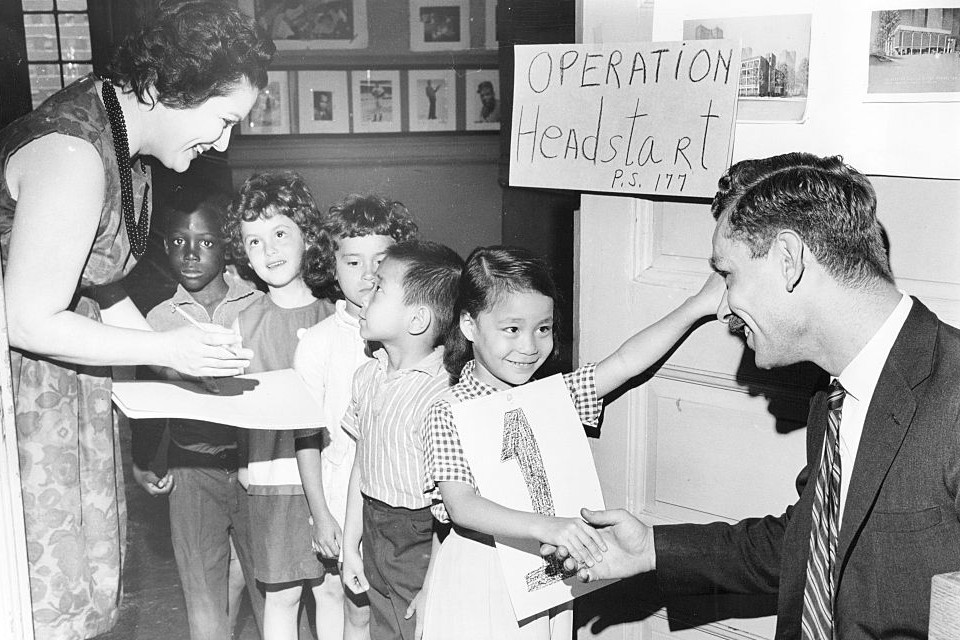
In this New York Post photo from the summer of 1965, Elizabeth Ching is first in line at PS 177 in New York City to register for Head Start.Louis Liotta (c) NYP Holdings, Inc. / Getty Images

This story is the third in a series about public preschools that will also examine preschool solutions found in other countries, the condition of preschool teachers, and the political future of preschool. The first story, about how little the U.S. invests in young children, can be found here. The second story, about how Boston’s preschool success is “percolating up” to later grades, can be found here.
PORTLAND, Ore.—Fifty-one years ago in the White House Rose Garden, former President Lyndon B. Johnson announced the launch of Head Start.
“Five- and 6-year-old children are inheritors of poverty's curse and not its creators,” Johnson told his audience as he explained that the federal government would be, for the first time, funding education and health services for children living in poverty in the form of a public preschool program. That first summer, according to a press release from the time, the program was to serve 530,000 children in 11,000 centers at a cost of $112 million, or $857 million in today’s dollars.
“This program this year means that 30 million man-years—the combined lifespan of these youngsters—will be spent productively and rewardingly, rather than wasted in tax-supported institutions or in welfare-supported lethargy,” Johnson promised.
But has that come to pass? No rigorous research project followed the children Johnson was talking about to determine whether now, in their mid-50s, the 1965 Head Start graduates are living the productive and rewarding lives predicted for them. Critics charge that Head Start is a big federal program spending billions of tax dollars on a pipe dream: that the effects of being born into poverty can be averted for a lifetime with a few hours a day spent in a classroom at age 4. On the other hand, its champions argue that everything Johnson predicted is still possible, if only the country gives the program the resources it needs to succeed.
Today, Head Start is nearing the end of a decade of big reforms, meant to improve quality and get closer to meeting the goals that Johnson laid out for it when he announced this new front in his War on Poverty. Simultaneously, cities and states are increasing their public preschool enrollments slowly, but steadily. If all continues apace, the largest public program in the country could be just one step ahead of the locals, creating a roadmap for how to operate a public preschool program big enough to serve more than 1 million children without sacrificing quality.
One of the key elements of Head Start has always been its emphasis on local control. Rather than rolling out a one-size-fits-all program, the idea was to give Head Start Preschool Program Has Room for Improvement - The Atlantic:


Standardized testing hits a nerve - USA TODAY Back To School magazine

Standardized testing hits a nerve:

Standardized testing hits a nerve

Nail biting, stress headaches, sleepless nights or all of the above. Standardized testing — and its side effects — has been part of the U.S. public education system for decades.
But lately, the Common Core curriculum and revamped tests are coming under fire. Critics say the new tests put too much pressure on kids, waste instructional time and encourage educators to emphasize rote memorization — teaching to the test — in lieu of meaningful learning.
The issue is proving political fodder during an election year, with both parties advocating for education reform. Critics of testing are picketing schools and urging parents to opt their children out of tests.
Celebrities are taking on the issue from both sides: Actor Matt Damon, the son of an educator, and comedian Louis C.K., who tweeted about his children’s stress over testing, have spoken against the over-reliance on standardized tests; actress Eva Longoria and musician John Legend are among those who helped fund an ad in support of standardized testing.
What’s a parent to do? Here’s the history behind standardized testing, so parents can decide on which side of the debate they stand.
No Child Left Behind
For years, states designed and administered standardized tests without much interference from the federal government. But amid growing concern about racial inequity in education and the U.S. falling behind international competitors, President George W. Bush signed the No Child Left Behind Act (NCLB) into law in 2002. It was the most sweeping reform of education since 1965, the year President Johnson’s War on Poverty created the Title I program and significantly expanded federal funding for education.
NCLB required states to test students in math and reading every year from third through eighth grades, and at least once from grades 10 through 12, with results broken out by race and subgroups, such as English-language learners and students with disabilities. Low-performing schools risked losing students to a better public school, or even closure.
Over time, educators realized that the law encouraged schools to focus on two numbers — scores on rudimentary English, language arts and literacy, and math tests — which often meant drilling basic skills and facts at the expense of a broader education.
“When you teach to a test or even prep for a test, educators are taken away from some of the good work they could be doing helping students learn,” says Elizabeth Green, author of Building a Better Teacher and co-founder of Chalkbeat, a news site covering education.
Common Core
While the reforms of NCLB were taking hold, another movement was gathering steam.
Unlike most developed countries, the U.S. had never required that every child acquire a specified set of skills and body of knowledge. So a third-grade math Standardized testing hits a nerve:


Will ESSA Energize "Adequate Education" in State Courts? - Rick Hess Straight Up - Education Week

Will ESSA Energize "Adequate Education" in State Courts? - Rick Hess Straight Up - Education Week:

Will ESSA Energize "Adequate Education" in State Courts?


Note: This week, Arnold Shober, associate professor of Government at Lawrence University in Appleton, WI, will be guest blogging.
 Sen. Lamar Alexander heralded the long-overdue ESSA as a gift to the states. And it does indeed return major educational decisions to state leaders, especially over the content of standards and methods of assessment. But giving the states additional authority over the federal government's premier educational equity law may be a gift that states rue. This week, I'd like to take a look at possible political consequences of this new state-federal alignment.
Perhaps the most overlooked sleeper consequence of the new law is a subtle institutional power shift from state legislatures to state courts. Sen. Alexander may have thought he was freeing legislators and governors to "make their own decisions," but ESSA may have instead offered an open invitation for state judges to assert themselves aggressively as arbiters of state education policy. Many did this in 1970s and 1980s finance cases, but ESSA covers much more than spending.
The original Elementary and Secondary Education Act (1965) was a way to take some decision-making power away from states and districts and redistribute it. Federal courts in that decade seemed eager to overturn decades of local control in favor of equal educational access — and perhaps even equal outcomes. Advocates tried to sever the link between local politics and education. For a time, court decisions culminating with Serrano v. Priest (1971) seemed to find that unequal education violated both the First (guaranteeing the ability to participate in politics through speech) and Fourteenth (equal protection) Amendments.
Still, the courts struggled with knowing what equality meant, at least after de jure racial barriers were eliminated. A federal court held that student "needs" were not "judicially manageable" and the courts could not provide "intelligent educational planning." Essentially, that court found that judges could tell if spending was equal but they could not really tell what was adequate for less well-off students. To top it off the Supreme Court held that trying to guarantee equal outcomes was a "judicial intrusion" in 1974. Education wouldn't be a fundamental right, and federal courts' remaining interests were the narrower questions of racial integration and desegregation.
Advocates for spending and outcome equity pressed on at the state level. By and large, they tried two different strategies in the courts. One simply argued that per-pupil spending should be equal anywhere within a state. This is an "equity" argument. This strategy met limited success in the courts and even advocates grew dissatisfied with the results. Some students, they came to argue, might need extra spending. So they tried something else.
The alternative, the "adequacy" defense, argued that states should guarantee that students couldmeet state standards, even if that meant very unequal spending. Unlike the federal Constitution, many state constitutions guarantee some form of educational equality. In one of the early cases, Kentucky's court took its constitutional guarantees to argue that education could not be equal unless it met some minimum standard of quality. A handful of state courts also adopted this view in the 1990s, but it was clear that it was the superior legal strategy. And so most contemporary cases are adequacy cases. State courts that have adopted this view recently include Colorado, Kansas, and Washington.
Here is where ESSA comes in.
In 1989, Kentucky's court-mandated adequacy standards required the state to pay for students to have "academic or vocational skills . . . to compete favorably with their counterparts in other states" and be prepared for "advanced training in either academic or vocational fields" at the completion of the K-12 sequence. This fits hand-in-glove with ESSA's (and Common Core's) college-and-career focus, and now the federal law requires states to adopt the same view.
Although ESSA does not itself require academic equity, state courts have become more interested in academic training recently —and because ESSA applies to all states, courts in every state could now use it to push equity. Last month, Kansas' supreme court announced it would hear arguments about the adequacy for ensuring academic achievement under a just-approved state financing system. This was a switch; Kansas' earlier finance case had only considered the "actual costs" of required education services. What might academic achievement be? Well, in 2011, a Colorado trial court faulted that state for "failing to quantify" the costs of academic standards. NCLB is mentioned, but only as a minor part of the story. Although the Colorado Supreme Court reversed the finding, other state courts have applied similar logic. Washington State's case indicated that districts had to be funded to meet state standards, and indeed, federal education laws are not mentioned in that supreme court's 2012 decision.
Prior to ESSA, states could at least use Colorado's strategy — keep one set of books for assessment at home and one set for the feds. This fact was well documented. Now, ESSA makes states central to identifying schools for improvement and crafting "turnaround" plans. What was once a sidebar in state court decisions may now be headliners. At least with NCLB, states could argue that the federal government's legislation, or Department of Education regulations, placed impossible demands on the states —like Connecticut did in its failed court challenge. Now, the state is responsible for setting the standards, measuring performance on those standards, andcreating consequences for the standards. It is not a hard stretch for litigants to argue that state governments must also make it possible for schools to meet those goals. It's all in-house work.
But wait, there more! ESSA requires a non-tested measure of schools, too. If they opt to use some sort of "school climate" measure — like California's SQII — a court could require schools to be adequately conducive to learning. A fuzzy concept like school climate would then be quantified. How much does one school happiness unit cost? That might also be the beginning: After all, Kentucky's Rose standards also require students to "appreciate his or her . . . heritage" and posses "self-knowledge." These are fuzzy concepts that are impossible to equalize, at least in the country's industrial, age-stratified school systems.
Although funding is unlikely to remedy inequality in a meaningful way in the short term, state courts have found it a convenient metric, not to mention that it is quantifiable. And it makes both Republicans and Democrats squirm. Although Republicans often take heat for clamping down on school spending, Democrats are just as skittish of giving courts a say over education funding. Democrat Christine Gregoire supported an appeal in Washington's case and Democrat John Hickenlooper was adamant that lower courts were ill-informed about the interaction of several state laws. The reasons aren't mysterious. As K-12 funding is often the largest single item in state budgets — approximately one-third of all general purpose revenue. (This does not include federal monies.) Those funds tie directly to state taxes, and few politicians are eager to let a state courts tie their hands on taxes.
ESSA was meant to move beyond NCLB's widely-panned proficiency obsession. But there is substantial political comfort in having someone else make the rules, and free will is frightening. Governors and legislators aren't likely to stray too far from simplistic NCLB-era accountability with which they've had a decade of experience. If Sen. Alexander meant to give authority to the states, he may have created a Trojan horse instead.

Turkey says rising anti-Americanism can be calmed by Gulen extradition | Reuters

Turkey says rising anti-Americanism can be calmed by Gulen extradition | Reuters:

Turkey says rising anti-Americanism can be calmed by Gulen extradition

Anti-American sentiment among Turks is on the rise and can only be calmed by the United States extraditing the Muslim cleric Ankara accuses of orchestrating last month's failed coup, Turkey's justice minister said on Tuesday.
Turkish President Tayyip Erdogan blames Fethullah Gulen, who has lived in self-imposed exile in rural Pennsylvania since 1999, and his followers for the July 15 coup, in which more than 240 people were killed and nearly 2,200 wounded.
Turkey has launched a series of mass purges of suspected Gulen supporters in its armed forces, other state institutions, universities, schools and the media since the abortive coup, prompting Western concerns for the stability of a key NATO ally.
Erdogan, who was visiting Russia on Tuesday, has criticized the United States and the European Union for showing what he says is a lack of solidarity with Turkey over the coup and of caring more for the rights of people he views as traitors.
"There is a serious anti-American feeling in Turkey, and this is turning into hatred," Justice Minister Bekir Bozdag said in an interview with state-run Anadolu Agency, broadcast live on Turkish television channels. "It is in the hands of the United States to stop this anti-American feeling leading to hatred."
Responding to Turkey's demand for Gulen's extradition, U.S. President Barack Obama has said Ankara must first provide clear evidence of wrongdoing. Last week a State Department spokesman said Washington was evaluating new documents it had received.
The 75-year-old Gulen, who built up a network of schools, charities and businesses in Turkey and abroad over decades, denies any involvement in the coup and has condemned it. He has also accused Erdogan of using the coup to amass greater powers.
"POLITICAL DECISION"
"Whether the U.S. extradites Gulen or not this will be a political decision," Bozdag said. "If he is not extradited, Turkey will have been sacrificed for a terrorist."
A recent opinion poll showed two thirds of Turks agree with their president that Gulen was behind the coup plot. Turkey has been holding almost daily mass rallies since July 15 in support of democracy and the government and against the plotters.
Authorities have suspended, detained or put under investigation tens of thousands of people in the armed forces, the judiciary, civil service and elsewhere since the coup, in which a faction of the military commandeered warplanes, helicopters and tanks in an attempt to topple the government.
On Tuesday Bozdag put the number of people now formally arrested awaiting trial at 16,000, adding that a further 6,000 detainees were still being processed. Another 7,668 people are under investigation but have not been detained, he said.
Since the abortive putsch, pro-government papers have been awash with conspiracy theories accusing the United States and the CIA of being the masterminds. Turkish officials privately said such reports do not reflect Ankara's formal stance.
One paper said the attempted power grab was financed by the CIA and directed by a retired U.S. army general using a cell in Afghanistan while another claims CIA agents used an island hotel off Istanbul as a nerve center for the plot.
Echoing Erdogan's criticism of the West, Prime Minister Binali Yildirim on Tuesday repeated a pledge to bring Gulen back to Turkey.
"That terrorist leader will come to Turkey and pay for what he did. We will hold him accountable for the blood of our martyrs and veterans," Yildirim told a meeting of his ruling Islamist-rooted AK Party in parliament.
"That religious, impudent, lying, bloody murdering nothing will be surely held accountable."


NATO member Turkey hosts American troops and warplanes at its Incirlik Air Base, an important staging area for the U.S.-led fight against Islamic State militants in neighboring Iraq and Syria.
The chairman of the U.S. Joint Chiefs of Staff Joseph Dunford tried to soothe strained ties with Turkey during a visit to Incirlik and Ankara just over a week ago. In Ankara he inspected the damage inflicted by the plotters' fighter jets on the Turkish parliament building.
U.S. Secretary of State John Kerry is expected to visit Turkey on Aug. 24.
Turkish authorities have said the country's intelligence service has cracked into several smartphone messaging apps that Gulen's followers used to communicate with each other in the years ahead of the coup attempt and was able to trace tens of thousands of people from the group.
A senior Turkish official said Turkey's intelligence agency has identified at least 56,000 operatives of Gulen's network after cracked a little-known smartphone messaging app called ByLock, which he said the group began using in 2014. By this year, Turkish intelligence were able to map their network.
"Our assessment is that 150,000 unique operatives used ByLock to communicate with others," the official said. The group had also used another app called Eagle which could be disguised as other popular instant messaging apps such as Whatsapp and Tango, he added.
"We assess that Eagle was used by operatives to share various operational details as well as during the planning stage of the July 15 coup attempt," the official said, adding that the Gulen network continued to use Eagle.


(Additional repporting by Daren Butler and Gulsen Solaker in Ankara; Writing Humeyra Pamuk; Editing by Patrick Markey and Gareth Jones)Turkey says rising anti-Americanism can be calmed by Gulen extradition | Reuters: