Latest News and Comment from Education

Friday, August 5, 2016

Black Boys in Crisis: Does Anyone Even Care? - Education Week

Black Boys in Crisis: Does Anyone Even Care? - Education Futures: Emerging Trends in K-12 - Education Week:

Black Boys in Crisis: Does Anyone Even Care?


 When we talk about reaching students in our classrooms that come from disadvantaged backgrounds, we tend to put several groups under one umbrella. Minority students. Immigrant students. Kids from low socioeconomic households. While it's true that all of these groups of students need a different approach, our education system is not yet doing enough to address specific needs within these at-risk groups. The initiatives that help one group tremendously may not have as large a positive impact on another, and vice versa.

Black boys are a student demographic that has been, and continues to be, misunderstood in P-20 classrooms. Misbehavior, learning styles, and social skills are often misconstrued as problems by educators when in fact, black boys are simply not receiving the most effective forms of discipline, lessons, and peer-interaction opportunities. As a result, many are slipping through the proverbial cracks and not learning at their potential levels. That lack of learning leads to higher school dropout levels, higher rates of poverty, and higher incarceration rates, too.
Perhaps there is no real connection between the academic failures of black boys and incarceration/poverty, or the eerily similar statistics associated with young Latino men. Are these young people simply bad apples, destined to fail academically and then live a life of crime? Proponents of genetic predisposition would argue that these young men never stood a chance at success and have simply accepted their lots in life. When I hear these sorts of excuses for why we aren't best serving the black boys in our classrooms, I often think they are just too easy to be the right answers. They are all just too convenient, particularly if the people speaking them into existence come from backgrounds and experiences that are not indicative of black young men.
What if all of these theories, these so-called truths about these often-vilified children learning in our schools, are just the lazy way out? What if scoffing at a connection between a strong education and a life lived on the straight and narrow is an easy way to bypass the real issues in K-12 learning that actually put real barriers in place for black boys? What if the failures of black boys are really our faults, not theirs?
While there is always a level of personal responsibility on the part of the student to weigh in, I believe all of society's failures when it comes to black boys are traceable back to education. While it is certainly not the fault of teachers or classroom settings, placing the blame on outside factors, like family setup or poverty, does not actually solve the problem. Schools, particularly public ones, are great equalizers for our children and youth.
When we have disadvantaged students in our midst, why aren't we employing every tactic we've got into trying to combat those outside factors that are so detrimental? When we throw up our hands and say that black boys can't be saved, or that individual students are better off serving suspensions or expulsions than sitting in our classrooms learning, we are really saying that we don't have any power in the lives of our students. I think most rational educators would argue that is the farthest argument from the truth.
Consider this: Black students tend to have lower amounts of teachers who are certified in their degree areas. A U.S. Department of Education report found that in public high schools with at least 50 percent Black students, only 75 percent of math teachers were certified, compared to 92 percent in predominantly white schools. In English, the numbers were 59 and 68 percent, respectively and in science, they were 57 percent and 73 percent. Numbers like these are just the tip of the iceberg when it comes to the disadvantages that take place in schools where children of color are the majority. When those children are boys, the outlook is even more dismal.
As an educational community, it's time to stop acting like generational poverty and crime are not related - that harsh discipline in schools is not related to incarceration rates. Low rates of literacy and high rates of special education referrals among black boys aren't coincidences. There isn't one reason that black boys are failing on such a large scale; the factors that play into the general underachievement of the black young men in our classrooms are varied, and complicated. Like all of the intricate problems in our school systems, improving the achievement of black young men in our schools won't happen overnight.Black Boys in Crisis: Does Anyone Even Care? - Education Futures: Emerging Trends in K-12 - Education Week:

The Fifth-Graders Who Put Mexican Repatriation Back Into History Books by Lani Cupchoy — YES! Magazine

The Fifth-Graders Who Put Mexican Repatriation Back Into History Books by Lani Cupchoy — YES! Magazine:

The Fifth-Graders Who Put Mexican Repatriation Back Into History Books

When a California history class noticed the U.S. 1930s Mexican Repatriation had been left out of the curriculum, they decided to take it up with the state Legislature.

Mexican repatriation California History.jpg
About 400,000 people were pressured or forced into “repatriation” by the United States. Photo from University of Denver.

Leslie Hiatt’s fifth-graders are no strangers to politics.
Seeking to empower children as agents of change, Hiatt’s U.S. history class encompasses more than the Pilgrims and the Constitution. Through project-based learning, students also study the Trail of Tears, the Chinese Exclusion Act, child labor laws, and Japanese internment camps.
And, just in time for the next school year, the 2016 presidential election.
“Considering the national political climate, my kids are very afraid of what will happen if Donald Trump becomes president, because they are scared to death for the future and security of their families,” said Hiatt, who teaches at Bell Gardens Elementary near southeast Los Angeles.
Until now, the newest addition to her history lessons was in 2014, when Hiatt looked through the history textbooks and saw something missing: Mexican Repatriation, the unconstitutional deportations of more than 1 million U.S. citizens and lawful residents of Mexican descent during the 1930s.
So Hiatt, along with her student teacher, Ana Ramos, designed a Mexican Repatriation unit to teach the class. The issue hit home for their students, which led to letter-writing campaigns, an audience with a state legislator, and, eventually, a change to state law.
“The kids felt a real personal connection to it because we had issues in the classroom with students and their families getting deported,” said Hiatt.
Ethnic studies looms large in education, and, in some cases, remains a subject of controversy.
Student Nicole Sandoval, along with her classmates, noticed right away the disconnect between what they were learning and what was in the state-issued textbooks. And they wondered why Mexican Americans had not received an apology for the injustices of the 1930s.
“My whole class felt that this is wrong,” Sandoval said. “It happened to kids like us who are Mexican Americans, and we do not want history to repeat itself.”
They launched a campaign that ultimately took them to the California State Assembly, where, late last year, a bill was passed to require the teaching of Mexican Repatriation. And as a new class joined this past year, the students’ effort has evolved to a push for a federal apology, just as other marginalized groups have received.

The story of the bill

Students started by writing persuasive letters to President Barack Obama, but his response did not address their specific questions—it only expressed encouragement. So they created PowerPoint presentations, poems, plays, and a movie, aiming to go viral on The Fifth-Graders Who Put Mexican Repatriation Back Into History Books by Lani Cupchoy — YES! Magazine:

Ed groups worry over proposed federal sanctions for opt-outs | WBFO

Ed groups worry over proposed federal sanctions for opt-outs | WBFO:

Ed groups worry over proposed federal sanctions for opt-outs

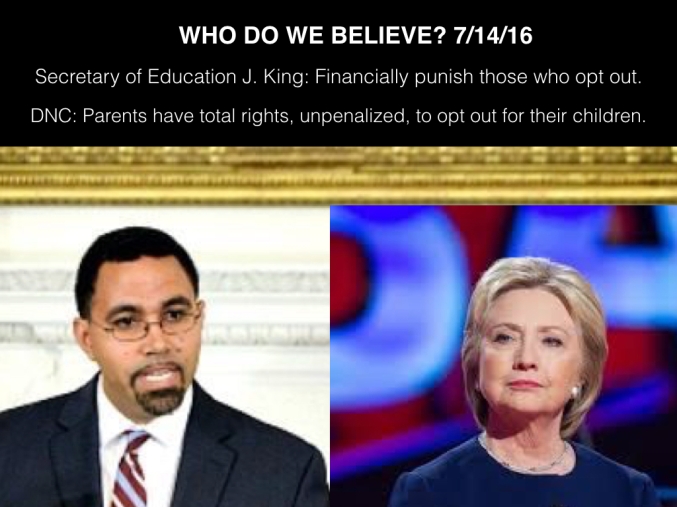
Hillary and John King OPT OUT.001


Education groups, dismayed by the federal education secretary’s threat to punish schools in New York with high opt-out rates for standardized tests, say he is re-igniting the controversy that state education officials have been trying to calm for the past year.
Education Secretary John King was New York’s education commissioner until about a year ago. Under King’s tenure in the state, controversy over the implementation of the Common Core learning standards escalated.
It led to a boycott movement for the third- through eighth-grade standardized tests that resulted in about one-fifth of students opting out last year. This year, a slightly higher percentage of students skipped the tests —22 percent, compared to 20 percent in 2015.
The new state education commissioner, Mary Ellen Elia, tried to minimize the boycott. Elia issued a recorded statement late last Friday, when the test results were released. She tried to stick to the positive, saying the test results improved over 2015.
“We’re very pleased with the performance this year,” said Elia, who noted English scores improved by 6.6 percent and math results by 1 percent.
Nevertheless, the test results still show nearly two-thirds of third- through eighth-grade students are less than proficient in English and math.
“We obviously have work to do,” Elia said.
The boycott could have some adverse consequences for schools with high numbers of students skipping the tests. King said in July that schools in which fewer than 95 percent of students take the tests should be labeled as low-performing and possibly face fines or even a takeover. The rules would be part of President Barack Obama’s Ed groups worry over proposed federal sanctions for opt-outs | WBFO:

For Anne Holton, Tim Kaine’s Wife, Elite Circles Are Old Turf - The New York Times

For Anne Holton, Tim Kaine’s Wife, Elite Circles Are Old Turf - The New York Times:

For Anne Holton, Tim Kaine’s Wife, Elite Circles Are Old Turf

Anne Holton, who is married to the Democratic vice-presidential nominee, Senator Tim Kaine, at a rally on Monday in Richmond, Va. CreditChet Strange for The New York Times

This weekend, Tim Kaine and his wife, Anne Holton, are expected to step off the campaign trail for a beach vacation with their extended family at the Virginia shore.
It is an annual tradition, as is Ms. Holton’s practice of making the adults hand over all their grocery store receipts. She ensures that every household, factoring in the number of children, has paid not a dollar more or less than its fair share.
“She is not the accountant, she’s the judge,” said her brother Dwight Holton, a former United States attorney in Oregon. “No one has ever questioned her Solomonic wisdom.”
The daughter of a governor who grew up to marry a man who became governor, senator and now vice-presidential nominee, Ms. Holton has lived since childhood in a world of politics and power. But relatives and friends describe her as being uncommonly unimpressed by the trappings of privilege and instead driven by an almost religious sense of fairness, an aversion to idleness and a family-bred commitment to service that has helped elevate her into one-half of Virginia’s most famous power couple.
As a child, Ms. Holton, 58, had a symbolic role in helping integrate Virginia’s public schools before graduating from Princeton and meeting Mr. Kaine at Harvard Law School. As he rose up Virginia’s political ladder, she achieved renown in her own right as a legal aid lawyer, family court judge and Virginia’s secretary of education, a job she resigned once her husband was chosen as Hillary Clinton’s running mate.
In some ways, Ms. Holton, who has been mentioned as a possible replacement for her husband in the Senate, represents Mrs. Clinton’s road not taken, continuing to pursue her career throughout her husband’s ascent rather than waiting her turn.
But now those roads have converged on the presidential campaign trail, For Anne Holton, Tim Kaine’s Wife, Elite Circles Are Old Turf - The New York Times:


Thursday, August 4, 2016

CURMUDGUCATION: Rocketship: Redesigning Children

CURMUDGUCATION: Rocketship: Redesigning Children:

Rocketship: Redesigning Children


Rocketship Academy's blog recently ran a piece by one of their teachers that really captures some critical problems with their entire approach to education. Step One, it suggests, is to get children to not behave like children.

Kindergartners Conquering Personalized “Quests” Learn To Love Reading was contributed by Lauren Berry, who has a solid modern charter background-- after graduating from USC with BA in English Language and Literature in 2013, she put in two years with Teach For America at Rocketship Academy, then moved up to Lead Teacher last year before becoming a Model Teacher for Rocketship just last month.


Berry is here primarily to plug eSpark, a computerized individualized personalized instruction program, aka one of the vendors set up to go after the Competency Based Education market. We could talk aboutwhat's wrong with that approach, and in particular could address the idea of delivering education via tablet to five year old children. But first let's look at some other problematic assumptions here, visible from her very first paragraph.

Anyone who’s worked to teach kindergarteners how to read knows that it can be a slippery challenge. Their squirmy bodies are full of energy, which can make it difficult for them to sit still through reading instruction, let alone through an entire text that they’re still struggling to understand.

This gives me an instant flashback to the words of Yong Zhao-- we are worried about getting 
CURMUDGUCATION: Rocketship: Redesigning Children:


Mike Klonsky's SmallTalk Blog: SEIU does the right thing. Gives Boardman the boot from Local #73

Mike Klonsky's SmallTalk Blog: SEIU does the right thing. Gives Boardman the boot from Local #73:

SEIU does the right thing. Gives Boardman the boot from Local #73

Readers may remember back in 2014 when I tangled with Local #73 Pres. Christine Boardman. At the time I was reacting to Boardman's sellout of CPS janitors and custodians by agreeing to Rahm's $340 million sub-contracting deal with Aramark and SodexoMagic ("magic" my ass). It was one of the largest privatization moves of any school district in the nation, leaving custodians out of work, schools filthy, and principals in revolt.


Boardman's threatening letter.
Boardman then put icing on her sell-out with a $25,000 contribution to Rahm's campaign war chest. Local #73 also tried to put the kibosh on other locals' support for Rahm's opponent,Chuy Garcia. 

"Ugh!", I wrote. "She's dirtier than a CPS bathroom" for "signing on" to the deal. I had searched in vain, including on the Local 73 website, for any sign of protest or public resistance.

Boardman flipped out, tried to bully me and even threatened to take me to court over my hyperbolic blog post. Her lawyer's letter to me argued that she never actually "signed off" on the deal and that in fact, she was not "dirtier than a CPS bathroom".

After consulting with my own attorneys at Pro, Bono & Plead, and having made my point, I retracted both statements. I had no hard evidence that Boardman had literally signed an acutal piece of paper on the Aramark/Sodexo deal or that she was indeed, dirtier than a CPS bathroom Mike Klonsky's SmallTalk Blog: SEIU does the right thing. Gives Boardman the boot from Local #73:


Jack Markell As The Next U.S. Secretary of Education? OVER MY DEAD BODY!!!! – Exceptional Delaware

Jack Markell As The Next U.S. Secretary of Education? OVER MY DEAD BODY!!!! – Exceptional Delaware:

Jack Markell As The Next U.S. Secretary of Education? OVER MY DEAD BODY!!!!


A fate worse than death would be Jack Markell as the United States Secretary of Education under President Hillary Clinton.  What Markell has done to Delaware education in less than eight years (twelve if you count his contributions towards Rodel’s plans) has been nothing short of a disaster.  As one of the chief proponents of Common Core, Markell was the ringmaster for state accountability systems designed to perpetuate an endless cycle of high-stakes testing, school labeling, teacher shaming, and student rigor.
We now know Jack Markell really wants to be the U.S. Secretary of Education.  John King is just filler until the next President.  Town Square Delawarereported this morning that because John King stated Markell “has had his eye on this job for years” based on a Politico report about Hillary’s potential Cabinet posts.  Granted, there are other contenders such as former Deputy Secretary of Education Jim Shelton, outgoing Chancellor of D.C. Schools Kaya Henderson, and even John King himself.  None of those would be a good pick.  If Clinton wins and picks any of these people, we will firmly know where she stands on education: she is a sell-out to corporations.
If Clinton wins and she nominates Markell as the next U.S. Secretary of Education, I will personally travel to D.C. to attend the Senate nomination hearing for Markell and testify against his capabilities to lead our country’s children.  This would be a major step backwards, not forward.  He is a Jack Markell As The Next U.S. Secretary of Education? OVER MY DEAD BODY!!!! – Exceptional Delaware:

Jersey Jazzman: Sweeney Goes Full Trump on NJ Public Employee Unions

Jersey Jazzman: Sweeney Goes Full Trump on NJ Public Employee Unions:
Sweeney Goes Full Trump on NJ Public Employee Unions

I guess NJ Senate President Steve Sweeney never really wanted to be governor:

Senate President Stephen Sweeney said Wednesday that threats by public worker unions to withhold campaign contributions unless the Senate passes pension legislation amounts to "bribery" and "extortion" and should be investigated by state and federal officials.
At a Statehouse news conference, Sweeney (D-Gloucester) responded to reports the state's largest teachers union, the New Jersey Education Association, told county Democratic Party chairmen it wouldn't release campaign cash until next spring as a cudgel to force action on a proposed constitutional amendment guaranteeing billions of dollars in contributions to the government worker pension fund.
Sweeney also said his office received a direct threat from the president of the Fraternal Order of Police. He penned letters to the U.S. attorney and state attorney general requesting investigate the threats as violations of both state and federal bribery laws.
"I think a crime was committed," Sweeney said. He added that unions can do what they want with their money, but when they hold it hostage to specific official action, it goes beyond politics as usual. 
"These unions are no longer engaging in public advocacy issues focused on education of our children," Sweeney said. "Instead they have made specific threats regarding specific legislative actions that benefit the Jersey Jazzman: Sweeney Goes Full Trump on NJ Public Employee Unions:

Charter School Political Action Committees target Connecticut legislative races - Wait What?

Charter School Political Action Committees target Connecticut legislative races - Wait What?:

Charter School Political Action Committees target Connecticut legislative races


Astroturf lobbying refers to political organizations or campaigns that appear to be made up of grassroots activists but are actually organized and run by corporate interests seeking to further their own agendas. Such groups are often typified by innocent-sounding names that have been chosen specifically to disguise the group's true backers

Look out, here they come again…
Outside groups have begun a campaign to persuade voters in New London and Bridgeport to support Democratic candidates committed to diverting even more scarce public funds to privately owned and operated charter schools.
As a result of Governor Malloy’s budget and corporate education reform agenda, while Connecticut public school students, teachers and schools are reeling from their deepest cuts in state history, charter school companies in the state will collect more than $110 million from Connecticut taxpayers, this year.
A massive amount of money considering these entities refuse to educate their fair share of students who face English Language challenges, children who need special education services, and students who have disciplinary issues.
But these schools simply aren’t satisfied with skimming off more than $110 million that should be going to help fund public schools and keep a lid on property taxes.  Charter schools want more and now they are trying to buy up candidates who will be loyal to their cause.
A national, pro-charter school, anti-teacher, corporate-funded group called Democrats for Education Reform has formed a new political action committee in Connecticut called Change Course CT.
Another New York based pro-charter group called Northeast Charter Schools Network has formed a second political action committee in Connecticut called Charters Care.
And these two big money groups are coming into Connecticut to add even more fire power to the existing pro-charter, anti-teacher groups that are already trying to influence public Charter School Political Action Committees target Connecticut legislative races - Wait What?:
 

Reformers ‘disrupted’ public education. Now an Ivy League dean says the consequences for kids are ‘devastating.’ - The Washington Post

Reformers ‘disrupted’ public education. Now an Ivy League dean says the consequences for kids are ‘devastating.’ - The Washington Post:
Reformers ‘disrupted’ public education. Now an Ivy League dean says the consequences for kids are ‘devastating.’


You’ve heard it before. Traditional public schools in America once worked but don’t anymore. They are failing. It is imperative, some say, to “disrupt” the situation. That is what corporate school reformers have attempted to do — with efforts to expand school choice, elevate the importance of education technology, and use test scores to drive policy as well as the evaluation of students, schools and teachers. Anyone who questioned the notion of failing schools, or the need for disruption, was called a lover of the status quo, someone who didn’t really want to help kids.
After years of educational “disruption,” some of the results are ugly. In this important post, Pam Grossman, dean of the University of Pennsylvania Graduate School of Education and a specialist in teacher education and development, writes about the dangerous effects of this type of “disruption” in the public schools.
By Pam Grossman
“Disruption” — the philosophy that’s worked its way through so many industries — has become a buzzword among education reformers. Tear up the systems. Invent something new. Iterate through the failures until you find success.
But in education, disruption that ignores research about what works can disrupt children’s lives and opportunities.  As we have seen in the cities where these experiment are being tried on the biggest scale — Detroit, New Orleans, Philadelphia — when disruption fails, the consequences for children are devastating.
In Detroit, the disruption came via a boom in charter schools that forced schools to compete for students and families to fill seats and make budgets work. Even the city’s best district schools and its best charters struggle to make progress in an environment where students routinely hop between schools and uncertainty is the only constant.  Schools are forced to compete not only for students, but for teachers and leaders as well – the human resources that are most critical to educational success.
The real disruption in Detroit has been the severing of relationships between students, families, teachers, and leaders, which research tells us is the very foundation of high quality education. The trust that families place in schools takes time to develop, as high performing schools of all kinds — district, charter, parochial alike — understand. The kind of churn we see in Detroit undermines the opportunity for even the most committed educators to develop that trust. The Reformers ‘disrupted’ public education. Now an Ivy League dean says the consequences for kids are ‘devastating.’ - The Washington Post:

Charter school payments draw scrutiny from Pa. auditor

Charter school payments draw scrutiny from Pa. auditor:

Charter school payments draw scrutiny from Pa. auditor


HARRISBURG - Pennsylvania's fiscal watchdog on Wednesday questioned millions of public dollars paid to charter school landlords and called for the state to monitor such lease payments more closely.
At a Capitol news conference, Auditor General Eugene DePasquale highlighted more than $2.5 million in lease reimbursements to nine charter schools, including the Propel Charter School System in Allegheny County, the Chester Community Charter School in Delaware County, and School Lane Charter School in Bucks County.
Without offering details, DePasquale said his office found ties between the schools and their property owners that could contradict state guidelines that deem buildings owned by a charter school ineligible for lease reimbursement.
"What we found in some of our audits is that the same people who own and operate charter schools, they themselves create separate legal entities to own the buildings and lease them to charter schools," DePasquale said.
Charter schools, which are public schools operated by private entities, have exploded across the commonwealth in recent years and become a contentious topic among educators, parents, and community leaders.
More than 150 operate statewide, enrolling well above of 128,000 students, state data show. Nearly half the schools are in Philadelphia.
The Republican-led legislature has been generally supportive of expanding charter schools, arguing that they provide parents with options and press the traditional public schools to improve. Gov. Tom Corbett agreed with them when he was in office.
Critics, including the state teachers' union, have questioned the academic success of charter schools and blamed payments to them for driving up district budgets and hurting traditional schools. Gov. Wolf, a Democrat who counts the teachers as reliable allies, has signaled his administration will look more closely at the impact of charter schools.
DePasquale, a Democrat seeking reelection this fall, faulted the state Department of Education for not checking who owns charter-school buildings.
"The problem is that we find zero evidence that the Pennsylvania Department of Education makes any effort to verify ownership of the buildings or look for conflicts of interest between the school and related parties," he said. "They simply write a check for whatever amount the charter school submits."
He said that the Education Department asked the Auditor General's Office about six years ago to review such connections and that the auditor's staff had done so.
"We keep finding it and supplying the information to the department, and they do nothing with it," he said.
DePasquale made a similar call for scrutiny in March 2013, when he said that audits of six charter schools found they had improperly received more than $550,000 in lease reimbursements from the state for properties related to or owned by the schools. It was unclear if that money was ever repaid.
In a statement late Wednesday, the department said any charter school seeking reimbursement for a portion of its lease expenses completes a request each year that requires the CEO to attest that the school is eligible for reimbursement.
"We have already begun reviewing our annual process to apply greater safeguards ensuring that every taxpayer dollar is spent appropriately," the statement said. "Unfortunately, current law does not grant PDE the authority to seek repayment from the charter schools for inappropriate payments."
In his announcement and at a news conference, DePasquale did not name the landlords or offer details on the alleged connections.
But he singled out the Propel system, which operates in at least seven Allegheny County locations, saying a new audit that examined the years December 2010 through Charter school payments draw scrutiny from Pa. auditor:
 

Troubled teachers | Educators in Florida are feeling stresses like never before | Florida Weekly

Troubled teachers | August 3, 2016 | Florida Weekly:

Troubled teachers

Educators in Florida are feeling stresses like never before, leaving many to reassess if their job really adds up.


IT’S THE MIDDLE OF A WEEKDAY AFTERnoon andJeananne Folaros, Ole Miss Class of 1974, is doing what she hasn’t done at that time of day in 42 years: She’s reading a book simply for pleasure — “The Nightingale.” It’s the story of teenage sisters in France in 1940 facing the coming German occupation and trying to survive, which might be only a slight exaggeration of the way some public-school teachers feel about their profession these days.
There’s a garden outside calling for the attention of Ms. Folaros, a glass of wine on her evening horizon, and the ringing din of a dynamic career in public education humming through her head.
“I’ve been retired for three weeks. It’s … such a luxury,” she confides, searching for words. “And I’m one of the lucky ones. I loved my job.”
Now she can call herself the former executive director of schools development in the Lee County School District, the Sunshine State’s ninth-largest and one of about 70.

FOLAROS FOLAROSShe could be from anywhere else in the state, though, and come to the same conclusion about the profession, she says: It’s a lot thornier than it used to be to teach school.
Ms. Folaros spent 13 years teaching English and journalism right out of Ole Miss, 20 years as a “champion” principal in the words of her colleague, Dr. Jeff McCullers, and nine years in district headquarters trying to make life better for her schools, their staffs and especially their students — all of which is why Florida Weekly has come calling.
She knows what she’s talking about.
So do other administrators, teachers and education activists in the region and the state who agreed to share their views of the noble profession here.

WISE WISEAt least one disturbing conclusion can be drawn from what they tell us: Teachers now face what is arguably the most difficult and demanding stampede of challenges in the contemporary history of public education. And that’s not good for students who face, in turn, a range of contemporary social challenges they might not have experienced en masse in previous generations.
For teachers, there is less time than ever before to teach, they say. There is data crunching and lack of trust and constant state-mandated testing of stressed students. Teacher evaluations and one-year contracts are based on the success of students as measured in tests created by people who don’t teach. There is pay that will not cover the costs of education and family life.
In the face of all this, what makes a great teacher, we asked them — and conversely, what makes it Troubled teachers | August 3, 2016 | Florida Weekly:


Teachers Divided Over Controversial 'No-Zero' Grading Policy

Teachers Divided Over Controversial 'No-Zero' Grading Policy:

Teachers Divided Over Controversial ‘No-Zero’ Grading Policy

no-zero policy

A small but growing number of school districts have implemented new grading systems that ban grades of less than 50% – the so-called “no-zero” policy. It usually works like this: If a student has completed an assignment – no matter how late or poorly done – he has shown a “good faith” effort, and therefore deserves somewhere between a zero and 49. School leaders who support the policy believe zero grades can put struggling students in too deep a hole.
But what kind of message does a no-zero policy send to a student? And aren’t teachers best-positioned to decide what kinds of grades are handed out in class?
These were just a few of the questions raised at a recent school board meeting in Prince George’s County, MD. Earlier this year, members put together a proposal to revamp the grading system of the area’s high schools that included this “good faith” provision. Other noteworthy changes: educators would no longer be able to use behavior, attendance or tardiness as grading factors and they would be required to allow make-up work, regardless of the reason for the student’s absence.
Supporters of the no-zero policy argued that such a low mark on a 100-point scale doesn’t accurately measure what a student knows and pushes them to give up on a class mid-semester.
Theresa Mitchell Dudley, president of the Prince George’s Country Educators’ Association, while praising the effort to review grading policies, called the proposal  “problematic.” Dudley told the board that it may be not be taking into account some serious issues surrounding accountability.
“How is this making students college and career ready when we are not teaching the basic skills of being timely with your work?” Dudley asked. “Our teachers are professional educators and each educator has a class system for late work. Is your name on a paper ‘good faith’?”
Creating a uniform policy is a one-size-fits-all approach that simply does not fit into every classroom and undermines our efforts to differentiate for our students’ needs” – Natalie Barnes, math teacher
It’s a concern echoed by Natalie Barnes, a math teacher at Martin Luther King Jr. Middle School in Beltsville, MD.
“A large portion of my work as a math teacher focuses on encouraging students to take pride in their work and follow through solving challenging tasks,” Barnes explains. “A grading policy that says ‘good faith’ is only completing half of the assignment completely undermines this message.”
Barnes points out that teachers undergo years of training to help them tailor instruction to meet the needs of students. “Creating a uniform policy is a one-size-fits-all approach that simply does not fit into every classroom and undermines Teachers Divided Over Controversial 'No-Zero' Grading Policy:


Bizarro Politics and Fearing the “Other” | the becoming radical

Bizarro Politics and Fearing the “Other” | the becoming radical:

Bizarro Politics and Fearing the “Other”


For decades, I was wasting my votes in South Carolina by aggressively voting against Republicans. I really never voted for a Democrat, but I certainly found all the Republicans so vile that I felt a moral duty to vote against them.
Then in 2005, I was sitting in a hotel in New Orleans just months before Katrina hit and watching an interview on TV with George Carlin. Prompted by Charlie Rose about the 1992 election, Carlin explained that he was a lifelong non-voter.
Since then, like W.E.B. Du Bois and Carlin, I have been a non-voter and very openly not a Republican, Democrat, or (the silliest of all) Independent.
With the rise of Trump, I also resisted addressing this new and unprecedented level of insanity in mainstream politics: Trump is a bizarro cartoon extreme of everything wrong with partisan politics and the U.S. (although he certainly isn’t an extreme conservative, which I address below).
Recently, I have broken my Golden Rule of not mentioning the fools who live by the glory of being mentioned, even when being called fools (again, Trump is the king of that crap).
I also have been forced to reconsider partisan politics—most disturbingly, to acknowledge that if the Republicans had nominated Jeb Bush, they would have had a very powerful leg to stand on in terms of refuting Hillary Clinton over ethics and honesty.
Yes, we all could have quibbled over policy (I detest Jeb Bush’s policy, especially the dumpster fire of education policy in Florida), but Jeb Bush proved himself one of the most honest candidates in the primary campaign, and Hillary Clinton has a legitimate credibility problem (one that is typical of almost all candidates and only easily exposed by an unusually ethical, honest candidate).
And while there is a long and disturbing history (especially in the South) of major blocks of voters voting against their best interests, the Trump phenomenon, again, is a truly extreme example of that paradox.
I have begun to understand this better after seeing a photo with a news story about Trump: A line of young Bizarro Politics and Fearing the “Other” | the becoming radical:

Russ on Reading: NJ School Board: Punish Children for Sins of Adults

Russ on Reading: NJ School Board: Punish Children for Sins of Adults:

NJ School Board: Punish Children for Sins of Adults


In an act of ignorance, arrogance, shortsightedness, and cowardice, the New Jersey State Board of Education has determined that the PARCC tests in Algebra 1 and 10th Grade English Language Arts will be the determining factor in whether a New Jersey school child will graduate from high school. The ruling begins with current 8th graders, which means the full effect of the law will hit in 2021. Currently, only about 40% of students pass these tests, but according to State Education Commissioner, David Hespe, "you have an aggressive goal." The proposal was opposed by a broad based group of parents, local school boards,  and teachers.

The School Board seems determined to set the target high for children, while setting the target very low for themselves.They have learned no lessons from recent education policy history, turned a blind eye to more promising ways to assess student learning in high school, and totally disregarded the failure of the state to provide learning conditions conducive to all students excelling in school. I wish Commisioner Hespe saw fit to set an "aggressive goal" for the School Board.

Recent history demonstrates that setting impossible to reach goals does 
Russ on Reading: NJ School Board: Punish Children for Sins of Adults: