Latest News and Comment from Education

Sunday, July 31, 2016

Wiped out? What's next for the Common Core

Wiped out? What's next for the Common Core:

Wiped out? What's next for the Common Core

Across the nation, parents, teachers and children are objecting to the educational reform of the Common Core, creating a trend of opting out and raising serious questions about its future.
The Common Core is a set of ambitious standards, the knowledge and skills that students will need to master by the end of a given school year, said Jonathan Supovitz, professor of leadership and public policy and co-director of the Consortium for Policy Research in Education at the University of Pennsylvania Graduate School of Education.
The goal of Common Core is for students to master what they will need to know so they will be able to attend college without taking any remedial classes, said Mindy Kornhaber, associate professor of education in educational theory and policy at Penn State College of Education.
A brief history
Adopted in 2010, Common Core peaked initially with 46 out of 50 states jumping on board but went downhill after that. Early adopter Indiana along with South Carolina and Oklahoma repealed the standards in 2014 and replaced them with a new ones, Supovitz said.
Only 32 percent of public school students live in states that are using the federally funded tests (called PARCC or Smarter Balanced) statewide, a drop from 46 percent a year ago, according to Education Week.
In spring 2015, when the first Common Core “tests were applied, opting out was a big phenomenon. There was a big outpouring of parents who chose to withhold their children” from testing, he said.
Why people opt out
The trend of opting out was triggered by a combination of reasons, both educators said.
First, many people think education should be a local issue, Supovitz said. They feel that the government is strong-arming local school districts into adopting national educational standards.
It became a political issue with people on both the right and left finding fault. The Right felt it was government overreach, while the Left felt wary of the foundations and private people that were contributing to public policy without any oversight, Kornhaber said.
“The Common Core has turned into a political hot potato,” Supovitz said. “It became a proxy issue for people who were opposed to educational reform.”
Others objected to the testing itself. Common Core’s “high-stakes testing” is testing with consequence, Kornhaber said, and some people object to having their teachers evaluated this way. If too many students opt out, a school’s state report card could go down, and it might not be eligible for federal grant money.
“Testing is the linchpin of this entire system,” Kornhaber said.
Others find fault with the technology. When the first tests were administered in 2015, many school districts had infrastructure problems.
“There was not enough bandwidth to give all students the tests,” Kornhaber said. Plus there are “technical equity issues,” Supovitz said. Poorer school districts may not have the technology available to them and some children may not have regular access to the technology at home, he said.
Additionally, the “test materials were rolled out too quickly, and teachers didn’t have good professional development,” Kornhaber said. “Teachers were required to start teaching things that they would be judged on before they were ready to.”
What’s next
Some states are balking at the cost associated with administering standardized testing.
“Billions were spent on No Child Left Behind, but we saw minimal educational gains,” Kornhaber said.
“The opt-out movement was a wake-up call,” said Supovitz. “It’s clearly a signal that the system has prioritized testing too much. We have to reposition testing. It has value but we need to recalibrate and find its appropriate role.”
“Whether Common Core could have done better, I don’t think we’ll ever know because the system was never really implemented they way it was supposed to be,” Kornhaber said. “Common Core hasn’t been wiped out, but it’s severely injured.”Wiped out? What's next for the Common Core:
 

Once, Students in the US Were Punished for Speaking Spanish. Here, They Are Honored. · Global Voices

Once, Students in the US Were Punished for Speaking Spanish. Here, They Are Honored. · Global Voices:

Once, Students in the US Were Punished for Speaking Spanish. Here, They Are Honored.

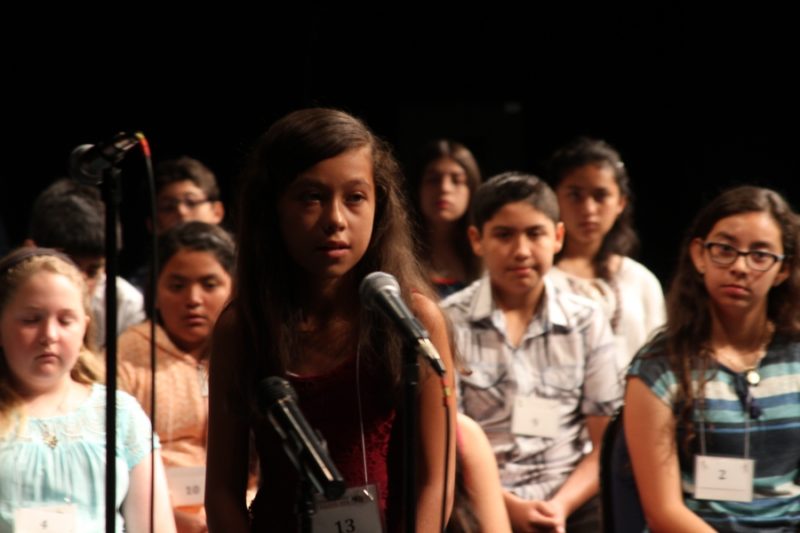
Kiara Rivas-Vasquez, a sixth-grader from Oregon, gives a confident smile to her mother who is watching on from the front row. Credit: Simon Thompson/PRI


This article by Simon Thompson originally appeared on PRI.org on July 27, 2016. It is republished here as part of a content-sharing agreement.
The amphitheater is humming: teachers hover, students murmur over spelling sheets and proud parents deliver the last gasps of pep talks. After final embraces and a tear or two, the spelling competitors are swept backstage.
It is sixth grader Jybr Reynoso Hidrogos’ second time competing. He made the top five last year, but fell short of a trophy. Every day since, he’s spent two hours or more practicing spelling. That’s what helped him beat out his classmates and win a preliminary contest to wind up here today.
“It seemed impossible and I am actually here. It is like a dream,” Jybr says.
This isn’t the Scripps National Spelling Bee that you watch on ESPN. This is Concurso Nacional de Deletreo en Español, the National Spanish Spelling Bee, held this month in San Antonio, Texas.
Words are drawn from the “Lista de Palabras,” a 1,448-long list of Spanish words. When contestants need a word repeated, defined or used in a sentence, they are encouraged to ask the judges in Spanish. They also have to correctly place any diacritical marks, like the tilde in artimaña (trick), the dieresis in ungüento (ointment) or the accent in constelación (constellation).
“It makes it hard sometimes,” says Jybr. “There some words where it seems like there is no accent — maybe you can’t hear it — but actually it is there.”
Jybr has been learning Spanish from the cradle. Though he is in the bilingual track at Bradley Middle School in San Antonio’s North East Independent School District, he mainly speaks English with his school friends.
His parents came to the US from Mexico before he was born. His father, Liborio Reynoso, says seeing his son compete in their native language is a massive point of pride.
“Oh man!” he says. “My first language, my native language. We want our language to grow up here in this country.”
It wasn’t that long ago that first-generation American citizens like Jybr were scolded for speaking Spanish at school and encouraged to abandon their native language.
The director of the Spanish spelling bee, David Briseño, grew up in the US state of New Mexico where his Spanish-speaking parents were convinced that teaching their children the language would hold them back. Now 60, he says he still hasn’t quite mastered Spanish.
“My parents went through the time when you were punished in school for speaking Spanish,” he says. “They wanted to make sure we weren’t getting punished.”
His parents, he says, were belittled, spanked or could have their mouths washed out with soap if teachers caught them speaking their native language. Many people don’t like to talk about this painful history, but another school administrator at the spelling bee tells me the same thing happened to her parents. At last year’s bee, José Reyes, a bilingual instructor from Gadsden Independent School District in New Mexico, told me that a teacher punished him for speaking in Spanish. He went to school in El Paso, Texas, in the 1960s and 70s.
“I used Spanish and I remember her taking me to the sink in the corner and washed my mouth with Borax, with soap. And she said, ‘You won’t use this language again.’”
Fifth-grader Mariana Moya-Rubiano from Thomas Harrison Middle School, Harrisburg, Virginia, correctly spells her first word in the competition. 27 students competed — accents, tildes and all — in the bee this year. Credit: Simon Thompson/PRI
Briseño founded the National Spanish Spelling Bee six years ago to change these attitudes and to raise the status of the Spanish language in the US.
Efforts like his are making a difference. The benefits of bilingual learning gained Once, Students in the US Were Punished for Speaking Spanish. Here, They Are Honored. · Global Voices:


United States must extradite Fethullah Gulen to Turkey: Ankara mayor | The Indian Express

United States must extradite Fethullah Gulen to Turkey: Ankara mayor | The Indian Express:

United States must extradite Fethullah Gulen to Turkey: Ankara mayor

Turkish authorities have launched a sweeping nationwide purge of suspected Gulen supporters since the coup.

Turkey, Turkey Coup attempt, Turkey Coup, Gulen, Fetullah Gulen, Melih Gokcek, Tayyip Erdogan, World news, International news, Turkey news,
A man attaches a mask with the image of United States extradite Fethullah Gulen, who is accused of being behind the violent July 15 coup, by a makeshift gallows at the Kizilay square in Ankara. (AP Photo|Ali Unal)
The United States must extradite Islamic preacher Fethullah Gulen to Turkey to remove any suspicion that Washington was involved in the failed July 15 coup, the mayor of Ankara Melih Gokcek said.
Gokcek, mayor for over 22 years and one of the most senior figures in the ruling Justice and Development Party (AKP) of President Recep Tayyip Erdogan, also told AFP in an interview he feared Turkey was entering a period where top officials could be at risk of assassination.
Turkey has squarely blamed Gulen for masterminding the rebellion, saying he assiduously built up a “parallel state” with followers in all institutions. From his secluded compound in Pennsylvania, the preacher has denied the charges.
Turkish authorities have launched a sweeping nationwide purge of suspected Gulen supporters since the coup, dismissing more than 50,000 people from their jobs and detaining more than 18,000.
With some officials now even alleging that Washington could have had a hand in the putsch, Ankara wants the United States to send back Gulen to face trial in the country he left in 1999.
“For America to prove it is not behind the coup, there is only one thing to do, deliver (him) to Turkey,” Gokcek told AFP in the capital.
He claimed that the US had already given “signals” it was involved in the coup after a top American general expressed concern that many of Washington’s former Turkish military interlocutors were now in jail.
“How will it be known whether America is or is not involved in this business? If they deliver (Gulen) there is no problem. But if they don’t the United States will not escape from the dock.”
Watch Video: What’s making news

Gokcek, who had previously suggested Gulen was hypnotising people, expressed bewilderment that Washington had tolerated the cleric’s presence and allowed his foundations to open up schools in the US.
“For America to tolerate this, it seems there are connections to FETO,” he said, referring to what Turkey calls the Fethullah Terror Organisation (FETO).
The US State Department has rejected suggestions it had any hand in the coup as “ludicrous”. Gokcek said Gulen’s role in Turkey went back to the premierships of Bulent Ecevit in the 1970s and admitted the AKP had mistakenly formed an alliance with his similarly Islamic-leaning supporters when it first came to power in 2002.
“But their biggest aim was to use us and to get their own people inside the army,” he said. Gokcek, one of the most outspoken senior figures in the AKP who regularly updates 3.4 million followers on Twitter with his views, said there would no longer be a risk of coups in Turkey but rather of assassinations.
“Politicians will be at risk of assassinations… of course I have increased my security,” he said.United States must extradite Fethullah Gulen to Turkey: Ankara mayor | The Indian Express:
Big Education Ape: Texas Opens Probe Into Gulen Connection to Charter Schools - WSJ - http://bigeducationape.blogspot.com/2016/07/texas-opens-probe-into-gulen-connection.html

Saturday, July 30, 2016

Where Clinton and Trump Stand on Education - The Atlantic

Where Clinton and Trump Stand on Education - The Atlantic:

Where Clinton and Trump Stand on Education

The convention dust has settled, and it’s back to the chalkboard.


When compared to Donald Trump’s single education policy-related sentence in his acceptance speech at the Republican convention, Hillary Clinton’s remarks on the subject Thursday night were certainly more extensive, as she sought to emphasize a track record of making schools, teachers, families, and students her political—and personal—priorities.
In accepting the Democratic Party’s nomination for president, Clinton touched repeatedly on education, from her work years ago supporting legislation on educating students with disabilities to her recently announced plans to make college “tuition-free” for low- and middle-income families at public universities. She also vowed to work toward a future where “you can get a good job and send your kids to a good school no matter what zip code you live in.”
Trump said much less much about education in his Cleveland address, although he did manage to fit a handful of buzzwordsinto one sentence: “We will rescue kids from failing schools by helping their parents send them to a safe school of their choice,” he said.

How the Republican presidential nominee will accomplish this, or what he would use as the barometer for a failing school, isn’t clear. His campaign, so far, has been very short on policy details. (In the meantime, the Obama administration continues to work on regulations and guidance to flesh out the Every Student Succeeds Act, the legislative successor to No Child Left Behind.)
The Republican Party’s platform is more detailed on education. Politico’s Michael Stratford noted that it includes a direct rebuke of a recent White House directive urging states to uphold the civil rights of transgender students. (Republicans said they “salute the several states which have filed suit against it.”)

As Dana Goldstein wrote earlier this month for Slate, Hillary Clinton is reshaping the Democratic Party’s relationship with the so-called “school-reform” movement:

Following eight years of federally driven closures and turnarounds of schools with low test scores, which have put union jobs at risk, it was music to the [National Education Association’s] ears when the presumptive Democratic nominee promised to end “the education wars” and stop focusing only on quote, “failing schools.” Let’s focus on all our great schools, too.
At the same time, a common thread in media coverage of the National Education Association’s recent convention was the overall strong support for Clinton’s platform—and the boos that followed her brief, supportive remarks about charter schools.

For an update on where the two presidential candidates stand on education Where Clinton and Trump Stand on Education - The Atlantic:


Insiders or outsiders: who runs public school districts better? - The Washington Post

Insiders or outsiders: who runs public school districts better? - The Washington Post:

Insiders or outsiders: who runs public school districts better?


Muriel Bowser, the mayor of Washington D.C., is in the market for a new leader of the city’s public school system. The current occupant of the job, Kaya Henderson, is leaving in a few months and Bowser has launched a nationwide search for a successor. Who and what should she be looking for? Someone from inside the district? Outside?
In this post, education historian Larry Cuban looks at the historical trends of district leadership — and offers the D.C. mayor some advice about how to make a solid decision. Cuban is as qualified as anyone to write about the subject. He was a high school social studies teacher for 14 years, a district superintendent (seven years in Arlington, VA), and is professor emeritus of education at Stanford University, where he has taught for more than two decades. He is the author of numerous books, including “Inside the Black Box of Classroom Practice: Change without Reform in American Education.” This appeared on his education blog and he gave me permission to republish.
https://larrycuban.wordpress.com/2016/07/25/insider-or-outsider-superintendents-in-big-cities/
By Larry Cuban
In Los Angeles Unified School District, the school board appointed an insider — Michelle King — superintendent earlier this year after a string of prior superintendents came from outside the district.
In New York City, Mayor Bill De Blasio appointed an insider – Carmen Farina –   as chancellor in 2014 after then Mayor Michael Bloomberg had appointed three outsiders since 2000.
These appointments of insiders to big-city districts, people who spent their careers within the district as teachers, principals, and district office administrators, are the exception, not the rule. For large urban districts, the rule has been to appoint outsiders who promise major changes in course to solve serious problems.
Why is that?
Outsiders have been appointed time and again in these districts because the unspoken and strong belief was that the serious educational, social, and political problems besetting the schools needed an innovative, energetic outsider, someone supposedly unbeholden to those inside the district.
An outsider, policy elites assumed, would shake the system by the scruff of its neck in turning around a failing district – “disrupt” is the fashionable word today. Insiders who had risen through the ranks would prize stability while looking for incremental improvements. Insiders  immersed in a network of relationships with peers and subordinates would supposedly be reluctant to disturb bureaucratic procedures, rules in effect for decades, and bonds of affection and respect for long-time peers and subordinates. Insiders would be loath to importing new staff and  innovations from elsewhere. They would rather seek new ideas and programs from sharp, knowledgeable insiders.
These strongly held beliefs about insiders and outsiders have shaped the appointment of superintendents to big city posts for well over a half-century.
In brief, the folk wisdom surrounding superintendents or chancellors heading urban districts says to appoint insiders if you like what has been happening in the system under the exiting superintendent in order to extend and protect what is working well for students, teachers, and the community. Stability and tweaking what works is the order of the day when insiders are Insiders or outsiders: who runs public school districts better? - The Washington Post:

What I didn’t hear in Hillary Clinton’s speech |

What I didn’t hear in HIllary Clinton’s speech |:

What I didn’t hear in Hillary Clinton’s speech

hillaryclinton


What concerns me most about Hillary Clinton’s speech is I what I didn’t hear.
I heard no mention of unions. Public sector or private. How strange. The omission suggests one of the traditional pillars of the Democratic Party, labor, is no longer even worthy of mention.
When Barack Obama was elected, he went to Washington promising to press for the union “check-off” provision that would have made it easier (and safer) for working men and women to vote for union representation. He gave up on the idea when he ahd the chance to save another priority, health care.
I heard no mention of traditional public schools. Oh, sure, there was talk about schools and even a nice story about a kind first grade teacher.  But public schools throughout the nation are under siege by so-called “reformers”–supported by Clinton– who want to privatize education, turn it into a profit-making industry. Clinton missed a chance to bring many Sanders’s supporters to her side.
Of course, the assault on public education is part of the assault on public sector unions. Democrats for Education Reform (DFER), led by Newark’s own Shavar Jeffries, has called teacher unions the “dam” that must be “burst” in order to improve public education.  Isn’t it strange that both the N EA and the AFT rushed to endorse Clinton before the primaries? Why do I hear the old union refrain, “Which side are you on, boys (girls?)…which side are you on?”
I heard no mention of standardized testing. Or Common Core.  Does Clinton endorse the infamous words of former US Education Secretary Arne Duncan that parents are opposed to punitive testing because they will learn their children aren’t as smart as they thought they were?
I heard no mention of PARCC or Pearson. We’re all supposed to get into an uproar about the hacking of the Democratic National Committee’s computers, but no one at the top of the Democratic leadership is complaining about cyber-spying on our children while they are taking tests that provide profits to testing companies from public tax money.
I heard no mention of racial isolation. Without racial segregation enforced by housing laws—a segregation now as bad as it ever was, especially in major cities—the desperate problems in the streets would not be so tragic. Schools would not be such instruments of  American apartheid. Violence could be countered.
I heard no mention of  crackdowns on Wall Street excesses. Including limits What I didn’t hear in HIllary Clinton’s speech |:

CURMUDGUCATION: $tand For Children: The Astroturfing of Advocacy

CURMUDGUCATION: $tand For Children: The Astroturfing of Advocacy:

$tand For Children: The Astroturfing of Advocacy


Astroturf lobbying refers to political organizations or campaigns that appear to be made up of grassroots activists but are actually organized and run by corporate interests seeking to further their own agendas. Such groups are often typified by innocent-sounding names that have been chosen specifically to disguise the group's true backers


Stand For Children's pedigree is impeccable. It's twenty year history begins with a huge June rally in DC, where 250,000 people did, indeed, stand up for children. Geoffrey Canada and Rosa Freaking Parks spoke. Time Magazine did a follow-up interview with child advocate and activist Marion Wright Edelman. Edelman was the first black woman admitted to the Mississippi bar, and in 1973 she founded the Children's Defense Fund.

Edelman's son Josh (his father worked for Robert Kennedy) teamed up with Eliza Leighton to work on that rally, and immediately after, they launched Stand For Children. This was Edelman's first big project; he had received his B.A. in History with a concentration on African-American studies from Yale University in 1992, then landed a Rhodes Scholarship to Oxford University, earning his Master of Philosophy and Doctor of Philosophy degrees in Politics in 1994 and 1995.

The organization kicked off with rallies all over the country, and launched as a chain of local, grass roots chapters.In a press release for the 1999 Stand For Children Day, we can see the organization spread over "1,500 volunteer-led events" calling for things like greater funding for pre-school. Thepriorities of SFC in those days were pretty simple:


  • Health coverage for uninsured children
  • Monitoring the impact of welfare reform
  • More money for affordable, high-quality child care
  • Safe and productive after-school activities
  • Schools that have small classes, well-trained teachers, high standards, and involved parents.
But by the late 00s, something was happening to Stand For Children.


One thing that was happening was huge truckloads of money from the Gates andWalton foundations. Stand For Children was making a whole lot of interesting new friends, and their old friends, includingparents like Susan Barrett, were noticing:

I think about the visits from the Policy Director of the New Teacher Project, and the former aide to New York City charter operator, Eva Moskowitz, who said she was moving to Portland and trying to set up a chapter of Democrats for Education Reform, the pro-charter, hedge-fund driven organization.  I think about their push for Oregon to submit a Race to 
CURMUDGUCATION: $tand For Children: The Astroturfing of Advocacy:


NY: 2016 Opt Out Remained Huge
The report on 2016 testing is out , and the bottom line is this: Despite various state attempts to pressure, brow-beat, threaten, cajole, and distribute a huge case of the PR-spin whirlies, the opt out numbers in NY actually went up. The increase is marginal-- in 2015, 20% did not test, and in 2016, 22% did not test. But then, in 2015 the state was caught somewhat flatfooted by the opt out moveme
Free Marketing Schools
Free market fans envision a story something like this: Finding themselves in a world where the power of the free market is unleashed, charters, private, and public schools all become transparent, competing with each other to be able to publish the finest student outcomes. Empowered consumers/parents study up on the student outcomes published by each school so that they can weigh the merits of each
Other Suns and the Illusion of History
It was impossible to drive across the country without thinking of Isabel Wilkerson's masterpiece The Warmth of Other Suns, a stunning telling of the story of the Great Migration. Wilkerson weaves numerous threads together (including those of her own life) and shifts effortlessly between close focus and the larger picture, but the book revolves around the stories of Ida Mae Brandon Gladney, George

JUL 28

Looking for Mr. or Ms. Change Agent
Over at the Fordham, Mike Petrilli has been slowly unspooling a series of posts looking at how reform goals might be pursued through means other than policy and politics. In his latest, he considers the leadership development approach to school reform. Petrilli expresses mixed feelings about the argument. On the one hand, he recognizes that great leaders have value. On the other hand, he's not sur
NV: Vouchers Go To Court
Last year, Nevada passed a voucher law that was a big wet kiss t o reformsters and everyone else who wants to dismantle public education. It's about the simplest voucher law we've ever seen. The state of Nevada will pay you $5,100 to take your kid out of public school. You can spend your $5,100 on a charter school, a private school, a religious school, or on supplies to home school (does a new roo

JUL 27

The Gardener and the Carpenter
Earlier this month, Dr. Alison Gopnick appeared in the Wall Street Journal plugging some thoughts from her soon-to-be-published book The Gardener and the Carpenter: What the New Science of Child Development Tells Us About the Relationship Between Parents and Children. Gopnick's point is about parenting, but it has direct implications for the teaching world as well. Gopnick argues that modern paren
This Non-Standardized Country
Two weeks, 5800 miles, and about 16 states (it's a stretch to count Colorado). Plus several days with my daughter, son-in-law, and grandson. I don't usually do photo essays here, but I want to show you just some of what I saw. This is home. This is what we're used to seeing. Here's downtown Cleveland, where a railroad era central building makes a backdrop for a modern monument. Off to our right is