Friday, June 17, 2016

John Thompson: Two Years in a KIPP Blue Ribbon School | Diane Ravitch's blog

John Thompson: Two Years in a KIPP Blue Ribbon School | Diane Ravitch's blog:

John Thompson: Two Years in a KIPP Blue Ribbon School


John Thompson, teacher and historian, writes here about KIPP in Oklahoma City. Will Oklahoma City surrender its public school to corporate charter chains?
Thompson writes:
A deeply emotional battle has erupted in Oklahoma City after its KIPP Reach Middle School attempted to take over the Martin Luther King Elementary School building, while promising to serve the entire neighborhood. OKC’s KIPP has no experience with pre-school through 4th grade instruction, but it promised to send its school leaders to Success Academy for guidance!?!? The charter not only has a much lower percentage of low-income students than OKC’s neighborhood middle schools, (76% vs 90+%) but it serves about 40% as many special education students as MLK. It co-locates with Moon Elementary where 21% of the students are homeless, and it would take over MLK where 17.2% are homeless. Only 1% of KIPP’s students are homeless.
After 15 years, KIPP has not been able to expand its student population beyond 300, but it now wants to quadruple its student body to 1200. It cites its 2012 Blue Ribbon School award as evidence that the No Excuses middle school could become a neighborhood pre-k to 8th grade school without pushing out excessive numbers of high-challenge students. Ironically, KIPP’s Blue Ribbon School application offers an overwhelming case against their attempt to take over an entire feed group.
2014-2015 STATISTICAL PROFILE 1-28-16 (2).pdf
In August, 2010, 285 students enrolled in KIPP. In October, 81% of its students were low-income, and 11.6% were on special education IEPs. By the spring, however, only 226 remained to be tested, which represented the loss of 1/5th of the students. Ten students, or 10% of the tested students, were alternatively assessed, meaning that they were on special education IEPs. So, at first glance, KIPP’s claim to accept the “same” students would seem to be an exaggeration, but it could not be seen as irrational. But, what did the other grades look like?
By 8th grade in 2011, however only 32 students were tested, and only 22 of them were eligible for free and reduced lunch! Only three special education students remained to be tested. And this was not an unusual year. The Blue Ribbon application provides data for 2006 through 2011, and it reveals a clear pattern. During those years, on average of nine 5th graders were on IEPs. By 8th grade the average number of tested IEP students was 1.4%! From FY2007 to FY2011, KIPP did not report a single 7th or 8th grade student on an IEP who passed an end-of-the-year math or reading test.
The next year, however, this attrition story got even worse. Using data John Thompson: Two Years in a KIPP Blue Ribbon School | Diane Ravitch's blog:


Finally, the feds move to fire an incompetent watchdog over for-profit colleges - LA Times

Finally, the feds move to fire an incompetent watchdog over for-profit colleges - LA Times:

Finally, the feds move to fire an incompetent watchdog over for-profit colleges

corinthian
California Atty. Gen. Kamala D. Harris exposed how Corinthian Colleges targeted vulnerable students in 2013. Corinthian later went out of business, and now its accreditation agency is in hot water. (AP)
Much of the world turns on paper credentials. But the fact that these often aren’t worth the paper they’re printed on has been spotlighted by the accreditation scandal in the for-profit college business. Scores of campuses have been given a seal of approval by accreditation agencies despite coming under state or federal investigation for fraud.
The federal government is preparing to bring down the hammer on one of these toothless watchdogs. Its target is the Accrediting Council for Independent Colleges and Schools, which is renowned for maintaining its accreditation of Corinthian Colleges right up to the day that chain of for-profit schools ceased operating in April 2015. Corinthian filed for bankruptcy days later. ACICS accredits some 900 campuses across the nation, giving those schools the formal imprimatur that allows them to collect an estimated $5 billion a year in federal financial aid on behalf of their students. 
But its role may be ending. The Department of Education staff on Wednesday recommended the revocation of ACICS’s recognition as an accreditation body. That means that schools bearing its seal of approval will have to find a new accreditation body within 18 months or lose their right to collect federal financial aid payments. 
The department’s recommendation isn’t the last word. The next step belongs to the National Advisory Committee on Institutional Quality and Integrity, which will meet next week. The decision ultimately will be rendered by Secretary of Education John King. But things look bad for ACICS; the department staff says it has fallen short on nearly two dozen issues or problems and doesn’t seem equipped to “remedy its compliance issues.”
ACICS has been pedaling furiously to stave off extinction. On June 6, it said it wouldsuspend new accreditations until it can get its house in order. But the Education Department staff recommendation implies it’s moving too late.
The ACICS case underscores the drawbacks of governmental outsourcing of its regulatory authority to outside agencies, especially self-regulatory bodies. These bodies often are dependent for revenue on the very institutions they oversee, which tends to file down their sharp teeth when confronted with the need to bite down hard on a fee-paying target. The phenomenon typically leads to abuses going unaddressed, as happened with credit-rating agencies such as Standard & Poor’s, which has been accused of giving high ratings to deeply impaired mortgage securities in the run-up to the 2008 financial crisis.
For consumers, accreditation seals of approval can look like reliable shortcuts to the checking that individuals should do for themselves. Students interested in Lincoln Technical Institute’s vocational programs, for instance, might be comforted by the word on its website that it’s accredited by ACICS, “one of the most respected, established national accreditors of academic institutions in the United States.” They would be hard-pressed to learn that Lincoln settled a lawsuit last year brought by the Massachusetts attorney general alleging it gave applicants for its criminal justice program bogus data about job placement by its graduates. The school settled for $850,000 without admitting the charges and forgave $165,000 in private student loans.
Big Education Ape: Who Keeps Billions of Taxpayer Dollars Flowing to For-Profit Colleges? These Guys - ProPublica - http://go.shr.lc/1tAxRDd 

Pro-charter group spends big in Los Angeles-area Assembly races | EdSource

Pro-charter group spends big in Los Angeles-area Assembly races | EdSource:

Pro-charter group spends big in Los Angeles-area Assembly races


Among all the state Assembly primaries last week, none raised more eyebrows in Los Angeles education circles than the race for an open seat in District 43, which includes Glendale, Burbank and parts of Los Angeles. The top two spots went to Laura Friedman, a member of the Glendale City Council, and Ardy Kassakhian, Glendale’s city clerk. Both Democrats, they’ll now face each other in a November runoff.
The seat was deemed important enough to The Parent Teacher Alliance, an independent expenditure committeesupporting the California Charter Schools Association, that it spent more than $1.3 million on behalf of Friedman, part of a campaign in which supporters for both of the leading candidates used an image of Donald Trump to tarnish the other. (The Alliance has no connection to the California State PTA.) 
The level of spending, as well as the links to Trump, made the campaign highly unusual for several reasons. First, education was not a major issue in the race, apart from Kassakhian reminding voters that his mother is a public school teacher. Also, there are no charter schools in Glendale and only one in Burbank. Second, Friedman’s campaign manager, Parke Skelton, said Friedman neither sought nor expected any financial support from a political action committee on behalf of charter schools. The level of support, he said, “was a shock to us.”
And finally, like Friedman, Kassakhian is a Democrat.
Ardy Kassakhian, second-place finisher in Assembly District 43 primary.
KASSAKHIAN CAMPAIGN
Ardy Kassakhian, second-place finisher in Assembly District 43 primary.
Heavy primary spending by the Parent Teacher Alliance – more than $3.8 million overall – comes as the charter association is pushing to meet its newly stated goal of serving 1 million children statewide by 2022, about double the current number. It also spent heavily for open Assembly seat races in districts 27 and 30.
Beyond that, the spending raises the possibility that charter interests will write more big checks next year, when four members of the L.A. Unified board face re-election, and the most divisive campaign issue is likely to be charter school growth. 
Already, L.A. Unified has more charters than any other school district in the country, about 230, with more planning to seek approval in the year ahead. With so many in operation, the district has become ground zero in the proxy war for resources between charters and teachers unions across California. The charters insist that parents need more choices for their children, while teachers unions argue that charters don’t necessarily improve the academic outcomes they promise and they drain valuable resources from public schools. The conflict is playing out as the district faces budget deficits after next year. 
At the moment, charter schools have only two reliable votes on the board — Mónica García, its longest-serving member and former president, and Ref Rodriguez, a former charter school executive who was elected to the board last year after a bruising campaign in which he defeated Bennett Kayser, the Pro-charter group spends big in Los Angeles-area Assembly races | EdSource:
Big Education Ape: Analysis: EdVoice with an IE for Dodd; Educational Reform Group Has Ties to Vergara Suit and Wa... http://bit.ly/1SJq26U

Big Education Ape: News Analysis: Education fight ‘over shades of Democrat’ | CALmatters http://bit.ly/25csc6L

Big Education Ape: Local legislative races become battleground in statewide fight over educationhttp://bit.ly/1WMlJKA

Big Education Ape: Edvoice pumps cash into Assembly campaign | News | Palo Alto Online | http://bit.ly/1s8OhSi

Big Education Ape: Charter school groups spending big in California legislative races | 89.3 KPCChttp://bit.ly/1TYIvJj
 

Charter schools want to sever ties with management company

Charter schools want to sever ties with management company:

Charter schools want to sever ties with management company

Newpoint Education Partners accused of theft, other crimes

JACKSONVILLE, Fla. - Two local charter schools want to sever ties from their management company, Newpoint Education Partners, which was indicted last month on charges of grand theft, money laundering and aggravated white-collar crime.
Over the last six months, Newpoint has operated charter schools in six counties and has withdrawn from its contracts voluntarily or been terminated by the school districts in four of those counties. The only two schools left under Newpoint management are in Jacksonville -- San Jose Academy and San Jose Preparatory High School.
San Jose Board Chair Bonnie Arnold and the schools' attorney, Gene Wheeler, decided Thursday night to get out of their five-year contract. The decision comes after the schools discovered they've possibly been paying interest on $235,000 worth of apparently non-existent loans from the management company.
"We've been in negotiations for a few days. There wasn't a decision made. We brought it to the board for them to move forward with a decision," Arnold said. 
Two weeks ago, Arnold told the News4Jax I-TEAM that the relationship with Newpoint was good and the indictment against the company in Escambia County didn't affect them. Then, after a public records request made by the media, the schools found out $235,000 in loans they've possibly been paying interest on don't exist, and the schools had a change of heart. 
"Because it's in the best interest of our school, our students, our staff and our community," Arnold said. 
Newpoint has been fronting the payroll, and the school pays them back. A month's payroll totals about $90,000 and San Jose Academy is a few payments behind, according to the board. San Jose Preparatory High School is current. 
Wheeler told the board Thursday evening that Newpoint wants them to pay back about $72,000 in management fees within the next 14 days, but the board doesn't believe it can afford that and keep the Charter schools want to sever ties with management company:
 

Thursday, June 16, 2016

We'd Be Better Off If Every Human Were As Good As the Top 10 Percent of Humans | Mother Jones

We'd Be Better Off If Every Human Were As Good As the Top 10 Percent of Humans | Mother Jones:

We'd Be Better Off If Every Human Were As Good As the Top 10 Percent of Humans

James Pethokoukis comments on an Economist cover story making the case that teacher quality is important:
Among the many studies cited: a University of Melbourne review of more than 65,000 papers on the effects of various classroom interventions. It concludes that what matters most is teacher expertise: “All of the 20 most powerful ways to improve school-time learning identified by the study depended on what a teacher did in the classroom.”
Another paper found that students taught by teachers in the top 10% for effectiveness learn 1.5 years’ worth of material in an academic year, three times as much as those taught by teachers in the bottom 10%....The big question, then, is to what extent good teaching can be taught. Are high-quality teachers born that way or can they be made?
I've been hearing about this approximately forever. And I don't really doubt it. Some teachers are better than others. Duh. The most effective 10 percent of teachers help their students more than the other 90 percent. Duh. It would be great if we could train all teachers to be as good as the top 10 percent. Duh. We ought to fire the really bad teachers. Duh.
Here's what I don't get: Why is it that this frenzy about "quality" is mostly reserved for teachers? Isn't it true of literally every profession? Some prison guards are better than others. The most effective 10 percent of accountants will do your taxes better than the other 90 percent. It would be great if we could train all police officers to be We'd Be Better Off If Every Human Were As Good As the Top 10 Percent of Humans | Mother Jones:


How some students who refused to take high-stakes standardized tests are being punished - The Washington Post

How some students who refused to take high-stakes standardized tests are being punished - The Washington Post:

How some students who refused to take high-stakes standardized tests are being punished

A school bus passes a sign encouraging parents to refuse that their children take state tests on Monday, April 13, 2015, in Rotterdam, N.Y. (AP Photo/Mike Groll)

What has come to be known as the “opt out” movement has become something of a a force in the education reform debate. Hundreds of thousands of parents have refused to allow their children to take federally mandated high-stakes standardized tests, including those aligned with the Common Core State Standards, and education officials don’t like it.
In 2015, 20 percent of parents in New York City opted out; this year’s numbers are not yet known. Parents who chose this course did not know if there would be personal consequences for their kids, but knew they were possible. Now, in some districts, they are finding out what they are.
Why would states and districts want to take action to stop the opt-out movement? The U.S. Education Department has been warning of possible sanctions if at least 95 percent of all students are not tested — a threshold set in federal K-12 education law, first in No Child Left Behind and now in its successor, the Every Student Succeeds Act. Last month, the department issued proposed rules that includes punitive options that  states should take to ensure 95 percent student participation rate on federally required state-selected standardized tests.
In this post, Carol Burris, a former New York high school principal who is now executive director of the nonprofit Network for Public Education, writes about what is happening to some opt-out parents.  Burris was named the 2010 Educator of the Year by the School Administrators Association of New York State, and in 2013, the same organization named her the New York State High School Principal of the Year. She has been chronicling botched school reform efforts in her state for years on this blog, and this is her newest piece.

By Carol Burris
Nearly half a million families across the country made the decision to opt their children out of Common Core state exams in 2015.  As a result, most districts are scrambling to come up with ways to adjust their policies and processes when decisions about students are made on the basis of test scores.  Sadly, some refuse to adjust and seek to punish opt-out students instead.
Recently, Florida opt-out parents accused their districts of retaliation by issuing threats of retaining young children, or excluding older students from early college programs.  A California high school principal went so far as to deny opt-out students parking privileges, participation in How some students who refused to take high-stakes standardized tests are being punished - The Washington Post:

CURMUDGUCATION: Can Cyber Schools Be Saved?

CURMUDGUCATION: Can Cyber Schools Be Saved?:

Can Cyber Schools Be Saved?


Say what else you like about them, but the charter school industry has a pretty keen sense of where its own vulnerabilities lie, and at the moment, there is no underbelly softer than the virtual charter sector-- what the rest of us call cyber-charters. Multiple studies have made it clear-- cyber charters do not deliver much of anything except giant truckloads of money to the people who operate them.

So we have this newly-released report, "A CALL TO ACTION TO IMPROVE THE QUALITY OF FULL-TIME VIRTUAL CHARTER PUBLIC SCHOOLS"-- yes, the call to action is so urgent that the report HAS TO YELL ITS NAME!!

The report was co-created by the National Alliance for Public [sic] Charter Schools, the National Association of Charter School Authorizers, and 50CAN. So we know that the report is not about examining the value or viability of cyber-charters-- this is going to be about figuring out which exercise program might build a six-pack on that soft underbelly and thereby decrease the vulnerability of the charter industry.


This is a double-problem. First, we know that cybers are not making their numbers and instead are having an "overwhelming negative impact" on students, suggesting that students would literally be better offplaying video games for a year. On top of that, the majority of cybers are for-profit, so they're barely pretending that they're in this For The Children.

Now, I will say this in cybers' defense. First, their ineffectiveness is being measured with standardized test scores and bogus units like years or months of learning. Second, non-profit charters are just as capable of being money-grubbing profit engines as a for-profit charter-- they're just sneakier about it.

But let's take a look at the report and see what advice the charter industry family will offer to the black sheep of the family. Will it be tough love or a bug cuddle? The report is only sixteen pages long, but I have read it so that you don't have to. Here we go.

Fun Facts: 

There are 135 cybers operating in twenty-three states plus DC, serving about 180,000 students. Last fall about 50.1 million students headed off to school, so that's about a third of 1% of all the students in the US.

Around 90,000 of those students are accounted for by the big three of cyber-schooling-- California, Ohio and Pennsylvania. One quarter of the cyber schools enroll about 80% of all cyber students. Put another way, about 80% of cyber students are enrolled in a school with over 1,000 students.

Cybers enroll far more white students and far fewer Hispanic students than public schools. They enroll more students in poverty, but fewer English Language Learners.

They are no more mobile than the general population of students, so the story about how cybers enroll students who are having a hard time because they've been moving all over the place-- that doesn't fly.

More Tough Love and Truth Talk

Well, this report isn't out to sugar-coat anything. As it moves into a section about results, the report lays out pretty bluntly some of the less-than-stellar outcomes of the cyber charters.

* Exceptionally weak academic results compared to bricks and mortar. They're going to go ahead 
CURMUDGUCATION: Can Cyber Schools Be Saved?:

Common Cause: Student Activist Training - LA Progressive

Common Cause: Student Activist Training - LA Progressive:

Common Cause: Student Activist Training


student training day
 California Common Cause 6th Annual Student Activist Training - Common Cause - https://secure2.convio.net/comcau/site/Donation2

Does Research Based Reform Require Standardized Tests?

Does Research Based Reform Require Standardized Tests?:

Does Research Based Reform Require Standardized Tests?

2016-06-16-1466099007-8549520-DoesResearch06_16_2016.jpg
Whenever I speak about evidence-based reform someone always asks this question: “Won’t all of these randomized evaluations just reinforce teaching to the (very bad word) standardized reading and math tests?” My wife Nancy and I were recently out at our alma mater, Reed College. I gave a speech on evidence-based reform, and of course I got this question.
Just to save time in future talks I’m going to answer this question here once and for all. And the answer is:
No! In fact, evidence-based reform could be America’s escape route from excessive use of accountability and sanctions to guide education policy.
Here’s how this could happen. I’d be the first to admit that today, most studies use standardized tests as their outcome measures. However, this need not be the case, and there are in fact exceptions.
Experiments compare learning gains made by students in a given treatment group to those in a control group. Any assessment can be used as the posttest as long as it meets two key standards:
a) It measures content taught equally in both groups, and
b) It was not made up by the developer or researchers.
What this means is that authentic performance measures, measures aligned with today’s standards, measures that require creativity and non-routine problem Does Research Based Reform Require Standardized Tests?:


The Invisibility of Homelessness in American Schools - The Atlantic

The Invisibility of Homelessness in American Schools - The Atlantic:

The Complicated Task of Identifying Homeless Students

Few states know where those children are, making it difficult to connect them with resources.

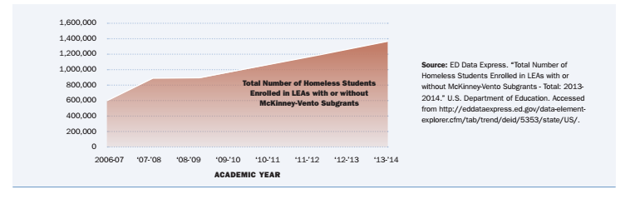
Increasing Rates of Student Homelessness, 2006-07 to 2013-14

The number of homeless students in the United States has doubled in the past decade. During the 2013-14 school year, more than 1.3 million students were homeless, a 7 percent increase over the previous school year, according to a newreport by the advocacy group Civic Enterprises and the polling firm Hart Research Associates. A disproportionate number are students of color or identify as LGBT.

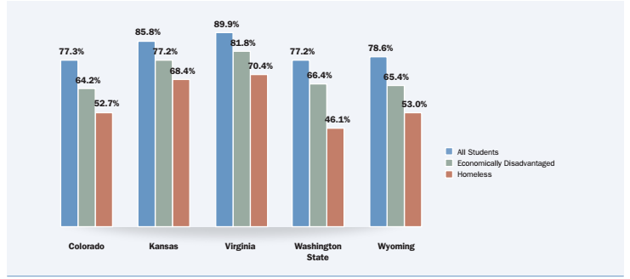
As alarming as those numbers are, the fact that figures on homeless students exist at all is a step in the right direction. That’s because, until recently, only five states have voluntarily collected that data: Colorado, Kansas, Virginia, Washington, and Wyoming. In those states, graduation rates for this population lagged behind the rest of the students, even those who are low-income. Now, provisions in the newly passed Every Student Succeeds Act (ESSA), the nation’s federal education law, are strengthening the visibility of homeless students and other disadvantaged groups. Beginning in the 2016-17 school year, states and local school districts will be required to disaggregate the graduation rates of homeless students for the first time in history, which educators say will help states and districts direct resources to the kids who need help the most.

Homelessness in schools has often gone unrecognized, John Bridgeland, the co-author of the report and the CEO of Civic Enterprises, said during a presentation of the report’s findings at the U.S. Capitol this week. Students who don’t have a stable place to go after school and at night are more likely to do poorly in class and more likely to drop out of school altogether, which means they are less likely to go to college, to find good employment, and to lead productive adult lives. Yet, the report notes, “Until this year, states and schools were not even accountable for tracking and making progress on their rates of graduation for homeless students.”

2014 Graduation Rates, by Economic and Housing Status

(Civic Enterprises)

One hurdle to collecting data is the difficulty of identifying homeless students in the first place. Unlike data that is collected on other groups of students (by income, race, ethnicity, disability, and language), homelessness is a challenge that is often invisible to the teachers and administrators tasked with supporting a student population whose educational performance is increasingly hampered by The Invisibility of Homelessness in American Schools - The Atlantic:

How Long Can Big Money Keep Democrats In The Charter School Camp?

6/16/2016 – How Long Can Big Money Keep Democrats In The Charter School Camp?:
How Long Can Big Money Keep Democrats In The Charter School Camp?


THIS WEEK: Chronic Absences … Homeless Students … Transgender Bathrooms … Poor Pay For Pre-K … New Reform Lie

TOP STORY

How Long Can Big Money Keep Democrats In The Charter School Camp?

By Jeff Bryant

“In the California Democratic Party’s primary race … many Democratic Party candidates relied on money from the petroleum industry and ‘education reform’ advocates backing charter schools to win their contests over ‘more progressive’ candidates … Charter school advocates also team up with big finance to influence Democratic Party candidates … Although, the issue of charter schools has barely been addressed in the presidential contest, there’s little doubt the subject is clearly a matter of intense and bitter debate down ticket.”
Read more …

NEWS AND VIEWS

More Than 6 Million U.S. Students Are ‘Chronically Absent’

NPR

“If students miss 10% of the school year – that’s just two days a month – research shows they are way more likely to fall behind – even drop out … More than 6 million kids are missing 15 days or more of school a year … More than 2 million high schoolers are missing 15 days or more. The figures for minority students are even more alarming: More than a fifth of black high schoolers are chronically absent. It’s 20 percent for Latino high school students and 27 percent for American Indians and Native Alaskans.”
Read more …

With Homeless Students On The Rise, Will New Education Law Help?

US News & World Report

“Homeless students are one of the fastest-growing subgroups of students in the U.S. … More than 1.3 million students were homeless during the 2013-14 school year… Students who experience homelessness are more likely than their non-homeless peers to be held back from grade to grade; have poor attendance or be chronically absent from school; fail courses; have more disciplinary issues; and drop out of school … Beginning in the 2016-2017 school year, states will be required under the new federal education law … to report graduation rates for homeless youth. In addition, districts will have more flexibility in how they use some pots of federal funding, and policymakers are hoping they choose to direct more of that toward providing support for homeless students.”
Read more …

What Does Research Suggest About Transgender Restroom Policies?

Education Week

“A 2013 national school climate survey of nearly 8,000 LGBT youths between the ages of 13 and 21 found that 63% of transgender students avoided school bathrooms, and 52% of transgender students avoided school locker rooms because they felt unsafe or uncomfortable … Regular access to restrooms can have a direct impact on academic participation and performance … There is currently no evidence of any increase in sexual assaults or other criminal behavior in restrooms in the 18 states and Washington, D.C., that have enacted gender-identity-inclusive public-accommodations nondiscrimination laws.”
Read more …

It’s Ridiculous How Little We Pay Preschool Teachers

Slate

“Teacher quality matters a lot in the early years … And yet. In spite of the rising need for childcare in this country – approximately 58 percent of mothers of infants work full time – and its increasingly obscene cost, preschool teachers are paid very, very little… an average of $28,570 last year. Daycare worker salaries are even more pitiable, with the average worker making $9.77 an hour in 2015, or $20,320 a year … Daycare workers have joined fast-food employees and other hourly wage workers in the Fight for $15.”
Read more …

The New Education Reform Lie: Why Denver Is A Warning Sign, Not A Model, For Urban School Districts

Alternet

Jeff Bryan writes, “Numerous articles and reports in mainstream media outlets and education policy sites enthusiastically tout Denver as the place to see the next important new ‘reform’ in education policy in action … Denverites tell a different story about Denver-style urban school reform. Instead of a glowing example, they point to warning signs. Rather than a narrative of success, their stories reveal disturbing truths about Denver’s version of modern urban school reform – how policy direction is often controlled by big money and insiders, why glowing promises of ‘improvement’ should be regarded with skepticism, and what the movement’s real impacts are, especially in communities dominated by poor families of color.”
Read more …


The new education reform lie: Denver is a cautionary tale, not a model, for urban school districts - Salon.com

The new education reform lie: Denver is a cautionary tale, not a model, for urban school districts - Salon.com:
The new education reform lie: Denver is a cautionary tale, not a model, for urban school districts
The city has opened 27 new charters in the past five years. At least 40 percent are performing below expectations


This article originally appeared on AlterNet.
AlterNet
Scott Gilpin works in advertising, so he’s used to dealing with people in the promotions business. He’s just not used to seeing them operating a local public school.
Gilpin lives in Denver, where he grew up, graduated from high school and now has two children enrolled in the public school system. Recently, when he decided to get more involved in Denver school politics, he discovered that the most rapidly growing form of school in his community were charter schools. So he determined to check one out.
When he toured his first charter, a school in the Strive Preparatory network, he couldn’t help but take note of the school’s staffing structure, which could have supported a mid-sized promotional campaign: his guide was the chief of external affairs for the network, and the school boasted a senior director of development and an associate director of recruitment, too.
Gilpin—who sent his children to the local public school they were zoned for, as his parents had done—wondered, “What kind of local public school needs to recruit its students?”
As Gilpin would learn, lots of new Denver schools are that “kind of school.”
Across the city, Denver has opened 27 charter schools in the last five years, and plans to start up six more in the 2016-17 school year – effectively doubling the number of charter schools in the city in less than six years, according to a recent report from the Center for Popular Democracy, a left-leaning research and advocacy organization in Washington, DC. Yet this rush to expand charters is hardly justified by the performance of the ones already in operation.
According to CPD, based on the school performance framework Denver uses to evaluate its own schools, “Forty percent of Denver charter schools are performing below expectations.” And of those schools, 38 percent are performing significantly below expectations.
Nevertheless, numerous articles and reports in mainstream media outlets and The new education reform lie: Denver is a cautionary tale, not a model, for urban school districts - Salon.com:

Librarian-Gate In Christina Heats Up: Sophie’s Choice or Misinformation? You Decide! – Exceptional Delaware

Librarian-Gate In Christina Heats Up: Sophie’s Choice or Misinformation? You Decide! – Exceptional Delaware:

Librarian-Gate In Christina Heats Up: Sophie’s Choice or Misinformation? You Decide!

I wrote a post yesterday about the Christina School District choosing not to rehire librarians that were cut as a result of their 2nd failed referendum last year.  Many have gone on the attack against the district and many have jumped to their defense.  One clear and obvious thing is Delaware needs to change their antiquated unit-based funding system to some extent.  I don’t think anyone is arguing that point.  But a lot of accusations were thrown out as a result of my article and I wanted to point out some of them.
During Christina’s 3rd referendum attempt, the situation was dire.  As a result of the last two failed referenda, they had to make some major cuts.  Teachers, para-professionals, specialists, and yes, including librarians.  In several places, whether in writing or spoken word, the district mentioned they wanted to hire back the positions they cut and reduce classroom sizes.  This year, there were anywhere between 35-45 kids in some classrooms.  That isn’t good for any student, much less some of the high-need populations in the district.  One of the members of Christina’s Citizen Budget Oversight Committee, Brian Stephan, also writes for Delaware Liberal.
Let me point out this simple fact: I like Brian.  I think he is a good guy and a very involved parent.  I wish more parents were as involved as Brian and his wife in public education (and on a volunteer basis at that).  I have no doubt in the world he is very well-versed in school financing.  But just as I get my readers stuck in the weeds on issues such as special education or regulations for example, I think that may happen to Brian when he is explaining district financing.  Like any television show, there is frequently a “previously on…” before the show starts.  The brains of everyday citizens don’t remember Librarian-Gate In Christina Heats Up: Sophie’s Choice or Misinformation? You Decide! – Exceptional Delaware: