Thursday, June 16, 2016

How Dr. Steve Perry Sells Black Kids To The Highest Bidder — Medium

How Dr. Steve Perry Sells Black Kids To The Highest Bidder — Medium:

How Dr. Steve Perry Sells Black Kids To The Highest Bidder

c.o Lance Murphey
As an educator who’s been doing this for 11 years, I’m always fascinated by the perfect stories we tell about kids. Either our kids are shining examples of the future or abject failures in need of reform. The word “failing” is of particular interest to me because, as I see my kids walk into class this morning, the first thing they don’t want to hear come out my mouth is “You’re a failure!” Even as sometimes-petulant teenagers, they prefer to hear “good morning” as they come into my class. Some come in with short haircuts with three cuts on the size, others in dreads, others still in fros. Their hair styles are extensions of their personality, perhaps, but if I decided to exclude them from my teaching, I’d be the failure that some of these pundits spew hate upon so confidently.

Which brings me to this weekend. On Saturday, June 11th, proselytizer Dr. Steve Perry celebrated a collaboration between him, comedian Steve Harvey, and the US Armed Forces. The cause? They would transform 200 young men of color into their version of righteousness:


In subsequent tweets, he comes within inches of calling himself the next Messiah, stopping kids from stuttering and pulling them from gangs, stepping in for their absent fathers, and keeping them up until midnight for no other reason than his own need to set these boys straight. In subsequent tweets, he How Dr. Steve Perry Sells Black Kids To The Highest Bidder — Medium:

State budget heads to Gov. Brown: How education fared | EdSource

State budget heads to Gov. Brown: How education fared | EdSource:

State budget heads to Gov. Brown: How education fared

Including the 2016-17 state budget, revenue for K-12 schools and community colleges from Proposition 98 has grown $24.6 billion or 52 percent since 2011-12, the low point of funding following the recession.
CREDIT: JUSTIN ALLEN / EDSOURCE
Including the 2016-17 state budget, revenue for K-12 schools and community colleges from Proposition 98 has grown $24.6 billion or 52 percent since 2011-12, the low point of funding following the recession.
Facing a midnight deadline, the Legislature Wednesday passed a $171 billion state budget for the fiscal year starting July 1 that steers an extra $2 billion that Gov. Jerry Brown demanded into a rainy day reserve and commits an additional half-billion dollars for early childhood education over the next four years. Brown is expected to sign the budget, which his staff negotiated.
Education will fare well. The 4 percent overall  increase in revenue for K-12 districts in 2016-17, while it pales compared with the unusual 11 percent increase last year, is large by historical standards. Forecasts of revenue in coming years are cloudy and will depend on whether a recession happens, as Brown predicts, and whether voters in November re-up Proposition 30, extending an income tax increase on the state’s wealthiest residents.
 Here are some of the big numbers for education in the budget for 2016-17:

PROPOSITION 98

  • $71.9 billion: The Proposition 98 guarantee, the main source of money for K-12 and community colleges. That’s $2.8 billion more than the revised total for 2015-16, and $3.5 billion more than the Legislature appropriated a year ago for the current year.
  • $10,657: Per-student funding, upState budget heads to Gov. Brown: How education fared | EdSource:


14 arrested at teacher protest in downtown Raleigh | News & Observer

14 arrested at teacher protest in downtown Raleigh | News & Observer:

14 arrested at teacher protest in downtown Raleigh


Police arrested 14 people Wednesday evening, including several teachers, after they blocked a downtown intersection during a protest of Gov. Pat McCrory’s education policies.
The Organize 2020 group, sponsored by the N.C. Association of Educators, had sought to meet with McCrory after a 23-mile protest march from Durham and North Raleigh to the State Capitol.
McCrory’s staff said the governor had a scheduling conflict and could not meet with the group. The governor’s office later offered to arrange a meeting with two top McCrory aides. But when the group arrived at the Capitol building around 5 p.m., the building was locked.
That’s when the group decided to block the intersection of Morgan and Fayetteville streets. About 14 of them sat down and linked arms in the street, while dozens of others cheered and chanted from the sidewalk.
“What would be the harm in him sitting down with teachers and students and parents to talk about the state of education?” said Todd Warren, a Spanish teacher from Greensboro who was one of the protest organizers. “Obviously, we’re not getting the governor’s attention. He was last night at a fundraiser for (presidential candidate Donald) Trump, catering to the wealthiest 1 percent.”
Raleigh police loaded the protesters into two prisoner transport vans and took them to the Wake County Detention Center. The department said they will be charged with impeding the flow of traffic and resisting, delaying or obstructing law enforcement officers. A police news release said the group “declined to follow multiple directives to disperse.”
When they were booked at the Wake County Detention Center, seven protesters said they work for the Durham Public Schools, two for the Wake County Public School System, two for the Guilford County schools and one for the Chapel Hill Carrboro City Schools. Two gave no employer.
McCrory spokesman Josh Ellis said the group initially didn’t respond to an offer to meet with the governor’s deputy chief of staff, Jimmy Broughton, and senior education 14 arrested at teacher protest in downtown Raleigh | News & Observer:


Read more here: http://www.newsobserver.com/news/politics-government/state-politics/article84023702.html#storylink=cpy

Charter advocates acknowledge ‘disturbingly low performance’ of virtual schools - The Washington Post

Charter advocates acknowledge ‘disturbingly low performance’ of virtual schools - The Washington Post:
Charter advocates acknowledge ‘disturbingly low performance’ of virtual schools


Full-time virtual charter schools have become increasingly popular during the past decade, now enrolling 180,000 students nationwide, students who learn by logging on to laptops from home instead of going to brick-and-mortar schoolhouses. But these schools’ growing enrollment has been accompanied by intense scrutiny: Journalists, activists and scholars have reported on virtual schools’ poor performance and raised questions about whether the schools are designed to effectively teach kids — or to effectively make a profit.
Now national charter-school advocates are calling for tighter oversight of virtual schools and closure of those that persistently fail, acknowledging that full-time virtual schools — most of which are run by for-profit companies — have “significant problems” and “disturbingly low performance.”
The Center for Research on Education Outcomes, which is generally seen as friendly to charter schools, found last year that students enrolled in full-time online charter schools learn far less than their peers in traditional public schools. The online charter students lost an average of about 72 days of learning in reading and 180 days of learning in math during the course of a 180-day school year, the study found. That is, in math, it’s as if the students did not attend school at all.
Charter advocates acknowledge ‘disturbingly low performance’ of virtual schools - The Washington Post:

NEWS FLASH - Malloy + Dems slammed with record fine for campaign finance violations but slip off the hook - Wait What?

NEWS FLASH - Malloy + Dems slammed with record fine for campaign finance violations but slip off the hook - Wait What?:

NEWS FLASH – Malloy + Dems slammed with record fine for campaign finance violations but slip off the hook


 During 2013 and 2014, Wait, What? repeatedly reported on the outrageous campaign finance violations being perpetrated by Democratic Governor Dannel Malloy and his political operatives during his 2014 gubernatorial re-election campaign.  Wait, What? coverage included both original investigative pieces and detailed analysis of the outstanding reporting of the Courant’s Jon Lender.

Now, a year and a half latter, rather than face the full impact of their illegal activities, Malloy’s team “plea-bargained” a deal that was quickly voted on today by the Connecticut State Elections Enforcement Commission.  The deal, adopted by a 2-1 Commission vote , lets Malloy and his team off the hook, although they will be paying a record fine for their violation of Connecticut law.
Had Malloy and his operatives been found guilty of intentionally violating Connecticut’s public financing system, he could have been forced to return his $6 million taxpayer-funded public finance grant that he received in return for swearing, under oath, not to circumvent that law and accept outside donations.  Instead, the Democratic Party will pay a $325,000 fine to make the “problem” go away.
The Hartford Courant, in a breaking story entitled, Agency Approves Settlement That Would End Probe Of Democrats’ Spending On Malloy Re-Election reports;
State election regulators voted in favor of a negotiated settlement to a high-
NEWS FLASH - Malloy + Dems slammed with record fine for campaign finance violations but slip off the hook - Wait What?:

Schools Matter: Los Angeles Education: The Corporate Black Box

Schools Matter: Los Angeles Education: The Corporate Black Box:

Los Angeles Education: The Corporate Black Box


Last year the wrinkled Putin-esque remains of Eli Broad announced a charter privatization plan for Los Angles that was unacceptable. 


Now the phony organization created to front the plan has announced another version of that unacceptable plan, any details of which shall remain a secret until such time as the withering Eli allows the public to know what he plans for their tax dollars.  
If this were Russia, one could understand.  This is Los Angeles, USA.  A clip from the LA Times:
Timed with the release of its plan, Great Public Schools Now will launch a six-figure TV and print campaign, including ads in the L.A. Times.  
“Let’s stop fighting and start fixing,” urges one, which then guides readers to the group’s website. 
While insisting that its focus will be on all schools, not charters alone, the group isn’t disclosing all pertinent details. It declined this week to provide information on its funders and how much money they are providing.  
The group’s board members dismissed concerns that the rapid movement of students to charters could lead to afinancial crisis in L.A. Unified, shrinking its budget as it struggles with long-term pension and healthcare obligations.
Will Eli allow some public schools to stay open, if they carry out Broad's paternalistic agenda?  Will magnet schools become part of the corruption?  Will the Third Way come to Los Angeles, which is just another way to let corporations control every element of public schools?  Will we hear an announcement from the corporate unions that they have arranged for union members to keep their jobs in these new hybrid hybrid hybrid hell schools?  Schools Matter: Los Angeles Education: The Corporate Black Box:


Mike Klonsky's SmallTalk Blog: WaPo's Strauss: Chicago's school system at the brink

Mike Klonsky's SmallTalk Blog: WaPo's Strauss: Chicago's school system at the brink:

WaPo's Strauss: Chicago's school system at the brink


Ed writer deluxe, Valerie Strauss at (Donald Trump's fave) Washington Post asks, "Is the nation’s third-largest school district in danger of collapse?" She's referring to Chicago, of course, even though technically, Puerto Rico  has the nation's third-largest. Chicago is fourth, especially now that so many African-American families have left the city.

But the answer to her question is a definite, YES.

Strauss writes:

Dozens of principals, including some from the district’s best schools, have decided to leave, but those who are staying were warned recently that they could see 39 percent cuts in funding. That goes for teachers, after-school programs and enrichment programs. Chicago public schools, long in dire financial straits, face a budget deficit of more than $1 billion and must contribute $676 million to the Chicago Teachers Pension Fund by June 30, which, the Chicago Sun Times says, would leave only $24 million in the district’s coffers.
 Meanwhile, problems with facilities have been growing  since the district, in what it said was a cost-cutting move, privatized cleaning services two years ago by awarding more than $300 million in contracts to two firms, Aramark and SodexoMAGIC (the latter associated with former NBA star Magic Johnson, who, Mike Klonsky's SmallTalk Blog: WaPo's Strauss: Chicago's school system at the brink:


Teacher Uses Settlement Proceeds To Fund Activists, Organizations | I AM AN EDUCATOR

Teacher Uses Settlement Proceeds To Fund Activists, Organizations | I AM AN EDUCATOR:

Teacher Uses Settlement Proceeds To Fund Activists, Organizations

BEM_PressConferencePic
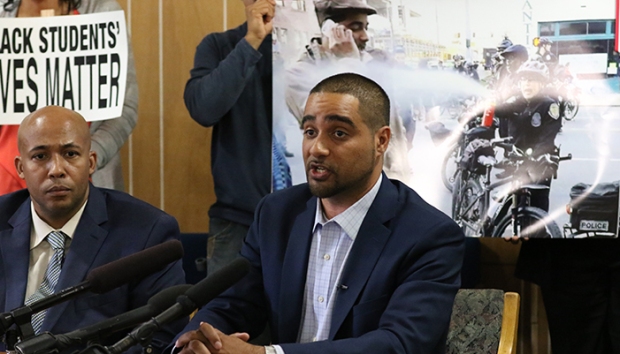
History teacher Jesse Hagopian talks about his $100,000 settlement with the City of Seattle after being pepper-sprayed by a police officer last year. Hagopian is using the proceeds from the settlement to fund youth activists and community-based organizations. Staff Photo/Chris B. Bennett.
By Chris B. Bennett
The Seattle Medium
Jesse Hagopian, a community activist and history teacher at Garfield High School, recently reached a $100,000 settlement with the City of Seattle for an incident in which he was pepper-sprayed, without provocation, by a Seattle Police officer after he gave a speech at a community rally on Martin Luther King, Jr. Day in 2015.
At the time of the incident, Hagopian was on the phone with his mother– arranging plans for a ride to his two-year-old son’s birthday party — when Seattle police officer Sandra Delafuente assaulted him with pepper-spray.
“That day was deeply painful, and not only because of the burning in my ears, nostrils, and swollen eyes,” said Hagopian. “What hurt the most was the fear that I brought to my two sons who were deeply troubled watching me writhe in pain and pour milk on face to try to sooth the burning.”
The pepper-spray assault was caught on video and garnered millions of views online and was the subject of national and international news stories. As a result of the video, Hagopian was able to show that the incident was unwarranted.
“It is deeply disappointing that we are in this place again that we see how protestors and peaceful marchers are treated by the Seattle Police Department,” said Attorney James Bible, whose law firm represented Hogapin in his claim against the City. “I think the question that should be posed by many is what would happen if there, in fact, was no video in this particular case. We’d be stuck with nothing but the narrative of law enforcement and what we know now is that the narrative of the law enforcement rarely, if ever, matches the video that we’re able to capture and gather on occasion.”
Hagopian, to his credit, has turned the incident into an opportunity to support people who are making a difference in the Seattle area, as he is providing money from the settlement to support the work of groups and individuals to improve the plight of people of color.
At a press conference held Monday at the NAACP office, Hagopian announced the establishment of his Black Education Matters Scholarship for student activist. Hagopian presented three high school students – Marcelas Owens, Ifrah abshir and Ahlaam Ibraahim – with $1,000 to use in order to continue their work in the community.
Marcelas Owens has been on the recognized for her work both locally and nationally on healthcare and transgender issues.
Ahlaam Ibraahim hosts an annual Islamophobic event to educate people who may be afraid of Muslim people due to media bias. In addition, she also uses social media to address bad things Teacher Uses Settlement Proceeds To Fund Activists, Organizations | I AM AN EDUCATOR:


CURMUDGUCATION: Eli Broad's Bloodless Coup

CURMUDGUCATION: Eli Broad's Bloodless Coup:
Eli Broad's Bloodless Coup
I don't think there's ever been anything like it.


Well, maybe Teapot Dome, kind of. Back in the early 1920s, the feds had special oil reserves set aside for the Navy. One was near Teapot Dome in Wyoming, and during the administration of Warren G. Harding, some folks engineered the oil reserves at Teapot Dome being handed off to the department of the interior. But since Secretary Albert Bacon Fall had been fully bought by Sinclair Oil, he quickly and quietly turned over what was supposed to be a public national resource to a private company in a secret-ish no-bid process that let the oil go for so little money that it could hardly be called selling it.

Imagine. There was a time when that sort of thing, with public officials bought and corrupted by private interests giving away public resources, was actually shocking.

But now it's 2016, and if Eli Broad wants to just go ahead and take over a public school system, he can just go ahead and do it in plain sight.

This, of course, is not new. Broad long ago decided that education would be better run by people with a business background, not an education one, and so he set up Broad Academy, a-- school? program? thingy?-- that finds the Right People, puts them through some edu-business training, and declares that they are fit to be superintendents because Eli Broad says they are. It is an amazing piece of ballsiness, as if I set up an Officer's Training School in my back yard and started issuing certificates declaring my graduates were First Lieutenants in the US Army. Well, it would be like that if I were really, really rich and well-connected and managed to convince the US Army to let my trained "officers" actually take command. But this is the guy who literally wrote the book about how to shut down a public school system and replace it with privately operated charters. 

Broadies have been put in place in districts all around the country. And what we saw in Kansas City, when Broad picked up the phone and told John Covington that he was going to Detroit, is that the 
CURMUDGUCATION: Eli Broad's Bloodless Coup:


Wisconsin Faculty Fighting the Destruction of Public Higher Education

Wisconsin Faculty Fighting the Destruction of Public Higher Education:

Wisconsin Faculty Fighting the Destruction of Public Higher Education

Scott_Walker_HigherEd_Cuts
A faculty vote of “no-confidence” is the nuclear option on campus— the “delete your account” of academia. It says publicly, loudly, and collectively that professors no longer believe their president or other leaders can give students what they need.
This spring, an unprecedented wave of thousands of faculty on University of Wisconsin (UW) campuses, plus the 13 two-year UW System Colleges, have voted no-confidence in UW System President Ray Cross and Board of Regents. Fed up with devastating state budget cuts, attacks on tenure and shared governance, and also what they see as the systematic demolition of one of the world’s finest public universities for political purposes, they have said enough is enough.
“By voting no confidence, we protest the intentional destruction of our internationally recognized university system,” UW-Milwaukee professor Rachel Ida Buff told the Milwaukee Journal Sentinel.
In Milwaukee, the largest meeting of  UWM faculty in decades or possibly ever—nearly 300 people—voted unanimously in May. Their vote was preceded by the initial action at UW-Madison, the system’s flagship university, and also UW-River Falls and UW-La Crosse, and then quickly followed by similar censures on other campuses. “This resolution is an expression of frustration…over what has happened to public higher education [here] over the past year, 18 months, whatever,” said Mitch Freymiller, University of Wisconsin-Eau Claire Senate chair, to Wisconsin Public Radio.
Meanwhile, key UW faculty members have thrown up their hands at Wisconsin Gov. Scott Walker—the architect of these university “reforms”—and quit UW altogether. “At my new university in another state, I will have stronger tenure protections than I now have here. I will earn about 50 percent more than my current salary for the Wisconsin Faculty Fighting the Destruction of Public Higher Education:


Orlando - Network For Public Education

Orlando - Network For Public Education:

Orlando
NPE Orlando Home Featured


 The Network for Public Education joins the BATs in expressing our deep sorrow for those killed in Orlando and urge educators to fight for LGBT inclusion and tolerance in our schools.

Click HERE to read the statement.

The Sacramento city voters have spoken - Opinions

Sacramento News & Review - The Sacramento city voters have spoken - Greenlight - Opinions - June 16, 2016:

The Sacramento city voters have spoken

The Sacramento Metropolitan Chamber of Commerce and city council should listen
Jeff vonKaenel is the president, CEO and majority owner of the News & Review newspapers in Sacramento, Chico and Reno.


The Sacramento city voters have spoken. Darrell Steinberg will be our new mayor, and city council members Allen Warren, Steve Hansen, Eric Guerra and Larry Carr all will be returning.

None of the city council races were seriously contested. No one even ran against Guerra. Despite a long list of mayoral candidates including Tony “The Tiger” Lopez and fighting single mom Councilwoman Angelique Ashby, Steinberg won in a landslide, capturing 59 percent of vote.

While the Sacramento council will be the same, it will be a whole new ballgame with Steinberg replacing disgraced Mayor Kevin Johnson. While reasonable people can agree or disagree about the arena or the strong-mayor initiative, anyone who has listened to the police-recorded transcript of Johnson talking with Phoenix teenager Mandi Koba will probably agree that a 10-foot pole should be kept between him and their underage daughter. And it appears there are numerous other women who wish a similar pole had been placed between them and Mr. Johnson.

Now that we have a new mayor, the new mayor and council should appoint the new city manager. In a puzzling and petty move, Johnson led an effort to replace City Manager Sacramento News & Review - The Sacramento city voters have spoken - Greenlight - Opinions - June 16, 2016:

Teacher Unions Are ‘Bargaining for the Common Good’

Teacher Unions Are ‘Bargaining for the Common Good’:

Teacher Unions Are ‘Bargaining for the Common Good’

Unions across the country are expanding their focus to the broader community.

AP Photo/Elaine Thompson
Teachers at West Seattle Elementary School begin walking a picket line Wednesday morning, September 9, 2015, in Seattle after last-minute negotiations over wages and other issues failed to avert a strike in Washington state's largest school district. 

This week, the Los Angeles school board voted to approve a new bargaining agreement with UTLA, the city’s teachers union. Local community organizations—like Los Angeles Alliance for a New Economy, Alliance of Californians for Community Empowerment, InnerCity Struggle, and the Advancement Project—hailed the “groundbreaking” agreement for directing more resources towards students in high-needs schools. Some specific items UTLA bargained for included hiring a Pupil Services and Attendance counselor for high-poverty high schools, and hiring a new teacher for the 55 most needy elementary schools in order to reduce class size. Union members voted overwhelmingly in support of this new contract a week earlier.
“We commend UTLA’s innovative leadership in leveraging its bargaining power to deliver real and impactful investments for low income communities of color,” said John Kim, the Advancement Project’s executive director, in a statement.
UTLA’s president, Alex Caputo-Pearl, said in an interview that his union sees collective bargaining as an important tool available to fight for equity and justice. “A lot of people consider teacher union contract negotiations to be about narrower issues like salaries, benefits, and work rules—and all of those are important and we deal with those—but we’re using these agreements to expand what the union goes to the table for.” Caputo-Pearl says UTLA can ultimately be a vehicle to push for collaborative policy alongside community organizations. “We’re bargaining for the common good,” he declared.
This idea of “bargaining for the common good”—and working in partnership with local allies—is not a new idea for labor unions, but its potential has never been fully realized, and past efforts have not gone deep enough. One major obstacle has been that labor law tries to limit unions to bargaining just over issues of wages and benefits.
“Unions have been significantly hobbled by the legal regime, and a lack of imagination to challenge it,” says Stephen Lerner, a longtime labor organizer.
But now, partly because of the historic action the Chicago Teachers Union took in 2012, when its members went on strike not just for themselves, but also for increased public services for the broader community, more and more unions have started to reconsider their fundamental roles and responsibilities. By expanding their bargaining demands beyond wages and benefits, unions are recognizing that they can more fully support, and engage their community partners—and get those community groups to support them in return.
“I think there’s a growing feeling that if you operate within the confines of the law, you restrict the things that potentially give you power,” says Lerner. “We have to be willing to go beyond what the law allows.”
In 2014, leaders from public sector unions and community organizations gathered Teacher Unions Are ‘Bargaining for the Common Good’:

Were Common Core’s ELA Standards written by charlatans? Sure seems so.  | NewBostonPost

Were Common Core’s ELA Standards written by charlatans? Sure seems so.  | NewBostonPost:

Were Common Core’s ELA Standards written by charlatans? Sure seems so. 


To bypass statutes forbidding the federal government to develop national standards, two private organizations—the National Governors Association (NGA) and the Council of Chief State School Officers (CCSSO)—in coordination with Achieve, Inc., a private organization established by the NGA and business officials in 1996, agreed to develop Common Core’s standards. Expenses for managing the project were defrayed by the Bill and Melinda Gates Foundation, another private organization. In the absence of information from all these private organizations, it seems that Achieve, Inc. and the Gates Foundation selected most of the key personnel to write the standards. We do not know why.
The “lead” writers for the grade-level English language arts (ELA) standards, David Coleman and Susan Pimentel, had never taught reading or English in K-12 or at the college level. Neither has a doctorate in language or literature. Neither had ever published serious work on K-12 curriculum and instruction. Neither had produced literary scholarship or research in education. In 2010, they were virtually unknown to the entire field of English and reading educators and higher education faculty in rhetoric, speech, composition, and literary study. The absence of relevant professional and academic credentials in the “chief architects” of Common Core’s ELA standards helps to explain their major flaws, including:
1.  Most of Common Core’s college-readiness and grade-level reading standards are content-free skills. For example, one “anchor” standard is: “Analyze how and why individuals, events, and ideas develop and interact over the course of a text.” The grades 11/12 standard “clarifying” this anchor standard is: “Analyze a complex set of ideas or sequence of events and explain how specific individuals, ideas, or events interact and develop over the course of the text.” This so-called standard is really a free-floating skill because it can be applied to “The Three Little Pigs” or to Moby-Dick.
Why does this matter? It matters because skill training in the absence of significant literary/historical content doesn’t prepare kids for college, career, or critical thinking.
2.  Common Core’s ELA standards stress writing more than reading at every grade level. Every experienced teacher knows the foundation for good writing is good reading. Students need to spend far more time in and outside of school reading in order to improve reading and writing in every subject. Common Core’s lead writers got it exactly backwards.
3.  Common Core’s writing standards are inappropriate at many grade levels. Most elementary children have little understanding of what “claims,” “relevant evidence,” and academic “arguments” are. How did this get by the hundreds of state department of education reviewers?
4.  Common Core expects English teachers to spend at least half of their reading instructional time at every grade level on informational texts. Common Core lists 10 reading standards for informational texts and 9 standards for literary texts at every grade level, reducing literary study in the English class, in effect, to less than 50 percent. However, English teachers are not trained, either by Were Common Core’s ELA Standards written by charlatans? Sure seems so.  | NewBostonPost:


Charter Schools Break the Rules and Don't Seem to Care

Charter Schools Break the Rules and Don't Seem to Care:
Charter Schools Break the Rules and Don’t Seem to Care


Charters schools, when first proposed in the late 1980s, were envisioned as a way for public school systems to experiment with educational options. Some still play this role. However over the last two decades charter schools have largely evolved into a way to make money from public dollars, either through for-profit charter school corporations or for well-paid CEOs of supposedly not-for profit charter school networks.
Thanks to big pushes by the Bill and Melinda Gates, Walton Family, and Broad foundations, California now has over 1,200 charters schools enrolling about seven percent of the state’s students. That includes about sixteen percent of the students in Los Angles and twenty-five percent in Oakland. The number keeps growing even though there is no proof that charters perform better than regular public schools. Three recent stories about Charter Schools and the school deform movement should make readers ask, “Is this what they mean by school reform?”
Alliance College-Ready Public Schools (Alliance), the largest charter school chain operating in Los Angles, California faces an investigation for using public funds to while trying to defeat a teacher-led union drive at its schools. A special committee of the California Legislature ordered the state auditor to investigate Alliance and the California Charter Schools Association (CCSA). The charter chain, which serves 11,000 students in 27 taxpayer-funded but privately operated schools, has received hundreds of millions of dollars in public funds. The committee wants to know how much public money was diverted into the fight against teachers who wanted to unionize and how CCSA acquired contact information for students and their families that they used in the anti-union campaign. The anti-union campaign reportedly included illegal surveillance of union activists, interference with meetings, phone calls to parents attacking teachers involved in the campaign, blocking teacher emails, and retaliation against organizers. State Senator Tony Mendoza (D), who initiated the move against Alliance charged, “The purpose of those funds is to educate children inside the classroom — not to intimidate teachers and parents.”
Teachers organizing the union drive at Alliance filed legal complaints with the California Public Employment Relations Board (PERB). Following a review of the charges, PERB attorneys filed four unfair labor practice complaints against Alliance and Los Angeles County Judge James Chalfont issued two restraining orders against the anti-union activities.
Groups associated with the California Charter Schools Association (CCSA) are pouring money into legislative campaigns trying to elect a pro-charter majorityCharter Schools Break the Rules and Don't Seem to Care:


Wednesday, June 15, 2016

CURMUDGUCATION: Houston Slams VAM (Plus: All About SAS)

CURMUDGUCATION: Houston Slams VAM (Plus: All About SAS):

Houston Slams VAM (Plus: All About SAS)


As a Pennsylvanian teacher, I am paying particular attention to the news from Houston, where VAM just suffered another well-deserved loss. I'll get to that in a second, but let me set the stage and tell you a little story of how we arrived here.

Houston and Reformsters 

The Houston Independent School District has always been out in front of education reformsterism. It was Houston where Superintendent Rod Paige performed the "Texas Miracle" of  raising test scores even for non-wealthy, non-white students. The Texas Miracle became part of the justification for the test-driven baloney of No Child Left Behind, and Rod Paige was whisked to Washington to employ his miracle-inducing powers as George Bush's Secretary of Education.

Only, there was no Texas Miracle. Houston was not an example of how test-centered accountability could create excellence; instead, it was an example of Campbell's Law, of how using bad measure as proxy for a complex social behavior just leads to increasing corruption (aka gaming, spinning and cheating) of that measure. Houston schools had pushed low-scoring students out the door, or held them back a year and then leapfrogged them over the testing grade.

Fast forward a few years, and we find HISD signing on with SAS to use their nifty Value-Added instrument called EVAAS.

The SAS Story 

SAS has been in the analytics for a while ("Giving you the power to know since 1976"). FounderJames H. Goodnight was born in 1943 in North Carolina. He earned a Masters in statistics; that combined with some programming background landed him a job with a company that built 
CURMUDGUCATION: Houston Slams VAM (Plus: All About SAS):

L.A. education reform group names board, signals shift from charter-school-only focus - LA Times

L.A. education reform group names board, signals shift from charter-school-only focus - LA Times:

L.A. education reform group names board, signals shift from charter-school-only focus

Controversial group that began with the mission of rapidly expanding charter schools in Los Angeles has named its board of directors, come out with a plan and publicly defined its mission as supporting new, successful public schools of any kind.
The board for Great Public Schools Now mostly includes faces and groups that are familiar in the education reform wars of L.A., including representatives from the Eli and Edythe Broad Foundation and the Walton Family Foundation.
The chair of the nonprofit is retired banker Bill Siart, the only board member who had been previously announced. In 1997, Siart vied to become superintendent of L.A. Unified, losing out to insider Ruben Zacarias. Later, Siart founded ExED, a company that provides specialized office services to charter schools.
Nearly all the other board members are widely regarded as pro-charter, even though their backgrounds are diverse.
Charters are independently operated, free public schools that are exempt from some rules that govern traditional campuses. Most are nonunion.
Siart said he hopes L.A. Unified will work with the nonprofit to create superior schools.
“They have some very good schools — some magnet schools and traditional schools — that are performing well for kids,” he said, then added, “and they have other schools that don’t,” even after repeated turnaround efforts.
“A lot of turnarounds don’t turn around,” Siart said. “We need to see demonstrated success, not hope.”
The group’s glossy, 16-page plan identifies 10 low-income, low-achievement neighborhoods as areas of focus. Clustered in the east San Fernando Valley and south and east of downtown, they include Boyle Heights, Pacoima and South Gate. 
Although the plan is short on specifics, the group plans to announce its first grants L.A. education reform group names board, signals shift from charter-school-only focus - LA Times: