Latest News and Comment from Education

Saturday, February 27, 2016

The Philanthropic Hypocrisy of Eli Broad, Billionaire and Leading Education Reformer - Working In These Times

The Philanthropic Hypocrisy of Eli Broad, Billionaire and Leading Education Reformer - Working In These Times:
The Philanthropic Hypocrisy of Eli Broad, Billionaire and Leading Education Reformer


 The Broad, an immaculate white postmodern structure, is the latest architectural jewel representing the revival of downtown Los Angeles.

The self-titled museum is a “gift” from Eli Broad, the billionaire Angeleno property developer-turned-philanthropist. Broad is attempting to use his gifts to the arts and a high-profile push to shake up the city’s education system as a way to etch his name deep into the streets of Los Angeles.
But Broad’s philanthropy is two-faced. While publicly making dramatic, self-aggrandizing gestures supporting Los Angeles’ poor children and their schools, Broad’s private business practices and political machinations cripple the very communities he claims to support. The $140 million museum, meant to be a symbol of Eli Broad’s public largesse, is actually a symbol of his philanthropic hypocrisy. 
The man who wants to transform public education by bringing market discipline to schools has no problem gorging at the public trough to beef up his namesake museum.
In 2011, Broad syphoned off $52 million of public tax dollars meant for Los Angeles’ poor communities to subsidize his museum’s parking garage—more than all of South LA’s 800,000 mostly low-income residents received from the same public fund that year.
For Broad, it’s all about the gestures. While South LA’s schoolchildren fight for a roof over their head, at least they’ll have a nice place to park when they come to see Broad’s personal art collection.
Eli Broad, who is estimated to be worth $7.4 billion, styles himself an advocate for poor black and brown children. Urban education is his pet project. Decrying the underperformance of poor children of color, Broad points the finger at unionized public school teachers and bureaucracy, claiming educators simply aren’t working hard enough to improve academic outcomes. To save the children, Broad wants to reform education along a corporate model—privatizing schools, busting teachers’ unions and imposing punitive accountability systems. Broad is calling for—and helping fund—a complete transformation of the American education system. And he wants it done in his name.
He trains school leaders to apply business practices to schools through the Broad Residency at the Broad Academy, and rewards compliant school districts with the Broad Prize, of $250,000. Broad’s latest headline-grabbing proposal is to pull 50 percent of Los Angeles’ schoolchildren (what one report refers to as “market share”) into privately managed, non-union charter schools over the next eight years.
But as Broad trumpets his self-branded corporate fix to education, his after-school activities actually undercut the communities he purports to be helping.
In 2012, Broad publicly proclaimed his support for California’s Proposition 30—a bill aiming to raise income taxes on the wealthiest Californians to stave off massive school budget cuts. “I do support it,” Broad told the LA Times in an article all about his progressive endorsement. “Those of us that are wealthy like myself should pay more. There are so many human needs in education and elsewhere.”
It was not until two years later that a state investigation uncovered Broad’s scheme. While soaking in public praise for The Philanthropic Hypocrisy of Eli Broad, Billionaire and Leading Education Reformer - Working In These Times:


Will Competency-Based Learning Rescue the Testocracy? - Living in Dialogue

Will Competency-Based Learning Rescue the Testocracy? - Living in Dialogue:

Will Competency-Based Learning Rescue the Testocracy? 

By Anthony Cody.
We have been badgered for the past 14 years by reformers insisting on the fierce urgency of change, and they have had their way – twice! First, seven years of NCLB, followed by the past seven years of Race to the Top, and now the “next generation” of tests, which were promised to be “smarter,” computer-adapted, and deliver results more quickly. None of it worked. Scores on the independent NAEP tests are flat or down. The SBAC and PARCC tests are more difficult without being any “smarter” in telling us about what our students can do. The idea that these tests could somehow promote and measure creativity and critical thinking is debunked. The growing opt out movement poses a huge threat to the standardized testing “measure to manage” paradigm.
So what is to be done?
Reinvent the tests once again, using technology. And who better for the job than Tom Vander Ark, formerly of the Gates Foundation, and now associated with a long list of education technology companies. The latest package of solutions is being called “competency based learning,” and it was featured prominently in theDepartment of Education’s latest “Testing Action Plan.”
Jobs to be done. To get at the heart of value creation, Clayton Christensen taught us to think about the job to be done. Assessment plays four important roles in Will Competency-Based Learning Rescue the Testocracy? - Living in Dialogue:


United Opt Out Conference Highlights Dual Role of Technology in Education | gadflyonthewallblog

United Opt Out Conference Highlights Dual Role of Technology in Education | gadflyonthewallblog:

United Opt Out Conference Highlights Dual Role of Technology in Education

FullSizeRender

Click Here to Watch United Opt Out Conference:  Live Streaming by Film Our Way Films - YouTube http://bit.ly/1n2E5rk


Technology is the most powerful weapon we have against corporate education reform.
It is also our greatest foe.
Such were the remarks of Dr. Stephen Krashen at the United Opt Out Conference on Friday.
The linguist, educational researcher and activist gave the opening keynote address to hundreds of people who traveled to Philadelphia for the conference.
Krashen, who is known for his work on second language acquisition and bilingual education, has been a strong critic of the test and punish policies of the Barack Obama administration.
He warned the assembly of parents, students, teachers, professors and activists about the dangers of Competency Based Education (CBE), the next big thing in the movement to dumb down public schools.
CBE is touted as a way to reduce high stakes standardized testing by allowing students to work at their own pace while on various computer programs. However, Krashen sees this is an increase in testing.
In effect, it’s testing everyday. The computer programs used in CBE are little more United Opt Out Conference Highlights Dual Role of Technology in Education | gadflyonthewallblog:

The newest fad in education — and why some teachers find it troubling - The Washington Post

The newest fad in education — and why some teachers find it troubling - The Washington Post:
The newest fad in education — and why some teachers find it troubling


It’s called “competency-based learning” and its the newest thing in education. What is it? Who likes it? Who doesn’t and why?
On its face, competency-based learning sounds good. Students learn material and move on when they have mastered the material, going at their own pace. But how exactly do students get this sort of education and what are the consequences? Veteran educator Anthony Cody writes in the following primer that competency-based education is fundamentally a way to push kids onto computers to learn — and to take test after test to prove their “competencies.”
Cody worked in high-poverty schools of Oakland, California, for 24 years, 18 of them as a middle school science teacher. He was one of the organizers of the Save Our Schools March in Washington, D.C. in 2011, and he is a founding member of the nonprofit Network for Public Education. A graduate of the University of California Berkeley and San Jose State University, he now lives in Mendocino County, California. This appeared on his worthwhileLiving in Dialogue blog, and he gave me permission to republish it.

By Anthony Cody
We have been badgered for the past 14 years by reformers insisting on the fierce urgency of change, and they have had their way — twice! First, seven years of the test-centric No Child Left Behind, followed by the past seven years of Race to the Top, and now the “next generation” of tests, which were promised to be “smarter,” computer-adapted, and deliver results more The newest fad in education — and why some teachers find it troubling - The Washington Post:


‘Why are they in my class?’ A teacher talks candidly about the most difficult students - The Washington Post

‘Why are they in my class?’ A teacher talks candidly about the most difficult students - The Washington Post:

‘Why are they in my class?’ A teacher talks candidly about the most difficult students


 People who enter the teaching profession are generally those who want to help and make a difference in the lives of young people. Kids who present problems of one kind or another are often seen as welcome challenges — except when they consistently, despite effort, prove highly disruptive to everyone else in the class. What are teachers supposed to do with students placed in their class who they just don’t want in their class?

Here is one teacher’s candid observations about her own experience with those students she would rather not be in her class. She is Alice Trosclair, who has been teaching for nine years in south Louisiana. She currently teaches American literature, English Language and Composition (AP), and English Literature and Composition (AP). She lives with her husband and son, and has what she calls hundreds of “adopted” children — her students. This was first published in The Educator’s Room here, and I am republishing it with permission.

By Alice Trosclair
We all have difficult students — and some are more difficult than others. I have never shied away from a challenging student. I have my “projects” than I am determined to save, even they don’t want to be saved because I believe ‘Why are they in my class?’ A teacher talks candidly about the most difficult students - The Washington Post:

Cameron Henry’s HB 122 Could Bust LDOE | deutsch29

Cameron Henry’s HB 122 Could Bust LDOE | deutsch29:

Cameron Henry’s HB 122 Could Bust LDOE

The Louisiana legislature is in special session in order to confront an almost $1 billion budget shortfall for 2015.
One principal concern is whether K12 education will take a severe hit. As such, HB 122 authored by Rep. Cameron Henry and introduced on February 23, 2016, was cause for consternation for including a $44 million reduction to Minimum Foundation Program (MFP) funding. Though Henry’s bill initially included wording to preserve the MFP from the 2014 regular legislative session, MFP at that time was already being underfunded under the Jindal administration– which still made HB 122 a threat to 2015 MFP.
A Louisiana Federation of Teachers (LFT) action alert email included the following details about Henry’s proposed $44 million MFP cut:
A bill that would cut $44.2 million from public education with just three months left of school was approved by the House Appropriations Committee. If the bill passes, it could mean drastic reductions, pay cuts, layoffs and early closure of school.
The bill, which came as a surprise to committee members this morning, could be heard as soon as Thursday, February 25.
HB 122 by Rep. Cameron Henry (R-Metairie) would cut $87 million from the budget, with about half of it coming from public K-12 education. …
The $44.2 million is money that then-Representative John Bel Edwards convinced lawmakers to add to the education budget last year. It was intended to help make up for the fact that the MFP has not included the usual 2.75% growth factor during much of the Jindal administration.
…The money goes toward the $600 pay raise approved for teachers in 2013, 
Cameron Henry’s HB 122 Could Bust LDOE | deutsch29:


Take NPR Ed's Survey ... Please! : NPR Ed : NPR

Take NPR Ed's Survey ... Please! : NPR Ed : NPR:

Take NPR Ed's Survey ... Please!

Take our survey!


 Take our survey now!

At NPR Ed we spend a lot of time thinking about metrics. In the education world this includes things like test scores and grades, and increasingly "big data" and "analytics". In the world of digital journalism, the analytics we use include pageviews, Facebook likes (or now, "Hahas" or "Wows"), comments, and retweets.
But sometimes we want to ask specific questions in a more nuanced way than just reading through a bunch of numbers. We really want to know:
What's your favorite NPR Ed story? Have you ever used NPR content in the classroom? What stories are you interested in? More K-12, or higher ed? What ​shouldwe be covering?
Also, who ARE you? Are you a teacher, a student, a parent, or is your name Ed and you thought this page was hyper-personalized content?
Educators, too, are increasingly using surveys to measure qualities that can't be gotten at by traditional tests.
We'd love to hear from you — just click here. There's a surprise for you at the end.Take NPR Ed's Survey ... Please! : NPR Ed : NPR:

CURMUDGUCATION: Choice $$ Lies and What Do They Know?

CURMUDGUCATION: Choice $$ Lies:
Choice $$ Lies

This little undated brief from the good people at The Heartland Institute lays out the straightforward argument for vouchers (and by extension, charter-choice systems) as a money-saver, and it's so clear and straightforward, it's easy to see where the lie is.

The Heartland Institute is a right-leaning thinky tank-- well, actually, they don't appear to be so much leaning as lying down on their right sides atop a mattress stuffed with corporate cash. Founded by a CATO Institute refugee, they're based in the Chicago area (Arlington Heights) and have previously taken such bold stands as teaming up with Phillip Morris to oppose tobacco bans. They've hooked up with some Tea Party groups, and they are a top clearing house for climate change denial.

Their argument in favor of vouchers is as simple as it is wrong.

Florida’s voucher program, for example, costs $3,950 per student, compared with a public school system that spends $7,000 per pupil. Surely even the efficiency of the free market can’t make up for a 44 percent funding deficit, right? Wrong: A Northwestern University study found no difference between achievement in students attending schools through voucher programs and those attending public schools.

I'm not even going to argue with the second part of their point, because the first part is where the lying occursThere are several links listed with the article, and they all make the same point-- that choice systems save the taxpayer money because choice-charter-voucher schools educate students for 
CURMUDGUCATION: Choice $$ Lies:

What Do They Know?


Anthony Cody has a great piece at his blog, Living in Dialogue (which should be on your must-read list) that puts the push for Competency based Education in the context of the reformster movement. In particular, this--

There are two unwritten assumptions that are constant from the beginning of NCLB and carry through to this new version. Teachers are not trusted to make judgments about what students learn, how they learn it, or how learning is assessed. Assessment is defined as the external monitoring of the work inside the classroom. The second assumption is that data and technology must be instrumental in whatever process is devised. The main innovation here is the more thorough and intrusive penetration of the classroom via computers capable of monitoring learning.

One question that naturally follows-- why, exactly, are teachers not to be trusted? Reformsters tend to fall into two camps.

One camp includes groups like DFER and Students Matter and some leaders of Teach for America, when they didn't think anyone was listening, who believe that the teacher biz is a giant, corrupt racket that the Big Teacher Unions keep in place in order to enrich themselves For an example, just flash back to Chris Christie's "punch in the face" comments.

But I believe the far larger camp is the one that thinks teachers can't be trusted because we Just 
What Do They Know?

Navigating a “No Zero” Policy – the becoming radical

Navigating a “No Zero” Policy – the becoming radical:

Navigating a “No Zero” Policy


 A “no zero” policy is receiving media attention and stirring controversy and resistance in Greenville, South Carolina.

Establishing a “no zero” policy is counter-intuitive for most people since it seems to work against a sense of fairness, and as those who oppose the policy typically respond, a “no zero” policy seems to encourage laziness and even passing students along who do no work.
However, a “no zero” policy is the right thing to do both statistically and academically—but only if that policy is part of wider assessment practices that support dropping zeroes as part of the grading system.
First, I recommend reading carefully an analysis that shows why assigning zeroes is flawed in a traditional A-F grading system in which the F range is often 50-60 points while all other grade ranges are 10 or fewer points. As Cristea explains:
The flaw in the system is that a 100-point grading scale does not mathematically equalize zeros to have the same weight as other scores. This paper presents the view that zeros are not fair to anyone including students, parents, teachers, and society as a whole.
The statistical flaw of zeroes and a disproportionate F range lead us to the equity problem. AsRick Wormeli has noted, fair isn’t always equal. So let me lay out briefly the broader assessment practices and concerns that must be in place when a “no zero” policy is adopted (and the “no zero” policy and these issue below should be implemented).
Schools, teachers, parents, and students must set aside grading as a system of rewards and punishments, and begin to see grading as a subset of assessment, which must be used as a system of feedback and student revision to support student learning.
In other words, assessment, tests, and grades must become part of learning and not the conclusion of learning.
In that context, student assignments, tests, and performances must be viewed as obligations by the students; in short, they must be done.
Ideally, all students would complete all assignments with mastery at the same rate, but in the Navigating a “No Zero” Policy – the becoming radical:

Schooling in the Ownership Society: Sleazeball U

Schooling in the Ownership Society: Sleazeball U:

Sleazeball U


“I really felt stupid that I was scammed by Trump,” Guillo said. “I thought that he was really legit.”
Don't feel so bad, Bob. The whole Republican Party is being scammed by The Donald.  
Students borrowed $36,000 to attend Trump University and all they got, according to Rubio, was a "picture with a cardboard cutout of Donald Trump.”

In three pending lawsuits, including one in which the New York attorney general is seeking $40 million in restitution, former students allege that the enterprise bilked them out of their money with misleading advertisements. their lawsuits, former students say they were given lessons that were useless or even illegal and that they were badgered into taking course after expensive course.

Trump University launched in the mid-2000s as an Internet venture owned by Trump. For several years, it also offered weekend classes in hotel ballrooms across the country to teach financial tips. Some students paid more than $30,000 for a chance to learn Trump’s investment magic and participate in mentorship programs, court records show. (Trump also sold Trump University merchandise, according to an archived website, including hats.)

It's not that Trump never had anything of value to offer. In a blog associated with his sleazy "university", he complained about Judith Miller’s reporting in The New York Times ahead of the 2003 Iraq invasion.

But students shouldn't have had to pay big bucks for that. They could have got that on my blog for free.Schooling in the Ownership Society: Sleazeball U:

How Bill de Blasio Is Using 'Community Schools' to Improve Education in New York City - The Atlantic

How Bill de Blasio Is Using 'Community Schools' to Improve Education in New York City - The Atlantic:

Why Non-Academic Needs Matter, Too

A day in the life of a new kind of educator who’s tasked with revitalizing one of New York City's campuses by supporting kids' health, attendance, and family lives

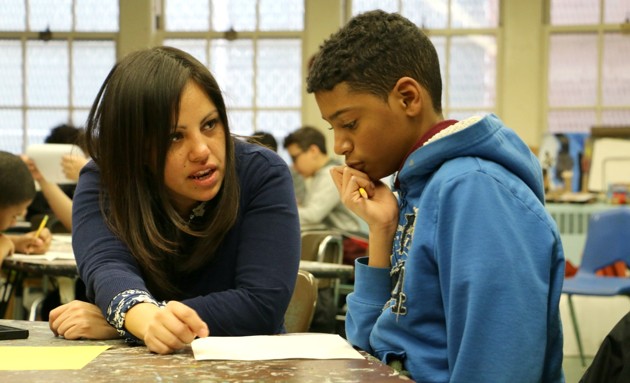
Fiorella Guevara, left, looks at student writing samples with a bilingual teacher at M.S. 50 in Williamsburg


 Around 4 p.m. on a recent Friday, Fiorella Guevara got around to eating her lunch. Then she leaned back in the student-sized chair where she was sitting in an empty classroom and let out a long sigh. “Oh man, I’m tired,” said Guevara, the new community-school director at M.S. 50 in Brooklyn’s Williamsburg neighborhood. “This is why I never sit down for too long.”

Instead, she bounds from room to room, checking on the classes she oversees, meeting with the principal or calling up parents, pausing just long enough to hug one of the students whose affection she’s earned in her few months on the job.
“She is a fireball,” said Franklin Tapia, the parent of an eighth-grader at M.S. 50, whom Guevara recently hired to work as a mentor and soccer coach. “I don’t know how she does it. She’ll come in 9 o’clock in the morning sometimes. and she won’t leave until 9:30, 10 o’clock at night.”

Community-school directors like Guevara play a key role in Mayor Bill de Blasio’s plan to revitalize 94 of New York City’s low-performing schools—including M.S. 50, where just one in 10 students passed last year’s state English tests, and 40 percent of students are considered chronically absent. The mission of community schools is to treat students’ physical or emotional ailments so they can focus on learning. Each director is responsible for coordinating the activities, social services, and parent workshops that the mayor is hoping will help set the schools on a different path.
That’s a tall order. But if anyone seems up to the task, it’s Guevara, who taught elementary school for five years before working with an advocacy group dedicated to creating service-rich schools that partner with parents.

“I truly, 100 percent believe in community schools,” she said.

Chalkbeat, which produced this story, stopped by M.S. 50 recently to see how the job really worked. Here are highlights from Guevara’s day.

Guevara works with a student during an art class. (Patrick Wall / Chalkbeat)
11:20 a.m.—Troubleshooting

Guevara’s role requires quickly switching from nurse to counselor to administrator. When she walked into a bilingual class, where the children were eating a lunch of chicken and rice, she found a boy who had hurt his ankle. In fluent Spanish, she told him to get some ice and elevate it. Then she read a letter a girl had received from the health department saying she was missing a mandatory physical exam, though the girl said she’d already had it. Guevara promised to investigate.

Next, she dropped by a peer-mediation class that she started at the school this year. She listened in as the students, munching on pizza, discussed the need to stay neutral when settling disputes between classmates. Then Guevara, whose iPhone is always on hand, took a snapshot of the attendance list: A few students were missing. “My day-to-day is ensuring that the vision we’ve laid out is going,” she expl

ained. “And also troubleshooting when there’s something that’s not going right with the plan.”

Later, when she stepped into the crowded hallway as students returned from lunch, she hugged a girl, told a boy to spit out his gum, then pulled aside a student who had skipped the peer-mediation class. Without scolding, Guevara told her how important it is to show up for class, then sent her on her way. “Alright kids,” How Bill de Blasio Is Using 'Community Schools' to Improve Education in New York City - The Atlantic:

Wake County school board criticizes charter schools | News & Observer

Wake County school board criticizes charter schools | News & Observer:

Wake County school board criticizes charter schools


The issue of competition from charter schools hung over the Wake County school board’s recent two-day retreat.
In the past three years, Wake's charter-school enrollment has increased 54 percent to reach 9,577 students this school year. During the Saturday and Monday meetings, board members discussed the impact of competing with charter schools while also accusing charter schools of resegregating schools.
Charters came up in the course of talking about the limits of using student assignment to promote diversity and what kinds of programming the district can use to compete for students. Charter schools are taxpayer-funded public schools that are exempt from some of the regulations that traditional public schools must follow.
Charters, along with home schools and private schools, reduced the school system’s percentage of the county’s students – aka market share – to 81.1 percent last school year. With 157,180 students, Wake is the largest school system in North Carolina.
On Saturday, school board member Susan Evans talked about how offering small, innovative schools could help the district compete with charter schools.
“The other thing that we’ve got to continue to think smart about is how we maintain our market share and how we remain attractive to those families who can make other choices to go to private schools and charter schools,” Evans said.
“The additional competitive nature in our market of charter schools and other alternatives does create somewhat of a political hot potato to go back to practices that may have been in place in the mid-’80s of just moving people to a more diverse environment,” school board member Bill Fletcher said Monday.
All the talk about competition with charter schools raised concerns from school board member Jim Martin on Monday.
“In our discussion, it frequently comes up we’re trying to compare about competition with charters,” Martin said. “I think we need to be really cautious about that comparison.
If we look at a lot of the choice of charters, it has been a choice to resegregate. We don’t want to be involved in that competition.”
Martin was talking about how charter schools in Wake County tend to have either much higher percentages of white students or higher percentage of black students than the district. Not many charters mirror the school district’s demographics.
Martin said the district has already got enough magnet schools and innovative programming that he wanted to talk more about what they can do for most of the schools as opposed to having more one-off schools.
School board member Christine Kushner followed up Martin’s remarks by talking about how magnet schools help Wake provide choice in an “ethical way,” unlike charter schools. Like Martin, Kushner has had children attend the magnet program.
“That is where the strength of the magnet program – which is nested in those overall valuesWake County school board criticizes charter schools | News & Observer:


Read more here: http://www.newsobserver.com/news/local/education/wake-ed-blog/article62746202.html#storylink=cpy

What's the Matter with Detroit Schools? Pt III: Say Nice Things about Detroit - Teacher in a Strange Land - Education Week Teacher

What's the Matter with Detroit Schools? Pt III: Say Nice Things about Detroit - Teacher in a Strange Land - Education Week Teacher:

What's the Matter with Detroit Schools? Pt III: Say Nice Things about Detroit


While you're at it, say nice things about Flint. Both are great cities where democracy has been abandoned in favor of a "dashboard" with "metrics" that tell an "emergency manager" how he's doing. And now they're both in the public eye-- one because that management put poison in their water, and the other bankrupt and begging the state to let them rebuild what they once governed.
One thing is certain--chucking democratically elected boards and councils is not the answer.
In the meantime, a hat tip to the teachers who will go to their classrooms in Detroit, and Flint, tomorrow and teach their hearts out.  Not much has changed for the better (see 2013 blog, below)--except this: You matter.
What to do about a city like Detroit? What's the best way to serve the children there, who deserve the same free, first-rate democratic education that children all over this country are receiving?
Is there a way to rebuild a large urban school system, make it leaner, more nimble and responsive? Or do we "unbundle" the district's publicly owned resources, facilities and human capital and offer them to the highest bidders? Can you really charter your way to 100+ diverse schools, scattered across a huge city, all meeting the needs of equally diverse children? Do we concede the inevitable risk of start-ups failing and adding to the misery and waste index?
What is the preferred solution for schooling in a post-industrial wasteland?
Step One: Stop thinking of it as a wasteland, and re-frame Detroit as blank slate, a canvas upon which we can re-imagine education and other critical services on a human scale. It's possible if we have the will and persistence to do so, and--key point--these imaginative new forms of schooling are generated from within, rather than imposed by those who believe they know best, or are looking to make a quick buck selling "reform."
Step Two: Understand that there is no monolithic or comprehensive solution. There is no urban system that Detroit can turn to as template for success (despite Arne Duncan's insulting comment that Detroit could benefit from a Katrina). There is no sure-fire, replicable school model to "scale up." There are pockets of success to build on, but reformers are impatient with small victories and building slowly.
Step Three: Acknowledge that race is the hot wire that runs through all discussions about Detroit. Fordham professor Mark Naison says: Education reformers have as much right to call themselves civil rights advocates as Pat Boone would to call himself the father of rock n roll. An apt observation in Motown.
There are competing narratives about what happened to shift a proud and thriving industrial city into a city of empty storefronts and blocks of rubble. Was it the rebellions of 1967, which triggered an upsurge in something that actually started much earlier--white flight? Was it corruption in school and city administration? Or was it the final clear-out of the resources and wealth necessary to building a strong economy, abandoning a hollowed-out city?
Diane Ravitch took an excerpt from the first blog in this series and re-posted it under the title "If This Doesn't Break Your Heart, Nothing Will." A long string of 57 comments follows, devolving into predictably simplified sound bites interspersed with thoughtful dialogue: The unions did it! "They" did this to themselves, through fraud and infighting--and deserve what they get! Detroit isn't really a food desert! (Check this blog, which features photographs of the 111 "full-service" groceries in Detroit, and make your own judgment.)
And so it's been, for decades now, wrangling over the causes and scope of the problem. Do you ever wonder why families and teachers fight to save "bad" schools? Because often, those schools are the only points of hope in a devastated neighborhood. And besides--who gets to decide which schools are bad, and which are serving kids as well as can be expected?
Right now, the solution of choice in Michigan is removing all power from elected boards and the administrators they hire--and replacing them with "emergency managers." Over 50% of all African-Americans in Michigan now live in communities where their votes don't count--their elected officials have been disenfranchised, rendered toothless. The Detroit Public Schools have been under outside management, in various programs and degrees, since 1999. Things have not gotten better.
On the day that I posted the first blog in this series, a friend who teaches at an elementary school in southwest Detroit contacted me, asking if I would write a recommendation for her. An easy task--this teacher persuaded a group of her colleagues to pursue voluntary, after-school professional development a couple of years ago. Just one more good thing happening under the radar.
There's actually a lot of that in Detroit: A cadre of confident teachers who attempted to develop a teacher-led school. A union-led peer review and coaching project. An award-winning teacher who left DPS to serve as administrator in a start-up charter, but came back after finding that even though Detroit was chaotic, the charter offered no opportunities to share her expertise, to be a genuine leader.
First-world education problems in big, complex urban districts: Constant administrative churn. Disenfranchised boards. No clear idea of who's in charge. An overdose of "help," leading to too many new programs to absorb, too much technical assistance and too little attention to relationships or tapping talent already on hand.
There are many small flames of hope and promise. The urban gardening movement, for example. The Hope District. Catherine Ferguson Academy getting grant funding to explore starting an intentional community, a place for young moms to live safely and grow their own food. A faith-based Maker Space. Dozens of publicly funded schools where kids are treated as precious resources. Small victories.
A young man I spoke with in Detroit said: We used to talk, all the time, about sustainability. But that's a 20th century concept. Now we talk about flexibility, the opportunity for constant growth, change and innovation. No one solution.
Why say nice things about Detroit? Detroit matters to the health of the whole state of Michigan.
In fact, Detroit matters to the entire nation. If we can't solve problems with flagship businesses like the auto industry, or the problem of educating kids in deep poverty, we're in trouble. If the gap between haves and have-nots continues to increase, we're in danger. If we haven't gotten past old "us vs. them" human divisions, we haven't moved into the 21st century. And if more states decide that abolishing democracy is the best solution to our economic woes, we all lose. Big-time.What's the Matter with Detroit Schools? Pt III: Say Nice Things about Detroit - Teacher in a Strange Land - Education Week Teacher:

Friday, February 26, 2016

The Battle for Seattle, Part 2: Hijacked! | Seattle Education

The Battle for Seattle, Part 2: Hijacked! | Seattle Education:

The Battle for Seattle, Part 2: Hijacked!

For the first post in this series see: The Battle for Seattle, Part 1.
The Battle for Seattle, Part 2: Hijacked!
MILKEN CONFERENCE
“We take an untraditional approach to giving. We don’t simply write checks to charities. Instead we practice “venture philanthropy.” And we expect a return on our investment.” -Eli Broad

The Broad Foundation was established in 1999 and Eli Broad wasted no time in providing funds to school systems around the country including Seattle.
In 2000, the Broad Foundation provided the Seattle Public School system with $800,000 for “teacher training” by way of the Alliance for Education.
wendy_kopp (1)
Teach for America Founder Wendy Kopp
That same year, according to the Broad Foundation’s Annual Report for 2009-2010, “Wendy Kopp, whose decade-old venture called Teach for America grew out of her senior thesis at Princeton University, visits Eli Broad seeking guidance and support. The Broad Foundation makes its first investment of $800,000 in the organization, which recruits and trains recent college graduates to work in urban and rural school districts for a minimum of two years. By 2009, the foundation’s investment in Teach for America exceeds $41 million.” As an aside, Wendy Kopp has no experience teaching and has no degree in the field of education.
In 2001 the Superintendent of Seattle Public Schools, Joseph Olfchefske, participated in the New Schools Venture Fund Summit and spoke on the subject of Convergence of the Sectors: Public, Private, and NonProfit. The moderators included Tom Vander Ark, Executive Director of the Bill and Melinda Gates Foundation, Dan Katzir, Director of Program Development at the Broad Foundation along with Wendy Kopp, Founder and President of Teach for America and an assortment of representatives from KIPP and Aspire charter schools.
According to the same annual report, the Broad Foundation awarded a $2.5 million grant to New Schools Venture Fund in 2002. The annual report states that NSVF “invests in public charter school management organizations and other entrepreneurial ventures working to increase the number and quality of charter schools nationwide. By 2008, the foundation’s total investment in New Schools Venture Fund exceeds $13.6 million.”
New Schools Venture Fund has funded and promotes the KIPP charter school franchise, the Green Dot charter school franchise as well as Aspire charter schools and Teach for America.
weingarten
American Federation of Teachers (AFT) President Randi Weingarten.
In 2002, Don Nielson participated in the Broad Center for Superintendents Inaugural classtraining as a faculty member along with Randi Weingarten who was then President of the United Federation of Teachers and Don McAdams.
Also in 2002, Mr. Olchefske participated in the The Battle for Seattle, Part 2: Hijacked! | Seattle Education:


Compton teachers call in sick for the second time in a week, and students follow suit | 89.3 KPCC

Compton teachers call in sick for the second time in a week, and students follow suit | 89.3 KPCC:

Compton teachers call in sick for the second time in a week, and students follow suit

Compton second grade teacher Tamara Carter protests for a pay increase at school district headquarters.
Compton second grade teacher Tamara Carter protests for a pay increase at school district headquarters. ADOLFO GUZMAN-LOPEZ/KPCC
The year-long conflict in Compton between the school district and its teachers unions escalated on Friday. Compton Education Association President Patrick Sullivan said teachers at ten of the school district’s 37 campuses called in sick.
It was the second apparent sick-out of the week after the teachers union said 200 teachers called in sick on Monday. School district officials refused to release exact numbers for how many teachers and students did not attend school. 
The union said that teachers called in sick at seven elementary schools and three middle schools; district officials confirmed that "many" teachers did not attend work at nine campuses, but refused to name them.
“This is the second time this week that the teachers have chosen to miss work and carry over the issues related to the contract negotiations to our students, schools, and community,” school board president Satra Zurita said in a written statement.
The union did not say the teacher sick-out was meant to pressure the school district in stalled contract talks.
But the union is currently at odds with the school district over teachers’ request for a new contract with a five percent pay increase.
“You need to put money into the classroom, where the students are and that should be the priority,” teachers union President Patrick Sullivan said at a teacher and staff rally at school district headquarters on Tuesday.
On Friday, students also reportedly skipped school in large numbers, anticipating that their teachers would also be absent -- even at campuses where most teachers did report for work. 
Students leaving Centennial High School, where many teachers called in sick on Compton teachers call in sick for the second time in a week, and students follow suit | 89.3 KPCC: