Latest News and Comment from Education

Friday, February 26, 2016

Former US bankruptcy judge to be new emergency manager of Detroit schools - World Socialist Web Site

Former US bankruptcy judge to be new emergency manager of Detroit schools - World Socialist Web Site:

Former US bankruptcy judge to be new emergency manager of Detroit schools


 Retired US bankruptcy judge Steven Rhodes told a meeting of teachers and other school employees Wednesday that he was assuming emergency manager powers over the Detroit Public Schools (DPS) and would complete the restructuring of the school district by midsummer.

Rhodes was brought in as the honored guest of the Detroit Federation of Teachers, which arranged the meeting after discussions with Michigan Governor Rick Snyder on Monday. The meeting was the latest effort by the DFT, backed by the national American Federation of Teachers, to contain opposition by teachers, including a wave of sickout protests that sparked student walkouts, against state-appointed emergency managers who have attacked teachers’ jobs and living standards while funneling more money to for-profit charter schools.
During the 2013-2014 Detroit bankruptcy, Rhodes established his reputation as a highly political judge capable of posturing as an even-handed arbiter and employing the services of the trade unions while ruthlessly imposing the dictates of the Wall Street bondholders. In a ruling that set a national precedent, the judge approved the gutting of city worker pensions in direct violation of the state constitution.
On Wednesday, Rhodes told the meeting that he “was not the dictatorial type” and was “immensely concerned” with overcrowded classes and the lack of school supplies that prohibited teachers from doing their jobs. While it was true he was an emergency manager—who would be paid $12,000 a month, like the previous emergency manager—he would be the school district’s “last emergency manager.” This was because “it is time to return local control over the Detroit public schools,” he said.
Under the bipartisan plan being debated in state legislature, a restructured school district will in fact be overseen by an unelected Financial Review Commission, similar if not the same as the one that Rhodes installed over the city of Detroit. The commission will have veto power over all spending decisions even after an elected school board is restored.
Rhodes made a pitch for the legislation, under which the current school district will be dissolved into an “old DPS”—tasked with liquidating debt—and Former US bankruptcy judge to be new emergency manager of Detroit schools - World Socialist Web Site:

Hillary Clinton Pushes for Extended Learning Time - Living in Dialogue

Hillary Clinton Pushes for Extended Learning Time - Living in Dialogue:

Hillary Clinton Pushes for Extended Learning Time


By Anthony Cody.
Hillary Clinton gave some idea of where she would take education policy last night at a South Carolina town hall, where she spoke of extended learning time as a key education strategy.
She said this:
There’s a lot of research which shows that, for most middle-class or well-off kids, they get out of school in the spring or early summer … and then they do things over the summer that keep them learning, A lot of disadvantaged kids get out and they actually lose some of the learning that they’ve gained during the year. So I want very much to expand the school day and the school year, and provide more structure. Starting with kids who would be most benefited from it, but I am in favor of states looking at how they might do that for every student.
As an educator, I am skeptical about this idea. In my experience, the capacity to learn diminishes as the day wears on. My afternoon classes often got less accomplished than my morning classes. As students grow weary, learning diminishes. High quality summer programs that give low income students access to some of the great learning experiences wealthier students enjoy would be great – but I would argue for programs Hillary Clinton Pushes for Extended Learning Time - Living in Dialogue:

CURMUDGUCATION: Stockman: Starve the Teachers

CURMUDGUCATION: Stockman: Starve the Teachers:

Stockman: Starve the Teachers

Writer Farah Stockman took to the pages of the Boston Globe yesterday to give professional educators a big fat punch in the face.

There's a great deal of battling over education going on in Massachusetts, with the grass roots and professional educators lined up against the various grifters and privatizers who have captured state offices. State Secretary of Education Jim Peyser worked previously for reformsters New Venture Fund, where he explained how to gut public schools for fun and profit. State Commissioner of Education Mitchell Chester was the head of the governing board of PARCC, the test manufacturers profiting heavily from reformy testing programs.  Paul Grogan, head of the Boston Foundation, one of those cool foundations that allows civic minded rich guys a way to impose political pressure onserve their community, is a regular agitator for charters.

And then there's Boston Mayor Marty Walsh, who pulled a bait-and-switch to get elected and now shills hard for cutting public schools off at the knees. Privatizers have launched legal attacks on the public schools, and profiteers have had vulture conventions in town to contemplate how they can get their hands on all that sweet, sweet public tax money.

The Boston Globe has long since abandoned any pretense of objectivity; they are reliably and regularly the sort-of-journalistic voice of privatization, of gutting the public school system in order 
CURMUDGUCATION: Stockman: Starve the Teachers:


Goodnight, and Good Luck | Al Jazeera America

Goodnight, and Good Luck | Al Jazeera America:

Goodnight, and good luck

A valedictory note from Al Jazeera America on what we tried to bring to the online news landscape

 The core principle driving the journalism that distinguished Al Jazeera America online as a unique voice in a cluttered news landscape was the simple — yet radical — proposition that no single human life is worth less than any other.

Whether it was Trayvon Martin or Michael Brown, teenage African-Americans killed in their prime; Syrian refugee child Alan Kurdi, whose lifeless body washed up on a Turkish beach or Palestinian baby Ali Dawabshe, who died in the flames of his firebombed home in a village under Israeli occupation; Nicaraguan peasant farmer Carlos Wilson Bilis contemplating the destruction of his livelihood by an epic canal project or LeeAnne Walters raising the alarm over the poisoned water pouring from the taps in Flint, Michigan, their stories deserved to be toldTheir names needed to be known and their voices to be heard; their plight, like so many hundreds featured in our coverage, revealed the human impact of decisions made — or evaded — in the corridors of power. 
And when ordinary people stood up and took action to transform their fates, we paid attention. Whether it was Priestess Bearstop and her struggle to evade Minneapolis gang life or Pamela Domingez and her Dreamer compañeros fighting for the dignity of citizenship;  St. Louis fast-food worker Olivia Roffle organizing for a living wage or Mexican student Salvador Castro Fernandez and his friends searching for justice for the 43 of their Ayozintapa classmates who went missing during a protest, we believed our readers needed to hear their voices.
Our passion for telling their stories and setting them in context renewed our sense of purpose each day. When buildings teeter and collapse as the ground beneath them is shaken by sudden violent spasms, we call that an earthquake — signaling that the sound and fury experienced at the scene could only be understood by reference to the unseen movement of tectonic plates. Our goal, whenever possible, was to provide the context, noting the tectonic shifts driving the dramas of the everyday news cycle. 
For Al Jazeera America online, no human tragedy could be reduced to a statistic or dismissed as the collateral damage of another’s “self-defense” or an inevitable consequence of geography, politics, class, race, sect or ethnicity. Poverty, violence and environmental degradation are not immutable forces of nature; they are the product of choices made by those in power. The media’s function in a democracy is to enable the public to make informed choices, which in turn requires laying bare the human consequences of policy decisions. That was a challenge we accepted with relish. Freed of commercial pressure to serve up clickbait, we could focus on stories that needed telling. 
Resonating through our stories are the cadences of ordinary Americans engaged in an urgent national conversation. And, mindful of the idea that journalists write history’s first draft, we constantly reminded ourselves that America’s social progress is, first and foremost, a story of the courage and sacrifice of ordinary women and men willing to put their bodies on the line to face down injustice. From slave revolts to suffragettes, Selma to Stonewall, from the epic mining and railroad strikes of the late 19th century to the Delano farmworkers strike of the 1960s and more, it was the courage of ordinary Americans willing to defy injustice that earned us the rights and dignity we take for granted today.
Black Lives Matter mattered to Al Jazeera America online, not only because it highlighted the intolerable epidemic of police shooting of young people of color, but also because it tapped into that tradition of active citizenship. So did the immigration reform campaign of the Dreamers. Our approach to politics was always centered far beyond the Beltway. 
Our award-winning opinion page consistently punched above its weight, leading and shaping national conversations by going beyond the banal polarities of political partisanship. Our international coverage was guided by a belief in global citizenship, equality and shared responsibility for a connected world rather than narrated from the perspective of any one country’s foreign policy establishment. Awards also came in recognition for our documentary-photography storytelling and our exceptional use of multimedia devices — even a comic book on privacy and digital surveillance. And, of course, day in and day out, our news desk weighed in on the breaking news dramas of the moment with rare depth, breadth and perspective.
We set ourselves high standards on question of race, class and gender biases in our reporting, always questioning from whose reality and experience a story was told; thinking not only about what was being said, but also about who was saying it. Much of the time, we knew we could do better. But the AJAM difference, for many of us, was that we sought to measure ourselves by those standards in the first place, trying amid the turbulence of an everyday American newsroom to question inherited assumptions about power and privilege in how stories are reported. 
AJAM online’s legacy, some of it captured on these pages, is a journalism of value and of values, not tied to any ideology or political entity, but morally committed when confronted by racism and bigotry, violence against the innocent, injustice and inequality, sexism and homophobia.
We tried in our brief tenure to uphold the fine tradition of an American journalism that comforts the afflicted and afflicts the comfortable. That tradition long predates AJAM and will hopefully long outlive it. But AJAM offered us a brief, inspirational taste of a world where talented journalists are unleashed to pursue the profession’s best traditions without commercial pressure. 
We are proud and honored to have been a part of it.Goodnight, and Good Luck | Al Jazeera America:

Activists Will Discuss Future of Opt-Out Movement at Sold-Out Conference - K-12 Parents and the Public - Education Week

Activists Will Discuss Future of Opt-Out Movement at Sold-Out Conference - K-12 Parents and the Public - Education Week:

Activists Will Discuss Future of Opt-Out Movement at Sold-Out Conference


 Last year was a "game changer" for opt-out activists.

Thousands of parents pulled their children out of standardized tests, often based on the Common Core State Standards, pressuring state and federal policymakers to pay attention and, sometimes, to change their approaches.
This year, the United Opt Out National conference, which runs Friday through Sunday in Philadelphia, is looking beyond its namesake cause to issues such as changes to teacher credentials and opposition to charter schools. 
"Opt out is child's play compared to where we are headed," said Peggy Robertson, president of United Opt Out National and one of the group's founders.
The conference, now in its fifth year, is sold out. The venue holds 160 people, but at least 50 more people have asked Robertson if they can come, she said.
Discussions, of course, will continue on how activists can get more parents to opt their students out of end-of-the-year standardized tests. But the group is pushing for more—such as opting out of "online daily testing" as part of the regular curriculum.
The group also will discuss "fighting the destruction of the teaching profession," as well as "corporate greed" in education and the "charter takeover."
United Opt Out started about five years ago through social media and now has leaders in just about every state, Robertson said. Across the country, opt-out activists in states are trying to figure out how they can build on their momentum to push for education change on a national level, according to a recent Education Week article.
While the opt-out movement has grown, not everyone supports policies that allow parents to exempt their children from testing. For example, the National Association of Secondary School Principals announced this week that it opposes opt-out policies.
At the time of the January 2015 United Opt Out conference, the discussions about updates to the federal education law were just beginning in Congress. Education Week extensively covered last year's conference where opt-out proponents discussed their strategies to get more parents to exempt their children from testing. Here is what some parents said about why they support opting out of testing.
  
Now that federal Every Student Succeeds Act, or ESSA, has passed, the law will be a major focus of conference talks, Robertson said.
"When opt out became mainstream, we accomplished our goal. Our goal was to get the word out in the mainstream media," Robertson said. "With that, came the passage of the ESSA. We are posed with an even greater challenge than before."

ESSA: Teacher evaluations and Pay for Success. | Fred Klonsky

ESSA: Teacher evaluations and Pay for Success. | Fred Klonsky:

ESSA: Teacher evaluations and Pay for Success.

POTUSessa1


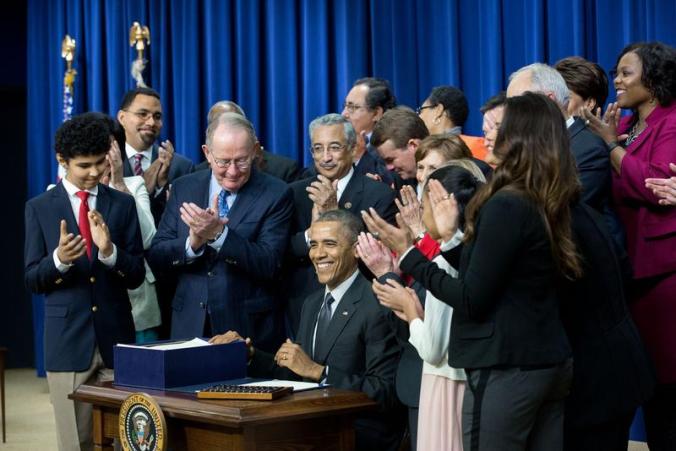
 President Obama signs ESSA last December.

-From a report by Springfield NPR education reporter Dusty Rhodes. The entire report from Illinois Issues can be found here
Another reason Illinois teachers may not feel much difference under ESSA is that —barring a transformation in the General Assembly — the new law’s teacher evaluation guidelines won’t apply here. Unlike the NCLB waiver system, ESSA does not require state teacher evaluation systems to hinge on students’ standardized test scores. But when Illinois applied for a federal Race To The Top grant in 2010, it had to prove that it was ready to implement exactly that kind of evaluation. It did so by enacting the Performance Evaluation Reform Act, which was rolled into a broader Education Reform Act in 2011.
Fred Klonsky, a retired Park Ridge art teacher and education blogger, can’t envision state lawmakers undoing that measure.
“Now that they’ve passed ESSA, that law doesn’t go away,” he says. “Teachers are still going to be evaluated exactly in the way that they were being evaluated before the bill was passed.”
There’s a reason NCLB was passed in the first place: States weren’t doing a great job of educating all children. But after 13 years of NCLB, the federal government hasn’t proven to be much better at it, as it failed to close the achievement gap. And while ESSA basically throws the ball back into the states’ court, it bring in one other player: the private sector.
For example, ESSA contains a provision allowing “pay for success,” also known as “social impact bonds.”
One example of the bonds in action comes from Utah. Goldman Sachs and ESSA: Teacher evaluations and Pay for Success. | Fred Klonsky:

New Study: In Education Money Matters, Helps Poor Districts, Raises Achievement | janresseger

New Study: In Education Money Matters, Helps Poor Districts, Raises Achievement | janresseger:

New Study: In Education Money Matters, Helps Poor Districts, Raises Achievement


Jesse Rothstein of the University of California at Berkeley and the National Bureau of Economic Research and his colleagues have just posted a working paper on the importance of statewide school finance reform.  Infusions of state money, whether as the result of court decisions or legislative action, significantly improve the finances of the poorest school districts and, over time, raise test scores.
From the study’s abstract: “Using an event study design, we find that reform events—court orders and legislative reforms—lead to sharp, immediate, and sustained increases in absolute and relative spending in low-income school districts. Using representative samples from the National Assessment of Educational Progress, we also find that reforms cause gradual increases in the relative achievement of students in low-income school districts…”
Rothstein and his colleagues explain: “American public schools have traditionally been locally managed and financed largely out of local property tax revenue.  As jurisdictions vary widely in their tax bases and inclinations to fund schools, this has meant that the resources available to a child’s school depended importantly on where he or she lives.”  Some earlier studies have seemed to show that an infusion of state funding makes little difference, but Rothstein and his colleagues note that earlier school finance lawsuits emphasized equity and sometimes resulted in leveling down—distributing a relatively small pot of money more equally.  The New Study: In Education Money Matters, Helps Poor Districts, Raises Achievement | janresseger:

Mike Klonsky's SmallTalk Blog: Pasi Sahlberg

Mike Klonsky's SmallTalk Blog: Pasi Sahlberg:

Pasi Sahlberg

At Harvard's Graduate School of Education, I got a handshake and a "keep up your great work" from renown Finnish educator, scholar, author and activist Pasi Sahlberg. 

Made my day.

Pasi is a former Director General of CIMO (Centre for International Mobility and Cooperation) at  Finland’s Ministry of Education and Culture in Helsinki and currently a visiting Professor of Practice at HGSE. I've used his best-selling book Finnish Lessons 2.0 in my own courses.

I've been a fan of his ever since I saw this interview with Mike Klonsky's SmallTalk Blog: Pasi Sahlberg:

Hispanic, black parents see college degree as key for children’s success | Pew Research Center

Hispanic, black parents see college degree as key for children’s success | Pew Research Center:

Hispanic, black parents see college degree as key for children’s success


Hispanic and black parents are significantly more likely than white parents to say it’s essential that their children earn a college degree, according to a recent Pew Research Center survey.
Hispanic and black parents place high value on a college degreeToday, 86% of Hispanic parents and 79% of black parents with children under 18 say it is either extremely or very important that their children earn a college degree. By comparison, about two-thirds (67%) of white parents say the same.
This gap may be linked to differing views on a college degree’s importance in moving up the economic ladder. Roughly half (49%) of Hispanics and 43% of blacks say that a college education is a requirement to be part of the middle class, compared with just 22% of whites. However, white adults are more likely than black or Hispanic adults to already bein the middle class or higher, which may account in part for the fact that fewer whites see college as essential.
Over the past two decades, educational attainment and college enrollment have increased substantially among Hispanics, the nation’s largest minority group, and blacks. For example, the high school dropout rates among Hispanics and blacks ages 18 to 24 reached record lows in 2014: just 12% for Hispanics and 7% for blacks, down from 33% and 16%, respectively, in 1993.
College enrollment has grown among all races and ethnicities since 1993, but gains have been biggest among Hispanics. In October 2014, 2.3 million Hispanics ages 18 to 24 were enrolled in either a two- or four-year college – up from 728,000 in 1993. Among blacks in the same age group, 1.5 million were enrolled in college in 2014 – up from 897,000 in 1993.
And while the share of Hispanics who have finished college hit a new high in 2014, they still lag other groups on this measure. Among adults ages 25 to 29, 63% of Asians, 41% of whites, 22% of blacks and 15% of Hispanics had earned at least a bachelor’s degree in 2014. This gap is partly due to the fact that Hispanics are less likely than other groups to enroll in four-year schools, attend academically selective colleges or study full-time.Hispanic, black parents see college degree as key for children’s success | Pew Research Center:

Common Core Lie of the Day: Standards Are Needed for STEM Training Because America Doesn’t Have Enough STEM Workers – Missouri Education Watchdog

Common Core Lie of the Day: Standards Are Needed for STEM Training Because America Doesn’t Have Enough STEM Workers – Missouri Education Watchdog:

Common Core Lie of the Day: Standards Are Needed for STEM Training Because America Doesn’t Have Enough STEM Workers

disney characters
Those Disney characters might just sell you out to the lowest bidder. Fired STEM workers at Disney see those characters in their nightmares.


earch Common Core and STEM and IT and you will obtain results extolling the need for Common Core:
stem lies 2


Contrary to the descriptions of why students need Common Core, the fact is that 2/3 of American workers with STEM degrees do not work in STEM fields.  From 2014:
It was announced last week that Microsoft, the tech giant, plans to eliminate 18,000 jobs. That has rankled many in the anti-common core movement because Bill Gates, Microsoft founder, has been out there promoting Common Core ostensibly because we need more STEM workers for companies like his. The claim he and other have made is that there is a shortage of such workers in the United States. What has upset the anti common core crowd is that Microsoft, along with other mega tech companies like Hewlett Packard and CISCO are simultaneously pressuring Congress to expand the H-1B Visa program to allow more highly skilled foreign workers in. While demanding more highly educated workers from the American education system, these large companies are demanding to import more labor from outside our shores. Something just doesn’t match up.
Computer World covered Senator Jeff Sessions response to the Microsoft firings (they are not lay offs). On 
Common Core Lie of the Day: Standards Are Needed for STEM Training Because America Doesn’t Have Enough STEM Workers – Missouri Education Watchdog:

Checker Finn Outraged by David Denby’s Admiration for Teachers | Diane Ravitch's blog

Checker Finn Outraged by David Denby’s Admiration for Teachers | Diane Ravitch's blog:

Checker Finn Outraged by David Denby’s Admiration for Teachers

 This is a sad story. From 1981 to 2009, nearly 30 years, Checker Finn was one of my closest friends. He was like a brother. Our families were close, and we almost telecommunicated about issues. We wrote article and reports together. we wrote a book together. We cofounded the Educational Excellence Network, and I was a founding member of Checker’s Thomas B. Fordham Foundation, as well as a colleague on the Koret Task Force of the Hoover Foundation.


But when I turned against testing and choice, our friendship deteriorated. I asked him if he would write a blurb for my book “The Death and Life of the Great American School System: How Testing and Choice Undermines Education”, but he said it was impossible. That book announced my break with the corporate reform movement. Or as I now know it, the privatization movement. He never forgave me for breaking ranks.
Readers of this blog have never read criticism of Checker here. I could not bring myself to speak personally against those who were once close friends, even though our disagreements are philosophically and politically profound.
Checker, however, has finally expressed his anger towards me in print. He slammed David Denby, who has written for the New Yorker for many years, for having written a tribute to teachers. He thinks Denby has turned into a defender of the status quo, which is apparently the worst insult a “reformer” can imagine.
But the privatizers ARE the status quo. How else to describe a “movement” that includes the President of the US, the Department of Education, the Council of Chief State School Officers, ALEC (which Fordham joined), all the red-state governors plus Governor Cuomo of New York, and Governor Malloy of Connecticut, the Gates Foundation, the Broad Foundation, the Walton Family Foundation, the Bloomberg Foundation, about a score of other foundations, and dozens of hedge fund managers who can raise a million dollars in a few hours. If this is not the status quo, I don’t know what is. They are actually quite few in number, but their wealth and political power is immense.
Checker trashed David Denby’s paean to teachers because Checker holds teachers in low regard, especially if they belong to a union and work on a public school.
I suspect this is the paragraph that Denby wrote that most angered Checker:
““A necessary commonplace: Almost everyone we know has been Checker Finn Outraged by David Denby’s Admiration for Teachers | Diane Ravitch's blog:

Obama's Pick for Education Focuses on States' Role - ABC News

Obama's Pick for Education Focuses on States' Role - ABC News:
Obama's Pick for Education Focuses on States' Role


President Barack Obama's nominee for Education Secretary told senators Thursday that the focus of decision-making on elementary and secondary education is "rightly shifting" to the states and away from the federal government.
John B. King Jr. is poised to oversee the Education Department as it is losing some of its authority. A bipartisan education law passed by Congress and signed by Obama in December revamps the widely criticized No Child Left Behind Act, and substantially limits some of the federal government's influence ushered in by that 2002 law.
The new law bars the Education Department from telling states and local districts how to assess the performance of schools and teachers. Instead, states and districts must come up with their own goals for schools, design their own measures of achievement and progress, and decide how to turn around struggling schools.
"As a former teacher, principal, and state commissioner, I know from personal experience that the best ideas come from classrooms, not conference rooms," King said at the hearing.
Under questioning from senators, King promised his department will adhere to the new law and its limits on federal intervention.
King, who began his career in education teaching high school social studies, joined the department in January 2015. He oversaw federal education programs for preschool through 12th grade before being tapped by Obama late last year to succeed longtime secretary Arne Duncan, who stepped down in December. King is currently serving as acting secretary.
In a sharply partisan Senate where Republicans have held up several of Obama's nominations — and are pledging no hearings for a potential Supreme Court nominee — King looks to be an exception.
Senate Health, Education, Labor and Pensions Committee Chairman Lamar Alexander, R-Tenn., who served as education secretary under former President George H.W. Bush, pressed the administration to nominate a new secretary after the bipartisan education overhaul was signed. He said he didn't think it was appropriate to go a whole year without a secretary firmly in place.
"We need an education secretary who is confirmed and accountable to Congress while we're implementing a law that may govern elementary and secondary education for some time," Alexander said.
After the hearing, Alexander said he thought King was "well received" by the panel and scheduled a committee vote on his nomination March 9.
"I think his prospects are excellent," he said.
In addition to the new law, senators also quizzed King on student loans and college campus sexual assault, among other issues.
On student loans, critics have complained the government didn't move swiftly enough to take action against for-profit schools like Corinthian Colleges, which filed for bankruptcy protection last year amid fraud allegations. The move closed schools, left thousands of students with hefty student debt and frustrated their efforts to earn degrees. The Education Department said earlier this month it will create a new student aid enforcement unit to respond more quickly to allegations of illegal actions.
"There's a lot of work to do to protect our students and borrowers, and we intend to do that," King said in response to questions on the issue from Sen. Elizabeth Warren, D-Mass.
The Obama administration has taken steps to push colleges to better tackle the problem of sexual assault, including releasing the names of colleges and universities in 2014 that were facing Title IX investigations for their handling of such cases. King said that continues to be a priority.
Before coming to Washington, King served as commissioner of education for the state of New York, where he pushed an ambitious improvement agenda for the state's public schools. During his 3 1/2 years as commissioner, King became a lightning rod for criticism over linking student test scores to teacher evaluations and a rushed implementation of the Common Core academic standards for grades K-12. The state's largest teachers' union said upon his departure that it had "disagreed sharply and publicly with the commissioner on many issues."
In his opening testimony, King said his New York City public school teachers "literally saved my life." He told the story of his mother's death when he was eight and his father's passing four years later. Both were educators.
He cited two of his New York teachers — "Mr. Osterweil" and "Miss D" — for his success. "If not for them, I could not have survived that turbulent period, and I certainly wouldn't be sitting before you today," King said.
———
Associated Press writer Jennifer C. Kerr contributed to this report.Obama's Pick for Education Focuses on States' Role - ABC News:


Russ on Reading: Who Holds Success Academy Accountable for Child Abuse?

Russ on Reading: Who Holds Success Academy Accountable for Child Abuse?:

Who Holds Success Academy Accountable for Child Abuse?


 Nadya Miranda. the mother of the first grade child berated by her teacher in theinfamous video published by the New York Times, has spoken out for the first time by giving an interview to the Times.In the interview she reports how she has withdrawn her child from the school and how she felt her child had been robbed of her confidence as a learner in her Success Academy classroom. She also expressed her frustration that she only received an apology from the school and the teacher after the video became public and that her child had never received an apology from the teacher, Ms. Dial. Ms. Miranda feels like Success Academy rallied to the defense of the teacher and ignored the impact of the verbal abuse on her child. Please read the article for a sense of the shattered hopes and dreams of Ms. Miranda and her daughter.


One thing that stood out for me in the article was this paragraph at the end of the piece.

Seeking to hold someone accountable for what happened to her daughter, Ms. Miranda went into a Department of Education building in Brooklyn to ask about filing a complaint, but was told that Success was independent from the school district. She said that Ms. Nicholls, the principal, had given her information about how to reach Success’s board of trustees, and 
Russ on Reading: Who Holds Success Academy Accountable for Child Abuse?:


Should Computer-Coding Skills Be Counted as a Foreign Language in Schools? - The Atlantic

Should Computer-Coding Skills Be Counted as a Foreign Language in Schools? - The Atlantic:

Does Coding Count as a Foreign Language?

A Florida bill proposes to let credits from computer-coding classes count like those for Spanish or French courses—but many are skeptical.


 Spanish. French. German. Computer coding. Are they the same?

This question is at the center of a debate in Florida, where legislators are currently considering a bill that would require high schools to offer computer coding as a foreign-language credit.
The bill is sponsored by the former Yahoo executive and democratic state senatorJeremy Ring, who sees coding as its own unique language. But some argue the skill doesn’t offer the value of spoken-language training and might be a better fit for the STEM disciplines.
Last December, the Miami-Dade County Public Schools Superintendent Alberto Carvalho said he “absolutely” disagrees with the idea that computer coding is an equal substitute for a foreign language. (So do the editorial staffs of the Tampa Bay TimesTallahassee DemocratOrlando Sentineland The Palm Beach Post.)

Research out of the University of Florida suggests most Floridians believe Spanish instruction should be required in the state’s schools. Miami-Dade County, where more than 66 percent of residents are Hispanic or Latino, is home to the largest school district in Florida and the sixth largest in the U.S. Recently, the district pledged to improve its Spanish-language instruction with better teacher training and a new curriculum.
“Based on both educational, intellectual development, and emotional development—as well as long-term economic development in an increasingly bilingual and biliterate community—computer coding is not a trade-off,” Carvalho told the Miami Herald.

Bills similar to Ring’s have passed or been introduced in other states, with proponents claiming the foreign-language-credit approach will benefit students who will need to compete in the modern-day workforce.

“By 2020, companies across the U.S. will have 1.4 million job openings requiring computer-science expertise and just 400,000 college graduates to fill them,” John Lauerman writes for Bloomberg Business.

But, as a source tells Lauerman, monolingual Americans will need to up their game, too. Mari Corugedo, who teaches elementary-aged English-language learners in the Miami-Dade district, knows this firsthand.

“In our case, in Miami-Dade, many of the jobs do require them to have the language of Spanish in order to communicate and do business here,” she said in a phone interview Monday. While teaching her students English, she also works with them to maintain proficiency in their first language so that by the time they graduate from high school, they are confident in both. Corugedo is also a district Should Computer-Coding Skills Be Counted as a Foreign Language in Schools? - The Atlantic:

Battle Over Teacher Tenure Laws Returns To LA Court « CBS Los Angeles

Battle Over Teacher Tenure Laws Returns To LA Court « CBS Los Angeles:

Battle Over California Teacher Tenure Laws Returns To LA Court


LOS ANGELES (CBSLA.com) — An appellate court panel in Los Angeles heard arguments but made no decision Thursday in a long-running legal battle over state employment laws governing tenure and the firing of teachers.
During an hour-long hearing in the 2nd District Court of Appeal, a three-judge panel heard arguments for and against California’s tenure system, which protects experienced teachers from layoffs and firings based on seniority.
Ted Boutrous, lead attorney for the plaintiffs, argued that current teacher job protections result in a “dance of the lemons,” in which “grossly ineffective teachers” are simply transferred from school to school.
“It’s impossible to dismiss these teachers,” the attorney said, adding that poor teachers invariably end up in low-income and minority outposts.
Justice Brian M. Hoffstadt, though, questioned whether the plaintiffs could prove that school administrators don’t have enough power to keep that from happening.
Certain school districts have managed to apply the laws “in a way that doesn’t result in this unlawful concentration” of poor instructors, Hoffstadt pointed out.
In his turn at the podium, Deputy Attorney General Nimrod Elias argued that there is no evidence that students at some poor and minority schools are being harmed by the protections.
“These laws help reduce teacher attrition,” he said. “There are benefits.”
Elias also argued that school districts statewide attract educators who might otherwise be dissuaded by what they may consider low pay and difficult working conditions. In California, administrators must in effect decide whether to grant teachers tenure — permanent employment — after just 18 months.
Vergara v. California was first filed in May 2012 by an advocacy group called Students Matter, on behalf of nine young plaintiffs. It alleged that tenure laws for public school teachers violated students’ constitutional rights to an equal education and named the state and two teacher unions, the California Teachers Association and the California Federation of Teachers.
Plaintiffs’ attorney Theodore Boutrous argued during the Superior Court trial that tenure and other laws made it too time-consuming and expensive to dismiss ineffective educators.
But lawyer James Finberg, representing the teacher unions, countered that the laws help prevent teachers from being hired and retained for reasons involving favoritism and politics.
In June 2014, Los Angeles Superior Court Judge Rolf M. Treu sided with the Students Matter and struck down the teacher tenure laws, saying students and educators alike are “disadvantaged” by the statutes. Treu issued an injunction blocking tenure laws for public school teachers, but also placed a stay on the ruling pending an appeal.
“This court finds that both students and teachers are unfairly, unnecessarily, and for no legally cognizable reason — let alone a compelling one — disadvantaged by the current permanent employment statute,” the judge wrote in his 16-page ruling.
Treu noted that teachers have a right to due process when they are being targeted for dismissal.
“However, based on the evidence before this court, it finds the current system required by the dismissal statutes to be so complex, time consuming and expensive as to make an effective, efficient yet fair dismissal of a grossly ineffective teacher illusory,” he wrote.
The ruling was a major blow to teachers unions, which contend the ruling will actually harm students and educators. They argue that the laws governing tenure ensure that quality teachers are in classrooms.
The court has 90 days to issue an opinion.
(©2016 CBS Local Media, a division of CBS Radio Inc. All Rights Reserved. This material may not be published, broadcast, rewritten, or redistributed. Wire services contributed to this report.)Battle Over Teacher Tenure Laws Returns To LA Court « CBS Los Angeles: