Latest News and Comment from Education

Thursday, February 18, 2016

Will Salary Increases Solve the Teacher Shortages? - The Atlantic

Will Salary Increases Solve the Teacher Shortages? - The Atlantic:

What If America’s Teachers Made More Money?

A number of states want to raise their salaries, but it’s unclear whether the increases will do much to solve schools’ staffing problems.

Tia Martin, a long-term substitute teacher, leads a third-grade class at an elementary school in Nevada, one of many states struggling with teacher shortages.John Locher / AP
As districts in certain parts of the country battle staffing shortages and schools nationwide seek to overcome a general sense of dissatisfaction among faculty, several states are considering proposals to pay their public-school teachers more money. The average public-school teacher salary in the United States in the 2012-13 academic year was $56,000, versus roughly $69,000 for nurses and$83,000 for programmers. Experts say raising that threshold could help improvethe profession’s lackluster reputation and encourage more high-achieving college students to pursue the career—especially in less-than-desirable schools and districts. The ultimate goal, of course, is to improve the quality of kids’ education: A recent report from the OECD found that students are more likely to be low-performers if they attend schools that struggle with shortages and low teacher morale.

In Oklahoma, Governor Mary Fallin’s proposed budget would allocate $178 million in new money to support a $3,000 raise for every teacher in the state, where teachers earned about $44,000 on average in 2012. “In this unprecedented teacher shortage, it is absolutely critical that we as a state address teacher compensation and give teachers a stronger reason to stay in Oklahoma classrooms,” state schools Superintendent Joy Hofmeister was quoted as sayingin response to the plan. In South Dakota, home to the country’s lowest teacher salaries, Governor Dennis Daugaard wants to raise the sales tax by half a cent in an effort to increase teacher pay to $48,500Tennessee and New Mexico are considering similar proposals, and a controversial bill is making its way throughIndiana’s legislature that would in part allow teachers to negotiate extra pay.
There’s a chance these plans will see results: A number of studies—including one on a program in North Carolina that offered a bonus of $1,800 to only math, science, and special-education teachers working in struggling public schools—have shown that modest salary increases can help stem turnover. But it’s hard to say whether such proposals will ultimately have long-lasting impact on the general teacher shortage. Surveys suggest that although teachers’ job satisfactionhas declined significantly in recent years, their perceptions about pay have hardly changed; factors beyond money contribute to the recruitment-and-turnover problems.

In places already struggling with shortages and those resorting to mass emergency certifications, the challenge is finding new teachers who are qualified, competent, and dedicated to the profession. Achieving this goal, researchers say, is complicated—something that a few extra hundred, or even thousand, dollars alone won’t solve. “If you want to improve the pipeline of new teachers, you have to start early,” said Sean Corcoran, an associate professor of educational Will Salary Increases Solve the Teacher Shortages? - The Atlantic:

Alabama places 'failing' label on majority black schools only | AL.com

Alabama places 'failing' label on majority black schools only | AL.com:

Alabama places 'failing' label on majority black schools only

 Alabama last week received a new list of failing schools, a two-page memo slipped under the door without explanation from the educators who prepared it.

What does it mean? Why these 76 schools? Why "failing"? 
The measure is straightforward. These are the state's lowest ranking schools on state tests of reading and math.
The larger meaning, the one that defies any safe bureaucratic commentary, is that Alabama continues to fail to educate black students who are schooled in relative isolation.
Look at the numbers. There are just under 37,000 children in failing schools in Alabama. More than 34,000 of those children are African American.
These 76 "failing" schools are the modern face of a legacy of segregation followed by desegregation followed by white flight followed by resegregation.
At three of the schools, every single child is African American this school year. Most of the schools are predominantly black. What's predominantly mean? At Hatch High in Perry County, 688 of the 689 students are black. At Hudson Middle in Selma, 465 of the 469 students are black.
There are no exceptions. Goodwyn Middle is the by far most "diverse" school on the list, and its student body is 72 percent African American.
All of these schools also serve poor families.
At half of the "failing" schools, three quarters or more of the children qualify for free or reduced-price lunch. At all of the schools, more than half of the students get subsidized lunch.
To spell that out plainly, every single one of the newly announced "failing" schools is both majority black and majority poor. 


The point of it all is not so plain.
The current accountability rules label as "failing" any school scoring in the bottom 6 percent on standardized tests for reading and math. That means Alabama lawmakers have guaranteed that the state will always have "failing" schools, same as in a football division. Someone has to finish last.
There are more useful options. The state could control for poverty levels to see which schools do the best with the students in their zone. This would be a better Alabama places 'failing' label on majority black schools only | AL.com:

Seattle Schools Community Forum: McCleary; It's Not Over

Seattle Schools Community Forum: McCleary; It's Not Over:

McCleary; It's Not Over


 It may appear that way to legislators and their big "whew, we got something done" but until we hear  the Supreme Court's weigh in, the issue is not done.


I just spoke to teachers at Roosevelt at the Red for Ed day.  My main message to them and to you is to keep the heat on.

Legislators need to hear that YOU are not happy.  They need to feel that pressure.

They also need to hear that you VOTE.  There is nothing like a voter to put the fear of God into an elected officials.  Certainly, if you are not their constituent, you might think they can brush it off but the power of saying you vote - out loud - surely gives all of them pause.

Here's the link to finding your legislator.  Once you get there, it's a pretty easy process with a fill-in e-mail form that can go to all your reps.

Also, I know many of you have probably heard about the "Breakfast After the Bell" program; we have two schools, Aki Kurose and Rainier Beach, currently doing this.  As well, four more are slated to come on-board - Roxhill, Dunlap, West Seattle elementary and the World School.)  There's a bill in support of this idea, it's HB1295.

Washington State ranks 45th for school breakfast participation (and that's probably not because we are a low-poverty state.)  

The legislation affects only high poverty schools where at least 70% of students 
Seattle Schools Community Forum: McCleary; It's Not Over:

CURMUDGUCATION: PA: Philly School Commission Gets Spanked

CURMUDGUCATION: PA: Philly School Commission Gets Spanked:

PA: Philly School Commission Gets Spanked


 Philly schools are, by any measure, a mess. And after almost two decades, they are a prime example of how badly state takeover districts fail.


In the nineties, the school gave up lost local control in exchange for enough funding to survive. In 2001, the state installed the School Reform Commission, a board created by the legislature and  made out of politicians appointed at the state and city level. Of course, the advantage is that politically appointed boards know secrets to effectively running school districts that locally elected boards do not. Ha! Just kidding. Despite its insistence that it could do better, the SRC doesn't know a damn thing about running school systems-- but they have certainly learned a lot. And the states supreme court just delivered another lesson.

In the process of gaining an education, the SRC has managed to anger just about everybody on every side of the education debates. Their overwhelming concern became coming up with more money because, shockingly, it turns out you can't just reverse the effects of Pennsylvania's cockamamie inadequate funding system just by Tightening Your Belt and Being More Efficient. So the SRC went looking for money everywhere.

They angered teachers by finding money in staffing. They found this money by unilaterally declaring that they would honor neither their contract nor state law. They declared for themselves the power that reformsters like TNTP dream of-- the power to ignore seniority in staffing choices. This power 
CURMUDGUCATION: PA: Philly School Commission Gets Spanked:

Stunning New Report Shows Power of Wraparound Community Schools | janresseger

Stunning New Report Shows Power of Wraparound Community Schools | janresseger:

Stunning New Report Shows Power of Wraparound Community Schools

Three organizations, the Center for Popular Democracythe Coalition for Community Schools, and the Southern Education Foundation have released an in-depth and very significant report: Community Schools: Transforming Struggling Schools into Thriving Schools.  It is a primer for those who want to understand what a full-service Community School is and who want to know why such schools are today’s most significant policy development. The new report can also serve as a beginning guide for school districts that seek to transform their schools into Community Schools.
The new report profiles elementary, middle and high schools that are currently implementing a variety of strategies of successful Community Schools. “Their stories describe what these schools and districts were grappling with prior to becoming Community Schools, how they began to use a transformational strategy, what elements were implemented in what specific ways, and the amazing results that accrued.”
The essence of a Community School, according to the new report, is its whole child strategy—that schooling cannot be conceptualized or measured with a mere test score.  Community Schools are described as increasing attendance, decreasing suspensions and expulsions, creating healthy and safe communities, as well as improving academic outcomes.
A Community School is a set of formal partnerships with “the Community School Coordinator… part of the leadership team” and a Community School Committee including “parents, community partners, school staff, youth and other stakeholders.”  Such partnerships can be sustained by patching together a number of readily available funding streams, but the coordination and administration of the funding partnership must be sustainable for a Stunning New Report Shows Power of Wraparound Community Schools | janresseger:

Chetty et al. v. Rothstein on VAM-Based Bias, Again | VAMboozled!

Chetty et al. v. Rothstein on VAM-Based Bias, Again | VAMboozled!:

Chetty et al. v. Rothstein on VAM-Based Bias, Again

VAMboozled!


 Recall the Chetty, Friedman, and Rockoff studies at focus of many posts on this blog in the past (see for example here, here, and here)? These studies were cited in President Obama’s 2012 State of the Union address. Since, they have been cited by every VAM proponent as the key set of studies to which others should defer, especially when advancing, or defending in court, the large- and small-scale educational policies bent on VAM-based accountability for educational reform.

In a newly released working, not-yet-peer-reviewed, National Bureau of Economic Research (NBER) paper, Chetty, Friedman, and Rockoff attempt to assess how “Using Lagged Outcomes to Evaluate Bias in Value-Added Models [VAMs]” might better address the amount of bias in VAM-based estimates due to the non-random assignment of students to teachers (a.k.a. sorting). Accordingly, Chetty et al. argue that the famous “Rothstein” falsification test (a.k.a. the Jesse Rothstein — Associate Professor of Economics at University of California – Berkeley — falsification test) that is oft-referenced/used to test for the presence of bias in VAM-based estimates might not be the most effective approach. This is the second time this set of researchers have  argued with Rothstein about the merits of his falsification test (see prior posts about these debateshere and here).
In short, at question is the extent to which teacher-level VAM-based estimates might be influenced by the groups of students a teacher is assigned to teach. If biased, the value-added estimates are said to be biased or markedly different from the actual parameter of Chetty et al. v. Rothstein on VAM-Based Bias, Again | VAMboozled!:

Thousands of Teachers and Students Denounce Budget Cuts in Nationwide Protests - Yahoo News

Thousands of Teachers and Students Denounce Budget Cuts in Nationwide Protests - Yahoo News:

Thousands of Teachers and Students Denounce Budget Cuts in Nationwide Protests

Raising signs that read “Support Our Schools” and “Actions Speak Louder Than Words,”  teachers, students, and community members held walk-ins across the country Wednesday morning to demand increased support for public education. The nationwide rallies were organized by the Alliance to Reclaim Our Schools, a nonprofit advocacy group comprising teachers’ unions and other groups, and interrupted classes in more than 900 schools in 30 cities across the U.S.
Demands varied by city and school district, but most shared a common grievance: lack of funding. Students and teachers pleaded for more public libraries, better special education programs, and less standardized testing, among other things. One Chicago school community simply asked for more teachers, while another, in Los Angeles, protested expansion of publicly funded, privately run charter schools.
The Center on Budget and Policy Priorities, a left-leaning nonpartisan research organization, reported last month that most states have failed to restore prerecession funding levels.
Even school administrators were calling for higher priority to be placed on creative subjects such as music, dance, theater, and art classes.
It’s no secret that arts programs in public schools are dwindling, with more budget cuts every year in some states. Last November, the Los Angeles Times used L.A. Unified School District data to rank arts programs in schools. Only 35 out of 700 schools received an “A” grade for their arts programming.
But creativity is a valuable part of the learning process, and many teachers argue that overreliance on high-stakes testing diminishes programming that aids’ students’ ability to think critically.
One study shows that this deprioritization of arts programs is a trend that starts as early as kindergarten. Researchers at the University of Virginia compared classrooms and teachers in 1998 and 2010, and found dramatic differences in curriculum, classroom structure, and expectations of students. The number of classrooms that had weekly art instruction decreased by 8 percent, and by 15 percent for dance instruction. Half of kindergarten teachers surveyed reported never doing theater activities with students in 2010, as opposed to 18 percent in 1998. Today, students are expected to know more coming into kindergarten, and teachers place more emphasis on science, technology, engineering, and math education and less on creative or nonacademic programming.
Many of the teachers and students marching at schools around the country are protesting that very trend. Demonstrators in various cities listed what they thought public school students were entitled to. “Art and chorus,” wrote one Miami student. “Art classes,” wrote a young girl in Denver. A teacher in Pittsburg simply added, “the resources we need to be successful.”  

Chicago 'walk ins': What are parents, teachers, and students protesting? - Yahoo News

Chicago 'walk ins': What are parents, teachers, and students protesting? - Yahoo News:

Chicago 'walk ins': What are parents, teachers, and students protesting?

Hundreds of Chicagoans stood behind the teachers' union in a demonstration against Chicago Public Schools and what they see as its failure to meet the needs of students and educators.


 Parents, students, and teachers are protesting at more than 200 schools across Chicago in a series of “walk-ins” against budget cuts and what they consider as failure on the part of Chicago Public Schools to meet the needs of students and educators.

Planned by the Chicago Teachers’ Union, the demonstration is part of a national campaign in defense of schools, organized by an umbrella group called The Alliance to Reclaim Our Schools. Supporters met 30 minutes before classes began on Wednesday and marched into the schools together.
"Our schools are being starved of funds. They're threatening layoffs in the middle of the school year – pay cuts in the middle of the school year,” CTU vice president Jesse Sharkey told ABC news. “We're trying to gather everyone who loves public schools to come into our buildings.”
Across the country, about two dozen cities are part of the wider campaign to “reclaim our schools.” In Boston, protesters are rallying at City Hall to deliver a petition to Mayor Marty Walsh, demanding that the district restore funding from next year’s budget cuts. And in Los Angeles, more than 20,000 are expected to be part of the walk-ins.
With signs that say “Fund schools with equity!” and “What happened to children first?” the Chicago protesters stood in solidarity with the teachers as their union continues to negotiate with the district on a multi-year contract after an initial offer was rejected.
#CTUwalkin pic.twitter.com/5icDlVm5Hp— Gray Elementary (@StallionNews) February 17, 2016
WPCP WALK-IN: Payton stdns in solidarity with all CPS schools! #WalkIntoCPS #CTUwalkin #ReclaimOurSchools pic.twitter.com/EN3rD5VAMd— Nik Barge (@nabarge) February 17, 2016
@ILRaiseYourHand Kenwood NEIGHBORHOOD HS supporters! #WalkIntoCPS pic.twitter.com/i3aEY5kvbj— brenda delgado-als (@brendadelgado1) February 17, 2016
As CBS Chicago reported, the demonstrators are calling on Mayor Rahm Emanuel and CPS Chief Executive Officer Forrest Claypool to make up for the district’s budget gaps from the city’s resources.
“After just three weeks of negotiations, the district made an offer that relied on a reduction of more than 2,000 educators from the system, made no provision against subsequent ballooning class sizes and included nothing but the vaguest indicators of where new revenue would be found,” the organization said in a statement last Tuesday.
CPS recently proposed $120 million in budget cuts and have borrowed $725 million in high-interest bonds while awaiting pension help from Springfield. The union says that this will only hurt taxpayers while benefiting big banks in which the city has a vested interest.
In preparation of the event, CPS addressed parents and staff Tuesday with a letter saying that the safety of students will be their main priority in dealing with the protest. Principals won’t be letting strangers into school buildings, the letter suggested.
“The safety of our students is always our top priority, and CPS Safety and Security will continue to work with each school to assess individual situations as they arise. We are hopeful that ongoing negotiations will lead to a final agreement,” Mr. Claypool wrote in the letter, co-signed by CPS chief education officer Janice Jackson.
“A permanent solution to our District’s financial crisis exists. Fair funding from Springfield is needed: despite being 20 percent of the students in the state, CPS students get less than 15 percent of what the state spends on education,” they continued.
In Chicago’s Brighton Park neighborhood, Kelly High School had about 75 students, teachers, and parents who participated in the walk-in. Among them is Evelyn Solis, a senior.
“I love it how Kelly is like a huge family, you know? If it wasn’t for the teachers and staff, I wouldn’t have been a straight A student. I wouldn’t know how important my education can be, and how it can affect my future,” she told CBS.
CPS has threatened teacher layoffs by the end of the month if the contract negotiation fails to wrap up. The union said that a strike may be feasible – and necessary. Chicago 'walk ins': What are parents, teachers, and students protesting? - Yahoo News:
Related stories

WTF Education Department Letting For-Profit Schools Off Because They’re ‘Too Big To Fail,’ Report Says

Education Department Letting For-Profit Schools Off Because They’re ‘Too Big To Fail,’ Report Says:

Education Department Letting For-Profit Schools Off Because They’re ‘Too Big To Fail,’ Report Says

Banks aren't the only "too big to fail" companies that put taxpayers at risk.


 Some giant for-profit colleges are ripping off students and squandering billions of taxpayer dollars, and the U.S. Department of Education is doing little about it because it considers them "too big to fail," a new report alleges.

Chris Hicks, a consultant to unions on student debt issues, argues that the Education Department's refusal to use its vast authority to penalize schools that violate state or federal rules amounts to an abdication of its responsibility to protect students and the integrity of the federal student aid program.
With college costs and student debt rising -- some 42 million Americans, or 1 in 8, collectively owe more than $1.3 trillion -- concerns are mounting that far too many households have been defrauded by colleges making unsupported claims about their students' career prospects while peddling credentials of questionable value and saddling students with unpayable debt.
State and federal authorities have ramped up their scrutiny of for-profit colleges that collectively enroll hundreds of thousands of students, probing their advertisements and claims to prospective students about their former students' graduation rates and success at landing jobs in their fields.
Already, the federal Consumer Financial Protection Bureau, Federal Trade Commission and several state attorneys general have sued giant for-profit college chains such as DeVry Education GroupCorinthian Colleges Inc. and ITT Educational Services Inc. for allegedly misleading students by advertising false job placement rates. The FTC and California's attorney general are investigating the University of Phoenix and its owner, the Apollo Education Group. The companies have denied wrongdoing.
For-profit colleges say they enroll students shunned by traditional public and nonprofit colleges, and give them ample opportunity to obtain credentials that employers value.
These colleges largely depend on taxpayers' money for survival. Nearly all of their revenues can come from the federal government, via student loans and grants from the Education Department; GI Bill funds from the Department of Veterans Affairs; and cash from the Department of Defense's Tuition Assistance program.
Most of for-profit colleges' revenues come from the Education Department, which has final say over which schools can receive a slice of the nearly $130 billion in federal student aid the department doles out annually.
But the Education Department isn't supervising colleges closely enough to prevent dodgy ones from taking advantage of students or taxpayers, according to Hicks.
He identified a range of possible tools Education Department officials haven't fully utilized, such as the power to demand that at-risk colleges stump up substantial letters of credit in case schools abruptly close, or former students who borrowed to pay for school assert their federal right to debt cancellations in instances where their school lied to them.
Letters of credit are assurances that cash would be available to the Education Department upon demand. The department can require schools to obtain letters of credit equivalent to at least 10 percent of their previous year's total haul of student Education Department Letting For-Profit Schools Off Because They’re ‘Too Big To Fail,’ Report Says:

Oops: School emails 'Hurt Feelings Report' that makes fun of whiners

Oops: School emails 'Hurt Feelings Report' that makes fun of whiners:

Oops: School emails 'Hurt Feelings Report' that makes fun of whiners


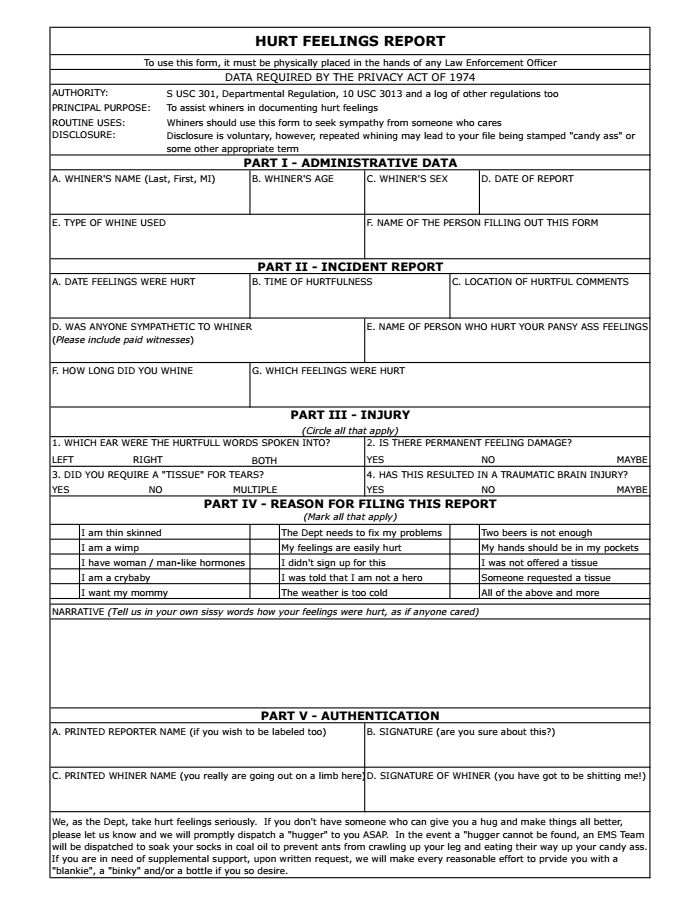
 WILMINGTON, Del. — Some Lombardy Elementary School parents are fuming after the school accidentally sent out a sarcastic "Hurt Feelings Report" that makes fun of "whiners."

The one-page form was included as an attachment to an email that was supposed to be about activities on "Exercise Your Brain Day," an upcoming school event.
The form includes places for "Whiner's Name" and "Type of Whine Used," as well as questions like "Did you require a 'tissue' for tears" and "I want my mommy."
It is structured like a bullying report "to assist whiners in documenting hurt feelings" and offers that "an EMS team will be dispatched to soak your socks in coal oil to prevent ants from crawling up your legs and eating their way up your candy ass."
The parent who forwarded the letter to The News Journal, who didn't want to be identified, called it "completely offensive and mocks children who are bullied in schools."
Brandywine School District spokeswoman Alexis Andrianopoulos on Wednesday said a staff member accidentally put the wrong attachment in a regular email the school uses to communicate with parents. She said the satirical form came from "a source external to the school" and said it was "not an official document of Lombardy Elementary or the Brandywine School District."
"This was an embarrassing mistake, but it was just that – a mistake," Andrianopoulos said in an email. "It should not have happened, and we apologize for the error."
Schools all over the country have taken steps over the past few years to reduce bullying in schools.
In Delaware, the state created a position for a bullying ombudsman who helps families handle incidents in their schools. School websites are supposed to post the contact info for that person prominently on their websites.
State leaders have also pressured schools to do a better job informing parents when bullying incidents occur.
In 2012, new laws went into place that put more responsibility with schools for battling cyberbullying and strengthened requirements for reporting incidents to parents and the state.
DOCUMENT
TEXT
Zoom

Most State Education Report Cards Miss the Critical Ingredients | The Progressive

Most State Education Report Cards Miss the Critical Ingredients | The Progressive:

Most State Education Report Cards Miss the Critical Ingredients


 Once when I was in high school, a friend handed me a plate of chocolate chip cookies. They looked delicious! But just as I was about to eat one, she snatched them back. They looked great on the outside, she told me, but they tasted terrible.  She had left out a key ingredient—sugar.

This story is exactly how I think about the numerous state education report cards making the rounds.  Instead of  filling you with great, inspiring information, most of these glossy, colorful reports are misleading and ideological. They are basically not worth consuming.
One of the mechanisms so-called education “reformers” have used to promote their top-down, privatization agenda for public education is the state-by-state education report card. Organizations such as Students FirstAmerican Legislative Exchange Council (ALEC), Thomas B. Fordham Institute, and Education Next have recently released report cards for each of the fifty states.
What’s wrong with these state report cards? Most state-by-state ratings focus primarily on outcomes, such as state standardized test scores, and basically ignore educational inputs—the ingredients—that make public education successful. These report cards are obsessed with accountability systems that look like bold education “reform,” but that favor top-down, private control of public schools, with dubious results for kids.
Take just two examples.  
Students First, an organization started by the controversial District of Columbia education reformer Michelle Rhee, issued report cards giving positive ratings to states if they allowed for parent trigger. Parent trigger is a policy that allows parents (in any given year) to vote to turn over a school and all of its public property to a corporation with a simple majority vote. The Students First report also gave states favorable ratings for prioritizing states’ and mayor's’ ability to take over school districts. Top-down hostile takeovers of schools by states and mayors have a long and documented history of underwhelming performance and failure.
The state education reports issued by ALEC, a prominent corporate lobbying group that promotes neoliberal model legislation across public policy issues, prioritized “innovative educational practices necessary for transformational change.” They gave states positive ratings if they allowed the use of public dollars for private school choice (i.e. tax credits, vouchers, education savings accounts).
Several decades of peer-reviewed charter school and voucher research have demonstrated that choice is not a panacea. In fact, school choice has in many ways enhanced this country’s
- See more at: http://www.progressive.org/pss/most-state-education-report-cards-miss-critical-ingredients#sthash.mEx0qY89.dpuf

DCPS changed its teacher-evaluation system—again. Why can't schools settle on a method?

DCPS changed its teacher-evaluation system—again. Why can't schools settle on a method?:
Why Do Schools Keep Changing the Way They Grade Teachers?


Last week, the District of Columbia Public Schools district announced major changes to its teacher evaluation program, called IMPACT. Again. Administrators have tweaked the program constantly since implementing it in 2009, mirroring a troubling national trend: The way teachers are graded in the U.S. has changed so many times in so few years that teachers have lost faith in a system meant to make them better. You couldn’t blame parents for giving up on it, either.
Since 2009, more than 25 states have overhauled their teacher-evaluation systems—some making changes every single year. One Wisconsin elementary school teacher, in the classroom for just six years, told Slate last year that she’s been evaluated using three completely different systems. Last spring, New York Gov. Andrew Cuomo implemented the use of outside evaluators and a 50 percent reliance on test scores in teachers’ evaluations; by December, after 20 percent of students across the state sat out of state math and reading tests in protest, the state Board of Regents, following Cuomo’s recommendation, eliminated the use of test scores (at least through 2018–19) altogether.
This kind of seesawing within education is common. No single education reform has seen a more “dramatic transformation” in the past decade than teacher evaluations, according to a National Council on Teacher Quality report that tracks the state of teacher evaluations in all 50 states.* Many of those changes came as states scrambled to qualify for President Obama’s now-defunded Race to the Top grant program or to adjust to the Common Core educational standards. But the changes were often hasty, leading to years of tweaks if not outright overhauls, furtherintensifying the reform fatigue that many teachers have felt for years. But despite a decade of change and experimentation, most teachers are still rated as effective, a major criticism of the old, insufficiently stringent evaluation systems. On the other hand, some teachers complain that the new wave of evaluations became too punitive and were ultimately unhelpful in improving their practice. 
D.C.’s IMPACT system emerged under the leadership of controversial education-reform leader Michelle Rhee. Since its 2009 debut, the school district has used a team of outside “master educators” to evaluate teachers, a method praised by some researchers. The latest changes will eliminate them completely, returning the responsibility of evaluations back to principals, a method that teachers, unions and researchers alike have criticized at times. The district will also reintroduce the controversial “value-added” model, which uses student test scores to judge teacherDCPS changed its teacher-evaluation system—again. Why can't schools settle on a method?: