Latest News and Comment from Education

Friday, February 12, 2016

Does PARCC Still Consider Mitchell Chester the “Real” Chair? | deutsch29

Does PARCC Still Consider Mitchell Chester the “Real” Chair? | deutsch29:

Does PARCC Still Consider Mitchell Chester the “Real” Chair?


The Partnership for Assessment of Readiness for College and Careers (PARCC) is playing around with information on its website in a manner that makes it appear that PARCC still considers Massachusetts Commissioner of Education, Mitchell Chester, its chair.
First of all, a recent revision on the Massachusetts PARCC page propagates the lie that Massachusetts fully administered the PARCC test in 2015 and will fully administer the PARCC test in 2016:
Here’s what PARCC has to say about Massachusetts:
MASSACHUSETTS AND THE PARCC ASSESSMENTS
Massachusetts administered the PARCC assessment in 2014-15 and will administer it in 2015-16. Massachusetts is a governing state.
In truth, not all Massachusetts districts administered PARCC in 2015, and as is true for Louisiana, Massachusetts will have a hybrid in 2016– part MCAS and part PARCC.
Still, in February 2016, PARCC is trying to make Massachusetts appear to be all in for PARCC, both in 2015 and 2016.
Even though Chester introduced a “compromise” between PARCC and MCAS, it sure looks bad for Chester– PARCC chair– to be pushing PARCC at all.
And it is possible that Chester’s “PARCC foot in the door”Massachusetts assessment compromise could be used as a means of virtually shutting out MCAS and indeed making Massachusetts “completely PARCC.”
If he wants to promote a quiet transition from MCAS to PARCC, surely it would be to Does PARCC Still Consider Mitchell Chester the “Real” Chair? | deutsch29:

PARCC Website Changes Its Story on 2015 Louisiana Test and Misleads on 2016 Massachusetts Test | deutsch29 http://bit.ly/1O6Pigr

WATCH THIS VIDEO – The Charter School Industry’s abusive “no excuses” approach to education - Wait What?

WATCH THIS VIDEO – The Charter School Industry’s abusive “no excuses” approach to education - Wait What?:
WATCH THIS VIDEO – The Charter School Industry’s abusive “no excuses” approach to education


 Charter Schools – Privately owned, but publicly funded.

Charter schools “pride” themselves on their “no excuses” strategies and techniques.
This time the horrifying video is from one of the infamous charter schools that make up the Success Academy charter school chain in New York City.
However the charter school industry’s “no-excuses” approach, primarily aimed at children of color, is the hallmark of the charter school industry across the nation, including at Achievement First, Inc., the large Connecticut-based charter school chain with schools in Connecticut, New York and Rhode Island.
The problems run far deeper than just one video.
This year, Governor Dannel Malloy and Lt. Governor Nancy Wyman have proposed a state budget that increases funding for Connecticut’s charter schools while making the deepest cuts in state history to Connecticut’s public schools.
Since taking office, Malloy and Wyman have doubled the amount of money spent to subsidize Connecticut’s charter school industry.  As a result of their “education reform” initiatives, well over $100 million in taxpayer funds will go to charter schools rather than the state’s local public school system.
A very similar story has been unfolding in New York, where Governor Andrew Cuomo, like Governor Dannel Malloy are charter school loyalists and disciples.  Both governors have refused to adequately fund public schools, which has shifted more and more of the burden for paying for public education onto the backs of local property taxpayers.
Why would any public servant divert scarce public funds to privately owned charter schoolsWATCH THIS VIDEO – The Charter School Industry’s abusive “no excuses” approach to education - Wait What?: 

Report Critiques State Takeover School Districts in LA, TN, and MI; Michigan’s Will Be Dissolved | janresseger

Report Critiques State Takeover School Districts in LA, TN, and MI; Michigan’s Will Be Dissolved | janresseger:

Report Critiques State Takeover School Districts in LA, TN, and MI; Michigan’s Will Be Dissolved

The Center for Popular Democracy released a fine new report earlier this week about three “‘takeover districts’ in which schools that are deemed ‘chronically failing’ are removed from the local school district and placed in a statewide district with a separate governance structure that is far less transparent and accountable to the public.”  The new report covers the Louisiana Recovery District, the Tennessee Achievement School District, and the Michigan Education Achievement Authority.
Such “recovery” or “achievement” school districts are a little different than direct state takeovers of school districts like those in Newark, New Jersey, or Philadelphia, Pennsylvania, or Highland Park, Michigan.  The states operating the “recovery” or “achievement” districts have created a separate statewide school district with the plan of removing particular low-scoring schools from their local district and inserting them into a new statewide governance body.
One of the first things you notice about these so-called statewide districts, however, is that they haven’t really succeeded well enough to operate statewide.  Louisiana’s Recovery School District (RSD) existed before Hurricane Katrina, but the rules for state seizure of schools were expanded immediately after the hurricane to enable state seizure of almost all of New Orleans’ public schools.  The state has added to the RSD several other schools in East Baton Rouge Parish, Point Coupee Parish, and Caddo Parish, but the majority of schools administered by the Louisiana RSD remain in New Orleans.  In Tennessee, according to the new report, “The state has elected to focus on Memphis: 27 of 29 Achievement School District (ASD) schools are located in Memphis; the remaining two schools are in Nashville.”  And in Report Critiques State Takeover School Districts in LA, TN, and MI; Michigan’s Will Be Dissolved | janresseger:

Kenney asked to investigate why Wister went charter

Kenney asked to investigate why Wister went charter:

Kenney asked to investigate why Wister went charter


A coalition of officials, parents, and activists asked Mayor Kenney on Wednesday to direct an investigation into an eleventh-hour School Reform Commission vote to hand Wister Elementary School over to a charter organization.
Councilwoman Helen Gym, chiefs of the unions representing Philadelphia School District principals and teachers, the head of the local NAACP chapter, and others asked Kenney to order the city's chief integrity officer to conduct "a full ethics review" of the school system and SRC.
A spokesman for Kenney said the city's integrity officer lacks investigatory powers, but separately will conduct an ethics review of the district and the SRC.
"Though not in response to today's request, [Chief Integrity Officer] Ellen Mattleman Kaplan does intend to conduct a thorough review of the 2012 Task Force report on Ethics at the Philadelphia School District, particularly as the administration considers future appointments to the SRC," said mayoral spokesman Mike Dunn. "It is a disappointment that the recommendations of that task force have been, thus far, largely ignored."
The SRC issued a statement that said, "We do not understand what Councilwoman Gym is referring to. The SRC has contracted with the city's inspector general to investigate anything in the district that comes to her attention. The councilwoman should direct her questions to the inspector general. The SRC and district will fully cooperate with any investigation the inspector general believes to be appropriate."
Wister, in Germantown, was one of three struggling schools identified for charter conversion in the fall, but Superintendent William R. Hite Jr. changed his mind after new data showed the school had made progress.
The SRC, on Jan. 21, scheduled votes to hand two other schools to charter providers; Wister was not on the agenda. But, after hours of public testimony at an emotionally charged meeting, Commissioner Sylvia Simms offered a resolution giving Wister to Mastery Charter Schools.
She said she had been swayed by parents who said the district had allowed low-income children to languish in failing schools. The resolution passed, 3-1, against Hite's wishes.
Gym and others say the city must look into "potential violations of the state's Sunshine Act, commissioners' potential conflicts of interest, and undisclosed lobbying" on behalf of would-be charter providers.
Simms' sister works for a firm that once counted Mastery as a client. Michael A. Davis,

Read more at http://www.philly.com/philly/education/20160211_Kenney_asked_to_investigate_why_Wister_went_charter.html#yJY9VghCOAYWz2Dh.99

Virginia Charter School & Reform Status with Rachel Anne Levy | Education Town Hall Forum

Virginia Charter School & Reform Status with Rachel Anne Levy | Education Town Hall Forum:

Virginia Charter School & Reform Status with Rachel Anne Levy 

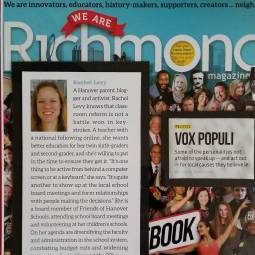
The Commonwealth of Virginia, for better and worse, has been slow to adopt charter schools and a variety of other education policies common in other states, says Rachel Levy, Virginia resident, teacher, activist, and “All Things Education” blogger. Levy joined the Education Town Hall on February 11 to discuss the status of education and reform efforts in the Commonwealth. Conversation with Levy — who joined the show remotely from the hallways of the Virginia House of Delegates — included the pending “Virginia Charter School Bill,” parental involvement, teacher preparation and related topics. Listen to full discussion below —

Education Town Hall, 2/11/16. Segment begins at 35:30

rlevyRachel Anne Levy lives in Ashland, Virginia, with her husband and three children. She was born in Washington, DC, and is a proud graduate of DC Public Schools. She got her BA from Wesleyan University in 1995 and her master’s degree in education with certification in secondary social studies and pk-12 ESOL (English for Speakers of Other Languages) from The George Washington University in 1999.
She has taught at a private Quaker school in Brooklyn, New York, in DC Public schools, in Albemarle County Public Schools, as an educator in Head Start classrooms for CYFS (Charlottesville Youth and Family Services), in evening classes for adults, and at a private preschool.
As a writer, she started her own education blog, All Things Education, in 2009. Her education writing and commentary has been featured in Blue Virginia, The Core Knowledge Blog, Joanne Jacobs’ Linking and thinking on education, So Educated, the Virginia Education Report, Education Week’s “Teacher in a Strange Land,” on Virginia Charter School & Reform Status with Rachel Anne Levy | Education Town Hall Forum:


Unaccountable Private School Voucher Program a Billion Dollar Boondoggle Under Gov. Walker and Republican Legislature

Unaccountable Private School Voucher Program a Billion Dollar Boondoggle Under Gov. Walker and Republican Legislature | Educate All Students: Larry Miller's Blog:

Unaccountable Private School Voucher Program a Billion Dollar Boondoggle Under Gov. Walker and Republican Legislature


‘A Bad Deal For Our Children, Our Public Schools and Wisconsin Taxpayers’
MADISON, Wis. — A new analysis from the nonpartisan Legislative Fiscal Bureau finds that under Gov. Scott Walker and the Republican-controlled legislature, Wisconsin taxpayers will have to foot a $1.18 billion plus tab for the private school voucher program by the end of the 2016-17 fiscal year. In addition, the state treasury will take a $30 million per year hit from a no top income limit tax giveaway to parents already sending their kids to private schools.
One Wisconsin Now Executive Director Scot Ross commented, “Not only did Gov. Walker and Republicans in the state legislature make the largest cuts to K-12 public education in state history, but by the end of this current budget they’ll have blown over $1.1 billion of taxpayer dollars on the unaccountable private school voucher program.”
According to a memo from the Fiscal Bureau, released today by Senate Democratic Leader Jennifer Shilling, spending on the unaccountable private school voucher program will skyrocket from $145.9 million in 2011 when Walker and Republicans came to power to over $257 million in 2016.
The state Department of Public Instruction (DPI) has reported that under the expanded voucher program approved by the GOP, in excess of over 80% of the students applying for the program for the 2014–15 school year did not attend a Wisconsin public school in the previous year and in 2013 over 70% of the student receiving taxpayer funded vouchers were previously covering their tuition by other means.
Independent reviews of student achievement has found that voucher students do no better, and in some cases worse, than peer students in public schools. Over the years the voucher Unaccountable Private School Voucher Program a Billion Dollar Boondoggle Under Gov. Walker and Republican Legislature | Educate All Students: Larry Miller's Blog:

Great Public Schools are for Every Student. No Exceptions! - Lily's Blackboard

Great Public Schools are for Every Student. No Exceptions! - Lily's Blackboard:

Great Public Schools are for Every Student. No Exceptions!

By Toni Smith, Trainer and board member, Georgia Safe Schools Coalition. Educator for 32 years. 
As an educator, I’ve been guided by a philosophy that evolved as I worked and developed my practice, and I’ve tried to articulate what I want for all children, including children who are lesbian, gay, bisexual, transgender, and questioning (LGBTQ). These students are marginalized and rejected with impunity. I want them to have love, security, and peace; how can I contribute to that?
Understanding that education is the key that unlocks all human rights, I know that the schoolhouse is the one institution that almost all people pass through and it holds the promise for all children.
So you see, the NEA vision statement says it all for me: Great Public Schools for Every Student. The word everymeans all of the individual members of a group without exception. As educators, policy makers, and supporters of public education, it is critical that we look at students through lenses not clouded by bias and cultural expectations. In choosing our life’s work, we have dedicated ourselves to the whole child — the unique individuals who populate our public schools.
So, let’s break down what we mean when we consider the whole child and how we can support every student.
Children come to us full of personality, assumptions, and values of their own. And while these change as they grow older, children start out with a baseline that is not solely formed by their surroundings; much of who we are is innate. Sexual orientation and sense of gender, like race, are real and inborn and make up so much of the human experience that they cannot be ignored or rejected.Students need
That sense of “boyness” or “girlness” or something altogether different is as much a part of the whole child as their physical build. In addition, at some point in growth, attractions to other people develop, and these crushes and relationships can make or break a child’s self-image and view of the world. We cannot separate children into little segments and cherry-pick those we accept.The whole child includes who they are inside and who they loveoutside. We must accept and include the whole child. Every child.
LGBTQ students are often regarded as “outside” of what society sees as the norm and that “otherness” can be reinforced daily through their home and community interactions, the media, and many institutions. School must not be one of those places.
It’s important to understand that what takes place in and around the schoolhouse can mean the difference between life and death for some students. School is sometimes the only place where students find unconditional acceptance. For LGBT or questioning students, this acceptance and the support that comes with it affects how they learn, the social decisions they make, the goals they set andGreat Public Schools are for Every Student. No Exceptions! - Lily's Blackboard: 

James Kirylo: Gates’ Plan to Take Over Teacher Education Advances | Diane Ravitch's blog

James Kirylo: Gates’ Plan to Take Over Teacher Education Advances | Diane Ravitch's blog:

James Kirylo: Gates’ Plan to Take Over Teacher Education Advances


Many of us could live our lives without giving a second thought to teacher education. Either we earned a degree in a teacher preparation program or we didn’t. Only those who work in these institutions are deeply engaged in their future.
Never fear, as Laura Chapman reported in the last post, and as James Kirylo documents here, Bill Gates has trained his laser vision on teacher education.
Kirylo writes:
“As most know, Bill Gates, through his foundation, has worked hard in an attempt to disturbingly shape K-12 education in his own image. Next on his radar is teacher preparation—with the awarding of $35 million to a three-year project called Teacher Preparation Transformation Centers funneled through five different projects, one of which is the Texas Tech based University-School Partnerships for the Renewal of Educator Preparation (U.S. Prep) National Center.
“A framework that will guide this “renewal” of educator preparation comes from the National Institute for Excellence in Teaching (NIET), along with the peddling of their programs, The System for Teacher and Student Advancement (TAP) and Student and Best Practices Center (BPC). Yet, again, coming from another guy with bags of money, leading the charge of NIET is Lowell Milken [brother of junk bond king Michael Milken] who is Chairman and TAP founder.
“Though a handful of other places could serve as an example, the state James Kirylo: Gates’ Plan to Take Over Teacher Education Advances | Diane Ravitch's blog:

This is What You Should Do for Valentine's Day (Pretty Please) - Lily's Blackboard

This is What You Should Do for Valentine's Day (Pretty Please) - Lily's Blackboard:

This is What You Should Do for Valentine’s Day (Pretty Please)

keep-calm-and-love-teaching-2


 We’re a little more than midway through the 2015-16 academic year, and what a whirlwind it’s been! I bet many of you can hardly remember those first heady days of school – learning students’ personalities, finding your rhythm, making it all work. After years in the classroom, much of it seems to just come naturally. But I remember my own early days in Utah. I didn’t start off as the state’s Teacher of the Year. Some days when I went into the classroom, I felt more like this.

Each year, 200,000 new educators join us as newbies. Many of them have yet to find their groove. They are struggling to keep their heads above water and may even be thinking that this first year may well be their last.
Now’s a great time for you to check in with your newest colleagues. You’ve been in their shoes. Offer them support, show them love, and let them know they’re part of a union that wants them to have everything they need to thrive.
National Center for Education Statistics study last year said that about 17 percent of new teachers leave the profession after only one year. Some estimates are upwards of 30 percent. As Linda Darling-Hammond of Stanford University points out, the challenge is not always recruiting new teachers, but retaining current teachers.
Many new educators wish they’d had more training in how to manage their classrooms and they yearn for meaningful, relevant professional development that will give them the confidence we all needed that first year.This is What You Should Do for Valentine's Day (Pretty Please) - Lily's Blackboard:

At Success Academy School, TWA Teaching While Angry - The New York Times

At Success Academy School, a Stumble in Math and a Teacher’s Anger on Video - The New York Times:
At Success Academy School, a Stumble in Math and a Teacher’s Anger on Video


 In the video, a first-grade class sits cross-legged in a circle on a brightly colored rug. One of the girls has been asked to explain to the class how she solved a math problem, but she has gotten confused.

She begins to count: “One… two…” Then she pauses and looks at the teacher.
The teacher takes the girl’s paper and rips it in half. “Go to the calm-down chair and sit,” she orders the girl, her voice rising sharply.
“There’s nothing that infuriates me more than when you don’t do what’s on your paper,” she says, as the girl retreats.
The teacher in the video, Charlotte Dial, works at a Success Academycharter school in Cobble Hill, Brooklyn. She has been considered so effective that the network promoted her last year to being a model teacher, who helps train her colleagues.
After sending the girl out of the circle and having another child demonstrate how to solve the problem, Ms. Dial again chastises her, saying, “You’re confusing everybody.” She then proclaims herself “very upset and very disappointed.”
The video was recorded surreptitiously in the fall of 2014 by an assistant teacher who was concerned by what she described as Ms. Dial’s daily harsh treatment of the children. The assistant teacher, who insisted on anonymity because she feared endangering future job prospects, shared the video with The New York Times after she left Success in November.
After being shown the video last month, Ann Powell, a Success spokeswoman, described its contents as shocking and said Ms. Dial had been suspended pending an investigation. But a week and a half later, Ms. Dial returned to her classroom and her role as an exemplar within the network.
Success’s own training materials, provided by the network’s leader, Eva S. Moskowitz, say that teachers should never yell at children, “use a sarcastic, frustrated tone,” “give consequences intended to shame children,” or “speak to a child in a way they wouldn’t in front of the child’s parents.”
Ms. Moskowitz dismissed the video as an anomaly. A group of parents gathered by the Cobble Hill school’s principal defended Ms. Dial and said the video did not reflect their experience of the school.
But interviews with 20 current and former Success teachers suggest that At Success Academy School, a Stumble in Math and a Teacher’s Anger on Video - The New York Times:

The new math section of the SAT doesn’t just test students’ knowledge of math - Quartz

The new math section of the SAT doesn’t just test students’ knowledge of math - Quartz:
The new math section of the SAT doesn’t just test students’ knowledge of math


The SAT, one of the US’ two major college admissions exams, has long been separated into its math and verbal components. But the newest version of the test, to be administered starting on March 5, would seem to make the split a little less clear.

In addition to algebra and data analysis, the math sections will require linguistic adroitness—enough, at least, to parse problems dealing with real-life applications. “It’s about the real world,” the nonprofit College Board, the test’s creator, says on its website. “Instead of testing you on every math topic there is, the new SAT asks you to use the math that you’ll rely on most in all sorts of situations.”
The new test seeks to show math in context, but some sample questions released through the online education platform and College Board partner Khan Academy may be straight-up confusing to teens.

A question on the old test about manipulating exponents might appear like this:
If p and m are positive integers and 16p = 2m, what is the value of m?
On the new test a similar skill appears as a word problem:


B = 70M0.75

Kleiber’s law, above, relates the basal metabolic rate, B, measured in kilocalories per day, of an animal to its body mass, M, measured in kilograms. If the body mass of an elephant is 106 times that of a 
The new math section of the SAT doesn’t just test students’ knowledge of math - Quartz:

Stop Humiliating Teachers - The New Yorker

Stop Humiliating Teachers - The New Yorker:
Stop Humiliating Teachers


A Necessary commonplace: Almost everyone we know has been turned around, or at least seriously shaken, by a teacher—in college, maybe, but often in high school, often by a man or a woman who drove home a point or two about physics, literature, or ethics, and looked at us sternly and said, in effect, You could be more than what you are. At their best, teachers are everyday gods, standing at the entryway to the world. If they are fair and good, they are possibly the most morally impressive adults that their students will ever know. For a while, they are the law, they are knowledge, they are justice.
Everyone celebrates his or her personal memory of individual teachers, yet, as a culture, we snap at the run-down heels of the profession. The education reporter Dana Goldstein, in her book “The Teacher Wars,” published in 2014, looks at American history and describes a recurring situation of what she calls “moral panic”—the tendency, when there’s an economic or social crisis, to lay blame on public-school teachers. They must have created the crisis, the logic goes, by failing to educate the young.
We have been in such a panic for more than a decade, during which time the attacks on public-school teachers have been particularly virulent. They are lazy, mediocre, tenaciously clinging to tenure in order to receive their lavish pay of thirty-six thousand dollars a year (that’s the national-average starting salary, according to the National Education Association). As Goldstein put it, “Today the ineffective tenured teacher has emerged as a feared character, a vampiric type who sucks tax dollars into her bloated pension and health care plans, without much regard for the children under her care.” Because of this person, we are failing to produce an effective workforce; just look at how badly we’re lagging behind other nations in international standardized tests. Our teachers are mediocre as a mass; we have to make a serious effort to toss out the bad ones before they do any more damage. And so on. It’s not just Republicans who talk this way. Democrats, too, are obsessed with ridding the system of bad teachers. From the President on down, leaders have been demanding “accountability.”
There’s an element of this rage at bad teachers that’s hard to talk about, and so it’s often avoided: the dismaying truth that we don’t know how to educate poor inner-city and rural kids in this country. In particular, we don’t know how to educate African-American boys, who, according to the Schott Foundation for Public Education, graduate high school at rates no better than fifty-nine per Stop Humiliating Teachers - The New Yorker:

Bringing failing charter schools to heel

Bringing failing charter schools to heel:
Bringing failing charter schools to heel


Gov. Rick Snyder and would-be education reformers in both parties talk ad nauseum about holding all Michigan’s schools accountable. But charter schools, which now serve 145,000 K-12 students in Michigan and vacuum up more than $1 billion in taxpayer funds, remain maddeningly insulated from public scrutiny.
When state legislators opened the floodgates to charter schools a generation ago, the charter movement’s champions pledged that nonprofit and for-profit operators freed from the yoke of teachers unions and meddling bureaucrats would dramatically improve educational outcomes for students, especially in impoverished cities, such as Detroit and Flint, where the failure of traditional public schools was manifest in low academic achievement and high dropout rates.
In some states — notably Massachusetts, where demanding standards and strict oversight have fostered charters that regularly out-perform that state’s exemplary public schools — the charter movement has been as good as its word.
But in Michigan, many charters cannot even clear the low bar set by the state’s most challenged traditional schools. In a survey conducted by Stanford University’s Center for Research on Education Outcomes, eight in 10 Michigan charter schools reported academic achievement metrics below the state average in reading and math.
In its second annual report card assessing the performance of Michigan’s burgeoning charter sector, Education Trust — Midwest sees some evidence that increased scrutiny by the media and nonprofit community has yielded modest improvements in the performance of 16 charter authorizers whose schools serve 95% of the state’s charter students. Eastern Michigan University and Oakland University, which ranked near the bottom in ETM’s initial assessment a year ago, were among authorizers who Bringing failing charter schools to heel:

Common Core State Standards: Debunking myths and concerns | Fox17

Common Core State Standards: Debunking myths and concerns | Fox17:
Common Core State Standards: Debunking myths and concerns


 GRAND RAPIDS, Mich. – Since Michigan adopted the Common Core State Standards into our classrooms, they have become highly politicized and very controversial. Parents and teachers alike have concerns and some have led to myths about what these teaching standards actually are.

Common Core State Standards are a set of English language arts and math standards that specify what K-12 students need to know at each grade level. Think of them as a road map for teachers to plan and create their curriculum.
They are a first-of-their-kind national standards that the National Governors Association and non-partisan group, the Council of Chief State School Officers, created, along with state educators. They are also internationally bench marked.
The Michigan Board of Education adopted Common Core in June 2010. Now, 42 states use them in full: four states have not adopted the standards (AK, TX, NE, VA); three states adopted and then withdrew from participation (OK, IN, SC); and Minnesota has only adopted the ELA standards.
A widely held concern is that Common Core tells teachers how to teach.
“It’s forcing the teachers to require all the children learn at the same pace, and children do not learn at the same pace,” said Melanie Kurdys, the co-founder of Stop Common Core in Michigan.
Kurdys is a former Portage School Board member and is now a math tutor who believes Common Core has taken the control out of the classroom. However, educators like Michelle Goodwin disagree, and believe it is still up to teachers to determine how to Common Core State Standards: Debunking myths and concerns | Fox17:

Chicago Dad's Sarcastic Absence Note Takes on Standardized Testing

Chicago Dad's Sarcastic Absence Note Takes on Standardized Testing:

Dad's Cheeky Absence Note Takes on Standardized Testing

Chicago's Jeff Jenkins said his daughter couldn't wait to get back to exams

In this Feb. 12, 2015, file photo, practice test books sit on a table at Morgan South Elementary School in Stockport, Ohio.   (AP Photo/Ty Wright, File)

(NEWSER) – A Chicago girl was sick from school on Wednesday, so her dad had to pen a note to explain her absence. And Jeff Jenkins didn't hold back in describing both why she missed class and how he feels about standardized testing, CBS Chicago reports. After noting his child had been ill, Jenkins wrote, in an obviously sarcastic tone: "She is feeling much better today and is eager to get back to school in hopes of achieving a high score on any number of Standardized Tests that will be given this year to insure that Private Corporations continue to receive huge and profitable contracts from [Chicago Public Schools] voted on by the Appointed Board of Education." Jenkins joins an outspoken number of parents who are raising a ruckus about what they say is a "toxic culture of testing," per CBS News.
Although students are made to take state tests once a year in grades three through eight and once more in in high school, states and districts often pile on their own tests, many tied to Common Core standards. The Council of the Great City Schools found that students end up taking an average 112 standardized tests during their pre-K-to-12th grade career,spending about 25 hours per school year on such exams. But many parents and students are now rebelling against the tests and joining the "opt-out" movement (the Sun-Timesreported 11% of Chicago students skipped the new PARCC test last year). In regard to his own rant, Jenkins tells CBS 2 that "using humor and irony to point out injustice and hypocrisy can be an effective way to promote dialogue and change." (But does it measure up to this school note?)Chicago Dad's Sarcastic Absence Note Takes on Standardized Testing:


Don't Scoff Conservatives and labor find common ground. Can they do it again? | The Weekly Standard

Don't Scoff | The Weekly Standard:

Don't Scoff

Conservatives and labor find common ground. Can they do it again?


 The Every Student Succeeds Act (ESSA), which replaces No Child Left Behind, unceremoniously ushers Uncle Sam out of a domestic arena like no legislation since welfare reform two decades ago. How in the world did that happen during the hyper-progressive Obama administration?

The conventional wisdom ascribes it to the president’s depleted political capital, bipartisan exasperation with recently departed education secretary Arne Duncan, and Senate committee chair Lamar Alexander's shrewd legislative strategy. But another explanation has gotten entirely too little attention: the collaboration of Republicans and teachers' unions. This ostensibly unlikely partnership contributed to an unexpected bipartisan win. But it also speaks to a deep-seated—some might say deeply buried—bond between conservatism and workers.
Political conditions may have created an unusually propitious opportunity to exploit this attachment. Elections analyst Henry Olsen recently noted how blue-collar anxieties are transforming political coalitions in a number of nations. Across the pond, for example, David Cameron's Conservative party is aiming to rebrand itself the "party of workers." Domestically, the most improbable pair of candidates, billionaire Donald Trump and socialist Bernie Sanders, are demonstrating that working-class votes are very much up for grabs.
But a pending Supreme Court case, Friedrichs v. California Teachers Association, may prove to be the most disruptive and auspicious variable in this equation. It could help untether labor from its progressive moorings and make new coalitions possible.
All of this is occurring alongside conservatives' peaking frustration with the power-consolidation of big government and crony capitalism. If that augurs the right's reinvigorated commitment to decentralization, a key question emerges: Might conservatives see workers and their local organizations as allies?
The story of this new federal education law offers invaluable insights into the roots and implications of Don't Scoff | The Weekly Standard:

Is America's Most Controversial Education Group Changing Its Ways? | Mother Jones

Is America's Most Controversial Education Group Changing Its Ways? | Mother Jones:

Is America's Most Controversial Education Group Changing Its Ways?

"The fact that we're discussing race and privilege in such a frank way is completely new."

Audrey Pribnow, with Teach for America, leads her class at University Academy in Kansas City, Missouri. Photo by Tammy Ljungblad/TNS/ZUMAPRESS.com


 Last weekend, Teach for America, the nonprofit that places freshly minted college graduates in schools to teach for two years, held a national summit in Washington, DC, to celebrate its 25th anniversary. The event featured a number of the organization's most celebrated alumni who helped build today's education reform movement—known for its passion for testing, ranking of teachers, and deep support of charter schools. Michelle Rhee, the former DC schools chancellor was there; so was Eva Moskowitz, the head of the largest chain of charter schools in New York City, and Michael Johnson, the Colorado senator who helped pass one of the early laws mandating the use of test scores in teachers' evaluations.

As soon as the summit began, Teach for America's zealous supporters and fierce critics took to Twitter. "Please tell me that somebody is protesting this awful, anti-public education conference," writer and author, Nikhil Goyal, tweeted. Joel Klein, a former superintendent of New York schools who now works for Rupert Murdoch's News Corporation, tweeted, "[Teach for America] has produced more great leaders fighting for edu[cational] equity than any other." Teach for America alum Gary Rubenstein launched a #FactCheckTFA25 hashtag that he said would deflate many of the organizations' exaggerations about its successes.
It's hard to think of an education reform organization today that is more well-known and more divisive than Teach for America. Many advocates say Teach for America is on the front lines of fighting educational inequity and racism by sending top talent to the most struggling classrooms; opponents charge that Teach for America sends poorly trained teachers into schools with high rates of kids in poverty that need qualified teachers the most. Opponents also argue the organization's elite recruits often displace veteran black and Latino teachers.
In the last three years, a stream of articles and open letters from Teach for America alums have fanned the flames. In 2013, Olivia Blanchard published an essay in The Atlantic, "I Quit Teach for America," in which she declared that the five-week Is America's Most Controversial Education Group Changing Its Ways? | Mother Jones:

Sacramento County, our Action Civics Initiative | Comstock's magazine

Action Civics | Comstock's magazine:

Action Civics

Civic learning belongs at the forefront of preparing students for college, career and civic life

Image of Action Civics


 We hear a lot about the bad news: Fewer than 8.2 percent of eligible voters ages 18–24 turned out in the 2014 general election; most Americans cannot name the three branches of government; many young people do not think their civic involvement is worthwhile. But there are pockets of good news all around us. More schools are building on the old adage, “I hear and I forget. I see and I remember. I do and I understand.” We call this “action civics,” and we know it works.

Here in Sacramento County, our Action Civics Initiative, comprising 12 teams of teachers in five districts, has a unified vision: to integrate civic awareness, skills and engagement across the curriculum; empower students to identify local issues, develop strategies and become change agents in their communities; and equip the next generation with the skills they need for college, career and civic life.
Every day in Sacramento County, schools are moving away from dry memorization of facts and, in doing so, seeing students ignite their own civic interests when they are encouraged to ask compelling questions, apply disciplinary tools and concepts, evaluate sources and gather evidence, communicate conclusions and take informed action. They begin to build the tools and dispositions to help solve societal problems. These teaching methods help students become better communicators, problem solvers and critical thinkers. They prepare students for the 21st century workplace, and for civic life and involvement in the democratic process.
Here’s how it works: Over 40 percent of Sacramento County’s Action Civics teachers are from disciplines other than history, civics or government. Through this initiative, students are not just learning civics as a stand-alone subject, often relegated to the last semester of their senior year. Instead, they are learning how to turn civics concepts into action at every grade level, across the entire curriculum. Math, language arts and science teachers are integrating civics as a tool to teach students how they can take action to address societal and local problems. For example, students in science classes discuss the role of government and what they can do to address environmental issues. Science teachers team up with history and social science teachers to guide students in Socratic seminars around current events that might focus on relevant topics such as the drought, clean water Action Civics | Comstock's magazine: