Wednesday, September 30, 2015

Education Research Report: Review of Report on the Effectiveness of Teacher Development Programs

Education Research Report: Review of Report on the Effectiveness of Teacher Development Programs:

Review of Report on the Effectiveness of Teacher Development Programs


Home


A recent report from TNTP, formerly known as The New Teacher Project, argues for fundamental changes in the way public school districts think about teacher professional development (PD) and growth. But a new review of that report explains key weaknesses and cautions against policy use of the report’s findings and conclusions, notwithstanding the report’s presentation of useful original data about how educators experience the PD.

Heather C. Hill, the Jerome T. Murphy Professor in Education at the Harvard Graduate School of Education, reviewed The Mirage: Confronting the Hard Truth About Our Quest for Teacher Development for the Think Twice think tank review project at the National Education Policy Center, housed at the University of Colorado Boulder’s School of Education.

The TNTP study uses original data collected from teachers and administrators in three school districts and one charter network. The report contends that PD options are often a poor fit for teacher needs, rendering those options ultimately unsuccessful in improving teacher evaluation scores. Hill’s review praises the study’s descriptive passages, including evidence that teachers find a lack of coherence in school district offerings and in the utility of their own PD.

Hill’s review, however, cautions readers about the report’s calculations of per-teacher cost estimates for PD, which TNTP determined by including salary increases resulting from development credits and master’s degrees. Because this choice is at odds with much of the prior research on this topic, it is a weaker component of the study. The analysis comparing growth in teacher evaluation scores to teachers’ PD experiences suffers from a number of issues as well, including a mis-match between the behaviors rewarded by teacher evaluation and the PD features explored in this study, Hill writes. In this vein, many of the report’s statements – such as that teachers are “marching in place” in terms of evaluation scores, lean toward hyperbole rather than reason.

However, the report does conclude with an astute comparison of the coherence of professional development in public districts to that of charter networks, finding that charter networks maintained a much more coherent system, one in which teachers were expected to improve and where they had regular feedback and opportunities for out-of-classroom practice in instructional techniques.

Hill concludes that “readers who rely more on the report’s empirical evidence and less on its hyperbolic statements will profit from reading this report.”
Education Research Report: Review of Report on the Effectiveness of Teacher Development Programs:

Thousands of Charter Schools Close: Rip Off Taxpayers, Steal Students’ Future | janresseger

Thousands of Charter Schools Close: Rip Off Taxpayers, Steal Students’ Future | janresseger:

Thousands of Charter Schools Close: Rip Off Taxpayers, Steal Students’ Future


Last week I received a press release about a new report: Center for Media and Democracy Publishes Full List of 2,500 Closed Charter Schools.  What to do with this information?  What does it really mean?  Isn’t the threat of possible school closure really the point of school choice driven by the theory of the marketplace?  Good schools will open and stay open but the bad ones will go out of business when parents vote with their feet.  Isn’t this the very mechanism by which the marketplace is supposed to hold schools accountable?
I opened the link to the Center for Media and Democracy’s website to learn the significance of the new report, which announced: “Among other things, this data reveal that millions and millions of federal tax dollars went to ‘ghost’ schools that never even opened to students… (N)early 2,500 charter schools have shuttered between 2001 and 2013, affecting 288,000 American children enrolled in primary and secondary schools…. For example, in the 2011-2012 school year, charter school students ran two and a half times the risk of having their education disrupted by a school closing and suffering academic setbacks as a result of closure.  Dislocated students are less likely to graduate.  In 2014, Matthew F. Larsen with the Department of Economics at Tulane University looked at high school closures in Milwaukee, almost all of which were charter schools, and he concluded that closures decreased ‘high school graduation rates by nearly 10%.  He found that the effects persist ‘even if the students attend a better quality school after closure.'”… Then there are the charter schools that never opened despite tax money from a federal program to help more entities apply to create even more charters.  Drilling down into the data of just one state in just one school year, 25 charter schools (or, really, just prospective charter schools) awarded grants in 2011-12 never opened in Michigan.  The non-profit groups behind these were granted a total of $3.7 million in federal tax money in implementation and planning grants, and they also received at least $1.7 million in state tax dollars.  These charter schools exist only on paper, in this case on grant notification forms and in databases of state expenditures.”
Back in May, the Center for Media and Democracy released another in-depth report that demonstrates the failure of the marketplace as a regulatory mechanism for schools.  In fact CMD’s report in May raises serious concerns about lack of regulation in the charter sector: “CMD’s review of appropriations reveals that the federal government has spent a staggering Thousands of Charter Schools Close: Rip Off Taxpayers, Steal Students’ Future | janresseger:


Mike Klonsky's SmallTalk Blog: SpEd cuts delayed? If you don't hit it, it won't fall

Mike Klonsky's SmallTalk Blog: SpEd cuts delayed? If you don't hit it, it won't fall:

SpEd cuts delayed? If you don't hit it, it won't fall


Winston jukes stats. Ignores CPS's own report on SpEd needs.

At yesterday's board meeting... Parent Wendy Katten of Raise you hand says, "My son's school lost four positions, they have no change in their enrollment there. You are going to face lawsuits."

At least one Board member (Jesse Ruiz?) apparently agrees with Wendy. He mutters into a hot mic -- "Yes we will." Look for him to be called on the carpet today by Rahm's people who will remind him to "speak when we tell you to speak."

Ald. Scott Waguespack (32nd) appeared on the parents’ behalf to offer a mild threat in language he thought the board could appreciate.

“These children need more assistance, not less,” he said, adding that “the lawsuits that will rain down” on the board by special ed parents will cost more than the cuts are projected to save.
Slick CEO Claypool is feeling the heat and moves to cover his ass. Now he's saying that CPS says it will delay the cuts until it "reevaluates every school's needs". A small victory. Shows that if you hit it hard enough, it will fall.

Cielo Muñoz, a special education teacher at Penn Elementary, described how the school security guard is now pitching in to change diapers. “Students are not getting the services they need,” she said after the board meeting. “I have three Mike Klonsky's SmallTalk Blog: SpEd cuts delayed? If you don't hit it, it won't fall:

A Bureaucrat Testifies to Where Student/Teacher Data is Sent & For What Purpose. Confirmed: It’s Cradle to Grave. » Missouri Education Watchdog

A Bureaucrat Testifies to Where Student/Teacher Data is Sent & For What Purpose. Confirmed: It’s Cradle to Grave. » Missouri Education Watchdog:

A Bureaucrat Testifies to Where Student/Teacher Data is Sent & For What Purpose. Confirmed: It’s Cradle to Grave.


2010 CCSSO Powerpoint


The blueprint for data retrieval has been in plain view for quite some time now if legislators and citizens were curious to know how/why data was being gathered on students and teachers.  Some legislators (Republican and Democrat) scoffed at the idea on why parents would be alarmed that their child’s personally identifiable information was being disseminated to unknown entities without parental knowledge and/or permission, and attempts at data privacy bills were stalled by Republican leadership on the state level.  A September 2013 MEW post, Common Core Standards and Data Collection Connection, described what data collection included, the purpose, the funding of the systems and how it aligned to the Common Core Standards:

The Common Core proponents say the standards are only that: standards.  They contend they have nothing to do with the Longitudinal Data Systems and personally identifiable data collection.

Are there data collection requirements associated with the Common Core State Standards?

There are no data collection requirements of states adopting the CCSS. Standards define expectations for what students should know and be able to do by the end of each grade. Implementing the CCSS does not require data collection. The means of assessing students and the data that results from those assessments are up to the discretion of each state and are separate and unique from the CCSS.
From the National PTA:
Is the federal government compiling student and family data into a federal database? No. Common Core is not a mechanism for federal data collection. Confusion over data collection likely comes from a misunderstanding of the National Education Data Model (NEDM), which is actually a framework describing the types of data that individual districts and states may choose to use to answer their own questions about policy. The NEDM does not contain any data, and there are no data collection requirements for the Standards. Federal law prohibits the reporting of aggregate data that could identify individual students. In addition, the federal government does not have access to the student-level information held in state databases.
What is their response to this Illinois Data Warehouse September 2010 pdf document?

The State Core Model – PESC

www.pesc.org/library/docs/…/State%20Core%20Model%2011-17.pdf‎
It was developed by CCSSO as part of the Common Education Data Standards … The Model is designed to address unique, complex P20 SLDS relationships, business …. (and sometimes prenatally) to age 3; and preschool programs (also called …… along the educational pipeline, which in higher education involves the …
On page 2 it states there is a clear connection with data collection, state longitudinal data systems and in fact, the sets come preloaded with Common Core learning standards:
1.0   Abstract
The State Core Model is a common technical reference model for states implementing state longitudinal data systems (SLDS). It was developed by CCSSO as part of the Common Education Data Standards (CEDS) adoption work with funding from the Gates Foundation.
The Model includes early childhood (EC), elementary and secondary (K12), post-secondary (PS), and workforce (WF) elements, known collectively as “P20,” and establishes comparability between sectors and between states. The State Core Model will do for State Longitudinal Data Systems what the Common Core is doing for Curriculum Frameworks and the two assessment consortia.

The core purpose of an SLDS is to fulfill federal reporting (EDEN/EDFacts), support SEA, LEA, and research data-driven decision making, and enable exchange of comparable data between education agencies. The Model could enable states to vastly reduce the number and burden of data collection by replacing 625 distinct Federal reporting types with record-level data collections. In addition, it A Bureaucrat Testifies to Where Student/Teacher Data is Sent & For What Purpose. Confirmed: It’s Cradle to Grave. » Missouri Education Watchdog:

How much do big education nonprofits pay their bosses? Quite a bit, it turns out. - The Washington Post

How much do big education nonprofits pay their bosses? Quite a bit, it turns out. - The Washington Post:

How much do big education nonprofits pay their bosses? Quite a bit, it turns out.


The Securities and Exchange Commission recently finalized a rule forcing businesses to share data with workers that expose how much more their chief executives make than they do.
In that spirit, let’s take a look at the compensation of the chief executives of three very large education non-profit organizations heavily involved in standardized testing — the College Entrance Examination Board, known as the College Board, which owns the SAT college admissions exam and the Advanced Placement program; the Educational Testing Service, which administers the SAT and AP exams for the College Board as well as other assessments for other organizations); and ACT, Inc., which owns the ACT college admissions and also is responsible for other tests and programs.
It’s easy to mistake big non-profits such as these as for-profit companies, because they operate in similar fashion. They pay their top people a lot of money, charge fees for their services, make investments, market and lobby legislators. So how well do their executives do financially? Pretty darn well, it turns out. And many of their subordinates do just fine, too.
According to the latest publicly available 990 tax forms filed to the IRS by the three organizations, which operate under 501(c)3 tax exempt status because of their declared educational missions:
  • Kurt Landgraf, now the former president and chief executive officer of the Educational Testing Service, earned for the 2013 fiscal year ending Dec. 31, 2013: $1,307,314 in reportable compensation and $42,210 in estimated other compensation from the organization and related organizations. [See the ETS 990 here.]
  • Jon Whitmore, the chief executive officer of ACT, earned for the 2013 fiscal year ending Aug. 31, 2014: $672,853 in salary, plus a bonus of $150,000, and other reportable compensation of $12,949, plus retirement contributions of $57,152,  plus other nontaxable benefits of $18,109. That’s a total of $911,073. [See the ACT 990 here.]
  • David Coleman, the president and chief executive officer of the College Board, as well as a trustee, earned for the 2013 fiscal year ending June 30, 2014: $690,854 in reportable compensation plus $43,338 in other compensation from the organization and related organizations. Total: $734,192. (Coleman, a co-author of the Common Core State Standards in English Language Arts, joined the College Board in 2012, and was new in his job). [See the College Board 990 here.]
High compensations at big non-profit organizations are permitted by the U.S. tax code. Major hospitals and research institutions are tax-exempt non-profits, as, in fact, was the National Football League for decades. (The NFL announced earlier this year it was ending its tax-exempt status, which, according to this Washington Post story, means that it will have to pay taxes on its income but “will no longer have to file yearly tax forms that publicly disclose details like executive pay, including for Commissioner Roger Goodell, who made $44 million in 2012.”)
A spokesman for the Internal Revenue Service said agency officials would not discuss the issue of tax-exempt status for the College Board, the ACT and ETS. But Marcus Owen, an attorney who was the director of the Exempt Organizations Division of the Internal Revenue Service for 10 years, said that non-profit organizations can pay their chief executives what “comparable institutions would pay for similar services under similar circumstances.” He said, “You can’t say $100,000 is too much or too little or just right without knowing more,” adding that non-profits that exceed market rates for compensation purposes are required to pay an excise tax.
In 2007, the Iowa attorney general’s office wanted the IRS to review the salaries of the Iowa City-based ACT after The Des Moines Register disclosed that ACT was paying board members more than 98 percent of nonprofit corporations nationally and that some ACT board members received more than $40,000 annually to attend four meetings. The ACT remained nonprofit.
Spokesmen for the College Board, the ETS and ACTs said that executive compensation experts help them set salaries for their leaders. Tom Ewing, director of external affairs at the Educational Testing Service, said:
ETS’s executive compensation, including for our president, is informed by guidance from expert independent compensation consultants and relevant market data for similar executive 
How much do big education nonprofits pay their bosses? Quite a bit, it turns out. - The Washington Post:


The Troubling Link Between School Funding and Race - The Atlantic

The Troubling Link Between School Funding and Race - The Atlantic:

The Data Are Damning: How Race Influences School Funding

Research shows that in Pennsylvania’s public schools skin color, not economics, determines how much money districts get.


PHILADELPHIA—In America, schools with a lot of minority students are chronically underfunded. Is that the case because these students are poor, and poor communities have fewer resources for funding their schools? Or, is it because of the color of these students’ skin?
Unsettlingly, recent research from data scientist David Mosenkis finds that poverty alone does not explain the underfunding. Mosenkis delved into funding data for 500 school districts in the state of Pennsylvania. Because richer school districts are able to drum up more cash through taxes, they should receive less state funding, and poorer districts should receive more. He looked at how much money they received and sorted those findings based on race and income.
Using a broad scope, Mosenkis found what one might expect: On the surface poor districts do receive more state funding than rich schools. But when he delved deeper into the data, sorting by race, what he found was disturbing.

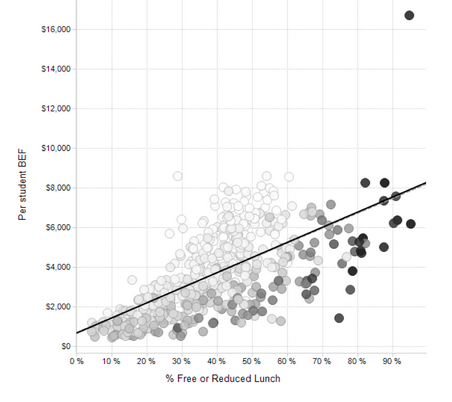
District Funding, by Racial Composition and Poverty Level

Black dots represent districts with no white students and white represents districts with 100 percent white students. (David Mosenkis)

“If you color code the districts based on their racial composition you see this very stark breakdown. At any given poverty level, districts that have a higher proportion of white students get substantially higher funding than districts that have more minority students.” That means that no matter how rich or poor the district in question, funding gaps existed solely based on the racial composition of the school. Just the increased presence of minority students actually deflated a district’s funding level. “The ones that have a few more students of color get lower funding than the ones that are 100 percent or 95 percent white,” Mosenkis said.
Issues with scarce budgets and troubled urban schools aren’t new, and they exist all over the country. In an article published in The Atlantic in 1954, Henry I. Willett attempted to answer the question of whether or not public schools cost too much by saying, “The amount spent for educational purposes as compared with amounts spent for many other items and services, including luxuries, would indicate that the importance of education in our democracy is not yet realized: and the hour is growing late.”
In Pennsylvania, the crisis is particularly acute. The state’s former governor stripped the education budget significantly. In the years since, schools have shuttered, teachers have been fired, and the schools that remain are existing on bare-bones budgets. Earlier this year, two children died after getting sick at district schools where no nurses were on duty due to budget reductions. Pennsylvania is also one of the only states in the country that hasn’t had a specific formula in place for distributing government aid to its districts. That’s left lots of room for partisan politics and funding bias.

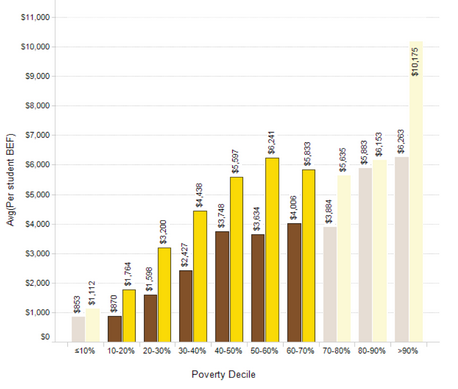
Funding Per Student, by Race and Poverty Level

Brown represents less white districts and yellow represents more white districts. (David Mosenkis)

This year, Pennsylvania Governor Tom Wolf—who took office in January—proposed increasing education funding in the state. And after studying the disbursement of funds, the Basic Education Funding Commission has voted toadopt a new formula that would theoretically address much of the bias when it comes to how state funds are doled out. That’s great, but the new formula hasn’t actually been enacted and the state has yet to actually pass a budget.
But even when both of those tasks are complete, it won’t eradicate the problem of racial bias in the state’s school funding appropriation. Mosenkis says that the The Troubling Link Between School Funding and Race - The Atlantic:

Alfie Kohn: Do This and You'll Get That: A Bad Way to Defend Good Programs - Education Week

Do This and You'll Get That: A Bad Way to Defend Good Programs - Education Week:

Do This and You'll Get That: A Bad Way to Defend Good Programs


When we're not sure people will support our cause, it's tempting to link it to something more popular. Because an idea may be controversial or lack broad support, we hitch a ride on an outcome that reflects mainstream values. It's a strategy widely used in education, although we may have failed to notice the pattern—and consider its risks. To wit:
• Play. The current cult of rigor has led to fewer opportunities for young children to explore, invent, and just be kids. But rather than take a stand in favor of the irreducible value of such activity, we defensively list the putative practical benefits of fooling around. Play is "children's work"; it teaches academic skills, promotes language development, offers opportunities for conflict resolution, and so on.
• Social-emotional learning. Let the headlines tell the story: "Study Finds Academic Payoffs in Teaching Students Social Skills" (Education Week); "Study: Whole-Child Program Boosts Reading, Math Scores" (ASCD SmartBrief). A Teachers College, Columbia University, report published earlier this year even tried to quantify "The Economic Value of Social and Emotional Learning."
• Music education. Lending new meaning to the phrase "instrumental justification," efforts to bring music to children's lives are often defended on the grounds of improved performance in math or a boost in general cognitive capabilities. (When was the last time you heard someone justify algebra as a way to help kids be better musicians?)
• Preschool. The economist James Heckman may be the most prominent proponent of the financial benefits of early-childhood education, but today you'll get millions of hits by Googling "preschool" and "investment." Forget its potential to enrich children's lives—the reason to get behind nursery school, we're told, is that it will enrich the treasury by reducing government spending once we see tots as "human capital."
• School itself. The logical conclusion of this strategy is the use of economic criteria to justify the very idea of giving children a good education. Politicians and corporate executives reflexively invoke the "competitive 21st-century global economy" whenever they want to make a case that schooling matters.
—Getty
What I'm describing isn't limited to our field, of course. Generosity is often promoted by citing the benefits that will redound to the giver (2013 article in the University Herald: "Charity Can Get You Laid"), while social programs to address infant mortality or homelessness are, like universal pre-K, routinely justified on economic grounds. I don't question the good intentions of people who talk this way; they're doing what they believe is most expedient to rally support for important initiatives.
But there are four serious problems with this strategy—all of them uncomfortably relevant to education.
1. It devalues the very thing you support. Scores of studies have found that offering people a reward for doing something (such as reading or helping) tends to reduce their interest in whatever they had to do to get the reward. One reason for this effect, though not the only one, is that anything presented as a prerequisite for something else—a means to another end—comes to be seen as less desirable. The recipient of the reward figures, "If they have to bribe me to do this, it must be something I wouldn't want to do."
This applies to programs and causes, too, because the implication of emphasizing the extrinsic benefits of, say, social and emotional learning is that there's no reason to support it other than those benefits, no intrinsic value to fostering social and emotional growth. We're implying that English/language arts and math are the only important disciplines, or that test scores are the sole outcome we ought to care about, or that financial gain is the ultimate criterion by which to gauge the value of our activities.
This is particularly ironic in the case of play because the whole point of play is that it has no point. Play is about process, not product; it has no goal other than itself. But this same pernicious paradox also shows up with any activity we care about: It will be even harder to support something once we've suggested that it acquires its value from something else. As the teacher and former Education Week Teacher blogger Peter Greene implored recently, "Do not defend a music program because it's good for other things. That's like defending kissing because it gives you stronger lip muscles for eating soup neatly. ... Defend it because it is music, and that's all the reason it needs."
2. It's a bargain with the devil. The consequences I've been describing are likely to result even if X does reliably bring about Y. But if doubts should develop about the empirical connection being alleged, you're really sunk. You've bet the house on a horse that didn't come in.
In fact, the researchers Peter K. Smith and Angeline Lillard have independently suggested that assertions about academic benefits derived from play may be overstated. Likewise, the case for the "Mozart effect" has been greatly exaggerated: In the classic study on the topic, music proved beneficial only with respect to spatial reasoning, an effect, moreover, that didn't last long and was demonstrated only with college students. As for education itself, a student's school achievement is only weakly related to his or her subsequent workplace performance, and there's little correlation between a nation's average test scores and its economic vigor.
"Every time we argue that preschool pays financial dividends down the road, we’ve missed another chance to defend the value of preschool in itself."
Once such findings become widely known, the case for funding and supporting education is likely to be far weaker than if we'd never emphasized economic results in the first place. The same is true of using academic outcomes to promote play, music, or social skills.
3. It may enhance the legitimacy of whatever we're using as the justification. I've been arguing that "do this in order to get that" deprives us of an opportunity to build a constituency for "this."
(Every time we argue that preschool pays financial dividends down the road, we've missed another chance to defend the value of preschool in itself.) But we also may be bolstering the value of "that."
Such a result may not trouble us when the claim is that social and emotional learning or the arts raise achievement in core academic subjects; that's not an objectionable Do This and You'll Get That: A Bad Way to Defend Good Programs - Education Week:

"A People's History" of the Opt Out Movement - UNITED OPT OUT: The Movement to End Corporate Education Reform

"A People's History" of the Opt Out Movement - UNITED OPT OUT: The Movement to End Corporate Education Reform:

“A People’s History” of the Opt Out Movement


The following post was written by Tim Slekar, one of the founders of United Opt Out National.
Howard Zinn talked about the writing of history and the intentional omission of certain facts and the strategic use of other facts in composing historical narratives.  His famous A People’s History of the United States was and still is most people’s first crash course with a critical narrative history of our country.  It’s the one book that most people read and very often quizzically ask, “Why wasn’t I taught this in school?”
There are many possible reasons, but as Howard talked about in the book, the most common reason—critical narratives that upset the status quo or question a power arrangement are not typically looked upon favorably.  Critical narratives are dismissed simply because they disrupt the narrative of those that wish to own history.
Over the weekend a “history” of the opt-out movement was made public.  Was this history factual? It was filled with facts that’s for sure.  But many facts were forgotten and the arrangement of the other facts told an interesting story—a new narrative.
This new narrative devalues other peoples’ facts and starts the process of supplanting a fictional feel-good story of good old American heroism.
This is not to say that the individuals included in this history did not act courageously or heroically—they did.  However, this simplistic narrative washes away the blood sweat and tears of those that came beforeand distorts reality.
Many of those that came before spent sleepless nights contemplating opt out. They sacrificed professional "A People's History" of the Opt Out Movement - UNITED OPT OUT: The Movement to End Corporate Education Reform:

Our Activist Handbook NOW Available for Purchase

Purchase our book today here at Information Age Publishing.
We have documented our activist journey in an effort to share a broader understanding of “opt out” – “opt out” is much more than simply refusing high stakes tests.
As we reclaim the conversation on public education with An Activist Handbook for the Education Revolution, we share with you our UOO personal journey, detailed actions, and research to support you in your work. All proceeds from our book will be used to further our efforts at United Opt Out to educate, take action and allow all children to have the following – as stated in our mission and demand:
United Opt Out National serves as a focused point of unyielding resistance to corporate ed. reform. We demand an equitably funded, democratically based, anti-racist, desegregated public school system for all Americans that prepares students to exercise compassionate and critical decision making with civic virtue.
Solidarity,
The UOO Team

Find us on Facebook

National Governors Association, Teachers Unions to Congress: Finish Work on NCLB - US News

National Governors Association, Teachers Unions to Congress: Finish Work on NCLB - US News:

Governors, Teachers Unions to Congress: Fix NCLB

The push comes just days after Speaker John Boehner, an original architect of NCLB, said he plans to resign.


Governors and major education groups urged Congress Tuesday to complete its work to overhaul the Elementary and Secondary Education Act – commonly known as No Child Left Behind in its latest iteration – and get a conferenced bill to the president's desk by the end of this year.
"Governors have long called for the bipartisan reauthorization of ESEA to restore the state-federal partnership," Washington Gov. Jay Inslee, a Democrat and chairman of the National Governors Association's Education and Workforce Committee, said in a letter to lawmakers. "We stand ready to work with Congress to complete ESEA reauthorization this year and move on to a state-led law that places every child on a path to success." 


The two-pronged push from the association and education groups – including the two national teachers unions – comes just days after House Speaker John Boehner, one of the original architects of No Child Left Behind, said he planned to resign at the end of October, prompting concerns that his departure could derail congressional efforts on the measure. The Ohio Republican has been integral in helping to nudge the process along in the House, where conservatives in the Republican Party sought to halt it.
In September, Rep. John Kline – a Minnesota Republican and author of the House's overhaul bill – also said he will not seek re-election next year. Combined with the increasingly congested congressional calendar, which includespunting a complex budget negotiation to December, some education policy experts say it's becoming more complicated for conferees to cobble together a negotiated No Child Left Behind rewrite from the bills passed by each chamber earlier this year.
"We know that Congress has a busy agenda this fall, but Congress must not lose focus on the needs of our nation's students," the 3 million-member National Education Association, 1.7 million-member American Federation of Teachers and eight other education groups wrote in a letter Tuesday to members of the House and Senate education committees. "ESEA reauthorization cannot wait."
The education organizations also include the Council of Chief State School Officers and the School National Governors Association, Teachers Unions to Congress: Finish Work on NCLB - US News:

How the Seattle Teachers’ Union Got Tough and Got Popular - Seattle Weekly

Seattle News and Events | How the Seattle Teachers’ Union Got Tough and:

How the Seattle Teachers’ Union Got Tough and Got Popular

The Seattle teachers’ strike shifted the public image of teachers’ unions—both in Seattle and across the country.


Three years ago, Jonathan Knapp took the helm of a Seattle Education Association that had taken its share of defeats. Teachers were dissatisfied with the contract they’d negotiated in 2010; voters approved the creation of charter schools in 2013 (seen by some as a rebuke of public schools); and ongoing conflicts over student testing were fraying everyone’s patience.


The picture is much different now. Two weeks ago, with teachers on strike for the first time since 1985, SEA and the Seattle School District agreed on a contract that not only sees pay increases across the board but makes major changes to everything from recess to teacher evaluations. We asked Knapp, who is leaving his post at the end of the school year after serving his second two-year term, how they did it.
SW: This was the first time the Seattle Education Association went on strike over contract issues in 30 years. Why now?
Knapp: Teachers were not just waiting to strike. We were ready to approve a contract on [August] 24th. We were ready to approve a contract on [September] third. But having raised the expectations and set some high goals, it was clear that members were not going to accept just anything.
I think the real answer is that we’ve been building our membership engagement and our power here very self-consciously in the past three years since I’ve been president. And, sure, things happen in a certain way. You’ve got severe underfunding of public education at the state level. You’ve got the region coming out of recession. Seattle is booming right now—more than any other city in the country, perhaps. And our members are determined not to be left behind.
But it had a lot to do with us being ready to be in a position to do something like this. Three years ago, five years ago, 10 years ago, I don’t think SEA was ready to do that.
Was there a specific moment or event that turned the tide for the union? A new era of solidarity, if you will?
Two springs ago—in the budget season going into last year—the district was proposing a bunch of budget cuts, and proposing to lay people off. And we had done some budget analysis, tracking district spending, what their trends had been over the past five or six years. They always have about 20 or 25 million dollars left over at the end of the year. They always plan for some reserves, a responsible amount, and they always have twice that. Every year.
So we organized against that. In the budget process, each school gets its allocation from the district and then has to approve a budget. We [told the schools], “Do the best you can with the money you’ve got, create a budget, and then vote it down. Because we’re not going to sanction this layoff of our office staff.”
At a halfway point in the process, when about 50 schools had said no, we got an invitation to come up to the district office. And the head of Teaching & Learning, who was chairing the meeting, said, “What’s going on here? We know that a lot of the elementary schools are fine with their budgets. They’re just voting ‘No’ out of solidarity.” And I just sat back and said, “Yeah, that’s exactly right.”
A lot of the issues that came up during the 2015 bargaining process were student-focused, such as recess, equity teams, and standardized testing. It wasn’t just about teacher pay. Was that new? Was that strategic?
Recess, equity teams, limits on testing—all of that is really important. That was getting a lot of airplay, and rightfully so. But those weren’t the only issues. There were a lot of things in this contract that we went after. In [public-sector] bargaining, there are mandatory subjects of Seattle News and Events | How the Seattle Teachers’ Union Got Tough and:

Civil and Human Rights Groups Gearing Up for ESEA Conference

Civil and Human Rights Groups Gearing Up for ESEA Conference:

Civil and Human Rights Groups Gearing Up for ESEA Conference


WASHINGTON –– In the lead-up to the House and Senate conference on the Elementary and Secondary Education Act, civil rights groups have continued to work with potential conferees to ensure that vulnerable students aren’t left out of the final legislation. The Leadership Conference on Civil and Human Rights and its partners have convened a coalition around key principles for ESEA reauthorization that must be met in order for the civil rights community to support its passage.  
In key districts, The Leadership Conference on Civil and Human Rights has collaborated with local parents, teachers, and chapters of the NAACP and LULAC to produce radio and social media ads in Memphis, Miami, the Twin Cities, and Denver, urging potential conferees to keep ESEA strong for vulnerable students. The Leadership Conference will also assist local groups in conducting in-state activities to amplify their message over the coming weeks. 
During the weeks of 9/21 and 9/28, we are running the following radio ads that will be complemented with a corresponding social media campaign beginning the week of 9/28.
Building on an NAACP lobby day that took place on September 16, The Leadership Conference and LULAC will both bring members to the Hill during the week of 9/28 to highlight the importance of ESEA to their communities.
  • On Tuesday, September 29, The Leadership Conference is hosting the “Don’t Betray ESEA: Advocating for Civil Rights Priorities in Education” advocacy day with participants from across the country.
  • On Thursday, October 1, LULAC will host its “ACTober Advocacy Day,” which will focus on ESEA, in addition to other key priorities to the community such as immigration reform and the status of Puerto Rico. 
The Leadership Conference on Civil and Human Rights is a coalition charged by its diverse membership to promote and protect the rights of all persons in the United States. The Leadership Conference works toward an America as good as its ideals. For more information on The Leadership Conference and its 200-plus member organizations, visit www.civilrights.org.  Civil and Human Rights Groups Gearing Up for ESEA Conference: