Latest News and Comment from Education

Wednesday, September 23, 2015

Reform bill would indirectly help schools keep equipment | The Columbus Dispatch

Reform bill would indirectly help schools keep equipment | The Columbus Dispatch:

Reform bill would indirectly help schools keep equipment


The big charter-school reform bill pending in the Ohio House would take steps toward curbing for-profit charter operators from keeping furniture and equipment bought with taxpayer money.
But it doesn’t directly address the issue.
The Ohio Supreme Court ruled last week that White Hat Management Co., run by Akron industrialist and major GOP donor David Brennan, owns the classroom equipment bought under terms of its contract. Ten of White Hat’s former schools had sued, arguing that the company violated its financial duty to the schools.
“The legislature has enacted statutes that take a laissez-faire attitude toward operators of community schools,” Justice Judith Ann Lanzinger wrote in her majority opinion.
State legislators hope to change that with House Bill 2, a package of wide-ranging reforms of Ohio’s heavily criticized charter-school laws. Although the bill does not specifically address for-profit operators owning taxpayer-funded equipment, supporters say some provisions will make such agreements far less likely.
The bill would require operators and boards to specify property ownership in all new and renewed contracts. The bill also would ensure that fiscal officers are independent of operators, and it would require more transparency from those serving on charter boards.
“If you’re an independent board, and you’re putting everything you own and don’t own down in writing ahead of time, you’re much more likely to make a decision that is not going to result in a bad outcome,” said Chad Aldis of the Thomas B. Fordham Institute, which supports school choice and sponsors 11 charter schools in Ohio.
House Republicans also note that House Bill 2 would repeal a law that allows management companies to overrule the governing board; the change would strengthen the board’s control when it crafts operator contracts.
Sen. Peggy Lehner, R-Kettering and chairwoman of the Senate Education Committee, agrees that the bill “goes a long way” toward addressing future ownership of furniture and equipment. “But I am open to explore whether that goes far enough.”
The House returns to session next week and is expected to send House Bill 2 to a conference committee, where the House and Senate work out final changes.
“The court very appropriately decided that there wasn’t enough protection in the Ohio law to prevent the sort of mischief that has gone on,” Lehner said. “That has been the premise of House Bill 2 all along,”
Lehner said she is exploring more-direct language that would no longer allow an operator to take possession of furniture and Reform bill would indirectly help schools keep equipment | The Columbus Dispatch:


GOP education reform gets trampled by Trumpmania | TheHill

GOP education reform gets trampled by Trumpmania | TheHill:

GOP education reform gets trampled by Trumpmania


Six months ago, it looked like conservative education thought would enjoy a renaissance in the race for the GOP presidential nod. Education was the signature issue of early front-runner Jeb Bush, former Florida governor, who always returned to his gubernatorial school reform record when making the case for brand of can-do, conservative leadership. Govs. Scott Walker (Wis.) and Chris Christie (N.J.) pointed to their fights with the teacher unions as evidence of their willingness to do the hard stuff. Sen. Rand Paul (Ky.) talked about school choice in urban centers as a way to explain the relevance of conservative solutions for low-income and minority communities. Sen. Marco Rubio (Fla.) made reforming higher education an emblem of his focus on middle-class concerns. Contestants seeking to be the face of a sunnier conservatism viewed education reform as the perfect way to talk about their ideas for expanding opportunity and promoting inclusive growth.
Last winter, the race was shaping up to be an upbeat contest to see which conservative reformer could put forward the most compelling approach to expand opportunity. Education has always been the essential foundation for any vision of opportunity-expanding conservatism. Rubio and Bush have called for taking on the higher education cartel, while the Republican field features governors who have championed a slew of interesting school choice proposals. This is all accompanied by important questions about how much of this a conservative president should take on from Washington and what to do about the cost of college and the Common Core.

All of this has been drowned out by the ascendance of Donald Trump. Two major GOP debates have now passed, and education has barely made an appearance. More tellingly, the very tenor of the GOP race has shifted in a way that has made such appeals seem quaint. Amidst Trump's bombast and the "hell-with-'em-all" frustration that has propelled outsiders, measured talk about education improvement can seem out of touch, like the candidate is missing the big picture.
Six months ago, it looked like the GOP campaign was going to highlight and sharpen policy thinking, while giving conservative proposals an opportunity to coalesce. It offered a chance to illuminate some of the sharp conservative thinking that's been quietly unfolding on Capitol Hill — as with the sensible rewrite of No Child Left Behind that is currently in process — and to show that Republicans could offer practical alternatives to bureaucratic, budget-busting Democratic proposals on issues like college affordability and early childhood.
But that all gave way to a summer of ad hominem attacks and talk of Mexican rapists. Now, don't GOP education reform gets trampled by Trumpmania | TheHill:

Sacramento mayor continues to resist public record requests for emails | Reporters Committee for Freedom of the Press

Sacramento mayor continues to resist public record requests for emails | Reporters Committee for Freedom of the Press:

Sacramento mayor continues to resist public record requests for emails


Kevin Johnson, the mayor of Sacramento, and the Sacramento City Attorney are now resisting efforts by two separate news organizations to gain access to public records, according to a recent filing in a California court.
The development is the latest twist in an unusual public records dispute in which Johnson has sued his own cityand the Sacramento News & Review in an effort to prevent the release of email requested by the newspaper under the California Public Records Act. Now both the mayor and the city’s attorney are trying to keep Deadspin, which also requested the email, out of the case.
Johnson, like many other officials around the country, has been criticized for using non-governmental email accounts to conduct public business. But a government official’s use of a private email account does not shield public records from disclosure under the Public Records Act.
Under California law, a public record includes “any writing containing information relating to the conduct of the public's business prepared, owned, used, or retained by any state or local agency regardless of physical form or characteristics.”
Earlier this year, the Sacramento News and Review filed a California Public Records Request to better understand how Johnson uses his various email accounts. The Sacramento Bee also filed a similar public records request. And Deadspin, a sports news website owned by GawkerMedia, also submitted a similar public records request over the summer.
After the News & Review filed its records request the Sacramento City Attorney indicated that, absent a court order, the email would be released. Before that could happen, however, Johnson sued the city and the newspaper, seeking an injunction that would prevent the city from making the emails public.
At least some of the requested email messages reportedly relate to Johnson’s involvement with the National Conference of Black Mayors, a group he briefly led before it filed for bankruptcy.
As mayor of Sacramento, Johnson reportedly tasked members of his office to work on NCBM matters.
In his petition to prevent the release of the records, Johnson claims that he is acting solely “in his official capacity as the former President elect of the NCBM and not as the Mayor . . . .” The trustee for NCBM, Edwin Palmer, is also listed as a petitioner in the case, along with NCMB and Johnson.

Arne Duncan's Wars

Arne Duncan's Wars:

Arne Duncan's Wars

With drive, ingenuity and a willingness to throw elbows, Obama’s closest friend in the Cabinet has tried to reshape American schools. Now will the backlash erase his legacy?


Education Secretary Arne Duncan is a mild-mannered, even-tempered, introverted kind of guy, but he’s spent much of his six and a half years in Washington in combat. He’s fought with school choice activists, student debt activists, gun activists, for-profit colleges, black colleges, traditional colleges, private lenders, loan collectors, the Tea Party, the Republican Party, and the teachers unions at the heart of the Democratic Party, among other interest groups. He’s in a multi-front war to fix America’s schools, and I recently sat down to delve into some of the wonkier details with Ted Mitchell, a former college president and education venture fund CEO who is now Duncan’s undersecretary. Mitchell spent a half hour patiently explaining to me the philosophy behind the Education Department’s fights—basically, making sure that all kids get a chance to succeed; that schools are accessible, accountable, and effective; and that adults who don’t do their part face consequences—until someone knocked on his door to say our time was up.

Then he started crying.

We had never met before, but Mitchell clearly had something personal he wanted to share, and my dull policy questions hadn’t given him much of an opening. His voice quivered as it finally spilled out: “I can’t let you leave without telling you what a privilege it has been to work with Arne.” He started to add something about fighting for students, but choked up mid-sentence. His press aide started crying, too. It sounds hokey, but I’ve never had an interview take such an abruptly emotional turn.

Education policy clearly inspires a lot of passion. It’s not just about cleverly named initiatives like Race to the Top and No Child Left Behind, or arcane regulations defining “gainful employment” and “adequate yearly progress.” It’s about kids and their futures. You can see the intensity in the comments on Duncan’s Facebook page, spewing rage over the Common Core math and reading standards or the national epidemic of standardized testing. Duncan’s loyalists are just as intense, inevitably gushing about Duncan’s constant mantra in policy meetings: What’s the right thing for kids? “Everyone says that,” said Justin Hamilton, a former communications aide to Duncan. “Arne f---ing means it!”

In a cynical town of posturing and spin, Duncan has earned a reputation for saying what he means and doing what he says. At the same time, he has faced growing dissatisfaction with what he has said and what he has done. Duncan has driven far more change than any previous education secretary, but as he heads into the home stretch of the Obama administration, much of that legacy is at risk.

Duncan has used his perch at the smallest Cabinet agency—and his tight relationship with President Barack Obama, his pickup basketball pal from Chicago—to put an unprecedented national stamp on a policy area with a long and strong tradition of local control. He’s helped make major inroads on K-12 reforms that unions despise, like using student test scores to evaluate teachers. He’s helped push big changes in higher education as well: a government takeover of student loans, a harsh crackdown on for-profit schools, a huge expansion of student aid. A department with only 4,200 employees, traditionally considered a kind of Washington backwater, has transformed the policy landscape for 100,000 schools and 5,000 colleges.

But Duncan has also helped unleash a huge backlash—against the Common Core standards, against over testing, against federal overreach in general. This fall, Congress plans to rewrite the main law overseeing public education, and activists on the left and the right have joined forces to try to roll back Washington’s power; the House and the Senate have both passed versions that would defang Duncan’s department, and the Senate vote was broadly bipartisan. Republican presidential candidates like Marco Rubio and Rand Paul have vowed to eliminate the department entirely, while Bobby Jindal and Chris Christie, governors who Arne Duncan's Wars:


On New Philanthropy, Education Reform, and Eli Broad's Big Plan for L.A. Schools

On New Philanthropy, Education Reform, and Eli Broad's Big Plan for L.A. Schools:

On New Philanthropy, Education Reform, and Eli Broad's Big Plan for L.A. Schools


The Los Angeles Times published a confidential document yesterday, which seems to confirm earlier reports that the Broad Foundation wants at least 50 percent of L.A. public school students educated in charter schools over the next eight years. Currently, 16 percent of students in L.A. Unified attend charters, and according to the report, getting to 50 percent would require creating 260 new schools, for 130,000 students, at a cost of $490 million.
“Los Angeles is uniquely positioned to create the largest, highest-performing charter sector in the nation,” the report stated. “Such an exemplar would serve as a model for all large cities to follow.”
Hmmm. That sounds familiar.
Earlier this month, veteran Washington Post journalist Dale Russakoff published a new book, The Prize, which explores education reform efforts in Newark from 2010-2015. Her book details the goals, mistakes, and challenges reformers encountered as they tried to “transform” Newark’s struggling school system—largely through expanding charters, closing “failing” schools, and implementing new teacher pay scales. The political drama and backroom dealings led by New Jersey Governor Chris Christie, Newark Mayor Cory Booker, and Facebook CEO Mark Zuckerberg offers humbling lessons to all those working to improve public education, no matter where one comes down on the policy specifics.
Like Eli Broad’s vision for Los Angeles, a key goal for Newark education reformers was to make the city a model for the rest of urban America. Booker wanted Newark to be transformed into “a hemisphere of hope” and repeatedly told Zuckerberg that their goal was not just to fix local education, but to develop the “high impact programs and best practices” that could fix education in all major cities. Booker believed that if he could succeed within a difficult district like Newark, then he could succeed anywhere. He emphasized that Zuckerberg’s investment could help lead to the “blueprint for national replication across America’s urban centers to transform its youth.”
This month, HistPhil, a blog that explores the history of the philanthropic and nonprofit sectors, has been running an excellent series on philanthropic On New Philanthropy, Education Reform, and Eli Broad's Big Plan for L.A. Schools:

The Global Search for Education: The New UN Agenda - What is the Role of Education? | C. M. Rubin

The Global Search for Education: The New UN Agenda - What is the Role of Education? | C. M. Rubin:

The Global Search for Education: The New UN Agenda - What is the Role of Education?


2015-09-22-1442930237-9135562-cmrubinworldkarencatopic1500.jpg


"Educators have an opportunity to engage students in shared problem solving towards the goals, and the responsibility to instill in the next generation a deep understanding of the power of informed action and the perils of inaction. The students of today will be the emerging leaders in 2030." -- Karen Cator
"Transforming our world: the 2030 Agenda for Sustainable Development" has set a plan of action in 5 areas: People, Planet, Prosperity, Peace and Partnership. The 17 Sustainable Development Goals (SDG's) and 169 targets represent a bold and ambitious universal agenda that aims to build on the Millennium Development Goals; to complete what these did not achieve and then go much further. The Agenda's key goal and "the greatest global challenge" of the SDG's is to eradicate extreme poverty by 2030, with the pledge that "no one will be left behind."
What role can education and learning play in achieving the critical goals for the new UN Agenda?
24 debaters from 11 countries will explore answers to the question in the Education Fast Forward live global debate on September 24. EFF Trustee and Education World Forum Director, Gavin Dykes, will chair the debate.
EFF guest speaker, Karen Cator, is President and CEO of Digital Promise and is a leading voice for transforming American education through technology, innovation and research. From 2009-2013, Karen was Director of the Office of Educational Technology at the U.S. Department of Education, where she led the development of the 2010 National Education Technology Plan. Prior to joining the department, Cator directed Apple's leadership and advocacy efforts in education. It is our pleasure to welcome Karen to The Global Search for Education.
Karen, what do you see as the key roles for education and educators building on the agenda of the "Transforming our World" summit at the UN?
Few would disagree that education is an urgent global priority for the health and prosperity of individuals, families, communities and nations. And, an enlightened and engaged education system will certainly support the attainment of the 17 new goals. To that end, students can be challenged to design solutions to problems associated with the goals. Problems are best solved through diplomacy, collaboration and the sharing of agendas, ideas, resources and solutions; and schools can and should help students develop the complex set of skills required for doing so. Educators have an opportunity to engage students in shared problem solving towards the goals, and the responsibility to instill in the next generation a deep understanding of the power of informed action and the perils of inaction. The students of today will be the emerginThe Global Search for Education: The New UN Agenda - What is the Role of Education? | C. M. Rubin:

Educating for Democracy: Connecting the Dots | Joel Shatzky

Educating for Democracy: Connecting the Dots | Joel Shatzky:

Educating for Democracy: Connecting the Dots


The recent debates of the Republican Presidential candidates sadly suggested to me as an educator how unlikely it would be for the viewers and voters to separate fact from fiction. History, to many American students, has always been "a thing of the past." It's all a matter of connecting the dots which most all of the presidential candidates would like to disconnect. Knowing a certain amount of history, or, more to the point, remembering some significant dates, names and events can be, I believe, very important for American citizens to remember in order to be well-informed voters; those who know how to "connect the dots." What makes it easier for politicians to "disconnect the dots"is Americans' woeful ignorance of history and civics. In a report several years ago, from "The Wire," it was observed:
Many Americans know U.S. students' test scores on subjects like math and reading are low. In civics, however, they're appalling. On the National Assessment of Educational Progress, a respected, voluntary nationwide test, 22 percent of students test proficient in civics, and only 18 percent rate proficient in U.S. history. American citizenship depends on its citizens sharing some body of knowledge together about the political structure that governs their daily lives. -- report coauthor Sandra Stotsky, who led Massachusetts in developing some ofthe country's best education standards in the 1990s.
Moreover, in today's obsession with facts both trivial and significant, it's hard to keep up with what is really fact from what is "disconnecting the dots."
The presidential debates I witnessed were so full of misstatements, exaggerations and some plain lies that it should have been expected for some of the commentators to point them out, although it would be more assuring if the viewers could do so themselves. But it seems that the core constituents don't seem to be concerned about the facts but about the "delivery" skills of the candidates. There was little fact checking that I could tell from the networks; and those few errors cited had little of substance to be really informative.
An example of disconnecting the dots was demonstrated by former governor Mike Huckabee of Arkansas: one of the Presidential candidates. Pandering to the Jewish voters as Evengelicals often do in order to hasten "The Second Coming,"he claims that the nuclear agreement with Iran will put the U.S. and the rest of the world in danger of being overwhelmed by Jihadists. It's alarming, certainly, but unless you connect the dots it would seem from Huckabee's tirade that no other Middle Eastern countries such as Pakistan and Israel have had the bomb for decades. Given that those countries as well as India have the ultimate weapon and for some good reasons the crazies don't seem to be able to get hold of one for their "Second Coming," all Huckabee's hysteria will do is make some of the electorate advocate scrapping the agreement with Iran and be willing to put American "boots on the ground" which has already been shown to be a futile and costly gesture..
But even one of the "moderate" candidates at the debate, Governor John Kasich of Ohio, demonstrated his disconnect of the dots when he casually mentioned that Educating for Democracy: Connecting the Dots | Joel Shatzky:

Common Core not so core | PCC Courier

Common Core not so core | PCC Courier:

Common Core not so core

Common Core is an answer that will not translate well from Chinese, Korean and Japanese to American English.


Lost in Education


With 20 percent of eligible third through eighth graders passing on the standardized exams last spring, the recently adopted Common Core standards have come under fire.
Common Core, a programs adopted by 45 of the 50 states sets national standards across the entire country as opposed to having 50 different standards controlled by each state, was originally passed to improve the overall test scores of students across the country.
However, with this recent rebellion and the numerous dissenting opinions emphasizing the lost of creativity due to the uniformity of common core, the question to be asked is “does it really work?”
Common Core was America’s answer to our mediocre test results nationally. According to a report by The Learning Curve, published by Pearson and written by The Economist, America ranked 20th in educational attainment in 2014.
Countries like Korea, Japan, and China ranked highly across the board in the education department. What these countries have in common, besides being in Asia, is that they have a set a more united national standard as individual countries that their students strive towards day and night.
Thus, the logic to Common Core was to reach a similar educational level by following these countries in standardizing a set goal across all 50 states. As previously, it was increasingly difficult to compare the educational levels of states due to the differences in curriculum nationally. As such, by gathering the states under one educational banner, they can begin to work towards a higher level together.
At first glance, this theory seems sound as the best way to learn anything is by copying.
However, copying doesn’t work when the test we have is a different form.
Although, the United States and these Asian countries had students taking the same test, the fundamental issues with the education system and culture are an entirely different monster to wrestle than those in Asia.
Common Core is an answer that will not translate well from Chinese, Korean and Japanese to American English.
“While there are reasons to doubt that claim [that a national education would improve America] — it’s hard to see how Utah, which spends less than one-third as much per student as New York, can offer a comparable education,”David L. Kirp of The New York Times writes.
A hole that Kirp pokes into the theory of Common Core is the contrasting levels of money and effort states place in their students. It is a foregone conclusion that New York, one of the most iconic states in the United States, would invest more into education than Utah, a more remote state, simply due to the massive gross income about 16 more million people would pay in taxes.
Yet, children in Utah are expected to hold their own to the same standards that students in New York are judged on. While ideally kids in Utah will rise to the challenge inspired by their teacher, this is reality, not a B-movie.
Furthermore, the teachers themselves will become handicapped. With Common Core, teachers must adhere to a rigid curriculum that stymies the teacher’s creative freedom while eating away precious hours in class.
With how radically different the standards are, teachers are forced to adapt and reallocate their time into time devoted into Common Core instead of their individual lessons.
The driving force of Common Core itself is the idea that the United States has dropped off from being one of the leading influences in education. But the idea that America was once the very epitome of the educational system is false.
“When the first international test was given in 1964, our students ranked 11th out of 12 nations,” Diane Ravitch, a research professor, wrote on CNN. Yet our nation went on to become the most powerful economy in the world.”
It would be foolish to call the American education system stellar, but it does have its strengths that these Asian countries do not possess.
“Models of best practice exist all over the world, but are most noticeably increasing in Asia. And, it’s not a one-way street,” Vishakha N. Desai, president of the Asia Society, wrote on a special on CNN. “Asian nations struggle with outmoded instructional practices and an over-reliance on high-pressure examinations — and they continue to look to America for clues in cultivating innovation in teaching and creativity in their students.”
What the rigorous curriculums of China, Korea and Japan promote is the memorization of scientific facts, mathematical equations and even aspects of literature.
Most notably in Korea, private institutions, sometimes referred to as cram schools, are a common fixture in a student’s life as they must attend them during the night to remain competitive in school.
Both Japanese and Chinese students share noticeably similar Eastern culture and philosophy that weighs Common Core not so core | PCC Courier:

Tuesday, September 22, 2015

Cerf: Newark school budget deficit is all Cami Anderson’s fault | Bob Braun's Ledger

Cerf: Newark school budget deficit is all Cami Anderson’s fault | Bob Braun's Ledger:

Cerf: Newark school budget deficit is all Cami Anderson’s fault


Cami Anderson? I don't know Cami Anderson and, besides, it's all her fault. (MIke Simpson)
Cami Anderson? I don’t know Cami Anderson and, besides, it’s all her fault. (MIke Simpson)


The state official running the Newark schools conceded at Tuesday night’s school board meeting that his predecessor–a woman he appointed–created a $63 million budget shortfall by relying on assumptions that “turned out not to be true.” Christopher Cerf, who named Cami Anderson to the Newark job four years ago, quickly added he didn’t believe she and her staff had deliberately lied about the budget or had done anything illegal.
Cerf, the former state education commissioner and a business entrepreneur whose company held contracts with the Newark schools, was then quickly put on the defensive by a school board member who accused him of budget manipulations in the effort to prevent the district from running out of money by the end of the year.
“This is a crisis,” said Antoinette Baskerville-Richardson of the budget shortfall that has resulted in a spending freeze at schools throughout the state’s largest school district. Baskerville-Richardson demanded that Cerf admit his own responsibility for the district’s financial troubles.
He angrily replied, “Okay–I accept responsibility.”
But, clearly he did not, all but dismissing the financial troubles as a problem he can resolve by the end of the year. Meanwhile, principals have complained they cannot pay for basic supplies and services like security because the district has frozen individual school budgets to save money to prevent the state-operated district from running out of money before July 1, 2017.
The three false assumptions were, at best, stretches. Anderson, he said, had “seriously overestimated” the number of employees, especially expensive Cerf: Newark school budget deficit is all Cami Anderson’s fault | Bob Braun's Ledger:

Achievement gap points to ineffectiveness of decades of reforms | EdSource

Achievement gap points to ineffectiveness of decades of reforms | EdSource:

Achievement gap points to ineffectiveness of decades of reforms


The vast achievement gaps in the Smarter Balanced test scores released this month point to the ineffectiveness of reforms over the past 15 years or more that were intended to close those gaps, raising the question of whether a new set of reforms being implemented in California are more likely to succeed.
Those new reforms range from the Common Core standards to the Local Control Funding Formula, which allocates additional funds for high-needs children, grants local districts more decision-making powers, creates a more comprehensive accountability system that focuses on deeper learning skills, and moves to a model that emphasizes support for schools and teachers rather than imposing punishment or sanctions.
Only 28 percent of African-Americans and 32 percent of Latinos who took the test in California met or exceeded standards on the English language arts section of the Smarter Balanced tests, which students took for the first time this spring. By comparison, 61 percent of whites and 72 percent of Asian-Americans met or exceeded standards in English language arts. The differences in math are even wider. Only 16 percent of African-Americans and 21 percent of Latinos met or exceeded the standard in math, compared with 59 percent of whites and 69 percent of Asian-Americans.

ADDRESSING RACIAL AND ETHNIC INEQUALITY

These differences come against the backdrop of the fiercest national conversation on the causes  and effects  of racial and ethnic inequality that has occurred at any time since the Civil Rights Movement.
The fact that the disparity is so wide in a “blue state” like California is even more troubling than in states where educational and political leaders have been less committed to serving students from diverse backgrounds. In addition, during the past two decades, California has beaten back the anti-immigrant sentiments surging through other states, especially against Spanish-speaking immigrants. Latinos now wield considerable political clout in the state, and have helped drive education reforms here.
The last time there was a substantial narrowing of the gap in the U.S. was from the early 1970s to the late 1980s, as measured on the National Assessment of Educational Progress, or NAEP, often referred to as “the nation’s report card.” A  2010 report by the Educational Testing Achievement gap points to ineffectiveness of decades of reforms | EdSource:

Breakin’ it down: The District 3 City Council race, Kshawma Sawant vs Pamela Banks | Seattle Education

Breakin’ it down: The District 3 City Council race, Kshawma Sawant vs Pamela Banks | Seattle Education:

Breakin’ it down: The District 3 City Council race, Kshawma Sawant vs Pamela Banks


break it down
Our focus is on education and that has generally meant for us at the Seattle Education website sticking to the school board races during election season but with the mayor and City Council member Tim Burgess insinuating themselves into the Seattle Public School district with the city’s preschool program (more on that later) and attempting to control the school board, we have begun to look at the city council races more closely.
Because of this, we will be publishing posts about the City Council and school board candidates during the campaign.
To start things off, here is a great video that a Seattleite made about the City Council race in District 3 between the incumbent Kshawma Sawant and Pamela Banks.


You know how we like to follow the money so the first thing we did after viewing the video was check out Pamela Banks’ donors and it is a rather telling list. It is similar to the same donor list as Tim Burgess’. Coincidence? I think not.
Donors on the real estate development side of things:
Matt Griffin:  A developer in Seattle who is a big supporter of charter schools. He Breakin’ it down: The District 3 City Council race, Kshawma Sawant vs Pamela Banks | Seattle Education:

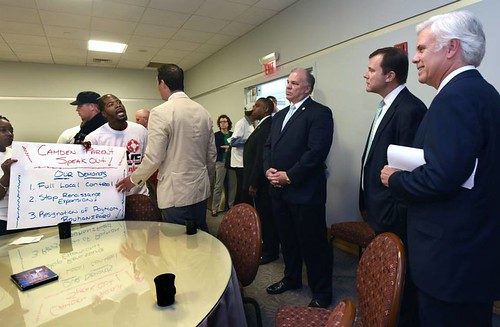
Blue Jersey:: Photo of the Day: Camden parents confront Norcross, Sweeney and Hespe

Blue Jersey:: Photo of the Day: Camden parents confront Norcross, Sweeney and Hespe:

Photo of the Day: Camden parents confront Norcross, Sweeney and Hespe


Camden parents confront George Norcross, Donald Norcross, Steve Sweeney
3 very different expressions on Steve Sweeney, Don Norcross, George Norcross 
as Camden parents confront them 
PHOTO: April Saul, Camden, NJ: A Spirit Invincible (on Facebook)


Inside, a $35 ticket conference hosted by the New Jersey "School Choice" Education Reform Alliance (quote marks, mine). Inside, the man who's made Camden his philanthropic playground, opened opportunities there for business friends to score, and put his name on a few some buildings - George Norcross, who also runs quite a few NJ Democrats. Next to him, two two beneficiaries, his brother Donald, for whom a seat in Congress was procured, and Senate President Steve Sweeney, the Norcross operation's presumptive pick for governor. Also there, NJ Education Commissioner David Hespe, appointed by Gov. Christie to grease the way for privatization targeting NJ's minority-majority cities.

Outside, about 50 fed up Camden parents, who say they represent many more who aren't available in the middle of a work day to crash a big wheelers' get-together.

These are Camden parents who are are tired of people who don't live in Camden calling the shots about how their kids are schooled and excluding their input. They object to the way their children are turned into commodities for the privatizers of education. Camden's only under state control two years and they already see the need to shake it off. And they want Christie-appointed Superintendent Paymon Rouhanifard gone.

Rosi Efthim :: Photo of the Day: Camden parents confront Norcross, Sweeney and HespeNewark's had 20 years of state control. Only after voters vaulted a public ed activist - Ras Baraka - into the mayor's office over the pro-charter candidate backed by Sweeney and Norcross, and after years of parents and students directly confronting Christie-appointed super Cami Anderson, did Newark's picture even begin to change. Among protesters today were Newark school board member Antoinette Baskerville-Richardson and NJEA officers Marie Blistan and Sean Spiller. Camden is organizing.

About April Saul: I found the photo above on Saul's Facebook page, called Camden, NJ: A Spirit Invincible. Saul is a Pulitzer Prize-winning journalist specializing in documentary photojournalism. She has a deep body of work at the Philadelphia Inquirer, where she is on leave on a Alicia Patterson Foundation Fellowship to document life in the city of Camden. More on April Saul and her work here and here.  Blue Jersey:: Photo of the Day: Camden parents confront Norcross, Sweeney and Hespe:


Schedules show Cuomo met with Dolan, Weingarten | POLITICO

Schedules show Cuomo met with Dolan, Weingarten | POLITICO:

Schedules show Cuomo met with Dolan, Weingarten


ALBANY — Gov. Andrew Cuomo met with Cardinal Timothy Dolan, the Catholic archbishop of New York, several weeks before re-introducing legislation to grant financial assistance for parents whose children attend private and parochial schools.
According to newly posted schedule records, the Democratic governor huddled with the Catholic prelate as well as with James Cultrara, the Catholic Conference's top education official, and Anthony de Nicola, a fund manager and board member of the group that pushed for the tax credit, on April 13 at the cardinal's residence in midtown Manhattan. Cuomo later held events around the state to rally support for the tax credit, which lawmakers did not enact.
The schedules also show:
-- Cuomo met with a trio of teachers' union leaders, Karen Magee of NYSUT, Michael Mulgrew of the UFT and Randi Weingarten of the AFT, on April 10, and again on April 22. The unions were vociferous opponents of the tax credit plan.

MORE ON POLITICO

-- The governor met with Jose Cabañas, the Cuban ambassador, 10 days before he led a trade mission to the island nation. Cuomo also called officials at the U.S. Department of State on April 17, the Friday before he departed.
-- The governor and New York City Mayor Bill de Blasio held a one-on-one meeting on May 27. A month later, after the conclusion of the legislative session, de Blasio accused his “friend” Cuomo of undermining his agenda.
-- Cuomo was scheduled to have a phone conversation with former vice president Al Gore on May 11.Schedules show Cuomo met with Dolan, Weingarten | POLITICO:

Race and Class Collide in a Plan for Two Brooklyn Schools - The New York Times

Race and Class Collide in a Plan for Two Brooklyn Schools - The New York Times:

Race and Class Collide in a Plan for Two Brooklyn Schools


Parents and students at Public School 8 Elementary School, right, in Brooklyn Heights and at Public School 307, left, in Dumbo, Brooklyn. CreditMichael Appleton for The New York Times, left; Sam Hodgson for The New York Times


At Public School 8 in Brooklyn Heights, the auditorium’s stage is crowded with music stands that were stored there when the music room had to be turned into a first-grade classroom.
The prekindergarten program was cut because of lack of space. And with the school operating far above capacity, 50 families who live within its zone — which also includes Dumbo and much of another Brooklyn neighborhood, Vinegar Hill — were placed on a waiting list for kindergarten last spring.
To the city, the solution for the overcrowding at P.S. 8 seemed obvious: move those two neighborhoods from P.S. 8’s zone and into that of P.S. 307, which is nearby and has room to spare. The proposal, however, has drawn intense opposition, and not only from the families who would be rezoned from the predominantly white P.S. 8 to the mostly black P.S. 307. Some residents of the housing project served by P.S. 307 also oppose the rezoning, worried about how an influx of wealthy, mostly white families could change their school.
For all its diversity, New York City, by some measures, has one of the most segregated school systems in the country, in part because many elementary schools are effectively closed off to children who live outside their zones. And although the Brooklyn rezoning is mainly a response to crowding, it is becoming a real-life study in the challenges of integrating just one of the city’s schools.
It is also, perhaps, an unavoidable result of the gentrification in its part of Brooklyn. For many years, the area that came to be named Dumbo, for Down Under the Manhattan Bridge Overpass, was a decaying industrial district with relatively few families.
Shirese Casenave, 51, who grew up in Farragut Houses, a public housing complex that now sends many children to P.S. 307, said she recalled some of her friends being bused to P.S. 8. “They had a choice,” she said.
That has changed, as Dumbo has become a thriving neighborhood where condominiums regularly sell for millions of dollars. Saying that the crowding problem was urgent, the city’s Education Department plans to present its proposal at the end of the month to the District 13 Community Education Council, which represents school parents in the area and has the power to approve rezonings. The department is hoping the council will vote on the proposal in time for the boundaries to take effect next year.
Continue reading the main story

A Proposed School Rezoning Creates Controversy

South Brunswick Board of Ed Tries to Oust Education Advocate - Education Lessons From A Sparkly District

Education Lessons From A Sparkly District: South Brunswick Board of Ed Tries to Oust Education Advocate:

South Brunswick Board of Ed Tries to Oust Education Advocate

sbboe1
Melissa Katz, far left, is watched by a police officer.


In every generation, you hope there will be people who are active and engaged in the community in which they live. You hope they are smart and willing to devote time to contribute and make things better in their corner of the world. New Jersey is lucky to have a lot of such people, especially in education advocacy. 


One of those people is a young woman named Melissa Katz. She is smart and funny and completely dedicated to becoming an urban educator. She is deeply involved in state advocacy for public education, seeing it not only as duty to a greater good, but also with the intent of saving a profession she dearly loves. Her future students will be very lucky to have her as their teacher.

Yesterday, I had a conversation with Melissa, actually I should say another conversation, about how her local Board of Education does a not great job of informing the public about their meetings -- specifically with regard to making their meeting agendas public. What is made available to the public before every meeting, via the district website, is a single page with an outline of a meeting. It looks like something the Business Administrator might start with before filling it in. As a member of the public, you should be able to look at an agenda, 48 hours in advance per the Open Public Meetings Act (OPMA), and discern what will be discussed. You should be able to decide if there is business you need to attend the meeting for -- either to comment or just to hear the details. South Brunswick Board of Education does not do this. You must attend the meeting to get an actual, full agenda.

Several members of the public have previously brought this to the Board's attention and nothing has been done. Melissa was troubled that the public comments had been ignored. We talked about the best way to approach the Board to ask for an explanation. This, with the full understanding that a Board does not have to respond to the question itself at a meeting. So, Melissa went home and looked at surrounding districts' websites for their Board agendas. All of Education Lessons From A Sparkly District: South Brunswick Board of Ed Tries to Oust Education Advocate: