Latest News and Comment from Education

Tuesday, September 22, 2015

Dale Russakoff's The Prize and How Corporate School Reform Failed in Newark | John Thompson

Dale Russakoff's The Prize and How Corporate School Reform Failed in Newark | John Thompson:

Dale Russakoff's The Prize and How Corporate School Reform Failed in Newark


Dale Russakoff's The Prize is a wonderful account of the way that Cory Booker, Chris Christie, Christopher Cerf, Cami Anderson and other corporate reformers largely squandered the $200 million opportunity created by Facebook's Mark Zuckerberg to improve the Newark schools. The subtitle of this invaluable book is "Who's In Charge of America's Schools?"
By now, most people interested in education policy are aware of The Prize and its main themes of hubris, and what happened when elites jumped in, imposed their opinions on others (who they knew nothing about), ignored social science and history, and refused to listen to the community or the professionals who they sought to transform. And they did so without even bothering to formulate anything resembling a plan.
When a plan was finally devised, its competition-driven, reward and punish approach was given the unintentionally ironic title of One Newark.
As Russakoff concludes, "For four years, the reformers never really tried to have a conversation with the people of Newark. Their target audience was always somewhere else." Elite reformers were seeking "a national proof point" which would demonstrate how they could provide incentives and disincentives to solve society's problems. As one reformer from the NewSchools Venture Fund explained, the new edu-philanthropy sector "understands leverage. If you get education right, you're going get people jobs, reduce incarceration, et cetera. So the idea is to help people analyze what's not working and inspire entrepreneurs to solve problems."

One of the many great things about The Prize is the way that Russakoff borrows the terminology of educators and reformers to explain both the facts of urban life and the scholarship that reformers dismissed, as well as the mentality that allowed them to be so destructively obstinate. One of the most quotable characters is the past and current czar of other people's schools, Christopher Cerf.
Cerf touted himself as the New York City schools' "chief of transformation." Working for the NYC Chancellor Joel Klein, who embodied the hurried, slash and burn style of school improvement, Cerf learned that the search for consensus was part of the problem. The stacking of casualties was part of the solution, and central to meeting his self-proclaimed "altruistic" goal. Cerf came to Newark to manage its schools because that troubled system "was a perfect test." Transformative change was possible because it had long been under state control and "we still control all the levers."

Weirdly, Cerf also spoke in opposition to "top-down, prescriptive policies" blaming them on bureaucracies. It is hard to square that ubiquitous reform soundbite with Cerf's other statement:
We can't have any more talks about respecting the community. Who is the Dale Russakoff's The Prize and How Corporate School Reform Failed in Newark | John Thompson:

School Board attorney takes issue with property opinion from charter’s lawyer | The Lens

School Board attorney takes issue with property opinion from charter’s lawyer | The Lens:

School Board attorney takes issue with property opinion from charter’s lawyer


The Orleans Parish School Board’s property lawyers are at odds with a charter school’s lawyers regarding a legal memo given to the charter two weeks before it bought a School Board building.
In the April 21 legal memo, which The Lens received through a public-records request, Adams and Reese lawyers wrote to Lycée Français de la Nouvelle-Orléans that the charter could easily assign its purchase rights to a third-party development firm.
They finished the memo with what seems like a stamp of approval from outside School Board lawyers.
“Without naming Lycée or Priestly, we also discussed the possibility of a charter assigning its purchase agreement of an OPSB site to a development firm,” the memo states. “OPSB counsel did not think that there would be an issue with such an arrangement.”
But that’s not how the conversation went, according to Rose Hager, a director and attorney with Aaron and Gianna PLC who was on the other end of the line. Her firm frequently represents the School Board in property matters.
Hager recalls having a brief conversation with Adams and Reese lawyer Marshall Hevron about applicable laws, but she says never gave blanket approval on behalf of the School Board.
Charter schools with small budgets may have trouble securing the millions of dollars it would take to renovate a long-empty school such as Priestley. One alternative, is to sell the property to a private developer and then rent the renovated building.
Hager suspects the lawyers were attempting to clear the way for Lycee to sell Priestley directly to a third-party to renovate. In the end, though, the Lycee board bought the property directly for $425,000 on May 4, and is still considering its options for renovation.
Lycée’s Priestley committee meets tonight. There is a discussion item called “financing options,” but no action items are listed.
Attorney Lee Reid, who also works for Adams and Reese, has worked with Lycee for a few years. He and Hevron authored the legal advice to the school.
“We believe that it reflects the conversation we had with them,” Reid said.
Hager thinks the memo is misleading.
“This whole opinion gives your client, and the public the opinion we waved the wand and said OK, and we did not,” Hager told The Lens last week, retelling a conversation she had earlier in the day with Adams and Reese attorneys.
Giving this kind of advice to charter schools is not something the School Board would do, she said, especially because it carries the School Board attorney takes issue with property opinion from charter’s lawyer | The Lens:

Mission Accomplished – Dem Party's Colonialism takes down country’s only big city Puerto Rican Mayor - Wait What?

Mission Accomplished – Dem Party's Colonialism takes down country’s only big city Puerto Rican Mayor - Wait What?:

Mission Accomplished – Dem Party’s Colonialism takes down country’s only big city Puerto Rican Mayor


Democrat Governor Dannel Malloy, Malloy’s entourage of neoliberals and Connecticut’s Democratic Establishment are doing the Happy Dance today with the news that their plan to install Greenwich native and political newbie, Luke Bronin, as the next Mayor of Hartford, Connecticut has taken a giant step forward with the news that Mayor Pedro Segarra has given up his re-election bid and endorsed the Bronin.
If independent candidate Joel Cruz fails to win the November general election, the outcome of the 2015 Democratic Primary will mean that the nation has lost the only Puerto Rican mayor of a major city in any of the fifty states.
An especially serious situation for the national Democratic Party considering the vital role Latino and Hispanic voters will play in the 2016 election.
While Luke Bronin eagerly plans for his installation as Hartford’s next chief elected official, much of the credit for the defeat of Hartford’s Latino Mayor rests with Governor Malloy and his political operatives.
Although Malloy, and to an even greater extent, Malloy’s Lt Governor, Nancy Wyman, appeared alongside Hartford Mayor Pedro Segarra dozens and dozens of times over the past five years, always applauding Segarra, Malloy turned on his political ally earlier this year when Malloy’s protégée and lead legal counsel officially announced that having moved to Hartford, he was now ready to seek the Democratic nomination to become Hartford’s mayor.
While every major Democratic leader in Connecticut looked away, Malloy and his political operation kicked into high gear on Luke Bronin’s behalf.
As the most recent campaign finance report reveals, in the day leading up to last week’s Democratic Primary for Mayor, Bronin raised an additional $236,226 for his campaign, Mission Accomplished – Dem Party's Colonialism takes down country’s only big city Puerto Rican Mayor - Wait What?:

Zimmer accuses Broad charter plan of strategy to 'bring down' LAUSD - LA School Report

Zimmer accuses Broad charter plan of strategy to 'bring down' LAUSD - LA School Report:

Zimmer accuses Broad charter plan of strategy to ‘bring down’ LAUSD


Steve Zimmer, president of the LA Unified school board, said today that plans by Eli Broad and other philanthropists to expand the number of charter schools in the district represents “a strategy to bring down LAUSD that leaves 250,000 kids vulnerable to damage.”
draft report of the plan appears show how the organizations involved would be creating the equivalent of a parallel school district, one with a defined goal of serving half the number of students attending LA Unified schools within eight years.
The “Great Public Schools Now Initiative” says the expansion would cost nearly half a billion dollars by 2023, through 260 new charter schools to serve an additional 130,000 students “most in need — low-income students of color.” Currently, about 151,000 students now attend charters in LA Unified, which has more charter schools, 264, than any school district in the country.
The 54-page report, dated “June 2015,” omits the names of authors or sponsoring organizations. But Eli Broad’s name appears at the end of a cover letter accompanying the report that makes a case for charter schools as “the greatest hope for students in L.A.” And alluding to the number of students on waiting lists to get into existing charters, now about 42,000, the need for more charters, he says, is urgent.
“We are committed to closing the waitlist and ensuring that every family in L.A. has access to a high-quality public school,” Broad writes. “Such dramatic charter school growth would address the needs of families who have been underserved by public schools for years, if not generations.”
He also argues that, “The stakes are extraordinarily high. In all our years working to improve public schools, we have never been so optimistic about a strategy that we believe has the potential to dramatically change not only the lives of thousands of students but also the paradigm of public education in this country.”
But Zimmer characterized the plan as a destructive one that would ignore the needs of thousands of other children “living in isolation, segregation and extreme poverty.”
“This is not an all-kids plan or an all-kids strategy,” he told LA School Report. “It’s very explicitly a some-kids strategy, a strategy that some kids will have a better education at a publicly-funded school that assumes that other kids will be injured by that opportunity. It’s not appropriate in terms of what the conversation should be in Los Angeles. The conversation should be better public education options and quality public schools for all kids, not some kids.”
He added, “To submit a business plan that focuses on market share is tantamount to commodifying our children.”
A spokeswoman for the Broad Foundation did not respond to numerous messages, seeking comment.
The draft report, a copy of which was given to LA School Report, represents the most comprehensive accounting so far of what the organizers intend to do, provided they can raise the considerable funds necessary. Broad says in his letter that $490 million “in new philanthropy” is necessary.
A full list of who is involved in the effort remains a mystery. So far, officials have acknowledged only the involvement of the Eli and Edythe Broad Foundation, along with the W.M. Keck and Walton Family Foundations — all leading players in educational reform efforts around the country. People familiar with the plans say the effort also involves more than a dozen other groups as well as wealthy individuals, some of them from Los Angeles.
The report says the Broad and Walton foundations are the initial funders for the effort.
The rationale for the expansion effort is based on the report’s assertions that charters do a better job of educating children than traditional public schools. Citing data from the California Charter Schools Association, the authors argue that charter students generally score better on statewide tests and have higher graduation rates even though it has widely been demonstrated that not all charter schools out-perform all traditional schools.
In building its case, the report is highly critical of LA Unified, the second-largest Zimmer accuses Broad charter plan of strategy to 'bring down' LAUSD - LA School Report:

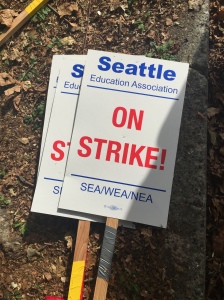
The Seattle Educators’ Strike for Social Justice | I AM AN EDUCATOR

The Seattle Educators’ Strike for Social Justice | I AM AN EDUCATOR:


The Seattle Educators’ Strike for Social Justice


IMG_3520


On Sunday evening, thousands of Seattle Education Association members gathered in a general membership meeting and voted to approve a new contract with the Seattle Public Schools. This vote officially ended the strike by Seattle educators, which began on September 10, 2015, and interrupted the first five days of school.

This new contract contains many hard fought wins for social justice that the school district said it would never grant. These groundbreaking victories are against the abuses of high-stakes standardized testing, for more recess, and for race and equity teams in the schools are a dramatic departure from our previous  broken model of collective bargaining and hold the potential to transform educator unionism in the nation. Yet the contract also contained some needless concessions to corporate style reforms—including succumbing to the district’s disrespectful pay raise offer, raising caseloads for some special education teachers, extending the school day and reducing teacher planning time—that could have been avoided if the union had kept the picket lines up for a few days longer and organized mass mobilizations.
But the most important outcome of this contract negotiation won’t be found in the fine print of the agreement. The true triumph of this contract battle was the achievement of solidarity—between teachers, office professionals, nurses, school librarians, instructional assistants, parents, and community organizations—in the struggle for the public schools.
Thousands of parents joined in solidarity with the teachers, including the celebrated “Soup for Teachers” group that formed to bring sustenance and solidarity to picket lines at every school in the district. The Coalition for the Schools Seattle Deserves united community organizations and joined the great Kimya Dawson to host a benefit concert to raise funds for the striking teachers.  The Seattle City Council, led by councilmember Kshama Sawant, passed a unanimous resolution in support of the strike. Marching band students used their pep-band anthems to root on striking educators, and local businesses donated to the picket lines.  Even the mainstream media regularly reported that parents were in support of the strike and that the educators were winning. There can be no doubt that this strike was overwhelmingly supported by the people in the Seattle area–except, perhaps, for the regions’ wealthiest resident, Bill Gates, who has invested his fortune in schemes to privatize education and reduce our schools to test prep centers.
So many of the union’s social justice demands were advanced in the current strike and The Seattle Educators’ Strike for Social Justice | I AM AN EDUCATOR:

The Progressive Launches New Project to Defend Public Education: Progressive Education Fellows | The Progressive

The Progressive Launches New Project to Defend Public Education: Progressive Education Fellows | The Progressive:

The Progressive Launches New Project to Defend Public Education: Progressive Education Fellows


Photo from http://iamaneducator.com/


ANNOUNCING OUR 2015 PROGRESSIVE EDUCATION FELLOWS!
A fundamental struggle for democracy is going on behind the scenes in statehouses around the country, as a handful of wealthy individuals and foundations pour money into efforts to privatize the public schools. The Progressive is launching a new project to help pull back the curtain and reveal what is at stake—to follow the money and expose the privatizers—but also to celebrate the resistance and the hard work of people on the front lines of public education.  Our goal is for all parents, teachers, and concerned citizens to understand what is going on and connect with each other to stick up for schools.
The “Progressive Education Fellows,” is an online gathering of twelve prominent, advocates, activists, thinkers, and writers in the progressive education movement. Throughout 2015 we'll be posting submissions from them on all things public education and democracy. Here's the backstory on why we feel this project is needed.
We're kicking things off with this dynamite talk from Jesse Hagopian, straight from the Seattle picket line (read the story here):


 - See more at: http://www.progressive.org/news/2015/09/188323/progressive-launches-new-project-defend-public-education-progressive-education#sthash.enkYNiNS.dpuf


Shavar Jeffries and the color of education ‘reform’ - The Washington Post

Shavar Jeffries and the color of education ‘reform’ - The Washington Post:

Shavar Jeffries and the color of education ‘reform’


Shavar Jeffries took over last week as president of Democrats for Education Reform, the national group that represents the wing of the Democratic Party that has embraced public charter schools, merit pay, mayoral control of urban school districts and other measures at odds with another Democratic constituency, the teachers unions.
Jeffries takes the helm of DFER, founded by a group of New York City hedge fund managers to be a counterweight to the unions, at a time when the movement to change education policy has been  criticized by some for being too white and elitist.
Jeffries, a 40-year-old attorney raised by his grandmother in Newark, N.J., won a scholarship in eighth grade to Seton Hall Preparatory, New Jersey’s oldest Catholic school. He went on to Duke University and Columbia Law School and was founding president of TEAM Academy, a Newark outpost of KIPP, the country’s largest public charter school network.
Jeffries also served as president of the Newark School Advisory Board, an elected body that is supposed to advise the state-appointed superintendent of the Newark Public Schools. The state seized control of the Newark public schools in 1995, citing chronic academic failure and fiscal problems.  Republican Gov. Chris Christie’s failed attempt to radically remake Newark public schools, with a $100 million gift from Facebook founder Mark Zuckerberg, has received national attention and is the subject of a current best-selling book “The Prize” by Dale Russakoff.
Jeffries unsuccessfully ran for mayor in Newark in 2014 — with backing from DFER — in a race that became a referendum on Christie’s school reform plan. Jeffries lost to Ras Baraka, a son of the radical poet Amiri Baraka and a former high school principal in Newark, who got heavy support from the Shavar Jeffries and the color of education ‘reform’ - The Washington Post:


CURMUDGUCATION: OH: 200 Failed Charters

CURMUDGUCATION: OH: 200 Failed Charters:

OH: 200 Failed Charters


When the Washington State supreme court ruled charters unconstitutional just before the school year started, charter fans were outraged. "How can you just toss those charter students into the street? How can you destabilize their educational life?" That's a legitimate complaint. But if charter boosters feel that way about the loss of Washington's modest charter school fleet, how must they feel about the charters of Ohio?

Ohio has worked hard to establish itself as the Nation's Bad Example when it comes to charter, providing ample examples of  every possible way to do charters poorly.

Earlier in the month, we were reminded of the scandal that unrolled when David Hansen, Ohio's department of education charter czar and husband of John Kasich's campaign manager, was forced to resign after it was discovered that he was cooking the books to pretty up the charters operated by big GOP donors (his defense was something along the lines of "Well, the rules are confusing and I don't see where it says I can't do this").

But the new year is barely under way and we are reminded, again, that Ohio wants to lead the nation in the vast number of charter schools that go belly up.

In East Columbus, families who thought they were sending their children to FCI Academy received a phone message the day before school was to start "reminding" them not to send their children to the school on Wednesday. Sure enough-- on Wednesday the building was locked and no officials to be found. The school turned out to be a half million dollars in debt, though that took some figuring since they also weren't keeping proper records or paying taxes.

FCI Academy was part of one more trend in John Kasich's Ohio-- religious-based charter schools. The 
CURMUDGUCATION: OH: 200 Failed Charters:


PA: Schools Are Starving


In Pennsylvania, we're on the downhill slide toward October, and still the capital suits in Harrisburg can't get their jobs done. The state budget is long overdue, and schools are starting to feel the money crunch.

Pennsylvania budget impasses are such a regular event that they get their own Wikipedia page. This year's giant legislative screw-up means we've had five late budgets out of the last nine. And this year's has shown no signs of solution, as new governor Tom Wolfe does head to head with a GOP-controlled legislature. There are a variety of issues out there from privatizing liquor stores to fixing the pension mess to neener neener you're not the boss of me.

But while Harrisburg fiddles, the schools of Pennsylvania are doing a slow burn. Chester Uplands made headlines for not making their payroll, but they were just the leading edge of a wave of school based disasters.

In Philadelphia, the schools have stopped hiring because they're having a capital-induced cash flow problem. Consequently, we get this story of a school with over seventy students in a class.

In Erie, the district is literally living paycheck to paycheck, with the teachers union saying they'll go short-term without pay and the district talking about shutting down until they get money again.

Meanwhile, in my own neck of the woods, my district has joined the many districts looking at 

PA: Schools Are Starving


Where Are All the Black Male Teachers? - NEA Today

Where Are All the Black Male Teachers? - NEA Today:

Where Are All the Black Male Teachers?

As minority children have become a majority in public schools, districts struggle to build a diverse educator workforce.


These days, the teaching profession can be a hard sell. It’s a fact made even more apparent as districts nationwide struggle to fill vacancies, and as some look to place Black male and other teachers of color in classrooms.
By the time the new school year launched at the end of August in Maryland’s Montgomery County school district, all but a dozen of the 600 to 700 new teacher slots were filled. Think of it as a real estate deal and new teacher recruits have the upper hand.
These days, the affluent county—a suburban enclave of Washington, D.C.—represents the aftermath of a fast moving racial shift that started to inch forward in the 1970s, says Christopher Lloyd, the new president of Maryland’sMontgomery County Education Association (MCEA). That was four decades ago, when district school students were 91 percent White and the teacher workforce was a close match with 80 percent White. Today, Lloyd says, “Racially and culturally, it’s like we have two Montgomery Counties—one White and the real one is largely immigrant, Black, and Hispanic.”
But even the county’s growing diverse population and its proximity to the nation’s capital hasn’t been enough to keep other competing districts from trolling for the same small applicant pool of racially and ethnically diverse teachers. Just two years ago Black male teachers represented 3.7 percent of teachers in Maryland public schools. And nationally, no more than 2 percent of teachers in the nation’s public schools are Black men.
“If I’m an African-American teacher in the D.C. metro area, I have a lot of choices of schools and careers in front of me,” a factor that’s kept the numbers low, Lloyd says. For the past five years, the percentage of teachers of color in Montgomery County schools has hovered between 24 and 30 percent of each hiring class. Preliminary hires the district made through the end of June 2015, pointed to an upswing, “about 10 to 15 percent more racial diversity,” says Lloyd, who was counting on a more noticeable bump as the hiring concluded before Where Are All the Black Male Teachers? - NEA Today:

What Is 'Public' Education? - Bridging Differences - Education Week

What Is 'Public' Education? - Bridging Differences - Education Week:

What Is 'Public' Education? 


Dear Harry and friends,
It's good to get back to a schedule with deadlines.  After a lifetime of deadlines this retirement life is sometimes harder to enjoy than it ought to be. 
Harry Boyte is a very old friend, although not as old as I am.  We've always been sort of on the same page but coming to it from different dispositions, life experiences and ways of seeing the world.   As a result I often turn to him when I'm perplexed and worried for the possibility that he can come up with a way of looking at the issues that gives me a new thread to pull at.
Our basic commitment to democracy has posed problems for us both, as you will discover.  We've "played" with it in different venues and settings, with occasional shared ones.  That helps.   Harry has managed to make life even more difficult for himself (and helpful to me) by having a longstanding and personal commitment to the saga of South Africa.
But we're going to tackle the complexity of the idea itself--as a way of living as well as a way of governing, and in the process we hope to help our friends and allies reexamine their positions around public schooling so that, at the very least, we are all on something closer to the same side than we often are now.  How can we define public in a democracy in such a way that it helps us separate the efforts to privatize education and the efforts to figure out how to more successfully provide an education for democracy for all of us? 
Lucky are those who can go to a free public school, close to home, where they can feel confident that their child is in good hands, with people you can trust, and with people who will take your concerns seriously and respectfully.   How to give professionals the respect and autonomy they want while you, their family, doesn't have any reason to fear that their autonomy will be used against their children's and their own best interests?  While also...still another hitch--expecting the larger public to pay the bill.  
Even families who have the means and desire to pay for  private school make compromises--but they have choices when and if the compromises become intolerable.  What about the rest of us?  Is choice an answer?  Or does it simply lead to pretending that an unequal market place is equally good for rich ad poor, white and black, atheists and the devoutly religious?   Of course, Harry, we may not end up covering all this, since as we go along we may discover many interesting bypaths--like when is representative democracy best vs direct?  Who should be "included"--the custodian, the cook?  Which tax payers?    And on and on.....
Dear Deb and colleagues,
I have always greatly appreciated your passion for democracy as the most important end of education, as well as your  deep respect for teachers' roles, and your view of education as a living, relational, consequential activity that should "liberate the powers" of each student, in Dewey's phrase.
We also have differences on what is "public" education and what erodes it. My story helps to explain.
I was shaped as a young white southerner in the 1960s by my family's involvement in the "civil rights" movement. I also agree with Martin Luther King's friend Vincent Harding, who said in Hope and History, "civil rights movement is too narrow a description...in fact [the movement] was a What Is 'Public' Education? - Bridging Differences - Education Week:

Schools must teach that black lives matter - The Hechinger Report

Schools must teach that black lives matter - The Hechinger Report:

Schools must teach that black lives matter

There is nothing wrong with black folk that ending racism can’t solve

Khalilah Harris, Deputy Director of the White House Initiative for Educational Excellence for African Americans (right) with Anita Sewell, 19, creator of the Souls of Black Girls.
NeW ORLEANS — Let’s get something straight; in a city where drinking and debauchery is as much a rite of passage as debutante balls, the sum of young people arrested shouldn’t be almost exclusively black.
But ninety-nine percent of all juveniles arrested in New Orleans are African-American. Blacks represent approximately 60 percent of all residents and about 77 percent of the children from age 10 to 19, according to Louisiana state estimates. Based on this data, I guess there is no white juvenile crime in New Orleans. Am I supposed to assume the juvenile crime problem in the city is on the shoulders of black boys and girls?
No, there is nothing wrong with black folk that ending racism can’t solve. Add “learning while black” to the list of regularly used phrases we must eliminate from the police harassment lexicon: “stop-n-frisk, shop-n-frisk, driving while black” and “three-strikes.” No-tolerance practices are as ubiquitous in schools as it is in policing. Schools route children to the criminal justice system. This is why the U.S. Department of Education is Rethinking Discipline.
Ending racism in schools is not simply about limiting suspensions and expulsions. Schools are either teaching beliefs that black students deserve the punishments they receive or they’re not instilling the kind of values that would have us eschew criminal-like punishments.
Destroying the school to prison pipeline will come from arresting all biased systems that entrap black girls and boys – curricula included.
Federal officials and juvenile justice advocates discussed the school to prison pipeline at the 45th Congressional Black Caucus Foundation Annual Legislative Conference in a session titled “Reversing the School to Prison Pipeline for African Americans and Minorities.” U.S. Department of Education staffers highlighted recently released maps showing exactly where students are most likely to be suspended.
According to the USDOE, “black students are suspended and Schools must teach that black lives matter - The Hechinger Report:

NYC Educator: There are No Oversized Apples for Oversized Classes

NYC Educator: There are No Oversized Apples for Oversized Classes:

There are No Oversized Apples for Oversized Classes


This Apple Will Probably Never Make it to a Teacher's Desk...


Ed. "reformers" believe that branding teachers as "ineffective" is the single most important way to improve educational outcomes.  Although driving away experienced teachers with seniority and burgeoning pensions may cut costs, it fails to help students.  Cutting class size, however, so teachers can deal more effectively with individuals, would work miracles.  Too bad, the financial costs of such reform make it prohibitive; too bad ed. "reformers" are more concerned about their personal pocketbooks than profiting students.

I teach three of my five classes in a row.  Each class contains about 37 students; the number will hopefully soon be reduced to 34.  Whether 37 or 34, the numbers are overwhelming.  When I return to the workroom after three periods, I have about one-hundred homework papers in hand.  Let me picture an ed. "reformer" grading that many papers on a regular basis.  Ineffective!

When I collect essay papers, I can get as many as 175.  If I fail to grade the old work before the new work comes due, the profusion of papers mounts.  Try keeping one set straight from another.  It is a profound triumph of organizational skill.  It is time-consuming, not to mention, a literally heavy burden.  Now, imagine trying to read each paper carefully and electronically enter grades.  Ineffective, again!

When students write short responses in class, provided the students are well-behaved, I try to circulate around the room and read as many as I can.  I end up skimming papers, trying to find some further question to ask each student or some grammatical suggestion.  I try to fly around the room NYC Educator: There are No Oversized Apples for Oversized Classes:

Has America Decided to Educate Promising Children and Leave the Rest Behind? | janresseger

Has America Decided to Educate Promising Children and Leave the Rest Behind? | janresseger:

Has America Decided to Educate Promising Children and Leave the Rest Behind?


In what seems to me the most chilling moment in The Prize, Dale Russakoff’s new book (discussed in yesterday’s post here) about the catastrophic five-year school reform experiment imposed by Mayor Cory Booker, Governor Chris Christie, and Facebook’s Mark Zuckerberg on Newark, New Jersey’s schools—the moment when teachers at a charter school co-located in the same building as a traditional public school ask Mayor Cory Booker how he plans to help and support the neighborhood school also operating in their building—Booker replies, “I’ll be very frank…. I want you to expand as fast as you can.  But when schools are failing, I don’t think pouring new wine into old skins is the way.  We need to close them and start new ones.'” (p. 132)
This is the same book in which a school administrator admits that charters cream the most able children of striving parents and tells Russakoff that 60 percent of Newark’s children are likely to remain in traditional public schools. What Mayor Booker, Governor Christie and philanthropist Zuckerberg are selling is school reform for the purpose of saving some children and leaving many of the most vulnerable behind. Such a school reform philosophy tacitly accepts the idea that our society is incapable of educating all of our children, and because we can’t save all children, we’ll at least try to educate those most likely to succeed.
While there is considerable research pointing to social and educational programs likely to expand opportunity for a mass of our society’s children, a lot of people can’t think beyond limited programs aimed to lift up promising children.  Others cynically doubt school leaders who outline expensive ideas that are far more ambitious.  I worry about the dearth of leaders willing to ask us to find the will to leave no child behind, and I worry more about broad skepticism when strong leaders do propose promising plans.  Have we as a society lost the belief that we can educate all children?
Skepticism persists about Mayor Bill deBlasio’s education plans, despite the successful launch Has America Decided to Educate Promising Children and Leave the Rest Behind? | janresseger: