Latest News and Comment from Education

Tuesday, September 22, 2015

Dismantling an Unstable Discipline: Education without Foundation | the becoming radical

Dismantling an Unstable Discipline: Education without Foundation | the becoming radical:

Dismantling an Unstable Discipline: Education without Foundation


“Whether we are willing to admit the role or not,” Lou LaBrant wrote in 1943, “schools cannot escape responsibility for some share in determining whether the peace which comes will last” (p. 225).
As the U.S. approached the mid-twentieth century—after decades of vibrant debate about the purposes of schools, the promise of universal public education—LaBrant and many progressive educators remained optimistic, if not idealistic, about the power of formal education to create broad social change.
LaBrant mused about the teacher as scholar, demanding from herself and other educators very high expectations for content knowledge and pedagogy among teachers. And she also “advocate[d]…that we attempt to develop the kind of students who can themselves make a world of peace even though we do not give them the pattern” (p. 228).
Over seven decades ago, LaBrant called for embracing authentic critical thinking over basic transmission of knowledge:
What I started to say was that we must not depend upon presenting a body of facts, useful as facts are, but that we must in our classrooms constantly remember that it isthinking about facts which is the important thing, and that this is as true in science and English and mathematics as it is in history or economics or the arts….(p. 229)
But she added:
Thinking is not sufficient. We must also have people who are accustomed to work with others (not against them), and who know that regardless of color, religion, clothing, occupation, or skills, people can work together….Teachers who are themselves striving to find answers will lead children toward those answers. (p. 229)
My career as an educator has spanned from the early 1980s until today, but my classroom practice and educational scholarship have much deeper roots, ones richly grounded in the history of U.S. education that was made real to me by the life and career of LaBrant.
Having taught from 1906 until 1971, LaBrant wrote her memoir as she approached 100 years of age, brushing aside the back-to-basics movement under Ronald Reagan as something she had witnessed herself twice before throughout her career as an English teacher and university scholar.
LaBrant’s last decade was spent in the first decade of the current accountability era, but even as her eyesight faded, LaBrant saw through the facile political and bureaucratic rhetoric and policies that now define the field of education, a discipline that was never very robust but which is now nearly completely dismantled.
Education, A Discipline Denied
During a video-taped interview of LaBrant for Missing Chapters, LaBrant claimed that despite Dismantling an Unstable Discipline: Education without Foundation | the becoming radical:

Mike Klonsky's SmallTalk Blog: Behind Rauner's call to 'end unfunded mandates'

Mike Klonsky's SmallTalk Blog: Behind Rauner's call to 'end unfunded mandates':

Behind Rauner's call to 'end unfunded mandates'


Rauner and Smith


Unfunded mandates. I hate 'em. Schools and school districts hate 'em.

It didn't take our demagogic, education-know-nothing governor, with help from his much-smarter State Supt. Tony Smith, very long to figure that out and issue a call to end all unfunded mandates -- which these days virtually means ALL mandates.

Former Oakland supt. Smith is a veteran of the old Coalition of Essential Schools and founder Ted Sizer's less-is-more philosophy. In Oakland, he talked the Sizer Essential Schools talk in order to close public schools, fire teachers, and replace them with privately-run charters in their place.

Sizer's progressive vision, expressed beautifully in his book, Horace's Compromise(a seminal text and must-read, especially for high school educators) was about smaller schools (including charters) and classrooms which were more like learning communities than shopping malls, where skilled teachers were empowered to make the most important educational decisions (and yes, compromise between what's nice and possible), to teach and not just test, and where students could engage in meaningful learning based on their interests and experience.

For Sizer, who served as dean of Harvard's Ed School, less-is-more was never 
Mike Klonsky's SmallTalk Blog: Behind Rauner's call to 'end unfunded mandates':

In Chicago, Students From Low-Income Neighborhoods Commute to Local School More Than Wealthier Peers - CityLab

In Chicago, Students From Low-Income Neighborhoods Commute to Local School More Than Wealthier Peers - CityLab:

When It Comes to School Choices, It's a Privilege to Have Fewer

While a range of options might seem like a plus, there are costs.


Image AP Photo/Charles Rex Arbogast


It’s no secret that public school funding comes largely from local property taxes —a model that has produced, in the words of the social-justice writer Jonathan Kozol, savage inequalities. Schools in lower-income neighborhoods often wind up with fewer dollars per student than those in wealthier areas, even though students from low-income families are often the ones most in need of extra support.
But are kids who live in poor areas confined to local schools? New research suggests that at least in Chicago, which contains the nation’s fourth largest school district, they’re not. Policies that decouple where kids live from where they must attend school—crafted with the best of intentions—have given poor students lots of “choices” when it comes to where they learn. But that’s not necessarily a good thing.
Julia Burdick-Will, an assistant professor of sociology at Johns Hopkins University, obtained and analyzed individual-level data for more than 24,000 eighth-graders enrolled in Chicago Public Schools in the fall of 2008. The data included the students’ census block group and tract, their standardized test scores, and the high schools they entered the fall of 2009, which numbered 122.
(Johns Hopkins University)
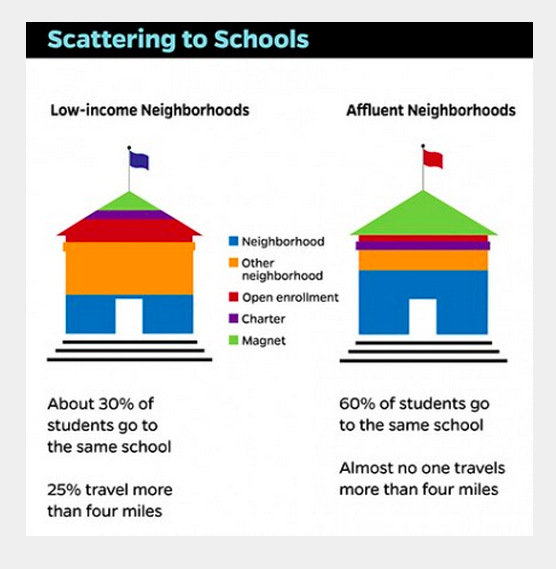
She found that, compared to kids from wealthier neighborhoods, students from the poorest areas actually attended a wider range of schools in terms of quality (based on University of Chicago’s metric, which includes average test scores, graduation rates, and safety), type (default neighborhood schools, schools in other neighborhoods with open enrollment policies, charter schools, and magnet schools, to name some), and sheer number.
While a range of school options might seem like a plus, there are costs. Though most students who chose to leave their neighborhood school went to higher-quality institutions, 15 percent traveled to a school that was objectively worse than their local option. And most were traveling further to school, spending more time commuting.
By contrast, students who lived in higher-income neighborhoods tended to stay at their default local schools, which were usually of higher quality than those in low-income neighborhoods. But when wealthier kids did choose, they generally went somewhere even better—a selective-enrollment school, for example, or a magnet school, where slots are competitive.
Why do poor families wind up sending kids away from local schools, when the outcome isn’t guaranteed to be better? The perceived quality, as well as the safety, of schools in low-income neighborhood might be two factors. “More violent neighborhoods in Chicago tended to have more scattering,” Burdick-Will says. “Some parents might be thinking ‘anywhere is better than here.’”
Burdick-Will’s research, which she presented at the American Sociological Association annual meeting in August, was less about why low-income students scatter across city schools, and more about proving that they do. She says that academics often assume poor children are “trapped” in local, underperforming schools, with the exception of special bussing programs. “This isn’t about a specific policy that buses a few hundred kids,” she says. “This is happening all the time, and only in certain neighborhoods.”
Burdick-Will’s research has limitations. She studied only one cohort of eighth-graders in only one year. And this was only within Chicago Public Schools. It would be wrong to conclude that this is the reality on the ground everywhere.
Still, many districts nationwide have policies that break the link between home and school location. In a 2007 national survey, 50 percent of parents reported that at least some choice was available within their children’s school districts.
Burdick-Will’s research also hints at one little-seen explanation for why schools in low-income schools underperform. She found that higher-achieving students were more likely to choose a school away from their default neighborhood schools, leaving those institutions with higher concentrations of struggling kids.
Those disproportionate numbers of lower-achieving students put more strain on resources, which are already scarce in low-income schools. That can lead to further depopulation, and even shuttering. Jelani Cobb’s latest in the New Yorker details how the decline and recent closure of Queens’ Jamaica High In Chicago, Students From Low-Income Neighborhoods Commute to Local School More Than Wealthier Peers - CityLab:

I asked if Obama, Duncan know the impact of their teacher evaluation policies. This is their answer. - The Washington Post

I asked if Obama, Duncan know the impact of their teacher evaluation policies. This is their answer. - The Washington Post:

I asked if Obama, Duncan know the impact of their teacher evaluation policies. This is their answer.
President Obama delivers remarks next to Secretary of Education in 2013. (YURI GRIPAS/REUTERS )

A focus of the Obama administration’s education reform effort has been the remaking of teacher evaluation systems to include student standardized test scores. States that wanted to receive federal funding in President Obama’s $4.3 billion Race to the Top education funding contest had to commit to linking test scores to teacher evaluation, and the same was true for those states that wanted to receive a federal waiver from the most onerous parts of No Child Left Behind. Most states wound up passing laws linking scores to evaluation, even though assessment experts — including the American Statistical Association — have warned against the “value-added measurement” method being used to make that linkage.
This linking has had some unusual consequences. Because there are standardized tests only in math and English Language Arts are tested, policymakers determined to evaluate all teachers on the scores devised ways of getting around the problem. They did this by, for example, evaluating teachers on the average scores of all students in a school, or grouping subjects together as they appear to relate to math or English Language Arts and evaluating teachers on those scores. For example, an art teacher in New Yorkis assessed by his students’ standardized math scores. The result: teachers are assessed on the test scores of students they don’t have and/or subjects they don’t teach.
Wondering whether President Obama and Education Secretary Arne Duncan knew that their policies had led to this state of affairs, I asked both the White House and the Education Department to respond to individual versions of this question:
Your Education Department has promoted policies that link teacher evaluation to student standardized test scores. Because tests are only given in math and English Language Arts, many teachers around the country are evaluated by the test scores of students they don’t have or by the test scores in subjects they don’t teach. For example, in New York City middle schools, it’s been estimated that over 60 percent of New York City teacher evaluations are out-of-subject. An art teacher would be evaluated in part on student math scores.  Are you aware of this state-level consequence of federal policy and do you think it is fair to teachers?
The White House responded by saying that the Education Department would respond.
This is the response from the Education Department:
At the center of great schools is great teaching and parent involvement. Both rely on good information about student progress and growth. No child, teacher or school can be measured by one test; success is tied to factors way beyond just academic. But teachers and school leaders need to know how students are progressing. Parents have a right to know how their children are doing in school. Students should be able to show what they know. Moreover, when schools don’t assess student progress, it’s the performance of the most vulnerable students that gets swept under the rug. Communities deserve accountable schools. Part of 
I asked if Obama, Duncan know the impact of their teacher evaluation policies. This is their answer. - The Washington Post:

5 years after Facebook pledge, Newark schools struggle - Yahoo News

5 years after Facebook pledge, Newark schools struggle - Yahoo News:

5 years after Facebook pledge, Newark schools struggle


NEWARK, N.J. (AP) — When Facebook founder Mark Zuckerberg appeared on Oprah Winfrey's show five years ago this week to announce a $100 million donation to remake education in Newark, it was presented as an effort to make a struggling city a national model for turning around urban schools.
Advocates see success in the most visible result so far — many more students in charter schools. But the exodus of students and the public funding that comes with them from the Newark Public Schools has deepened a financial crisis in a district that still educates most of the children in New Jersey's largest city.
A big part of Zuckerberg's mission was also to improve the traditional public schools. While there have been major changes there, too, indicators such as student test scores have been mixed.
Add to that frustration that the reformers weren't using input from the people of the city, and it's safe to say that the awe of Zuckerberg's high-minded intentions for using his first major foray into philanthropy to try to effect sweeping change has receded.
So has Zuckerberg's donation, which was matched with another $100 million from other donors, shown that big-scale philanthropy guarantees quick change?
The answers vary.
"The gift has been enormously productive and beneficial," said Christopher Cerf, the district superintendent. "It's also been pretty deeply misunderstood."
On the other hand:
"We've proven at this point that answer is no," said Derrell Bradford, a supporter of Zuckerberg's effort and leader of the New York school reform group NYCAN, who previously worked for similar groups in New Jersey. Bradford pointed out that $200 million is a tiny portion — about 4 percent — of what it has cost to run the school district for the past five years.
Even Zuckerberg didn't expect quick results. In an interview last year with The Associated Press, he said it would take years to measure.
The donation to Newark schools, which were taken over by the state in 1995, came about as a meeting of the minds of Zuckerberg with Gov. Chris Christie, a Republican, and Cory Booker, a Democrat who was then Newark mayor and is now a U.S. senator. The politicians agreed on a strategy focused on closing the worst schools, offering incentives to higher-performing teachers and launching new kinds of schools — and they sold it to Zuckerberg.
Charter schools — run by private entities, with more freedom than traditional public schools to set hours and curriculum and to choose their students, and where test scores and graduation rates are often better — have received about $58 million, according to "The Prize: Who's in Charge of America's Schools?", a book by journalist Dale Russakoff released this month. The number of students in charters has more than doubled since 2010 and now represents just over one-fourth of Newark's 48,000 school students.
Ryan Hill, the chief operating officer of the New Jersey schools run by national charter operator KIPP, said the contributions allowed the group to expand from two Newark schools to eight. Children in Newark — and especially African-American pupils — are now far more likely to be in a good school, Hill said.
"Starting new high-performing schools is a lot easier than turning around an enormous system," he said.
David Sciarra, director of the Education Law Center, a Newark-based group that has sued the state seeking better educations for low-income children, believes Newark is in worse shape now.
From 2010 to 2014, the percentage of district students meeting standards on statewide tests fell in many cases. For instance, a lower portion of both fourth and eighth graders score as at least proficient in language arts. The passage rate also declined for fourth graders in math, while a slightly higher percentage of eighth-graders passed.
Sciarra believes the growth of charter schools has hurt traditional schools by siphoning off money, as well as students from the families most motivated to succeed.
"Conditions on the ground have not improved. They've gotten worse," Sciarra said.
Still, the graduation rate made a big jump from 2011 to 2012 and has been relatively steady since then. Cerf, the superintendent, said the improving graduation rate is significant and so is another development — that teachers rated as "ineffective" started leaving their jobs more often than those deemed "effective" or "highly effective."
As traditional public schools shrank in Newark, Cami Anderson, the state-appointed superintendent, wanted to avoid laying off teachers because the union contract would require ousting the newest teachers first, even if they were doing a good job. Instead, she moved teachers rated as less effective to support jobs, where they remained on the payroll.
Partly because of that, budget problems remained even as donations rolled in, including more than $48 million to fund a new teacher contract that included back pay and something new for teachers in New Jersey — merit pay.
Anderson left the job in July. Cerf's duties include ushering the district out from under state control.
Sharon Smith, a schools activist with two daughters in Newark traditional public schools and one in a charter, said she was excited after the donation was announced and attended meetings to give ideas.
"Finally, there was an opportunity," she said.
But instead of using parents' ideas to improve public schools, she said, officials used their criticism to justify expanding charters.
Cerf said that's not the case. More money has gone to traditional public schools than to charters, he said, and charter growth is on the same trajectory as it was in 2006, before Zuckerberg's involvement.
Garth Davenport, a 51-year-old single father with 6-year-old twins, said he believes Newark's public schools are doing better for his sons, both of whom have autism, than the schools in neighboring East Orange did when the boys were very young. He said that he's had problems with administrative issues, such as transportation, but that his sons dive into their homework every night and seem to be increasingly communicative. He credits their schools with that.
"They're picking up," he said.
Last year, Zuckerberg and his wife, Priscilla Chan, announced a $120 million donation to improve the educations, especially of low-income students, in the San Francisco Bay area. Zuckerberg's Startup:Education foundation says it's applying some lessons from Newark, especially about "the importance of meaningful community partnerships."5 years after Facebook pledge, Newark schools struggle - Yahoo News:
Follow Mulvihill at http://www.twitter.com/geoffmulvihill

The fight for Dyett will go on #FightForDyett

The fight for Dyett will go on | SocialistWorker.org:

The fight for Dyett will go on


Coalition to Revitalize Dyett spokesperson Jitu Brown speaks at Operation PUSH (Bob Simpson)

After 34 days, a group of parents, teachers and community activists who had been on hunger strike to demand the establishment of a new neighborhood school in a former Chicago high school closed down by the city announced an end to their strike at an event at Operation PUSH on September 19. Below is the speech of hunger strike leader Jitu Brown explaining the activists' decision and what's ahead--his remarks are preceded by a news introduction by Chicago activist and journalist Bob Simpson.
"And this hunger strike has taught people that we don't have to fight by other peoples' rules. And we can make the decision...if you could please repeat after me...make the decision...that you will not bow down to people that don't love your children."
-- Jitu Brown speaking at Rainbow PUSH


 IT WAS an emotional moment for the Dyett hunger strikers at the weekly Rainbow PUSH Coalition livestream TV broadcast on Saturday, September 19. Joined by Rainbow PUSH leaders and other hunger strikers, Jitu Brown made the announcement that the hunger strike was coming to an end after 34 days. Brown pledged, however, that the struggle to create the Walter Dyett Global Leadership and Green Technology High School would go on.

The Chicago Board of Education was forced by the pressure of the hunger strike to reopen the now-closed Dyett high school, located in the historic African American neighborhood of Bronzeville. But instead of accepting the proposal that the Coalition to Revitalize Dyett had submitted for a global leadership-green technology school, Chicago Public Schools (CPS) insisted it would reopen Dyett as an arts-focused school, with a technology component.
Although the decision was called a "compromise," the Coalition to Revitalize Dyett was excluded by CPS. Flanked by politicians loyal to Mayor Rahm Emanuel, CPS chief Forest Claypool announced the hastily cobbled together "plan" 15 minutes after informing Coalition spokesperson Jitu Brown that there would be no further negotiations. Coalition members were excluded from the September 3 press conference. So the hunger strike continued.
On the September 9 Chicago Tonight show with Carol Marin, Brown explained why green technology was such an important part of the Coalition proposal for a community-based neighborhood school:
Why did we settle on Dyett Global Leadership and Green Technology High School? Number one, Dyett sits in the heart of Washington Park. There's a wildlife observatory there, there's a fully functional pond where people go fishing, there's a thriving youth-run farm and, most importantly, green technology is the number one growth industry in the U.S. So when the mayor imposed an arts school on the community, it was insulting, and that's why we didn't stop. Because what's the number one industry for unemployment? The arts. We are not opposed to a strong arts program in our school, but we just want to see a school that prepares our young people to be the next scientists, the next civic leaders and the next doctors.
At the core of the Coalition's green technology plan is organic urban agriculture. A 2013 United Nation report stated that small-scale organic farms are the best way to ensure that humanity has an adequate food supply while also improving the quality of the planetary biosphere. Dyett students could even participate in researching this through their own urban farming projects, especially when coupled with the global leadership component.
In addition to its global leadership green-technology focus, the rest of the Coalition's proposal envisions a rich, full curriculum, with democratic school governance and deep-The fight for Dyett will go on | SocialistWorker.org:

$490-million plan would put half of LAUSD students in charter schools - LA Times

$490-million plan would put half of LAUSD students in charter schools - LA Times:
$490-million plan would put half of LAUSD students in charter schools


itics of Los Angeles public schools have outlined an ambitious $490-million plan to place half of the city's students into charter schools over the next eight years, a controversial gambit that backers hope will serve as a catalyst for the rest of the nation.

According to a 44-page memo obtained by The Times, the locally based Eli and Edythe Broad Foundation and other charter advocates want to create 260 new charter schools, enrolling at least 130,000 students.

Organizers of the effort have declined to publicly release details of the plan. But the memo lays out a strategy for moving forward, including how to raise money, recruit and train teachers, provide outreach to parents and navigate the political battle that will probably ensue.

The document cites numerous foundations and individuals who could be tapped for funding. In addition to the Broad Foundation, the list includes the Gates, Bloomberg, Annenberg and Hewlett foundations. Among the billionaires cited as potential donors are Stewart and Lynda Resnick, major producers of mandarin oranges, pistachios and pomegranates; Irvine Co. head Donald Bren; entertainment mogul David Geffen; and Tesla Motors' Elon Musk.

L.A. Unified already has more charters than any school system in the country, representing about 16% of total enrollment. Charters are independently run, publicly financed schools that are exempt from some rules that govern traditional campuses; most are nonunion.

But the proposed expansion would mean more than doubling the number of charter schools in Los Angeles, a feat that even backers say might prove demanding.

The push is already generating resistance from the school district as well as from powerful L.A. Unified employee unions.

Critics say charter schools create greater inequities because they frequently draw more-motivated and higher-achieving students and leave traditional schools worse off.

The situation, they say, leaves district schools with less money to serve a larger percentage of students with behavior problems and disabilities and those who need to learn English. And in some areas with active charter programs, traditional schools don't have enough students.

"While I continue to support and be proud of the successful charter schools we have in Los Angeles, this plan is not one for transforming our public schools, but an outline for a hostile takeover," said school board President Steve Zimmer.

Others, however, argue that parents deserve more options for their children, especially those who have to deal with struggling schools.$490-million plan would put half of LAUSD students in charter schools - LA Times:


After debate, Regents pass teacher-evaluation rules

After debate, Regents pass teacher-evaluation rules:

After debate, Regents pass teacher-evaluation rules


The state Board of Regents passed a revamped set of rules Wednesday for New York's new system of evaluating teachers, but promised to pen a letter to Gov. Andrew Cuomo and state lawmakers outlining their many concerns.
The Regents, the state's education policymakers, voted 10-6 in favor of the new regulations, which included a new system for some teachers to appeal their ratings and the loosening of an observation requirement for small school districts.
The vote came after significant debate and some nose-holding among the Regents.
Several voted no in protest of the new system, which was required by a state law approved by Cuomo and the Legislature in March and has been derided by teachers unions. Other Regents warned of a possible loss of state money for local schools if the rules were voted down, noting the board was required by the law to approve a set of rules governing the process.
"Quite frankly, I have met with hundreds of people, and all I hear is the joy of teaching is being squeezed out of them as a result of this process," said Regent Judith Johnson, whose district stretches from Poughkeepsie to Westchester County. She voted against the proposal.
The vote Wednesday was of the Regents' P-12 Education and Higher Education committees, with the full board set to vote Thursday. But Thursday's vote is largely a formality: All 17 Regents sit on the two committees.
One Regent, Andrew Brown of the Rochester area, was absent.
The new teacher-evaluation system puts a greater emphasis on how teachers' students fare on the state's standardized exams, including the grade 3-8 tests and Regents exams for high schoolers. The remaining portion of the teacher and principal evaluations is based on observations, both by a school administrator and an "independent" observer -- such as a After debate, Regents pass teacher-evaluation rules:

Monday, September 21, 2015

How we got the Common Core Standards: Federal Manipulation Through Race to the Top | Seattle Education

How we got the Common Core Standards: Federal Manipulation Through Race to the Top | Seattle Education:

How we got the Common Core Standards: Federal Manipulation Through Race to the Top


race to the top4


Arne Duncan’s former chief of staff pulls back the curtain on Race to the Top
We couldn’t keep up with the enormous load of data that the competition generated—and we learned that we didn’t have to. The public did it for us. State and local watchdogs kept their leaders honest by reviewing and publicly critiquing applications. Education experts provided analyses of competition data. And researchers will be mining this trove of information for years to come.
Joanne Weiss was the director of the Race to the Top program at the U.S. Department of Education and Education Secretary Arne Duncan’s chief of staff. She wrote an essayat Stanford Social Innovation Review that is enlightening in that we finally have a USDED official admit the truth about the federal role in foisting Common Core on to the states.
I encourage you to read the whole piece, but I’ll pull a few excerpt f interest.
Weiss acknowledges that budgetary challenges along with offering larger awards induced states to apply.
The competition took place during a time of profound budgetary challenge for state governments, so the large pot of funding that we had to offer was a significant inducement for states to compete.
This process is typically different than how federal grant making has been done before as she explains:
…we decided that winners would have to clear a very high bar, that they 
How we got the Common Core Standards: Federal Manipulation Through Race to the Top | Seattle Education:

Ed Notes Online: Eva Moskowitz Sept. 30 Rally Prelude to her Mayoral Campaign: Using Kids, Parents and Teachers Paid With Public Funds

Ed Notes Online: Eva Moskowitz Sept. 30 Rally Prelude to her Mayoral Campaign: Using Kids, Parents and Teachers Paid With Public Funds:

Eva Moskowitz Sept. 30 Rally Prelude to her Mayoral Campaign: Using Kids, Parents and Teachers Paid With Public Funds


Leaked Success Academy memo: tell parents rally is not political... Upcoming charter Sept. 30 anti-de Blasio rally is blatant misuse - theft of public funds.
Success administrators are also strongly encouraging parents to attend the rally and march even if it presents hardships for them in terms of arranging for child care or taking time off from their jobs.
Meaning they have to take off from work - and if they don't want to attend the rally they have to arrange alternate child care ...

The majority of Success Academy students — 77 percent — are eligible for free or reduced price lunch, meaning their families live at or below the poverty level.  For parents who feel they cannot take time off from work, employees are asked to respond, "parents took off work to stand up and make sure that you have this great school option for your family. What if they hadn't shown up and taken the day off work?"
And they will be "tossed" if they don't attend:

Staffers are also encouraged to suggest that parents with children in Success' elementary school may not have Ed Notes Online: Eva Moskowitz Sept. 30 Rally Prelude to her Mayoral Campaign: Using Kids, Parents and Teachers Paid With Public Funds:


Systems Thinking: Seeing How Everything is Connected | Creative by Nature

Systems Thinking: Seeing How Everything is Connected | Creative by Nature:

Systems Thinking: Seeing How Everything is Connected

“People normally cut reality into compartments, and so are unable to see the interdependence of all phenomena. To see one in all and all in one is to break through the great barrier which narrows one’s perception of reality.” ~Thich Nhat Hanh


paradigm_shift


Nowadays, most people seem to be aware of the ecological crisis facing our planet. We understand that our consumer lifestyles create toxic waste that pollutes the air, water and land. We understand that these come back to us and may account for the rise in health problems such as cancer, asthma and allergies.
We know that animal species are going extinct because of the forests we have cut down in order to raise cattle and grow popular “consumer” foods such as cocoa and coffee. Most of us grasp that the increase in carbon dioxide in the air (from our burning of fossil fuels) is making the earth warmer, which creates more hurricanes, melts glaciers and will lead to rising ocean levels and flooding.
We can understand how deforestation leads to an expansion of deserts, which then creates dust storms in Beijing and food shortages in Northern Africa. Thanks to the media and schools most people (not living in denial) understand the connections between these Systems Thinking: Seeing How Everything is Connected | Creative by Nature:

It doesn’t look good for Newark’s neighborhood schools | Bob Braun's Ledger

It doesn’t look good for Newark’s neighborhood schools | Bob Braun's Ledger:

It doesn’t look good for Newark’s neighborhood schools


BARAKACHRISTIE


The committee that is supposed to figure out how the state will give up control of the Newark schools after 20 years has scheduled its first public meeting Wednesday night (Sept. 23).  The  “Newark Educational Success Board” (NESB)– established in a deal between Gov. Chris Christie and Newark Mayor Ras Baraka–is supposed to find out what the community  thinks but the committee has only met secretly since its creation  in June. The members of the committee–five appointed by Christie, four appointed by Baraka (with Christie holding a veto over the mayor’s choices)–won’t even say how many times they’ve met secretly because they are under a gag order that forbids its members from making public statements. All questions must be directed to the mayor’s office and the mayor has a major political stake in the perception of its success.
So much for the word “public” in public education. So much for transparency. But that may be the least of its problems.
Early signs are not promising for those favoring, not just a return to local school control, but also a restoration of traditional neighborhood public schools after 20 It doesn’t look good for Newark’s neighborhood schools | Bob Braun's Ledger:

Raw Scores, Scaled Scores, and Louisiana’s PARCC-ish Tests | deutsch29

Raw Scores, Scaled Scores, and Louisiana’s PARCC-ish Tests | deutsch29:

Raw Scores, Scaled Scores, and Louisiana’s PARCC-ish Tests


A number of Louisiana parents are insisting that the Louisiana Department of Education (LDOE) release raw score information on the PARCC-sort-of test that it administered in spring 2015 to students in grades 3 through 8.
I agree that parents have the right to know their children’s raw scores. Yet these raw scores must accompany scaled scores in order to be understood.
The reason for this is that standardized testing utilizes various forms of a test. Sometimes various forms are given in the same test administration. Other times, the forms are altered as items are changed out in order to avoid unfair advantage to test takers in future administrations.
For any standardized test, a raw score is available for each test taker. However, some versions of a test are easier than other versions. Therefore, the raw score could be biased in favor of students taking the easier test. In other words, two students– one who scores a higher score on an easier version of a test and another who takes a more difficult version– might actually be “equal” in their performance when the outcome is adjusted for differences in test difficulty.
Scaled scores account for the difficulty of tests and adjust the score to account for such differences in test form difficulty. They do so via a method called “equating.”
For more on raw scores, scaled scores, and equating, see this brief, 2011 article by ETS.
Now, let’s turn our attention for a moment to Louisiana and its PARCC-ish test.
All of the other states that purported to give PARCC tests in 2015 contracted with Pearson, the vendor of PARCC tests. Louisiana gave its PARCC-styled tests via an old contract with Data Recognition Corp (DRC).
So, for all other states that called themselves “PARCC states” in spring 2015, Pearson is handling the scoring (including scaling and equating).
DRC appears to be doing so for LDOE. (The PARCC website for Louisiana notes that Raw Scores, Scaled Scores, and Louisiana’s PARCC-ish Tests | deutsch29:

Another Opt Out Message Being Hijacked - UNITED OPT OUT: The Movement to End Corporate Education Reform

Another Opt Out Message Being Hijacked - UNITED OPT OUT: The Movement to End Corporate Education Reform:

Another Opt Out Message Being Hijacked


In August 2015 the National Association of State Boards of Educators (NASBE) created a handy dandy chart entitled “Opt Out Guidance” for all fifty states. How wonderful of them. Their chart was highlighted in a recent Washington Post article and seems to be gaining traction. Sounds great….right? Um. Nope. Why?
The NASBE chart itself is problematic. It gives little useful information. For example under Florida it simply states “opt outs are not permitted” and explains why. That’s it?
Meanwhile three years ago United Opt Out created 50 state opt out guides, that provide, in DETAIL, current information for each state, written by opt out leaders in those states, and updated annually. Our guides say, “This is what your state legislation says,” and, “this is what you need to do.” Of course, the long and the short of it is this: REFUSE THE TESTS. REFUSE IT ALL. THIS IS AN ACT OF CIVIL DISOBEDIENCE. In the end it doesn’t matter what your state legislation “permits.” But parents want to be informed. And so the guides try to provide as much information as possible.
So is the information that NASBE publishing (or promoting) actually USEFUL? Not really.  It might serve to deter many parents in most of these states, to just give after reading “No opt out permitted” in their state.
The second and more important reason promoting the NASBE guide is problematic (and is probably tied to why it’s basically useless) is WHO NASBE is. Before steering opt out parents to their site folks might do well to know more about NASBE. The partners who fund them include:
Pearson
The Bill and Melinda Gates Foundation
McGraw Hill
ETS
K12 Inc
Wireless Generation
ACT
College Board
Measured Progress
And many, many more…..
Why is Another Corporate-Driven Non-profit Trying to Appear “Opt Out Friendly”?
Again, the opt out narrative is being hijacked.  And it’s not the first time. Education Commission of the States(ECS) also created an “opt out guide” and attempted to steer traffic to their website under the guise of appearing supporting of testing refusal. And yet… Closely examine the funders and partners of ECS.  The list includes General Electric, State Farm, Amplify, Pearson, Verizon, Corinthean,Another Opt Out Message Being Hijacked - UNITED OPT OUT: The Movement to End Corporate Education Reform: