Latest News and Comment from Education

Thursday, August 27, 2015

California voters back extending Proposition 30 to funnel more money to public schools | Policy Analysis for California Education

California voters back extending Proposition 30 to funnel more money to public schools | Policy Analysis for California Education:

California voters back extending Proposition 30 to funnel more money to public schools


PACE/USC Rossier Poll shows voters have little knowledge of Local Control Funding Formula reform meant to dramatically alter public school finance and accountability in the state
Contact: Merrill Balassone at balasson@usc.edu or (213) 740-6156
LOS ANGELES – August 27, 2015 – As optimism about the state of California’s public schools continues to rise, a strong majority of California voters would back the reauthorization of Proposition 30 to channel additional money to public campuses, according to a new poll released Thursday.
The PACE/USC Rossier School of Education Poll shows 63 percent of voters are in favor of extending at least one provision of Prop. 30 – the tax increase on high incomes or the sales tax hike or both – that is set to expire at the end of 2016. Only 28 percent of voters said both fiscal provisions should be allowed to expire, the poll showed.
Approved by the voters in 2012, Prop. 30 temporarily increased the state sales tax by a quarter cent and the personal income tax rate on people earning more than $250,000 a year to fund public education and other government programs.
Six in 10 voters said California should be spending more on schools, as opposed to 26 percent who said the state’s public schools have enough money, the poll showed.
“Since the inception of this poll in 2012, we have identified valuable trends that not only reflect the opinions of the state’s voters but also influence policymakers in Sacramento,” said USC Rossier School Dean Karen Symms Gallagher. “The latest results indicate a growing confidence in our public school system as voters are clearly willing to provide greater financial support to education."
Voters were comparatively less enthusiastic about proposed changes to Proposition 13, which sets limits on property taxes. Changing the rules on the taxation of business and commercial property would raise an estimated $6 billion to $10 billion per year, of which 40 percent would go to public schools. A slight majority of voters – 51 percent – said they would support changes to Prop. 13, as compared to 39 percent who would oppose it.
“Although voters want more invested in education, we don’t see an underlying appetite for more extreme measures, such as making changes to Prop. 13,” said Jeff Harrelson, chief operating officer of Republican polling firm MFour Mobile Research, part of the bipartisan team with Democratic polling firm Tulchin Research that conducted the PACE/USC Rossier Poll. “Policy makers should be prepared to engage in an extended voter education effort on this issue."
Said Ben Tulchin, president of Democratic polling firm Tulchin Research: “Voters believe California’s public schools have made some progress over the last few years. As a result, a large majority of California voters wants to extend Proposition 30, particularly its tax on the wealthy, in order to continue this progress.”
California voters have become less pessimistic about the state of their public schools. Between 2012, when the question was first asked, and 2015, the percentage of voters who say the state’s public schools have gotten better more than doubled, from 7 percent to 17 percent. During that same time period, the percentage of voters who said public schools were getting worse declined, from 57 percent to 39 percent. Thirty-six percent of voters said public schools had stayed the same.
When asked about their neighborhood public schools, 17 percent of California voters said they had gotten better, up from 11 percent in 2012. Thirty-four percent of voters said their local public schools had gotten worse, down from 45 percent in 2012. Thirty-eight percent of voters said local public schools had stayed the same.
“Voters are clearly not satisfied with the state of California’s public education system, but they are beginning to see their schools moving in the right direction,” said David Plank, executive director of PACE. "They still see a lot of room for improvement, but this is a very encouraging trend.”
Lack of awareness of Local Control Funding Formula “alarming”
Sixty-five percent of California voters said they have never heard or read about the Local Control Funding Formula, or LCFF, Gov. Jerry Brown’s 2013 reform under which billions of dollars have been funneled to school districts to directly help English learners, foster children and students from low-income families, and an additional 21 percent said they had not heard or read much about it, the poll showed. Only 14 percent of voters said they had heard or read a little or a great deal about the LCFF.
When given basic information about the new funding formula, 57 percent said they approved of the policy, while California voters back extending Proposition 30 to funnel more money to public schools | Policy Analysis for California Education:

Thompson: Greg Toppo Sees the Game's Future and It Works This Week In Education:

This Week In Education: Thompson: Greg Toppo Sees the Game's Future and It Works:

Thompson: Greg Toppo Sees the Game's Future and It Work


image from images.macmillan.com


I've always been confused by the seemingly absurd dichotomy. Brilliant computer geeks and digital geniuses create such potentially liberating technologies. But, they also became a driving force in corporate school reform and its efforts to turn schools back to the early 20th century.
Gosh, as Greg Toppo explains in The Game Believes in You, computer games were pioneered by a small group of mostly unconnected, visionaries, In the earliest days of the 1960s computer breakthroughs, some inventors were even influenced by LSD. So, why did such creative people commit to turning schools into a sped up Model T assembly line?
It would be too much to ask of Toppo, or any other single writer, to definitively answer this question but his excellent book helps us understand why so many architects of 21st century technological miracles helped impose test, sort, reward, and punish, bubble-in malpractice on our schools.
Toppo chose to study computer gaming after his still dynamic young daughter became disenchanted with reading, and after he tired of reporting on school reform wars.  The fundamental problem predates corporate school reform; for instance, 1/3rd of high school graduates never go on to read another book for the rest of their lives. And, as teacher and reading expert Kelly Gallagher says, the problem is both under- and over-teaching of reading. But, full-blown "readicide" has been made far worse by the test prep which was caused by output-driven, competition-driven reform. 
Toppo writes:
At exactly the same time that schools have taken the questionable path of implementing more high-stakes standardized tests keyed to the abilities of some imaginary bell-curved students, games have gone the opposite route, embedding sophisticated assessment into gameplay ... becoming complex learning tools that promise to deflate the tired 'teach to the test' narrative that weighs down so many great teachers and schools. 
The Game Believes in You does a great job explaining the cognitive science behind computer games (and in doing so he may foreshadow an explanation why corporate school reformers became so obsessed with competition that they helped impose nonstop worksheet-driven, basic skills instruction on so many schools.)


Games can be great learning tools because they build on students' desires to belong, to bond with their peers, and to compete. Games allow kids to fail without facing consequences that are too dire. And, they offer a holistic learning experience. As neurologist Frank Wilson notes,  "A hand is always in search of a brain and a brain in search of a hand."
Toppo explains that "kids are paying attention to everything including each other." So, as This Week In Education: Thompson: Greg Toppo Sees the Game's Future and It Works:

Going the extra mile OR Part of the same team - Lily's Blackboard

Going the extra mile OR Part of the same team - Lily's Blackboard:

Going the extra mile OR Part of the same team 


Like many of you, I, too, cheered for the U.S. women’s national soccer team when it won the World Cup this summer. As I watched the team celebrate, one thing stood out: everyone involved with the organization contributed to the team’s success.
The players and head coach are the most visible. Equally important, however, are the assistant coaches, equipment managers, team trainers, nutritionists, and countless others who all played a critical role in making sure that the athletes performed at their best.
I've never scored a goal in my life without getting a pass from someone else. - Abby Wambach

Abby Wambach, one of the members of the U.S. national team, once said, “I’ve never scored a goal in my life without getting a pass from someone else.”
That quote encompasses the way I feel about our indispensible Education Support Professionals. Like a sports team, an educational team comprises many different people who contribute to the school community’s success. Helping students achieve their potential requires every available resource.
Teachers are often the first to come to mind when thinking of the people who play a part in a child’s education. But even the greatest teachers catch a pass from staff who, among many things, transport students to school, maintain the building, prepare meals, communicate with the community, offer support in the classroom, and direct the library and front office.
It takes team members like Janet Eberhardt, who was named the 2015 Education Support Professional of the Year (ESP) for her outstanding contribution to the San Francisco Unified School District, her community, and the profession. During her remarks before more than 7,000 attendees at the National Education Association’s 153rd Annual Meeting and 94th Representative Assembly (RA) in Orlando, Florida, I was especially moved by her passion in calling for ESPs, teachers and higher education faculty to join together and fight for students and public education.
NEA President Lily Eskelsen Garcia joins 2015 Education Support Professional of the Year Janet Eberhardt on the stage after addressing the Assembly  at 153rd Annual Meeting, 94th Representative Assembly at the Orange County Convention Center, Orlando Fl.  July 4nd 2015. Photo by Calvin Knight
NEA President Lily Eskelsen Garcia joins 2015 Education Support Professional of the Year Janet Eberhardt on the stage after addressing the Assembly at 153rd Annual Meeting, 94th Representative Assembly at the Orange County Convention Center, Orlando Fl. July 4nd 2015. Photo by Calvin Knight

When I presented Janet with the national award earlier this year, I said that she is an absolute dynamo, and I feel even more strongly about that sentiment now. She leads by example by developing ESP training opportunities and developing future leaders. In her 29 years with the San Francisco Unified School District, Janet has created programs to engage and mentor students and families as well as developed several reading and student creativity programs to unlock a love for reading. As a union leader within the United Educators of San Francisco, she has held multiple important leadership roles, including planning, coordinating, and delivering ethnic minority leadership Going the extra mile OR Part of the same team - Lily's Blackboard:

People Don’t Like Current Education Policies, So Why Do Policy Leaders?

8/27/2015 – People Don’t Like Current Education Policies, So Why Do Policy Leaders?:

People Don’t Like Current Education Policies, So Why Do Policy Leaders?


THIS WEEK: People Hate Education Reform … New Orleans Miracle Is A Myth … No Quick Progress From Common Core … Don’t Let States Take Over Schools … Rep Mark Takano Talks Education

TOP STORY

People Don’t Like Current Education Policies, So Why Do Policy Leaders?

By Jeff Bryant

“The big annual poll on how Americans view public schools and education policy is out, and anyone eager to don the mantle of “education reform” might want to rethink twice their wardrobe … What was particularly jarring about the findings of this year’s PDK-Gallup poll is how much those results contrast to the pronouncements of current policy leaders from the Democratic Party and Republicans who are vying for their party’s presidential nomination. Recent policy pronouncements in the halls of Congress and from political speeches betray a staunch adherence to education policies that are completely not in favor, or are becoming less favorable, among the populace.”
Read more …

NEWS AND VIEWS

Poll: Most Americans Oppose Key Tenets Of Modern School Reform

The Washington Post

“The 47th annual PDK-Gallup poll, the longest continuously running survey of American attitudes toward public education … finds that a majority of Americans, as well as a majority of American public school parents, object to some of the key tenets of modern school reform … 64% say there is too much emphasis on standardized testing (7 percent say there isn’t enough) … Most Americans have an issue with evaluating teachers with student standardized test scores… About 80% of Americans said that student engagement with classwork and a high level of hope for the future are very important for measuring the effectiveness of public schools … Fewer rated the percentage of graduates attending college and getting a job right after high school as very important. Testing came in last as a measure of effectiveness.”
Read more …

The Myth Of The New Orleans School Makeover

The New York Times

“At a time when states and municipalities nationwide are looking to New Orleans, the first virtually all-charter urban district, as a model, it is more important than ever to accurately assess the results … Stark problems remain … Principals engage in widespread ‘creaming’ – selecting, or counseling out, students … No agency is responsible for keeping track of all kids … Louisiana’s official dropout rates are unreliable … A new report … found that over 26,000 people in the metropolitan area between the ages of 16 and 24 are counted as ‘disconnected,’ because they are neither working nor in school … Adding to the difficulty … Louisiana education data has been doled out selectively, mostly to pro-charter researchers, and much of the research has been flawed.”
Read more …

Lessons From New York: Don’t Expect Fast Change Under Common Core

The Hechinger Report

“As frustration about Common Core has mounted across the country, New York’s experience suggests that it might be many years before there is evidence of success under the new standards and it’s not clear if parents and educators whose patience has been tested are willing to wait that long … Scores have not improved much in the three years … The gulf between black and Latino students and their [white and Asian] peers has widened … These results buck the conventional wisdom that as teachers and students get more comfortable with a test, scores increase.”
Read more …

State Takeover Of Schools Harms Black, Latino Communities, Report Contends

Education Week

“A new report … traces the history of what the group calls ‘market-based intervention and reform,’ from the state takeover of three New Jersey school districts in the late 1980s and mid-1990s to the present-day push to allow state-run schools in Georgia. The authors contend that the growing number of state takeovers and achievement districts has increased segregation, dismantled community schools, and undermined the financial stability of the affected school districts … None of the current takeovers affect majority white school districts … 97% of the students in the currently operating state-run districts are black or Latino … The … report also criticizes the charter school industry, claiming that it has spearheaded the growth of state achievement districts by promoting charters as the solution to poor student performance.”
Read more …

Right On Banks, Wrong On Schools: “No Child Left Behind Wasn’t Designed For The Types Of Realities In My School”

Salon

Jeff Bryant interviews Democratic Representative Mark Takano who says, “I am surprised to the extent to which my own party has members who are true believers in the education reform movement, who take on the mantle of reformer … Where we’re not united is this issue of accountability … That accountability said if your students didn’t meet certain targets on standardized tests, you had to take a number of harsh measures or lose your federal funding. So we had this list of accountabilities that were really punishments … Effective education doesn’t work that way. Effective education is building relationships with students. It’s about teachers strategizing on how to engage students … Test-driven accountability is like constantly pulling the plant out to see if the roots are growing … If you liken education to bean counting, that’s not going to work.”
Read more …8/27/2015 – People Don’t Like Current Education Policies, So Why Do Policy Leaders?:

Schools Matter: New Test to Solve Tennessee's "true ethical and moral dilemma"?

Schools Matter: New Test to Solve Tennessee's "true ethical and moral dilemma"?:

New Test to Solve Tennessee's "true ethical and moral dilemma"?


Candice McQueen has replaced Tennessee's toxic former Commissioner of Education, Kevin (Rhee) Huffman.  In doing so, McQueen has inherited one of the most aggressive corporate education agendas in the nation. 

At the same time, she has taken the reins of a state system that has been underfunded for at least the past 35 years, as governors and legislators have jumped from reform one bandwagon to another to collect any free federal cash being handed out, even as the percentage of the state's budget committed to education has continued to dry up (see Part II of The Mismeasure of Education).

If these challenges were not enough, Dr. McQueen faces a literacy meltdown as measured by state test scores, even with the infusion of $501,000,000 from Race to the Top federal funds--most of which never reached the classrooms or the severely underfunded school library programs that remain on life support.  

At the same time, poverty continues to grow across the state, with more than one in four children now living in poverty, and one in three black or brown children.  The state ranks 43rd in the nation in child poverty and 48th in Hunger and Food Insecurity.  As poverty and hunger spread, literacy scores continue to tank, especially since math prep has been the major focus of year-round test prep.

For Dr. McQueen, however, it is not the hunger, poverty, and oppression that represent the "true ethical and moral dilemma; it is, rather, the low reading test scores.

As these developments unfold, the billionaire governor, Bill Haslam, continues to hand out to his cronies as much of the public resources as he can, including the shuttering of public schools in favor of the corporate welfare charter reform schools.  And the chief federal architect of the racist new states rights education policy based on the proliferation of charter schools, Lamar 
Schools Matter: New Test to Solve Tennessee's "true ethical and moral dilemma"?:

The student as education insurgent | Philadelphia Public School Notebook

The student as education insurgent | Philadelphia Public School Notebook:

The student as education insurgent


"Educating for Insurgency," by Jay Gillen, makes the case that the transformation of our schools depends on recognizing the critical role of young people in high-poverty schools.
Gillen is a Baltimore math teacher who helped organize the Baltimore Algebra Project, a student-run collective that provides tutoring services and engages in political advocacy. The project was inspired by and draws on the legacy of the iconic Student Nonviolent Coordinating Committee leaders Bob Moses and Ella Baker.
Gillen’s book centers on a discussion of what he calls "schools of poverty" and the efforts to reform them. He compares the organization and norms of the plantation during slavery with today’s schools.  
The view of slaves as lazy and resistant to authority is carried over in the attitudes toward students, which are sometimes overt but more often coded, by many of today’s educators. Today’s schools of poverty, no less than plantations in slavery times, rely on repressive discipline.
… the official policies of most schools for adolescents in poverty assume that without "consequences" (the 20th century euphemism for ‘punishment)’, students would do no work at all, probably would not even bother attending school or classes, and would, most likely, run amok. A whole panoply of physical movements are alternately prescribed and proscribed: where the students must or many not sit; where they must or may not go; which doors they are required and which doors they are forbidden to use; which books or materials they must or may not touch; which websites they may see or must not see; when they must stand and when they may not stand; when they may use the bathroom; when they may eat, when they may or must leave the building; when they may or must speak. All these modal constraints depend utterly on punishments and the threat of punishment. Well-run schools, like well-run plantations, are places where the “consequences” for violating requirements are swift and certain.
For Gillen, efforts at fixing these schools break down, because students are seen as objects, to be manipulated for the purposes of others, rather than as subjects, who are actively engaged in shaping their own learning.
The other blind spot he identifies is the tendency to take student behavior literally. Things are not always what they seem for Gillen, who draws on the work of philosopher Kenneth Burke and novelist Ralph Ellison. Young people are experimenting with different personae and acting in a cultural context that is not always apparent to adults. Schools of poverty are contested territory in which student resistance, primarily in the form of non-conformity, challenges the role of these schools as the means for reproducing the social relationships that serve those with power.   
The portrait of robust official optimism with scientific, data-driven methods on the one The student as education insurgent | Philadelphia Public School Notebook:

TBT: The 1970 Chicano Moratorium Against the War in Vietnam – 45 Years Later!

The 1970 Chicano Moratorium Against the War in Vietnam – 45 Years Later!:

The 1970 Chicano Moratorium Against the War in Vietnam – 45 Years Later!


Chicano Moratorium poster


By Herman Baca / August 26, 2015
Long forgotten by US history and barely remembered by many (even in the Chicano community) is the historical 45th anniversary of theAugust 29, 1970 Chicano Moratorium against the War in Vietnam.
The Moratorium held in Los Angeles, California was one of the most seminal historical events for Chicanos in the US since the end of the US/Mexico War of 1848.
Depending on whom you speak with; the moratorium drew 20 to 40,000 Chicanos from all over the US that marched and protested the war in Vietnam, where Chicano youths were dying in disproportion numbers. Parents, children, seniors, working people, students, war veterans and activists from thru-out the U.S., Mexico and Puerto Rico marched.
Numerous persons were hurt; hundreds were jailed including national Chicano leader, Rodolfo “Corky” Gonzales. Three people were shot and killed by the police; martyred Angel Diaz,Lynn Ward, and LA Times Journalist, Ruben Salazar. The moratorium at the time was the largest protest to be organized by Chicanos in their 130 years history as a conquered people in the US. In essence, the demonstration turned into a police riot that was planned and carried out by the LA police, and the US Government.
The Vietnam War – President Lyndon B. Johnson in 1965 had declared a police action in Vietnam. Chicanos, at that time comprised but 6% of this nation’s population, but made up an obscene number of the causalities in Vietnam! Young whites were receiving college deferments and white controlled draft boards begin to draft (in record numbers) poor people, blacks, and especially Chicanos for Vietnam.
After five years of the Vietnam War, reality finally hit home. Young Chicanos were dying and numerous “body bags” were being returned to the homes of grieving families throughout the US.
It had always been the Chicano movement’s political position that the US’s white supremacist system had made Chicanos strangers in their own land, placed them last in jobs, education and rights but had always placed them first to die in its wars!
From the beginning, the demonstration organized was to be a peaceful protest to seek redress from the US Government under rights supposedly guaranteed and protected by the US Constitution.
I remember arriving in Los Angeles on Saturday morning around 7:00 am. At least one thousand persons from San Diego attended the demonstration. The march was 5 long miles, it was a very hot day and arrived at Laguna (now Salazar) Park around 2 or 3 p.m. People were tired, resting on the grass and the scene appeared to be like a giant family picnic.
As we sat down we heard and saw a commotion at a liquor store on Whittier Blvd. Suddenly without provocation the sheriff and police began to advance on the peaceful crowd. Security (the The 1970 Chicano Moratorium Against the War in Vietnam – 45 Years Later!:

High-stakes teacher evaluations may not help :: SI&A Cabinet Report

High-stakes teacher evaluations may not help :: SI&A Cabinet Report :: The Essential Resource for Superintendents and the Cabinet:

High-stakes teacher evaluations may not help


(N.Y.) High-stakes teacher evaluations have not been shown to improve student achievement and may even be detrimental to student success, according to a recent study.
Researcher Alyson Lavigne, an assistant professor of curriculum studies at Roosevelt University, said that even when highly-reliable and valid measures are implemented and teacher retention is based on effectiveness instead of seniority, results may be dismal.
“Even if basic requirements and assumptions are met, gains in student achievement may be short-lived, insignificant, or practically meaningless,” Lavigne wrote. “The possible unintended consequences could result in worse, rather than better, student achievement outcomes and increase the gap in opportunity to learn for students attending the most and least affluent schools.”
Prompted by federal grants and No Child Left Behind waiver exceptions, a large majority of states have battled with the complexities of adopting new college and career ready standards while also overhauling teacher evaluation systems in order to include student test scores. Critics argued that it was unfair to base teacher salary or job security on student scores which were expected to be lower due to the new tests.
Specifically, Race to the Top winners must consider teacher evaluations when making decisions regarding professional development, compensation, promotions, tenure and dismissal. A similar demand has been made on states that received waivers from key requirements called for under NCLB.
Supporters of high stakes evaluations say they make it easier to remove ineffective teachers, reward effective ones, and identify and support those who are struggling, thereby creating a better learning environment for students.
According to the study’s author, however, unintended consequences in areas including teacher attrition, retention, stress, morale and job satisfaction arise from the use of such evaluations despite the good intentions when considering them.
As part of a natural pattern, effective teachers will likely choose to remain while ineffective ones will drop out of the profession without being pushed out through a tough evaluation process. However, even effective teachers are more likely to leave struggling schools when graded on a value-added High-stakes teacher evaluations may not help :: SI&A Cabinet Report :: The Essential Resource for Superintendents and the Cabinet:


SBE to set attendance mark for federal reporting

(Calif.) Elementary and middle schools would be expected to maintain an average student attendance rate of 93 percent for federal accountability purposes, under a plan set to come before the California State Board of Education next week.
Staff is also recommending the board consider using chronic absenteeism rates as an indicator of school success in its own accountability system – currently under development.
A memo out this week from the California Department of Education said that “the impact of chronic absenteeism on student achievement and dropout rates, and its correlation with attendance data suggest that chronic absenteeism would be a good indicator in the new multiple measures accountability system.”
The action follows adoption earlier this year of several amendments to the state’s federally-required accountability plan, one of which was using attendance data to replace California’s Academic Performance Index as an indicator of Adequate Yearly Progress under the No Child Left Behind Act.
Amendments to the plan, which must be approved by the U.S. Department of Education, are being made even as Congress is considering a rewrite of the federal education law that would return broad authority over accountability reporting to the states. The CDE staff notes, for instance, that 2015 could be the last year the agency is required to produce the AYP report if NCLB is reauthorized this fall.
California – one of only six states in the nation not granted a waiver from meeting the performance mandates set out in NCLB – has gone its own way, refusing to report test scores not aligned to current curriculum and negotiating with federal officials on alternate methods for accountability.
The state board in January approved seven amendments to the so-called Consolidated State Application Accountability Workbook, including replacing the test score-based API. That move effectively gave students and teachers another year to adjust to the new content standards without having to worry about performance requirements.
While statewide testing is a part of the plan being worked out between state and federal officials,

SBE to set attendance mark for federal reporting


#FightForDyett Parents Hunger Strike For High School City Of Chicago Planned To Close | ThinkProgress

Parents Hunger Strike For High School City Of Chicago Planned To Close | ThinkProgress:

Parents Hunger Strike For High School City Of Chicago Planned To Close


A small group of parents and community members in the South Side of Chicago have gone on a hunger strike until the Chicago Board of Education agrees to a proposal to revitalize a local school. It has lasted 10 days. Dyett High School will shut its doors by the time the 2015-16 school year begins, unless officials decide to move forward with a proposal to convert it into the Global Leadership and Green Technology High School.
To understand what is happening in Chicago, and why the story has gained national attention in the news and on social media, you have to look at the long, heated fight between the Chicago Teachers Union President Karen Lewis and Chicago Mayor Rahm Emanuel (D). In 2012, there was a massive teachers strike over maintaining the schedule for career advancement, putting less emphasis on standardized testing in teacher evaluations and providing compensation for longer school years.
In 2013, Emanuel announced a decision to close 49 schools, which were mostly in black neighborhoods. Lewis commented on the closings, saying, “Let’s not pretend that’s not racist.” Lewis led protests outside of City Hall, where protesters accused the mayor of racism for the proposed closures. Emanuel countered that the closures and other reforms would be better for students over the long haul, saying, “We used to have four out of 10 kids drop out of high school … In two years’ time, we’re going to have eight out of 10 graduate high school. And more kids now are going to high school than ever before in the city of Chicago.” The veracity of the data Emanuel has used on graduation rates has been questioned, however.
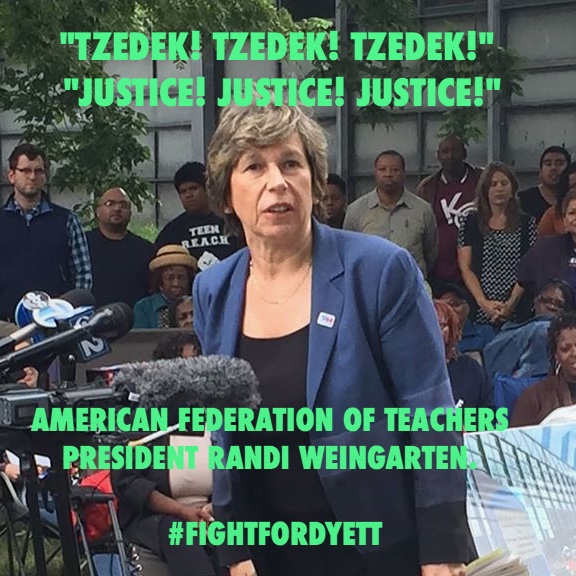
In the hunger strikes, advocates have reignited a discussion on school closings in black and Hispanic communities, which has the support of Rev. Jesse Jackson, Randi Weingarten, president of the American Federation of Teachers and Alliance to Reclaim Our Schools. The 11 hunger strikers, one of which is in the hospital, continued their protest Wednesday. Hunger strikers and supporters picketed outside of the Chicago School Board and held a press event outside Dyett High School Wednesday morning.
There is urgency on this issue because the Chicago Public School system is having a budget crisis, as it is still in negotiations with the teachers union and cuts may exceed $200 million or the district must borrow more money if more funding is not provided. There will be 1,500 staff layoffs and the city estimates a $1.1 billion budget deficit for next school year. CPS Chief Executive Officer Jesse Ruiz wants the Chicago Teachers Pension Fund to loan back $500 million to help offset the budget deficit. CPS asked the Chicago Teachers Union to take a 7 percent pay cut but Lewis said the proposal would be worth striking over. In an interview with In These Times, hunger striker Jeanette Taylor-Raman argued that CPS has the funds, but “black and brown people are just not the priority,” citing the fact that CPS spent millions on a new building recently.
A Chicago-based fiscal responsibility watchdog group, Civic Federation, has released a warning, saying that if a multi-year plan for Chicago Public Schools is not created soon, the school system could fail. It asked CPS to send out a contingency plan to teachers, parents and taxpayers. More than $6 billion of the school district’s debt falls into the junk bond category, according to Reuters.
Of course, the closure of public schools in black neighborhoods in Chicago has been going on well in advance of Emanuel becoming mayor. In 2002, the trend toward closing low-performing schools and replacing them began, led by CPS CEO Arne Duncan. The idea was that by closing low-performing schools and starting from scratch, students would have a better chance to succeed, but now, even some of Duncan’s turnaround schools have been closed by CPS. According to areport by the Chicago radio station WBEZ on school closures from the 2001-2002 school year to 2011-2012 school year, school closings and school turnarounds have disproportionately affected schools in black neighborhoods. Many of the closings are near former Chicago Housing Authority Developments and only 15 percent of replacement schools were rated high performing by CPS and Parents Hunger Strike For High School City Of Chicago Planned To Close | ThinkProgress:

Dirty Tricks in District 6 | Crazy Crawfish's Blog

Dirty Tricks in District 6 | Crazy Crawfish's Blog:

Dirty Tricks in District 6


Kathy Edmonston, my opponent in the District 6 BESE race, just released a poll that her political consultant ran that shows her tied with the incumbent Chas Roemer, me at 6%, and the undecided at 44%. 
This is not the first time I’ve seen or heard these numbers.  The first time I heard them was Thursday August 20th when some of my friends reported that people were contacting them them about this poll, and telling them they needed to stop backing me.  They were being told that I was helping Chas Roemer (who has not declared his candidacy by the way) win, by staying in the race.  (Coincidentally? This was the same day I was endorsed by the NPE (Network for Public Education) and Diane Ravitch, which probably impacted the timing of their release of their poll numbers to me and my supporters.)
I was a bit hurt by this.  Kathy and I had agreed to run a clean campaign on issues and let the voters decided based on our stances, not money, or attacks, or dirty tricks.  I had agreed to this originally with her friend and longtime supporter on the Ascension Parish Republican PEC Kathryn Goeppelt, who asked me to pray with her over our lunch where we met to set some ground rules.  While Kathryn was clearly running the show and doing most of Kathy’s speaking for her at every event I attended, I subsequently confirmed this arrangement with Kathy Edmonston.
I had a significant online presence and following at the time and Kathy had nothing really on Facebook, or anywhere else.  I could have used my early advantage to question the timing of Kathy’s entrance into the race, a mere 4 months or so ago after it was rumored Chas would not be running. I did not even bring up very legitimate questions such as:
“Where we you the last  four years that I have fought Common Core, John White and Chas Roemer?”
“Where were you, Kathy, when I spoke at numerous Common Core rallies, testified and Dirty Tricks in District 6 | Crazy Crawfish's Blog:


AFT President Randi Weingarten joins #FightForDyett hunger strikers. | Fred Klonsky

AFT President Randi Weingarten joins #FightForDyett hunger strikers. | Fred Klonsky:

AFT President Randi Weingarten joins #FightForDyett hunger strikers.


JUSTICE


Life in Rahm’s Chicago. Welcome back, Amer


ahmad
My drawing from July, 2014.
The poster boy for Rahm’s City Hall corruption, Amer Ahmad, is coming home.
Not home to Chicago, where he was hired by Mayor Rahm’s Chief Financial Officer, Lois Scott.
Home to Ohio where he is accused of steering $3.2 million in securities and brokerage work to a high school classmate who then kicked back $500,000 to Ahmad.
His flight back to Ohio was free.
Ahmad was extradited from Pakistan and flown to Columbus, Ohio, where he will appear for a hearing before U.S. District Court Judge Michael H. Watson at 10 a.m. Friday.
Ahmad was a fugitive in Pakistan ever since he fled the States following his conviction for bribery and conspiracy and sentenced to 15 years in prison.
His crimes had all taken place prior to Lois Scott bringing him to Chicago.
Scott was known as Rahm’s financial guru.

CURMUDGUCATION: PA: Charter Vampires on the Loose

CURMUDGUCATION: PA: Charter Vampires on the Loose: "PA: Charter Vampires on the Loose"

PA: Charter Vampires on the Loose


In Pennsylvania, opening a charter school, particularly a  cyber-charter, has long been just like printing money in your garage (only you won't get in any trouble for it).

The current plight of the Chester Upland School District highlights just how screwed up the whole mess is, and how charters are set up to suck the public system dry. Yesterday's news roundup at Keystone State Education Coalition has most of the best coverage of the story, but let me pull up some highlights for you.

I'll remind you that before CUSD ever started to get in trouble, the state of Pennsylvania has been distinguishing itself by some of the most inequitable funding in the country. This is a bi-partisan screwing of public ed. Democratic Governor "Smilin' Ed" Rendell used stimulus funds exactly as he wasn't supposed to, as a replacement for regular state funding of education, and his successor Republican Tom "One Term" Corbett slashed education on top of the auto-slashing that occurred when those stimulus funds went away. Bottom line-- funding of our poorest schools is in free-fall, because they get very little from the state.

As it turns out, CUSD gets negative support from the state. That's because the hugely generous payment formula for charters has resulted in CUSD losing more money to charters than they get from the state of Pennsylvania.

Each school district pays charters based on their own per capita costs per student. That's right-- what the charter collects has absolutely nothing to do with what it actually costs to educate the student. Perhaps that's how it's possible to pay the six top executives at cyber monster K12 a grand total of $16.4 million. Perhaps that's how Vahan Gureghian, King of the Keystone Edupreneurs, can end up building (and now selling) an $84.5 mansion in Palm Beach (not to be confused with the 30,000 square foot manse he built in upscale suburban Philly).

Gureghian operates one of the largest charters in PA, located right in Chester County. So it's only a mild stretch to say that Chester Upland Schools are in danger of being shut down so that Gureghian 
CURMUDGUCATION: PA: Charter Vampires on the Loose: "PA: Charter Vampires on the Loose"