Wednesday, August 19, 2015

Parents hold hunger strike outside Bronzeville high school | WGN-TV

Parents hold hunger strike outside Bronzeville high school | WGN-TV:

Parents hold hunger strike outside Bronzeville high school


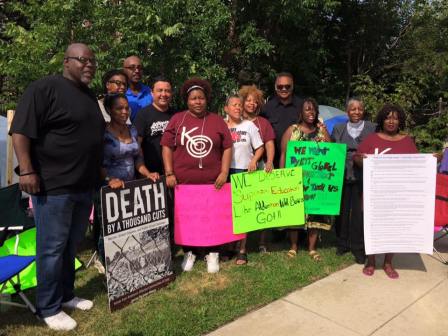
CHICAGO — A group of concerned parents are staging a hunger strike in front of Dyette High School.
The Chicago Board of Education voted to phase out the school after what they call years of poor performance and declining enrollment.
In fact, this past year, only 13 students made up the senior class.
But the district is interested in re-opening Dyett for the 2016-17 school year as an open enrollment neighborhood school with a revamped curriculum and focus.
There are three proposals.
The parents who are part of the hunger strike worked with local and national education experts to come up with one of them: The Global Leadership and Green Technology plan.
The other two include a sports-focused academy and an arts school.
Parents say there was supposed to be a final meeting with the school board this month and then a vote on the 26th.  But they just learned both were tabled.
One protestor, whose lives nearby, says her daughter is going into 8th grade this year and if Dyett isn’t reopened in 2016, her daughter would have to travel 16 miles to the nearest high school.
She is not happy and feels her group’s proposal isn’t being taken seriously.
CPS spokesperson Bill McCaffrey released a statement saying
Chicago Public Schools is carrying out a community driven process to select a new high-quality school for the former Dyett site. Identifying a high-quality education option for the former Dyett site is a priority for the District, and CPS is reviewing school proposals to determine the best open enrollment, neighborhood education option for the site.
Chicago Public Schools says it will hold a public hearing on September 15th at 6 p.m. at CPS headquarters for community members to provide additional input on the three proposals.Parents hold hunger strike outside Bronzeville high school | WGN-TV:
11049569_829908000464142_2624846350042095332_n

Why Gene Glass is No Longer a Measurement Specialist | VAMboozled!

Why Gene Glass is No Longer a Measurement Specialist | VAMboozled!:

Why Gene Glass is No Longer a Measurement Specialist


VAMboozled!


One of my mentors – Dr. Gene Glass (formerly at ASU and now at Boulder) wrote a letter earlier this week on his blog, titled “Why I Am No Longer a Measurement Specialist.” This is a must read for all of you following the current policy trends not only surrounding teacher-level accountability, but also high-stakes testing in general.
Gene – one of the most well-established and well-known measurement specialists in and outside of the field of education, world renowned for developing “meta-analysis,” writes:
I was introduced to psychometrics in 1959. I thought it was really neat.By 1960, I was programming a computer on a psychometrics research project funded by the Office of Naval Research. In 1962, I entered graduate school to study educational measurement under the top scholars in the field.
My mentors – both those I spoke with daily and those whose works I read – had served in WWII. Many did research on human factors — measuring aptitudes and talents and matching them to jobs. Assessments showed who were the best candidates to be pilots or navigators or marksmen. We were told that psychometrics had won the war; and of course, we believed it.
The next wars that psychometrics promised it could win were the wars on poverty and ignorance. The man who led the Army Air Corps effort in psychometrics started a private research center. (It exists today, and is a beneficiary of the millions of dollars spent on Common Core testing.) My dissertation won the 1966 prize in Psychometrics awarded by that man’s organization. And I was hired to fill the slot recently vacated by the world’s leading psychometrician at the University of Illinois. Psychometrics was flying high, and so was I.
Psychologists of the 1960s & 1970s were saying that just measuring talent wasn’t enough. Talents had to be matched with the demands of tasks to optimize performance. Measure a learning style, say, and match it to the way a child is taught. If Jimmy is a visual learner, then teach Jimmy in a visual way. Psychometrics promised to help build a better world. But twenty years later, the promises were still unfulfilled. Both talent and tasks were too complex to yield to this simple plan. Instead, psychometricians grew enthralled with mathematical niceties. Testing in schools became a ritual without any real purpose other than picking a few children for special attention.
Around 1980, I served for a time on the committee that made most of the important Why Gene Glass is No Longer a Measurement Specialist | VAMboozled!:

Parents think standardized tests are useless. Teachers agree. - Vox

Parents think standardized tests are useless. Teachers agree. - Vox:

Parents think standardized tests are useless. Teachers agree.


Parents think standardized tests are largely useless. But they think students should be required to take them anyway.
Education Next, a journal of education research that generally supports the education reform movement, polls parents, teachers, and the public annually to ask what they think about education. The results are, well, contradictory — and they demonstrate why it can be hard to judge whether education ideas are popular.

Parents generally support standardized testing

One of the most contentious issues as Congress tries to overhaul No Child Left Behind, the massive federal law governing K-12 education, was whether students should still be required to take tests every year.
A majority of parents in the Education Next poll said they should be. (The question didn't use the word "standardized," but it asked if the federal government should require students to be tested annually.) Parents were more supportive of annual standardized testing in reading and math than teachers were:
And only about 32 percent of parents said parents should be able to choose whether their children participate in the test; the rest agreed testing should be mandatory.

But they don't think standardized testing is very effective

Here's where things get weird: Parents and the public don't think the tests do a great job of measuring what students have learned. And yet they still think kids should have to take them.
This is part of a bigger issue with evaluating whether education policies are popular. It's the conventional wisdom that standardized tests are widely hated, and it's true that a backlash driven by both parents and teachers has grown over the last few years. Looked at one way, the results indicate that parents think standardized testing is pretty pointless — it does, at best, a fair job of measuring what children have learned.
On the other hand, it's also valid to interpret the poll as finding that parents are generally fine with their kids taking annual standardized tests, and that they think the tests are more effective than teachers do.
Those contradictions show up in other questions, too. People, including parents and Parents think standardized tests are useless. Teachers agree. - Vox:

America’s most (and least) educated cities - MarketWatch

America’s most (and least) educated cities - MarketWatch:

America’s most (and least) educated cities 


If you want to live amidst people with advanced degrees or have your kids attend the best schools, you’re far better off in some cities than others.
2015’s Most and Least Educated Cities
A study released Monday by personal finance site WalletHub.com found that the level and quality of education in cities around the country varies widely. No. 1 ranked Ann Arbor, Mich. has the highest percentage of adults 25 and up with bachelor’s, graduate and professional degrees in the country — and it’s startling to compare the city’s numbers with other locales. Indeed, the percentage of people who have a bachelor’s degree in Ann Arbor is four times as high as in the 149th ranked Visalia, Calif., and the percentage of people who hold a graduate or professional degree in Ann Arbor is six times higher than in last-place Brownsville, Texas.
This study used data from the U.S. Census Bureau, the U.S. Bureau of Labor Statistics, GreatSchools.org and U.S. News & World Report to rank the top 150 largest metropolitan areas in the U.S. in terms of the level of education (high school, college, grad school, etc.) residents had obtained, as wells as the quality of education offered both in terms of public grade schools and universities.
Why are some cities so much better educated than others? There are myriad theories, among them: Cities with a high proportion of people with college and advanced degrees sometimes attribute that to the fact that they have plenty of high-paying jobs (indeed, research shows a strong correlation between the median income earned in a city and the level of education attained.)
Meanwhile, there is evidence to suggest that there is a relationship between the quality of public school education and the amount of public funding, so more affluent communities often have better public schools. What’s more, other studies suggest that certain wealthy areas (with well-funded and high-performing public schools) have effectively created gated communities through public policies and “exclusionary zoning” that can lock poorer residents out.
Here are the 10 most -- and least -- educated cities in America, according to WalletHub, which looked at 150 metro areas. You can delve into the full rankings here.
The most educated cities in America
1. Ann Arbor, MI
2. Washington, D.C.
3. Madison, WI
4. Provo, UT
5. Colorado Springs, CO
6. Seattle, WA
7. Boston, MA
8. Lansing, MI
9. Minneapolis, MN
10. Raleigh, NC
The least educated cities in America
141. Fresno, CA
142. Lafayette, LA
143. Hickory, NC
144. Modesto, CA
145. Lakeland, FL
146. Beaumont, TX
147. McAllen, TX
148. Bakersfield, CA
149. Visalia, CA
150. Brownsville, TX
America’s most (and least) educated cities - MarketWatch:

Councilmembers Say Sexual Harassment Training Should Be Mandatory For Them - capradio.org

Councilmembers Say Sexual Harassment Training Should Be Mandatory For Them - capradio.org:

Councilmembers Say Sexual Harassment Training Should Be Mandatory For Them


Some members of the Sacramento City Council say the City Charter should be changed to require all members take sexual harassment training.
Councilman Jeff Harris introduced the idea to the full council Tuesday night and asked the council's Good Governance Committee to act on it.
"It would be as simple as saying that all members of the council would be required to take sexual harassment training on a two-year basis," he says.
Councilwoman Angelique Ashby is on the committee.
"It's not required of us, but we can require it of ourselves," she says. "That will be a likely recommendation from the group and I am happy to hear you bring it up today and I thank you for doing that."
Ashby says she and other members of the committee had already discussed the idea.
Councilman Jay Schenirer, Mayor Kevin Johnson and Councilman Allen Warren are also on that committee.
Warren is currently the subject of a sexual harassment complaint and investigation.
Johnson sent a memo to all council members last week asking them to take sexual harassment training.
He was cleared of wrongdoing in a sexual harassment complaint that was filed against him by a city employee earlier this year.Councilmembers Say Sexual Harassment Training Should Be Mandatory For Them - capradio.org:

New superintendent has support for agenda from board, Albany - City & Region - The Buffalo News

New superintendent has support for agenda from board, Albany - City & Region - The Buffalo News:

New superintendent has support for agenda from board, Albany

Is Cash the answer for school reform?


A reform-centric state education commissioner holds unprecedented power in Albany.
The majority bloc on the Buffalo School Board shares the same ideas for school turnarounds.
And now, a man with a national reputation as a school reformer is running the Buffalo Public Schools, at the recommendation of the commissioner.
Elections typically drive the agenda for the Buffalo Public Schools, and the board majorities that come and go are based on the current politics of the city.
But as the final piece of the school leadership puzzle falls into place, some believe the appointment of Kriner Cash as Buffalo school superintendent on Wednesday – coupled with a new receivership law – ensures a reform agenda for years to come, regardless of what happens in the next board election.
“The reform agenda could have been dead in May,” board member Larry Quinn said of the next election, which could easily upset the narrow majority on the board. “It he turns out to be good, we’ll have a reform agenda for years.”
Even if the election in May flips the majority, or there is any effort to remove Cash from the job, many insiders speculate that Education Commissioner MaryEllen Elia could then use her power to appoint him – or another reform-minded educator – to take over the Buffalo schools as an outside receiver.
As it stands now, nearly half of the Buffalo schools are in receivership, and many more could follow. And Cash, who oversaw the dismantling of the Memphis school system and prepared it for merging with the surrounding county, pointed out after his appointment Tuesday that the Buffalo district is “one step away” from falling into receivership.
“If it doesn’t work out with him, we still have the added benefit of an independent receiver,” said Samuel L. Radford, president of the District Parent Coordinating Council, who supports many pieces of the reform agenda.
Despite Cash’s reputation, those generally opposed to what is called the school reform movement – marked by school closures, accountability, charter schools and higher standards for teachers – have been strangely quiet in the weeks leading up to his appointment.
Even Buffalo Teachers Federation President Philip Rumore said he looks forward to working with Cash, and is seemingly dismissive of his background.
“Everyone has their stories,” Rumore said of Cash.
Few questions have been raised about his background, or the fact that he comes as the hand-picked choice of the commissioner.
Rather, those on both sides express cautious optimism based largely on the fact that Cash made an effort to meet with a variety of stakeholder groups before taking the job.
“We went in skeptical, defensive because of the way he was recommended by the commissioner,” said Larry Scott, a co-chairman of the Buffalo Parent-Teacher Organization, members of which have been critical of both the state Education Department and the reform agenda pushed by the board majority. “But I felt like at the meeting we were able to ask some questions and tell him what we are about, and hear what he’s all about. I felt like there was a mutual respect there.”
While past Buffalo superintendents have claimed the title of reformer, Cash may be the first to actually run in the same circles as some of the biggest names in the national reform movement.
He was one of a handful of urban superintendents to receive a multimillion-dollar grant from the Bill and Melinda Gates Foundation to come up with a teacher evaluation system. He New superintendent has support for agenda from board, Albany - City & Region - The Buffalo News:

Democratic Dissidents | Frontpage Mag

Democratic Dissidents | Frontpage Mag:

DEMOCRATIC DISSIDENTS

Campbell Brown and Kirsten Powers take on the leftist establishment.


Democrats are known for many things, but chief among them is the relentless determination to maintain a rigid progressive orthodoxy within their ranks. Bucking that orthodoxy requires character and conviction because those who do can expect a certain level of contempt directed their way from their oh-so-tolerant brethren. Campbell Brown and Kirsten Powers are two women who have demonstrated a willingness to take positions decidedly at odds with the progressive establishment. 
Brown’s Democratic roots can be traced back to her father, Louisiana Democratic State Senator and Secretary of State James H. Brown Jr. Although James Brown is Presbyterian, Campbell was raised as a Roman Catholic, which she remained until converting to Judaism following her marriage to Republican strategist and Fox News analyst, Dan Senor.

Brown worked her way up through the ranks of television reporting, winning an Emmy award for her reporting on Hurricane Katrina while working at NBC. She followed an 11 year career at that network with a stint at CNN. She began in 2008 as an anchor for CNN's "Election Center,” renamed "Campbell Brown: No Bias, No Bull” and ultimately “Campbell Brown.” During the 2008 election cycle, she engaged in a controversial interview with John McCain spokesman Tucker Bounds, questioning Republican VP candidate Sarah Palin's executive bona fides. That interview earned her accusations of bias from the McCain campaign, who accused her of going “over the line.” In 2010 CNN released her from her contract due to low ratings.

Brown moved on to writing opinion pieces that indicated such bias was a figment of John McCain’s imagination. In 2012 she penned two pieces for the New York Times.  In one, she insisted a “paternalistic” Barack Obama should stop “condescending to women.” In the other she criticized Planned Parenthood’s self-destructive strategy of embracing “blind partisanship” that was costing the organization supporters. In 2013 she urged Daily Beast readers to keep the shooting in Newton, CT off the “culture war battlefield. Yet it was a piece for the Wall Street Journal that same year indicating where she was going with her post-TV career: Brown began challenging the left’s cherished nexus between the Democratic Party and the unionized education establishment, taking the New York City teachers unions to task for protecting sexual predators.

Ever since, she’s remained on the offensive regarding public school reform. She began with the Partnership for Educational Justice (PEJ), a non-profit watchdog group "committed to reclaiming the promise of public education for all students.” It took on NYC’s mishandling of sexual predator cases, pressuring city mayoral candidates to sign a pledge to reform the system, and spending $100,000 on an ad wondering whether candidates who declined to do so had "the guts to stand up to the teachers' unions.”
That earned her scorn from leftist publication Mother Jones, which cited Brown for a ”conflict of interest” because her husband was a board member of Students First, founded by former Washington, DC, schools chancellor Michelle Rhee. Education unions despise Rhee because she advocates for charter schools, and because her nonpartisan organization advocated for too many Republican candidates during the 2012 election and used a Republican consulting firm to produce the aforementioned ad.

In 2014 Brown upped the reform ante, filing a lawsuit challenging New York City’s tenure laws. And despite the insinuations of Mother Jones, PEJ’s chairman is Democratic lawyer David Boies, who represented Al Gore during the 2000 election dispute. 

Earlier this year Brown illuminated her rationale for pursuing that suit. “There’s a monopoly controlling public Democratic Dissidents | Frontpage Mag:

Black Schools Matter – Chicago Protesters Go on Hunger Strike to Save Their Last Neighborhood School | gadflyonthewallblog

Black Schools Matter – Chicago Protesters Go on Hunger Strike to Save Their Last Neighborhood School | gadflyonthewallblog:

Black Schools Matter – Chicago Protesters Go on Hunger Strike to Save Their Last Neighborhood School


11049569_829908000464142_2624846350042095332_n


Somewhere in Chicago tonight, Mayor Rahm Emanuel may be sitting down to his favorite desert – warm pecan pie with vanilla ice cream.
Across the city in the South Side neighborhood of Bronzeville, 11 parents, teachers and community members aren’t eating so well. Their meal – a few sips of coconut water to keep their strength up.
These brave men and women are on the third day of a hunger strike to save their last open enrollment public school.
If the Emanuel administration has its way, this mostly black community will have to choose between sending their children to a failing charter school or a failing public school run by a private company – all while the neighborhood’s historic Walter H. Dyett High School is closed.
Nat King Cole, Dinah Washington, Red Fox and Bo Diddley are all alumni of Dyett.
Why close such a vibrant connection to the community’s proud past?
It’s the same excuse lawmakers used in 1988 to take away local control from Chicago residents throughout the city. Most Americans have the right to vote for the people who run their local public schools. But not in Chicago, Philadelphia, New Orleans or many other places dark complected people live. The poorer the people and the darker their skin, the more likely the state will swipe away their right to self government on the excuse that their neglected and underfunded schools are “failing.”
Chicago, the third largest district in the country, is a prime example of this kind ofdisaster capitalism.
While schools in wealthier neighborhoods had all the amenities, Dyett students had no honors or AP classes and no art or music. Even physical education classes had to Black Schools Matter – Chicago Protesters Go on Hunger Strike to Save Their Last Neighborhood School | gadflyonthewallblog:

School Districts Have the Power to Change TFA | EdCircuit

School Districts Have the Power to Change TFA | EdCircuit:

School Districts Have the Power to Change TFA


In the last few years, Teach For America (TFA), has seen a massive increase in critique levied at the organization. One of the most recent complaints about the organization is its terrible track record for dealing with critique and criticism. Late last year, the Nation reported on a leaked internal memo that outlined TFA’s obsession with covering up critique and marginalizing critics while simultaneously seeking to expand – a similar corporate disposition that recently put TFA in the crosshairs of NonProfit Quarterly where, when confronted with criticism, TFA is said to have a “self-protective reaction [that] can breed certainty and hubris.” Yet, while there is undoubtedly more than can be said from a critical perspective on TFA, here we outline a “wish list” for real changes that can be affected.
Instead of TFA’s hype we need solutions. And since TFA’s typical response to critique is hype, to us, the real power for change is in the hands of school districts that decide to hire TFA Corps Members (CMs).
Overall, districts should first hire credentialed new teachers who have had sufficient teacher training and student teaching internships. Districts should only use TFA staffing when there is both a shortage of qualified teachers and the only alternative is to hire uncertified and emergency teachers or substitutes. This, however, should never be the case when staffing teachers in special education. CMs are not skilled in general education, let alone, special education law and issues of remediation.
Moreover, districts should not request or require TFA’s to write grants, tutor kids after school, coach, sponsor clubs or assume “extra” duties during their first year. They are trying to figure out teaching and that alone consumes their time.
Again, since it is unlikely that TFA will enact meaningful change in the face of criticism, we contend that the school districts that have the power to decide to partner with TFA or not begin to set those changes into motion.
Here are a few things that districts can do now:
  • Tell TFA to provide you with people who see teaching as a career, not just a stepping stone or 

Capstone—Should Middle and High School Students Do a Thesis?

Capstone—Should Middle and High School Students Do a Thesis?:

Capstone—Should Middle and High School Students Do a Thesis?


Electronics schematic


A good parent, who cares about her kids and is savvy about what is happening with school reform, asked me if I knew anything about capstone projects. She’s concerned and I don’t blame her. For years, the Great Schools Partnership has been pushing middle and high school students to do a capstone project much like a college thesis.
First, encouraging students to do projects is not a bad thing per se and how elaborate such projects are should be determined by the student and the teacher. But shouldn’t projects come from within the school, or the local school district, and not be imposed on all schools by a national nonprofit? If you want to worry about nationalistic schooling, doesn’t this fit the bill?
Also, if you Google capstone, you will find it to be like close reading in that colleges require it. Here it is at Duke University Law School and here it is applied toMechanical, Industrial and Manufacturing Engineering at Oregon State University. There are many more if you look.
For students in middle and high school the education reformers describe what they mean by a capstone project.
While capstone projects can take a wide variety of forms from school to school, a few examples will help to illustrate both the concept and the general educational intentions:
  • Writing, directing, and filming a public-service announcement that will be aired on public-access television
  • Designing and building a product, computer program, app, or robot to address a specific need, such as assisting the disabled
  • Interning at a nonprofit organization or a legislator’s office to learn more about strategies and policies intended to address social problems, such as poverty, hunger, or homelessness
  • Conducting a scientific study over several months or a year to determine the ecological or environmental impact of changes to a local habitat
  • Researching an industry or market, and creating a viable business plan for a proposed company that is then “pitched” to a panel of local business leaders
Parents who like to “supervise” their student’s science project (if you know what I Capstone—Should Middle and High School Students Do a Thesis?:

LIVE STREAM: Bush, Christie, Fiorina, Jindal, Kasich and Walker Talk K-12 at the 2015 NH Education Summit | The 74

LIVE STREAM: Bush, Christie, Fiorina, Jindal, Kasich and Walker Talk K-12 at the 2015 NH Education Summit | The 74:

LIVE STREAM: Bush, Christie, Fiorina, Jindal, Kasich and Walker Talk K-12 at the 2015 NH Education Summit


Governors Chris Christie and John Kasich have announced that they will be traveling to Manchester, New Hampshire on Aug. 19 to join the four previously announced candidates in talking education with The Seventy Four. Live stream the full discussion below (through 4 p.m. EST), learn more about the speakers' education platforms and follow the online reaction live here.


Every four years, as America’s campaign cycle rumbles back to life, two of the country’s smaller states again return to the national spotlight.
Taking advantage of this political stage, The Seventy Four aims to bring the urgent conversation of America’s K-12 education system to both Iowa and New Hampshire in the coming months. (Read Campbell Brown's essay: Why It's Time to Make Our Leaders Talk Education)
As first reported in The New York Times, The Seventy Four, a non-partisan, non-profit news website about education, announced it will be hosting and organizing two 2015 Education Summits beginning in August. Sponsored by the American Federation for Children, the nation’s leading school-choice advocacy organization, and organized in partnership with The Des Moines Register, the first-of-its-kind summits will gather prominent elected officials, political influencers, and education thought leaders to discuss the challenges now facing America’s education system.
“Last year, 1.3 million children dropped out of school, and U.S. students have flatlined on national and international tests,” said Betsy DeVos, chairman of the American Federation for Children. “It’s time to have a national conversation and no better time than as we look to 2016.” (The Seventy Four receives support from the Dick & Betsy DeVos Family Foundation.)
The first of the 2015 Education Summits will be held in New Hampshire on Aug. 19 and will be moderated by The Seventy Four co-founder and Editor-in-Chief Campbell Brown and others. Confirmed speakers (thus far) include Governor Jeb Bush, Governor Chris Christie, former Hewlett-Packard CEO Carly Fiorina, Governor Bobby Jindal, Governor John Kasich and Governor Scott Walker. (Check out The Seventy Four'sdetailed education profiles of the six GOP leaders participating Wednesday)
Additional New Hampshire speakers will be confirmed in the coming weeks. Watch The74Million.org and EdSummits2015.org for new announcements, and check back for video and updates from both summits.
“These summits are an unprecedented opportunity to have an honest and intelligent discussion with our leaders about the failures of the education system”
The second summit, to be held in Iowa in October, will be co-hosted by The Seventy Four and The Des Moines Register, Iowa’s most influential news outlet.
The 2015 Iowa Summit will spotlight Democrats from both Iowa and across the nation — elected officials, analysts and thought leaders with clear thoughts on how to solve America’s education challenges.
All speakers at both the 2015 New Hampshire Summit and 2015 Iowa Summit are invited in their current personal or professional capacities and will appear on stage separately for an important conversation about America’s education challenges and opportunities.
When it comes to most political debates, K-12 education issues tend to get overshadowed by a landslide of other domestic policy issues. The 2015 Education Summits will keep the conversation focused on America’s most urgent policy issue, affording featured speakers time to provide in-depth perspectives outside the formal parameters of the presidential debates.
“As the political world descends on New Hampshire and Iowa, these summits are an unprecedented opportunity to have an honest and intelligent discussion with our leaders about the failures of the education system,” Brown said. “We must begin to treat fixing our education system with the urgency the crisis demands, as it is vital not only to our children’s future, but also the future of this nation.”