Latest News and Comment from Education

Thursday, June 18, 2015

Privatizer, Corporate Matchmaker: Jeb Bush’s Impact on Public Schooling | janresseger

Privatizer, Corporate Matchmaker: Jeb Bush’s Impact on Public Schooling | janresseger:

Privatizer, Corporate Matchmaker: Jeb Bush’s Impact on Public Schooling


On Monday, Jeb Bush declared himself a candidate for President. It’s a good time to review Jeb’s record on public education, and there is a significant record, as Bush made public school reform a centerpiece of his two terms as governor of Florida from 1999 to 2007.  His work on education continued after he completed his second term. In 2008,  he founded and chaired the Foundation for Excellence in Education, which has engaged actively to promote particular education policies across the states.
In a column on Monday, the day that Jeb Bush declared himself a candidate for President, theWashington Post‘s Valerie Strauss summarized Jeb’s record: “Words matter, so it’s important to know that Bush doesn’t call public school districts public school districts.  Instead, he says the United States has ‘over 13,000 government-run monopolies run by unions.’  He doesn’t mention that some districts don’t have any unions, that unions can’t win a contract agreement by politicians, that a number of governors have sharply curtailed the power of unions.”  “Bush advocates using public money for students to use to pay for private school tuition.  The focus of his 1998 campaign for Florida governor was the ‘Opportunity Scholarship Program,’ a voucher program that allowed state funds to be used to pay tuition at church-run schools.  It was struck down by the state Supreme Court in 2006… Bush did successfully push through the Florida Tax Credit Scholarship Program, which allows students to attend private school with the help of publicly funded tax credits.” “Meanwhile, the ‘About Us’ page of his Foundation for Excellence in Education, which he founded after leaving the Florida governorship to take his school reform agenda national, uses the word ‘public’ twice—but never with the word ‘school’ or ‘education’ after it (but rather ‘public awareness’ and ‘public outreach’).”  “Bush has said that ‘we can’t just outsource public education to bureaucracies and public education unions and hope for the best,’ but he likes outsourcing public education to for-profit education companies who open public charter schools but run them like a business.  (Is it a coincidence that Florida has the second-highest number of for-profit charter schools?)”
Late in January, this blog summarized Alec MacGillis’s in-depth profile in the New Yorkermagazine of Jeb Bush’s education interests, promoted when he was governor of Florida and later through the Foundation for Excellence in Education. MacGillis is particularly critical of the lack of regulation that accompanied the explosive growth of charter schools in Florida during Bush’s tenure as governor: “(I)n 2002, Bush signed a law allowing charter operators who were denied approval by local school boards to appeal to the state.  In 2003, he signed a law to eliminate the state’s cap on the number of charters, which had been set at twenty-eight in the largest counties.” “By 2006, Jeb’s last year in office, there were more than three hundred charter schools (for-profit and nonprofit) in Florida, with more than a hundred thousand students, most of them in big metropolitan areas such as Miami and Tampa. But the state made only sporadic efforts to track their performance.  The 1996 law called for annual Privatizer, Corporate Matchmaker: Jeb Bush’s Impact on Public Schooling | janresseger:

Kelly Donnelly to become Chief of Staff for Connecticut Department of Education - Wait What?

Kelly Donnelly to become Chief of Staff for Connecticut Department of Education - Wait What?:

Kelly Donnelly to become Chief of Staff for Connecticut Department of Education


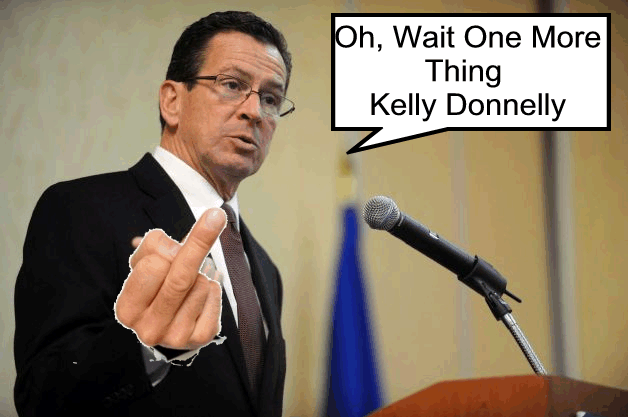
The key role of Chief of Staff for Governor Dannel Malloy’s State Department of Education will go to Kelly Donnelly who was brought in from New Jersey in December 2012 to serves as former Commissioner of Education Stefan Pryor’s PR person.
Although Donnelly has no work experience in public education and her only education policy experience is as the agency’s communications person, multiple sources confirm that Commissioner of Education Dianna Wentzel will by-pass numerous qualified professional staff to hand the Chief of Staff duties to Donnelly.
Donnelly will be replacing Adam Goldfarb, who resigned earlier this year soon after Stefan Pryor left Connecticut to become Rhode Island’s Economic Development Commissioner.
Goldfarb, a Yale Law School graduate, came with Pryor from New Jersey.  Goldfarb served as one of Pryor’s policy advisors in Newark, New Jersey and spent time as Pryor’s intern when Pryor worked for the Lower Manhattan Development Corporation.
Goldfarb was initially brought in under the title of Executive Assistant, but then immediately was made Chief of Staff with a starting salary of $99,000, up 33 percent from what he was making as Pryor’s assistant in New Jersey.  Goldfarb finished up his duty as a Connecticut public servant earlier this year with a salary of $116,000
Donnelly was hired as Pryor’s Communication Director with a starting salary of $82,000.  It is unclear what her salary will be as the State Department of Education’s Chief of Staff.
Prior to coming to Connecticut, most of Donnelly’s experience was with political campaigns in New Jersey and Long Island although she did spend nearly two years in 2010-2011 with 1st Light Energy Inc, where she, “Oversaw residential and commercial photovoltaic (solar system) installations for the entire scope of the project.”
Donnelly, who is from Edison, New Jersey graduated from Notre Dame in 2002 with a BA Kelly Donnelly to become Chief of Staff for Connecticut Department of Education - Wait What?:

ASK BILL GATES: Why don’t Americans trust their teachers? - Quartz

Why don’t Americans trust their teachers? - Quartz:
Why don’t Americans trust their teachers?


What should students in high school and college English classes read?

Whether you think they should be reading Ovid and Melville, or only books written by diverse, contemporary authors, or books with no explicit sex, or books with no explicit violence, most people have an opinion on how and what teachers teach in their classrooms.

And yet, no one expects to know what doctors should prescribe, or what arguments lawyers should make in court. With most professions, there’s an assumption of professional competence and knowledge. A doctor, after examining a patient, is thought to be more likely to diagnose a problem correctly than is some random person off the street, who has no medical training and has never met the person in question. But when it comes to assigning texts, or determining a curriculum, teacher expertise and experience is regularly disregarded.
Americans’ low opinion of teacher competence was highlighted—again—in a couple of ways over the last week. At Crafton Hills College in San Bernardino, a student was so upset by the sexual content in an English 250 graphic novel course—which required her to read Alison Bechdel’s Fun Home, Marjane Satrapi’s Persepolis, Neil Gaiman’s The Sandman, Vol. 2: The Doll’s House, and Brian K. Vaughan and Pia Guerra’s Y: The Last Man—that she staged protests on campus alongside her parents. “I expected Batman and Robin, not pornography,” the student declared, adding that she believed the books should be “eradicated from the system. I don’t want them taught anymore. I don’t want anyone else to have to read this garbage.” Instead, administrators agreed to provide a content warning for the books in future classes (a more reasonable outcome than in South Carolina, where the use of Bechdel’s Fun Home in freshman reading courses at public colleges prompted the state legislature to slash the schools’ funding.)

At the same time as the Crafton Hills controversy was unfolding, Dana Dusbiber, a veteran high school English teacher in Sacramento, California, wrote an op-ed for the Washington Post explaining why she didn’t want to teach Shakespeare to her class.

Dusbiber said she is not fond of Shakespeare herself, and that her mostly non-white students don’t connect with the work. “What I worry about is that as long as we continue to cling to ONE (white) MAN’S view of life as he lived it so long ago, we (perhaps unwittingly) promote the notion that other cultural perspectives are less important,” she writes. Moving away from Shakespeare is tricky, however, because his works are specifically referenced in Common Core English standards.
The question of whether to teach Shakespeare isn’t just a personal decision for Dusbiber; it’s a matter of public policy. Shakespeare is ratified and to some degree enforced through state standards and administrative decisions. Dusbiber, as a teacher, is making an argument that she should have the authority to assign texts, just as teachers at Crafton Hills or in South Carolina want the authority to assignFun Home. Parents, state boards, or students may object to those decisions because they condemn homosexuality, or because they condemn explicit sex, or because they think Shakespeare is the most important author ever and everyone should read him. But whatever the reasoning, the baseline assumption is that someone outside the classroom is better positioned to determine what gets read inside of it.

It’s natural, of course, for parents and policy-makers to feel that they have some stake in what kids are learning, just as it’s natural for the public and policy makers to have a (large) stake in medical policy. But there’s a line between broad accountability and micromanagement, and the US approach to education frequently crosses it. As Jal Mehta argues in his 2013 book The Allure of Order, high school teaching has never been considered fully professionalized, in part because it was originally dominated by women. The history of education reform has, he says, basically been a history of trying to give someone—anyone!—other than teachers control of the classroom, whether that be principals, politicians, testing gurus, or fresh-faced Teach for America volunteers.
Dana Goldstein makes similar points in her 2014 book The Teacher Wars. “The history of education reform shows … recurring attacks on veteran educators,” she writes. Secondary teachers aren’t respected, and aren’t even trusted. College professors have more power and autonomy—but even that is being eroded as colleges rely more and more on adjuncts, who are paid a fraction of the salary and afforded fewer protections from state or administrative Why don’t Americans trust their teachers? - Quartz:

The Watchdogs of College Education Rarely Bite - WSJ

The Watchdogs of College Education Rarely Bite - WSJ:

The Watchdogs of College Education Rarely Bite

Accreditors keep hundreds of schools with low graduation rates or high loan defaults alive


Most colleges can’t keep their doors open without an accreditor’s seal of approval, which is needed to get students access to federal loans and grants. But accreditors hardly ever kick out the worst-performing colleges and lack uniform standards for assessing graduation rates and loan defaults.
Those problems are blamed by critics for deepening the student-debt crisis as college costs soared during the past decade. Last year alone, the U.S. government sent $16 billion in aid to students at four-year colleges that graduated less than one-third of their students within six years, according to an analysis by The Wall Street Journal of the latest available federal data.
Nearly 350 out of more than 1,500 four-year colleges now accredited by one of six regional commissions have a lower graduation rate or higher student-loan default rate than the average among the colleges that were banished by the same accreditors since 2000, the Journal’s analysis shows.
“They told me I could build a future there,” says Rachel Williams, 24 years old, who dropped out of Kentucky State University in Frankfort in 2013 because her family couldn’t afford the college anymore and she was losing faith in it. She amassed about $34,000 in federally backed loans.
Kentucky State has a graduation rate of just 18%, and nearly 30% of students who began repaying their loans in fiscal 2011 had defaulted within three years.
The Southern Association of Colleges and Schools Commission on Colleges reaffirmed Kentucky State’s accreditation in 2009. A preliminary report by the reviewers made no mention of loan defaults and praised Kentucky State for plans to improve its graduation rate.
College officials say they couldn’t find the final report and wouldn’t comment on the findings. The accreditation group doesn’t publicly release reports.
Belle Wheelan, president of the Southern Association, which is based in Decatur, Ga., and reviews colleges in 11 states, declines to comment on Kentucky State but says accreditors don’t follow “bright lines” when assessing performance because students enter college The Watchdogs of College Education Rarely Bite - WSJ:

RI School Districts Lose Millions to Charter Schools - GoLocalProv

GoLocalProv | RI School Districts Lose Millions to Charter Schools:

RI School Districts Lose Millions to Charter Schools


School districts are losing millions in much-needed funds in inflated tuition payments to charter schools, according to a GoLocalProv analysis of data contained in a report from a legislative panel on the education funding formula.

Under the new formula, which was adopted in 2010, the cost of educating a child should follow him or her to a charter school, leaving no impact on districts. “What does not follow is all the expenses associated with the school district,” said state Rep. Jeremiah O’Grady, a Lincoln Democrat who chaired the panel.
Flawed assumption in funding formula
Frank Flynn, the president of the Rhode Island Federation of Teachers and Health Professionals and a panel member, offers the example of a classroom where just one or two students might leave. The money follows those one or two students to the charter school they have chosen, but the district still has to pay the full salaries and benefits of the teacher for that classroom—now without the money that went to the charters for those two students.  
There are also other costs that are mandated for districts but not charters, such as the transition programs for special education students aged 18 to 21, pension payments, and early childhood programs, according to Flynn.
“So there is definitely a discrepancy in the … funding formula that we believe needs to be addressed,” Flynn said.
Many school districts say they are losing money to charter schools because of such fixed costs that do not “follow” the child to the charter school. Seven districts provided data to the panel showing a total of $5.4 million lost in the last school year. (Those districts are: Burrillville, Chariho, Cumberland, Exeter-West Greenwich, Lincoln, North Kingstown, and South Kingstown.) 
The districts listed are those that were most affected, according to Tim Ryan, the executive director of the Rhode Island School Superintendents Association, which backs the findings of the report.

In fact, a GoLocalProv analysis for all school districts suggests that the total may be at least three times that. (See below slides.)
Cumberland official: school districts being defunded
And those costs are rising fast, according to Phil Thornton, the schools superintendent in Cumberland.
In 2008, the charter school tuition bill from charter schools to Cumberland was $125,000. In 2015 it is an estimated $3.2 million. In 24 months it will hit $4 million, according to Thornton. “We have increased costs each year and largely have the same student population,” Thornton said.
The disparity becomes apparent when viewed in terms of state aid.
“Cumberland’s state aid for next year will increase by $952,596. Of that amount, Cumberland will pay out an additional $832,147 to charter schools—for approximately 445 students. The 4,600 Cumberland School District students will receive just $120,000 in state aid. So each charter school student will receive $1,869 in new state aid and each Cumberland School District student will see $26,” Thornton said.
“If we want choice in RI, we need to fund choice. Our current system is simply defunding existing school districts for the creation of new charter districts,” Thornton said.

Providence could lose millions
Some districts are only beginning to feel the impact. In Providence, the opening of Achievement First was expected to cost the district $1.8 million in the current fiscal year, according to a December 2011 forecast prepared by Internal Auditor Matt Clarkin.
By 2018, Providence is projected to be losing as much as $9.2 million in funding to Achievement First, according to Clarkin’s analysis.
One glaring disparity is in special education.
Under the current education funding formula, expenditures are divided by the number of students to get a per-pupil figure. That figure is the tuition amount paid out to any charter schools that students who reside within the district are attending. But school districts have special education mandates that charters do not. They also have a higher percentage of special education students—and those students tend to have more severe disabilities than students with learning disabilities at charters, according to Flynn.
As a result, the special education share of per pupil expenditures is higher in school districts than it is for charters.
For example, the average per-pupil cost of special GoLocalProv | RI School Districts Lose Millions to Charter Schools:

Ensure A Reauthorized ESEA Protects Children And Civil Rights

Ensure A Reauthorized ESEA Protects Children And Civil Rights:


Ensure A Reauthorized ESEA Protects Children And Civil Rights

Advocacy Letter - 06/18/15
Source: The Leadership Conference on Civil and Human Rights
Recipient: U.S. Senate

Dear Senator:
On behalf of The Leadership Conference on Civil and Human Rights and the 36 undersigned organizations, we write to express our views regarding the Every Child Achieves Act of 2015. We are committed to a reauthorized Elementary and Secondary Education Act (ESEA) that preserves the critical federal protections of that law and builds on the lessons of the past to ensure greater academic progress for all students. We believe that the bill must be improved by: strengthening accountability for student outcomes; providing additional data on student groups; addressing disparities in resources; and providing a more meaningful federal role. We look forward to working with you to ensure that the critical protections included in this bill continue to be preserved and that the improvements we seek are incorporated in the final bill. We do not support the bill in its current form because, without addressing these issues, it will not fulfill its functions as a civil rights law.
Accountability
We applaud maintaining the requirement for college or career aligned state standards, statewide annual assessment, disaggregated student achievement (including the 1 percent cap on using alternate assessments based on alternate achievement standards to assess students with the most significant disabilities), and goals for achievement and high school graduation. These tools provide invaluable information to parents, communities, educators, advocates, and policymakers to help ensure all students receive an equitable and excellent education. The power of this reporting, however, is greatly curtailed by the absence of meaningful accountability. States must be required to identify schools where all students or groups of students are not meeting goals and to intervene in ways that raise achievement for students not meeting state standards.
Data
The bill does not require schools to report disaggregated data in a way that can be cross-tabulated by gender and disability status across major racial and ethnic groups. The bill also does not include additional data necessary to track the progress and treatment of all students, including different groups of Asian American students, students in foster care, pregnant and parenting students, and other vulnerable groups of students. It is critical that states transparently report on student groups in order to understand how all of our students are doing and what their needs might be.
Resource Equity
We appreciate that the existing targeting of Title I funds to students, schools, and districts in the greatest need was maintained and that the portability provision was excluded from this bill. We also believe that the new transparency around per-pupil expenditures, school climate and discipline, and access to qualified and effective teachers, principals, and other school leaders will help to identify disparities in educational opportunity. However, while the reporting is robust, there is no requirement to act on the basis of that information. It is critical that states intervene to remedy disparities in access to resources between school districts and that the comparability loophole be closed.
Federal Role
While there are fewer limitations on the authority of the Secretary of Education than were included in the Chairman’s discussion draft, there remains insufficient federal oversight to ensure that the law is faithfully executed as Congress intends. The Secretary must have sufficient authority to ensure the law is appropriately implemented and the most vulnerable students are protected.
We appreciate the work of Senators Alexander and Murray and their staff and look forward to working with you on the Senate floor and as the process moves forward to ensure that the successes of this legislation are maintained and the weaknesses addressed. If you have any questions, please do not hesitate to contact Nancy Zirkin, Leadership Conference Executive Vice President, at zirkin@civilrights.org, or Liz King, Leadership Conference Director of Education Policy at king@civilrights.org.

Sincerely,
The Leadership Conference on Civil and Human Rights
Alliance for Excellent Education*
American Association of University Women (AAUW)
American-Arab Anti-Discrimination Committee (ADC)
Association of University Centers on Disability (AUCD)
Children's Defense Fund
Council of Parent Attorneys and Advocates
Democrats for Education Reform*
Disability Rights Education & Defense Fund
Easter Seals
Education Law Center-Pennsylvania*
Judge David L. Bazelon Center for Mental Health Law
Lawyers' Committee for Civil Rights Under Law
League of United Latin American Citizens
MALDEF
NAACP
NAACP Legal Defense and Educational Fund, Inc.
National Center for Learning Disabilities
National Center for Special Education in Charter Schools*
National Congress of American Indians
National Council of La Raza (NCLR)
National Association of Councils on Developmental Disabilities
National Disability Rights Network
National Down Syndrome Congress
National Indian Education Association
National Urban League
National Women's Law Center
PolicyLink
Southeast Asia Resource Action Center
Southern Education Foundation, Inc.
Southern Poverty Law Center
Stand for Children*
TASH
Teach Plus*
The Education Trust*
TNTP*


* KNOWN FRONT GROUPS FOR PRIVATIZATION

Ensure A Reauthorized ESEA Protects Children And Civil Rights:

Keeping better tabs on California's education funding - LA Times

Keeping better tabs on California's education funding - LA Times:

Keeping better tabs on California's education funding


Educational history is full of examples of expensive, well-intended programs that never helped impoverished students.


One of Gov. Jerry Brown's greatest and most dramatic accomplishments has been his reform of the way California allocates money to public schools. He used the recession to hit the reset button, replacing an arcane and blatantly unfair formula with a streamlined and equitable distribution: a certain amount of funding per student, and significantly extra for those who are poor, in foster care or not fluent in English — in other words, students who need extra help.

But this fairer approach will work only if school districts are committed to spending the money for the benefit of the disadvantaged students for whom it was intended, and early signs are that at least some school districts are defining that benefit broadly — perhaps too broadly.


The Fresno Unified School District, for instance, is seeking permission to use the added funding for teacher raises. Now a study from UC Berkeley finds that Los Angeles Unified has spent a significant portion of the extra money on library aides and assistant principals for schools districtwide, not just those with the most students in need.

These developments are troubling to some of the people who initially cheered the Local Control Funding Formula, and they're right. Of course some flexibility is needed, but there is enough cause for concern that the state should be thinking about tighter, though still-sensible, controls.Keeping better tabs on California's education funding - LA Times:

ANYONE SURPRISED? Bill Gates Fined $148k for His' horse poop only pays $30.600 - palmbeachpost

Settlement approved on Bill Gates' horse poop case in Wellington | www.palmbeachpost.com:

Settlement approved on Bill Gates’ horse poop code case


WELLINGTON — Billionaire philanthropist and Microsoft founder Bill Gates has 30 days to pay $30,600 in Wellington to clear up code violations involving a misplaced manure bin.
The infractions against Gates’ Mallet Hill estate were resolved during a hearing Thursday. The case was part of the consent agenda approved without comment by village special magistrate Rafael Suarez-Rivas.

Settlement approved on Bill Gates’ horse poop code case photo
Dimitrios Kambouris/Getty Images

There was no discussion about the settlement Gates’ representatives reached with the village. The $30,600 settlement is a markdown of 80 percent from the total fines that had accumulated,which happens frequently with code compliance cases in Wellington.
Special magistrates in Wellington are appointed attorneys who serve as judges in deciding code enforcement cases. They almost always accept the recommendations or settlements presented to them by Wellington’s code compliance office, and that’s what happened Thursday with Gates’ case.
A private trust affiliated with Bill and Melinda Gates bought a 4.5-acre, $8.7 million home in the village’s Mallet Hill community in April 2013. Their daughter, Jennifer, is a competitive show jumper who has shown at Wellington’s Winter Equestrian Festival.
In January 2014, a village inspector found an existing horse waste bin was built too close to a nearby canal and the one the Gates family built to replace it elsewhere on the property wasn’t permitted, and the Gates family was cited for two code violations.
The family said in the fall that they didn’t know about the violations until then because an incorrect contact address had been listed with the property appraiser. A spokeswoman at the time chalked up the case to a paperwork mistake and said the family was working to fix the infractions.
Fines of $250 a day on each of the two violations accumulated to about $148,000 until they ceased last month when the problems were ultimately corrected.Settlement approved on Bill Gates' horse poop case in Wellington | www.palmbeachpost.com:
RELATED STORY

Why is HISD Blocking Planned Parenthood's Website on Campus? | Houston Press

Why is HISD Blocking Planned Parenthood's Website on Campus? | Houston Press:

UPDATED: IS HISD BLOCKING PRO-CHOICE WEBSITES ON HIGH SCHOOL CAMPUSES?


Lamar High School student Grace Wells was denied access to Planned Parenthood's website on campus.
Images courtesy Grace Wells


(See update at the bottom of this story) 
Last semester, Grace Wells opened up her school-issued laptop, logged into her student account to connect to Houston ISD's wifi network at Lamar High School and typed in PlannedParenthood.org. Instead of hitting the site's homepage – which links to pages on birth control, the morning-after pill, abortion, STD prevention and treatment, health insurance, and a box to plug in your zip code to find the nearest Planned Parenthood clinic – Wells got a message saying “Access Denied.”
“The site you are attempting to visit is blocked because it belongs to the following category: Abortion.”
Wells, who will start her senior year at Lamar in August, was taken aback. “I wondered what else was blocked,” she told the Press. So Wells started plugging in other URLs. It seemed everything Planned Parenthood-related was blocked, including the organization's info page explaining birth control options, everything from abstinence to pills, patches and condoms. She was denied access to Prochoice.org, the website for the National Abortion Federation, the professional association for abortion providers in North America. 
UPDATED: Is HISD Blocking Pro-Choice Websites on High School Campuses? (2)
Then, she discovered something curious: seems HISD doesn't block all abortion-related websites, just those that happen to be pro-choice. Wells typed out prolifeacrossamerica.com, and the home page for one of the largest anti-abortion groups in the country pulled right up.
When we asked HISD for an explanation this week, all district spokeswoman Ashley Anthony could say was that “Our district policy is in line with the federal Children's Internet Protection Act (CIPA),” a law passed in 2000 meant to ensure that libraries and schools block or filter “minors' access to materials harmful to them,” like obscene or pornographic images.
Why, exactly, HISD would interpret CIPA to block access to Planned Parenthood or other pro-choice websites is unclear. When asked for their specific policy on how and when students are allowed to access abortion-related material on the web, HISD couldn't provide one (*see update at the bottom of this story). But when Wells first discovered pro-choice websites were blocked earlier this year, she took the matter to a friend who serves on the board of Planned Parenthood Gulf Coast. HISD ultimately provided Planned Parenthood this response: 
“HISD allows all staff, high school and middle school students access to sites which provide information or arguments in favor of or against abortion, describing abortion procedures, offer help in obtaining or avoiding abortion, or provide information on the effects, or lack thereof, of abortion. It is blocked for elementary students, any generic account or generic student account and our guest networks since we will not be able to identify who is using the computer.” 
 When Wells tried to access an anti-abortion website, it wasn't blocked by HISD's system.


While that sounds like a reasonable policy, that's not how it worked for Wells. “The expectations they set for someone to access sites like Planned Parenthood, I met them, and I was still denied access,” she said. Screengrabs Wells took of the “Access Denied” messages shows she'd connected to HISD's network with her student-specific account.
Wells says she's particularly concerned Planned Parenthood websites would be blocked, “considering 97 percent of their business is not related to abortion. … It's a medical resource, an informational resource, and there's a ton of information on their website that we're not allowed to see on campus that would be extremely helpful to us.” Moreover, she's troubled that pro-choice websites would be blocked when anti-abortion websites, like prolifeacrossamerica.com, aren't. Regardless of a person's stance on abortion, she says, students should have access to well-rounded information on the issue before deciding how they feel. “By blocking these sites, I feel like they're trying to make this decision for us," she said.
But ultimately Wells worries about other HISD students who don't have easy access to the Internet off campus. “The majority of HISD students are on free or reduced lunch, meaning they have a hard time even paying for their meals every day,” she said. “How should we expect they'll access this information outside a school campus? Many HISD students aren't privileged enough to have Internet access at home. And if they look this up on a high school campus, it's because they really need this information. And I'm afraid HISD is keeping it from them.” 
*UPDATE 6/17/15 @ 5:55 p.m.:
HISD spokeswoman Ashley Anthony just sent us this:
"While blocked at the elementary school level, the sites and subject matter in question should not have been blocked for students at the middle school and high school levels. IT will be reviewing internet filters for student accounts to ensure all settings are in compliance with district policy and administrative regulations. Below is our statement.
HISD Statement
HISD is reviewing internet filters for student accounts to ensure the settings are in compliance with the district’s technology resources board policy and administrative regulations. The district uses filtering software to filter material considered inappropriate or harmful to minors. Websites that provide information about abortion are currently categorized as accessible for middle and high school students. This material, however, is blocked for elementary school students, as well as any student who may be logged into a HISD computer as a guest or through a generic student account that does not specify grade level.
There are a handful of subjects that are considered inappropriate and blocked across the district:
· Nudity/pornography
· Images or descriptions of sexual acts
· Promotion of violence
· Illegal use of weapons, drug use, discrimination, or participation in hate groups
· Instructions for performing criminal acts
· Online gambling"
Still no explanation why, if this was a simple IT mistake, an anti-abortion website that fits the filter description for elementary and middle schools (content related to abortion) was not blocked when Wells punched it into her computer. Why is HISD Blocking Planned Parenthood's Website on Campus? | Houston Press:

Arrogance - Change The LAUSD

Arrogance - Change The LAUSD:

Arrogance


Election season was clearly over on Tuesday afternoon as the LAUSD set about to fulfill the legal requirement of getting public input into the Local Control Funding Formula. Outgoing District 3 representative Tamar Galatzan did not even bother to show up to the meeting. District 2’s Monica Garcia left as public comment began. Even George McKenna’s seat was empty before the last speaker had a turn at the podium.
A limited audience was not the only barrier faced by stakeholders who wanted to present their concerns to the Board. In case the inconvenient start time of 2:30 was not enough to dissuade people from attending, the board set a limit of 75 speakers, each of whom were allowed to speak for two minutes. They were warned in advance that the Board “would not be rude” about enforcing this limit, the mike would just be cut.
When adult speakers went over their allotted time, Board President Richard Vladovic summoned his patience to politely remind them to wrap up their comments. However, when a young adult pushed the limit in expressing his frustration with the district, the Vladovic with anger management issues was on full display. When the speaker proved that he would not need a mike to finish his comments, Vladovic sent the school police in to remove him from the podium.
As the assembly line of speakers neared its end, Jose Gallegos stepped up to the podium. He began by requesting that the clock not be started until all Board members had put down their phones so that they could pay attention. When he realized that this request had been counted against his time, he declared the situation “f***ed up.”He then shared his thoughts about how the district had failed him. He told the story of his sister who was unable to walk at graduation Arrogance - Change The LAUSD: