Wednesday, June 17, 2015

New Orleans school changes worked, Cowen Institute says | NOLA.com

New Orleans school changes worked, Cowen Institute says | NOLA.com:

New Orleans school changes worked, Cowen Institute says


Cowen Institute says the National Study of CMO Effectiveness aims to fill the gap in systematic evidence about CMOs, providing the first rigorous nationwide examination of CMOs’ effects on students’ achievement and attainment. The study includes an examination of the relationships between the practices of individual CMOs and their effects on student achievement, with the aim of providing useful guidance to the field. Mathematica Policy Research and the Center on Reinventing Public Education (CRPE) are conducting the study with funding from the Bill & Melinda Gates Foundation and the Walton Family Foundation and project management assistance from the NewSchools Venture Fund. This updated edition of the report provides key findings from the study on CMO practices, impacts, and the relationships between them. A forthcoming report will explore promising practices in greater depth.


Ten years after Hurricane Katrina, have New Orleans' massive education changes worked? Tulane's Cowen Institute for Public Education Initiatives issued its answer in a Wednesday (June 17) report:
"The academic performance of New Orleans' schools has improved remarkably over the past 10 years," authors Patrick Sims and Vincent Rossmeier write in the anniversary edition of the institute's annual evaluation.
Before the storm, only one parish in the state did worse.
In the months after the disaster, the state took over all but about 15 of the city's 120-plus public schools and began turning them into independently run charters. Most of the schools left under local control became charters too. The city stopped assigning students to neighborhood schools and allowed everyone to choose where to go.
student percents charTap to enlarge 
Now the city has climbed all the way up to ... average. In 2014, it earned a C on the state report card. The percentage of students attending schools that perform above the Louisiana average has almost doubled – to 31 percent, according to the report.
The on-time graduation rate went from 56 percent in 2004 to 73 percent last year, the authors write. Due to the disruption of Katrina, the state did not immediately calculate a New Orleans graduation rate for the Class of 2005, but officials later went back and did so.
Public schools are becoming more popular, especially among white families who fled the system after desegregation. From 2006-2012, white enrollment in private schools increased by 1.5 percent – compared to a 38 percent increase in public school enrollment. From 93 percent African American before the storm, the city's schools are now 84 percent black, 7 percent white and 5 percent Hispanic, according to the report.  
New Orleans public school enrollment by race/ethnicity
2004-052014-15
Black93.2%84.2%
White3.67.2
Asian1.91.6
Hispanic1.25.1
Other0.11.8
The authors say "most would agree" with their assessment. Not mentioned in the report is a vocal minority of critics, such as national charter opponent Diane Ravitch, who accuse administrators of cooking the books.
For instance, in a 2014 state audit, the Recovery School District couldn't provide the records to prove a sample of transfer students didn't just drop out. The same happened in this year's audit, according to data the Education Department recently provided to NOLA.com | The Times-Picayune.
student spending chartTap to enlarge 
Some also question whether test scores show true intellectual growth. Former Loyola professor Andre Perry is among those who say the public school revolution has not yet contributed enough to general community economic development.
Not all students have benefited equally. The Tulane report has ample data to show the persistent divide between the Orleans Parish schools -- mostly schools that were never taken over, plus a few new charters – and the takeover schools.
It's well known that Orleans Parish schools enroll different students from the generally lower-scoring Recovery charters: more white, fewer poor, fewer disabled. They also have teachers and administrators with more education and more experience, and they spend more per student, according to the report.
Teacher education and experience, 2013-14
OPSB charterOPSB direct-runRSDBESE
Teacher years of experience11.617.17.14.9
Administrator years of experience16.213.48.39.7
% of teachers with post-baccalaureate degrees61%48%26%29%
Student : teacher ratio16 : 115 : 119 : 113 : 1
Forty-two percent of Orleans Parish students posted scores that showed they were truly proficient in the subject, compared to 12 percent of Recovery students, the New Orleans school changes worked, Cowen Institute says | NOLA.com:

Going to the NEA RA in Orlando. For many Disney workers it’s no Magic Kingdom. | Fred Klonsky

Going to the NEA RA in Orlando. For many Disney workers it’s no Magic Kingdom. | Fred Klonsky:

Going to the NEA RA in Orlando. For many Disney workers it’s no Magic Kingdom.


disney-strike-one1


Later this month I am in Orlando, Florida for the National Education Association’s Representative Assembly. I am an elected Retired delegate. I will also being attending the NEA Retired Conference that just precedes the RA.
The NEA brings a lot of people and a lot of money to wherever it holds its annual meeting. We are nearly 10,000 delegates and thousands of support staff. It is a big financial deal for the city where we meet, even for a mega-tourist town like Orlando.
I have been to the RA in Orlando before. The place resembles a company town.
And the company is Disney.
Old Walt Disney was born not far from my house here in Chicago.
He moved to Hollywood to seek his fame and fortune, first as a cartoonist and then as the head of his own film company and then  a multi-national entertainment corporation.
But always a union-hater.
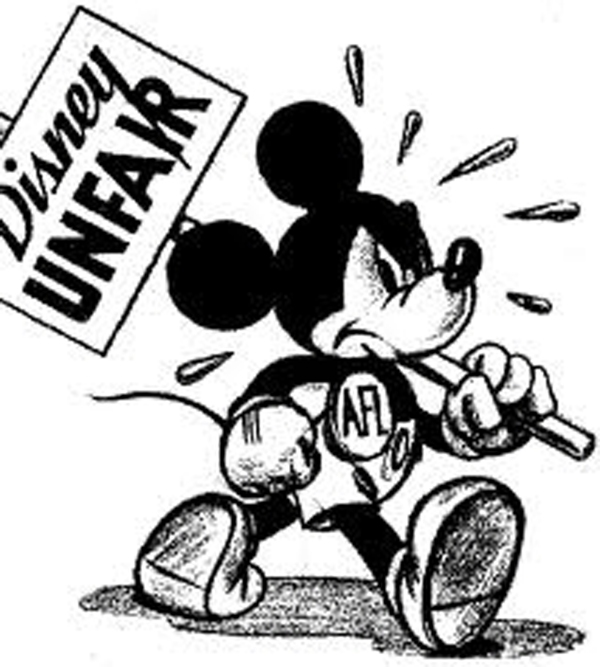
In 1941, the cartoonists working for Disney walked off the job in a strike for union recognition.
As Walt Disney turned his fashionable Packard roadster onto Buena Vista Blvd. he found the entrance to his studio ringed with a mob of 300 picketers and reporters. The protesters were his own cartoonists. Every couple of feet one stood on a soapbox and made angry speeches to passing picketers. Under the clear blue skies colorfully handpainted signs bobbed: DISNEY UNFAIR!, ONE GENIUS vs. 600 GUINEA PIGS, WE HAD NO SCABS AT SCHLESINGERS, LEONARDO, MICHELANGELO and TITIAN WERE UNION MEN, and a picture of Pluto with the title, ID RATHER BE A DOG THAN A SCAB!
The strike was long and bitter.
The strike lasted for nine weeks until Disney was at last compelled by Federal mediators, nationwide boycotts, his financiers the Bank of America and his brother Roy to give in and recognize the Guild. On Sept 21, 1941, everyone went back to work. Salaries doubled overnight for a 40-hour workweek and screen credits were established. The Screen Cartoonist Guild now represented 90% of Hollywood animation workers.
Walt Disney never changed. He remained a hater of unions and a backer of right-wing causes his entire life. A Koch brother of his day.
The Disney corporation has come a long way since Walt and his first drawing of Going to the NEA RA in Orlando. For many Disney workers it’s no Magic Kingdom. | Fred Klonsky:

Practice Educational Civil Disobedience: Refuse The Survey» Missouri Education Watchdog

Practice Educational Civil Disobedience: Refuse The Survey. Homeschoolers Need to Pay Attention Too. » Missouri Education Watchdog:

Practice Educational Civil Disobedience: Refuse The Survey.


dept of ed survey
#RefuseTheSurvey. The answer is ‘no’.

The data mining in schools on children expands into the home and families, including home schooled families.  From the June 16, 2015 Federal Register:
********************************
Title of Collection: National Household Education Survey 2016 (NHES:2016) Full-scale Data Collection.
OMB Control Number: 1850-0768.
Type of Review: A revision of an existing information collection.
Respondents/Affected Public: Individuals or Households.
Total Estimated Number of Annual Responses: 191,803.
Total Estimated Number of Annual Burden Hours: 32,029.
Abstract: The National Household Education Surveys Program (NHES) is conducted by the National Center for Education Statistics’ (NCES). NHES is NCES’s principal mechanism for addressing education topics appropriate for households rather than establishments. Such topics cover a wide range of issues, including early childhood care and education, children’s readiness for school, parent perceptions of school safety and discipline, before- and after-school activities of school-age children, participation in adult education and training, parent involvement in education, school choice, homeschooling, and civic involvement. The NHES consists of a series of rotating surveys using a two-stage design in which a household screener collects household membership and key characteristics for sampling and then appropriate topical survey(s) are mailed to sample members. Data from the NHES are used to provide national cross-sectional estimates on populations of special interest to education researchers and policymakers. NHES surveys were conducted approximately every other year from 1991 through 2007 using random digit dial (RDD) methodology; beginning in 2012 NHES began collecting data by mail to improve response rates. This submission seeks clearance to conduct NHES:2016, which will repeat the child topical surveys conducted in 2012: The Early Childhood Program Participation (ECPP), the Parent and Family Involvement in Education-Enrolled (PFI-E), and the Parent and Family Involvement in Education-Homeschooled (PFI-H), and will include the first adult topical survey in NHES since 2005, the Adult Training and Education Survey (ATES). The adult survey was developed in conjunction with the Interagency Working Group on Expanded Measures of Enrollment and Attainment (GEMEnA) and was pilot tested in the 2014 NHES Feasibility Study.
**************************************
Are these topics the business of the Federal Government?  Should this information be given to the NCES for Practice Educational Civil Disobedience: Refuse The Survey. Homeschoolers Need to Pay Attention Too. » Missouri Education Watchdog:

White collar criminals snared by federal probes :: SI&A Cabinet Report

White collar criminals snared by federal probes :: SI&A Cabinet Report :: The Essential Resource for Superintendents and the Cabinet:

White collar criminals snared by federal probes


(District of Columbia) A former finance director from a Texas school district was sentenced to prison for stealing more than $4 million in public money. A director of federal programs in Alabama is going to jail after steering $24 million in school contracts to her husband’s company.
And in Virginia, a middle school principal was convicted in an embezzlement scheme involving fake timesheets and work orders.
These are among the 35 investigations completed during the six-month period ending in March, 2015 by the U.S. Department of Education’s Office of Inspector General. The probes – mostly focused on fraud and corruption – recovered more than $54 million in settlements and fines while sending a number of school employees to jail.
Although a part of the Education Department, the OIG operates independently with responsibility and authority to conduct audits and investigations into schools’ use of federal money with the goal of eliminating waste, fraud and abuse.
The concept was introduced into the civilian side of the federal government in 1978 with the creation of Inspector General’s at 12 agencies – but today there are 72 across most of the federal bureaucracy.
A report out this month details activities by the investigative bureau over use of federal education money and the serious threat of penalty public school officials face when found to have violated federal compliance requirements.
If the majority of cases that come to the watchdog agency involve violations done in good faith, unfortunately, many do not.
One of the more notable cases came out of Dallas where owners of a Supplemental Education Service firm bilked schools out of more than $3 million between 2011 and 2013. Owners of the company, one of whom was a former teacher in the Dallas Independent School District, had organized four companies to mislead state and local officials.
They also had teams going door to door in low-income neighborhoods giving gifts to students agreeing to sign up for the tutoring service and then later used the student information to falsify attendance logs to back fraudulent bills to the schools.
Company owners have plead guilty to fraud and are awaiting sentencing.
In the Alabama case, a central player was the director of federal programs for the state department of education. Her crime was participating in the decision to award $24 million in School White collar criminals snared by federal probes :: SI&A Cabinet Report :: The Essential Resource for Superintendents and the Cabinet:

Norwalk School Board goes with Adamowski 5-4 - Wait What?

Norwalk School Board goes with Adamowski 5-4 - Wait What?:

Norwalk School Board goes with Adamowski 5-4


NORWALK — The Board of Education appointed Steven Adamowski as the next Superintendent of Schools in a close vote of 5-4.
[…]
With concerns of Adamowski’s certification to be superintendent, he will first serve as Acting Superintendent until requirements are fulfilled.
Dr. Adamowski received a waiver from the Commissioner of Education in 2007, which is unlimited in its application to either school districts or time,” said BOE Chairman Michael Lyons. “Based on that letter, both Dr. Adamowski and PROACT felt that he was qualified to serve as a superintendent.”
The waiver was issued to Adamowski when he served as superintendent of Hartford Public Schools. Commissioner of Education Dianna Wentzell was willing to accept the waiver but gave Adamowski the option to either use the waiver or fulfill the certification requirements to avoid controversy about his status, said Lyons.
Adamowski opted to fulfill the requirements.
Lyons said the same method was used two years ago to appoint Dr. Manuel Rivera, who had the qualifications for superintendent but needed a course in special education. Rivera later showed that he met the requirement from his previous experience and was granted certification in July 2013.
“Adamowski will serve as acting superintendent as of July 15, 2015 and then upon completion of certification requirements, he will become superintendent for a term of three years from July 15, 2015 to June 30, 2018,” according to a post resolution Lyons read Tuesday.
The four dissenting votes came from Democrats Sherelle Harris, Migdalia Rivas, Rosa Murray and Shirley Mosby.
“We spent a lot of money on a search firm to do a vetting. This was one of the requirements for certification that the applicants had. My question tonight is how did that slip through the cracks. How did we not see this coming?,” said Mosby.
Rivas stated that she didn’t hear about many of the allegations involving Adamowski until after the selection of Adamowski was made public. She suggested the Board should table the vote until the end of the week until the allegations were investigated.

U.S. Department of Education’s Own Audit Condemns Department’s Failure to Regulate Charters | janresseger

U.S. Department of Education’s Own Audit Condemns Department’s Failure to Regulate Charters | janresseger:

U.S. Department of Education’s Own Audit Condemns Department’s Failure to Regulate Charters


Back in 2010, I was at a meeting where I heard U.S. Secretary of Education Arne Duncan say, “Good charters are part of the solution. Bad charters are part of the problem.”  He did not, at that time or any other time I’ve heard, discuss what to do about regulating the bad charters he said are part of the problem.  While the federal Race to the Top competition prioritized grant proposals from the states that agreed to remove caps on the authorization of new charter schools, the federal government has left it up to the states to do something about the bad charters.  In my state anyway, as this blog pointed out yesterday, the state legislature, beholden for political contributions to the rich owners of the for-profit Charter Management Organizations, has chosen to abstain from regulating charters to prevent academic malpractice and financial malfeasance.
Last Friday in the Washington Post, Lindsey Layton reported that a coalition of education and labor organizations has written to Secretary Arne Duncan to demand that the Department of Education find a way to protect our nation’s public schools and to protect the huge investment the Department itself continues to make to expand and develop charter schools: “The department has given $1.7 billion in grants to charter schools since fiscal 2009, according to an agency spokeswoman.  In its budget request for 2016, the Obama administration is seeking $375 million for the program—a 48 percent increase over current funding levels.”
In their letter to Secretary Duncan, the Alliance to Reclaim Our Schools—American Federation of Teachers, Alliance for Educational Justice, Annenberg Institute for School Reform at Brown University, Center for Popular Democracy, Gamaliel, Journey for Justice Alliance, National Education Association, National Opportunity to Learn Campaign, and Service Employees International Union—cites formal audits from 2010 and 2012 in which the Department of Education’s own Office of Inspector General (OIG), “raised concerns about transparency and competency in the administration of the federal Charter Schools Program.”  The OIG’s 2012 audit, the members of the Alliance explain, discovered that the Department of Education’s Office of Innovation and Improvement, which administers the Charter Schools Program, and the State Education Agencies, which disburse the majority of the federal funds, are ill equipped to keep adequate records or put in place even minimal oversight.  The State Education Agencies that lack capacity to manage the programs are the 50 state departments of education.  The U.S. Department of Education’s Office of Innovation and Improvement was, during the time of the audits, managed by Jim Shelton, who later became Deputy Secretary and who was recently the subject of this blog.
The Alliance to Reclaim Our Schools enumerates the problems discovered by the Department of Education’s own Office of Inspector General:  that the Office of Innovation and Improvement (OII) did not maintain records of the charter schools funded through grants to states,  that OII “lacked internal controls and adequate training in fiscal and program monitoring,”  that none of the three states selected as samples for investigation by the Office of Inspector General—Arizona, California, and Florida—sufficiently monitored the charter schools funded through the Department of Education’s State Education Agency grants,  that 26 charter schools in these three states were shown by the Office of Inspector General to have closed after being awarded $7 million,  and that even when the schools closed, nobody tracked “what happened to assets that had been purchased with federal funds.”
The Alliance to Reclaim our Schools  asks Secretary Duncan to report on the steps the U.S. Department of Education’s Own Audit Condemns Department’s Failure to Regulate Charters | janresseger:

Calls Mount for a National Moratorium on Charter Schools

Calls Mount for a National Moratorium on Charter Schools:

Calls Mount for a National Moratorium on Charter Schools


Making public education more accountable has been the solemn pledge of government officials for years, including the Obama administration and Secretary of Education Arne Duncan. Yet that same level of accountability doesn’t seem to apply to the fastest growing sector of K-12 education – charter schools.
That has to stop, says a coalition of labor, community, and public education advocacy organizations. The coalition, the Alliance to Reclaim Our Schools, has written a letterto Secretary Duncan raising concerns about his department’s continued funding of charter schools – $1.7 billion in grants since 2009, according to an article in The Washington Post – while providing little to no oversight over what schools did with the money.
The office overseeing the federal outlays doesn’t keep a full record of the individual schools that received the money, the letter states, and doesn’t track the efforts of state agencies monitoring the schools.
Some of the charter schools receiving the funds never even opened and didn’t account for what happened to unused assets purchased with the money.
Given this negligence, AROS questions the department’s recent proposal calling for a 48 percent increase in funding for charter schools and repeats a previous demand for a moratorium on federal funding for public charter schools.
As a basis for its concerns, AROS draws from a study by the department’s inspector general and a recent report published by the Center for Media and Democracy which both warn that taxpayer money meant for charter schools is generally being sent into a black hole.
The 2012 report from the Department of Education’s Office of Inspector General raised concerns about transparency and competency in the administration of the federal charter schools program, including lack of monitoring both from the department and the state agencies entrusted to track charter school results.
Audits carried out in just three states, for instance, found 26 charter schools that closed after being awarded about $7 million in funds. Of the 26 closed charter schools, about 35 percent did not have a documented reason for closing. There were no records kept of key individuals associated with the schools, and in one of the states, California, there were no indications of what happened to assets purchased with federal funds.
The CMD report found, “The federal government has spent a staggering sum, $3.3 billion, of taxpayer money creating and expanding the charter school industry over the past two decades, but it has done so without requiring the most basic transparency in who ultimately receives the funds and what those tax dollars are being used for.”
In documents obtained from a total of 33 Freedom of Information Act requests,CMD researchers found, “No one actually tracks the list of charter schools that received federal tax dollars to open, expand and/or replicate charter schools, how much they received, or how they spent the people’s monies.”
Given these revelations, authors of the AROS letter want to know what specific steps has the Department of Education taken to ensure greater accountability.
According to an official from the Department of Education, quoted in The Post story linked above, “We weren’t holding states responsible for monitoring these programs.”
The official claims that the federal government has made efforts to “make standards clear,” but standards alone are not what are in order when there are no mechanisms for monitoring and enforcement. Although the department now appears to at least Calls Mount for a National Moratorium on Charter Schools:


Letter to the U.S. Senate Opposing High-Stakes Testing: Diane Ravitch's blog

Letter to the U.S. Senate Opposing High-Stakes Testing: Your Organization Should Sign Too | Diane Ravitch's blog:

Letter to the U.S. Senate Opposing High-Stakes Testing:

Click on picture to Listen to Diane Ravitch

 Your Organization Should Sign Too |


From: The Network for Public Education
To: Members of the United States Senate
Re: The Reauthorization of the Elementary and Secondary Education Act
To the Senate:
We, the below undersigned organizations oppose high-stakes testing, because we believe these tests are causing harm to students, to public schools, and to the cause of educational equity. High-stakes standardized tests, rather than reducing the opportunity gap, have been used to rank, sort, label, and punish Black and Latino students, and recent immigrants to this country.
We oppose high-stakes tests because:
  • There is no evidence that these tests contribute to the quality of education, have led to improved educational equity in funding or programs, or have helped close the “achievement gap”.
  • High-stakes testing has become intrusive in our schools, consuming huge amounts of time and resources, and narrowing instruction to focus on test preparation.
  • Many of these tests have never been independently validated or shown to be reliable and/or free from racial and ethnic bias.
  • High-stakes tests are being used as a political weapon to claim large numbers of students are failing, to close neighborhood public schools, and to fire teachers, all in the effort to disrupt and privatize the public education system.
  • The alleged benefit of annual testing as mandated by No Child Left Behind was to unveil the achievement gaps, and by doing so, close them. Yet after more than a decade of high-stakes testing this has not happened. Instead, thousands of predominantly poor and minority neighborhood schools —the anchors of communities— have been closed.
As the Seattle NAACP recently stated, “Using standardized tests to label Black people and immigrants as lesser—while systematically underfunding their schools—has a long and ugly history. It is true we need accountability measures, but that should start with politicians being accountable to fully funding education and ending the opportunity gap. …The use of high-stakes tests has become part of the problem, rather than a solution.”
We agree.
Yours sincerely,
Network for Public Education
50th No More (Florida)
Action Now
Alaska NAACP
Alliance for Quality Education
Badass Teachers Association
Better Georgia
Chicago Teachers Union
Class Size Matters
Community Voices for Education
NE Indiana Friends of Public Ed
Defending the Early Years
Delaware PTA
EmpowerEd Georgia
FairTest
HispanEduca
Indiana PTA
Indiana State Teachers Association
Journey for Justice
More Than A Score
NE Indiana Friends of Public Ed
Newark Parents Union
Newark Students Union
NJ Teacher Activist Group
NY State Allies for Public Ed
Opt Out Orlando
Oregon NAACP
Parents Across America
Providence Students Union
Rethinking Schools
Save Our Schools March
Save Our Schools NJ
Seattle King County NAACP
Students United for Public Ed
Texas Kids Can’t Wait
The Coalition for Better Education
The Opt Out Florida Network
United Opt Out
Voices For Education (Arizona)
Washington State NAACP
We Are Camden
Young Teachers Collective
[Readers: If your organization wishes to add its name to this statement, please contact NPE executive director Robin Hiller at rhiller@voicesforeducation.org