Latest News and Comment from Education

Monday, June 15, 2015

Why ‘I believe all students should have the same standards’ — principal who backs Common Core - The Washington Post

Why ‘I believe all students should have the same standards’ — principal who backs Common Core - The Washington Post:

Why ‘I believe all students should have the same standards’ — principal who backs Common Core


In this photo taken Feb. 12, 2015, students in Carrie Young’s sixth grade class work through an exercise on their laptops during a practice session to prepare for the the Common Core State Standards test at Morgan Elementary School South in Stockport, Ohio. (AP Photo/Ty Wright)


This is the eighth in a continuing series of letters between two award-winning school principals, one who likes the Common Core State Standards and the other who doesn’t. The debate over the Common Core State Standards has become so polarized that it is hard to get people who disagree to have reasonable conversations about it. The Hechinger Report, a nonprofit, independent news Web site focused on inequality and innovation in education, is hosting a conversation between Carol Burris of New York and Jayne Ellspermann of Florida (in a format that Education Week once used with Diane Ravitch and Deborah Meier as the authors).  The Report’s editors as well as both principals have given me permission to republish each letter.
Burris has served as principal of South Side High School in the Rockville Centre School District in New York since 2000. In 2010, she was recognized by the School Administrators Association of New York State as their Outstanding Educator of the Year, and in 2013, she was recognized as the New York State High School Principal of the Year. Ellspermann is principal of West Port High School in Ocala, Florida.  She has served as a principal in elementary, middle, and high schools for the past 24 years and is the 2015 Principal of the Year for the National Association of Secondary School Principals. 
The first letter was written by Burris, a Core opponent, to Ellspermann, a Core supporter. Burris explained why she once liked the Core but changed her mind after New York State schools began to implement them several years ago. You can read her letter to Ellspermann here. Ellspermann’s reply letter,which you can read here, explained why she thinks the schools in her district benefit from the Common Core. In the third letter, Burris explains why she thinks Core testing hurts disadvantaged students. The fourth, by Ellspermann, says that critics should not blame the Common Core standards for bad implementation and she writes why she likes the English Language Arts emphasis on reading text rather than allowing students to rely on personal experience. In the fifth letter, Burris asked Ellspermann why she thinks she needs the Core. In the sixth letter, Ellspermann responds by discussing why she opposes the opt-out movement and how the Core is working in her school. Burris came back, in a seventh letter, explaining why she doesn’t think the Core will do for students what supporters say it will. Here’s the eighth letter, from Ellspermann, originally posted on May 21 on the Hechinger Report. Burris’ reply is in the post above this one.

Dear Carol,
In your last letter you asked if I support the Common Core because I “believe that all states should have the same standards?” Actually Carol, I believe all students should have the same standards. Where a student lives should not determine educational expectations. As educational leaders, we need to assure the public that we understand the challenges students face after graduation and that we are preparing them for college and the work place. College and career ready standards must be a part of K-12 education. Whether Why ‘I believe all students should have the same standards’ — principal who backs Common Core - The Washington Post:

Connecticut Coalition for Justice in Education Funding | Adequate and Equitable Educational Opportunity for PreK-12 Students and Their Communities

Connecticut Coalition for Justice in Education Funding | Adequate and Equitable Educational Opportunity for PreK-12 Students and Their Communities:


Library time MEDIUM dreamstime_m_7036363
CCJEF is fighting to ensure that all CT public school children have equal opportunity to a quality education.
what is ccjef


CCJEF is a broad-based 501(c)(3) nonprofit that seeks to achieve an adequately and equitably funded PreK-12 public education system that is based on the learning needs of students and the real costs of delivering high-quality education in every community.


In 2005, CCJEF and several named school children and their parents filed suit against the State of Connecticut (CCJEF v. Rell) for its failure to meet its constitutional obligation to adequately and equitably fund the public schools. In a 2010 pretrial ruling, the Connecticut Supreme Court affirmed the State’s constitutional obligation and remanded the case back to the trial court for full trial on the merits of Plaintiffs’ adequacy and equity claims. That trial is expected to commence sometime in 2015.

 
Is this how we need to pay for education?

From Around the Web: Rumblings in WI - Living in Dialogue

From Around the Web: Rumblings in WI - Living in Dialogue:

From Around the Web: Rumblings in WI


In this trenchant look into the battle for Milwaukee schools, teacher/journalist Jay Bullock asks whether City Alderman Tony Zielinski’s recent proposal to reel in charter authorization is an act of principle or politics. Whatever it is, charters, like Rocketship, don’t like it. Is that why his fellow aldermen quicklytabled the proposal?
From Around the Web: Rumblings in WI - Living in Dialogue:


Low-Income School Districts Need More, But Many Are Starved Instead

Low-Income School Districts Need More, But Many Are Starved Instead:

Low-Income School Districts Need More, But Many Are Starved Instead


Fairness in school funding is “the sleeper civil rights issue of our time,” says Leadership Conference on Civil Rights president Wade Henderson. But it’s clear from a new report by the Education Law Center that this issue comes with a loud alarm: In many states around the country, the children who need the most support in order to succeed in school are actually getting the least.
Not only have states been generally slow to restore the cuts to public school funding that they made during the 2007-2008 economic downturn, but there are often extreme disparities between the per pupil spending in wealthy school districts and low-income districts.
“In Vermont, Wyoming, and North Dakota, high-poverty districts receive only about 80 cents for every dollar in low-poverty districts, while in Nevada high-poverty districts receive a startling 48 cents to the dollar,” the report said. Eleven other states had “regressive” funding patterns, 10 states had no significant difference in funding between low-income and high-income districts, and 15 states had “progressive” funding practices that resulted in low-income districts receiving more per pupil than higher-income districts.
“The four most progressive states — South Dakota, Delaware, Minnesota, and New Jersey — provide their highest-poverty districts, on average, with between 30% and 38% more funding per student than their lowest-poverty districts,” the report said.
Why does this matter? Because a child born into poverty needs more public support than a child born into a financially well-off family. Study after study has drawn a direct correlation between student achievement and poverty. When a child is less likely to have educational resources at home, is less likely to have a well-educated parent with the time to help the child learn, and is more likely to come to school malnourished, it makes sense that public school funding steps up to compensate.
Or so one would think.
The reality is that the way school systems are funded – primarily through local property taxes – guarantees that wealthy districts will have more to spend on their children than districts with concentrated poverty, unless states intervene to require that money from wealthy districts be used to help elevate children who don’t have the same advantages.
For those who think there is a red state-blue state contrast on this issue, the reality is mixed. Among the states that get an “F” in school funding fairness includes the blue state of Maryland as well as deep-red Texas and swing states Iowa and Pennsylvania. The states with an “A” rating include Louisiana, but that is no doubt the result of vigorous fights between school activists and Republican Gov. Bobby Jindal, who is a leading proponent of “school choice” and critic of public schools.
It’s also important to note that some states – Florida is a good example – appear to be more fair in distributing school funding only because their across-the-board cuts in public school Low-Income School Districts Need More, But Many Are Starved Instead:


Opinion: Torlakson green-lights teacher pay raises for union allies | The Sacramento Bee

Opinion: Torlakson green-lights teacher pay raises for union allies | The Sacramento Bee:

Opinion: Torlakson green-lights teacher pay raises for union allies


The CTU rallies for a contract and a lot more | SocialistWorker.org

The CTU rallies for a contract and a lot more | SocialistWorker.org:

The CTU rallies for a contract and a lot more

Gala M. Pierce reports from a rally called by the Chicago Teachers Union to prove that teachers and their supporters are ready for another fight against Rahm Emanuel.


Chicago teachers and their supporters rally for a fair contract and a just Chicago


 NO SUPERMAN will swoop down to save the Chicago Public Schools (CPS). But thousands of spirited, red-shirted Chicago Teachers Union (CTU) members and their supporters were in the streets to make their defense of public education at the CTU's Rally for a Fair Contract and a Just Chicago June 9.

Educator and organizer Tara Stamps, who forced a runoff election in the 37th Ward aldermanic race in city elections earlier this year, said the community has to stand up and fight not just for teachers, who are facing demands for a pay cut of as much as 10 percent in their looming contract battle, but for all public-sector jobs and services.
"You might as well put on your cape," Stamps said in a passionate speech near the close of the rally, after a march from the James R. Thompson Center down the LaSalle Street financial corridor to the Chicago Board of Trade building. "This is not a CTU fight, this is a public employees' fight...This is bigger than a contract: This means war!"
Stamps asked the crowd to repeat her words, and each time, a loud "I declare war!" echoed down the canyon of buildings.
And what was the demonstrators' answer to the city's claim of a $1.1 billion deficit in the CPS budget--which the union has been describing as "broke on purpose"? From CTU President Karen Lewis to the picket signs of individual marchers, the refrain was the same: Tax the rich.
"Make the rich pay their fair share, and if you don't, we'll be back on the streets," said Rhoda Rae Gutierrez, a member of Parents 4 Teachers.
Gutierrez lambasted Mayor Rahm Emanuel and School Board President David Vitale for suggesting a casino to fix the city's fiscal crisis when they constantly gamble away public money through toxic interest-rate swap deals made through Wall Street investment firms--and siphon money out of public funds for tax-increment financing districts.
Instead, Gutierrez advocated for a financial transaction tax for LaSalle Street and a graduated income tax.
- - - - - - - - - - - - - - - -
THE RALLY was organized after the Board of Education rebuffed the following CTU demands: a librarian and nurse in every school, limits on standardized testing, enforced class size limits and restorative justice measures to ensure racial justice in a system where the students are overwhelmingly Black and Brown.
The board countered instead by asking that the union pay for pension costs, which would amount to a 7 percent pay cut--plus more for health care costs, which would take another 3 percent bite out of pay.
Ilhan Avcioglu, who teaches history to upperclassmen at Kenwood Academy, agreed that something has to give, and the rich to need pay their fair share. He was most concerned about teachers keeping their jobs, class sizes ballooning and pensions being stolen. "Teachers are doing the best they can under these conditions," Avcioglu said. "The cuts The CTU rallies for a contract and a lot more | SocialistWorker.org:

The Washington Teacher: No Teacher Left Behind: The Story of Ballou Senior High Reconstitution

The Washington Teacher: No Teacher Left Behind: The Story of Ballou Senior High Reconstitution:

No Teacher Left Behind: The Story of Ballou Senior High Reconstitution


By Candi Peterson, WTU General Vice President

Ballou teachers stage a sit-in in the cafeteria with their students in protest of their schoolsreconstitution on Monday-June 15th. Follow
updates @TheWashTeacher - hashtag #TeachersMatter

In a letter to Ballou Senior High staff, dated May 21, 2015, DC Public Schools Deputy Chief of Human Resources, Crystal Jefferson announced the restructuring of the high school.

The Deputy Chief cited poor performance and the desire for the district to improve student outcomes as the reason to begin restructuring the school.

Staff were called into the school's auditorium at the end of the school day with only a day's prior notice. A "Frequently Asked Questions" fact sheet on Reconstitution was distributed. Instructional Superintendent (IS), Daniel Shea cited No Child Left Behind Act as the authority under which restructuring process will begin.

While NCLB allows any school district multiple options for restructuring, IS Shea and Ballou's principal, Yetunde Reeves said that all staff will have to re-apply for their jobs and only 50% would be selected to remain. Of course the schools principal will not be among those heading for the exit door.

Principal Reeves shared a PowerPoint presentation of her new vision for the next school year. Much like other principals before her, you couldn't help but think - here we go again!

Among the 65 teachers currently at the school, Latisha Chisolm, teacher and WTU Building Representative said only twenty-two teachers were chosen to remain next year. Chisolm says she was not selected to remain at Ballou.

The No Child Left Behind Act (NCLB) was enacted to improve education through a system of accountability for schools and school districts. Schools who fail to meet Adequate Yearly Progress (AYP) for five years in a row must undergo a series of five restructuring options.

These options include: [1] reopening the school as a public charter; [2] replacing all or most school staff relevant to AYP failure; [3] collaborating with an external partner; [4] submitting to a State takeover; or [5] developing another major restructuring effort.

This is the second time Ballou has been reconstituted in five years. The last time was 2010. At that time Ballou had a 30 percent proficiency rating in reading and 26 percent in math for high school sophomores on the 2010 D.C. CAS. Three years prior (in 2008), Ballou's test scores were in the single digits.

Despite a reconstitution in 2010, Ballou's scores have declined even further to a 16 percent proficiency rating in reading and a 15 percent in math.


% Proficient
200920102011201220132014


0255075100
24
30
21
20
14
15

Reading


% Proficient
200920102011201220132014
0255075100
22
26
19
23
19
16

Math

The bottom line: this NCLB strategy doesn’t work.

Ballou, also commonly referred to as a "drop out factory' has a 63 percent attendance rate with a 50 per cent The Washington Teacher: No Teacher Left Behind: The Story of Ballou Senior High Reconstitution:

Sunday, June 14, 2015

Fraud at the Heart of Current Education Reform | Creative by Nature

Fraud at the Heart of Current Education Reform | Creative by Nature:

Fraud at the Heart of Current Education Reform

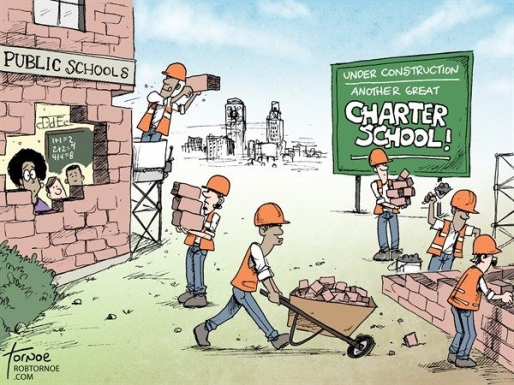
charter3


For many Americans it is becoming increasingly clear that the people behind current education “reforms” in the United States are purposefully attempting to sabotage the nation’s schools and deceive the public. Such is the story shared in a new book Common Core Dilemma by Mercedes Schneider and a documentary Education Inc coming out this August, by filmmaker Brian Malone. It’s a tale that was told last year by Diane Ravitch (see this excellent March 2014 Bill Moyer’s interview) and in Building the Machine: The Common Core Documentary. Here’s a summary of the fraud that is being perpetrated, a Letter to the Editor which I wrote to a local New York state newspaper last March…
Fraud at the Heart of Current Education Reform
There’s a scene in the film Dead Poet’s Society, set in 1959, where Robin William’s character Mr. Keating asks his students to read from the introduction of a poetry textbook. The text describes a rating method by which one can measure and assess the greatness of poems. After charting and rating a poem on the blackboard Keating tells his students this method of assessing poetry is “excrement.” Next he instructs them to rip the entire introduction out, which they proceed to do, putting the pages into a trash can.
ab16ee1eda360fe8a5836df4d760fa2a“This is a battle, a war, and the casualties could be your hearts and souls,” Keating tells his students. We can’t understand poetry by measuring it with numbers, by comparing and ranking poems. We don’t study poetry in order to get good grades. “We read and write poetry,” Keating says, “because we are members of the human race. And the human race is filled with passion.”
The film goes on to show how the students learn to express themselves creatively, to experience life more deeply as they come to appreciate how their lives are like verses of poetry. Both Williams and his character Keating encouraged all of us to live as poets, with gratitude and passion, to cherish the beauty of life, to appreciate our own uniqueness, and not to measure, rank or compare ourselves with others.
It’s an important life lesson, which unfortunately the architects of 21st Century school reform either do not understand, or do not care about. Since 2001, when George Bush’s “No Child Left Behind” policies were put into motion, we’ve experienced a nation-wide obsession with assessment, ranking, testing, measuring, and quantifying both students’ Fraud at the Heart of Current Education Reform | Creative by Nature:

Schools for Democracy – Deborah Meier | Creative by Nature

Schools for Democracy – Deborah Meier | Creative by Nature:


Schools for Democracy – Deborah Meier

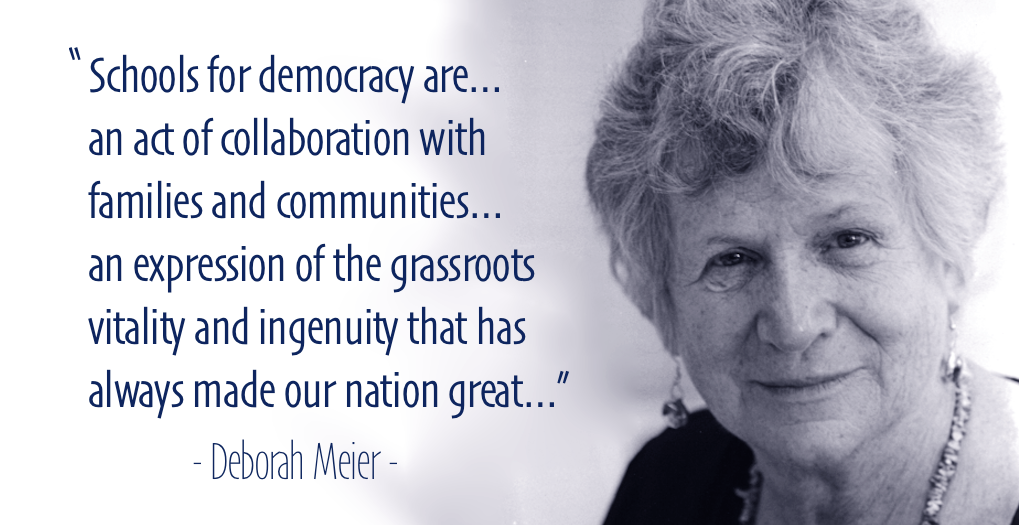
Deborah Democracy
I’d like to share some insightful observations from one of the “real” pioneers in education reform, Deborah Meier. In this presentation she made in Chicago, from 2006, Dr. Meier talks about how most of America’s schools function as authoritarian institutions, where democracy and collaboration are neither practiced, taught, experienced or modeled.
This is a huge failing of our nation, because in order for children to truly understand democracy they need real life opportunities to observe and apply it. Dr. Meier’s insights are aligned with the ideas of progressive educators such as John Dewey and Maria Montessori, as well as the research of Barbara Rogoff, and the theories of Lev Vygotsky, about the role of apprenticeship experiences, adult modeling and scaffolding with children’s learning.
In another presentation, she said:
“The motives of the drivers behind NCLB—which fixes in law our misplaced obsessions—vary, but between them they have helped create a climate that removes democracy from our schoolhouses. Folks like us who advocate a different kind of childhood are on occasion labeled elitist, failing to confront the gap between advantaged and disadvantaged that requires that we throw overboard the frills of childhood along with the frills of local democracy.
“The” poor need, our critics argue, something different—something more akin to a boot camp with a boot camp approach to intellectual skill and authority. And to this end, they say, we must cut out our romantic love affair with local democracy.”
I would argue that Dr. Meier’s ideas are not romantic, and that designing schools for democracy is an idea whose time has come. It’s also something that is backed up with real research evidence, and has already been successfully implemented in many places.
A few months ago, in the New York Times article Make Schools a Democracy, UC Berkeley Prof. David Kirp described how the Escuela Nueva (New School) model has been flourishing in thousands of Columbian and Latin American schools for decades:
“Escuela Nueva turns the schoolhouse into a laboratory for democracy. Rather than Schools for Democracy – Deborah Meier | Creative by Nature:

First Marylin Zuniga – Now Art and Humanities Classes – Cops Calling the Shots in Discourse at NJ Public Schools

Decarcerate The Garden State: First Marylin Zuniga – Now Art and Humanities Classes – Cops Calling the Shots in Discourse at NJ Public Schools:

First Marylin Zuniga – Now Art and Humanities Classes – Cops Calling the Shots in Discourse at NJ Public Schools


It started with the persecution of Marylin Zuniga.  She is the elementary school teacher whose students wanted to send get well cards to Mumia Abu Jamal, a former death row incarcerated man who was convicted in a sham trial over seen by a judge with proven racist beliefs.  Mumia Abu Jamal has been denied access to adequate health measures and has been subjected to medical and dietary neglect resulting in severe health deterioration.  Ms. Zuniga allowed some of the students to write cards out to Mumia as an after class work voluntary activity.

The Philadelphia Fraternal Order of Police, a scandal plagued organization whose members have been involved in police violencedrug related scandals and other corruption complained about it and the media broadcast the complaints resulting in a massive backlash agains Ms. Zuniga and ultimately to her being removed as a teacher – inspite of massive community protests in defense of her.

Now the stage is set in NJ – the police are getting to the point of calling the shots of what is acceptable discourse in the halls of NJ public high schools.  In at least two cases so far, police have intervened in attacking educators and high school students – one case an art class project and in the other case a humanitarian class project.  The pressure from the police is effective – both in intimidating administrators to the point of acquiescing to the police demands and also in creating a chilling effect where administrator, educators and students will likely think twice before freely expressing their views about the violence and impunity emanating from today’s policing.

First there was an art project at Westfield High School.  Students there expressed themselves artistically in pieces that were themed around the protest of the ongoing killing with impunity – 
throughout the USA as well as in NJ.  News report:


In this case the art was exhibited for a couple of days at an art show and police and media went haywire that students would dare to criticize police impunity.  By the time the superintendent responded the art show was over so no repressive measures were taken to censor the art.  A superintendent letter was issued attempting to clarify the situation – and contain the controversy:
 
I have to give the superintendent credit for tactfully rebuffing the attempts to attack the art exhibit – hopefully though it will not result in suppressing future free expression by students at Westfield High School.

The more recent flare up does not have such a result however.  In this case it was a humanities class in which posters addressed several sides of policing issues – including critical of police killings with impunity –on the hallway walls of the school.  Once again – cops – perhaps emboldened by Marylin Decarcerate The Garden State: First Marylin Zuniga – Now Art and Humanities Classes – Cops Calling the Shots in Discourse at NJ Public Schools: