Thursday, May 21, 2015

Teachers Under Siege: BATs Call on Federal Lawmakers to Demand Scientific Study on Teacher Stress Badass Teachers Association

Badass Teachers Association:

Teachers Under Siege:  BATs Call on Federal Lawmakers to Demand Scientific Study on Teacher Stress 


Teachers are under siege!  BATs initiated a study to be done on teacher stress by the AFT.  Our collaboration, the first of its kind, shows that a growing number of educators are under siege in this country.  Many are reporting high levels of bullying and stress.  Time to tell the United States Department of Education and National Institute of Occupational Safety and Health to conduct a scientific study on teacher stress and work environment.  Please demand that our lawmakers press them to do this and hold hearings on the outcome.

Here is the letter you can send and our link on Action Network to send a quick letter https://actionnetwork.org/letters/congress-demand-the-usdoe-and-nihos-study-teacher-stress?source=direct_link&referrer=badass-teachers-association

Dear Senator/Representative:
The Badass Teachers Association (BATs), an education activist group with over 55,000 members nationwide, respectfully asks you to tell the USDOE and National Institute of Occupational Safety and Health  to conduct a scientific study on teacher stress.  In May of 2014 BATs and the AFT collaborated in conducting a study on teacher stress and work environment that had astounding results.  Over 90,000 Teachers started the survey with over 30,000 completing.

 The initial results found that teachers are under siege and suffering.  Here are the base results: http://www.aft.org/sites/default/files/worklifesurveyresults2015.pdf 

We are asking you, our federal lawmakers, to please call Secretary Duncan and Dr. John Howard TODAY and demand they conduct a scientific study on this matter.   We also respectfully ask that when they do the study that Congress hold hearings regarding this epidemic! 
Badass Teachers Association:

Accountability? How Overseers Let Charters Off the Hook; $3.3 Billion Spent

Accountability? How Overseers Let Charters Off the Hook; $3.3 Billion Spent:

Accountability? How Overseers Let Charters Off the Hook; $3.3 Billion Spent


(Photo: Money in the garbage via Shutterstock)
Earlier in this special report series, CMD revealed how states that do not hold their charter schools and authorizers accountable have the upper hand when the US Department of Education (ED) evaluates applications to the quarter-billion-dollar-a-year charter schools program. But if the review process is deeply flawed, the oversight of the $3.3 billion disbursed within the charter schools program is not much better.
New Finding: Audits and Open Records Show Ongoing Lack of Accountability
A scathing 2012 audit from the ED Office of the Inspector General (OIG), and recent documents obtained through open records requests, show that when faced with the conflict between ED's pledges to hold the industry accountable, and the reality on the ground - the agency has often deferred entirely to the states.
Here are some details from the OIG audit and, as more recent documents obtained by CMD reveal infra, not much has changed.
  • California's SEA, as of 2013, had captured "very little information about the status, progress, or fiscal responsibilities of the monitored schools."
  • Additionally, the charter schools it was reviewing were chosen not based on whether the schools had problems or potential problems but "based on staff preference for geographic location."
  • More than half of the staff the California SEA assigned to review charters "were unqualified to conduct onsite monitoring of charter schools" (e.g., no fiscal monitoring experience).
Similarly, email communication from 2014 between the Charter School Office at the New York State Education Department and WestEd - a company contracted by ED to monitor how states implement federal charter school grants - reveals that the problem of biased school selection is endemic. Faced with a an on-site audit, the NY state officials recommended that WestEd visit six schools, not based on any suspected problems there, but because they were "logistically friendly from a travel perspective." WestEd accepted this rationale.
In the case of closed charters the lack of financial controls for federal dollars was absurd, as exposed by the 2012 OIG audit:
  • "In some cases, the closed schools received SEA grant funds without ever opening to students.
  • The school files had "no follow-up documentation for any of the 12 closed schools reviewed."
  • "No indication of what happened to any of the assets purchased with SEA grant funds."
  • "California was able to provide the status for only 5 of the 12 closed schools' assets."
Amid concerns that ED still cannot account for where the money goes when schools close down, the OIG will complete a "Nationwide Audit of Closed Charter Schools" in 2015.
Florida also "could not provide a reliable universe of charter schools that received SEA grants nor an accurate list of charter schools that received onsite monitoring, desk audits, or closed during the grant cycle." And, like Arizona and California, the state had "[l]imited ability to ensure authorizers were approving and granting charters to quality charter schools and providing adequate monitoring to them after the opened."
  • Florida "did not track how much SEA grant funds charter schools drew down and spent."
  • "All funds received by charter schools were [reported as] drawn down . . . which made it impossible to track funds received and spent" nor could DOE "trace funds between the Florida SEA Charter School Division's data and the Florida SEA Grant Management and Comptroller data."
  • Florida also could "not determine the SEA grant funds disbursed to closed charter schools."
  • "None of the schools files had information showing what happened to any assets the school purchased with the SEA grant or if any . . . grant expenditures needed to be returned."
In sum, investigating charter school funds awarded to SEAs in Arizona, California, and Florida, and then sub-granted to individual charter schools, the OIG discovered a nearly total lack of accountability: states, as well as individual charter schools, were free to flout federal regulations without fear of losing federal grant money.
In response, ED held a training suggesting possible courses of action for SEA if no Accountability? How Overseers Let Charters Off the Hook; $3.3 Billion Spent:

Why we should diversify the overwhelmingly white U.S. teaching force — and how - The Washington Post

Why we should diversify the overwhelmingly white U.S. teaching force — and how - The Washington Post:

Why we should diversify the overwhelmingly white U.S. teaching force — and how


Students have been shown to benefit from having a diversity of teachers, yet the vast majority of teachers in the United States are white and female. What can be done about this? Leslie T. Fenwick, dean of the Howard University School of Education and a former visiting scholar at Harvard University, takes up that question in this post. Her research examines education equity, school leadership and urban school reform. She is a contributing author to the best-selling book “The Last Word: The Best Controversy and Commentary in American Education.” This appeared in Diverse: Issues in Higher Education, and I am republishing it with permission.

By Leslie T. Fenwick
Nearly 75 percent of inner-city school teachers and 91 percent of urban school teachers are white, according to the National Center for Education Statistics. Is there anything that can or should be done about the tremendous demographic mismatch between the public school teaching force and student population?
Do we really believe what the Carnegie Forum on Education and the Economy proclaimed nearly 25 years ago, when it said the nation cannot tolerate a future in which white and minority children are confronted with almost exclusively white authority figures in their schools?
For the first time in history, the majority of the nation’s public school students are children of color. Today’s public school student is more likely to be African-American, Hispanic/Latino or Asian than White and less likely to speak English as a first language.
In fact, 50 percent of English as a Second Language (ESL) students are American citizens. Spanish, too, isn’t the only language ESL students are speaking — Chinese, Haitian Creole, Hmong, Vietnamese, Arabic and Somali are among the top 10 languages spoken in American schools. How this new Why we should diversify the overwhelmingly white U.S. teaching force — and how - The Washington Post:

Trust: The Foundation Of Student Achievement | Shanker Institute

Trust: The Foundation Of Student Achievement | Shanker Institute:

Trust: The Foundation Of Student Achievement


When sharing with me the results of some tests, my doctor once said, "You are a scientist, you know a single piece of data can't provide all the answers or suffice to make a diagnosis. We can't look at a single number in isolation, we need to look at all results in combination." Was my doctor suggesting that I ignore that piece of information we had? No. Was my doctor deemphasizing the result? No. He simply said that we needed additional evidence to make informed decisions. This is, of course, correct.
In education, however, it is frequently implied or even stated directly that the bottom line when it comes to school performance is student test scores, whereas any other outcomes, such as cooperation between staff or a supportive learning environment, are ultimately "soft" and, at best, of secondary importance. This test-based, individual-focused position is viewed as serious, rigorous, and data driven. Deviation from it -- e.g., equal emphasis on additional, systemic aspects of schools and the people in them -- is sometimes derided as an evidence-free mindset. Now, granted, few people are “purely” in one camp or the other. Most probably see themselves as pragmatists, and, as such, somewhere in between: Test scores are probably not all that matters, but since the rest seems so difficult to measure, we might as well focus on "hard data" and hope for the best.
Why this narrow focus on individual measures such as student test scores or teacher quality? I am sure there are many reasons but one is probably lack of familiarity with the growing research showing that we must go beyond the individual teacher and student and examine the social-organizational aspects of schools, which are associated (most likely causally) with student achievement. In other words, all the factors skeptics and pragmatists might think are a distraction and/or a luxury, are actually relevant for the one thing we all care about: Student achievement. Moreover, increasing focus on these factors might actually help us understand what’s really important: Not simply whether testing results went up or down, but why or why not.
For the past ten months we've been highlighting this body of research in “the social side of education”series. This has been an uphill battle for a variety of reasons: 1) the research in this area seems less likely to be picked up by the popular media; 2) the research is in a variety of different disciplines and employs different approaches within disciplines, which requires a lot of synthesizing work; and 3) in order to pay attention to this evidence (let alone be persuaded by it), a mind shift is necessary. We are so used to thinking about individual, rational actors who respond to incentives and disincentives that it's just hard to imagine anything else.
But there is some indication -- or at least I am hopeful -- that our collective ability to view school performance and improvement more broadly, and in a more complex way, is expanding. For one, many Trust: The Foundation Of Student Achievement | Shanker Institute:

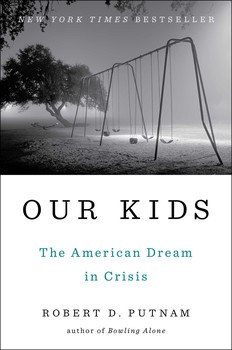
Robert Putnam's Our Kids and Reclaiming the American Dream | John Thompson

Robert Putnam's Our Kids and Reclaiming the American Dream | John Thompson:

Robert Putnam's Our Kids and Reclaiming the American Dream


Robert Putnam, in his seminal synthesis Bowling Alone, recalls the first two-thirds of the twentieth century when "a powerful tide bore Americans into ever deeper engagement in the life of their communities." In Our Kids, Putnam describes the 20th century boom that produced increases in both absolute and relative socio-economic mobility. The rich, the poor, and the middle class all benefited from the prosperity driven by industrial growth. The rising tide of the manufacturing economy raised all boats and, often, it raised the dinghies sailed by the poor more than the yachts.

Bowling Alone focused on the few decades preceding the 1990s when "silently, without warning -- that tide [toward deeper engagement in community life] reversed and we were overtaken by a treacherous rip current." Our Kids grounds the decline in social capital of America's poor in the decline of economic opportunity. It starts with Putnam's hometown in Ottawa County, Ohio where the industrial economy and economic mobility started to tremble and decline in the 1970s.
Ottawa County illustrates the devastation wrought by deindustrialization throughout the nation. Good-paying jobs started to disappear in the 1970s and, by 2012, real wages were down by an average of 16%. This spurred a population decline and placed extreme stresses on families and communities. The rise of single parent families made it more difficult to prepare young children for the education necessary in the post-industrial, global economy, and schools were not able to address the Adverse Childhood Experiences (ACEs) endured by children during hard times.
Putnam recognizes that Bowling Alone could be read as a part of the "declensionist" tradition and he warns against interpreting his work as "simple nostalgia." He writes, "The fifties and sixties were hardly a 'golden age,' especially for those Americans who were marginalized because of their race or gender or social class or sexual orientation. Segregation, by race legally and by gender socially, was the norm, and intolerance, though declining, was still disturbingly high." But, he makes the case that the self-assurance that comes with a sense of belonging helped in the battle against racism, sexism, and intolerance. 

Putnam observes:
We were a "can do" people, who accomplished whatever we set out to do. We had licked the Depression, turned the tide in World War II, and rebuilt Europe after the war. ... Freedom Summer was an audacious undertaking consistent with the exaggerated sense of importance and potency shared by the privileged members of America's postwar generation.
Moreover, Bowling Alone foreshadows a key theme in Our Kids by noting that "a well-connected individual in a poorly connected society is not as productive as a well-connected individual in a well-connected society." Putnam expands on this theme by documenting the divisive nature of the self-segregation of the last two decades.
One passage in Bowling Alone resonates for me because it recalled the special event when my elementary school principal took us to the junior high to watch a documentary. The real reason we need school, he added, was that in the future the work week would be 20 hours or less. We needed a great education so we could get the most out of new opportunities, be the most creative and fulfilled in our free time.
Putnam cites a 1958 University of Chicago study which "fretted that 'the most Robert Putnam's Our Kids and Reclaiming the American Dream | John Thompson:

Madison schools could be subject to takeover bill | Education - Channel3000.com

Madison schools could be subject to takeover bill | Education - Channel3000.com:

Madison schools could be subject to takeover bill

Milwaukee schools immediately qualify


MADISON, Wis. -

A sweeping proposal giving control of the lowest-performing schools in Milwaukee to a commissioner who could fire all the teachers and administrators might also apply to other large, racially diverse school districts in Wisconsin, including Madison.

The Legislature's Joint Finance Committee, around 1:30 a.m. Wednesday, approved the overhaul plan for Milwaukee. The so-called Opportunity Schools and Partnership Program requires three criteria to be met, and Milwaukee is the only district that would immediately qualify.
But Madison and Racine meet two of the three criteria and could be brought into the forced reorganization plan later.
One of the criteria is that a school district must receive the lowest rating on the most recent accountability report in two consecutive years. Madison Metropolitan School District Superintendent Jennifer Cheatham told News 3 Madison schools are currently meeting expectations and she doesn't believe the district would be subject to a takeover.
Under the Republican-backed proposal, an independent commissioner would be able to convert the three lowest-performing schools to private voucher or independent charter schools in the first year and then up to five more schools each of the following years.Madison schools could be subject to takeover bill | Education - Channel3000.com:

The financial crisis, as planned by the state, has become a political crisis in Newark | Bob Braun's Ledger

The financial crisis, as planned by the state, has become a political crisis in Newark | Bob Braun's Ledger:

The financial crisis, as planned by the state, has become a political crisis in Newark


Damage control for Christie and Anderson
They call it reform


The crisis is at hand. The decision by Cami Anderson, appointed by Gov. Chris Christie to run the Newark schools four years ago, to cut neighborhood school budgets by an additional five percent brings closer the day, predicted by a deputy state education commissioner, when the financial crisis becomes a “political crisis”–and the political crisis results in a decision to turn the entire district over to private hands.
Andy Smarick, the former deputy commissioner, indicated that was the state’s plan. It’s also the plan outlined by his then boss, Christopher Cerf, in his “School Turnaround Proposal” (Does that word ring a bell?), funded by the Broad Foundation that would create a special “achievement school district” in which all collective bargaining contract provisions would be suspended (Can’t do it, huh? Heard anything about the inviolability of pensions, lately? Public employees now live in a free-fire zone).
Smarick: Getting his political crisis
Anderson’s demand that every school in Newark cut their spending plans by anywhere from $200,000 to $700,000 meets  her needs–the further degradation of neighborhood schools that would allow further expansion of the privatized sector,  meeting the $70 million deficit she ran up through wasteful spending on favored consultants, hopeless legal cases costing hundreds of thousands of dollars, and the assignment of fully paid teachers to rubber rooms, and creating a pretext for the state’s approval of a seniority waiver that is still sitting on the desk of state education Commissioner David Hespe. If Hespe signs that waiver,  seniority The financial crisis, as planned by the state, has become a political crisis in Newark | Bob Braun's Ledger:

Kevin Johnson Truth? Who To Believe In Sacramento? SN&R or SacBee

Sacramento News & Review - Sacramento arena lawsuit unearths new emails, documents that suggest illegal collusion and gifts to the Kings - News - Local Stories - May 21, 2015:

Kevin Johnson Truth? Who To Believe In Sacramento? SN&R or SacBee


Sacramento arena lawsuit unearths new emails, documents that suggest illegal collusion and gifts to the Kings

Is there now proof that majority owner Vivek Ranadive asked city for $100 million in ‘sweeteners'?


Mayor Kevin Johnson and friends traveled to the Tribeca Film Festival last month for the premiere of the ESPN-produced documentary Down in the Valley, which recounts Team K.J.’s triumphant campaign to keep the Kings in Sacramento. For many, that is the only version of the Kings arena story that needs telling.

But a different story is spooling out in Sacramento Superior Court right now. Three Sacramento residents and their lawyers are suing the city, claiming Sacramento officials committed fraud by giving Kings investors as much as $100 million worth of “sweeteners,” including the rights to build digital billboards, and the city-owned parking garage beneath Downtown Plaza. The city gave these assets to ensure the team’s profitability, while never disclosing the real costs to the public.

In this version of the story, the mayor, the city and the Kings colluded to shift millions of dollars in costs away from NBA owners and onto taxpayers, without the public catching on.

The city of Sacramento’s attorneys call this story “salacious,” “slanderous” and a “work of fiction.” But emails and other documents submitted to the court show the Kings’ majority owner, Vivek Ranadive, did ask the city for millions in additional revenue, above and beyond the city’s contribution to the arena, because he felt he overpaid for the team. https://www.newsreview.com/sacramento/sacramento-arena-lawsuit-unearths-new/content?oid=17159293

Music to Listen to While Reading Cosmo Garvin:


Opinion: Sacramento suit against the arena is taking money from your wallet


For months, high-ranking Sacramento officials have been frustrated by the last remaining lawsuit blocking completion of the downtown arena.
Headed to trial on June 22, the lawsuit purports to be about saving taxpayers money – but it may actually cost city taxpayers as much as $80 million.
Filed two years ago, the suit alleges fraud in the way the arena was financed, and was brought by Sacramento residents Isaac Gonzalez, James Cathcart and Julian Camacho.
As The Bee’s Dale Kasler and Ryan Lillis wrote recently: “(The lawsuit) says the city’s contribution (to the arena) represents ‘a fraud on the public’ and a ‘waste of public funds.’ It says the city is giving the Kings a ‘secret subsidy’ worth tens of millions of dollars, making the total contribution, which includes several land parcels and other assets, worth far more than the officially stated $255 million.”
The fear among city officials has been that while this lawsuit dragged on, the city couldn’t issue bonds to pay for its share of the arena. If interest rates rise by 1 percent this summer, as some economists predict, it could increase the city’s debt load. That would mean Sacramento taxpayers would have to pay about $80 million extra in finance chargers over the 30 years to pay off the notes.
Sacramento City Treasurer Russ Fehr said Friday that delays are already preventing the city from saving millions of dollars in estimated arena costs.
“We have an opportunity right now to lock in this deal and sell the bonds at an interest rate that could cost the city millions less than the (financing) model we presented to the City Council last May,” Fehr said.
If he could take bonds to market now, Fehr said the city’s annual debt service could be cut from an estimated $22 million a year to between $17 million and $18 million.
With millions of dollars at stake – and no serious chance of stopping an arena already sprouting steel beams at the old Downtown Plaza site – some in the community have suggested a settlement of some kind.
Mind you: It’s not the Kings – the primary tenants of the arena – who would pay these guys to go away.
It would be Sacramento.
But perhaps a few million bucks of extortion for persistent litigants would be far less painful to Sacramento than paying an extra $80 million?
No way.
The city should call the bluff and go to trial.
This is about much more than just money.
Along with others, the plaintiffs in the fraud suit have been fighting the arena and losing for years. They say they are about democracy, but actually they are only about democracy they agree with.
These are the same people who last year joined the opposition to a change in the city charter that would have granted Mayor Kevin Johnson more authority if voters approved.http://www.sacbee.com/news/local/news-columns-blogs/marcos-breton/article18298874.html
Music to Listen to While Reading MARCOS BRETON:


Parent Trigger Testimony: A One-way Street to Private Control #SB14 | Cloaking Inequity

Parent Trigger Testimony: A One-way Street to Private Control #SB14 | Cloaking Inequity:

Parent Trigger Testimony: A One-way Street to Private Control #SB14

Screen Shot 2015-05-21 at 7.38.06 AM
Parent Trigger is a one-way street to non-democratic, private control of our public schools.
During the last round of Parent Trigger law attempts, I wrote about it in the posts Parent trigger laws: Wolves in sheep’s clothing and astroturfing and The Teat: Where does parent trigger movement get their $?
I flew to Texas Tuesday to testify at the Texas House of Representatives Public Education Committee against SB14— the latest Parent Trigger bill in Texas. I don’t recommend 5 a.m. flights two days in a row. I left for Texas on at 5 a.m. and returned to California the next day at 5 a.m. I still feel punch drunk.
I have included a YouTube video of the ~8 minute testimony below. The video also includes 4 questions (Reps Farney, Allen and Gonzales) from members of the House Public Education Committee after I completed my testimony. Here is a transcript:
My name is Julian Vasquez Heilig. I am a Professor of Education Policy and Leadership Studies at California State University Sacramento. Prior to being appointed as Professor at Cal State, I was on faculty in the College of Education at the University of Texas at Austin for 8 years.
I will publish my testimony on my education policy blog Cloaking Inequity.
I am testifying against SB14. I do not represent my institution on this bill.
My research studies have focused on a variety of issues including community-based reform and also market-based reforms.
The current research on parent trigger suggests that we should have major concerns about SB 14
SB14 is parent empowerment without the empowerment. Parental involvement without the involvement.
Why? Students and parents rights are actually more limited. Once the petition goes forward, the rights that are currently guaranteed to parents, students and teachers under the democratically defined education code are squelched. Under private control, parents and students no longer have guarantees on class size limits, disciplinary decisions, or qualified teachers among others.
As the Houston preacher just said, “parents deserve to have a say.”
Furthermore, as my real estate agent recently told me “Location!, Location!, Location!” I understand why there is great interest in parent trigger. Schools are sitting on very valuable parcels of land in Austin, in Houston, in Dallas.
It would be a coup for those shopping for real estate and facilities if just a few parents from any particular year are given the reins to easily transfer hundreds of millions of dollars in public assets. Let’s do some quick math.
Originally the SB14 Parent Trigger bill would have impacted more than 200 schools. Based on changes to the bill in the Senate, estimates that I have heard are that this would probably now impact 60 schools per year. Let’s estimate those schools are worth $3-5 million each in terms of property and buildings.
A few thousand parents could move $300 million in property resources out of the public space! Thus, Parent Trigger as written in SB14 is a one-way easy street.
My understanding from attorneys that I have talked to today is that it’s a grey area whether Texas could 
Parent Trigger Testimony: A One-way Street to Private Control #SB14 | Cloaking Inequity:


History remains battleground in American education as California university equates U.S. history with anthroplogy | Deseret News National

History remains battleground in American education as California university equates U.S. history with anthroplogy | Deseret News National:

History remains battleground in American education as California university equates U.S. history with anthroplogy


A state university in California has decided that anthropology can be substituted for U.S. history, raising the ire of at least one history professor, who thinks something vital is lost in the exchange.
Writing in a Sacramento Bee op-ed article, Joseph Palmero, a history professor at Sacramento State University, argues that U.S. history is a vital component in developing a competent citizenry.
"For most Sacramento State students, this 15-week G.E. requirement will be the only American history class they’ll take in their lives. Many of our students are the first in their families to attend college, so it can’t be assumed they’ve been exposed to U.S. history at home."
Palmero is not arguing that U.S. history should be airbrushed or gussied up. When he cites examples of what is lost by the switch, he focuses on iconic moments in American history that provide fodder for the left as well as the right.
"The new introductory 'history' course leaves out," Palmero writes, "among other things, the Progressive Era, World War I, women’s suffrage, the Great Depression, FDR, the New Deal, World War II, McCarthyism, the Cold War, the Korean War, the nuclear arms race, the Cuban Missile Crisis, the JFK assassination, Freedom Summer, the United Farm Workers Union, the Vietnam War, Stonewall, Watergate, Second Wave Feminism, the Iranian hostage crisis, the fall of the Berlin Wall, the Gulf War, globalization, the 9/11 attacks, and the wars in Afghanistan and Iraq."
The Sacramento State move echoes ongoing battles over what should be taught in U.S. history courses, rather than whether they should be taught at all.
Ongoing disputes center on the new American History AP course offered in public high schools, which critics argue paints the American legacy in an unduly harsh light. The new AP course was launched last year.
Earlier this month, Politico noted that "conservative groups have challenged the course across the country in a variety of localities and states, including North Carolina, Texas, South Carolina, Georgia and Colorado, where students in Jefferson County staged a walkout over what they saw as the local school board’s efforts to censor their curriculum."
Last summer, Newsweek quoted Larry S. Krieger, a recently retired AP history teacher from New Jersey, who looked at the new AP course framework and was appalled.
"As I read through the document, I saw a consistently negative view of American history that highlights oppressors and exploiters," Krieger said on a conference call reported by Newsweek.
Krieger used to start his AP classes with John Winthrop's "city on a hill" and would continue that theme through Abraham Lincoln and Martin Luther King.
"Instead of striving to build a city on a hill, according to the framework our nation's Founders are portrayed as bigots who 'developed a belief in white superiority' — that's a quote — that was in turn derived from 'a strong belief in British racial and cultural superiority' and that of course led to 'the creation of a rigid racial hierarchy.’ ”
Politico's report came as an Oklahoma lawmaker first proposed and then withdrew a bill that would have defunded the AP exam.

Read more at http://national.deseretnews.com/article/4542/History-remains-battleground-in-American-education-as-California-university-equates-US-history.html

L.A. school board seat is a pivotal purchase for charter school movement - LA Times

L.A. school board seat is a pivotal win for charter school movement - LA Times:

L.A. school board seat is a pivotal purchase for charter school movement


Supporters of charter schools won a groundbreaking election victory in Los Angeles this week, putting one of their leaders, for the first time, on the governing board of the nation's second-largest school system.

The triumph of charter school co-founder Ref Rodriguez gave leaders of that movement, once outsiders and competitors, a seat at the controls of the Los Angeles Unified School District. The win gives the district's 211 charter schools a key ally they never had before.

Rodriguez defeated one-term incumbent Bennett Kayser to win election to a school board post that represents areas north and east of downtown and the cities of southeast L.A. County.

The Kayser/Rodriguez contest became a high-cost, bitter proxy campaign between charter advocates and the teachers union, a face-off with implications well beyond Los Angeles.

Charter advocates spent more than $2 million to elect Rodriguez. The teachers union put more than $1 million behind Kayser. In three races Tuesday, outside groups spent more than $5million.

The charter group, in opposing the union-backed candidates, took on a role filled by then-Mayor Antonio Villaraigosa in past elections. Current Mayor Eric Garcetti has declined to be actively involved.

The outcome of races for the Board of Education fell short of a clean sweep for either side. In the west San Fernando Valley, incumbent Tamar Galatzan, who had the support of charter advocates and other well-funded groups, lost to challenger Scott Schmerelson, an ally of the teachers union.

In the third contest, board President Richard Vladovic won a third term; he avoided becoming a target of any powerful political action committees. He represents an area stretching from South Los Angeles to L.A. Harbor.

Rodriguez, 43, now is poised to be a voice on the seven-member board for charter operators and their clientele across the system — families who have left traditional or private schools to enroll their children in the free and publicly funded but independently operated campuses, most of which are nonunion.

"Ref understands just how hard it is to run a great public school serving a low-income community," said Jim Blew, president of StudentsFirst, a national group that frequently confronts teachers unions over education policy. "He's particularly sensitive to how hard it is to run a great public charter school in the hostile environment created by the L.A. school board."

No district in the nation has more charters, or more students enrolled in them, than L.A. Unified. About 15% of district students attend those campuses.

"We need high-quality options so that parents can choose what's in the best interests for their children," Rodriguez told supporters Tuesday night. "We need our schools to fit our young people, not the other way around."

That allusion to charters, before backers of those schools, was as close as Rodriguez came to carrying the flag for the movement. He spent more time talking about supporting teachers, a possible fence-mending gesture toward United Teachers Los Angeles.

Rodriguez's elevation has practical and symbolic implications, especially because Kayser had become the board's most unrelenting opponent of charters, routinely voting against starting new campuses or renewing operating agreements with existing ones.

Within his district, Kayser had opposed allowing charters to share space on traditional campuses — charters have a right to classroom space under state law.

"Charter schools will have a bigger voice on the board and someone with a vested interest in supporting the movement in general," said Sharon Weir, principal of New West Charter School, which has clashed with the district in the past. She "wholeheartedly" had encouraged parents to vote for Rodriguez.

The growing number of charters, along with the parents whose children attend them, provides a new and critical grass roots foundation. These enthusiasts include Gloria Soto, a 65-year-old grandmother who had worked in the 1990s to build support for construction of a high school downtown to relieve overcrowding.

Now three grandchildren are enrolled in a charter that she likes, one that Kayser was unable to keep from taking control of a newly built campus in Echo Park.

"I heard a lot of negative and positive about the charters and I believe the best thing is to give it a try and not just go by hearsay," she said.L.A. school board seat is a pivotal win for charter school movement - LA Times:


The Seattle teachers’ walkout in pictures | Seattle Education

The Seattle teachers’ walkout in pictures | Seattle Education:

The Seattle teachers’ walkout in pictures

17877501325_bdf6e36447_o
17691247039_ef0ed17707_o324671112