Thursday, May 7, 2015

Parent Opt-Out Movement: Engine of Common Core Unraveling? | Allison Hertog

Parent Opt-Out Movement: Engine of Common Core Unraveling? | Allison Hertog:

Parent Opt-Out Movement: Engine of Common Core Unraveling?


2015-05-06-1430947275-6668283-CommonCoreOpposition.jpg
You've probably heard about the thousands of parents all over the country who are "opting-out" of the new Common Core state tests. These tests are state and federally-mandated, but somehow breaking the law seems reasonable to a lot of otherwise law-abiding people. In many districts, such as in New York, Louisiana, Missouri andMassachusetts, parents have chosen to have their kids "sit and stare" instead of taking the tests. While their classmates take the test, all they can do is sit and stare at their desks. This seems pretty extreme when students have ostensibly been preparing for weeks, if not months, for these assessments, and the scores may not count against the student - at least for this year. How bad could they be? And where is all this fierce parental passion coming from?
The word I hear on the ground is that hatred of the new tests is nearly universal - whether that hatred results in a boycott is another matter. Mandated K-12 testing is not new to our country, but fierce parent opposition to it is. And though the testing of the No Child Left Behind Act was also considered "high-stakes," parents were at least initially very supportive of those state-developed tests and of their schools being held more accountable for educating their children.
The reasons for opting-out of the tests are nearly as diverse as the people of this country. Some, in Utah for instance, are opting-out because they see the new tests as commandeering their God-given right to direct their child's education. In New York, for example, many refusers align the tests with a "corporate takeover" of the public education system. Others, such as parents of struggling learners, simply object to holding their children to academic standards that they believe they can't, or haven't been taught to, meet.
I'm a Common Core supporter because I believe that U.S. students need to meet higher standards to compete on the global stage, but what's clear is that whatever the boycotter's rationale, there are many practical reasons for parents - and teachers - to dislike the tests. I would argue that most of those practical problems (e.g., teaching more complex curriculums, learning more advanced curriculums without adequate foundation, computer glitches, adapting the standards to disabled students) will be resolved in time.
The question of teacher support for the tests is more complicated. Teacher's unions have been obligated to support the Common Core outwardly but have covertly (and not so covertly as of late) urged some of the parental opposition against it because student performance is tied to teacher evaluations. But in the long run many parents and teachers may grow to support the Common Core. Parents, because they will see that their children are mastering more difficult skills, and will ultimately be able to qualify for better jobs. And teachers, because the curriculums are more interesting to teach - there's more hands-on learning and potential for creativity. Would they really want to return to "drill and kill"?
Sure, there will continue to be strong opposition to the Common Core in some quarters, but the fierceness of the opt-out movement in places like New York will hopefully be a temporary entry in the short history of parental civil disobedience. In the meantime, from where I sit more parents are fleeing to private schools with the hope of escaping the standards - whether they can afford to self-pay or they will come to support school vouchers in greater numbers.Parent Opt-Out Movement: Engine of Common Core Unraveling? | Allison Hertog:

'Don't Yelp Us!' Bro - Debate Over Teacher Evaluation Data Spawns a New Bad Idea

'Don't Yelp Us!' Debate Over Teacher Evaluation Data Spawns a New Bad Idea - NEA Today:

‘Don’t Yelp Us!’ Bro Debate Over Teacher Evaluation Data Spawns a New Bad Idea


releasing_teacher_evaluation_data


The debate surrounding teacher privacy, transparency and student test scores reemerged recently when a parent in Loudon County, VA, filed a lawsuit against state officials requesting the release of the state’s teacher evaluation data.
Brian Davison, a father of kindergarten and third-grade public school students, filed a Freedom of Information Act in March pressing for the disclosure of teacher ratings. Davison believes that parents need this data – which is based on student test scores – to determine whether their children’s educators are performing up to par.
The Virginia Education Association and state education officials are challenging the suit, arguing release of such information would present at best an incomplete picture of teacher effectiveness, violate privacy and needlessly damage reputations.
In 2011, Virginia began collecting student growth percentiles (SGP) from standardized test results to calculate student academic growth from year to year. However, the state passed a law in 2013 making “teacher performance indicators” confidential, finding that such data proved to be unreliable measures of teacher quality.
No single score can be considered an accurate measure of the learning that goes on in a classroom or an accurate assessment of the teacher in that classroom, explains Meg Gruber, president of the Virginia Education Association.
“There is no way that a number can sum up how effective someone is at reaching and teaching our students,” says Gruber “People are going to be blamed without any understanding of their context, their classroom, [or] their students. It would be like saying journalists are ineffective because newspaper circulation is going down or fewer people are watching the news.”
Creating Metrics on Educators
The controversy over releasing teacher evaluation data to the public initially broke out in 2010, when the Los Angeles Times published a database containing thousands of the city’s school district’s elementary school teachers’ names and their respective ratings. The data used English and math test scores to assess students’ academic progress and their teachers’ effectiveness. The newspaper’s decision was widely denounced, including by many who generally support the prominent use of value-added data in teacher evaluations.
Because of privacy issues and the incomplete picture of teacher performance it presents, very few states release teacher evaluation data to the public.
The push to release this data soon cooled off. Only in a handful of states, including Florida, New York, and Michigan do parents have access to teacher evaluations, and some states have recently passed legislation to prevent releasing data to the public. Arkansas and Indiana require schools to report teachers’ average performance while shielding individual identities.
Unfortunately, a nagging sense that parents are somehow being shortchanged by denying them a public arena for evaluating teachers persists. Recently, Yahoo! political blogger and former New York Timesreporter Matt Bai generated some buzz with a column titled, “A Yelp for Teachers.”
Bai uses the Virginia lawsuit as a springboard to argue that if districts won’t release evaluation data, then parents should have a place to create their own metrics.
“Let’s have a discussion about transparency about accountability …How is it that the business of teaching has somehow eluded the most ubiquitous and influential form of evaluation in modern America? I’m talking about customer feedback,” Bai writes.
Bai rips a couple of pages out of the education reformers’ playbook. His arguments tap into the persistent misperception that what’s good for the private sector must also be good for public education (“We review Amazon products, Uber drivers, sellers on Ebay, but about the only thing you can’t find online is which seventh-grade math teacher is best for your kid”) and he predictably resorts to hackneyed attacks on teacher unions (“defenders of the status quo”).
Peter Greene, a high school teacher in Pennsylvania, dissected the substance of the  proposal on his blog, exlaining the challenges of getting reliable data and pinpointing a problem that is already rampant in countless Yelp reviews:
“Voluntary participation would insure that the few who left comments would really mean what they said, but only teachers who evoked particularly strong feelings would elicit comments– twenty-five sets of parents from my class might say nothing because they think I do a fine regular old vanilla job, but the twenty-sixth parent, who’s angry about how Little Chris flunked for never doing work, might blow me up.”
Greene also points out that the quality of the  “product” isn’t known for years.  “‘Every high school teacher has stories of the kid who comes back years later to say, ‘Boy, at the time, I hated you and I hated your class. But I want to thank you because it turned out you were right to push me,'” he writes.
‘Just the Wrong Way to Go About It’
Educators are not opposed to accountability and feedback, says Prudence Plunkett, a 'Don't Yelp Us!' Debate Over Teacher Evaluation Data Spawns a New Bad Idea - NEA Today:

Part time Sacramento Mayor Kevin Johnson and Michelle Rhee invites Memphis to Charter UP with Stand Up - The Commercial Appeal

Charter advocate Stand Up invites Memphis to join - The Commercial Appeal:


Part time Sacramento Mayor Kevin Johnson and Michelle Rhee invites Memphis to Charter UP with  Stand Up 


 Stand Up for Great Schools, the pro-school choice network that challenges African-American “grass tip” leaders to take charge of their children’s education, held its first “policy summit” in Memphis Thursday.

The pro-charter school message at the Hamilton Eye Institute on the University of Tennessee campus was a spirited call to action from Sacramento Mayor (and former NBA player) Kevin Johnson and Roland Martin, national broadcast personality, as they spelled out what they think is wrong with the current state of public education.
“We are sitting here, defending, allowing and assisting the current system to disenfranchise our children, and we are accepting that as the status quo,” Martin said.
“We are so caught up in defending a building in our neighborhood, but no one is asking what is happening in that building,” he said.
Roland encouraged the audience to align with Republicans working to extend charter schools in the state, saying they don’t have to agree on all the issues but must start working with the power brokers that share their interest in charters.
“Either the issues and the kids matter, or your party matters,” Roland said. “You are going to have to pick your team.”
Johnson, who is married to the former Michelle Rhee, aligned himself with Stand Up’s mission in 2009.
The event included a panel discussion with Michelle (Rhee) Johnson, former chancellor of public schools in Washington; Eric Mahmoud, founder of Seed Academy & Harvest Preparatory School in Minneapolis; George Parker, former head of the teachers union in the Washington schools; and Connecticut state Rep. Charlie Stallworth.
Besides Sacramento, Stand Up is working in Tulsa, Oklahoma; Birmingham, Alabama; Nashville; and Atlanta to help community leaders exert control by running their own charter schools or taking charge in other ways.
“Now, we are in Memphis,” Kevin Johnson said. “We’ve been to each of those cities twice. Now you guys have to do something yourself. You have to create a steering committee, create an agenda and then get back to us so we can continue the conversation. These are our children all over the country.”
Stand Up said it invited 65 people to Thursday’s summit. About 50 were present, including former Memphis Schools Supt. Carol Johnson and Rev. Kenneth Whalum.
Mayor A C Wharton stopped in briefly.
Alexis Gwin-Miller, executive director of Momentum Edge Coaching and Consulting, said she had heard good things about Stand Up’s work in the other cities.
“We have to take the same kind of stand in Memphis. I think we have begun to tackle that in ways by looking at the real results of students from economically impoverished backgrounds in Memphis. Teachers need help. The students need help. The parents need help,” she said.
Memphis has more than 50 charter schools with a total enrollment in excess of 15,000 students. More than 95 percent are African-American.Charter advocate Stand Up invites Memphis to join - The Commercial Appeal:

Whistleblower: For-Profit Charter School Lied About Attendance To Get State Cash

Whistleblower: For-Profit Charter School Lied About Attendance To Get State Cash:

Whistleblower: For-Profit Charter School Lied About Attendance To Get State Cash


Another charter school scandal is in the news. And once again, GOP leaders who collect millions in campaign cash from failing charter schools are suspicious of the allegations but eager to go after the unidentified whistleblower who brought the matter to their attention.
In case you missed it, this scandal involves the Ohio Virtual Academy, a chronically poor performing online school.
The top Republican and top Democrat on the House Education Committee received the whistleblower’s tip that the school failed to dis-enroll hundreds of chronically truant students in order to pad its rolls. The amount of state money the school receives depends on the number of students it enrolls.
According the Ohio Associated Press, which broke the story:
Ohio Virtual Academy, which serves about 13,000 students statewide, said it follows all state reporting laws and enrollment guidelines.
Reps. Bill Hayes and Teresa Fedor, the House Education Committee’s top Republican and Democrat, told The Associated Press they have forwarded an anonymous whistleblower’s email to state Auditor Dave Yost, whose office has made school attendance fraud a priority.
Fedor wants the matter investigated AND wants the committee to hear from Dr. Richard Ross, Ohio’s top education official.
Hayes wants the matter investigated, doesn’t think the committee should hear from Ross AND asked the state to investigate the whistleblower, since disseminating private student data is a violation of federal law.
Last July, when a panel of teachers from Concept Charter Schools told the state school board of everything from test tampering to sexual misconduct in the classroom, some board members wanted the teachers to be investigated for failing to report the in-class groping games.  Concept Schools is another chain that does a magnificent job of collecting millions of public money but does an abysmal job of educating kids.
To help put this in perspective, let’s turn to a blog post by Steve Dyer, an attorney and former chair of the House Education Committee:
This is not a new occurrence in Ohio’s E-Schools. Ohio’s first E-School, the Electronic Classroom of Tomorrow (ECOT) — now the country’s largest for-profit school — was fined $1.7 million by State Auditor Jim Petro in 2001 after it couldn’t account for all the kids it claimed to be educating.
OHVA is run by the notorious K-12, Inc. — the nation’s largest operator of E-Schools, with schools in 33 states. However, OHVA is K-12’s biggest cash cow, accounting for at least 10% of its total revenue, according to the company’s SEC filings. The company recently lost its operating contract with its other cash cow — Pennsylvania’s Agora online school. So its dependence upon OHVA’s cash has only increased.
K-12’s Tennessee affiliate, Tennessee Virtual Academy has been shuttered by the previous state education commissioner, Kevin Huffman (Michelle Rhee’s ex-husband).  The decision was upheld by the following commissioner and the courts.
Back in Ohio, K-12 officials said they suspect opponents of charter schools are behind the new allegations.
That excuse is getting a little old.
In past 6 months or so, both pro-charter groups and long-time charter critics got on the same page.
In fact, last October, Greg Harris who heads pro-charter StudentsFirst Ohio, told the Columbus Dispatch:  “We think a lot of them (charters) need to be closed, because they’re not doing a good job. We think charters have a role in the education base, but we also think most of the charters in Ohio stink.”
They do stink, and one of the more vocal advocates for change has been Ohio Auditor David Yost. The central Ohio Republican has urged legislators debating reform legislation to adopt changes to better hold the e-schools accountable.
The whistleblower’s information has been forwarded to Yost – one of the few signs of hope.Whistleblower: For-Profit Charter School Lied About Attendance To Get State Cash:


Related Stories

  1. Athens School Board Member: Charter Schools Focus On Profit Not Students
  2. Auditor Report Reveals Ohio Is Paying Millions For Empty Charter School Seats
  3. Carney Confronts Yost On Horizon Charter School Scandal
  4. Will The Sun Ever Shine On Charter School Spending?
  5. Ohio Department of Education Threatens Action Against Charter School “Whistleblowers”

The One about Peter Cunningham, Education Post and Spin... - Badass Teachers Association

Badass Teachers Association:

The One about Peter Cunningham, Education Post and Spin...

BY:  Dr. Mitchell Robinson


John Oliver's recent takedown of standardized testing has met with near-universal praise, and deservedly so. It was a brilliant, thoughtful and bitingly funny analysis of the fatal flaws in the testing business, and was clearly based on extensive research and investigation. There has, however, been one lonely outpost of denial with respect to Mr. Oliver's piece: the intrepid externs at Education Post, and their fearless leader, Peter Cunningham.

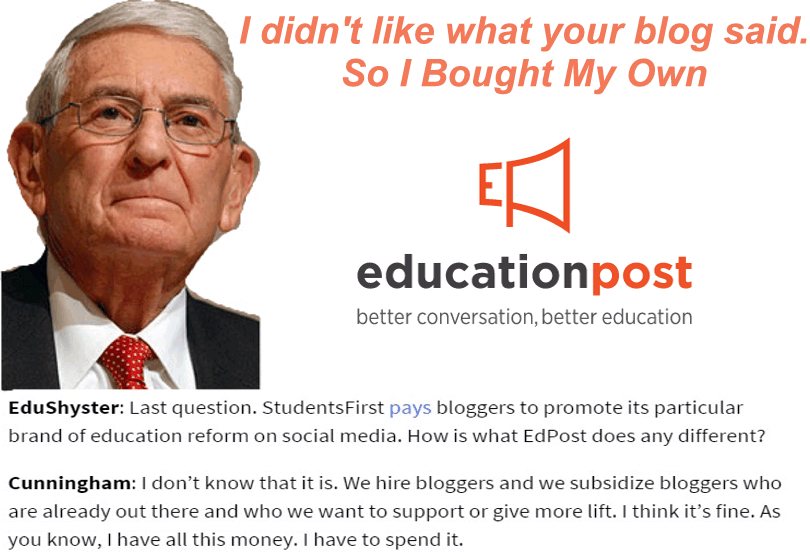
Mr. Cunningham is from the long lineage of education leaders who have no degrees in education, have never taught and have zero experience in education outside of decision making and check cashing. By last count, about $12 million of that, as he points out in a recentEduShyster interview:

Cunningham: We hire bloggers and we subsidize bloggers who are already out there and who we want to support or give more lift. I think it’s fine. As you know, I have all this money. I have to spend it.

Mr. Cunningham, using generous donations from the Broad and Walton foundations, among others, has attempted to carve himself a niche as a "reasonable reformer," advocating for a more civil dialogue around the issues he believes are at the core of the reform debate. His agenda is based on 3 "Issues" that form the core of his beliefs about education reform:

1. High Standards for All Students: Is my child learning what is needed to be successful?
Even if our kids are coming home with straight “A”s, how do we really know if they’re learning what they need to succeed in college, in career, and in life?  One teacher’s “A” could be another teacher’s “C”.
We need to have clear and consistent standards for what our kids should be learning.
That is the thinking behind the Common Core — a common set of high learning standards for kids.

As you can see, Mr. Cunningham is a big Common Core booster. He also seems to believe that standardized tests are the only way we will "know if they’re learning what they need to succeed in college, in career, and in life"--which makes sense if you remember that he never taught, so he must not be aware of portfolios, formative assessments, playing checks, demonstrations, essays, poems, term papers, quizzes, drawings, dances, improvisations, compositions, science experiments, interviews, observations, and hundreds of other assessment tools that tell us what students know and can do in rich, meaningful ways.

His essay flagellating Mr. Oliver also uses florid imagery (Oliver throws poor kids under the bus) to defend the Common Core and standardized tests under a cloak of faux-racist indignation, as though more and harder tests will provide the magic solution to lifting poor kids out of poverty. Mr. Cunningham also makes outlandish accusations that exaggerate his importance in the grand scheme of American education:

We know these things because we force the educational bureaucracy to test kids, publish results and take action. Until we demanded real accountability, many states, with a few exceptions, simply ignored these kids.

For a person who has never taught, and holds no elected office, that's a pretty gaudy resume. Mr. Cunningham seems to believe he has the power to "force" schools to test Badass Teachers Association:

Testimony by a mother who knows: The SBAC, graduation, “College and Career Ready” | Seattle Education

Testimony by a mother who knows: The SBAC, graduation, “College and Career Ready” | Seattle Education:


Testimony by a mother who knows: The SBAC, graduation, “College and Career Ready”

JON KRAUSE/NEWS ART
I am a high school math teacher and Richland School District parent. I’ve worked on the SBAC as a contractor for McGraw-Hill and on assessment committees for Washington State’s Office of Superintendent of Public Instruction (OSPI). I am a parent who understands the history of Washington state standards and assessments, and how we came to SBAC and the Common Core State Standards. There was a time that I supported the Common Core. I believe in accountability and rigor. But making a question harder is not rigor and closing the door to a child’s future is not accountability.
Our community’s future grows dark when our children can’t graduate. Without a diploma, they can’t enter the military, apply for trade jobs, and entry into community college or finding work becomes less likely. It’s easy to say “Not our kids” when we’re used to living in a community with an 80% graduation rate. But the probability of our children not graduating will increase with the SBAC. The SBAC designers have predicted an average failure rate of at least 60%. 60% of our children are going to be labeled as failing in school, at learning, and failing at their future before they even step out of high school. They will be labeled failing by a test that doesn’t actually assess what OSPI says it does.
While Pearson, Gates, and McGraw-Hill are draining billions of dollars from our public schools, they are giving us false promises that the SBAC will make our children “college and career ready”. The SBAC can’t do that. Recent studies have shown that even the SAT isn’t an accurate predictor of college readiness. High school students who have scored well on the SAT, but did poorly in high school, were more like to drop out of college than students who did well high school but struggled with testing. If the SAT can’t make these predictions, then neither can the SBAC.
The people who teach our children and live in our community do a far better job of Testimony by a mother who knows: The SBAC, graduation, “College and Career Ready” | Seattle Education:

Why My Charter School Needs a Union | EduShyster

Why My Charter School Needs a Union | EduShyster:

Why My Charter School Needs a Union


Urban Prep teacher Dave Woo says unionization can shine a light *into the dark unknown crevices of charter school management*…
By Dave Woo
Urban_Prep_EnglewoodWhy does my charter school need a union? In a word: accountability. After having worked at Chicago’s Urban Prep Charter Academy for six years, I have serious concerns about how resources are allocated by my own charter network. And my research into whether charter schools are truly public or private entities under the law has convinced me that these problems aren’t confined to schools like Urban Prep or Chicago’s UNO network. There are serious questions that need to be asked about the lack of accountability for charter school operators. Having a union at charters schools will force operators to think twice before doing anything that isn’t in the best interest of students.
Shining a light
When a majority of teachers and staff at Urban Prep decided to organize a union represented by the Chicago Alliance of Charter Teachers and Staff, one of the first actions we took was to file a FOIA request in order to get a better sense of how the Urban Prep network uses the tax dollars and private donations it receives. Here are some of the things we found:
  1. trump towerUrban Prep spends over a quarter of a million dollars a year renting out downtown office space across the street from the Trump International Hotel and Tower for the network administrative staff.
  2. Urban Prep spends $70,000 dollars every year to take all of its staff to St. Charles, IL (a far west suburb almost an hour away from Urban Prep’s closest campus) for a network retreat.
  3. Urban Prep pays its principals salaries that are comparable to the salaries Chicago Public Schools principals, but pays first year teachers  $10,000 less on average than what the average CPS teacher earns.
  4. Urban Prep pays Tim King $220,000 to run 3 schools while the CEO of CPS earns $250,000 to run a district of nearly 200 schools.
  5. Since January 2014, Urban Prep has paid just over $100,000 to public relations firms.
urban prep 2Raising questions
Although the FOIAs haven’t uncovered anything illegal, Urban Prep’s allocation of resources raises questions about whether this money is actually going to improve the education of students. Our decision to form a union at Urban Prep isn’t primarily about compensation. It is about asking Urban Prep why they choose to rent out a space downtown for their administrative offices, when they could use a fraction of their rent to provide better technology to teachers (many teachers have had to purchase their own technology resources or ask for donations from Urban Prep). It is about asking Urban Prep why their administrators deserve Why My Charter School Needs a Union | EduShyster:

What, Exactly, Are We Celebrating About Charter Schools? | Alternet

What, Exactly, Are We Celebrating About Charter Schools? | Alternet:

What, Exactly, Are We Celebrating About Charter Schools?

When Obama asks us to increase support for charter schools, he has missed the larger point.


In his proclamation for National Charter Schools Week, President Barack Obama asks us to accept a truth as yet unproven. He writes: “Today, our nation's very best charter schools are gateways to higher education and endless possibilities, lifting upstudents of all backgrounds and empowering them to achieve a brighter future.”
Obama is not the only one building the hype. Political praise for charter schools emanates from both sides of the aisle; nearly every conservative call for education reform extols charter schools, with said accolades usually accompanying calls for the holy grail of free-market thinking in the educational realm: more parental “choice.”
But no amount of proclaiming and rallying can upend the evidence, which is not good for the charter school camp. Considering that under Obama, the basic framework of education reform has hewn closely to the deeply flawedtemplate created by George W. Bush’s No Child Left Behind Act (and, arguably, raised the stakes even higher), perhaps we should use this week less for celebration and more to seriously consider the evidence. What, exactly, are we meant to celebrate about charter schools? What have they achieved?
Charter Advocacy Fails Against Evidence
For education reformers committed to market forces as a way to force public schools to improve, the initial focus was on vouchers that allowed parents to use public money to pay for private schools. During the Bush administration, however, researchers found that when controlling for student characteristics, private and public schools were mostly alike—both demonstratinga range of quality, the greatest factors being student characteristics.
Since the public has often resisted private-school vouchers, charter schools have become the next great hope that school choice will motivate public schools to reform. Yet in an analysis of charters conducted for the Shanker Institute, researcher Matthew Di Carlo has concluded that “there is nothing about ‘charterness’ that leads to strong results.” In other words, there is nothing about a school being identified as a charter school that excludes other types of schools (regular public, private) from adopting the same policies or practices; there is also nothing about a school operating as a charter school that specifically leads to success. (Take that as your first indication that charter advocacy is more about ideology than evidence-based reform.)
But if there’s nothing about the structure of charters that separates them from the pack, are we celebrating charter schools because of superior student achievement?
In my home state of South Carolina, the picture on student achievement in charters is much like it is in the rest of the U.S. Over a two-year analysis, I have compared SC charter schools with public schools with similar populations of students. Approximately 95% of those charter schools reflect student achievement about the same or worse than comparable public schools.
In other words, charter, public and private schools have about the same range of student outcomes. As Di Carlo stressed in his report, what we know to be true is that the type of school structure matters far less than what schools do and who the students are.
So if it’s not about school structure and it’s not about student achievement, are we celebrating charter schools for reversing the trend of re-segregation in U.S. public schools?
Sixty years after Brown v. Board, public schools across the country have become increasingly segregated by race and class. Few who seek education reform would argue against seeking policies that would counter that trend. Charter schools have demonstrably not met that need because they are significantly segregated—and charter schools also cause serious concern about selectivity, pushing out and under-serving marginalized student What, Exactly, Are We Celebrating About Charter Schools? | Alternet:

solidaridad: Rally against the cuts to Adult Education, Early Education, School Nurses, and Counselors

solidaridad: Rally against the cuts to Adult Education, Early Education, School Nurses, and Counselors:

Rally against the cuts to Adult Education, Early Education, School Nurses, and Counselors


Rally against the cuts to Adult Education, Early Education, School Nurses, and Counselors


All the Pieces Matter

Join us at LAUSD headquarters on Beaudry next Tuesday, May 12, for UTLA's "All the Pieces Matter!" rally against the RIFs.  Come together and show support for our students and Adult Education, and other programs being cut such as Early Education, and counselors. As educators, we are all an important piece in the fight for the Schools L.A. Students Deserve: Parent-enriched Early Education to K-12 to Adult Ed to every classroom to Health and Human Services.