Latest News and Comment from Education

Sunday, May 3, 2015

Karen Wolfe: Teachers! Turn Out for Bennett Kayser! | Diane Ravitch's blog

Karen Wolfe: Teachers! Turn Out for Bennett Kayser! | Diane Ravitch's blog:

Karen Wolfe: Teachers! Turn Out for Bennett Kayser!


 Karen Wolfe is a public school parent in Los Angeles:

She writes:
“Just like a rash of neighborhood robberies reminds us to double check that our doors are locked, Ref “Reformer” Rodriguez’s campaign to take the school board seat away from experienced educator Bennett Kayser reminds us how vulnerable we are.
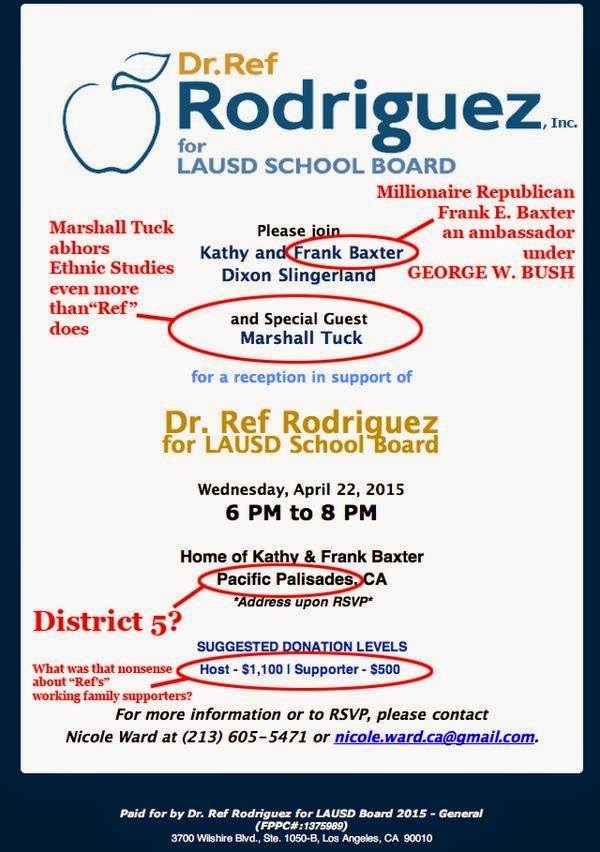
“One recent alarm came in the form of an invitation to a fundraiser at the home of Frank Baxter (supporter of charters since they were a twinkle in his eye, in the 1990s, and now co-chairman of the board of the Alliance charter management organization).
“The Special Guest was none other than Marshall Tuck, the recently defeated candidate for California Superintendent.
“Defeat is no obstacle for someone like Tuck. Sure, in addition to losing his election, he was left off the “really good list of ed reform leaders in LA :)” which LA School Report publisher Jamie Alter Lynton sent to her husband, Sony chief Michael Lynton. (Readers can see the whole list in the treasure trove of leaked Sony emails exposed on WikiLeaks.)
“So, at the Ref Rodriguez fundraiser, Marshall Tuck was the Special Guest.

“The suggested donations were $500-$1100 per person. Why stop at $1100? I thought the LA City Ethics Commission in January raised the campaign donation limit to $1300. Maybe supporters are purposely reserving $200 because it’s just enough for a trip to Walmart for campaign supplies–valet parking included. That’s what Students For Education Reform disclosed spending on April 13, working *independently* to defeat Bennett Kayser.
“Humor aside, it turns out $1100 is the donation limit, and $200 in receipts is not even a drop in the bucket to Walmart of course. The billionaire retailer is waging a war on labor unions and the quickest route is through public schools.
“No one has stood up more consistently for the school district’s union partners than Bennett Kayser. So where is the brotherhood and sisterhood as we fight to protect and restore our schools? As Bennett Kayser wages the campaign fight for his life?
“According to folks close to Kayser’s campaign, SEIU has stepped in. This is surprising to education activists who have been unnerved by SEIU’s advocacy for former superintendent Deasy and other privateers. Let’s hope they increase their support tremendously–immediately. But where are the teachers, for whom Bennett Kayser—a former classroom teacher—has been a steadfast supporter? While UTLA strongly backed Bennett Kayser in the primary campaign, their organization is invisible as we near the finish line.
“Bennett Kayser is being outspent by charters 9:1. But if every teacher that lives in Board District 5 brings in two votes, Bennett Kayser will win and, once again, people will win over corporate power. UTLA can provide the kind of support that can make a monumental difference. They need to do it today.
“The alarm is sounding for Bennett Kayser’s campaign.
“Anyone wishing to volunteer can contact 323-535-9930 and donations can be made at http://www.bennett2015.com/donate-online.html. Every single bit helps.”Karen Wolfe: Teachers! Turn Out for Bennett Kayser! | Diane Ravitch's blog:
Picture
Big Education Ape: How is CCSA’s Ref Rodriguez hiding his billionaire and ideologue contributors? http://bit.ly/1cad3tk
Big Education Ape: Nonprofit hopes $25,000 prize lures L.A. schools' District 5 voters - LA Times http://bit.ly/1cad9RV
Big Education Ape: Schools Matter: Is CNCA paying parents to support CCSA's Ref Rodriguez's LAUSD Board campaign? http://bit.ly/1HuWyDX
Big Education Ape: OMG: CCSA's Ref Rodriguez's PUC Lakeview Charter Academy Audit http://bit.ly/1DD60Pe

Big Education Ape: L.A. Unified delays release of audit on school with ties to candidate - LA Times http://bit.ly/1DKMhP2

Schools Matter: High School Charter Expansion in Memphis Assisted by Green Dot Exec on School Board

Schools Matter: High School Charter Expansion in Memphis Assisted by Green Dot Exec on School Board:

High School Charter Expansion in Memphis Assisted by Green Dot Exec on School Board


Yesterday the Commercial Appeal reported that the next corporate assault on Memphis public schools will be directed toward the hostile takeover of high schools next year.  Although the upper grades corporate charter chain, Green Dot, was not mentioned in the story, the California corporation is already advertising for instructional and admin positions in Memphis.  From current Green Dot ad for a finance and operations director in Memphis (my bolds):
The Green Dot Public Schools Tennessee Director of Finance & Operations will support up to 10 schools in Memphis as they are added into the Green Dot network.  For the 2015-2106 school year, the Director will be responsible for supporting two existing schools as well as 1-2 new schools for the 2016-2017 school year. He/she will partner with Green Dot’s National Expansion Growth Team, Green Dot National Departments, the Memphis Executive Director, and Home Office team members to set up processes and systems to support the operations and finances of Green Dot Tennessee schools. 
And why wouldn't Green Dot be confident of big growth opportunities in Memphis, especially since they have an executive, Miska Bibbs, serving their corporate agenda while also serving on the Shelby County School Board.  Last year the multi-tasking Ms. Bibbs chaperoned a group of Fairley parents and students to Los Angeles to see Green Dot in action. Photo below.  This year Green Dot has taken over Fairley.
No doubt this will be embarrassing enough that the SCS School Board will insist on Bibbs resigning her Green Dot post.  And why shouldn't she? She has already done her job and earned her keep.

Below is my posted comment on the Commercial Appeal story announcing big growth in high school charter operations in Memphis:

If we follow the mandate to change what's failing, there are a couple of things I would address before shutting more community schools and turning them over to corporate operators.  It's hard to say what would be first, but here goes:

1) Change the failed accountability system that has been used since 2002 to verify over and over that where poverty is high, test scores are low. If there were some remedy coming out of this truth that we have known for generations, that would be good. But there is not.

National studies show charter schools that replace public schools are no better at changing the stubborn fact that the poverty gap is, indeed, the test achievement gap, even though a great deal of attention goes to those charters that appear to have the miracle scores that would seem to defy reality. How do they do it? Let me point out which charters I am talking about:

a) those charters that receive extra money from investors looking for big tax breaks and bigger real estate deals;

b) those charters that are laser focused on test results to the detriment of healthy child development and intellectual growth;
c) those charters that issue total compliance contracts between families and schools that demand meeting expectations or else, which leads to massive de-selection of low performers and problem students who end up in the remaining public schools;
d) those charters that burn through, every two years, idealistic amateur non-teachers [seeGreen Dot ad here] who are fed up and exhausted by the time they learn to teach on the children of the poor;
e) those charters with fewer special education kids and English language learners;
f) those charters that abuse and humiliate children to grind out higher test scores that are used to build corporate charter brand names and add more school contracts;
g) those charters that spend 50 percent more time in schools constantly prepping for the next standardized tests;
h) those charters that impose cultural sterilization and brainwashing techniques that are presented as character training--techniques that no middle class parent would ever allow.

2) Change the way we attempt education reform. Rather than pretending that taxpayers should believe that corporate amateurs can get results that educational professionals cannot, let us move the focus from what happens inside the school building to what happens in our society, which includes the school. Schools, alone, either corporate or public, cannot alleviate the effects of poverty. As the great educator, Jean Anyon said, "Trying to Fix an Urban School without Fixing the Neighborhood in Which It is Embedded is Like Trying to Clean the Air on One Side of a Screen Door."

As long as we ignore the poverty, segregation, institutional racism, and lack of cultural, social, and economic opportunities in the communities where we expect miracle schools to defy 
Schools Matter: High School Charter Expansion in Memphis Assisted by Green Dot Exec on School Board:

CURMUDGUCATION: Edushyster: Peter Cunningham's Woes

CURMUDGUCATION: Edushyster: Peter Cunningham's Woes:

Edushyster: Peter Cunningham's Woes


I have now met Jennifer "Edushyster" Berkshire, and I totally get it. I don't believe there is a human being on the planet who, upon sitting down with her, would not want to answer every question just to prolong the conversation and once you're talking, well, lying to the woman would be like kicking a puppy.

So it makes perfect sense that just about anybody would be willing to talk to her, even if she is on the Pro-Public Education side of the fence.

She's just put up an interview with Peter Cunningham, the former Arne Duncan wordifier who now runs Education Post, a pro-reformster political war room style rapid response operation (I knew I'd moved up in the blogging world when they took the time to spank me personally). 

I don't imagine there are people who read this blog who do not also read Edushyster, but I'm going to keep linking/exhorting you to head over and check out this interview while I note a few of my own responses here.

There are a couple of eyebrow-raisers in the interview that really underline the differences between the reformsters and the pro-public ed side of these debates. In particular, Cunningham notes that many reformsters feel isolated and under attack. When explaining how Broad approached him about starting EP, Cunningham says

There was a broad feeling that the anti-reform community was very effective at piling on and that no one was organizing that on our side. 

Organized?! Organized!!?? It is possible that Broad et al have simply misdiagnosed their problem. Because I'm pretty sure that the pro-public ed advocate world, at least the part of it that I've seen, is not organized at all. But we believe what we are writing, so much so that the vast majority of us do it for free in our spare time (I am eating a bag lunch at my desk as I type this), and we pass on the things we read that we agree with. 

In fact, it occurs to me that contrary to what one might expect, we are the people using the Free Market version of distributing ideas-- we create, we put it out there, we let it sink or swim in the marketplace of ideas. Meanwhile, the reformsters try to mount some sort of Central Planning approach, where they pay people to come up with ideas, pay people to promote those ideas, pay people to write about those ideas, and try to buy the marketplace so that their products can be prominently displayed. 

It is the exact same mistake that they have brought to education reform-- the inability to distinguish between the appearance of success and actual success. If students look like they are succeeding (i.e. scoring high on tests they've been carefully prepped for), then they must be learning. If it looks like everybody is talking about our ideas (i.e. we bought lots of website space and hired cool writers and graphics), then we must be winning hearts and minds.

But what is Cunningham to do to save these poor beleaguered millionaires in their cushy offices (who are probably not eating a bag lunch at their desks as I type this-- isolated and alone in my classroom, I might add)?


I’ve created the ability to swarm, because everyone felt like they were being swarmed. We now have people who will, when asked, lean in on the debate, when people feel like they’re just under siege.


"Lean in" is a great way to put it. I've been "leaned in" upon. It just feels kind of mean, and definitely not like an attempt to create a better conversation. Which is, well, odd because I've actually had some certainly fine conversations with people on the other side of the edu-fence. It's really not impossible, or even difficult. 

Cunningham himself has proven capable of critiquing the reformster party line. But he's been hired to do a job, and he's doing it. Which is perhaps part of the problem.

Mind you, I'm not by any stretch of the imagination claiming that I am extra-noble or super-swell because I toil away in unfunded obscurity. There are people (Jennifer is one of them) who do this as their main gig and ought to be getting deservedly rich for it; the fact that I'm not doesn't make me a better person.

But it tells us something about the two sides of the fence that the separate pastures are fertilized with such different-- yeah, let's drop that analogy. It says something that if all the money evaporated from the pro-public ed movement, things wouldn't change much at all. But take away Gates money and Broad money and Walton money, and we wouldn't be having these conversations. Reform has consistently side-stepped both the democratic process and the marketplace of ideas, adopting instead the corporate boss model of, "I'm paying your salary. Do as I say." Since democracy and the market place of ideas started fighting back, reformsters have been trying to adapt. But it's hard. And lonely.

Cunningham notes that by 2012-2013, pro-public ed was "very effectively calling a lot of reform ideas into question." Well, not exactly. They were effectively pointing out that a lot of reform ideas were crap. Marketing and PR do not necessarily beat actual substance. But Cunningham is a man who's been given a giant pile of money to hire swarms and bloggers and a big, shiny website, so he's going to spend it. for at least two more years. Read the edushyster interview. CURMUDGUCATION: Edushyster: Peter Cunningham's Woes:

New study suggests Corporate Profits do significantly better in charter schools | Deseret News

New study suggests urban students do significantly better in charter schools | Deseret News:

New study suggests urban students do significantly better in charter schools


 Students in major urban centers around the country perform better in charter schools than they do in traditional public schools, according to a new study from the Center for Research on Education Outcomes at Stanford University.

The CREDO study found that charter schools in urban areas received “the equivalent of roughly 40 days of additional learning per year in math and 28 additional days of learning per year in reading," a substantial gain over their peers in traditional public schools.
Along with the results in math and reading scores, the study seems to dispel the notion that urban charter schools systematically pull in better-off students, but the numbers do vary significantly by region. The same is true of enrollment for English language learners, with some regions enrolling far more than their public school peers, and some far fewer.
The finding comes from a massive trove of data collected by CREDO, which looked at over 1.5 million charter school students. It also matches each charter student with a nearly identical "virtual twin" in a traditional public school.
This is the third such study conducted by CREDO. But the first two looked at charter schools nationwide, including rural and suburban schools. This one focused only on 41 urban centers.
The 2009 CREDO study found that charter schools actually performed slightly worse than traditional schools, while CREDO’s 2013 study found charters to be roughly equal.
But the CREDO study has left some researchers unimpressed, arguing that the actual differences shown in the data do not merit concluding that charters are performing better.


Explaining the data
Disputes over the meaning of complex numbers are a key part of the policy debate. Faced with standard deviations ranging from .05 to .3, how does a reader know which numbers are a big deal—and which might as well be zero?
Margaret Raymond, CREDO's director, says she is very conscious of the difficulty of explaining the data, and CREDO works over its reports obsessively to ensure maximum clarity and accessibility.
CREDO responds to that challenge in this case, in part, by “translating” standard deviations in “days of learning.” That is, rather than leave the reader guessing what the raw statistics say, they instead tell the reader that a given level of change in the study translates into extra days of schooling.
Using that metric, the CREDO report finds that urban charter students gain the equivalent of 40 days of math and 28 extra days of reading instruction over their virtual twins in a traditional public school.
Those are impressive gains. If CREDO has done that translation well, then the reader has something to hold on to.
But Andrew Maul, a UC Santa Barbara professor who specializes in measuring educational outcomes, questions the “days of learning” formula. Or, more precisely, he wonders what it is. The method for that calculation is not laid out in the report, he says, and he therefore cannot evaluate it.
Large or small?
Kevin Welner, director of the National Education Policy Center at the University of Colorado at Boulder, says he's impressed with the body of data CREDO collects, but he's cautious about drawing any conclusions.
Welner says that the results are “statistically significant,” which mainly reflects the large data set, but “practical significance” is another matter. And on the latter measures, he finds the results unimpressive. Welner argues that the data actually show what similar studies have shown in the past, namely that there is very little difference in effectiveness between charters and traditional public schools.
Looking at the raw data before that translation to “days of learning,” Maul said he doubts the effect sizes are truly newsworthy. He said that only six of the 41 regions in the CREDO study produced a standard deviation larger that 0.1 and only two were larger than 0.2.
“The very largest of these effect sizes, in Newark and Boston, may rise to the level of ‘small,’ ” Maul said, “and everything below that is ‘smaller than small,’ so basically trivial.”
But Raymond defends the effect sizes. “I call anything above .15 pretty dramatic,” she said, and she describes Boston and Newark, which range between .2 and .25 standard deviations, as “kicking it out of the park.”
Who funds whom?

When the data are too complicated to readily convey to the lay reader, as is the case here, there is a natural impulse to “follow the money.” Those who can’t be sure on the accuracy of a claim can at least weigh the motives of those who make it.
Raymond responded to the NEPC challenge, in part, by questioning the source. “The center in Colorado has a very specific objective in mind,” Raymond said. “They are paid, outright, by a set of organizations that have an interest in refuting anything that looks positive for charter schools.”
NEPC is heavily funded by the American Teachers Federation, Raymond said, which Kevin Welner denies.
Welner also said that he has never made an issue of CREDO’s funding, even though it is vulnerable. The CREDO research was supported by the Walton Family Foundation, created by the Walton family of Wal-Mart fame and a key financial player in the education wars in the side of school choice and charters.
Opponents of the "corporate reform" agenda often flag Walton money, on the assumption that they would not fund a neutral broker.
For her part, Raymond insists that Walton funding carries no strings for CREDO. The first study CREDO did, in 2009, was also funded by Walton, Raymond said, and the results were not friendly to charter school advocates.
“Our methods have not changed,” she said. “We let the data speak. We have been receiving funding from Walton for years, because they know they can never move us.”New study suggests urban students do significantly better in charter schools | Deseret News:

When the Governor Sneezes the Whole State Catches a Cold - Finding Common Ground - Education Week

When the Governor Sneezes the Whole State Catches a Cold - Finding Common Ground - Education Week:

When the Governor Sneezes the Whole State Catches a Cold


"Instead of being a means of educational improvement, standardized testing has become an obsession in itself." Sir Ken Robinson
It's been a year since I have been out of the role of principal in a public school system. Although I work with public schools in a new capacity, it's definitely been a challenge to let go of the role I held for many years. Maybe it was being in a great district, with an awesome staff and parents, or maybe it was the day-to-day interaction trying to engage students, but the role of the principal is one that never leaves you, even after you may leave it.
Unfortunately, that role is changing a great deal, especially in New York State where I spent 11 years as a teacher and the last 8 as a principal. A changing role is not a bad thing. After all, there is a lot of dialogue happening in articles, blogs and social media about whether principals should be called Lead Learner, Instructional Leader or some combination of both because there is an increased need for principals who will be heavily engaged in the learning happening in their schools.
Principals, teachers, students and parents working in partnership around the goal of learning.
However, the proposed changes in NY prevent principals from being instructional leaders, and has created a lot of noise which doesn't allow for leaders, teachers, students and parents to focus on learning, because they are too busy being consumed by high stakes testing. John Hattie, who I work with, speaks a lot about the Politics of Distraction. School stakeholders can't focus on learning because they are buried by the adult centered noise that surrounds them.
NY State is filled with politics and distractions...and parents are taking notice.
In fact, over 175,000 parents opted their children out from high stakes testing this year, which is up from 60,000 last year. There are numerous reasons why parents opted their children out, and I'm not going to get into it here, but we need to wake up and learn something from the opt out movement. 175,000 to 200,000 parents don't opt out because they are happy with the present system of high stakes testing.
When the Governor Sneezes...
Todd Whitaker said, "When the principal sneezes the whole school catches a cold," and unfortunately New York State education has gotten a cold because of the constant sneezes of Governor Andrew Cuomo. He wants the Annual Professional Performance Review (APPR) to tie 50% of a teacher's evaluation to high stakes testing, among other changes, and the whole state has been consumed by the cold...to the point it has become a flu. 
In January, Capital New York's Jessica Bakeman wrote,
Governor Andrew Cuomo wants to amend his signature teacher-evaluation system by increasing the reliance on student test scores, decreasing the importance of classroom observations and diminishing local school districts' ability to design components of the ratings system.
Bakeman went on to write,
"According to a book outlining Cuomo's policy and budget speech on Wednesday, the governor will propose a "simplified and standardized" evaluation system that rates teachers 50 percent on state test scores (or a comparable measure of student growth for teachers in subjects that are not tested) and 50 percent on observations."
In Creative Schools, Sir Ken Robinson writes, "When standardized tests are the primary factor in accountability, the temptation is to use the tests to define curriculum and focus instruction." This, of course, is something NYSED has done through the use of the Common Core modules. Robinson goes on to write,
"To be globally competitive, developed countries must offer something qualitatively different, that is, something that cannot be obtained at a lower cost in developing countries. And that something is certainly not great test scores in a few subjects of the so-called basic skills."
Where observations are concerned, we know they need work. They have not been outstanding in every school across the state, but there are many principals and teachers who have been working collaboratively on goals and better ways to engage students in learning over the past few years. Evidence based observations, which were part of proposed APPR changes a few years ago, have been taken seriously, and those should not be diminished for any reason.
The newly purposed changes also include having an outside evaluator to do at least one of the 2 or 3 observations done on teachers. It would be a better system if observations were done with teachers, but the outside evaluator option comes with many questions. How will this happen?
  • Does this mean someone from outside the building but inside the district will be included?
  • How does an outside evaluator begin the process?
  • Do they get to know the teacher and the class make-up?
  • Do they have teaching experience and understand the nuances of the teacher-student relationship?
  • Considering how important relationships are to maximizing growth in teacher observations, how will this person create ongoing relationships with teachers as opposed to being seen a compliance officer for the state education department?
  • Will this be an extra cost to districts that are already strapped because of a lack of funding and budget cuts? 
A few months ago the governor called the present evaluation system "baloney" which seemed odd because he was the one who directed that it be in place. If you live in NY, you have no doubt seen the commercials where Governor Cuomo talks about two different school systems, one for the rich and one for the poor. Has his present system changed that? We are all for equity within the public school system, and would love to know if any of that has changed.
Another commercial purports that the governor has cut down on testing. If 50% of an evaluation is tied to testing, how does that cut down on testing? Test prep will continue to explode in NY, which will make one particular publishing company very happy. I understand that state leaders will say that they are not forcing schools to do test prep, but we understand that test prep will become even more commonplace.
In the End
For the last few years, education in New York State has been a mess due to the changes that have been put in place, but instead of stepping back to see what works and what doesn't, it seems as though the Governor and others want to keep pushing forward although parents, teachers, students, leaders and researchers (like Robinson) argue that the changes are even more harmful, and opted out of high stakes testing in massive numbers.
We can't keep pushing forward with more harmful changes. Education in NY state can be so much better, but the politics of distraction are constantly getting in the way, and we're all a little tired of the sneezing from the top. 

Weingarten regrets supporting Cuomo's running mate | Capital New York

Weingarten regrets supporting Cuomo's running mate | Capital New York:

Weingarten regrets supporting Cuomo’s running mate


weingarten-regrets-supporting-cuomos-running-mate


 BUFFALO—American Federation of Teachers president Randi Weingarten regrets campaigning for Governor Andrew Cuomo's running mate in last year’s elections, she told Capital during a union convention on Saturday.

Weingarten, former president of New York City’s United Federation of Teachers, voiced a last-minute robocall supporting current lieutenant governor Hochul last September when the former Buffalo congresswoman faced what appeared to be a serious challenge from an anti-Cuomo insurgent candidate, Tim Wu, in the Democratic primary. (Wu, a Fordham University law professor, ran with Zephyr Teachout, whose surprisingly strong challenge to Cuomo led to an unflattering result for the governor.)
Weingarten’s push for Hochul drew some union members’ ire at the time, but Cuomo's relationship with the state's teachers unions has gotten even worse since then, as he has pushed for more stringent evaluations.
“Look, Kathy Hochul as a congresswoman was a terrific congresswoman,” Weingarten said, after addressing more than 2,000 New York State United Teachers members who gathered in Buffalo for their annual convention. “And on balance, she would have been, and she should be, a terrific lieutenant governor. But what’s happened is that actions speak louder than words.

MORE ON CAPITAL

“In seeing what we’ve seen, I’m really disappointed, and I regret what she’s done, and I regret actually making it clear that she was terrific beforehand,” Weingarten said, when asked directly whether she regretted doing the robocall.
“Now, you know, I believe in redemption,” she continued. “And ultimately, at the end the day, the way schools move forward is by collaboration. ... What tends to happen, and we see this after strikes, and we see this after big fights—what tends to happen is the great Weingarten regrets supporting Cuomo's running mate | Capital New York:

Why the movement to opt out of Common Core tests is a big deal - The Washington Post

Why the movement to opt out of Common Core tests is a big deal - The Washington Post:

Why the movement to opt out of Common Core tests is a big deal


The movement among parents to refuse to allow their children to take Common Core-aligned standardized tests has been growing in a number of states, as recent Answer Sheet posts have chronicled (here and here, for example). As opt-out numbers have grown, so too has reaction from officials who argue that frequent testing is valuable and that school districts could loss federal funds if too many students refuse to take the test (a threat that appears to be based on shaky ground.) Though testing supporters have attempted to minimize the importance and impact of the opt-out movement, it is having a big impact, as explained in the following post by award-winning New York Principal Carol Burris.
Burris, of South Side High School in Rockville Centre, was named New York’s 2013 High School Principal of the Year by the School Administrators Association of New York and the National Association of Secondary School Principals. In 2010, she was selected as the 2010 New York State Outstanding Educator by the School Administrators Association of New York State. She has written several books, numerous articles and many posts on this blog about the seriously botched implementation of school reform in her state — including the Common Core standards and the implementation of high-stakes Core-aligned exams — and about the misuse and abuse of high-stakes standardized tests. She recently announced that she had decided to retire early and to advocate for public education in new ways.

By Carol Burris
New York opt-out is reverberating around the nation. The pushback against the Common Core exams caught fans of high-stakes testing off guard, with estimates of New York test refusals now exceeding 200,000.
It was evident that the state would be far below the 95 percent federal participation rate as soon as the 3-8 English Language Arts tests began. When math testing started, the numbers climbed higher still. In the Brentwood School District, a 49 percent opt-out rate for ELA rose to 57 percent during math tests. These rates defy the stereotype that the movement is a rebellion of petulant “white suburban moms.” Ninety-one percent of Brentwood students are black or Latino, and 81 percent are economically disadvantaged. Brentwood is not unique–Amityville (90 percent black or Latino, 77 percent economically disadvantaged) had an opt-out rate of 36.4 percent; Greenport (49 percent black or Latino, 56 percent economically disadvantaged) had an opt-out rate that exceeded 61 percent; and South Country opt outs (50 percent black or Latino and 51 percent economically disadvantaged) exceeded 64 percent. New York’s rejection of the Common Core tests crosses geographical, socio-economic and racial lines.
There are also reports that student opt-outs were suppressed by administrators in some districts, who called in non-English speaking parents and pressured them to rescind their opt-out letters. Parent activist Jeanette Deutermann states that she “was contacted by dozens of NYC teachers who were horrified by the scare tactics being used on parents in their schools, to coerce them into participating in this year’s assessments. Language barriers and the absence of a social media presence resulted in a lack of knowledge about their rights to refuse the test. Teachers reported that administrators exploited this language and information barrier, telling parents that their children would not be promoted if they refused, or that they simply had no right to refuse. This is blatant discrimination at best.”
Despite attempts to suppress opt out, refusal rates were over three times last year’s 60,000, and activist parents are already planning to increase numbers next year. The opt-out movement is spreading across the nation. PARCC opt out is taking off in ColoradoNew Jersey and California, especially among high-school students.
As the Refuse the Common Core Test movement grows, the three people Why the movement to opt out of Common Core tests is a big deal - The Washington Post:

Saturday, May 2, 2015

Out-of-state Dark Money seek to influence Tennessee's legislators | Local News | Times Free Press

Out-of-state interests seek to influence Tennessee's legislators | Local News | Times Free Press:

Out-of-state interests seek to influence Tennessee's legislators


 NASHVILLE -- Out-of-state interests have long sought to shape public policy in Tennessee, but some national organizations that are relative newcomers to the Volunteer State have added millions of dollars to the mix of political money and lobbying intended to achieve that influence.

The apparent increase in groups headquartered elsewhere trying to sway decision-making by legislators had limited success in the 109th General Assembly session, a Tennessee News Network review indicates.
But the outside interests are trying. In the session that ended last month, they engaged in controversial issues such as Gov. Bill Haslam's Insure Tennessee proposal and gun laws, all the way down to less-noticed matters such as experimental drugs and state subsidies to parents of children with specified disabilities.
Most prominent in enhanced spending are three national organizations that have dramatically expanded their Tennessee activity within the past three years:
* Americans for Prosperity, based in Arlington, Va., was founded and -- at least initially -- mostly funded by businessmen and philanthropist brothers David and Charles Koch with the proclaimed aim of advocating for free enterprise. AFP's Tennessee operation reported spending more than $1.1 million in Tennessee lobbying last year. AFP reported spending less than $10,000 in all prior reports filed with the Tennessee Ethics Commission since it became active within the state in 2012. AFP reported no explicitly political spending, but state Director Andrew Ogles says the lobbying report covers "educational" ads that sometimes criticized or supported legislative candidates.
* The American Federation for Children, based in Washington, D.C., advocates education reforms involving "school choice" for parents. The AFC's state organization reported spending between $75,000 and $150,000 on Tennessee lobbying in 2014 to the Ethics Commission and reported a total of $606,345 in political spending by the political action committee set up by its state affiliate, the Tennessee Federation for Children, to the state Registry of Election Finance during the 2014 election cycle, including 2013. The state PAC was launched in 2012.
* StudentsFirst, based in Sacramento, Calif., and founded by Michelle Rhee, a former District of Columbia school superintendent, also advocates expanded options for education, including school vouchers. The organization reported spending between $100,000 and $200,000 on lobbying in 2014 -- plus a $13,907 reception for legislators -- and reported spending of $573,917 within the state during the 2014 election cycle by its state PAC, which was launched in 2012. (Rhee was formerly married to Kevin Huffman, who served four years as Tennessee's education commissioner.)
These groups set up shop in Tennessee fairly recently and started building a "grass roots" network of state resident members, although much of their funding still comes from outside the state -- substantial chunks of money transferred from national headquarters in the case of StudentsFirst and AFC.
AFP made defeat of Insure Tennessee its top priority this year and claimed success on that front when the governor's bill died in committee. But a broad school voucher bill was a high priority for AFC and StudentsFirst, and AFP supports the idea as well -- and that bill failed for the third straight year.
AFP has also pushed for repeal of the state's Hall income tax and that didn't happen either, although lawmakers approved an increase in the exemption from the tax that will benefit senior citizens of modest income.
Americans for Prosperity does not disclose its sources of money, as permitted under its legal setup, or how that money is spent except for the lobbying expenditures, which Ogles says include "educational" and "issue advocacy" ads that often criticize a candidate or urge residents to contact legislators and express support for or opposition to a pending bill.
A long list
The groups join a long list of established special interests headquartered outside the state with varying ties to groups within the state.
"We've always had outside influence," said state House Speaker Beth Harwell. "When I started in the Legislature, sitting on the Education Committee, the AFL-CIO would be in the audience, the National Education Association would be in the audience ... and the American Civil Liberties Union has always had a presence here."
Harwell, first elected to the Legislature in 1988, says there once were no major lobbying opponents to such groups, prone to support Democrats.
"That day is over," she said. "Now business understands how important education is, and they are involved, too" through national groups as well as Tennessee business lobbyists.
But Harwell said legislators can be trusted to look to the interests of their constituents, not of the lobbyists.
The speaker referred to the national AFL-CIO being represented by its state affiliate, the Tennessee Labor Council, and other nationwide unions and the NEA being represented by its state affiliate, the Tennessee Education Association. While union political donations have decreased in Tennessee as Republicans gained dominance in the state, the TEA is still active -- reporting $350,130 in spending by its PAC in the 2014 election cycle and between $110,000 and $175,000 in lobbying expenditures.
The ACLU has not made political contributions to state legislators, and the Tennessee ACLU reported less than $10,000 in lobbying expenditures last year. But the ACLU made substantial contributions to a campaign committee opposing Amendment 1 to the state constitution in last year's election. The amendment, which cleared the way for legislation putting new restrictions on abortion rights, passed.
Other interest groups engaged in Tennessee range from the National Rifle Association, which has had considerable success in enacting gun rights legislation, to the U.S. Chamber of Commerce, which has taken to introducing a package of bills drafted at the national level each year that are distinct from the agenda of its state affiliate, the Tennessee Chamber of Commerce and Industry, and hiring its own lobbyists.
Last year, Haslam vetoed a U.S. Chamber-backed bill after determining it had the unintended consequence of reducing penalties for pollution. This year, the offending provision was deleted and the bill, designed to outlaw "flash mobs" in Tennessee, passed again -- with Haslam's signature expected.
The National Association of Realtors PAC last year made its first appearance in Tennessee legislative campaigns, with more than $200,000 in independent expenditures. Its state affiliate, the Tennessee Association of Realtors, made $118,000 in direct donations to legislative candidates.
Off in a category by itself is the American Legislative Exchange Council, which has various Tennessee legislators as members and attendees at twice-a-year ALEC conferences where they can collect "model bills" drafted in meetings with national business interests and bring them back for enactment as state laws. Critics contend the group amounts to the ultimate in secretive out-of-state influence for wealthy corporations, contrasting with the National Conference of State Legislatures, which presents itself as providing information without advocacy.
While not worried about the lobbying by out-of-state groups, Harwell said she is concerned that heavy spending on political attacks, funded by outside groups, is "out of hand" and a matter of considerable concern, but there's not much to be done about it based on U.S. Supreme Court campaign financing decisions.
"If I could put limits in place, I would," she said. "But the courts have spoken, and that's the way it is."
Defeat by spending
In last year's elections, at least two House incumbents were defeated after being targeted by six-figure spending by AFC and StudentsFirst, much of it on attack advertising. They were former Rep. Dennis "Coach" Roach, R-Rutledge, defeated in the GOP primary, and former Rep. Gloria Johnson, D-Knoxville, who lost in the general election. Other legislators attacked, on the other hand, survived -- although by narrow margins in some cases.
Veteran Tennessee political operative Tom Ingram sees nothing wrong with lobbying by out-of-state groups "unless the lobbyist is more interested in underwriting candidates than in educating legislators." But he denounced the "corrupting influence" of big money flowing into campaigns from outside interests.
Haslam, despite losing to AFP in a clash over Insure Tennessee, says he believes that loss was due to other factors and the impact of out-of-state policy efforts is "overstated," although one of those was Republican fear of being tied to "Obamacare" -- a theme AFP emphasized in its radio ads attacking Insure Tennessee.
The governor, responding to questions last week, also said he would defer to those who had been involved in state government longer than he on whether out-of-state influence is growing.
The Legislature's most senior member, Senate Finance Committee Chairman Randy McNally, R-Oak Ridge, said outside influence is growing. He said issue-advocacy groups are "now much more powerful Out-of-state interests seek to influence Tennessee's legislators | Local News | Times Free Press: