Latest News and Comment from Education

Sunday, April 26, 2015

Illinois Gov. Bruce Rauner Accuses Unions Of Manipulating Elections

Illinois Gov. Bruce Rauner Accuses Unions Of Manipulating Elections:

Illinois Gov. Bruce Rauner Accuses Unions Of Manipulating Elections


CHICAGO -- Illinois Gov. Bruce Rauner Saturday accused lawmakers who accept campaign contributions from public employee unions of engaging in a “conflict of interest,” railing against the influence of organized labor in determining state workers’ salaries and benefits. But Rauner dismissed questions about his own potential conflicts of interest: his acceptance of campaign contributions from executives at financial firms that manage state pension money.
“They are just taxpayers. They don’t do business [with the state],” Rauner told International Business Times.
In November, International Business Times reported Rauner accepted more than $140,000 worth of campaign contributions from executives at firms contracted to invest Illinois pension money. He has also accepted millions more from executives at other financial firms, which face state regulation and oversight.
The governor appoints members of the boards that oversee the state’s pension investments. Securities and Exchange Commission records show Rauner is still listed as holding a partnership stake in the financial firm GTCR. As governor, Rauner will now oversees two state retirement systems that have GTCR listed as managing Illinois pension money, state documents show.
In his speech at the Society of American Business Editors and Writers, Rauner cited a $6 billion budgetdeficit and $111 billion pension shortfall to label Illinois “the worst run state in America.” A former private equity executive who made his fortune, in part, from fees charged to institutional investors like public employee pension systems, Rauner specifically took aim squarely at teachers, firefighters, police officers and other public workers. He said: “The groups that make their money from government in Illinois have a lot of money, they have the taxpayers' money and they are using it against the taxpayers’ interest.”
He added: “When a government union leader can sit across the table from an elected official and say we will get you back into office. ... We will get you there give you X millions of dollars of our union dues to pay for your campaign and 5,000 of our members to work for your election, we will answer the phones and knock on doors for you, we will get you in office, and then after you get in the office, we will negotiate what our pension is going to be, what our work rules are going to be, what our healthcare is going to be -- it is a fundamental conflict of interest.”
Rauner also commented on proposals to raise taxes to fill Illinois’ budget shortfalls. He told the crowd some people have said to him: “Just put in a graduated income tax, just get wealthier people to pay more, get them to pay their fair share, and that will solve the problem. We will have the money and we will fix it. And I say no we won’t. That will not fix the problem.” The Huffington Post reported Rauner could reap a personal windfall from the expiration of an tax surcharge on income above $750,000.
Rauner declined to take any questions from reporters at the event, and his government staff members attempted to shield him from questions as he left the conference room, drawing jeers from assembled journalists at the conference. As he was exiting the room, IBTimes asked Rauner if it is a similar conflict of interest for him to have taken money from firms that either are regulated by or do business with the state. He said only it is not the same, but did not explain further.
In 2014, Rauner’s campaign raked in $67 million, including nearly $13.5 million from Citadel’s Ken Griffin, whose Chicago-based financial firm is overseen, in part, by state securities regulators. Rauner’s opponent, then-incumbent Pat Quinn, raised $30 million, with more than $6 million coming from public employee unions. Illinois Gov. Bruce Rauner Accuses Unions Of Manipulating Elections:


National experiment in school choice, market solutions produces inequity | Get Schooled

Opinion: National experiment in school choice, market solutions produces inequity | Get Schooled:

National experiment in school choice, market solutions produces inequity


An educational researcher once expressed skepticism to me that successful practices at one school could influence what occurs at a school down the road. ???????????????????The problem, he told me, is that education tends to be insular and best practices in one classroom seldom influence what occurs in the classroom next door, never mind classrooms miles away.
The price of our unwillingness to learn from the successes and mistakes of others?
Repeat failures. And it occurs on a broader scale as well.
For example, Georgia keeps looking to unproven practices to jump start its schools when Massachusetts offers a proven blueprint. That northeastern state leads the nation in academic performance and has done so by  investing in preschool and teacher quality, raising rigor and adopting and sticking to whole school reform plans.
Yet, Gov. Nathan Deal escorts a contingent of lawmakers to New Orleans to study school reform. The performance of low-income students in Louisiana remains far below what Massachusetts — and Gwinnett County for that matter — is achieving.
Why didn’t the governor go to Boston or Norcross if he wanted to see successful practices in action?
The United States also resists looking to other countries to learn what’s worked and what hasn’t.
The knee-jerk reaction to any international comparison is always the same: This is America and things are different here.  We dismiss Finland’s success with the flip statement that Finland’s secret is a country full of Finns, disregarding that nation’s comprehensive campaign to raise teacher quality.
We refuse to learn not only from successful reforms in other nations, but from failed ones, too.
In this essay, two education researchers focus on what we could learn from the country of Chile and its experimentation with market-based approaches to education.
The authors are Alfredo Gaete of Pontificia Universidad Catolica de Chile and Stephanie Jones of the University of Georgia.
By Alfredo Gaete and Stephanie Jones
Imagine a country that was once committed to quality public education, but began to treat that public good like a market economy with the introduction of charter schools and voucher systems.
Imagine that after a few years, most students in this country attended private schools and there was public funding for most of such schools, which must compete for that funding by improving their results. Imagine the state fostered this competition by publishing school rankings, so parents were informed of the results obtained by each institution.
Imagine, finally, that school owners were allowed to charge extra fees to parents, thereby rendering education a quite profitable business.
But let’s stop imagining, because this country already exists.
After a series of policies implemented from the 1980s onward, Chilean governments have managed to develop one of the most deregulated, market-oriented educational schemes in the world.
Inspired by the ideas of such neoliberal economists as Hayek and Friedman, the “Chilean experiment” was meant to prove that education can achieve its highest quality when its administration is handed over mainly to the private sector and, therefore, to the forces of the market.
How did they do this?
Basically by creating charter schools with a voucher system and a number of mechanisms for ensuring both the competition among them and the profitability of their business. In this scenario, the state has a subsidiary but still important role, namely, to introduce national standards and assess schools by virtue of them (in such a way that national rankings can be produced).
This accountability job, along with the provision of funding, is almost everything that was left to the Chilean state regarding education, in the hope that competition, marketing, and the like would lead the country to develop the best possible educational system.
So what happened? Here are some facts after about three decades of the “Chilean experiment” that, chillingly, has also been called the “Chilean Miracle” like the more recent U.S. “New Orleans Miracle.”
  • First, there is no clear evidence that students have significantly improved their performance on standardized tests, the preferred measurement used to assess schools within this scenario of the free market.
  • Second, there is now consensus among researchers that both the educational and the socioeconomic gaps have been increased. Chile is now a far more unequal society than it was before the privatization of education – and there is a clear correlation between family income and student achievement according to standardized testing and similar measures.
  • Third, studies have shown that schools serving the more underprivileged students have greater difficulties not only for responding competitively but also for innovating and improving school attractiveness in a way to acquire students and therefore funding.
  • Fourth, many schools are now investing more in marketing strategies than in actually improving their services.
  • Fifth, the accountability culture required by the market has yielded a teach-to-the-test schema that is progressively neglecting the variety and richness of more integral educational practices.
  • Sixth, some researchers believe that all this has negatively affected teachers’ professional autonomy, which in turn has triggered feelings of demoralization, anxiety, and in the end poor teaching practices inside schools and an unattractive profession from the outside.
  • Seventh, a general sense of frustration and dissatisfaction has arisen not only among school communities but actually in the great majority of the population. Indeed, the ‘Penguins Revolution’ – a secondary students’ revolt driven by complaints about the quality and equity of Chilean education – led to the most massive social protest movement in the country during the last 20 years.
So even though there still are advocates of the private model of education, especially among those who have profited from it, an immense majority of the Chilean society is now urging the government for radical, deep reforms in the educational system of the country.
Very recently, in fact, an announcement was made that public university would be free for students, paid for by a 24 percent tax on corporations.
The ‘Chilean Miracle’ – like the ‘New Orleans Miracle’ – it seems, is not a miracle of student growth, achievement, equity, and high quality education for all. Rather, it is a miracle that a once protected public good was finally exploited as a competitive private market where profit-seeking corporations could receive a greater and greater share of public tax dollars.
It is also a miracle that such profit-seeking private companies and corporations, including publishing giants that produce educational materials and tests, have managed to keep the target of accountability on teachers and schools and not on their own backs.
Their treasure trove of funding – state and federal tax monies – continues to flow even as their materials, technological innovations, products, services, and tests fail to provide positive results.
So we don’t have to guess what the result will be of the current “U.S. experiment” with competition-infused Opinion: National experiment in school choice, market solutions produces inequity | Get Schooled:


dmaxmj | Life, education, and politics, not necessarily in that order.

dmaxmj | Life, education, and politics, not necessarily in that order.:

A lobbyist for students


At the end of this intro is a rewrite, edited down in the neighborhood of a couple hundred words, of this original post. This shorter version appeared in the Cortland Standard on April 24th (page 6). Most important to me is that news media of all formats step up and begin to acknowledge that the “opt out” movement is more than a kerfuffle between a suddenly interested and active teachers’ union and an unpopular and self-interested governor. It is also more than helicopter parents that just don’t understand how good tests are for their children. While much is heard from leaders promoting value for struggling students in underfunded schools via tests, data and a building full of frightened and sad professional educators…many parents are now seeing the inconsistency, evasiveness, and dishonesty in leadership. “Opting out” is not just a fashionable trend. It was not driven by teachers afraid of accountability. It is a public declaration that citizens know they are being misled, that tests are neither truth or the answer. Tests should be the tool they once were-not a weapon of those with dollars in their pockets or dollar signs in their eyes. I like tests. I used to go and score state tests. I used to be able to use the information more efficiently to address student needs and make smart instructional decisions. My daughters are top scorers on these types of things, but that does not stamp a value on the school or their teachers. The misuse of these instructional tools by those with their own agenda in mind, the continued dismissal and disrespect of a profession by those not qualified to even enter the arena…these are the reasons my girls don’t “opt out”, they refuse.

Our leaders continue to defy research and evidence regarding the true needs of our students. Instead of providing more standardized funding and opportunity on the front end, they “opt out” of their responsibilities and hinge school reform on standardized outcomes on the back end-using state tests to enforce and evaluate the efforts of others. The tests and the corporations contracted to create them, meanwhile, are afforded more privacy, respect and protection than the students and teachers being subjected to them. While assessments can provide valuable information when educators are more involved, the current approach isn’t about that. Still, I am not a fan of “opting out”. Opting out is like saying “no thanks” to dessert, and doesn’t address “opting in” to the important stuff: collaborating with teachers, keeping track dmaxmj | Life, education, and politics, not necessarily in that order.:

Yes, To Be Clear, I Am Anti-Testing, Anti-Grading | the becoming radical

Yes, To Be Clear, I Am Anti-Testing, Anti-Grading | the becoming radical:

YES, TO BE CLEAR, I AM ANTI-TESTING, ANTI-GRADING

Since the early to mid-1990s, I have actively practiced and preached de-testing and de-grading as an educator.
So, to be clear and not as some ploy to be provocative or to slip into hyperbole, I am solidly anti-testing as well as anti-grading.
That stance is based on a very simple point of logic: Tests and grades have been central to formal education for over a century, and the stakes of those tests and grades have dramatically increased over the last three decades; yet, virtually no one is satisfied with our system or so-called “student achievement.”
In the colloquial parlance of my South, we cannot admit that weighing a pig doesn’t make it fatter.
However, virtually every time I speak publicly, write a public piece, or am interviewed by the media about testing and grades, I come against something like this from Jordan Shapiro:
If we consider standardized testing in schools, it is clear to me that many folks get caught up in the fire of the debate and lose the ability to see both sides of the story clearly. Those who take an extreme anti-testing position are well meaning. They want to protect children’s individuality. They want to shield them from unnecessary anxiety. They want to protect valuable learning time. They want to spare children the indignity of punching chads and filling in circles. And they want to empower young people by providing them with life-long experiential learning skills.
But some of these critics also seem to forget that those who advocate for measured accountability are also well meaning….
Ultimately, there’s no way for the Federal Department of Education to equitably serve the 50 million students who attend public schools in the United States without some sort of assessment data. But do the current tests provide meaningful data? The critics say no. The advocates point out that all data is ultimately incomplete, but that doesn’t make it worthless.
Typically, the reasonable position is that both sides have good and bad; as well, the final point always swing back to Yes, To Be Clear, I Am Anti-Testing, Anti-Grading | the becoming radical:

How Sweet It IS…to be Phalen Leadership Academy | gaylecosby

How Sweet It IS…to be Phalen Leadership Academy | gaylecosby:

How Sweet It IS…to be Phalen Leadership Academy


 2015-4-28 IPS_PLA_1321 Agreement

I just had to make you all aware of the sweetest deal in the history of sweet deals.  Next week IPS will be briefed (Tuesday night at 6pm) and vote (Thursday night at 6pm) on a contract with Phalen Academy to take over the operations of school 103, on Indy’s far east side.
For more history on how this deceptive deal came to pass, please see my previous blog post on the Innovation Network Process.
Let’s dissect this agreement, shall we?
What IPS provides: A free building, complete with water, sewer, electricity, heating and cooling, snow removal and lawn maintenance, factilities maintenance, security services,transportation.
IPS even throws in a few copier machines for good measure.
IPS also will provide the staffing and oversight for ALL SPECIAL EDUCATION and ENGLISH LANGUAGE LEARNER programs.
WHAT IPS PAYS:  This is where the contract gets a little murky for me.  If you are a mathmetician or a lawyer, and I’ve made a mistake reading the contract, please let me know.  Here is what I gathered from the document:
$635.91 PER MONTH, per student, payable on the first business day of each month (CONTRACT DOES NOT SPECIFY DURING THE SCHOOL YEAR, SO I’M ASSUMING 12 MONTHS PER YEAR) $7630.92 per student.  That is equivalent or more than the entire financial allotment per student that IPS would be receiving based on the funding formula.
PLUS:
A “FINANCIAL MANAGEMENT FEE” Which Begins at 10% of the Monthly Payment amount, then decreases by 1% each year following… So add $63.51 per student per month…
In case you didn’t think the deal could get any sweeter than that…
PLUS:
$175,000 “PREOPERATIONAL FUNDS” TO GET STARTED WITH!!
I’m beside myself. If we poured this many resources into ANY OF OUR schools, we’d all be passing the stupid tests.  What are we doing that mirrors this for our own teachers in our own buildings??
As always, if you have comments or questions – email me at gayle_cosby@yahoo.com
Thoughts are my own, not reflective of official district viewpoints…obviously.
If you’re as pissed as I am, come to the board meeting.  Sign up to be a delegate by calling 226-4418 (although we might have missed the deadline on this one, folks).How Sweet It IS…to be Phalen Leadership Academy | gaylecosby:

Thanks to Vincent Precht I got to Watch The NPE Conference Live and It was A Gas! #‎NPEChicago


Thank You Vincent Precht

itunes pic


California Father


I am a teacher, writer, filmmaker and live streamer. I have produced live stream events for United Opt Out featuring addresses by Diane Ravitch and Karen Lewis and am making a documentary, which includes interviews with Noam Chomsky, Jesse Hagopian and many others. Published in the New York Times, Seattle Review, TriQuarterly and elsewhere, I have written award winning short stories. I have been a public school teacher for 29 years. The biggest moments of my life were having a son and 40 years earlier meeting the Beatles.

Vincent Precht http://bit.ly/1GwPEPv
schoolhouselive.org


Vincent Precht http://bit.ly/1GwPEPv

Land Shark Alert: 'Odd couple' battles it out for senate seat - ContraCostaTimes.com

'Odd couple' battles it out for senate seat - ContraCostaTimes.com:

'Odd couple' battles it out for senate seat


 WALNUT CREEK -- It's hardly your typical political matchup -- pitting a missionary's daughter backed by Planned Parenthood and nearly every major Democratic lawmaker against a close confidant of Gov. Jerry Brown, who is counting on independents and Republicans to carry him to Sacramento.

The state Senate race between Assemblywoman Susan Bonilla, D-Concord, and Orinda Mayor Steve Glazer is a confrontation between Democratic moderates who have drifted in opposite directions and now champion causes that might have surprised their earliest supporters.

File: Assemblywoman Susan Bonilla, center, visits with campaign volunteers Doug Jones and Mary Jo Rossi at her campaign office in Concord, Calif., on
File: Assemblywoman Susan Bonilla, center, visits with campaign volunteers Doug Jones and Mary Jo Rossi at her campaign office in Concord, Calif., on Tuesday, March 17, 2015. (SUSAN TRIPP POLLARD)
It is also a battle between two of the most powerful interests in Sacramento -- organized labor and the Chamber of Commerce -- both of which see far more at stake in the May 19 special runoff election than merely who will represent much of Contra Costa County and the Tri-Valley region of Alameda County in the already strongly Democratic state Senate.

The seat was vacated last year when Mark DeSaulnier, D-Concord, was elected to Congress.

A Glazer victory, after he made headlines during his unsuccessful bid for Assembly last year by calling for the outlawing of BART strikes, could have statewide ramifications for the Democratic Party and its allies in organized labor, political analysts said.

"I think labor is one of the last trip wires the Democrats can't step over," said Richard Temple, a Republican consultant with the firm McNally Temple Associates. "If Glazer wins, this will tell other Democratic candidates that there may be a path that doesn't require them to have union support."

That path comes at a steep cost as voters inundated with a daily barrage of campaign mailers can attest. Glazer has benefited from nearly $2 million in independent expenditures from the Chamber of Commerce and Bill Bloomfield, a Republican-turned-independent Southern California millionaire who funds pro-business Democrats.

File: Mayor Steve Glazer chats with vendors at the Orinda Farmer’s Market in Orinda, Calif., on Saturday, April 4, 2015.
File: Mayor Steve Glazer chats with vendors at the Orinda Farmer's Market in Orinda, Calif., on Saturday, April 4, 2015. (Dan Honda)
Bonilla, who votes with the chamber about 40 percent of the time, has benefited from the nearly $1.5 million that union-supported committees have spent opposing Glazer. Bonilla has voted for every labor-backed bill since 2012, including legislation last year that required employers to provide paid sick leave.

With the advent of California's "top two" election system and the Republican Party's long decline, it's becoming increasingly common for labor and business to back different types of Democrats in politically moderate legislative districts.
What makes this runoff so closely watched is the degree to which Glazer, who finished first in last month's primary, has been willing to buck local Democratic leaders on union issues, especially 'Odd couple' battles it out for senate seat - ContraCostaTimes.com:

Susan Bonilla for Senate 2015

Susan Bonilla for Senate 2015:


Susan Bonilla for Senate 2015

photo.Susan_Bonilla.140x250
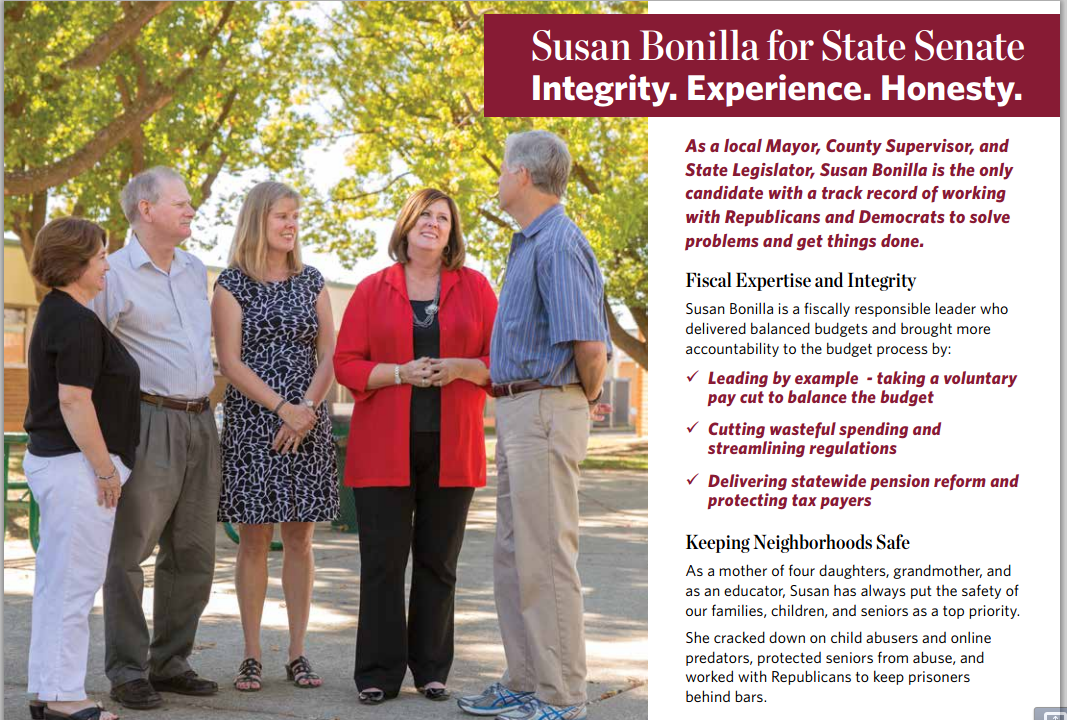
Assemblywoman Susan Bonilla is a former high school teacher, mayor and county supervisor, who has worked to strengthen neighborhood schools, protect public safety services, and support job growth and working families across the state.
Prior to her election to the State Assembly in 2010, Bonilla served as a Contra Costa County Supervisor and as the Mayor of Concord – the largest community in the State Senate District. While serving her local community, Bonilla built and expanded job-training programs and job creation efforts that successfully helped residents get back to work during the recession.
Additionally, Susan Bonilla authored Assembly Bill 484 – an important and revolutionary change to education policy. Signed by the Governor Brown in 2013, the law enables our schools to phrase out outdated STAR tests and prepare students and teachers for better assessments that reflect the real world knowledge needed in tomorrow’s job market.
Susan has provided steadfast leadership in protecting early childhood education programs, saving transitional kindergarten, which provides our youngest learners the foundations they will need to succeed.
Susan authored historic legislation that expanded health care access for women, created the highest safety standards for California industrial sites while protecting manufacturing jobs, and provided more tools for law enforcement to keep our communities safe.
As a member of Contra Costa County’s Board of Supervisors, Assemblywoman Bonilla created the Foster Youth Employment Program, providing youth in the county foster system job opportunities within the county structure. She also developed partnerships to open the Michael Chavez Center for Economic Opportunity to provide job training directly to residents within the Monument Corridor of Concord.
Prior to serving in public office, Susan was an English teacher in the Mt. Diablo Unified School District. She has a B.A. in English from Azusa Pacific University and teaching credentials from CSU Los Angeles. Susan resides in Concord with her husband, John. They have four daughters and three grandchildren.

Martin R. Castro, civil rights chairman, criticizes school districts not enrolling undocumented kids - Newsday

Martin R. Castro, civil rights chairman, criticizes school districts not enrolling undocumented kids - Newsday:

Civil Rights Commission Chairman Martin R. Castro criticizes schools not enrolling undocumented children

Martin R. Castro, chairman of the U.S. Commission
Martin R. Castro, chairman of the U.S. Commission on Civil Rights, in an undated photograph. Photo Credit: U.S. Commission on Civil Rights


CHICAGO - A top federal civil rights official criticized school districts Saturday who have been slow to enroll recent waves of undocumented refugee children from Central and South America.

Martin R. Castro, chairman of the U.S. Commission on Civil Rights, took aim at districts such as Hempstead.

“Every child, regardless of their immigration status…is entitled to a free public primary education and secondary education,” he said, citing a federal court case.

DATAPlacement of immigrant kidsSEE ALSORead the auditMORE COVERAGEOpinion and analysis: Hempstead School District

The Hempstead district, along with others across the country, has been accused by immigrant rights groups of failing to admit children who recently entered the United States illegally.

New York State has investigated and attorney general Eric Schneiderman reached a settlement with Hempstead schools. An independent monitor was hired earlier this month.

Hempstead schools officials have denied charges of discrimination. They have said the district lacked the space and resources to educate the influx of children.

Castro, speaking to business journalists here, said it was “a common misperception” that undocumented children aren’t entitled to a public school education.

He also said the children’s “due process rights” in the deportation process are being trampled upon.

Hearing notices aren’t being received and representation by attorneys is rare, leading to more deportations of children.

“Many of them have been deported,” Castro told the Society of American Business Editors and Writers convention. “Many of them are awaiting their hearing and while they are, one of the benefits they are entitled to is a free public education.”

He said the civil rights commission will tour immigration detention centers in Texas next week to investigate reports of sexual abuse of refugee children.

http://www.newsday.com/news/breaking/state-audit-reveals-questionable-financial-decisions-in-hempstead-school-district-1.9757933

SEE ALSORead the audit

How school reform stacks up against Grade 5 Common Core test standards. (Hint: not well.) - The Washington Post

How school reform stacks up against Grade 5 Common Core test standards. (Hint: not well.) - The Washington Post:

How school reform stacks up against Grade 5 Common Core test standards. (Hint: not well.)


Scott Levy is a parent of children with attend New York state public schools. From February 2014 through February 2015, he was a senior research fellow at the Harvard Kennedy School of Government, during which he analyzed the rollout of the federal Race to the Top program in in New York State. In the following post, Levy looks at the standards set for the fifth-grade math assessment aligned to the Common Core State Standards that students took over three days last week across New York. Then he uses them to evaluate just how well school reforms set by education policymakers in Albany stack up against those standards. Hint: Not so well.

By Scott Levy
More than 1 million students, including my fifth-grade daughter, just took the New York State Common Core Mathematics Test. But there’s something about state education policy that just does not add up. Shouldn’t we hold our politicians in Albany to the same standards that the state expects from my fifth-grader? Let’s measure Albany’s education reforms against the standards outlined in the New York State Educator Guide to the 2015 Grade 5 Math Test.
As one would expect, the Grade 5 Math Testing Rubric requires students to employ “mathematically sound procedures.” Ironically, many academics have expressed serious doubts about the type of statistical procedures the state utilizes to link test scores to teacher rankings. The American Statistical Association (ASA), whose mission is to promote “sound statistical practice to improve public policy,” has cautioned that “ranking teachers by their VAM (Value-Added Model) scores can have unintended consequences that reduce quality” and that “large standard errors make rankings unstable.” Furthermore, the ASA asserted “the lack of consistency among various methods using the same data alone raises concerns about the application of VAMs for high stakes decisions.” Yet Albany has upped the ante on high stakes testing, making it an overriding factor in the teacher evaluation process.
The exam also measures fifth-graders on their “ability to critique the arguments of others.” During an April 1st Capitol Pressroom interview, Gov. Andrew Cuomo was asked about the argument put forth by statisticians who believe that VAMs are unreliable. He responded, “That’s been seized upon because that’s what people have used to excite parents.” Is that response, devoid of substance on the statistical efficacy issue at hand, the Governor’s best defense? I don’t think New York parents are that naïve.
The Grade 5 Math Test is used to “assess student reasoning.” Unfortunately, the latest legislation in Albany does not pass the reasonable test. First, it has been widely documented that New York State managed the roll out of the Common Core and Race to the Top very poorly. The governor himself admitted, “Common Core’s implementation in New York has been flawed and mismanaged from the start.” Furthermore, parents across the state have pushed back on the use of high stakes tests, and many states across the country are reducing reliance on high stakes exams. So what did Albany decide to do? Despite the poor track record, New York’s 2015 budget shifts additional power to the state at the expense of local districts and amplifies the role of high stakes standardized testing. These actions defy logic and reason.
My fifth-grade daughter recently asked, “Dad, if we spend nine hours taking state tests, how come we can’t get them back so we can at least learn from our mistakes?” I wish I had an answer that passes the reasonable test. Regrettably, the current testing program prioritizes teacher evaluations above student learning.
The state exam asks fifth-graders to “apply their knowledge to the context.” But instead of applying their policy knowledge in the proper context, the state designed a “one size fits all” policy solution. The highest-performing public schools must implement the same changes as under-performing schools. Although certain charter schools were given flexibility to opt out of the state’s current teacher evaluation program, New York’s top public schools were denied the ability to do so. On a positive note, New York State Chancellor Merryl Tisch recently started a dialogue about providing more autonomy to highly successful public schools.
Another  fifth-grade test component is how to “represent and interpret data.” Albany can use remedial help in this regard. The state uses data to justify policy decisions, but its data has not always been accurate. Just recently, local districts found major discrepancies in a state report that measured the percentage of 2012 high school students still in college.
New York’s fifth-graders are expected to demonstrate “procedural fluency.” As parents understandably explored the pros and cons of having their children opt-out of state exams, they quickly discovered that the state could not fluently explain its own procedures. A message sent by a Westchester school district to families eloquently captured the situation, stating “we’ve been working with the state on a daily basis to get clarification on testing regulations. We’ve received vague and often contradictory responses.”
Lastly, it is required that a “student shows appropriate work” on the fifth-grade test. Don’t you wish we had the same level of transparency from Albany? Perhaps then we can understand how crucial reform policies that impact millions of children were embedded deep within the 2015 state budget.
It is clear from statewide protests and a growing opt-out movement that How school reform stacks up against Grade 5 Common Core test standards. (Hint: not well.) - The Washington Post:

Opinion: Why competitive model fails schools. No one should lose in education. | Get Schooled

Opinion: Why competitive model fails schools. No one should lose in education. | Get Schooled:

Why competitive model fails schools. No one should lose in education.


An academic essay by two education researchers published on this blog sparked discussion around the country and promoted strong responses, two of which I shared.
The authors of the piece comparing the school privatization program in Chile with what we are now seeing in the United States were Alfredo Gaete of Pontificia Universidad Catolica de Chile and Stephanie Jones of the University of Georgia.
The pair sent me a second essay that addresses some of the criticisms:
No hedBy Alfredo Gaete and Stephanie Jones
Newspaper editorials are not the ideal form for opening up complex problems, and yet they play a key role in informing the public and generating dialogue and ideas of what might be possible.
We wrote an essay that was criticized by institutions that support the privatization of education and the idea that an unregulated free market is the best way to organize a society, including the public education system.
We responded to one of the critiques and largely perceived the second critique as a public relations effort. The Cato Institute has published a second critique, however, and we wish to respond to that criticism here.
Both criticisms focused on one or both of the first two points, out of seven, that we made in our original essay about the results of Chilean market-based education reform after 30 years of implementation. We acknowledge these two statements could have been phrased more precisely – and we will do so here.
But before doing that we want to note that even if we cut off these two points from the list, there are still five points virtually untouched by the criticism we have received so far – and also that these five points alone are everything needed to raise serious doubts about the desirability and success of the market-based educational model in question.
We claimed that the following seven facts were helpful to assess “the Chilean experiment” (the last 3 decades of market oriented educational policy in Chile):
  • First, there is no clear evidence students have significantly improved their performance on standardized tests, the preferred measurement used to assess schools within this scenario of the free market.
  • Second, there is now consensus among researchers that both the educational and the socioeconomic gaps have been increased. Chile is now a far more unequal society than it was before the privatization of education – and there is a clear correlation between family income and student achievement according to standardized testing and similar measures.
  • Third, studies have shown that schools serving the more underprivileged students have greater difficulties not only for responding competitively but also for innovating and improving school attractiveness in a way to acquire students and therefore funding.
  • Fourth, many schools are now investing more in marketing strategies than in actually improving their services.
  • Fifth, the accountability culture required by the market has yielded a teach-to-the-test schema that is progressively neglecting the variety and richness of more integral educational practices.
  • Sixth, some researchers believe that all this has negatively affected teachers’ professional autonomy, which in turn has triggered feelings of demoralization, anxiety, and in the end poor teaching practices inside schools and an unattractive profession from the outside.
  • Seventh, a general sense of frustration and dissatisfaction has arisen not only among school communities but actually in the great majority of the population. Indeed, the ‘Penguins Revolution’ – a secondary students’ revolt driven by complaints about the quality and equity of Chilean education – led to the most massive social protest movement in the country during the last 20 years.
Now, regarding point one, we neglected to include up-to-date data showing that in fact there are some relevant gains both in PISA and SIMCE scores (the two measures invoked by our critics) during the last 10 years or so.
Yet, researchers (including Professor Elacqua, whose work was cited against our assertions) have reasons to believe – and our critics have neglected to report this in turn – that these gains are not due to the competition mechanisms of the market-oriented scheme, but rather to other factors such as, for instance, the implementation of the “Ley SEP,” a recent affirmative action legislation developed precisely to alleviate the inequalities of the scheme.
It is this same affirmative action legislation that may explain the improvements in the last decade that have been made on equality, especially regarding the academic achievement gap. So it would not be in order, we think, to invoke this progress as evidence of the alleged advantages of the privatization of education. Nor does this render false our second point, namely, that Chilean society is more unequal (both academically and economically) today than it was before the privatization of education and that the correlation between family income and student achievement is clear.
And finally, we regret to acknowledge that in our original essay we fell into the trap of highlighting and questioning test scores as part of our argument against the privatization of public education. The testing and accountability fetish being used to support privatization efforts is destroying the integrity of the teaching profession, engaging in what we consider child labor where children’s forced and repetitive work on test preparation and testing has financial benefits for adults and private companies, and diminishing what the word education means in practice and theory.
Regardless of the “miracles” claimed by proponents of competition and privatization efforts, it seems as though the dirty – and much more complex – truth comes out at some point. The Texas Miracle used to design No Child Left Behind was a case of cooking the books; the Atlanta Miracle included systemic cheating to save jobs and schools from being closed and educators are now sentenced to serve time behind bars; the New Orleans Miracle continues to be an embarrassment with the retraction of research reports indicating success and criticisms about bad data; and in 2013 there was confirmed test cheating in 37 states and Washington D.C., but surely it is more widespread than that given the high-stakes of the very tests that have been criticized for their bias, invalidity, very high cost, and damaging effects on what schooling has become.
Not everything is a competition, not everything should be designed as a competition, and education – especially – should not be treated as a competition where there are guaranteed winners and losers.
No one should lose in education.
Education is a public necessity that calls for collaboration; the sharing of resources, information and practices; and justice. It should be the job of a healthy state aiming for the common good, not a game for businesses with a focus on profits, losses, and hedging financial bets.Opinion: Why competitive model fails schools. No one should lose in education. | Get Schooled: