Latest News and Comment from Education

Wednesday, April 22, 2015

Sir Ken Robinson has a lot to say about U.S. school reform (it isn’t good) - The Washington Post

Sir Ken Robinson has a lot to say about U.S. school reform (it isn’t good) - The Washington Post:

Sir Ken Robinson has a lot to say about U.S. school reform (it isn’t good)


The previous post is an excerpt from a new book by Sir Ken Robinson and Lou Aronica, titled “Creative Schools: The Grassroots Revolution That’s Changing Education.” Changing education is what Robinson has been all about for some years, as a professor, author, and adviser to governments and numerous nonprofit organizations around the world. From 1985 to 1988, he was the director of an initiative to develop arts education in England and Wales that involved a few thousand teachers and artists. He served as the head of a national youth arts development agency in the United Kingdom called Artswork. Robinson was a professor of education at the University of Warwick for a dozen years, and in 1998, he was appointed by the British government to lead a commission to examine creativity and education. He has written several books on creativity and learning, and in 2003, Queen Elizabeth II of England knighted him for his life’s work.
Robinson became famous worldwide in 2006 with his Ted Talk “How Schools Kill Creativity,” which now has more than 32 million page views on the TED Web site, with millions more views on YouTube videos of the same talk. His life’s work has been based on the belief that schools can and should nurture creativity in kids through instruction that is personalized and customized for the communities where students live. I talked to Robinson (who, incidentally, is very funny) about his book and his views of U.S. education reform. Here are excerpts of that conversation:
Q: Tell me about the new book.
A: I’ve been concerned about education obviously for a long time now. A lot of people know me best, I should think, through the TED talks I started giving in 2006. I remember I was actually at an event at a university in the Midwest last year, in Michigan I think it was. And I was there to talk to all the students in the basketball stadium, and over lunch one of the faculty, as I mentioned in the [new] book, said to me, “You’ve been at this a long time, haven’t you?” And I said, “What?” He said, “Trying to change education. What is it? Seven years now?” Since the TED talks. I said: “Yes, I’ve been alive before that. I’ve been doing this a long time.”
I’ve been involved in education all my professional life, since my early ’20s, and I’ve done a lot with systems reforms, with governments, school districts, different countries. And it’s all been empowered by the same set of principles, which is reduced to the fact that I think our systems are outmoded. They make poor use of people’s talents. And we can’t afford that socially, culturally or economically anymore. We do need to think very differently about how we educate kids… Now people keep asking me this: Supposing we agree with that — and a lot of people do — then what do we do about it? This book is my summary of what I think the sort of education I am recommending looks like and how we can make that happen for more kids, for all kids.
Q: What kind of education are you talking about?
A: It’s to make education more personalized for students and more customized to the communities in which they are part of. The reason I say that is that education has become, over the past 20 years particularly, increasingly seen as kind of a strategic issue for governments. Years ago, countries didn’t pay much attention to what was happening in other countries in terms of education. People in France weren’t much interested in what was happening in Germany and Italy …. Nowadays people compare the systems like they are defense policies or economic policies, and it is because people all around the world recognize that education is absolutely fundamental to economic growth. In fact, it is fundamental to the social fabric, fundamental to cultural development and so on. And the interest in all of these things has been driven very hard by the publication of these Sir Ken Robinson has a lot to say about U.S. school reform (it isn’t good) - The Washington Post:

Marzano group takes issue with TNTP report criticizing Pasco schools | Tampa Bay Times

Marzano group takes issue with TNTP report criticizing Pasco schools | Tampa Bay Times:

Marzano group takes issue with TNTP report criticizing Pasco schools


 The group that supports Pasco County schools' teacher evaluations has issued a harsh rebuttal of TNTP's recent report criticizing the district's evaluation, training and hiring strategies.

Researchers for the Marzano Center blasted TNTP's methods, interpretations and findings in a 21-page document sent to the Gradebook on Tuesday. They suggest that TNTP failed to identify critical context, made inaccurate policy implications and relied on "factual errors and misleading misstatements." Moreover, the group noted that TNTP did not mention it is a competitor that could benefit from its recommendations.
(We did ask TNTP project managers about that potential conflict of interest at the time of the report. They acknowledged doing such work but said that was not the intent of their review.)
Overall, the Marzano group called the TNTP paper "highly imbalanced" and insufficient to support its "high-stakes claims":
Recommendations based on incomplete reports can cause harm in such high-stakes situations. Educational researchers should hold themselves to the highest standards—making sure that data reported are accurate, without flaws, and able to be replicated. Scientific researchers are under an obligation to provide readers with sufficient information to make informed decisions. These are ethical obligations scientists share with their colleagues in the scientific community, even when findings may contradict the ultimate aim of the organization. Researchers should operate under circumstances where it is their duty to report negative findings, even when doing so does not benefit the organization responsible for implementing the study. 
District officials said they had not yet read the report, having just received it
Superintendent Kurt Browning said he was not surprised by the Marzano response, "or that the response focuses on the part of the review that relates to their product."
"Pasco Schools views the TNTP report more broadly," Browning said. "We see it as a welcome review of what we are doing well and where we need to focus on improvement in teaching the standards and our collaborative professional learning communities; the alignment of our curriculum and assessments to the Florida Standards; and how we hire, evaluate, retain, and release teachers." 

There's more to be said about TNTP's Pasco schools study


There's a mini ed reform storm swirling in the Pasco County school district, as two prominent groups pushing differing teacher evaluation models take shots at one another.
Briefly, TNTP (founded by Michelle Rhee) issued a report (funded by the Gates Foundation)blasting Pasco's teacher hiring, training and evaluation system, created by the Marzano Center.
Next, Marzano (one of two state-approved evaluation providers) fired back, calling the TNTP review inaccurate and imbalanced.
Go figure, but TNTP didn't let that stand as the last word. Partner Andy Jacob took issue with Marzano's characterization of its work, and with the insinuation that TNTP might be seeking business as an offshoot of its time in the district. 
“Our analysis is intended to provide a snapshot of how well Pasco County Schools are transitioning to the new Florida Standards, not a study of any particular company’s products," Jacob  said in an email to the Gradebook. That’s why our report is rooted in the experiences and voices of thousands of educators from across the district.
"We stand by our assessment of the challenges teachers and principals are facing as they adjust to the new standards, and we’re glad it has started a conversation about how to better support them. As a non-profit, mission-driven organization, our sole interest is to help the district understand what it’s doing well—and how it can improve—so that every student in Pasco County graduates ready for success in college and life."
The dispute has amused some teachers and union leaders, who mused on Facebook that it looked like the reformers were about to start devouring each other. 
United School Employees of Pasco president Kenny Blankenship, meanwhile, sent a letter to superintendent Kurt Browning suggesting there was some good in the TNTP review, but adding that he had concerns similar to Marzano's. (That email came before he saw the Marzano rebuttal.)
"USEP has raised, during negotiations with the District, many of the same concerns that TNTP presented," Blankenship wrote to the superintendent. "In particular, we have brought up the impact of PLC meetings on teacher planning and the lack of resources and Florida standards aligned teaching materials. USEP has also raised concerns with Employee Relations about TNTP’s ties to Michelle Rhee which may color the resulting opinions and remedies that they would bring to the district."
He continued: 
We have questioned in the past, the Discovery Education program, which is out of line with the current Florida Standards, emphasizing rote memorization over critical analysis.
One major flaw that I find in the report is that TNTP only looked at a few grades and two subject areas; therefore the blanket statement about rigor is too broad a conclusion.
With only six schools and 100 classrooms studied, the usefulness of the report and subsequent conclusions is very limited. Much more thorough analysis is warranted before drawing such a broad conclusion about the totality of school district’s teaching practices.  
USEP has continuously advocated for better training, stronger curriculum, and more time to 

There's more to be said about TNTP's Pasco schools study

As Deal signs school takeover bill, signs from Michelle Rhee and Kevin Johnson that APS cluster may be target | Get Schooled

As Deal signs school takeover bill, signs from Michelle Rhee and Kevin Johnson that APS cluster may be target | Get Schooled:

As Deal signs school takeover bill, signs from Michelle Rhee and Kevin Johnson that APS cluster may be target


Gov. Nathan Deal should have signed his Opportunity School District legislation at a Morehouse College education forum this morning headlined by former NBA star and Sacramento Mayor Kevin Johnson and his wife and former Washington, D.C., Chancellor Michelle Rhee.
“This legislation is groundbreaking. It’s unheard of,’’ said Johnson, who acted as master of ceremonies while his more controversial wife limited her role to panelist.
Deal signed the legislation this afternoon at the Gold Dome, a more sedate setting than the Morehouse forum where fiery speeches and biblical references by Atlanta’s Rev. Gerald Durley and former CNN pundit Roland Martin lent a revival feel to the day.
In blasting critics of the black leaders in Georgia who backed Deal’s plan, Martin said, “Too many of us are apologizing for standing up for kids…We’re putting unions and civil rights groups in front of kids…We believe there is only one way to educate kids. I don’t care what way a child gets educated as long as they get educated.”
The program was sponsored by Johnson’s education advocacy group Stand Up and Rhee’s StudentsFirst. Morehouse President John S. Wilson introduced the pair by saying, “This is a power couple if I have ever seen one or known one.”
Rhee’s comments followed a pragmatic path, telling the 100 people in the audience they need to identify the failing schools in their communities eligible for takeover, study successful reform models including the charter schools her husband founded in Sacramento, St. Hope Public Schools, and then present a plan for their school.
“It is doable,” she told the crowd. “You don’t need more to do this than who is in here right now.”
In what ought to be considered a warning shot for APS Superintendent Meria Carstarphen, Rhee and Johnson cited the five elementary schools, two middle and one high school in Atlanta’s Carver cluster as ideal candidates for state takeover.
Flashing slides of the schools’ failing grades from the state Department of Education and the enrollment, Johnson said a takeover would help 4,690 APS students. “This is manageable,” he said, “Eight principals, 15 teachers at each school. This is not an unattainable goal and the Opportunity School District gives up an opportunity to do that.”
No one mentioned the extensive reforms already under way in the Carver cluster under Carstarphen, and whether ditching those to start anew with another plan would help or hurt, although I have to assume that question crossed the minds of APS school board chair Courtney English and board member Matt Westmoreland, both of whom were at the forum.
When Deal signed his bill, he issued this statement:
By signing the Opportunity School District bill, we are promising better days ahead for students trapped in failing schools. The power of positive change now rests in the hands of Georgia’s voters, and I know they share my belief that every child can learn and should have access to a high-quality education that prepares them for the workforce or for college.
There are currently 139 schools across Georgia that have received a failing grade from the state accountability system for at least three consecutive years. Too few of these students go on to higher education, too few attain job skills and too few get a high school diploma. Too often this leads to a life that never fulfills its potential. With this new system, we can and will do better.As Deal signs school takeover bill, signs from Michelle Rhee and Kevin Johnson that APS cluster may be target | Get Schooled:

The Money Pit: Charter schools event a $9M success | Page Six

Charter schools event a $9M success | Page Six:

Charter schools event a $9M success


Charter schools event a $9M success


Wall Street leaders and political power players gathered at Cipriani 42nd Street to raise over $9 million for New York’s Success Academy Charter Schools.
Hedge funders Dan Loeb, John Scully and Joel Greenblatt mingled Monday night with CongressmenKevin McCarthyGregory Meeks and Hakeem Jeffries, former city schools chancellor and current Amplify CEO Joel Klein and Brooklyn DA Ken Thompson.
The event, hosted by Success Academy founder and CEO Eva Moskowitz and honoring Edythe and Eli Broad who gave the first investment to SA, celebrated the academic success of scholars at the city’s largest network of charter schools.
But much of the talk was also about boldly standing up to opposition the charter school movement has faced from teachers unions, Mayor de Blasio and Schools Chancellor Carmen Fariña.
SA Network board chair Loeb told the crowd of nearly 800, “The politicians and union leaders seem to rationalize that in their fight to maintain centralized power and monopoly control, there is collateral damage to actual children.”
Talking about Harlem Central Middle School, recently ranked second in math in New York State: “It was this school, and several others that the mayor and the chancellor tried to shut down last year. The schools chancellor — whose primary mission is educating children — has dismissed results like these as a statistical aberration, using excuses that are at best uneducated falsehoods.”
Loeb added to laughs, “We hope Chancellor Fariña will hop on the train to make her first [Success Academy] visit soon — hell, I will even call her an Uber.”

Addressing a recent New York Times story that discussed SA’s so-called “polarizing tactics,” co-chair Campbell Brown told staff and supporters, “What is so amazing about the Success community is that you never stop trying and you have found a better way . . . And that is why you are a threat to a lot of people, to politicians and teachers-union bosses who have shamefully protected a broken system for decades now . . . You are a threat because you are demonstrating an alternative model, you are in their face every day showing everyone what public education can look like.”
The $9.3 million raised will fund six new schools serving 3,000 children.Charter schools event a $9M success | Page Six:

Nonprofit hopes $25,000 prize lures L.A. schools' District 5 voters - LA Times

Nonprofit hopes $25,000 prize lures L.A. schools' District 5 voters - LA Times:

Nonprofit hopes $25,000 prize lures L.A. schools' District 5 voters


Comment
"I just sent Antonio Gonzalez of the Southwest Voter Education Project the following email; 
Dear Mr. Gonzalez, 
District 7 also has a high percentage of Chicano voters and a Chicana, Lydia Gutierrez running for school board. Why no prize here? I'm going to vote and I can use $25,000 especially since I don't have a job. I used to be a school teacher in this district. 
According to the LA Times; 
"If overall turnout is higher, it's hard to say what the effect would be," said Dan Chang, (Broad "Academy" graduate) who directs a political action committee that has endorsed Rodriguez. "If there is higher turnout among Latinos, the conventional wisdom is that Ref Rodriguez will do better — a Latino candidate with a Latino surname." 
Chang, Rodriguez and Richard Vadovic, candidate for re-election in district 7, are supported by the same charter school cabal so why doesn't your organization put up an equivalent prize here? 
Sincerely, 
Michael Dominguez"


Nonprofit voter group has a plan to turn around traditionally abysmal turnout for a key election to the Los Angeles Board of Education: It's going to pay one lucky voter $25,000.
Those who cast ballots in the race for District 5 in the May 19 election will be entered in a drawing.
The idea is the brainchild of Southwest Voter Registration Education Project.
"This is an experiment, a nontraditional out-of-the-box strategy" because "participation has gotten so bad," said Antonio Gonzalez, president of the organization, which focuses on increasing voter turnout, especially within the Latino community.
The March primary for the school board drew marginal voter interest in a citywide election that also failed to attract much interest.
Three board races are going to a May runoff. Southwest Voter Registration is especially interested in District 5, because about 57% of registered voters there are Latino.
Challenger Ref Rodriguez finished first against incumbent Bennett Kayser, who is seeking a second term.
Voter turnout was just under 12% in the area, which includes Los Feliz and Silver Lake as well as an economically diverse range of Latino neighborhoods, including the cities of southeastern L.A. County.
The most notable dividing point between Kayser and Rodriguez is over independently managed charter schools, which are exempt from some rules that govern traditional campuses.
Kayser has tried to limit their growth; Rodriguez co-founded one of the largest charter organizations, People Uplifting Communities.
"If overall turnout is higher, it's hard to say what the effect would be," said Dan Chang, who directs a political action committee that has endorsed Rodriguez. "If there is higher turnout among Latinos, the conventional wisdom is that Ref Rodriguez will do better — a Latino candidate with a Latino surname."
Both campaigns pushed hard to win the Latino vote in the bitter, high-cost primary and said they are doing so again.

Gonzalez's nonpartisan group hasn't endorsed either candidate. And his lottery strategy could increase turnout among all ethnicities.

He calls the idea "voteria," a play on the Spanish term "lotería," for lottery.

I just sent Antonio Gonzalez of the Southwest Voter Education Project the following email; Dear Mr. Gonzalez, District 7 also has a high percentage of Chicano voters and a Chicana, Lydia Gutierrez running for school board. Why no prize here? I'm going to vote and I can use In its current form, the area's voting boundaries were carved out with the idea of increasing Latino representation in a school system that is more than 70% Latino.
That hasn't happened.
Kayser is white, and that seat has had white board members for 16 of the last 20 years.
The nonprofit has never before given out money but has tried other incentives. To increase turnout in the 2004 presidential race, it held drawings to give away a new car in each of four states: New Mexico, Colorado, Nevada and Arizona. To enter, a voter had to recruit four others.
Gonzalez said his group has concluded that handing out a $25,000 cash prize is legal in California but would violate federal law. The plan is to publicize the contest through traditional media and social media platforms, such as Facebook, Twitter and Snapchat.
Other recent projects have included phone banking to turn out Latinas in the 14th City Council District who voted rarely or inconsistently, and regional training sessions for Latinos considering a run for office.
The nonprofit has teamed with Earth Day Network and the NAACP to launch a nationwide effort to mobilize a million voters over the issue of climate change.
howard.blume@latimes.com
Twitter: @howardblume


 Nonprofit hopes $25,000 prize lures L.A. schools' District 5 voters - LA Times:


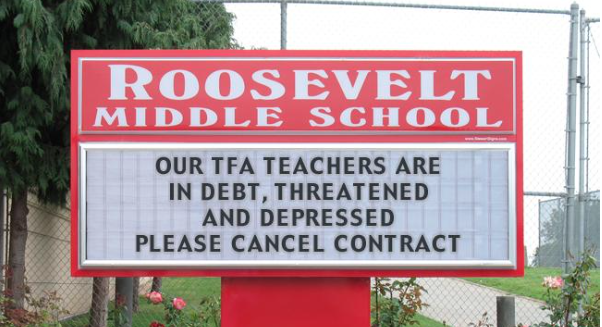
Will San Francisco cancel TFA?: Alum letter to Board details threats, depression, and debt | Cloaking Inequity

Will San Francisco cancel TFA?: Alum letter to Board details threats, depression, and debt | Cloaking Inequity:


Will San Francisco cancel TFA?: Alum letter to Board details threats, depression, and debt

Screen Shot 2015-04-22 at 2.06.36 AM
Teach For America is facing headwind. Several states have cut back funding and they have reported they are short of their lofty recruiting goals that they set when they received $50 million from Arne Duncan a few years ago. (See all of Cloaking Inequity’s posts on Teach For America here). Today I was contacted by two different individuals from the Bay Area about Teach For America. Jose Luis Pavon contacted me to relay that the San Francisco school board is reconsidering Teach For America. I will begin the post with his letter. Later in the day, I received a phone call from a TFA corp member who relayed a tell-all. I will conclude with her letter. (See also Tell-All From A TFA and KIPP Teacher: Unprepared, Isolation, Shame, and Burnout and “I felt Strange and Guilty”: Annie Tan @TeachForAmerica alum speaks) Jose Luis Pavon’s letter:
Dear Parents, Educators and Allies,
I am writing to inform you about a very important decision being made by the San Francisco Unified School District (SFUSD) school board that will impact Everett Middle School. On April 14, 2015 the SFUSD school board made a motion to terminate the school district contract with Teach for America and a final decision will be made soon.
Administrators at Everett have failed to inform parents and the public about the detrimental activities of Teach for America at Everett and SFUSD. Teach for America (TFA) is a large scale corporate non-profit (www.teachforamerica.org). TFA is national non-traditional teacher training program that claims to support education equity. They offer college students with a bachelor’s degree money to pay off loans, a five week training program and a full time teaching intern position for two years at a public school where they are given permission to teach a class room, without attaining a credential or doing a student teaching internship. After two years the TFA teaching interns have the option to pursue a teaching credential or quit teaching and pursue a separate career. The individual teaching interns and credentialed TFA alumni put their hearts and hard labor into their work as educators with good intentions, the teachers are not the problem. It is the TFA leadership, management methods, policy agenda, and corporate funders such as Walmart that must be scrutinized because of the damage they can do potentially to SFUSD. TFA has a track record nationally of scapegoating teachers, supporting high stakes testing, attacking teachers unions, and privatizing public schools by dismantling them into corporate charter schools. TFA is funded by corporations like Walmart and Monsanto, consequently TFA supports running schools like a business (https://www.teachforamerica.org/sites/default/files/150217_annualletter_financialsfinal.pdf).
Public Schools are not private for profit businesses, they are publicly owned institutions with an essential mission to provide high quality education to the public and insure a strong democracy. We must support and defend high quality public education. There is a national movement of parents, educators, scholars, public officials and labor leaders opposing TFA and defending public education. a. (A Force for Real Education Reform Emerges. October 9th, 2013. By Jeff Bryant, Education Opportunity Network. http://www.otlcampaign.org/node/3274) b. (http://www.networkforpubliceducation.org/)
There is a growing list of serious concerns among teachers, parents, administrators, public officials and community members regarding the activities of TFA at Everett and other SFUSD schools. 
  • Sending novice teachers to teach classrooms of high need students such as low performing students of color, low income students, students with IEPs, English language learners and high risk students. Allowing teaching interns to train on the job managing a classroom instead of apprenticing under a credentialed teacher lowers the quality of education for high need students and sets up TFA teaching interns as well as students to fail.
  • TFA is practicing unconventional education reform policy experiments on students with out informing parents or public officials.
  • Everett administrators have a high rate of suspensions and police contact with high risk students and is not efficiently utilizing its resources to implement racially equitable restorative practices.
  • Enlgish Langauge Learners are being assigned TFA intern teachers or teachers with minimal Will San Francisco cancel TFA?: Alum letter to Board details threats, depression, and debt | Cloaking Inequity:

Tuesday, April 21, 2015

NEA - Educators: students need opportunity, not just tests

NEA - Educators: students need opportunity, not just tests:


Educators: students need opportunity, not just tests

Proposal would reduce federally mandated tests to ensure greater educational opportunity for all students


WASHINGTON - April 21, 2015 -


U.S. Sen. Jon Tester (D-Mont.) today introduced a bill to bring much-needed reform and relief to students from the federally mandated testing required by No Child Left Behind (NCLB). The Student Testing Improvement and Accountability Act would reduce the amount of federally required high stakes, standardized tests by more than fifty percent, and, instead, restore “grade-span testing.” This would occur both in English and Math—once in elementary school, once in middle school and once in high school. This past week, the Senate began in earnest the process to reauthorize the federal law with unanimous passage of the Every Child Achieves Act of 2015 out of its Health, Education, Labor and Pensions Committee.
NCLB more than doubled the number of high-stakes tests in reading and math. In these subjects alone, K-12 students now take 14 federally mandated tests, compared to six before enactment of the law. In some cases, more than a month of instructional time is lost to test preparation and administration in a single school year.
The following statement can be attributed to Lily Eskelsen García, a sixth grade teacher who was named the 1989 Utah Teacher of the Year and elected president of the 3 million-member National Education Association:
“What is clear after years of too much testing is that the status quo isn’t working for students, especially those in high-poverty areas. We must reduce the emphasis on standardized tests that have corrupted the quality of the education received by children. Parents and educators know that the one-size-fits-all annual federal testing structure has not worked and has not sufficiently exposed the reasons for opportunity gaps where they exist. The needs of students will be best served when states and districts are allowed to put into place different kinds of assessments that provide valuable information for students, parents and educators to help find solutions.
“Last week we saw progress with the Senate markup of the NCLB reauthorization. This legislation by Sen. Tester keeps us going in the right direction by reducing the emphasis on standardized, one-size-fits-all tests, which have not worked to sufficiently exposed opportunity gaps where they exist. By allowing states and districts to return their focus to providing students with access to a rich variety of courses that encourage creativity and problem solving, we help students reach their full potential.
“We have to level the playing field and close the opportunity gaps that persist in our public schools, just as the original law intended. We have to move the needle forward for our most vulnerable students.
“We commend Sen. Tester for stepping up and speaking out for kids with the introduction of this very important legislation. The Student Testing Improvement and Accountability Act recognizes the growing problem with too much testing and proactively putting forward a commonsense proposal that would again allow educators to inspire students and their natural curiosity, imagination, and desire to learn.”
Follow us @NEAMedia

Keep up with the conversation on social media at #GetESEARight
###
The National Education Association (www.nea.org) is the nation's largest professional employee organization, representing more than 3 million elementary and secondary teachers, higher education faculty, education support professionals, school administrators, retired educators and students preparing to become teachers. Learn more at www.nea.org.
CONTACT: Staci Maiers, NEA Communications  202-270-5333 cell,smaiers@nea.org  NEA - Educators: students need opportunity, not just tests:

CPS: Corrupt Public Servants (Part 1: SUPES and Byrd-Bennett) | Troy LaRaviere‘s blog

CPS: Corrupt Public Servants (Part 1: SUPES and Byrd-Bennett) | Troy LaRaviere‘s blog:

CPS: Corrupt Public Servants (Part 1: SUPES and Byrd-Bennett)

Barbara Byrd BennettScreenshot 2015-04-20 15.58.01
An Invitation
In July of 2013–along with hundreds of principals across Chicago–I received an email with the subject, “Leadership Launch with Dr. Barbara Byrd-Bennett.”  The email implored principals to join Byrd-Bennett “for the comprehensive launch of the Chicago Executive Leadership Academy (CELA).” CELA was the title given to the series of professional development workshops organized by SUPES Academy under their $20+ million no-bid contract with Chicago Public Schools (CPS); a contract that is now under federal investigation. The launch was a huge event, staged at the UIC Forum.  It was advertised as an “invite only” affair for which we had to reserve a ticketed seat (see mine above).
The Boiling Point
As expected, the event did not open up with any discussion of the SUPES training. Instead we got what we had come to expect at the start of every principals meeting: talk of an impending budget apocalypse that can only be solved by CPS defaulting on its obligation to provide a secure retirement for its teachers.
The meeting opened up with CPS board member and former school principal, Dr. Mahalia Hines.  I’d heard her twice before; her primary function seems to be to tell stories that convince her listeners that Rahm Emanuel actually cares about south and west side children from low-income households.  However, during the CELA launch, her comments were aimed at preparing principals for budget austerity.  During her talk, she mentioned a couple principals who had written grants and gotten external funding.  She praised these principals efforts because, in her words, “You can’t rely on the board to get funding for your schools.”  Yes. She actually said those exact words. Having succeeded in convincing many of the best principals in the room to consider looking for more secure employment in the suburbs, she then introduced Barbara Byrd-Bennett who continued the austerity theme with empty corporate speak about principals “leveraging partnerships” to get free or low-cost services for our students.
“Did she really just say that?” I thought.
Did she just tell us that we need to make up for lost funding by “leveraging partnerships?” I imagined Ms. Byrd-Bennett could have used her relationship or leverage with SUPES to get free or low-cost services for CPS, but she did not.  In fact, she used 20 million tax-payer dollars taken directly from school budgets to pay SUPES significantly more than their training was worth.
I could not endure the insulting lies and misinformation any longer without responding. It was blatant in-your-face hypocrisy such as this–and its disregard for our children’s learning–that moved me to publicly criticize CPS’s misinformation during a speech at City Hall 10 days after Byrd-Bennett’s performance at the UIC Forum.
My Time in SUPES “Training”
When I arrived at my first training session, I picked up the SUPES materials and sat next to a principal who had participated in previous SUPES workshops.  I asked her what she thought of it.  “A waste of time” was her answer.  I would soon find out why. The workshop was a continuation of CPS’s  “Do more with less” theme.  The session was filled with CPS talking points about its new “Student Based Budgeting” (SBB) scheme; talking points we’d already heard in a dozen previous meetings.  Principals’ chief complaints about the new system was that it slashed their budgets, forced them to increase class size to save money, and pushed them to hire cheaper inexperienced teachers.  It was as if our work for children was being deliberately undermined.  In fact SBB would be better described as Sabotage Based Budgeting.
Yet there we were once again being insulted by SUPES “master teachers” with CPS budget spin regarding the additional “autonomy” and “freedom” the new system would give us.  Later that afternoon we all had to tell our “leadership story.”  When each of us was done, every person in the room had to say something complimentary about each story they heard.  This was the principal “training” for which Rahm Emanuel’s appointed board of education and CEO spent twenty million taxpayer dollars.
A month later I attended my second SUPES course.  It actually went well.  I had great conversations with fellow principals and learned a lot from them.  Then, at the end of the session, the facilitator announced, “I know I went off script and just let you guys talk, but I felt that was what you needed today.”  My disgust returned as I realized the reason the session went so well was because the facilitator ditched the SUPES curriculum and just let principals talk and learn from one another.  Did CPS have to pay SUPES $20 million to put principals in a room and let us talk to each other?
The next week Barbara Byrd-Bennett got wind of the fact that principals were getting vocal CPS: Corrupt Public Servants (Part 1: SUPES and Byrd-Bennett) | Troy LaRaviere‘s blog:

Senate ESEA Draft: Review of Approved Amendments, Part II | deutsch29

Senate ESEA Draft: Review of Approved Amendments, Part II | deutsch29:

Senate ESEA Draft: Review of Approved Amendments, Part II


On April 16, 2015, the Senate education committee approved the Alexander-Murray draft of the reauthorization of the Elementary and Secondary Education Act of 1965 (ESEA), a 601-page document entitled, The Every Child Achieves Act of 2015.
The draft approval was accompanied by 29 amendments, which can be found on this Senate ed page.
I reviewed the entire original 601-page Alexander-Murray draft in a series of six posts that can be accessed here.
I have already reviewed 10 of the 29 amendments. My review of those first 10 can be accessed here.
In this post, I continue my review of the 29 amendments with the next 10. (I will review the remainder in yet another post.)
I am reviewing the amendments mostly in alphabetical order by file name. Below each file link is my review for that particular amendment.
Let’s begin:
This single-page amendment allots a greater proportion of Title II state funding for “the improvement of teaching and learning” grants based upon “the number of individuals age 5 through 17 from families with incomes below the poverty line in the State.”  The original proportion was 65 percent; the amendment raised the proportion to 80 percent.
This three-page amendment to Title II (“High-quality Teachers, Principals, and Other School Leaders”) has to do with a “hold harmless” provision noting that no given funding amount is guaranteed for Title II, Part A “Fund for the Improvement of Teaching and learning”).  Among the “hold harmless” stipulations are that states will not being awarded less in 2016 than 14.29 percent of the amount the state was awarded in 2001 (at the inception of No Child Left Behind). The “not less than 14.29 percent” reduction can be doubled in 2017, and tripled in 2018, and so forth– unless there is less money– in which case the secretary will adjust accordingly.
If there is more money than expected, the secretary will once again adjust accordingly.
This “hold harmless” amendment was approved, as was another “hold harmless” amendment for the very same section, but with slightly different details: Casey_TitleII_Amendment#4 Modified – Signed. The Casey amendment uses simpler formulas for funding decisions than does the Burr amendment (the one explained above). I do not know which one was finally approved.
This eight-page amendment adds to Title II grants for developing “ready to learn” television programs “for preschool and elementary school children and their parents in order to facilitate student academic achievement” and “to develop and disseminate education and training materials, including interactive programs and programs adaptable to distance learning technologies, that are designed to promote school readiness….”
Entities receiving such grants will be required to submit an annual report to the Senate ESEA Draft: Review of Approved Amendments, Part II | deutsch29: